“I Will Wipe out the word WASTA from the Traffic Dictionary”
Wooo HOOOO on You, Major General Abdulfattah Al-Ali!
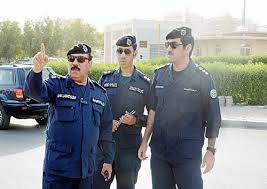
Sometimes, when you are reading a newspaper looking for content, the most significant articles can be little small ones:
Major Al-Ali vows to redraw traffic map
KUWAIT: “I have orders from higher authorities to organize the traffic and the law will be implemented strictly, Assistant Interior Ministry Under Secretary for Traffic Affairs Major General Abdelfattah Al-Ali said. “I will change the traffic map within six months and wipe out the word wasta from the traffic dictionary ,” he added. “I have strict orders from higher authorities to organize traffic and the law will be implemented very strictly,” Major Ali said.
The Kuwait Times got his title wrong; it is Major GENERAL, not Major, LOL, that’s a big difference. It appears he has the clout – and the backing – to make a brave and steadfast stand:
“WIPE OUT THE WORD WASTA FROM THE TRAFFIC DICTIONARY”
I can hardly believe my eyes. This is going to be very painful for young Kuwait men, who have learned – from prior experience – that the rules do not apply to them. IF Major General Abdulfattah Al-Ali can maintain his strong position, there may be more young Kuwait men who live to be grown-up men, there may be fewer heart-wrenching funerals, far fewer trips to the emergency room (did you know that some of the best head-trauma physicians in the world are in the ER’s in Qatar, Kuwait, and the UAE? There’s a reason for that.) The days of seeing babies on their daddy’s laps in traffic may be over. People may actually start wearing seatbelts!
Wooo HOOO on You, Major General Abdulfattah Al-Ali. You are a brave and courageous man, with a vision for a safer future for Kuwait.
11,800 Deported: Kuwait Deportations Continue “Without an End Date”
I still have a large contingent of loyal readers from Kuwait, but by early this morning, I could see something was up:
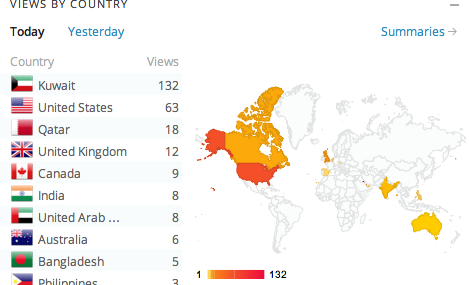
It’s not often that I have 132 Kuwait hits before noon.
So I checked the Kuwait Times:
Expat deportations will continue: Traffic chief – 11,800 deported in two-and-a-half months
KUWAIT: Major General Abdulfattah Al-Ali’s name has become synonymous with extensive traffic campaigns, aimed at enforcing the law at all costs, including implementation of mass deportations. The senior Interior Ministry official, who takes pride in deporting 11,800 people and impounding 3,000 vehicles during his tenure as head of the Ahmadi Security Department over the past two and a half years, told a local daily that deporting expatriates for serious violations will continue without an end date. “Administrative deportation of violating expatriates is not going to stop, especially of those carrying passengers illegally, in which case a person would be in violation of traffic and labor regulations,” Maj Gen Al-Ali, the Interior Ministry’s Assistant Undersecretary for Traffic Affairs, told Al-Rai on Friday.
He added that any ticket can be disputed “by a request to refer the case for traffic department investigations”. In the series of crackdowns that started late April, at least 2,000 traffic violations were registered, including 1,000 tickets issued directly on the street, while thousands of people were reportedly deported. Moreover, Maj Gen Al-Ali revealed that the ministry collected KD4 million, out of the KD24 million owed in traffic fines, during the same period. In that regard, the senior official pointed out that only KD8 million worth of fines are registered against individuals, while the rest are against companies and state departments. Out of the KD8 million, KD6 million is registered against expatriates, Maj Gen Al-Ali said. “Cases are soon to be filed with the traffic court in order to issue travel ban orders against people with more than KD80 in fines owed to the ministry,” he added.
Al-Rai published Maj Gen Al-Ali’s statement yesterday, along with a transcript of an interview with Al- Watan TV during which he defended the ongoing campaigns. “Our procedures are necessary to save lives, with average statistics indicating that 450 people are killed and 3,000 are injured annually due to traffic accidents,” he explained. During the interview, Maj Gen Al-Ali insisted that all drivers are equal when it comes to implementation of the law. “There have been doctors among the people deported, including a surgeon caught driving without a license for three years,” he said, before confirming news reports that he had taken a decision to impound a vehicle owned by Minister of Cabinet Affairs Sheikh Mohammad Al-Abdullah Al-Sabah on grounds of repeated violations committed by his personal driver. Meanwhile, the senior official urged any person who had obtained a license through illegal means to dispose of it “because once caught, they are going to be charged with forgery”. —Al-Rai, Al-Watan
Continued Efforts to Deal with Expats in Kuwait
93,000 illegals in Kuwait?
Minimum wage KD500 for Dependency Visa?
Forced retirements?
During my years in Kuwait, I saw many sorry situations. It doesn’t matter where you are on the social scale, if you are not Kuwaiti, you are expat labor. When management, for whatever reason, wants you to go, you go. People who have lived in Kuwait 50 years, who are elderly, sent home, and sent home quickly, barely time to sell what you can’t take with you, people who have had a health setback and can’t work anymore, handed their papers and told their visas will no longer be valid in 30 days.
There is no point in romanticizing your position. You’re hired help. You think you have friends, but your friends are not going to help you live out your days and die in Kuwait. When your usefulness is over, they want you gone.
We often had to get special permission to bring in professional workers for critical jobs who were over – or even approaching – 60 years old. Long-in-the-tooth is not a highly valued characteristic for imported labor.
Have an exit strategy.

The Kuwait Times title for this photo is “Illegals”
Embassies push for deportees’ rights – KD500 minimum wage proposed for dependency visa
From 30 May 2013 Kuwait Times:
KUWAIT: Two Asian embassies complained to Kuwaiti officials about the “arbitrary actions” taken during the deportation of illegal residents and lawbreakers, who were arrested in a series of crackdowns over the past few weeks across the country, a local daily reported yesterday, quoting sources with knowledge of the case.
Nearly 1,260 people of Arab and Asian nationalities have been deported since Kuwait launched crackdowns on traffic violators late last month. The General Traffic Department stated that deportation was enforced in cases of repeat offenders.
Thousands of others have been detained in simultaneous crackdowns targeting people with expired visas or those working in violation of labor regulations. But according to a report published yesterday by Al-Qabas daily, the Ministry of Interior received complaints from the embassies of India and Bangladesh, regarding the swift deportation of a large number of their nationals without them getting the opportunity to receive what they were owed from their employers.
The sources, who spoke to Al-Qabas on the condition of anonymity, said many of the deportees were sent back home through the use of travel documents released by their respective embassies, instead of their original passports that, in most cases, are kept by their sponsors. “The Indian and Bangladeshi embassies are currently taking legal recourse to secure the rights of the deported nationals, including their original passports”, the sources said.
Many expatriates arrested during the recent traffic crackdowns reportedly remain in custody, as their respective embassies refuse to grant authorities travel documents on the grounds that their visas are still valid. In that regard, the sources revealed the ministry had been trying to reach the employers in order to retrieve the passports of the soon-to-be-deported expatriates.
Meanwhile, a senior Interior Ministry official defended Kuwait’s right to deport illegal residents or foreigners who break the law. “It is the right of every country to deport expatriates who violate its residency laws or its laws in general, or take legal action against them, in order to maintain safety and security, in line with human rights principles,” Assistant Director of the ministry’s General Training Department, Brigadier General Adel Al-Saadoun, was quoted by Al-Jarida yesterday. He made these comments at a workshop on Tuesday, organized by the International Organization for Migration office in Kuwait.
In other news, Undersecretary Assistant for Citizenship and Passports Affairs, Major General Sheikh Faisal Al-Nawaf Al-Sabah, during a meeting with directors of migration departments in Kuwait, called for “tougher procedures” with regard to the issuance of visitor visas, so marginal labourers would not be able to gain access into the country.
He made the demand amid a discussion on efforts to address Kuwait’s demographic imbalance, which senior ministry officials described as “a main duty” for his department. “Maj Gen Al-Sabah told the directors that labor forces in countries having internal struggles should not be able to move to Kuwait, and that Kuwait should not become a shelter for them and their problems,” said sources quoted in an Al-Rai report yesterday.
Nationals of Syria, Iraq, Iran, Pakistan, Afghanistan, and Yemen are currently banned from obtaining visas to work in or visit Kuwait. In that regard, Maj Gen Al-Sabah said the lifting of the ban on them in the future must be coupled with controls to regulate their entrance and prevent the country’s demographic imbalance from getting worse, said the sources, who spoke to Al-Rai on the condition of anonymity.
The meeting also discussed other suggestions aimed at reducing the number of expatriate workers in Kuwait, including Maj Gen Al-Sabah’s intentions to “prepare a memorandum about the benefits of raising the minimum cap for foreigners applying for dependency visas for relatives”. Currently, such visas can be obtained as long as a supporter earns a minimum of KD250 a month, but the Undersecretary Assistant reportedly suggested during the meeting that the cap be raised to KD500.
“Maj Gen Al-Sabah questioned the capability of a man who receives KD250 a month to meet the educational, health and living requirements of a family with children,” the sources explained. They added that the senior official also plans to refer a letter to the Ministry of Social Affairs and Labor, recommending that it suspend issuing work visas to holders of commercial visit visas.
Minister of Social Affairs and Labor Thekra Al-Rashidi announced two months ago a plan to deport 100,000 foreigners every year, as part of a strategy to reduce the number of expatriates in the Gulf state by one million over a period of 10 years. Criticism sparked by the lack of details about the proposed plan prompted the minister to later clarify that the plan targeted illegal residents, whose numbers have reached 93,000, as per official statistics released last year. Kuwait is home to 2.6 million expatriates who account for 68 percent of the country’s total population of 3.8 million.
Meanwhile, minister Al-Rashidi released an order – with effect from July 1, 2013 – to terminate the services of expatriate employees who have worked for at least 30 years in the Social Affairs and Labor Ministry. According to sources familiar with the issue, the ministry has already started the process to end the services of nearly 70 foreigners by the beginning of July. The decision is in accordance with a government plan that requires forcing Kuwaitis who have held government posts for 30 years, including senior officials, into retirement. According to official statistics, published by Al-Qabas yesterday, 138 senior officials, including 11 women, will be subjected to this regulation. – Al-Qabas, Al-Jarida & Al-Rai
In a related article, measures are gaining support for withdrawing Kuwait citizenship from naturalized citizens for different reasons; below another article from the 30 May 2013 Kuwait Times Foreign spouses married to Kuwaitis watch these developments with trepidation.
MPs want citizenship revoked for breaching security – Long-time employees won’t be forced out
KUWAIT: A number of MPs yesterday proposed that Kuwaiti nationality should be withdrawn from naturalized Kuwaitis who abuse the country’s internal security or insult the country’s figures. The lawmakers also proposed that all benefits given to the naturalized person proven to have breached national security should be withdrawn and this measure should include withdrawing the citizenship of other people who gained the citizenship as a result of naturalizing that person. The proposal also suggests that people who applied for Kuwaiti citizenships and carried out similar offenses should have their applications rejected even if they fulfilled all the conditions for nationality.
To become effective, the proposal must be adopted by the concerned Assembly committees, mainly the legal and legislative and the interior and defense committees and then passed by the National Assembly and eventually accepted by the government. The proposal comes amid protests by opposition activists and former MPs and a crackdown on opposition tweeters – several of whom have received jail terms on charges of insulting the Amir. Meanwhile, MP Faisal Al-Duwaisan yesterday asked Justice Minister Sharida Al-Meosharji about implementing a law passed a few months ago to establish the Anti-Corruption Authority. Besides the corruption authority, the legislation also calls for wealth disclosure of ministers, MPs and top government officials. Duwaisan asked the minister about the steps that have been taken to implement the law and the obstacles facing it.
MP Yacoub Al-Sane said yesterday that he was informed by Prime Minister Sheikh Jaber Al-Mubarak Al- Sabah that top bureaucrats who served 30 years and above will not be forced to resign as has been published. The lawmaker said he told the premier that forcing such top officials to step down is “unconstitutional” and the prime minister replied that the government will not force them to resign but will grant them incentives and benefits to encourage them to resign. In the meantime, MP Saud Al- Huraiji questioned Finance Minister Mustafa Al-Shamali about the charges collected from expatriates for the health insurance scheme and other charges since applying the law in 1999. Huraiji said that he learned that KD522 million have been collected since that year but the ministry of finance has failed to utilize the funds in proper channels. He asked the minister if the ministry has any plan to spend the funds in the right way.
By B Izzak, Staff Writer
‘Hundreds’ deported for traffic offences
KUWAIT: Kuwait has deported hundreds of expats for traffic offences in the past month, a report said yesterday, drawing condemnation from a human rights group.
The Al-Anbaa newspaper cited a senior interior ministry official as saying that as many as 1,258 foreigners have been deported for traffic violations since a crackdown began about a month ago.
Foreign residents caught driving without a licence, using their cars to carry paying passengers, jumping a red light for a second time, or breaking the speed limit by more than 40 km per hour, can be deported without a court order. The Kuwait Society for Human Rights called on the government to halt the deportations describing them as “oppressive”. “The oppressive measure against expatriates… violates the basic principles of human rights,” it said.
The group warned that the measure could tarnish the state’s image abroad at a time when its human rights record is under scrutiny. Kuwait is home to 2.6 million expatriates who form 68 percent of the country’s 3.8 million population.
Kuwaiti nationals who commit similar offences have their vehicles seized and can be sent to court. Last month, Minister of Social Affairs and Labour Thekra Al-Rasheedi said the state plans to deport around 100,000 expatriates every year for the next decade to reduce the number of foreigners living in the Gulf state by one million. She did not say what measures she would adopt to carry out the plan.
Foreigners need to hold a university degree, earn KD 400 a month and have lived in Kuwait for at least two years to be eligible to apply for a driver’s licence, under a decision issued nearly a decade ago. —AFP
Making Idols
A confluence of events happened at a period in my life when I was paying attention, and those things coming together have influenced me enormously. The first was participation in a bible study conducted in a branch of Christianity not my own, whose dogma is occasionally repellant and repugnant to me, but whose study of the chapter in the bible is thorough. The second was my move back to the Islamic world, and my choice to study Arabic at the Qatar Center for the Presentation of Islam.
In both cases, what I learned is that we have more in common than we have differences. I also learned that if we focus on the differences, it can be devastating.
Both groups know the Bible. My Moslem sisters knew the bible better than I did, and when discussing such issues as covering hair and wearing abaya, could quote me verses from my own book which re-inforced their argument. It was mortifying – and edifying.
My Baptist friends also surprise me. For every one who rails against gay marriage or ordination of women, there was another who would laugh and quote scripture saying “did you notice the same penalty for a woman who cuts her hair? or wears pants in public?” I learned a lot about my own religion, my own beliefs, and the goodness of others by my interactions with both these groups.

One of the differences in the Moslem world was that many houses I went into (I was honored to be invited into their homes) were very plain. The furniture might be basic or elaborate, but often, the walls were bare. Maybe there might be a calligraphy with a Quranic verse on the wall – that was it. No paintings, especially no human figures – no idols, no images.
In my house, I am surrounded by images, photos, paintings, weavings – they give me joy, but I do not worship them. They are not idols, they are merely art or family – things that make me smile. I distinguish between idols and gods. Yesterday’s reading from Deuteronomy sticks with me, however, and I can hear my sweet teachers at QCPI saying to me “But doesn’t it say in Deuteronomy 4 that you are to have no idols?”
Deuteronomy 4:25-31
25 When you have had children and children’s children, and become complacent in the land, if you act corruptly by making an idol in the form of anything, thus doing what is evil in the sight of the Lord your God, and provoking him to anger, 26I call heaven and earth to witness against you today that you will soon utterly perish from the land that you are crossing the Jordan to occupy; you will not live long on it, but will be utterly destroyed.
27The Lord will scatter you among the peoples; only a few of you will be left among the nations where the Lord will lead you. 28There you will serve other gods made by human hands, objects of wood and stone that neither see, nor hear, nor eat, nor smell. 29From there you will seek the Lord your God, and you will find him if you search after him with all your heart and soul. 30In your distress, when all these things have happened to you in time to come, you will return to the Lord your God and heed him. 31Because the Lord your God is a merciful God, he will neither abandon you nor destroy you; he will not forget the covenant with your ancestors that he swore to them.
The Little Blue Pill
I’m not a person who feels a lot of pain. I hardly ever get a headache, rarely get even a paper cut. At one point in my life, when my biliary duct blocked, the doctor gave me pictures and looked at me sternly and said “You could have died, politely waiting out there in the waiting room. When this happens, come in immediately, show the ER people these photos and tell them you need this blockage cleared immediately.”
That one really did hurt, but I’m not much for groaning and writhing in pain, so I didn’t.
Today was a confluence of events. Yesterday, when the air conditioning people were at our house, all day, configuring and installing the new air conditioning system, the terrified and disoriented Qatari Cat spent the day in the large laundry room, with his cat bed and his food and water, and his litter box. It was a long day, and he was alone, and he could hear loud bumps and thuds, and he could smell strange smells, and hear strange voices. Therefore, when let out, he needed to snuggle, closely, to the one he thinks is his mother, i.e. me.
He curled into my arm and purred and cried about his long day and how scared he had been. He was still snuggling, closer and closer, during the night, as I was trying to sleep. He is a good sleeper, doesn’t move around a lot, but when he is snuggled up against me, it is hard to move. Now and then he will snore, or go into kitty-dream state, legs thrumming along and sub-vocal snarling, which can wake me.
Our normal water aerobics instructor was out, and the substitute was wonderful, but we did more repetitions of high kicks, jacks-crunches, and more high kicks; it was a great workout, different from what we are used to.
We really needed to clean our floors after the air conditioning crew, so AdventureMan took all the carpets outside for a good vacuum front and back while I tackled the tile floors throughout the main level of the house. Some of the grime was ground in, this wasn’t one of those quick swish washes but a lot of stoop and scrape, or hands and knees and scrub kind of jobs. While down close, I also noticed the base boards needed a swab, more bending and stooping.
I still had one appointment to go before I could kick back, and while waiting, I noticed my back was a little uncomfortable. By a little uncomfortable, I mean it had my attention, I couldn’t get comfortable. By the time I got home, it had my undivided attention. I know what works for me, back when I had a reaction to a root canal, I discovered Aleve, so I had some on hand.

When I went to take one, I saw this great big capsule. I remembered tiny little blue tablets, sort of ovoid, but I guess I had just grabbed whatever I saw and it happened to be a capsule. Swallowed the capsule.

There is a reason I don’t like taking medicines, and that reason is that because I don’t take a lot of medications, when I do, I can tell. It takes the edge off. I feel slow. I feel a little loopy. I feel tired. And then, by the grace of God, in an hour or so, I feel no pain in my back.
It wasn’t a bad day, just a day with some unexpected conditions. Scrubbing floors is not my favorite thing. In Kuwait and in Doha I had wonderful women who kept my floors sand-free, and sparkling clean. As I clean my floors, I found myself remembering them fondly.
AdventureMan popped his head in the door to tell me how much he likes vacuuming the carpets outdoors, where he can see the intricacies of the patterns. He can see I am grumpy. “I don’t really like cleaning floors!” I grump.
“Let’s hire someone to do it for us!” he responds, and my day suddenly looks a lot brighter. 🙂
Miracle Birth in Kuwait
Found the following on AOL News / What to Expect:
Clinically Dead Woman Is Revived After C-Section Birth

A pregnant woman in her ninth month was admitted to a hospital in Kuwait with an acute blood pressure condition, suffered cardiac arrest, and was pronounced dead. Doctors rushed to deliver her unborn child. The cesarean section was performed without anesthesia since the mother was presumed dead, and a healthy 6.8 lb baby boy was delivered. Then with one last attempt to revive the 36-year-old Filipina woman, doctors were astonished when she started breathing again.
“This is a scientific miracle at all levels,” hospital manager Dr. Hmoud Al-Zobi told theKuwait Times. Three days later the 36-year-old Filipina (or Pinay) woman named Zuraida remains unconscious at Al-Farwaniya Hospital, but doctors say she is in stable condition and are hopeful that she will return to health.
Zuraida’s husband, Verdadero, remains by her side. “When I visited her today, tears were rolling down her eyes. I felt she could hear me, she could feel my presence and was trying her best to communicate. ”
Said Verdadero, “I brought her to the hospital because she experienced blood and the water discharged at that time. Of course, I knew that she was already in pain and it was about time for her to deliver our second child. I was very happy. But my happiness changed to uncertainty when I heard that she was vomiting blood and was in danger and only a miracle could save her. I prayed hard for her to survive.”
Verdadero is a truck driver who is often away for days in Iraq and elsewhere. He feels lucky that he happened to be in Kuwait when his wife was ready to deliver their baby. “At least I was with her when it all happened and I really pray that she will be okay.”
During pregnancy, it is recommended that women and their doctors keep a close eye onblood pressure. There are many reasons for occasional spikes in blood pressure and most are nothing to worry about (in fact, worry only contributes to elevated levels). But chronic high blood pressure during pregnancy is something that should be monitored and treated to ensure that mother and baby are as healthy as can be.
Expats in Kuwait: A Burden on the State?
From today’s Kuwait Times . . . .

KUWAIT: The government has sent a draft law to the parliament stipulating an increase in fees collected from expatriate residents for using public services in Kuwait, a senior state official said in statements reported yesterday by the local press.
Minister of Cabinet Affairs Sheikh Mohammad Al-Abdullah Al-Sabah further indicated that the proposal is currently under review primarily to ensure it was in keeping with the constitution. “The state pays KD6 billion to subsidize public services, including electricity and water, while only KD2 billion of it is the average share of Kuwaitis,” he told a gathering of third constituency women voters at MP Ahmad Al-Mulaifi’s dewaniya on Monday night.
He also termed the remaining KD4 billion, a cost which supposedly the government bears for services used by expatriates, “a burden on the state.” Al-Sabah, who is also the State Minister for Municipality Affairs, added that similar steps have been adopted in the rest of the Gulf Cooperation Council states to increase the state revenue from expatriates. “Unfortunately, Kuwait’s law prohibits the government from increasing the fees unilaterally,” he said, referring to regulations which stipulate that such decisions must be passed by the parliament before becoming effective.
The minister’s statement is the latest turn in the government’s efforts seen targeted at the country’s expatriate community which comprises two thirds of the population, including a Ministry of Social Affairs and Labor announcement to deport 100,000 foreigners annually as part of a ‘demographic balance restoration plan’; the details of which are yet to be announced.
Meanwhile, Undersecretary Assistant for Traffic Affairs in the Interior Ministry, Major General Abdulfattah Al-Ali, announced that 213 expats were deported in the past few days for committing ‘grave’ traffic violations. In this regard, Al-Ali told Al-Rai on Tuesday that deportations only happen in cases where people have a record of repeated violations. “An expatriate who commits the same violation over and over again must be deported in the public interest,” he said, calling a person in this case as “abnormal” and “untreatable.” According to the ministry, the violations warranting deportation include driving without a driver’s license, jumping the red traffic light for a second time, using private vehicles to carry passengers and exceeding speed limits by 40 km. Al-Ali refuted the notion that the recent deportations were connected to the MSAL’s plan mentioned above.
Minister of Social Affairs and Labor Thekra Al-Rashidi had indicated that the annual deportation plan, through which the government hopes to deport a million foreigners in ten years, is chiefly going to target ‘marginal labor forces’ or workers who usually accept menial jobs and often live without valid visas.
Such workers are often the victim of visa traffickers who exploit loopholes in the ministry’s system to release work permits in the name of fake companies or nonexistent job openings, and then sell them to unskilled labor forces looking for a chance to work in the oil-rich Gulf region. The system is based on the kafala (sponsorship of foreign workers) program which is often criticized by international organizations for human right violations recorded in Kuwait and the entire region.
On a related note, Al-Rai reported yesterday that the social affairs and interior ministries are studying the possibility of creating an ‘amnesty period’ during the summer to allow illegal residents to leave Kuwait or obtain a new visa without paying the cumulative fines.
Anonymous sources were quoted in the report as saying that the project depends on the two ministries’ ability to “plug some loopholes” which could make violators irresponsive to it. “For example, we cannot expect Bangladeshi nationals staying illegally in Kuwait to leave when they know that they will be banned by law in this case from ever returning to Kuwait,” one source explained. “There are violators who become stuck in Kuwait due to circumstances in their home countries combined with regulations that prevent them from issuing a residency in Kuwait.
Legal obstacles in similar cases need to be removed before an amnesty period is announced,” the source added.
Pope Francis Defines Slave Labor
I have had wonderful women who have worked for me; they were from the Philippines, from Sri Lanka, from India. They worked hard and they didn’t spend their money. They sent their money home to help support mothers, fathers, siblings, children. They had some real horror stories to tell about how they had been treated in prior employment – employers with jealous wives, touchy-feelie employers and their sons, people who seemed to assume that because they were working under their sponsorship, they owned their lives. In Qatar and in Kuwait, Labor law provides for a mandatory day off – except for house-workers. Some work from crack of dawn getting the children ready for school until the last thobe is ironed, late late in the night.

I did a little research. Here is what 38 Euros per month – slave wages – is worth:
$50.13 US Dollars (Minimum wage $7.25/hour + social security)
Qatari Rial 182.52 (Qatar has not set a minimum wage)
Kuwaiti Dinar 14.24 (Minimum wage = 60 KD per month)
From Agence France Presse via AOL News:
Pope Francis on Wednesday condemned as “slave labour” the work conditions of victims of a factory collapse in Bangladesh in which more than 400 people have been found dead, Vatican radio reported.
“A headline that really struck me on the day of the tragedy in Bangladesh was ‘Living on 38 euros a month’. That is what the people who died were being paid. This is called slave labour,” the pope was quoted as saying at a private mass.
“Today in the world this slavery is being committed against something beautiful that God has given us — the capacity to create, to work, to have dignity. How many brothers and sisters find themselves in this situation!” he said.
“Not paying fairly, not giving a job because you are only looking at balance sheets, only looking at how to make a profit. That goes against God!” he was quoted as saying.
“There are many people who want to work but cannot. When a society is organised in a way that not everyone is given the chance to work, that society is not just,” he said.
Copyright (2013) AFP. All rights reserved.
If you have the time for some fascinating reading, it’s all available on the internet at the US State Departments Human Rights website; you can access by clicking here. Read – or skip – the overview, then go to the second column where you can see what is happening in every individual country. I’ve printed out labor excerpts below, but there are also fascinating observations on leadership, government, human rights and human trafficking.
QATAR: Labor Conditions according to
Country Reports on Human Rights Practices for 2012
a. Freedom of Association and the Right to Collective Bargaining
The law does not adequately protect the right of workers to form and join independent unions, conduct legal strikes, and bargain collectively, a situation that made the exercise of these rights difficult. The law provides workers in private sector enterprises that have 100 citizen workers who are18 and older a limited right to organize, strike, and bargain collectively. For those few workers covered by the law protecting the right to collective bargaining, the government circumscribed the right to bargain collectively through its control over the rules and procedures of the bargaining and agreement processes. The labor code allows for only one trade union, the General Union of Workers of Qatar (General Union), which was composed of general committees for workers in various trades or industries. Trade or industry committees were composed of worker committees at the individual firm level.
Noncitizens are not eligible to join worker committees or the national union, effectively banning foreign workers from organizing, striking, or bargaining collectively. The law explicitly prohibits public sector workers or the military from organizing.
Civil servants and domestic workers do not have the right to strike; the law also prohibits strikes at public utilities and health or security service facilities, which include the gas, petroleum, and transportation sectors. Although the law recognizes the right to strike for some workers, restrictive conditions made the likelihood of a legal strike extremely remote. The law requires approval for a strike by three-fourths of a company’s workers committee. The Complaint Department of the Ministry of Labor in coordination with the Ministry of Interior must rule on all industrial disputes before workers can call a strike.
In organizations with more than 30 workers, the law permits the establishment of “joint committees” with an equal number of worker and management representatives to deal with a limited number of workplace issues. Foreign workers may be members of joint labor-management committees. The law offers a means to file collective disputes. If not settled internally between the employees and employer, the Ministry of Labor can be brought in to mediate a solution to such disputes.
The law requires Ministry of Labor approval for worker organizations to affiliate with groups outside the country. The law does not prohibit antiunion discrimination or provide for reinstatement of workers fired for union activity.
Freedom of association and the right to collective bargaining were not respected in practice. The General Union was not a functioning entity. Employees could not freely practice collective bargaining, and there were no workers under collective bargaining contracts. While rare, when labor unrest occurred, mostly involving the country’s overwhelmingly foreign workforce, the government responded by dispatching large numbers of police to the work sites or labor camps involved; the strikes generally ended peacefully after these shows of force. In most cases the government summarily deported the workers’ leaders and organizers. For example, on January 24, 127 Nepali workers were detained after they went on strike to protest low pay; some were later deported.
b. Prohibition of Forced or Compulsory Labor
The law prohibits all forms of forced or compulsory labor, and the government generally enforced the law.
The government made efforts to prevent and eliminate forced labor during the year. The government arrested and prosecuted individuals for labor law violations; two cases each of forced labor and bonded labor were before courts at year’s end. In addition the government closed 15 recruitment firms during the year. The QFCHT and the NHRC conducted several training sessions during the year for migrant laborers to educate them on their rights in the country. The NHRC printed and distributed pamphlets that included pertinent articles of the labor and sponsorship laws in multiple languages to better educate migrant workers on their rights. In addition the Ministry of Labor opened a free legal clinic for low-income migrant workers in March.
There were continuing indications of forced labor, especially in the construction and domestic labor sectors, which disproportionately affected migrant workers. Exorbitant recruitment fees incurred abroad entrapped many workers in long-term debt, making them more vulnerable to being exploited for forced labor. Some foreign workers who voluntarily entered the country to work had their passports and pay withheld, were refused exit permits, and worked under conditions to which they had not agreed. In a critical June report, Human Rights Watch highlighted a number of these problems, including poor living conditions, employers who routinely confiscated worker passports, and a sponsorship system that gave employers inordinate control of workers.
Also see the Department of State’s Trafficking in Persons Report at www.state.gov/j/tip.
c. Prohibition of Child Labor and Minimum Age for Employment
The law sets the minimum age for employment at 16 and stipulates that minors between the ages of 16 and 18 can work with parental or guardian permission. Minors may not work more than six hours a day or more than 36 hours a week. Employers must provide the Labor Department with the names and occupations of their minor employees and obtain permission from the Ministry of Education to hire a minor. The Labor Department may prohibit the employment of minors in jobs judged dangerous to their health, safety, or morals. The government generally enforced relevant laws effectively, and child labor rarely occurred in practice.
d. Acceptable Conditions of Work
There is no minimum wage. The law requires equal pay for equal work in the private sector. The labor law prescribes a 48-hour workweek with a 24-hour rest period and paid annual leave days. Employees who work more than 48 hours per week or 36 hours per week during the holy month of Ramadan are entitled to an overtime pay supplement of at least a 25 percent. The law requires premium pay for overtime and prohibits excessive compulsory overtime. The government set occupational health and safety standards. The labor law and provisions for acceptable conditions of work do not apply to workers in the public sector, agriculture, or to domestic servants.
Responsibility for laws related to acceptable conditions of work fell primarily to the Ministry of Labor as well as the Ministry of Energy and Industry and the Ministry of Health. The government did not effectively enforce standards in all sectors; working conditions for citizens were generally adequate, as government agencies and the major private sector companies employing them generally followed relevant laws. Enforcement problems were in part due to insufficient training and lack of personnel. There were approximately 150 inspectors in the Ministry of Labor. Fear of penalties such as blacklisting, which allows the Ministry of Labor to suspend specific operations, appeared to have had some effect as a deterrent to some labor law violations.
The government took action to prevent violations and improve working conditions during the year. According to foreign diplomats and some individual migrant workers, the Ministry of Labor’s Department of Labor Affairs was perceived to be objective within its mandate when dealing with the nonpayment of wages, health and safety violations, and other labor law violations. The department claimed it resolved 80 percent of the 6,000 complaints filed by workers during the year. The ministry referred 292 cases to the labor courts for judgment. During the first half of the year, the labor courts heard 8,101 cases, of which 813 received final verdicts, 920 received preliminary verdicts, 5,236 were still under review, 1,111 were cancelled, and 21 were linked to existing cases. The courts ordered that companies provide both financial compensation and airline tickets to their country of origin for plaintiffs in 49 cases, financial compensation only in six cases, and airline tickets only in five cases. A limited number of labor complaints were referred to the criminal courts, but statistics were not publicly available.
The Labor Inspection Department conducted monthly and random inspections of labor camps; when it found them below minimum standards, the operators received a warning, and authorities ordered them to remedy the violations within one month. If they did not remedy the violations, the Ministry of Labor blacklisted the company and on occasion referred the matter to the public prosecutor for action. Some cases went to trial. During the year inspectors conducted 46,624 observations of work and labor housing sites. Inspectors found 90 percent of companies were compliant with the administrative aspects of the law, such as timely payment of salaries and work regulations, while 70 percent were found to be compliant with safety standards. The Ministry of Labor issued 7,337 warning notices, 5,245 for health and safety reasons and 2,092 for administrative reasons. There were 377 companies that were issued reports of violations, 231for health and safety reasons and 146 for administrative reasons. Violators faced penalties of up to 6,000 riyal ($1,648) and 30 days’ imprisonment in the most serious cases, but labor observers reported that most safety and health violations were handled through administrative fines or blacklisting. The Ministry of Labor maintained an office in Doha’s industrial area, where most unskilled laborers resided, to receive complaints about worker safety or nonpayment of wages.
Violations of wage, overtime, and safety and health standards were relatively common, especially in sectors employing foreign workers, in which working conditions were often poor. Employers often ignored working hour restrictions and other laws with respect to domestic workers and unskilled laborers, the majority of whom were foreigners. A November survey by Qatar University’s Social and Economic Survey Research Institute found that 90 percent of unskilled laborers worked on average six days per week and 9.3 hours per day. Many unskilled foreign laborers were housed in cramped, dirty, and hazardous conditions, often without running water, electricity, or adequate food. The International Trade Union Confederation (ITUC) has repeatedly reported abusive conditions, including unexplained and work-related deaths, for migrant workers, especially in the construction sector. After an ITUC investigation of working conditions for Nepali workers, the organization alleged that work-related deaths due to problems such as heat exhaustion were wrongly attributed to heart attacks or natural causes.
Domestic workers, who are not protected by the labor law, often faced unacceptable working conditions. Many such workers frequently worked seven days a week and more than 12 hours a day with few or no holidays, no overtime pay, and no effective means to redress grievances.
According to the ITUC and other organizations, foreign workers faced legal obstacles and lengthy legal processes that prevented them from seeking redress for violations and exploitative conditions. The sponsorship law was widely considered the root of these violations. Under the country’s sponsorship system, most employees cannot leave the country without permission and are prevented from switching jobs without a “no objection letter” from their employer. Employees leaving the country without a no objection letter are barred from reemployment in the country for two years.
Kuwait Labor Practices According to
Country Reports on Human Rights Practices for 2012
a. Freedom of Association and the Right to Collective Bargaining
The law protects the right of workers to form and join trade unions, conduct legal strikes, and bargain collectively, with significant restrictions. The law does not apply to public-sector employees, domestic workers, or maritime employees. Discrete labor laws set work conditions in the public and private sectors, with the oil industry treated separately. The law permits limited trade union pluralism at the local level, but there was only one government-authorized federation, the Kuwait Trade Union Federation (KTUF). The law also stipulates any new union must include at least 100 workers, and that at least 15 of the total must be Kuwaiti citizens.
The law provides workers a limited right to collective bargaining, excepting domestic servants, maritime workers, and civil servants. There is no minimum number of workers needed to conclude such agreements.
Public-sector workers do not have the right to strike. Private-sector workers have the right to strike, although cumbersome provisions calling for compulsory negotiation and arbitration in the case of disputes limit that right. Legal strikes require permission from the Ministry of Interior, which was rarely granted. The law does not prohibit retaliation against striking workers or prevent the government from interfering in union activities, including the right to strike.
The law prohibits antiunion discrimination and employer interference with union functions, and provides for reinstatement of workers fired for union activity.
However, the law empowers the courts to dissolve any union for violating labor laws or for threatening “public order and morals,” although a union can appeal such a court decision. The Ministry of Social Affairs and Labor can request the Court of First Instance to dissolve a union. Additionally, the emir may dissolve a union by decree.
Foreign workers, who constitute approximately 85 percent of the workforce, may join unions only as nonvoting members after five years of work in the particular sector the union represents, provided they obtain a certificate of good conduct and moral standing from the government. They cannot run for seats or vote in board elections. Both the International Labor Organization and the International Trade Union Confederation criticized the citizenship requirement for discouraging unions in sectors that employ few citizens, including much of private-sector employment, such as construction.
The government enforced applicable laws, and procedures were generally not subject to lengthy delay or appeals.
Although the law restricts freedom of association and collective bargaining rights, the government did not always enforce these limits. For example, according to KTUF, the government did not consistently enforce the requirement that foreign workers have at least five years working in Kuwait in a specific sector prior to joining a union.
The government also treated worker actions by citizens and noncitizens differently. While citizens and public-sector union leaders and workers faced no government repercussions for their roles in union or strike activities, companies directly threatened noncitizen workers calling for strikes with termination and deportation.
The government did not respect freedom of association and the right to collective bargaining. Worker organizations were generally not independent of the government, and the government interfered in union activities. The government essentially treated licensed unions as parastatal organizations, providing as much as 90 percent of their budgets and inspecting financial records; if a union ceases to exist, the government confiscates its assets.
While the National Trade Union Federation petitioned the government for official recognition during the year, it did not receive a license by year’s end.
b. Prohibition of Forced or Compulsory Labor
The law prohibits forced or compulsory labor “except in cases specified by law for national emergency and with just remuneration,” but the government did not effectively enforce the law.
Forced labor and conditions indicative of forced labor occurred in practice, especially among migrant workers. Such practices were usually a result of employer abuse of the sponsorship system for noncitizen workers. Employers frequently and illegally withheld salaries from domestic workers and minimum-wage laborers.
Domestic servitude was the most common type of forced labor, principally involving foreign domestic workers employed under the sponsorship system, but forced labor in the construction and sanitation sectors also existed. Forced labor conditions for migrant workers included nonpayment of wages, long working hours, deprivation of food, threats, physical and sexual abuse, and restrictions on movement, such as withholding passports or confinement to the workplace. There were numerous media reports throughout the year of domestic workers being abused by their sponsors or sustaining significant injuries while trying to escape from their sponsors; some reports alleged abuse resulted in workers’ deaths. Female domestic workers were particularly vulnerable to sexual abuse. Police and courts were reluctant to prosecute citizens for abuse in private residences.
See also the Department of State’s Trafficking in Persons Report at www.state.gov/j/tip.
c. Prohibition of Child Labor and Minimum Age for Employment
The law prohibits child labor. The legal minimum age for employment is 18 years; however, employers may obtain permits from the Ministry of Social Affairs and Labor to employ juveniles between 15 and 18 years old in some nonhazardous trades. Juveniles may work a maximum of six hours a day with no more than four consecutive hours followed by a one-hour rest period. Juveniles cannot work overtime nor between 7:00 p.m. and 6:00 a.m.
Although it was not extensive, there were credible reports of child labor by domestic servants of South Asian origin and Bidoon children. Some underage workers entered the country on travel documents with falsified birth dates.
Bidoon children as young as seven worked long hours as street vendors, sometimes under dangerous conditions, according to reports by human rights NGOs. Their need to provide for their families often led to poor educational performance or abandoning school.
The government made efforts to enforce the law effectively. Approximately 300 Ministry of Social Affairs and Labor inspectors routinely monitored private firms for labor law compliance, including laws against child labor. Noncompliant employers faced fines or a forced suspension of their company operations. However, the government did not enforce child labor laws in informal sector occupations, such as street vending.
d. Acceptable Conditions of Work
The law sets the national minimum private-sector wage at 60 dinars ($216) per month.
The law limits the standard workweek to 48 hours (40 hours for the petroleum industry), and gives private-sector workers 30 days of annual leave. The law also forbids requiring employees to work more than 60 hours per week or 10 hours per day. The law provides for 13 designated national holidays annually. Workers are entitled to 125 percent of base pay for working overtime and 150 percent of base pay for working on their designated weekly day off.
The government issued occupational health and safety standards. For example, the law provides that all outdoor work stop between 11 a.m. and 4 p.m. during June, July, and August or times when the temperature rises to more than 120 degrees Fahrenheit in the shade.
The law and regulations governing acceptable conditions of work do not apply to domestic workers. The Ministry of Interior has jurisdiction over domestic worker matters.
The Ministry of Social Affairs and Labor was responsible for enforcement of wage and hour, overtime, and occupational safety and health regulations. However, enforcement by the ministry was poor, especially with respect to unskilled foreign laborers.
Approximately 500 labor inspectors monitored private firms. The government periodically inspected enterprises to raise awareness among workers and employers and to ensure they abided by existing safety rules, controlled pollution in certain industries, trained workers to use machines, and reported violations.
The Ministry of Social Affairs and Labor monitored work sites to ensure compliance with rules banning summer work and recorded hundreds of violations during the year. Workers could also report these violations to their embassies, the KTUF, or the Labor Disputes Department. Noncompliant employers faced warnings, fines, or forced suspensions of company operations, but these were often not substantial enough to deter violators.
Workers submitted complaints to the Ministry of Social Affairs and Labor’s Labor Disputes Department; however, the government did not enforce the standards uniformly.
At times the Ministry of Social Affairs and Labor intervened to resolve labor disputes between foreign workers and their employers. The Ministry of Social Affairs and Labor’s labor arbitration panel sometimes ruled in favor of foreign laborers who claimed violations of work contracts by their employers. The government was more effective in resolving unpaid salary disputes involving private-sector laborers than those involving domestic workers. However, during the year the Ministry of Interior’s Department of Domestic Labor Office collected 8,340 dinars ($30,000) owed to 71 domestic workers by their employers.
Foreign workers were vulnerable to unacceptable conditions of work. Domestic servants and other unskilled foreign workers in the private sector frequently worked substantially in excess of 48 hours a week, often with no day of rest.
Since labor standards did not apply to domestic workers, such workers had little recourse when employers violated their rights. There were no inspections of private residences, the workplace of the majority of the country’s domestic workers, nor did the government make significant efforts to address working conditions for these workers. Reports commonly indicated employers forced domestic workers to work overtime without additional compensation. There were frequent reports of domestic workers committing or attempting suicide due to desperation over abuse or poor working conditions.
86 Expats Deported; “Kuwait Traffic Laws Will Be Strictly Implemented”
This is a very interesting article from the April 27th Kuwait Times; after stating all the things that will happen to expats violating traffic rules – like running a red light – Lt Gen Al Ali adds that “of course” they will deal strictly with Kuwaits when their violations might endanger the safety of people on the roads. Hmm. When Qatar implemented a very strict traffic code with high fines for violations, they quickly discovered that the majority of the violations were committed by Qataris, whose families were highly indignant that they would be expected to pay fines – high fines.
Traffic laws are only effective when equally applied across the board. I congratulate the Kuwaiti police for making the decision to implement this new law equally, against all traffic violators, native and expat alike.
KUWAIT: The Assistant Undersecretary for Traffic Affairs Lt Gen Abdul Fattah Al-Ali said 86 expats have been deported during the past few days, emphasizing that he is implementing the instructions of the First Deputy Premier and Interior Minister Sheikh Ahmad Al-Hmoud, and the Undersecretary Gen Ghazi Al-Omar. He said that traffic department will not allow any kind of violation of the country’s law.
The traffic department held an extended traffic campaign in Shuwaikh industrial area, with the participation of 72 traffic patrols and 17 cranes. The campaign resulted in more than 300 citations, and the detention of about 70 vehicles, . Lt Gen Al Ali also announced some new procedures to be taken besides activating the existing traffic law articles, to overcome all mistakes that used to happen before.
Al-Ali said: “We have received green light from the minister of interior and undersecretary to take strict actions against expatriates who do not abide by traffic rules, especially those who jump red traffic light and drive without driving license and over speed. Those instructions have been passed to all patrols, and was given the blessings of first deputy prime minister and minister of interior, which calls for immediate deportation of any expatriate who drives without license.
Also all expatriates who jump red signal or overspeed will be deported. Of course, we will also take strict actions against citizens who commit such traffic violations as those violations endanger the lives of other people. Therefore, article 33 of traffic law will be strictly implemented, and the vehicle of the citizen who breaks the law will be impounded for three months.”
Al Ali said that new procedures will be taken against owners of the cars that are taken into custody, and they will have to pay all fines in addition o detention charges and cost of transporting the vehicle to the dumping ground. He added that the Ministry of Interior will take strict actions against reckless driving in Wafra, Subhan and Fahaheel.
He added in his report to press reporters that once the law completely implemented,there will be safety and security on the road and the number of road accidents which costs the state billions of dinars annually will come down. Ministry of Interior started communicating with Ministry of Commerce to cancel the license of any garage found repairing cars without repair permit from the local police station.
By Hanan Al-Saadoun, Staff Writer

KUWAIT: MoI assistant undersecretary for traffic affairs, Maj General Abdul Fattajh Al-Ali said that citizens and bedoons would be detained for committing severe traffic violation whereas expats would be deported for doing the same. “Law must be applied without exceptions”, he said noting that drivers committing severe traffic violations such as driving through red lights, speeding, driving without holding a driver’s license or vehicle registration or illegal use of vehicle as a taxi would be immediately detained and a special record would be made of their ‘traffic records’ to check if they had committed the same violations earlier. —Al-Rai
Top MOI officials to retire in reshuffle
KUWAIT: Two top Interior Ministry officers are poised to retire by the end of the month in a prelude to major reshuffles planned by First Deputy Prime Minister and Minister of Interior Sheikh Ahmad Al-Hmoud Al-Sabah. This was published by Al-Rai on Thursday quoting “reliable sources” who indicated that Minister Al-Hmoud “did not request extending the service for Major General Mustafa Al- Zaabi and Major General Khalil Al-Shamali”, who occupy the posts of Assistant Undersecretary for Traffic Affairs and Assistant Undersecretary for Correctional Institutions Affairs respectively. The reshuffle which starts sometime this month is set to cover directors and deputy directors and will fill the vacuum left by the two assistant undersecretaries. In this regard, the sources who spoke on condition of anonymity indicated that Assistant Undersecretary for General Security Affairs, Major General Mahmoud Al-Dousary, is expected to be shifted to the traffic affairs department “in order to utilize his long experience in the field which can prove helpful in carrying out strategic plan to end the state’s traffic problem”. The same sources further indicated that the ministry plans to launch a “comprehensive study” to address the problem of the shortage of staff through measures that will include “simplifying enrollment conditions at the Saad Al-Abdullah Police Academy”. — Al-Rai
Worst Drivers in the World: Traffic Fatalities by Country
Driving in the Middle East is a whole other world, a world of chaos until you realize that the rules are different, no matter what the published rules are. To drive in Qatar, I started at 0430 on a Friday morning, when there was little or no traffic (things have changed) and would drive until traffic began to thicken. Eventually, I knew the city and gained confidence that I could drive without getting killed. In Kuwait, for months, I would only drive to relatively nearby shopping areas, or drive only on back roads carefully plotted on the map during low traffic hours. After a while, you begin to get a sense of things, and the sensation of imminent death lessens.
Adventures in Qatar: a radiator dropping off a truck in front of me, being hit on purpose by a man who didn’t like women driving, being pushed into a round about by a Hummer, being nearly assaulted by two young Qataris who believed we had insulted them by being in the lane where they wanted to be, watching men drive up the wrong side of the ring roads because they were too important to wait in line, later standing and laughing at their crashed cars – Daddy would buy them another. It sounds crazy, but you get used to it.

Kuwait was a whole different ball game, controlled chaos at high speeds. Adventures in Kuwait: the sleeping elderly man driving in the lane next to me who almost hit me, watching drivers drive through red lights as if they were green, sparks off the fenders of SUVs on Highway 30 as people wove quickly in and out of traffic, the dramatic crashed and burned out cars on the sides of the highways, the car impaled on a palm tree – 10 feet above the road. Kuwait was so surreal that I couldn’t even begin to imagine how some of the accidents happened; I learned to be a very prayerful driver.

So out of idle curiosity, today I looked up highest rate of traffic fatalities per country, and found this on Wikipedia. So here’s a surprise . . . Kuwait’s fatalities statistic is roughly equal to that of the United States. Qatar’s is significantly higher, and many countries are even double or triple Kuwaits fatality rate. I’m having trouble wrapping my mind around this.
List of countries Fatalities per 100,000 inhabitants
World 20.8
Afghanistan 39.0
Albania 13.9
Angola 37.7
Argentina 13.7
Armenia 13.9
Australia 5.71
Austria 8.2
Azerbaijan 13.0
Bahamas 14.5
Bahrain 12.1
Bangladesh 12.6
Barbados 12.2
Belarus 10.9
Belgium 10.1
Belize 15.6
Benin 31.2 1
Bhutan 14.4
Bolivia 16.7
Bosnia and Herzegovina 10.9
Botswana 33.8
Brazil 19.9
British Virgin Islands 21.7
Brunei Darussalam 13.8
Bulgaria 8.8
Burkina Faso 31.1
Burundi 23.4
Cambodia 12.1
Cameroon 28.1
Canada 9.2
Cape Verde 25.1
Central African Republic 32.2
Chad 34.3
Chile 13.7
China 5.1
Colombia 11.7
Comoros 30.3
Republic of the Congo 28.8
Cook Islands 45.0
Costa Rica 15.4
Croatia 9.1
Cuba 8.6
Cyprus 10.4
Czech Republic 10.4
Denmark 3.1
Dominican Republic 17.3
Ecuador 11.7
Egypt 42.0
El Salvador 12.6
Eritrea 48.4
Estonia 7.5
Ethiopia 35.0
Fiji 7.0
Finland 6.5
France 5.5
The Gambia 36.6
Georgia 16.8
Germany 4.5
Ghana 9.32
Greece 14.4
Guatemala 14.7
Guinea-Bissau 34.4
Guyana 19.9
Honduras 13.5
Hungary 9.9
Iceland 3.8
India 11.1
Indonesia 16.2
Iran 35.8
Iraq 38.1
Republic of Ireland 3.51
Israel 3.7
Italy 8.7
Jamaica 12.3
Japan 3.85
Jordan 34.2
Kazakhstan 30.6
Kenya 34.4
Kiribati 7.4
Republic of Korea 11.3
Kuwait 16.9
Kyrgyzstan 22.8
Laos 18.3
Latvia 8.7
Lebanon 28.5
Lesotho 26.7
Liberia 32.9
Libya 40.5
Lithuania 14.8
Luxembourg 9.0
Madagascar 33.7
Malawi 26.0
Malaysia 24.1
Maldives 18.3
Mali 32.1
Malta 3.4
Marshall Islands 7.4
Mauritania 35.5
Mauritius 11.1
Mexico 20.7
Federated States of Micronesia 14.4
Mongolia 14.5
Montenegro 14.6
Morocco 28.3
Mozambique 7.0
Myanmar 23.4
Namibia 28.6
Nauru 9.9
Nepal 15.1
Netherlands 3.9
New Zealand 8.6
Nicaragua 14.2
Niger 37.7
Nigeria 32.3
Norway 5.4
Oman 21.3
Pakistan 25.3
Palau 14.8
Palestinian territories 5.6
Panama 12.7
Papua New Guinea 14.2
Paraguay 19.7
Peru 21.5
Philippines 20.0
Poland 10.7
Portugal 7.9
Puerto Rico 12.8
Qatar 23.7
Republic of Macedonia 6.9
Republic of Moldova 15.1
Romania 9.4
Russia 19.5
Rwanda 31.6
Saint Lucia 17.6
Saint Vincent and the Grenadines 6.6
Samoa 12.8
San Marino 0
Sao Tome and Principe 33.0
Saudi Arabia 29.0
Senegal 32.5
Serbia 9.8
Seychelles 18.5
Sierra Leone 28.3
Singapore 4.8
Slovakia 7.1
Slovenia 10.4
Solomon Islands 16.9
South Africa 33.2
Spain 6.9
Sri Lanka 13.5
Sudan 34.7
Suriname 15.8
Swaziland 26.3
Sweden 2.9
Switzerland 4.7
Syrian Arab Republic 32.9
Tajikistan 14.1
Thailand 19.6
Timor-Leste 16.1
Togo 28.1
Tonga 7.0
Trinidad and Tobago 15.5
Tunisia 34.5
Turkey 13.4
Turkmenistan 18.6
Tuvalu 9.5
Uganda 24.7
Ukraine 11.2
United Arab Emirates 37.1
United Kingdom 3.59
United Republic of Tanzania 34.3
United States of America 12.3
Uruguay 12.8
Uzbekistan 9.7
Vanuatu 18.6
Venezuela 21.8
Vietnam 16.1
Yemen 29.3
Zambia 25.6
Zimbabwe 27.5
Like all statistics, I think some are honest, and some need to be taken with a grain of salt. I found reading through them fascinating. You can get more information, accidents per thousand cars, total accidents, etc.
Recent Comments
ExpatAlien on What Country am I Living … intlxpatr on Yellowstone: Old Faithful to C… Michelle on Yellowstone: Old Faithful to C… Cathy on No Grown-Ups in Charge intlxpatr on Waiting for Snow Wikipedia Donate Button

Amazina


Early Voting in Florida


 Here There and Everywhere