Gazpacho
Quick and easy, blender Gazpacho hits the spot as temperatures rise . . .
It’s hitting over 100 degrees fahrenheit in Kuwait this week, and it’s time to make up your first batch of heat-quenching Gazpacho. Not only does it taste good – it has relatively few calories, and lots of vitamins and minerals. It is also very filling for those who are trying to watch their weight.
It was a steamy hot day in Washington DC the first time I saw this made or tasted it, and the heat serves as a condiment, underlining the cool, refreshing, healthy taste of this all-time favorite cold soup. So tasty, and so so EASY!
Beth’s Gazpacho
1 large clove garlic
1 peeled onion
2 cucumbers
2 tomatoes
1/2 large green pepper
1 can condensed consomme
1/4 cup wine vinegar (red vinegar in Kuwait)
1/3 cup olive oil
1/4 teaspoon tabasco
1 teaspoon salt
Fresh, coarsely ground black pepper
2 8 ounce cans of tomato sauce (small packets in Kuwait)
Cut garllic and rub inside of chilled pottery or glass bowl. then crush garlic and put in bowl. Add consomme and tomato sauce. Chop 1/2 onion and 1 tomato and puree in blender with some of tomato – consomme mixture. Pour all into bowl and add other ingredients except vegetables.
(I actually add all the vegetables to the blender and blend to get a thick soup, but I am giving you the original recipe above. I also add some fresh Kuwaiti cilantro – maybe 2 tablespoons)
Chop remaining vegetables as garnish. You can also garnish with some garlic croutons and a dollop of sour cream.
On a hot day, this thick soup can be a meal in itself, with a loaf of French bread or a mezze or two, or you can serve it in smaller portions as an appetizer.

Gazpacho photo courtesy of fotosearch.com.
Audio and Video Streaming Stopped?
My neice, Little Diamond, checking on Kuwaiti Censorship went to the Ministry on Information where she found this statement:
الإذاعة والتلفزيون
على الإنترنت
حتى إشعار أخر
Audio & Video Streaming is stopped
until further notice
And I just checked it, but I can’t figure out if it means they are discontinuing audio and video streaming from their site, or if they intend to discountinue audio and video streaming into Kuwait?
Anyone know anything?
Qatteri Cat Gets Bored
The Qatteri Cat remembers what it was like to live on the streets. He doesn’t remember the hunger, the thirst or the danger. What he remembers are the smells, and the great adventure.
When he first came to live with us, he often escaped. He could run out the back, up a tree and once over the wall, he was GONE. He always came back . . . unless, of course, he was stuck in someone’s back yard, or up a tree so tall he couldn’t figure out how to get down. We always knew when that happened – we could hear him yowling all the way home.
But now, he can’t get out. There are days when he yearns for the street, for the smells and strangeness of the great outdoors. We try to amuse him, and he humors us.
We hid one of his “babies” under the sack. It’s driving him crazy:
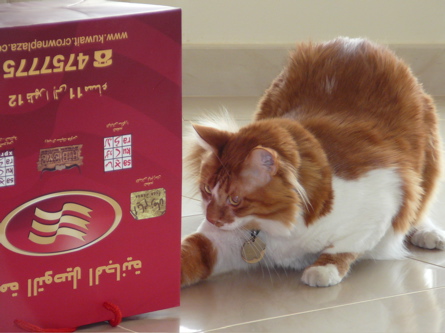
He pushes the sack, trying to get his baby:

Finally, he wins!

777
This week I saw an accident, and called 777. My experience was very positive – my call was answered on the first try, and although the lady didn’t speak English, we managed. The ambulance people called me, the police called me multiple times, the ambulance showed up, the police showed up. All in all, not bad.
It would have been better had I spoken better Arabic, but we all managed. One guy put me on the speaker phone and had everyone listen to me and then someone said what I was saying. It was one of those Woh is der Bahnhof experiences where they would keep asking me “Where? Where?” and I would tell them and tell them, and then they would say “”Oh! You are saying . . . ” and it would be EXACTLY what I had been saying! Exactly!
But I could also hear them smiling as they talked to me, and I was glad I knew a few words. I probably sound like a four year old, but a four year old with enough sense to make a much-needed call and get the police and ambulance where they are needed, al hamdullah!
Oxo Salad Spinner
The first time I ever used the Oxo Salad Spinner in Kuwait, I became a fan. Do you ever buy the Kuwaiti Salad Greens at the Sultan Market? I hope you wash them before you use them!
The Oxo Salad Spinner has three parts; an outer bowl, and inner bowl like a seive, and a top that you press on and it makes the inner bowl spin very very fast inside the outer bowl, and the centripetal force makes all the water fly off the leaves and fall to the bottom of the bowl. So you can just lift out the inner bowl and empty the water out.
No electricity needed, it is entirely mechanical, and so well engineered that the bowl will spin on and on and on unless you stop it.
Before I spin the salad, I put all the salad greens in the inner bowl, put the inner bowl in the outer bowl and run cold water over the greens until the bowl is full. I leave it a couple minutes, then pull the inner bowl out, and empty the water from the outer bowl. The water is BROWN with dirt! I put the inner bowl in the outer bowl and rinse again, and again, until the water comes clear. Then, and only then, do I spin the lettuce/greens dry.
After emptying the spin-off water, I can actually put the spinner in the refrigerator, with the greens inside, or I can transfer them to another bowl or sack. They don’t last too long in our salad-eating house.
This is what the Oxo Salad Spinner looks like:
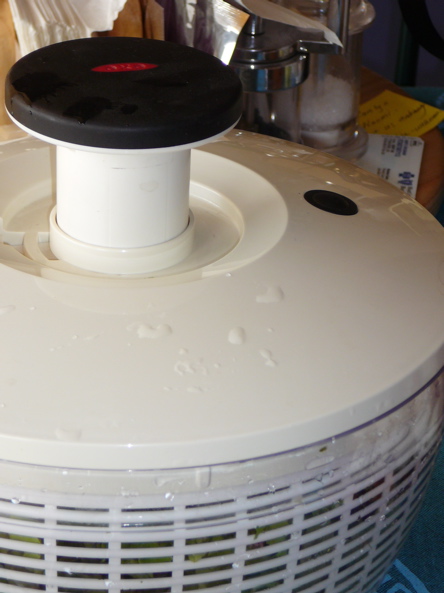
The part sticking out can be locked in the down position for storage. There is also a button that stops the salad spinner’s spinning motion, otherwise it takes a long time for the spinner to slow and stop.
If you are a reader who does not live in Kuwait, but who buys from local markets or farmer’s markets, you will still find this honey incredibly handy.
You can find the salad spinner by Oxo at Amazon.com for $24.95 plus shipping.
“Make This Case Go Away”
This is from today’s Kuwait Times.
MP Intervenes to save rapists
by Hanan Al-Saadoun
Kuwait: Two men accused of kidnap, rape and assault were let off the hook after pressure from a lawmaker and a senior police officer. A captain from the Traffic Department was on duty in Khaitan when he saw a parked car with an Asian maid in it and a man standing next to the car. The maid suddenly pointed to the officer and cried for help, so the captain rushed to the car and found another man inside with the maid.
The captain asked the man outside what the problem was. The main replied that this was a runaway maid and he was a detective. The captain asked for his ID but the man refused. The captain then realized that the man smelled of alcohol.
The men suddenly assaulted the captain and bit his hand, injuring him severely (emphasis added by blogger.) After the captain subdued both men, they confessed that they were drunk and that they had tried to rape the maid. The captain then tried to file a case at the Khaitan police station against the two men, but the MP intervened and tried to stop the captain from registering the case. The captain persisted and kept pushing to file a case for a week, until his superior intervened too and told him to “forget the incident.”
My comment: If I ever stop getting outraged when I read reports like this, God forbid, I will be dead.
First, the maid’s life is seriously damaged. Any victim can tell you that the terror of abduction, with or without rape, resonates through your life. When you are in a situation where you have no power, and are at the mercy of someone stronger or more powerful than you are, it is a life-changing event. And would her sponsor accept her back, even though it were no fault of her own? Would they not be afraid she might be diseased? They might even accuse her of inviting the assault – and this was an assault.
Second, these young men lied to the police, impersonated a police officer, resisted arrest and caused bodily harm to a senior police official. Did you notice – THEY CONFESSED.
Third, the police captain had the guts and integrity to persue filing this case against these wicked young men, inspite of pressures from above. WOOOOOO HOOOOOOOOOO on you, brave one, for your integrity.
Last, kudos for Hanan al-Sadoun who does such a great job presenting so many of these outrageous stories in an objective manner, letting us fill in the details and express our outrage in our blogs. Brava, habeebti.
Evidently this air tight case will never get to court.
And what have these young men learned about accountability? That their name and wasta will make their despicable actions go away? What is the fitting punishment for what they have done? C’mon readers, check in on this one.
OK, OK, I’ll take a deep breath and stop now.
The Best Tomato Salad
The best tomato salad starts with my friends’ home-garden-grown Kuwaiti tomatoes, little tiny cherry ones, that we cut in half. We mix up some of the best olive oil and balsamic vinegar, we cut some fresh basil leaves from their garden and chop them and throw them in.
Then we add cubes of this:

We grind fresh salt and fresh pepper, add the dressing, and oh! It is almost a meal in itself. Perfect with “sheem” and rice and zucchini. Coffee in the garden, while the nights are still so moderate and pleasant.
If there is someone making fresh mozarella in Kuwait, I haven’t been able to find him/her. This is about as close as I have been able to come. It is horrifyingly expensive, and worth every fil. You find it at the Sultan Center, in the dairy section.
My Addiction
Even though I know it is hopeless, I always look. It’s never there, or only once in the entire time I have lived here, and that was at the BIG Sultan Store in Salmiyya. But without any real hope, I looked and there it was!
When I was a kid growing up in Germany, there was something called PX rules. PX means Post Exchange, it is the place where American military people, or state department, or Canadians or British peoples would shop for things that the local German economy didn’t carry. The first rule is “if you see it, buy it.” The second rule is “if you see it and like it, buy several, as you may never see it again.”
So I bought all four bottles:

Even knowing that this behavior is known as “hoarding” and that hoarding leads to shortages and that is probably why I see it so rarely, and knowing I should leave a bottle or two for someone else . . . knowing all that, I still bought all four bottles. I couldn’t help it. I’ve been conditioned. The rules are too strong; I can’t resist.
When I first go back to the US, and see it plentifully on the grocery store shelves, it is still hard to just buy one . . . except that there, you can even buy a litre size, and that usually lasts me a week or so.
Vanilla Caramel . . . ahhhhhhhhhhhhhhhhhhh . . .
ATV Man
Why would a grown man – this guy must’ve been in his 40’s – drive an ATV to the Sultan Center?

Senior Citizens in Kuwait Taking Hospital Beds?
Tacked on to another article in yesterday’s Kuwait Times was this tiny bit of news, with much larger social implications:
“In other news, sources revealed that senior citizens have changed the rooms of public hospitals into old aged homes due to the low fees that are imposed on reserving a room at the hospital.
The rooms at public hospitals are worth KD 1 per day, and if the patient stays for two months, then he will pay only 500 fils per day.
Effective measures must be adopted by the Ministry of Health such as giving a determined time for each patient in order to enable hospitals to receive other patients.”
In a related article several months ago, a article in the same newspaper said that the hospitals were overrun with old people because people couldn’t take care of them at home, and it was much less shameful to say “my Mother is in the hospital” than to say “my mother is in a home for old people.”
It sounds to me like the solution is for the Kuwait government to open a state of the art “hospital” specializing in Gerontology, which in reality would be a retirement center for people unable to take care of their own physical needs, and whose families cannot meet their needs (believe me, after my father’s lengthy and debilitating illness, I know there is only so much a family can do), and they can still say that their parent(s) are in a hospital.
It would meet the need of “hospitalization,” would provide the older people with the intensive and personal services that they need, and would free the beds in traditional hospitals for the seriously ill and damaged citizens.
It’s only words.
Recent Comments
intlxpatr on Shampoo Ginger tigerbutterya0c5ff1d… on Shampoo Ginger intlxpatr on British Soldier Kidnapped, Esc… John on British Soldier Kidnapped, Esc… intlxpatr on British Soldier Kidnapped, Esc… Wikipedia Donate Button

Amazina


Early Voting in Florida


 Here There and Everywhere