Tuesday’s Dust Storm
I didn’t think Tuesday’s dust/sand storm was that bad – I was out, driving here and there (and everywhere LOL); you could see about a hundred meters, enough to stop. I was on side streets, mostly, not going all that fast and I never felt like it was that bad. I didn’t even think the tiny bit of rain we got was a problem (we need rain so badly) until I saw the outside of my car; it looked like I’d driven from Dakar to Paris; it looked hmmm. . . weathered!
My first sand storm was in Doha, Qatar. My niece and I were grocery shopping, and suddenly we saw people outside with their gutras and scarves wrapped around their faces like Lawrence of Arabia (you don’t see that a lot here.) When we went out, it was gritty. The air was full of sand, but you could still see.
Using our worst judgement, we decided to go driving along the Corniche. Hunhhh – there wasn’t a lot of traffic; we had the roads pretty much to ourselves and the wind was whipping and the sand got thicker and thicker and everyone we saw was covering their faces – at some point, good judgement kicked in and we crawled slowly back home, exhilarated with our sandstorm adventure. It really was a sand storm. There were drifts of sand all over the road.
In Kuwait, the grit is a lot smaller. These are mostly dust storms – your face is stiff and tight if you are out for any length of time, and I find I am having to wash my hair all the time, even twice a day, if I have to go out, because it is like my fine hair has suddenly gone coarse – the layer of dust adheres to hair and makes it thick and tangly.
Here are a couple photos from the dust storm on Tuesday:

I love the lushness of the palm trees thickly surrounding this mosque.

I love it that private citizens put up these sabilles, to provide drinking water to the thirsty. I love it even more when the sabille is beautiful, fun, or unusual in some way that takes it out of the merely serviceable and into the realm of imagination. This is a take-off on the huge Kuwait water towers, unique to Kuwait, a symbol of the city.
Requiring New Contracts
This is from today’s Al Watan, and is pertinent to the labor issues we have been discussing on Here, There and Everywhere. Bad surprises happen from top to bottom.
This applies to everyone – the contract you think you are signing when you come to Kuwait may not be what really happens. It depends a lot on the company, on how you are recruited, etc. For example, if you are recruited by a US company doing business with the government here, things are fairly straight-forward. Read your contract carefully before you sign. If you are recruited by one of the manpower agencies – be very very very careful.
Expat workers protest job contract fraud
Ricky Laxa
Staff Writer
KUWAIT: Embassies in Kuwait have been receiving many complaints from expatriate workers of being forced by employers to sign new job contracts with salaries that are far lesser than what they had initially agreed upon back in their countries before arriving in Kuwait. A number of Filipino workers, who recently arrived in Kuwait, have resorted to the Philippines Overseas Labor Office to file complaints against the agency that was responsible for their employment in Kuwait.
In an exclusive interview with Al Watan Daily on Thursday the complainants provided copies of contracts and other documents, which have been signed by the employer and the employees in the Philippines, in addition to another set of contracts, which indicate that their salaries have been reduced by more than half with totally different job descriptions.
A complainant said she has been asked to settle the amount of 40,000 Philippine pesos (335 Kuwaiti dinars) as placement fees. This amount does not include other expenses like medical checkـup, health insurance and other expenses. She added that most of the fees have been overpriced on receipts that are handwritten on ordinary sheets of paper “The receipts issued are not official ones as required by the Philippines” government, and the concerned authorities have ignored their malpractices,” she said. An embassy official indicated that most of these placement agencies are registered under Filipino representatives, who are usually the owners” wives, girlfriends or Filipino nationals who had previously worked in Kuwait and these are the people who make the manipulation of contracts an easy task.
Al Watan Daily managed to acquire some original copies of the contracts, which have been signed by the employers and the employees. In one of the job contracts, a salary of KD 200 has been signed by both parties with the job description cited as ”Receptionist” and in another contract bearing the same name the salary has been slashed to KD 100 with the job description cited as “Cashier.”
“Two hours prior to our departure, we were asked to sign letters of undertaking stating that we have agreed to the alterations on the contracts. We refused to sign the new contract s yet for some of us, we had no choice but to agree to the amount,” added another complainant.
Al Watan Daily spoke to the agency”s representative who was asked by the Philippines labor official to meet the complainants and resolve the cases. The representative initially denied the allegations but fearing being exposed she admitted to the change in contracts.
She stated that the employer called a few hours before the scheduled flights and she was told to reduce the salaries under the pretext of the global economic crisis, which the labor official ignored and dismissed.
Al Watan Daily also found out that the license of the said agency to recruit workers from the Philippines has been suspended for unknown reasons. “Our company is employing fifty medical staff at the end of the month and we have signed agreements with other big companies,” said the representative.
A settlement has been reached between the complainants and the employer in the presence of the labor official on Thursday and some of the complainants have agreed to accept KD 150 instead of KD 200. Other workers opted to be repatriated without a refund of the placement fees that were paid to the Philippine agency.
“How many more agencies such as this will continue to mislead and cheat overseas workers? Agencies are literally taking undue advantage of the poor situation that these people are faced with back in their countries. Most of them leave their countries after paying huge amounts just to be able to finance the requirements needed to work abroad. These agencies should not be allowed to recruit locally and internationally. Strict legal measures must be taken against those who violate the terms and conditions drawn in the original contracts,” stressed an embassy official.
Informed sources also told Al Watan Daily that an alarming number of Western nationals also experience similar situations. In a lecture concerning employees and employers” rights that was held recently by a local organization, a relatively large number of Western nationals raised questions on the alteration of articles drafted in contracts.
“My contract stipulates specified allowances for house rent and education fees for my children. I agreed to sign the contract and came to Kuwait with my family only to find out that education fees for my children will not be provided,” complained a British national who attended the lecture.
He also said that school fees allowance is an important factor, which made him agree to sign the contract knowing that the salary he agreed on will not be sufficient to finance the education of his children. The company eventually agreed to provide half of the amount.
Meanwhile, an American teacher complained that the accommodation provided by the school is being relocated to a remote area and that traveling between the two places is very time consuming. She was also said that she would be given her own flat only to find out that she would have to share with another teacher.
“These conditions were not mentioned in the contract and we were informed that the situation is temporary but it has been a year since. I am definitely not renewing my contract,” stressed the teacher. Similarly, a South American manager of a spa complained about extra working hours being imposed on her, in addition to a 24ـhour onـcall policy. Her contract clearly stipulates nine working hours and a day off per week. During an orientation, she was handed over a company handbook, which defines her job functions. Rules require her to manage the spa and administer treatments as well. She recently resigned from work.
When you read articles like these, you can understand how some employer/employee relationships are doomed from the start. A family asks an agency for a maid, and when she arrives, having been told she will earn far less than she expected, she will not be a receptionist or a cashier, but a housecleaner / cook / nanny, and her working conditions are not covered nor guaranteed by labor law, she shows up sullen and angry. The family, expecting someone who is happy to be earning a good salary, (and who often paid those fees that the maid is also being charged for) are dismayed at this ill-tempered and sullen employee, and the employee is resentful and depressed at being tricked and in servitude. It’s not a great start for a good relationship.
The same is true for higher level professional positions. Once hired, some employers here seem to think that the employee is a human resource – on call. It’s like they think the contract implies some kind of ownership. When people complain, salaries are late, conditions worsen and the employee is STUCK. Worst case, you have a travel ban placed against you and you can’t even get out of Kuwait.
About 85 – 90% of the population of Kuwait is from somewhere else. You have few rights. This is a true story – a western employee driving on a ring road – a fast road – hit a man who ran across the road. The western employee had to go to jail while they waited to find out if the man hit would survive. The man survived, and was discovered to be here in Kuwait illegally, and was deported. The western man was allowed out of jail, but when his contract ended, could not leave the country because a travel ban was posted against him. He could not be brought to trial because the witness against him – the man who had run in front of his car – could not be found. He could not be found because he had been deported. It took forever for this poor man to leave Kuwait, and it was pressure brought by the newspapers publishing his story that finally got the case . . . resolved? dropped? There is no explanation. Maybe someone had to cross an official’s palm, who knows?
It doesn’t matter who you are, or where you are from, it doesn’t matter if you are a maid, a cashier, a waiter, an accountant, a teacher, a consultant; if you are an expat worker, the law and the enforcement of the law, at the current time in Kuwait, is not your friend.
Weather – or Not?
This morning, Weather Underground (you can go see for yourself by clicking on the temperature widget over at the right) says it is “clear”.
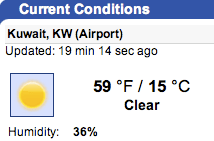
I don’t know what “clear” looks like in your neck of the woods, but here is “clear” from our vantage Point:
The “clear” sunrise

“clear” over the water

First, do you see that thin layer of yellow? Usually we see that about a couple of kilometers out, but this morning, it is barely 200 meters off the shore and approaching. Second, the thick – and thickening – haze is white today, not yellow or red. It may be dust, but it may also be air pollution of some kind.
Yesterday I had a weird headache. Not a killing headache, but a persistent low grade headache that would not go away, not until the sun went down. I took aspirin, it did not go away. I was fine until this morning, felt fine when I woke up, but once I had been up for about an hour, this persistent low-grade headache is back. I think it is weather related. I think this is SMOG. I never have headaches!
Bah! humbug!
Final Entry Bu Yousef: The Great Kuwait National Holiday Challenge
Just one entry from Bu Yousef, but oh, what a great one! Thank you, Bu Yousef and Umm Yousef! 🙂

You know, I think I am going to skip the voting. The photos are all so different, and all so good. Thank you, all, for your participation. You had some truly spectacular photos.
Holiday Sunrise
Good morning, Kuwait, and a beautiful day it is going to be:

No, that isn’t an attack helicopter in the photo, it is a bird, and I didn’t even see him until I uploaded the photo. The sun is coming up around 0615 in the morning, and mornings are still cool and comfortable.

It’s a quiet morning, as people sleep in; today is a holiday – the Prophet Mohammed’s birthday.
Honored Guest
In every country where I have lived, we have felt like honored guests. This week, I have been truly honored, my blogging friend Hilaliya has asked me to be an occasional guest blogger on his revamped blog, now featuring a Kuwait Blogging Diwaniya. Pretty cool, huh? I have to admit it, I have a smile from ear to ear.
The revered blogger Don Veto led the way with an article yesterday, and I jumped in today.
In honor of my ear-to-ear smile, it’s called Smile for me Baby – Let Me See Your Grill but fair warning – it’s political polemic, about parliamentary gridlock, so you will see a grittier side of Intlxpatr.
Housing Prices Fall 30 – 40% in Kuwait
From today’s Arab Times
Price of residential homes falls as ‘meltdown’ digs in
KUWAIT CITY, March 10, (KUNA): Prices of residential homes in Kuwait have fallen between 30 and 40 percent since February, the Manazel Holding Company chairman said here Tuesday. The drop differs from one area to another, dipping by 60 percent at some areas and 15-20 percent at others, Adnan al-Nesf told Kuwait News Agency (KUNA). The prices have been on the wane since Laws 8 and 9 for 2008 were put in place. Both laws bar companies from selling or buying houses, he said.
The global financial crisis is to blame for the decline in house rates, al-Nesf added. The laws were adopted after the prices had reached record levels, but the situation could have been solved in a way that would not lead to a ban on home activities by mortgage companies, he said. Several rules and controls could be imposed on dealing in homes that directly concern citizens; including allowing landlords to sell their houses only after five years of buying, he suggested.
However, he voiced optimism that the crisis would be resolved soon, especially following a recent court ruling allowing the Kuwait Finance House (KFH) to deal in houses. An improvement in the real estate sector would surely push the economic wheel forward, he argued, pointing out that the property market was waiting for an in-the-offing rescue plan to be put in place soon. Just like other companies, real estate dealers have been negatively affected by the current world financial meltdown, he affirmed. But, he recognized that most property dealers were trying to retrench their expenses, lay off workers or cut workers’ salaries.
Wild Blue Yonder
Today was the Kuwait show of military might. No sandstorm, thanks be to God. Somehow, I had thought yesterday was Wednesday and thought how sad it was it would have had to be cancelled. When I woke up today and realized it was Wednesday, I could hardly wait.
Just the sound of the roaring jets gives me a grin. I once lived near a huge airbase, and we lived with the sound day and night. It never bothered me. I always knew these were men and women who sacrificed their lives to serve their country in a profession that looks a lot more glamorous than it is. Flying can be exciting, but it can also be very tedious. You are away from your family for long hours. It gets old. They persevere.
The young men and women chosen to fly these fighter planes have to have superior physical condition and reflexes. Think about you and the car your daddy gave you – it may be expensive, but it didn’t cost billions. These planes do. It’s an amazing responsibility, a privilege and an honor to be selected.
Bu Yousef, tell your friend he was supposed to waggle his wings when he flew by so I would know which one he was! 😉
Macaholic, it was a little hazy, but the attack helicopters are for you. 🙂




‘Kuwait could deport 11,000 expats’
From today’s Arab Times
‘Kuwait could deport 11,000 expats’
KUWAIT CITY, March 10: Kuwait will deport 11,000 expatriate workers after the issuance of a decision to close files of sponsors involved in human trafficking and establishment of illusory companies, reports Al-Qabas daily quoting a reliable source from the Ministry of Social Affairs and Labor. According to the source, the ministry has prepared a comprehensive report about the human trafficking cases in Kuwait, ahead of the US State Department Trafficking in Persons (TIP) Report, which will be released by the middle of this year.
The report states that Kuwait is bent on clearing its name over human trafficking accusations. It highlighted negative comments about Kuwait, which include the absence of a law to incriminate those involved in human trafficking and incompetence of personnel in charge of human trafficking victims. This has prompted the ministry to coordinate with its justice counterpart and other relevant government authorities to lay down a draft bill to curb human trafficking and people smuggling. The draft bill has been finalized and referred to the Cabinet, which will pave the way for its submission to the National Assembly for voting. Both ministries are also exerting efforts to establish a higher authority to support the expatriate workers.
Despite claims that Kuwait has taken positive steps to remove its name from the TIP watch list, Kuwait received a letter from the charge d’ affaires of the American Embassy in Kuwait mid-last year, warning that the country might retain its ranking in the watch list if it fails to take the necessary measures to curb human trafficking, and provide training to the Ministry of Social Affairs and Labor employees on how to deal with the victims of human trafficking.
The reports also mentioned the establishment of a shelter in Kheitan for expatriates who run away from their sponsors, indicating several international and Arab delegations visited and praised the center, but they all demanded for more procedures. In response to such demands, the Ministry of Social Affairs and Labor asked its education counterpart to provide more schools as temporary shelters for the expatriate workers, as well as its finance counterpart to allocate the required budget for the construction of shelters in various governorates.
Meanwhile, the report has also underscored the fact that the employees assigned at the shelter have undergone various training courses at Johns Hopkins University in the US, in addition to a workshop conducted under the supervision of the International Organization for Migration (IOM), which was held in Bahrain several months ago. The report has also confirmed that the human trafficking victims have been provided with the necessary services, such as psychological and medical services, through an integrated team, consisting of representatives from the concerned ministries.
The Most Dangerous Job in Kuwait
From today’s Al Watan:
KUWAIT: The operations room received a call informing them that an Asian domestic maid tried to commit suicide by stabbing herself while at her sponsor”s house in the Salmiya area. Police officers and medical teams rushed to the scene where paramedics administered emergency medical aid and rushed her to Mubarak Hospital, where she was admitted to the intensive care unit. However, on interrogating her, she alleged that she did not attempt suicide but that she had been stabbed. Investigations are underway to ascertain the authenticity of the statement.
OK. Stop and think about it. How do you stab yourself? I can imagine, if I were wanting to commit suicide, a hundred ways easier than trying to stab oneself. Don’t you think the police would have been suspicious from the very beginning?
Every time I read about another domestic committing suicide, I wonder. I have heard many many things.
I wonder how many women commit suicide by “jumping” off the balcony? Those who survive often say they were thrown, or pushed, by “the madam.”
One girl told me that every maid brought into the household where she works immediately has to have her hair cut very short (and unflattering) and to wear voluminous and ugly uniforms, because “the madam” is afraid her husband and sons will be attracted to the maids.
I wonder how many slaps, how much screaming, how many humiliations, how many approaches or attacks from male members of the household one endures before absconding?
Think about it. You’re from a really really poor country, and you leave behind family, even your own children, for the hope of earning enough money so that the children can go to school, and have a better life, so that maybe you can build your own little bungalow one day, not fancy, just a roof over your head. People who come here to earn a living have a lot of incentive to make it work. They will endure a great deal before seeking a way out.
I have so many friends who treat their household help like members of the family, teaching them new skills, helping them earn extra money, giving them food and clothing. I believe they are in the majority, the kind employers.
But so many stories of domestics being abused! Even if it is a mere, say 5%, what options does the domestic have? The brave ones, the self-confident ones, might go to the police, only to have her employers state that she stole something, and she finds herself under arrest, or quickly deported. Many cannot even leave the house, and have no telephone with which to call a friend in an emergency situation.
Will the new labor law have anything to say about protecting these very vulnerable family helpers from a dangerous or abusive employer? What effect does it have on children to see their parents treating employees like mere possessions? How does it impact our souls and our entrance into paradise when we don’t (as the Quran instructs) pay our employees their promised salary at the agreed upon time?
What will happen to this poor woman, stabbed, in a strange hospital, whose employers claim she stabbed herself?
Recent Comments
ExpatAlien on What Country am I Living … intlxpatr on Yellowstone: Old Faithful to C… Michelle on Yellowstone: Old Faithful to C… Cathy on No Grown-Ups in Charge intlxpatr on Waiting for Snow Wikipedia Donate Button

Amazina


Early Voting in Florida


 Here There and Everywhere