The Great Kuwait Sand and Surf Challenge: Onlooker
Onlooker says this is Goa – and while there is sand and surf, he also throws in a sunset for free – is it not gorgeous?

There is so much going on, it is easy to forget that The Great Kuwait Sand and Surf Challenge continues! You have but one week! The challenge closes next Saturday, when all contestants will go up for a ballot on who wins the Sand and Surf challenge.
It is perfect Sand and Surf weather. There is even surf! Go forth and photograph!
Meanwhile – HHOOOOAAAHHHhhhhhhh! Onlooker!
Kuwait Stock Exchange Closing Poll
This is from today’s Al Watan. I think investors all over the world have confused saving with investing. When you know your family is going to need the money, for something like a vacation, a new washing machine, a car – you save. When you have the luxury of a little extra that you can afford to lose, you invest. Smart investors will investigate the investment carefully. If the market goes down, but the company whose shares you bought is still solvent and strong, you hang on – after all, it you didn’t invest anything you can’t afford to lose, right?
Lawmakers alarmed by bourse closure
Attorney lauds court order, says action was necessary
Ghenwah Jabouri
and agencies
KUWAIT: A number of MPs have criticized a Court of First Instance order to halt trading on the Kuwait Stock Exchange (KSE), saying that the court”s move is “the most dangerous decision” ever taken in relation to Kuwait”s economy and bourse.
They explained that closing the bourse has cemented a lack of confidence and will drive the index down further once trading resumes, while rhetorically asking who would bear the consequences of such an eventuality.
They also stressed the need to benefit from the experiences of other countries to strengthen the Kuwaiti stock market.
The MPs also called on the government to take measures to limit damages resulting from the closure of the KSE.
In an exclusive statement to Al Watan Daily, attorney Labid AlـAbdal said the global financial crisis is finding its effects on many strong markets around the globe and that the situation requires Kuwait and other GCC countries to draw up a serious plan to protect its markets.
“Kuwait should choose safe investments and strengthen its reserves of gold at the Central Bank of Kuwait,” he added.
He stressed that most of Kuwait”s active financial and commercial companies are directly and indirectly linked to the international economy and that they will need well supported banking systems to maintain safe credit transactions and protected debt recovery.
“Given the mentioned circumstances, closing the local stock market in Kuwait is a necessity to prevent further losses by registered companies and to protect the citizens from losing any more assets,” he explained.
Kuwait must select very protective measures, especially after the fall of the oil price and the lack of trust in the international financial system,” AlـAbdal concluded.
Last updated on Friday 14/11/2008
What do you think? Do you think closing the Kuwait exchange prevented further losses, or do you think closing the exchange fed the fear that is feeding the rapid decline? Or do you have another opinion totally?
First Female Police Class Graduates
Congratulations to the first class of female police academy graduates! I remember when women were first integrated into the US Military, my husband was assigned one of the first female lieutenants in Europe. I remember him saying, a year or two later that many of his best soldiers were women. I expect that that it will take some getting used to in Kuwait – just as it does in any country – and that the country will be the better for it in the long run.
These brave women have had the courage to break a barrier. God bless their work!

Al Watan staff
KUWAIT: The Support Authority at the Ministry of Interior held an open day on Wednesday for the parents of the first group of female cadets who joined the police academy this year. The event was held under the patronage of Undersecretary for Training and Education Brigadier Sheikh Ahmad AlـNawaf AlـSabah.
Brigadier Yusuf AlـMudhika welcomed the parents and sponsors of the event and said that Kuwait is grateful to the Kingdom of Bahrain for “making this dream a reality.” Bahrain has provided Kuwait with muchـneeded expertise in this field as it has already established a police academy for female cadets.
AlـMudhika explained that the new training for women has been designed to conform with Islamic teachings, customs and traditions and that the female cadets have proved to be as efficient and punctual as their male counterparts. He also referred to the curriculum and their daily timetable and said that their uniform has also been carefully selected to suit the cadets and that military accessories are being used to give a professional and disciplinary appearance.
He also mentioned the CCTV cameras within the academy and said that the parents had toured the cadets” dorms and shown satisfaction with their daughters” daily activities and their living quarters.
Last updated on Friday 14/11/2008
State Blocks Diwaniyas on State Land
I can understand the state not wanting to allow the people to build on public land, land reserved to preserve right of way, land reserved for parks, land to protect the ability to see around a corner. We watched all the illegal diwaniyas come down in our area, carted away on trucks, to be replaced with outdoor diwaniyas, which are lovely – but what to do when the temperatures start going up again?
Many of our friends have diwaniyyas – one – or more (!) built into their homes. An outdoor diwaniya is a luxury if you have the space for it. It looks to me like more homes are being built with a permanent diwayiya designed to match the house.
My real question is – How does this differ from the chalets? Are the chalets not also built on state property? Is there a bureau from which you get a permit? Is there any contractual understanding, like the land is deeded to you for 99 years before you put up an expensive chalet? Or do you build, knowing the government can reclaim that land at any time?
State succeeds in blocking diwaniyas bill
Al Watan staff
KUWAIT: The Parliament rejected a controversial draft law on Wednesday that called for regulating the construction of private diwaniyas on State property.
After a discussion, the proposal was overruled by a vote of 34 against and 26 in favor.
A number of MPs had presented the proposal, which was aimed at allowing the construction of private diwaniyas on State property adjacent to owners” homes provided that a license is obtained from the Ministry of Finance in exchange of an annual fee of no more than 0.250 Kuwaiti dinars per square meter.
Moreover, the Parliament also rejected a proposal to form a committee to investigate violations committed by the team tasked with removing all structures that have been illegally built on State property.
This proposal was voted down by 35 of the 61 legislators who were present at the session.
Earlier, the Parliament”s Finance and Economic Affairs Committee had rejected the draft law regulating the construction of private diwaniyas on State land, saying that it will have a negative impact regardless of the traditions related to these forms of gathering places.
It said the construction of these structures on State property will increase security, administrative and financial burdens on the State.
This issue was first discussed during Tuesday”s Parliament session, but a lack of order in the Abdullah AlـSalem Hall led to an adjournment of the session.
The Kuwaiti government had opposed the bill since the beginning, saying it bears many implementation difficulties and encourages encroachments on State property in a disorganized fashion.
Last updated on Thursday 13/11/2008
Post Sunrise November 13, 2008
It’s a little chilly this morning and the Qatteri Cat is cuddled up next to me, right on my left typing arm, so I am pecking away as best I can. It’s another beautiful day – and, as forecasted, there are small, light, fluffy clouds gathering – and a 20% chance of rain tomorrow. Here is what this morning looks like in Kuwait:
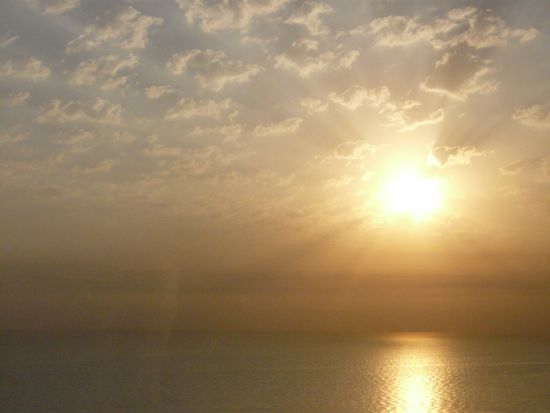
Have a great day, Kuwait!
Kuwait Sunrise November 12 2008
Yesterday had to be one of the loveliest days I have spent in Kuwait – driving down the highway, car full of friends, wind blowing in our hair – what a great day. It looks to me like we have another beautiful day coming:

At 0630 it was only 59° F / 15°C, which I also see is close to the high temperature expected in Seattle. Whoa! Get out the sweaters!
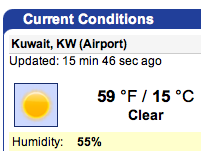
Goooood Monring, Q8!
Veteran’s Day Sunrise
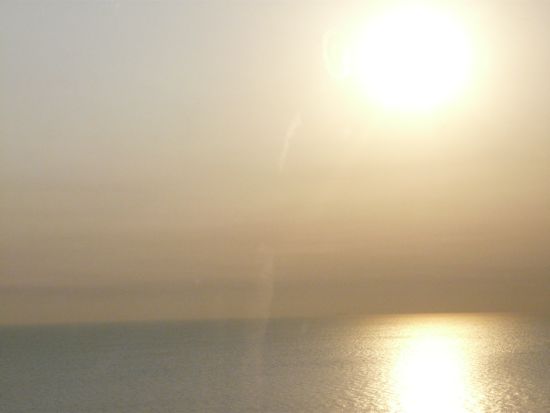
This is for you, AdventureMan, your own Veteran’s Day sunrise.
To anyone who has ever served in a nation’s armed forces. We salute you. Today and every day, we honor the service you gave to your country.
If you talk to any Kuwaiti veteran of the Gulf War and Liberation in Kuwait, you will learn that even a very short time in service can be a transformational experience. Those memories are vivid, and last the rest of your life.
Have a great day, Kuwait.
Better Watch Out! Traffic ambushes!
Think they will also be watching for mobile phone users? This is from today’s Al Watan
Al Watan staff
KUWAIT: Kuwait City Traffic Department launched a security campaign on Sunday morning against reckless drivers. Under the leadership of First Lieutenant Khalifa AlـSabah, several ambushes were set on the Second Ring Road where 37 citations were issued for drivers for violating traffic laws. A security source informed Al Watan that several ambushes would be set up in different locations in the area during the next few days to eliminate the phenomenon of irresponsible drivers who threaten other motorists and pedestrians” lives.
Drizzle!
It’s a beautiful morning, but maybe a little wet in some areas. Drive carefully, Kuwait!
The sunrise – again – was gorgeous:

“Look at that contrast!” said AdventureMan, as we finished our morning prayers. The threatening overcast made the sea and sky almost all one color, and the wake stands out brightly:

And while many are bemoaning the rain, it is so needed in dry Kuwait. Here is what the weather picture is for right now:

Have a great Monday, Kuwait!
Blood Spatter and Persephone’s Pomegranates
This morning I was hulling pomegranates. I’m not very good at it, and I was imagining the cooks at someplace like Shebastan could make quick work of what took me quite a while. My hands were thoroughly stitcky, but I had a nice healthy bowl of seeds, which I now know are called Aril, that I will eat like candy, and pop into my morning oatmeal – makes it edible and it tastes like health in a bowl.
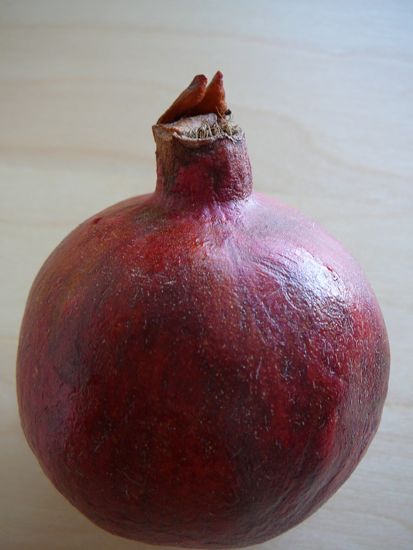
Pomegranate - Just look at that beautiful color!
My very cool Mom bought me my first pomegranate – here in Kuwait, they are called Roman’, which my husband said is because they came in with the Romans, but that seems very strange to me because clearly they are Iranian in origin. It took me forever to dig the seeds out. Now I know to just lightly cut the skin in a few places, tear off a hunk and start separating. I read on Wikipedia that it goes faster in water, the seeds sink and the pulp floats. I’ll have to try that next time.

Pomegranate seeds - again - look at those colors!
Mom bought me the pomegranate because I was crazy about Greek mythology, and Persephone had to spend six months in hell every year because (it’s a long story, this is just the short version) she had been tempted to eat and she ate just six pomegranate seeds, and so when she was freed from hell she still has to go back for six months and that’s why we have winter (well, I was just a kid and it made sense to me) but I always wondered what a pomegranate would be like.
I’ve loved them ever since. But when I was done, I noticed I had spots and streaks like something out of Dexter all over the walls. I think I have it all cleaned up, but I keep finding places I missed!
But you know how one thing leads to another, and then leads to Wikipedia. I wanted to make sure I got the legend of Persephone right, but instead, I learned that pomegranates have symbolism in all three religions of the book – Judaism, Christianity and Islam. Click on the blue type above and you can learn more about Pomegranates. Read below for what Wikipedia tells us about the pomegranate’s symbolism in different religions:
Pomegranates and symbolism
[edit]Judaism
Exodus 28:33–34 directed that images of pomegranates be woven onto the hem of the me’il (“robe of the ephod”), a robe worn by the Hebrew High Priest. 1 Kings 7:13–22 describes pomegranates depicted on the capitals of the two pilars (Jachin and Boaz) which stood in front of the temple King Solomon built in Jerusalem. It is said that Solomon designed his coronet based on the pomegranate’s “crown” (calyx).[31]
Jewish tradition teaches that the pomegranate is a symbol for righteousness, because it is said to have 613 seeds which corresponds with the 613 mitzvot or commandments of the Torah. For this reason and others, many Jews eat pomegranates on Rosh Hashanah. However, the actual number of seeds varies with individual fruits.[32] It is also a symbol of fruitfulness.[33] The pomegranate is one of the few images which appear on ancient coins of Judea as a holy symbol, and today many Torah scrolls are stored while not in use with a pair of decorative hollow silver “pomegranates” (rimmonim) placed over the two upper scroll handles. Some Jewish scholars believe that it was the pomegranate that was the forbidden fruit of the Garden of Eden.[33] Pomegranate is one of the Seven Species (Hebrew: שבעת המינים, Shiv’at Ha-Minim), the types of fruits and grains enumerated in the Hebrew Bible (Deuteronomy 8:8) as being special products of the Land of Israel.
[edit]Christianity
For the same reasons, pomegranates are a motif found in Christian religious decoration. They are often woven into the fabric of vestments and liturgical hangings or wrought in metalwork. Pomegranates figure in many religious paintings by the likes of Sandro Botticelli and Leonardo da Vinci, often in the hands of the Virgin Mary or the infant Jesus. The fruit, broken or bursting open, is a symbol of the fullness of his suffering and resurrection.[33] In the Eastern Orthodox Church, pomegranate seeds may be used in kolyva, a dish prepared for memorial services, as a symbol of the sweetness of the heavenly kingdom.
[edit]Islam
According to the Qur’an, pomegranates grow in the gardens of paradise (55:068). According to Islamic tradition, every seed of a pomegranate must be eaten, because one can’t be sure which aril came from paradise. The Prophet Mohammed is said to have encouraged his followers to eat pomegranates to ward off envy and hatred.[33] The Qur’an also mentions (6:99, 6:141) pomegranates twice as examples of good things God creates.
[edit]Greece and Greek mythology
The wild pomegranate did not grow natively in the Aegean area in Neolithic times. It originated in eastern Iran and came to the Aegean world along the same cultural pathways that brought the goddess whom the Anatolians worshipped as Cybele and the Mesopotamians as Ishtar.
The myth of Persephone, the chthonic goddess of the Underworld, also prominently features the pomegranate. In one version of Greek mythology, Persephone was kidnapped by Hades and taken off to live in the underworld as his wife. Her mother, Demeter (goddess of the Harvest), went into mourning for her lost daughter and thus all green things ceased to grow. Zeus, the highest ranking of the Greek gods, could not leave the Earth to die, so he commanded Hades to return Persephone. It was the rule of the Fates that anyone who consumed food or drink in the Underworld was doomed to spend eternity there. Persephone had no food, but Hades tricked her into eating four pomegranate seeds while she was still his prisoner and so, because of this, she was condemned to spend four months in the Underworld every year. During these four months, when Persephone is sitting on the throne of the Underworld next to her husband Hades, her mother Demeter mourns and no longer gives fertility to the earth. This became an ancient Greek explanation for the seasons.
Dante Gabriel Rossetti’s painting Persephona depicts Persephone holding the fatal fruit. It should be noted that the number of seeds that Persephone ate varies, depending on which version of the story is told. The number of seeds she is said to have eaten ranges from three to seven, which accounts for just one barren season if it is just three or four seeds, or two barren seasons (half the year) if she ate six or seven seeds. There is no set number.
The pomegranate also evoked the presence of the Aegean Triple Goddess who evolved into the Olympian Hera, who is sometimes represented offering the pomegranate, as in the Polykleitos’ cult image of the Argive Heraion (see below). According to Carl A. P. Ruck and Danny Staples, the chambered pomegranate is also a surrogate for the poppy’s narcotic capsule, with its comparable shape and chambered interior.[34] On a Mycenaean seal illustrated in Joseph Campbell’s Occidental Mythology 1964, figure 19, the seated Goddess of the double-headed axe (the labrys) offers three poppy pods in her right hand and supports her breast with her left. She embodies both aspects of the dual goddess, life-giving and death-dealing at once. The Titan Orion was represented as “marrying” Side, a name that in Boeotia means “pomegranate”, thus consecrating the primal hunter to the Goddess. Other Greek dialects call the pomegranate rhoa; its possible connection with the name of the earth goddess Rhea, inexplicable in Greek, proved suggestive for the mythographer Karl Kerenyi, who suggested that the consonance might ultimately derive from a deeper, pre-Indo-European language layer.
Pomegranate — opened up
In the 6th century BC, Polykleitos took ivory and gold to sculpt the seated Argive Hera in her temple. She held a scepter in one hand and offered a pomegranate, like a ‘royal orb’, in the other. “About the pomegranate I must say nothing,” whispered the traveller Pausanias in the 2nd century, “for its story is something of a mystery.” Indeed, in the Orion story we hear that Hera cast pomegranate-Side (an ancient city in Antalya) into dim Erebus — “for daring to rival Hera’s beauty”, which forms the probable point of connection with the older Osiris/Isis story. Since the ancient Egyptians identified the Orion constellation in the sky as Sah the “soul of Osiris”, the identification of this section of the myth seems relatively complete. Hera wears, not a wreath nor a tiara nor a diadem, but clearly the calyx of the pomegranate that has become her serrated crown.
The pomegranate has a calyx shaped like a crown. In Jewish tradition it has been seen as the original “design” for the proper crown.[31] In some artistic depictions, the pomegranate is found in the hand of Mary, mother of Jesus.
In modern times the pomegranate still holds strong symbolic meanings for the Greeks. On important days in the Greek Orthodox calendar, such as the Presentation of the Virgin Mary and on Christmas Day, it is traditional to have at the dinner table “polysporia”, also known by their ancient name “panspermia,” in some regions of Greece. In ancient times they were offered to Demeter[citation needed] and to the other gods for fertile land, for the spirits of the dead and in honor of compassionate Dionysus.
When one buys a new home, it is conventional for a house guest to bring as a first gift a pomegranate, which is placed under/near the ikonostasi (home altar) of the house, as a symbol of abundance, fertility and good luck. Pomegranates are also prominent at Greek weddings and funerals. When Greeks commemorate their dead, they make kollyva as offerings, which consist of boiled wheat, mixed with sugar and decorated with pomegranate. It is also traditional in Greece to break a pomegranate on the ground at weddings and on New Years. Pomegranate decorations for the home are very common in Greece and sold in most homegoods stores.[35]
The photos, by the way, are of Indian pomegranates, but I bought Indian ones, Iranian ones and Egyptian ones; some are great big and very red, some are more orangey-red. These Indian ones are delightfully sweet!
Google can help you find all kinds of pomegranate recipes, but there is actually an organization called Pomegranates.org that lists lots of recipes in one easy location. 🙂 This must be pomegranate season, because they are plentiful, and reasonably priced, and oh, what luxury!
Here is one of their recipes:
Chicken with Pomegranate and Walnuts
2-3/4 pound fryer chicken
2 cups walnuts, finely chopped
3 tablespoons shortening
3-1/2 cups water
1/2 teaspoon poultry seasoning
1 teaspoon salt
1/2 teaspoon cinnamon
1/2 teaspoon pepper
2 teaspoons lemon juice
1 large onion, finely chopped
1 cup fresh pomegranate juice
3 teaspoons butter
2 teaspoons tomato sauce
1 teaspoon sugar
Prepare chicken for frying. Saute chicken with poultry seasoning in shortening until light brown, set aside. In a large pot saute the onion in 3 teaspoon butter until golden brown. Add tomato sauce and saute for a few minutes. Add walnuts to the onions and saute over meduim heat about 5 minutes, stirring constantly. Add water, remaining seasonings, lemon juice, and pomegranate syrup. Cover and let cook on low about 35 minutes. Taste the sauce and add sugar if needed. Arrange browned chicken pieces in the sauce, cover and let simmer 20-25 minutes. Serve over white rice.
Serves 6.
Recent Comments
ExpatAlien on What Country am I Living … intlxpatr on Yellowstone: Old Faithful to C… Michelle on Yellowstone: Old Faithful to C… Cathy on No Grown-Ups in Charge intlxpatr on Waiting for Snow Wikipedia Donate Button

Amazina


Early Voting in Florida


 Here There and Everywhere