Babies and Bilingualism
Fascinating article from The New York Times on babies and language development:
Hearing Bilingual: How Babies Sort Out Language
By PERRI KLASS, M.D.
Published: October 10, 2011
Once, experts feared that young children exposed to more than one language would suffer “language confusion,” which might delay their speech development. Today, parents often are urged to capitalize on that early knack for acquiring language. Upscale schools market themselves with promises of deep immersion in Spanish — or Mandarin — for everyone, starting in kindergarten or even before.
Yet while many parents recognize the utility of a second language, families bringing up children in non-English-speaking households, or trying to juggle two languages at home, are often desperate for information. And while the study of bilingual development has refuted those early fears about confusion and delay, there aren’t many research-based guidelines about the very early years and the best strategies for producing a happily bilingual child.
But there is more and more research to draw on, reaching back to infancy and even to the womb. As the relatively new science of bilingualism pushes back to the origins of speech and language, scientists are teasing out the earliest differences between brains exposed to one language and brains exposed to two.
Researchers have found ways to analyze infant behavior — where babies turn their gazes, how long they pay attention — to help figure out infant perceptions of sounds and words and languages, of what is familiar and what is unfamiliar to them. Now, analyzing the neurologic activity of babies’ brains as they hear language, and then comparing those early responses with the words that those children learn as they get older, is helping explain not just how the early brain listens to language, but how listening shapes the early brain.
Recently, researchers at the University of Washington used measures of electrical brain responses to compare so-called monolingual infants, from homes in which one language was spoken, to bilingual infants exposed to two languages. Of course, since the subjects of the study, adorable in their infant-size EEG caps, ranged from 6 months to 12 months of age, they weren’t producing many words in any language.
Still, the researchers found that at 6 months, the monolingual infants could discriminate between phonetic sounds, whether they were uttered in the language they were used to hearing or in another language not spoken in their homes. By 10 to 12 months, however, monolingual babies were no longer detecting sounds in the second language, only in the language they usually heard.
The researchers suggested that this represents a process of “neural commitment,” in which the infant brain wires itself to understand one language and its sounds.
In contrast, the bilingual infants followed a different developmental trajectory. At 6 to 9 months, they did not detect differences in phonetic sounds in either language, but when they were older — 10 to 12 months — they were able to discriminate sounds in both.
“What the study demonstrates is that the variability in bilingual babies’ experience keeps them open,” said Dr. Patricia Kuhl, co-director of the Institute for Learning and Brain Sciences at the University of Washington and one of the authors of the study. “They do not show the perceptual narrowing as soon as monolingual babies do. It’s another piece of evidence that what you experience shapes the brain.”
The learning of language — and the effects on the brain of the language we hear — may begin even earlier than 6 months of age.
Janet Werker, a professor of psychology at the University of British Columbia, studies how babies perceive language and how that shapes their learning. Even in the womb, she said, babies are exposed to the rhythms and sounds of language, and newborns have been shown to prefer languages rhythmically similar to the one they’ve heard during fetal development.
In one recent study, Dr. Werker and her collaborators showed that babies born to bilingual mothers not only prefer both of those languages over others — but are also able to register that the two languages are different.
In addition to this ability to use rhythmic sound to discriminate between languages, Dr. Werker has studied other strategies that infants use as they grow, showing how their brains use different kinds of perception to learn languages, and also to keep them separate.
In a study of older infants shown silent videotapes of adults speaking, 4-month-olds could distinguish different languages visually by watching mouth and facial motions and responded with interest when the language changed. By 8 months, though, the monolingual infants were no longer responding to the difference in languages in these silent movies, while the bilingual infants continued to be engaged.
“For a baby who’s growing up bilingual, it’s like, ‘Hey, this is important information,’ ” Dr. Werker said.
Over the past decade, Ellen Bialystok, a distinguished research professor of psychology at York University in Toronto, has shown that bilingual children develop crucial skills in addition to their double vocabularies, learning different ways to solve logic problems or to handle multitasking, skills that are often considered part of the brain’s so-called executive function.
These higher-level cognitive abilities are localized to the frontal and prefrontal cortex in the brain. “Overwhelmingly, children who are bilingual from early on have precocious development of executive function,” Dr. Bialystok said.
Dr. Kuhl calls bilingual babies “more cognitively flexible” than monolingual infants. Her research group is examining infant brains with an even newer imaging device, magnetoencephalography, or MEG, which combines an M.R.I. scan with a recording of magnetic field changes as the brain transmits information.
Dr. Kuhl describes the device as looking like a “hair dryer from Mars,” and she hopes that it will help explore the question of why babies learn language from people, but not from screens.
Previous research by her group showed that exposing English-language infants in Seattle to someone speaking to them in Mandarin helped those babies preserve the ability to discriminate Chinese language sounds, but when the same “dose” of Mandarin was delivered by a television program or an audiotape, the babies learned nothing.
“This special mapping that babies seem to do with language happens in a social setting,” Dr. Kuhl said. “They need to be face to face, interacting with other people. The brain is turned on in a unique way.”
Speak Kuwaiti
Thanks to commenter Zak who recommends a new book available in Kuwait. Wish it had been available when I was there. I had to learn by asking friends. I’m still tempted to answer the phone “Weynich?? Weynich?” (Where are you – to a female)
“SPEAK KUWAITI”
I liked the idea of this new book “Speak Kuwaiti”, unlike any other book, this book has been compiled and designed to focus on the spoken Kuwaiti dialect in the easiest and most interactive way possible. I have many expatriate friends who often ask me “How can I speak Kuwaiti ?” or “How to say I’m hungry, tired, happy in Kuwait?” Well this book is the answer
The price is 3.600 K.D and can be found at Virgin, That Al Salasil, and Jarir bookshop, Kuwait Bookshop.
Zak
A God of Infinite Mercy
This morning, Father Neal Goldsborough of Christ Church Pensacola gave a sermon that held us all totally spellbound. It had to do with the fundamentalist preacher who – once again – forecast the coming rapture, which he says was scheduled for yesterday. (I wonder what he has to say today? He was wrong once before, in 1994. Or maybe people were raptured yesterday, but all the folk I know are, like me, sinners who didn’t make the cut.)

Father Neal talked about his service in the chaplain corp overseas, and faiths which exclude based on narrow rules, specific rules, churches and religions who say ‘this is the only way and all the rest of you are damned to everlasting fire” whether they use those words or paraphrases. He pointed to Jesus, who broke the rules of his time and flagrantly spent time with sinners, and the unclean, and showed them by his love and by his actions what the infinite love and mercy and forgiveness of Almighty God looks like.
It couldn’t have come at a better time for me.
Soon, I will be meeting up with three women who are particularly dear to me, friends for many years in Qatar, friends who worshipped at the Church of the Epiphany in Doha, Qatar. The new Anglican Church of the Epiphany is being built on land dedicated to church use by His Highness Sheikh Hamad bin Khalifa Al-Thani, the Emir of Qatar, and will be used by many denominations.
My friends and I all returned to the USA within months of one another, and have been sending e-mails with “reply to all” as we struggle with our re-entry into our old church communities. We struggle with the hatreds and prejudices and ignorance about our Moslem brothers and sisters, and we struggle with the narrow strictures imposed by our churches and study groups. I thank God to have these wonderful women among whom we can share our dismay and our hurting hearts, and re-inforce the lessons we learned living in a very exotic, and sometimes alien culture, but which had so many wonderful and mighty lessons to teach us. I often joke that in my life, God kept sending me back to the Middle East (Tunisia, Jordan, Saudi Arabia, Qatar and Kuwait) until he saw that I finally got it. My sisters-in-faith were quicker studies than I was. 🙂
It was a breath of the Holy Spirit I felt this morning, as Father Neal spoke about God’s mercy, his plan to redeem ALL of his creation, God’s desire for our love and our service. I couldn’t help it, it made me weep with relief to know my church is a church that serves God by including, rather than excluding, and which mercifully welcomes sinners like me.
Here is the really cool part. Christ Church Pensacola has recently begun putting the sermons online. If there is one thing Christ Church has, it is great sermons – and if you want to hear Father Neal’s sermon, you can click HERE, in a few days and you can hear his sermon for yourself. 🙂 Look for the May 22 sermon by Father Neal Goldsborough.
Ewww. Just Ewwww.
This one just creeps me out, and it didn’t even end up in the spam file. Ewww. Just Ewwwww.
Hello dear friend.
Glad that I’m just browsing now in the Internet and found your profile here on (intlxpatr.wordpress.com) i was much feelings over it, I’m miss vera khalifa by name, please i will like us to hold a good relationship with a real love, I’m happy to look at your profile today, you sound so gentle to me that was the reason why i fall very much interested in you, for more introduction also i will sent my pictures to you so we can know more about each other, i will be happy to see your email, your love vera
I was much feelings, too, Vera, and not good. Sorry.
Looking for Ebonics Masters
I haven’t heard a word about ebonics for a long time, and then this, in today’s AOL News. I had thought it was one of those flash-in-the-pan things, here today and gone tomorrow. Have not heard a serious word about ebonics in, literally, years.
DEA Seeking Ebonics Experts for Narcotics Investigations
Allan Lengel
Contributor
(Aug. 23) — If you speak Ebonics, the federal government may have a job for you.
The Drug Enforcement Administration wants to hire people fluent in Ebonics to help monitor, transcribe and translate secretly recorded conversations in narcotics investigations, according to the website The Smoking Gun and DEA documents.
The Smoking Gun reports that up to nine Ebonics experts will work with the DEA Atlanta Division after obtaining “DEA Sensitive” security clearance.
Ebonics, or “Black English,” generally is defined as a nonstandard form of English spoken by African-Americans.
According to the job description, Ebonics experts will decipher the results of “telephonic monitoring of court ordered nonconsensual intercepts, consensual listening devices, and other media,” the website reported.
Why We say . . . .
I can’t vouch for the verity of these, but I sure had a lot of fun reading them. Thank you, my Kuwait friend. 🙂
1. Q: Why are many coin banks shaped like pigs?
A: Long ago dishes and cookware in Europe were made of a dense orange clay called pygg. When people saved coins in jars made of this clay, these became known as pygg banks. An English potter misunderstood the word and made a bank resembling a pig…and it caught on.
2. Q: Why do dimes, quarters and half dollars have notches, while pennies and nickels do not?
A: The US Mint began putting notches on the edges of coins containing gold and silver to discourage holders from shaving off small quantities of the precious metals. Dimes, quarters and half dollars are notched because they used to contain silver. Pennies and nickels aren’t notched because the metals they contain weren’t considered valuable enough to shave.
3. Q: Why do men’s clothes have buttons on the right while women’s clothes have buttons on the left?
A: When buttons were invented, they were very expensive and worn primarily by the rich. Because wealthy women were dressed by maids, dressmakers put the buttons on the maid’s right. Since most people are right-handed, it is easier to push buttons on the right through holes on the left. And that’s where women’s buttons have remained since.
4. Q. Why do X’s at the end of a letter signify kisses?
A: In the Middle Ages, when many people were unable to read or write, documents were often signed using an X. Kissing the X represented an oath to fulfill obligations specified in the document. The X and the kiss eventually became synonymous.
5. Q: Why is shifting responsibility to someone else called passing the buck?
A: In card games, it was once customary to pass an item, called a buck, from player to player to indicate whose turn it was to deal. If a player didn’t wish to assume the responsibility, he’d pass the buck to the next player.
6. Q: Why do people clink their glasses before drinking a toast?
A: It was once common to try to kill an enemy by offering him a poisoned drink. To prove to a guest that a drink was safe, it became customary for the host to pour a small amount of the guest’s drink into his own glass. They’d then drink simultaneously. When a guest trusted his host, he’d merely touch or clink the host’s glass with his own.
7. Q: Why are people in the public eye said to be in the limelight?
A: Invented in 1825, limelight was used in lighthouses and stage lighting by burning a cylinder of lime, thus producing a brilliant light. In the theatre performers in the limelight were seen by the audience to be the center of attention.
8. Q: Why do ships and aircraft in trouble use mayday as their call for help?
A: This comes from the French word m’aidez (meaning help me) and is pronounced mayday.
9. Q: Why is someone who is feeling great on cloud nine?
A: Types of clouds are numbered according to the altitudes they attain, with nine being the highest. If someone is said to be on cloud nine, that person is floating well above worldly cares.
10. Q: Why are zero scores in tennis called love?
A: In France, where tennis first attained popularity, a big, round zero on the scoreboard looked like an egg and was called l’oeuf– which is French for egg. When tennis was introduced into the US, Americans pronounced it love.
11. Q: In golf, where did the term caddie come from?
A. When Mary, later Queen of Scots, went to France as a young girl (for education & survival), King Louis learned that she loved the Scottish game golf. So he had the first golf course outside of Scotland built for her enjoyment. To make sure she was properly chaperoned (and guarded) while she played, Louis hired cadets from a military school to accompany her. Mary liked this and, when she returned to Scotland (not a very good idea in the long run), she brought the practice with her. In French the word cadet is pronounced ca DAY, which the Scots changed to caddie.
Ya Gotta Love the Qatar Press

OK, bear with me. I am picky about language. I dance with joy to see that the Qatar press no longer uses “flay” on a daily basis; it is a strong word, a word that literally means ‘to skin’, and it was often used when one team triumphed over another, like Arsenal Flays Manchester, or some such, even if the victory was just points.
“No! No!” I would shake my head in horror, “please stop! Use some restraint! Choose the right word!”
But when it comes to rain, the press vocabulary seems stunted, and once again, predictably, we were treated to a ‘lashing’.
Think about it. It’s a strong word. What does lashing rain look like?
A lashing rain is blowing in bursts, coming at you sometimes at almost a 90° angle, an umbrella is useless. A lashing rain can hurt your face, it hits so hard, a lashing rain is heavily wind blown. A lashing rain has FORCE behind it.
What we had in Doha was a steady, drenching rain. At no time did it exceed an angle of maybe 15%; almost 100% of the time the rain came steadily down. Maybe it streamed. Maybe it soaked. Maybe it even flooded. But lashing? No. No. It was never lashing. There was no great wind behind it, no great force. It gently, steadily dripped. It accumulated. It never never lashed.
Debate on Media Freedom in Doha, Qatar
From today’s Gulf Times:
Debate on Qatari press law
The Doha Centre for Media Freedom (DCMF) will hold a roundtable discussion on the Qatari press law that dates back to 1979, on Wednesday, at The Ritz-Carlton Doha, an official said yesterday.
According to the official, under the discussion will be the need for a Qatari media, and the view concerning modification and changes to the accrual Press Law, in order for it to match the requirements of the current era.
Discussions will be moderated by DCMF deputy director general Maryam al-Khater, while senior media officials of the country, editor-in-chiefs, senior journalists, heads of media organisations and others are expected to be in attendance.
After an introductory presentation of the most-recent study prepared by DCMF on the Press Law, comprising recommendations, suggestions, and analyses, the floor will be opened to what is expected to be a “vigorous debate”, the official said.
“The DCMF calls on all media specialists to exercise their right of expression by participating in this gathering and sharing their thoughts about the possibility of amending the negative provisions of the law for journalists’ rights as well as adding provisions which respond to their ambitions,” the official added.
The event coincides with the National Day for Human Rights, which falls on November 11 every year.
There was an earlier report, on June 24th, that most of the original members of the DCMF had resigned:
Media Freedom Centre team leaves office
DOHA: Robert Ménard, director- general of the Doha Centre for Media Freedom and his team have left the Centre.
“We no longer have either the freedom or the resources to do our work,” said Menard, in a statement issued yesterday.
The heads of the assistance, research and communications departments have also left the Centre, said the statement.
The Center was set up on the initiative of H H Sheikha Mozah bint Nasser Al Missned and Reporters Without Borders in December 2007.
Ménard, who became director-general on April 1, 2008, was the founder of Reporters Without Borders, which he headed for 23 years.
I imagine this is going to be a very interesting “vigorous” debate, of interest to all those who write – or blog – on Qatar. One of the things I notice in both Kuwait and Qatar is that in the interest of self-preservation, the newspapers self-censor. For example, when a crime is committed, if it is an Asian, or even, rarely, a westerner, the name of the criminal can be printed. If it is a local citizen, they do not print the names, not ever, unless it is a rare case where the defendant is convicted and appeals – on rare occasions, the name will appear then. In order to spare the family the embarrassment, I have been told, but I would think that the fear of embarrassing the family would have a strong deterrent effect on young men, for example, who think it is OK to abduct, rape and humiliate young men and women, without fear of having their crime made public.
In Kuwait, they publish the crimes committed, at least. In Qatar, you would think from reading the papers, that these crimes don’t exist. They do. They aren’t reported.
I think it is very cool that in Qatar, many of these issues are opened for public debate, as in this media debate, and in the ongoing Doha Debate series.
Garden Saga
This has provided us with an ongoing burble of amusement, every time we drive into our compound.
Someone wants the name of the compound in the garden. It seemed a simple enough request, doesn’t it?
The first try I saw, was a perfect ‘A’ followed by a second ‘A’. I started laughing. It was being put in by laborers who are probably illiterate in their own language, much less have any idea about western letters. To them, these are just meaningless shapes, not symbols for sounds. The second ‘A’ was gone the next day, torn out, and replaced with the appropriate letter.
But concrete blocks are big and unwieldy. When the name was finished, it was big, with no spaces between words, and no ‘s’ on the end.
They tore it out, too.
Now, working with smaller bricks, working with templates, working with a diagram, the name is finally being completed accurately. It is actually lovely, so we can’t laugh anymore.
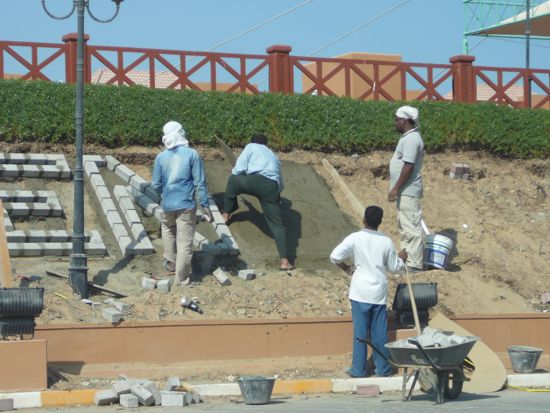
I wonder how we would do, trying to lay out the same in Arabic . . .
“We Be Slangin'” from TrendCentral
Have you heard of TrendCentral.com, another website that keeps track of the most ephemeral of the ephemeral – what is happening now and what might be coming down the pipeline?
Here is an article from TrendCentral.com on new vocabulary, for those who want to understand what the next gen is saying:
WE BE SLANGIN’
Decoding the latest Gen Y vocab
Did you know the word “hipster” didn’t always mean someone who laced every sentence with snark and pretended not to know other people’s names? Yeah, at one time “hipster” was used to describe beatniks that listened to jazz in the “wrong” side of town and took speed-induced road trips across America. As pop culture evolves, so does the slang we use to describe the world around us. Here are a few new words and terms we have been hearing around the block and on the web:
Real Talk
n. This phrase is used to highlight that whatever is being said is the actual truth and not the rose-colored variety. One of the most famous users of this expression is vlogger Mr. Chi-City, who tends to drop the phrase every few seconds.
“Real talk, I was so hungover, I slept next to the toilet, real talk.”
Social Notworking
v. Checking your social networking pages while on the job.
“I got caught Facebook stalking by my boss today. I hope he doesn’t get mad I was social notworking.”
Gypster
n. A person who dresses like a hybrid of a gypsy and a hipster.
“There were hoards of gypsters at that Fleet Foxes concert afterparty in Echo Park last night.”
Shress
n. A tunic or shirt that is scandalously worn as a dress; the term has come into use because of the trend of girls leaving the house without a vital component – their pants. (And we’re not talking about mistaking leggings for pants; we mean the bare-legged girls that seem to be just wearing an oversized men’s shirt.)
“Can you believe she wore a shress to school? She looked like she just came from a slumber party.”
Epicocity
n. A word used to describe just how epic (i.e. awesome) something is.
“Did you see Tony jump out of the tree into the swimming pool? It was totally stupid but I gotta say the epicocity level was 10.”
DT
abbr. This strictly means “down to” and originated in the land of texting. Like other phrases that begin at the thumbs of teenage girls, DT has migrated into actual verbal conversations.
“Do you want to go shopping tomorrow?” “DTGS”
Berry
n. A term used to describe a member of the opposite sex.
“See them berries sipping on martinis? They look ripe for a picking.”
Total LOL at Social Notworking!
Recent Comments
ExpatAlien on What Country am I Living … intlxpatr on Yellowstone: Old Faithful to C… Michelle on Yellowstone: Old Faithful to C… Cathy on No Grown-Ups in Charge intlxpatr on Waiting for Snow Wikipedia Donate Button

Amazina


Early Voting in Florida


 Here There and Everywhere