China Trusts Prostitutes More than Chinese Politicians
LLLOOOLLLL, thank you, BBC News for livening up the deadly August news scene:
China ‘trusts prostitutes more’
China’s prostitutes are better-trusted than its politicians and scientists, according to an online survey published by Insight China magazine.
The survey found that 7.9% of respondents considered sex workers to be trustworthy, placing them third behind farmers and religious workers.
“A list like this is at the same time surprising and embarrassing,” said an editorial in the state-run China Daily.
Politicians were far down the list, closer to scientists and teachers.
Insight China polled 3,376 Chinese citizens in June and July this year.
“The sex workers’ unexpected prominence on this list of honour… is indeed unusual,” said the China Daily editorial.
“At least [the scientists and officials] have not slid into the least credible category which consists of real estate developers, secretaries, agents, entertainers and directors,” the editorial said.
Soldiers came in fourth place.
I can’t help but wonder how the same survey would result in other countries?
“Whip Me if You Dare” Sudan Woman Wears Pants
This woman doesn’t have to take the whipping – she was a UN employee, and could claim diplomatic immunity. She wears a headscarf, she wears modest clothing. She could have quietly escaped. But like Rosa Parks, the black woman in segregated America, who refused to give up her seat and move to the back of the bus, Lubna Hussein has chosen to take a stand, even take a whipping, rather than back down.
Do you think it is un-Islamic for women to wear pants?
‘Whip me if you dare’ says Lubna Hussein, Sudan’s defiant trouser woman
Lubna Hussein, the Sudanese woman who is daring Islamic judges to have her whipped for the “crime” of wearing trousers, has given a defiant interview to the Telegraph.

As the morality police crowded around her table in a Khartoum restaurant, leering at her to see what she was wearing, Lubna Hussein had no idea she was about to become the best-known woman in Sudan.
She had arrived at the Kawkab Elsharq Hall on a Friday night to book a cousin’s wedding party, and while she waited she watched an Egyptian singer and sipped a coke.
She left less than an hour later under arrest as a “trouser girl” – humiliated in front of hundreds of people, then beaten around the head in a police van before being hauled before a court to face a likely sentence of 40 lashes for the “sin” of not wearing traditional Islamic dress.
The officials who tried to humiliate her expected her to beg for mercy, as most of their victims do.
Instead she turned the tables on them – and in court on Tuesday Mrs Hussein will dare judges to have her flogged, as she makes a brave stand for women’s rights in one of Africa’s most conservative nations.
She has become an overnight heroine for thousands of women in Africa and the Middle East, who are flooding her inbox with supportive emails. To the men who feel threatened by her she is an enemy of public morals, to be denounced in the letters pages of newspapers and in mosques.
As she recounted her ordeal in Khartoum yesterday Mrs Hussein, a widow in her late thirties who works as a journalist and United Nations’ press officer, managed cheerfully to crack jokes – despite the real prospect that in a couple of days she will be flogged with a camel-hair whip in a public courtyard where anyone who chooses may watch the spectacle.
Her interview with The Sunday Telegraph was her first with a Western newspaper.
“Flogging is a terrible thing – very painful and a humiliation for the victim,” she said. “But I am not afraid of being flogged. I will not back down.
“I want to stand up for the rights of women, and now the eyes of the world are on this case I have a chance to draw attention to the plight of women in Sudan.”
She could easily have escaped punishment by simply claiming immunity as a UN worker, as she is entitled to under Sudanese law. Instead, she is resigning from the UN – to the confusion of judges who last Wednesday adjourned the case because they did not know what to do with her.
“When I was in court I felt like a revolutionary standing before the judges,” she said, her eyes blazing with pride. “I felt as if I was representing all the women of Sudan.”
Like many other women in the capital, Mrs Hussein fell foul of Sudan’s Public Order Police, hated groups of young puritans employed by the government to crack down on illegal drinkers of alcohol and women who, in their view, are insufficiently demure.
Despite their claims of moral superiority, they have a reputation for dishonesty and for demanding sexual favours from women they arrest.
Mrs Hussein was one of 14 women arrested at the Kawkab Elsharq Hall, a popular meeting place for the capital’s intellectuals and journalists, who bring their families. Most of them were detained for wearing trousers. The police had difficulty seeing what Mrs Hussein was wearing under her loose, flowing Sudanese clothes. She was wearing green trousers, not the jeans that she said she sometimes wears, and wore a headscarf, as usual.
“They were very rude,” she said. “A girl at a table near mine was told to stand up and told to take a few steps and then turn around, in a very humiliating way. She was let off when they ‘discovered’ she was not wearing trousers.”
After her arrest, on the way to a police station, she tried to calm the younger girls.
“All the girls were forced to crouch on the floor of the pick-up with all the policemen sitting on the sides,” she said. “They were all very terrified and crying hysterically, except me as I had been arrested before during university days by the security services.
“So I began to try to calm the girls, telling them this wasn’t very serious. The response of the policeman was to snatch my mobile phone, and he hit me hard on the head with his open hand.
“On the way I felt so humiliated and downtrodden. In my mind was the thought that we were only treated like this because we were females.”
Christian women visiting from the south of Sudan were among the 10 women who admitted their error and were summarily flogged with 10 lashes each. But Mrs Hussein declined to admit her guilt and insisted on her right to go before a judge.
While waiting for her first court appearance, she said she was surprised to find herself held in a single cramped detention cell with other prisoners of both sexes. “How Islamic is that?” she asked. “This should not happen under Sharia.”
Mrs Hussein is a long-standing critic of Sudan’s government, headed by President Omar al-Bashir, the first head of state to face an international arrest warrant for war crimes. Sudan has been accused of committing atrocities in the Darfur region.
Before her arrest she had written several articles criticising the regime, although she believes she was picked at random by the morality police.
The regime has often caused international revulsion for religious extremism. In 2007 British teacher Gillian Gibbons was briefly imprisoned for calling the classroom teddy bear Mohammed.
The government is dominated by Islamists, although only the northern part of the nation is Muslim. Young women are frequently harassed and arrested by the regime’s morality police.
Mrs Hussein said: “The acts of this regime have no connection with the real Islam, which would not allow the hitting of women for the clothes they are wearing and in fact would punish anyone who slanders a woman.
“These laws were made by this current regime which uses it to humiliate the people and especially women. These tyrants are here to distort the real image of Islam.”
She was released from custody after her first court appearance last week, since when she has appeared on Sudanese television and radio to argue her case – which has made headlines around the world.
She is not only in trouble with police and judges. A day after her court appearance she was threatened by a motorcyclist, who did not remove his helmet. He told her that she would end up like an Egyptian woman who was murdered in a notorious recent case.
Since then she has not slept at home, moving between the houses of relatives. She believes her mobile telephone has been listened to by the security services using scanners.
But she has pledged to keep up her fight. “I hope the situation of women improves in Sudan. Whatever happens I will continue to fight for women’s rights.”
Sharing Your Faith in Qatar Gets Leader Deported
I heard a very strange tale and while there is nothing in the paper about it, I wonder where the truth lies. This week, the leader of the local Phillipine evangelical church (I don’t know the exact name) and his wife and three daughters and grandson were visited by the CID one morning and told that they had to be out of the country by night, that they needed to go back to the Phillipines. The person who told me could not imagine what might have caused this.
These are good people, she told me, and we are just about to do a performance about Joseph and his dreams, and his wife was making the costumes.
I thought about it, and said that well, it is an evangelical church, meaning you seek actively to bring souls to Jesus, and it is forbidden by law, in Qatar, to share our faith with Moslems. Is there any chance he was trying to convert Moslems?
She told me that people attending the church were expected to bring visitors, and that when visitors came, they were welcomed to the front of the church, where they were baptized.
I was horrorified. “Do they have any understanding of what is happening?” I asked her, and she replied no, and that most of the baptized visitors never come back. But, she added, the director still gets credit for all those baptisms, and his statistics look pretty good when he reports back to the church in the Phillipines.
In addition to her tithe (Christians are supposed to give 10% of their income to the church and charities) she said members of the congretation were tasked extra monies to pay the rent on the villa, to pay for food and travel of visitors who stayed there, etc, and she said it put a great burden on those who didn’t have sufficient income to contribute the extra. She said it wasn’t a voluntary contribution; if you didn’t contribute the extra, it was like you weren’t really a part of the church.
Last weekend, among those baptized, was a new Nigerian Moslem family who had been invited to visit. I can only imagine how I would feel, visiting a church, invited to the front to be welcomed, and then receiving a baptism I neither asked for nor wanted. I would never come back, but if I were Moslem, I might be horrified enough – and angry enough – to report it to the authorities. To me, at the very least, it is disrespectful.
There may be more to this story than the few details I was given. I expect the entire story is fascinating.
Thai Airport Shoplifting Scam
Imagine – you’re heading home from a wonderful vacation, and out of the blue, you are arrested, accused of shoplifting, and threatened with jail until you cough up several thousand dollars. And it is happening repeatedly!
By Jonathan Head
BBC News, Bangkok
Bangkok’s showcase new international airport is no stranger to controversy.
Built between 2002 and 2006, under the governments of then-Prime Minister Thaksin Shinawatra, the opening date was repeatedly delayed.
It has been dogged by allegations of corruption, as well as criticism of the design and poor quality of construction.
Then, at the end of last year, the airport was shut down for a week after being occupied by anti-government protesters.
Now new allegations have been made that a number of passengers are being detained every month in the duty free area on suspicion of shoplifting, and then held by the police until they pay large sums of money to buy their freedom.
That is what happened to Stephen Ingram and Xi Lin, two IT experts from Cambridge, as they were about to board their flight to London on the night of 25 April this year.
They had been browsing in the duty free shop at the airport, and were later approached by security guards, who twice asked to search their bags.
Mr Ingram and Ms Xi were told they had to pay £8,000
They were told a wallet had gone missing, and that Ms Lin had been seen on a security camera taking it out of the shop.
The company that owns the duty free shop, King Power, has since put the CCTV video on its website, which does appear to show her putting something in her bag. However the security guards found no wallet on either of them.
Despite that, they were both taken from the departure gate, back through immigration, and held in an airport police office. That is when their ordeal started to become frightening.
Interpreter
“We were questioned in separate rooms,” Mr Ingram said. “We felt really intimidated. They went through our bags and demanded that we tell them where the wallet was.”
The two were then put in what Mr Ingram describes as a “hot, humid, smelly cell with graffiti and blood on the walls”.
Mr Ingram managed to phone a Foreign Office helpline he found in a travel guide, and was told someone in the Bangkok embassy would try to help them.
The next morning the two were given an interpreter, a Sri Lankan national called Tony, who works part-time for the police.
They were taken by Tony to meet the local police commander – but, says Mr Ingram, for three hours all they discussed was how much money they would have to pay to get out.
Mr Ingram and Ms Xi were taken to meet the local police commander
They were told the charge was very serious. If they did not pay, they would be transferred to the infamous Bangkok Hilton prison, and would have to wait two months for their case to be processed.
Mr Ingram says they wanted £8,000 ( about $13,000) – for that the police would try to get him back to the UK in time for his mother’s funeral on 28 April.
But he could not arrange to get that much money transferred in time.
‘Zig-zag’ scheme
Tony then took Ms Lin to an ATM machine and told her to withdraw as much as she could from her own account – £600. He then withdrew the equivalent of £3,400 from his own account.
According to Mr Ingram this was then handed over to the police, and they were both forced to sign a number of papers.
Later they were allowed to move to a squalid hotel within the airport perimeter, but their passports were held and they were warned not to leave or try to contact a lawyer or their embassy.
“I will be watching you,” Tony told them, adding that they would have to stay there until the £8,000 was transferred into Tony’s account.
On the Monday they managed to sneak out and get a taxi to Bangkok, and met an official at the British Embassy.
She gave the name of a Thai lawyer, and, says Mr Ingram, told them they were being subjected to a classic Thai scam called the “zig-zag”.
Their lawyer urged them to expose Tony – but also warned them that if they fought the case it could take months, and they risked a long prison sentence.
After five days the money was transferred to Tony’s account, and they were allowed to leave.
Mr Ingram had missed his mother’s funeral, but at least they were given a court document stating that there was insufficient evidence against them, and no charge.
“It was a harrowing, stressful experience,” he said.
The couple say they now want to take legal action to recover their money.
‘Typical’ scam
The BBC has spoken to Tony and the regional police commander, Colonel Teeradej Phanuphan.
They both say Tony was merely helping the couple with translation, and raising bail to keep them out of prison.
Tony says about half the £8,000 was for bail, while the rest were “fees” for the bail, for his work, and for a lawyer he says he consulted on their behalf.
In theory, he says, they could try to get the bail portion refunded.
Colonel Teeradej says he will investigate any possible irregularities in their treatment. But he said any arrangement between the couple and Tony was a private affair, which did not involve the police.
Letters of complaint to the papers here in Thailand make it clear that passengers are regularly detained at the airport for alleged shoplifting, and then made to pay middlemen to win their freedom.
The Danish Embassy says one of its nationals was recently subjected to a very similar scam, and earlier this month an Irish scientist managed to flee Thailand with her husband and one year-old son after being arrested at the airport and accused of stealing an eyeliner worth around £17.
Tony told the BBC that so far this year he has “helped” about 150 foreigners in trouble with the police. He says sometimes he does it for no charge.
The British Embassy has also warned passengers at Bangkok Airport to take care not to move items around in the duty free shopping area before paying for them, as this could result in arrest and imprisonment.
Kuwait – American Woman Abducted and Raped
I received this notification this morning from the American Women’s League of Kuwait, guidance from the US Embassy:
We received a report that the spouse of an American citizen was kidnapped and sexually assaulted by three men in Mahboula. The victim was forced in a vehicle, taken to a secluded location, sexually assaulted, and left in the desert. The authorities are working to solve this heinous crime.
As a reminder to all, it is very important to keep an eye on who may be observing your activities while in Kuwait. Surveillance is not something that is just done by terrorists – almost every criminal who commits a crime conducts some sort of surveillance on their target either seconds, minutes, or hours before trying to commit a crime or assault a person.
Keep the following in mind:
Surveillance – think about who may be watching you. If it feels wrong, it probably is. Alert the local security personnel or store management of anything you feel is suspicious – DO NOT KEEP THIS INFORMATION TO YOURSELF AND TRUST YOUR INSTINCTS.
If you think you are being followed, make every effort to stay in a very public place until you can either make contact with the local security personnel or have some sort of an escort. Do not proceed to your vehicle or restroom, thus giving the person following you an opportunity to get you alone so they can rob or assault you.
Exiting/returning to your vehicle – this is the time when all people are vulnerable because your mind is focused on getting out of the car, watching traffic, trying to control children, or placing packages in/out of the car. Especially when returning to your vehicle, a good practice is to look around the exterior of your vehicle for people or suspicious items. Once in the vehicle, lock your doors and make sure your windows are up at all times.
Travel in groups whenever possible. Tell others where/when you are going and when you plan to return.
If being picked up wait inside a public place as opposed to alone and outside.
Carry a cell phone with pre-programmed emergency numbers, Post One, Police, Home, etc.
Last, think about fighting your attacker, especially if the attacker wants to take you to another location. Do not let that happen and draw attention to yourself and situation.
James Lee Burke and Swan Peak
When I read the description of this book on Amazon.com, I thought “haven’t I read this before? Dave Robicheaux and his buddy Clete go to Montana for a vacation?” but the description sounded like it was probably a new book and the copyright date was recent. I’ve been burned before – especially with Donna Leon books, where I order a book and discover I have already read it – it was published in England under one title and then – years later – in America, under a different title. That is so frustrating!
It arrived just as all the household goods arrived, so I had something to look forward to reading after the long, grueling days of toting and unwrapping, and putting away.
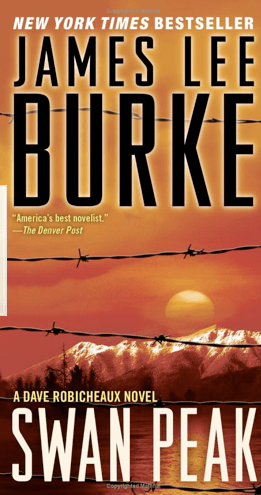
Some of the reviewers say it’s just another James Lee Burke, same story, different setting, and, to some extent, they are correct. I would counter with my opinion that no matter which James Lee Burke story you are reading, there are moments of pure poetry, and moments of keenly cynical insights that lift any book he writes out of the ordinary and puts it in the can’t-live-my-life-without-reading-this-book catagory.
Dave and Clete are vacationing in Montana (Dave’s wife is there, too, but barely appears in this book). As usual, they find themselves peripherally involved with a couple killings, and are interviewing a witness, Jamie Sue Wellstone, wife of a transplanted-from-Texas oil tycoon.
The garden was dissected by gravel pathways and surrounded by a gray stone will that was stippled with lichen in the shade. The flower beds were planted with pansies, English roses that were as big as grapefruit, forget-me-nots, violets, clematis vine and bottlebrush trees. I wondered if the eclectic nature of the ornamentals in the garden said something about the undefined and perhaps deceptive nature of the Wellstones and their ability to acquire an entire culture as easily as writing a check.
In the following section, he writes about the drifters, the people who end up in places like Montana, Alaska – wherever there is still a laxity in formal structures:
The waddies and drifters who worked for him were the kind of men who were out of sync with both history and themselves, pushed further and further by technology and convention into remote corners where the nineteenth century was still visible in the glimmer of the high-ceilinged saloon or an elevated sidewalk that had tethering rings inset in the concrete or an all-night cafe that served steaks and spuds to railroad workers in the lee of a mountain bigger than the sky.
Most of them were honest men. When they got into trouble, it was usually minor and alcohol or women or both. They didn’t file tax returns or waste money on dentists. Many of them didn’t have last names, or at least last names they always spelled the same way. Some had only initials, and even friends who had known them on the drift for years never knew what the initials stood for. If they weren’t paid to be wranglers and ranch workers, most of them would do the work for free. If the couldn’t do it for free, most of them would pay to do it. When one of them called himself a rodeo bum, he wasn’t being humble.
Their enemies were predictability, politic, geographical permanence, formal religion, and any conversation at all about the harmful effects of vice on one’s health. The average waddie woke in the morning with a cigarette cough from hell and considered the Big C an occupational hazard, on the same level as clap and cirrhosis and getting bull hooked or stirrup-drug or flung like a rag doll into the boards. It was just a part of the ride. Anybody who could stay on a sunfishing bolt of lightning eight seconds to the buzzer had already dispensed with questions about mortality.
There are many who object to the violence and brutality in every James Lee Burke novel. The problem is, he is writing about people who have to deal with violence and brutality and a way of life most of us never see. Burke writes about cops, about gangsters and organized crime, and about prisoners and prison life. It isn’t pretty. His main characters in this book, Dave and Clete, have seen too much. They are cynical as only deep-dyed idealists can be cynical. They are the guardians of our society; the enforcers of the codes. Without the police, and those who fight with them against crime, it is the rule of the jungle, where might makes right. The bullies rule, and as we have seen through history, unlimited power invites abuse.
What all predators hated most was to be made accountable. It wasn’t death that they feared. Death was what they sought, onstage, with the attention of the world focused upon them. But when you took away their weapons and their instruments of bondage and torture, when you pulled the gloves off their hands and the mask off their face, every one of them was a pathetic child. They were terrified of their mother and became sycophantic around uniformed men. The fact they were reviled by other felons and that cops would not touch them without wearing polyethylene gloves was not lost on them.
But how do you get your hands on a guy who has probably been killing people for years, in several states, leaving no viable clues, threading his way in and out of normal society? How do you find a sadist who probably looks and acts just like your next-door neighbor?
Much later in the book, he describes the kind of hero that crops up in each book the same way:
But if there is a greater lesson in what occurred inside that clearing, it’s probably the simple fact that the real gladiators of the world are so humble in their origins and unremarkable in appearance that when we stand next to them in a grocery-store line, we never guess how brightly their souls can burn in the dark.
There is only one Dave Robicheaux book I have kept – A Morning for Flamingos, the first one I ever read. I’m pretty sure it was in the late 1980’s, and I have been a James Lee Burke addict ever since. James Lee Burke hates organized crime, and he hates most of all those criminals who make themselves wealthy by bribery and corruption, who attend the society balls and events, whose photos appear in the paper looking like you and me – like respectable folk. People who get photographed making a donation to charity with wealth stolen from the common purse. His heros – and heroines – are modern day gladiators, they are the bureaucrat who refuses to hide the illegal wiretaps, the plodding cops and FBI officers who track down the slightest clue to bring down the Madhoff and the white-collar robbers, the prosecutors who risk their lives to put the bad guys away.
I guess for me, reading James Lee Burke is like reading a fairy-tale (If you have ever read the original fairy-tales, you will know what true gruesome violence and brutality is all about!) where those who flout the law, those who oppress the poor, those who use their ill-gotten wealth to isolate themselves high above the common man – get their justice. They think they are above the law. They are wrong.
Signs of the Times in Doha, Qatar
There are a whole series of these signs, carefully placed at eye-level at most stoplights. Here are two; it takes me a while to get in the right position at the right time and to have my camera ready, but I am learning to always have my camera ready:
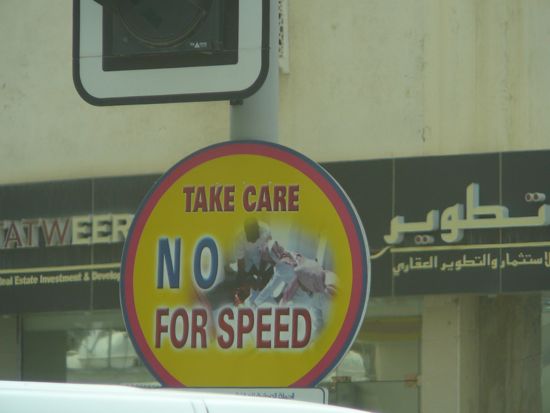

May God richly bless my husband for his patience; I am always calling out “Can you pull over so I can get a picture of that sign?” In Arabic, this one says “Bunshury al Rodoa”

I speak some Arabic, not a lot, like I can’t discuss politics with you, or anything complex, but I know shapes and colors and directions, and it all comes in handy. I took this sign because my favorite color is purple, and it is a very hard name to remember, when you are looking for something specific that is purple. 🙂

And see if you can guess why this is my very favorite photo of all 😉

The Appeal by John Grisham
One of the things I like about John Grisham is that he really likes the underdog. In his books, the person often the least likely to prevail does so, usually because he has a smart attorney, one who is paying attention and taking good care of the client. Warning – this book review contains a spoiler, so don’t go any further if you don’t want to know too much about the plot and resolution.
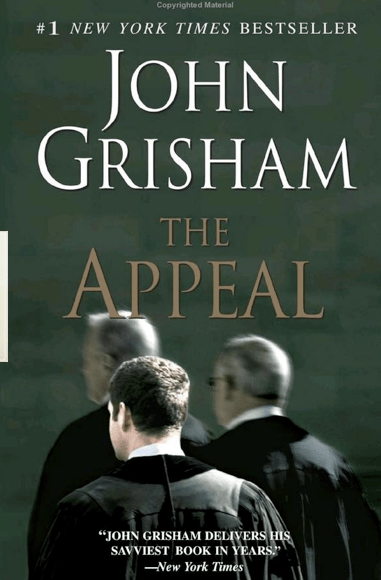
The Appeal is the exception. No one wins, not even the apparent winner, who sails off in the end with his empty, unsatisfying life. He schemes, he exploits, he lies, he buys elections, and he makes a fortune – and he isn’t satisfied. He is married to a woman who sounds more like a greyhound, all skin and bones and self-absorption.
The subject matter is a case where a chemical company has dumped toxic wastes into the ground in Mississippi, it has penetrated into the groundwater, and polluted the entire water system of a small fictional town. Two lawyers, married to one another, sacrifice everything and face bankruptcy to win a case for their client who has lost both husband and son to cancer caused by the toxic chemicals dumped. They win.
There is an appeal.
What this book is about isn’t just about groundwater contamination, or even about buying elections in Mississippi – it is an indictment of every state that elects judges. The core of the novel is about how big money, big corporations, pick candidates and fund them, legally and illegally, and insure that they win. They pack the courts with judges who are opposed to large settlements.
God bless John Grisham. With all his great legal thrillers, he has made a bundle and can take risks like writing a book like The Appeal, which should be an eye opener, and should be read by every caring citizen.
Judges should not be elected. When the judiciary are elected, they have to think about their next election, with every legal decision. It taints objectivity. It corrupts objectivity. It eliminates objectivity. Without an objective judiciary – why bother? They will always rule on the side whose interests are the most powerful and profitable.
Here are a couple quotes that tell you where the novel is going. My Kuwaiti friends are going to love this – I have taken so many shots at Kuwait corruption – so here it is, my friends, exposure of the institutionalized corruption in my country:
Barry laughed and crossed his legs. “We do campaigns. Have a look.” He picked up a remote and pushed the button, and a large white screen dropped from the ceiling and covered most of the wall, then the entire nation appeared. Most of the states were in green, the rest were in a soft yellow. “Thirty-one states are in the green. The yellow ones have the good sense to appoint their courts. We make our living in the green ones.”
“Judicial elections.”
“Yes. That’s all we do, and we do it very quietly. When our clients need help, we target a supreme court justice who is not particularly friendly, and we take him, or her, out of the picture.”
“Just like that.”
“Just like that.”
“Who are your clients?”
“I can’t give you the names, but they’re all on your side of the street. Big companies in energy, insurance, pharmaceuticals, chemicals, timber, all types of manufacturers, plus doctors, hospitals, nursing homes, banks. We raise tons of money and hire the people on the ground to run aggressive campaigns.”
* * * * * * * *
The Senator did not know who owned the jet, not had he ever met Mr. Trudeau, which in most cultures would seem odd since Rudd had taken so much money from the man. But in Washington, money arrives through a myriad of strange and nebulous conduits. Often those taking it have only a vague idea of where it’s coming from; often they have no clue. In most democracies, the transference of so much cash would be considered outright corruption, but in Washington the corruption has been legalized. Senator Rudd didn’t know and didn’t care that he was owned by other people. He had over $11 million in the bank, money he could eventually keep if not forced to waste it on some frivolous campaign. In return for such an investment, Rudd had a perfect voting record on all matters dealing with pharmaceuticals, chemicals, oil, energy, insurance, banks and on and on.
I like almost every book I read by John Grisham. He is a man with a conscience, and he is trying to raise our awareness of corruptive factors before our system goes entirely under. I couldn’t put this book down, and I can hardly wait to read the next one.
Recent Comments
intlxpatr on Shampoo Ginger tigerbutterya0c5ff1d… on Shampoo Ginger intlxpatr on British Soldier Kidnapped, Esc… John on British Soldier Kidnapped, Esc… intlxpatr on British Soldier Kidnapped, Esc… Wikipedia Donate Button

Amazina


Early Voting in Florida


