“Silver Lining of a Down Economy”
I found this in yesterday’s Seattle Times:
Highway crashes kill more than 41,000 in 2007
Traffic deaths in the United States declined last year, reaching the lowest level in more than a decade, the government reported Thursday.
By KEN THOMAS
Associated Press Writer
WASHINGTON —
Traffic deaths in the United States declined last year, reaching the lowest level in more than a decade, the government reported Thursday.
Some 41,059 people were killed in highway crashes, down by more than 1,600 from 2006. It was the fewest number of highway deaths in a year since 1994, when 40,716 people were killed.
The fatality rate of 1.37 deaths for every 100 million miles traveled in 2007 was the lowest on record, the National Highway Traffic Safety Administration said in its report.
“Thanks to safer vehicles, aggressive law enforcement and our efforts, countless families were spared the devastating news that a loved one was not coming home,” said Transportation Secretary Mary Peters.
California had the largest decline, 266 fewer fatalities than the previous year. The largest percentage decreases were in South Dakota and Vermont.
North Carolina’s death toll increased the most in the nation, up 121 over the previous year. The District of Columbia and Alaska had the highest percentage increases.
Motorcycle deaths increased for the 10th straight year. There were 5,154 motorcycle deaths last year, compared with 4,837 in 2006.
Peters, an avid motorcyclist who keeps a scuffed helmet in her office that she credits with saving her from a severe head injury in a 2005 crash, said the rise in motorcycle fatalities was disappointing. The increased deaths have come while the number of registered motorcycles have surpassed 6 million, compared with 3.8 million in 1998, and vehicle miles traveled have risen.
Peters said with higher fuel prices, more people may use motorcycles or scooters that can get 50 to 60 miles per gallon.
Transportation officials said they plan to target motorcycle drivers in a $13 million anti-drunk driving advertising campaign running during the upcoming Labor Day holiday. The department has also discussed new safety and training standards for novice riders, increased training for law enforcement and curbing counterfeit safety-labeling of helmets.
Still, safety officials said they were encouraged by the overall trends.
Fatalities in crashes that involved a driver or motorcycle rider with a blood-alcohol level of 0.08 percent, the legal limit, declined to just under 13,000 deaths in 2007, a 3.7 percent decrease.
Traffic injuries fell for the eighth straight year, to fewer than 2.49 million injuries in 2007, compared with 2.58 million in 2006. And the number of people killed in large-truck crashes fell by more than 4 percent.
Adrian Lund, president of the Insurance Institute for Highway Safety, said the sluggish economy was likely a factor in the declines.
He predicted that the combination of a slowing economy and gas prices approaching $4 a gallon throughout the U.S. could lead to further reductions in highway deaths in 2008. Many states have reported double-digit drops in fatalities during the first part of this year.
“Fewer highway deaths is always the silver lining of a down economy,” Lund said.
From the Arab Times – let’s hope this is also a silver lining:
350 motorists booked for not wearing seat belts, using phone while driving
Kuwait : During a crackdown on reckless motorists and traffic law violators, the Hawalli Traffic Department has Thursday issued 350 citations, reports Arrouiah daily. Upon instructions from Major-General Mahmoud Al-Dousari of the General Traffic Department, the Hawalli traffic police erected surprised checkpoints at entry and exit points throughout Hawalli and issued citations for motorists for not wearing seat belts, talking on the cell phone while driving and not complying with safety regulations. The source added the campaign will continue in various parts of the country to impose security and ensure compliance of traffic rules and regulations.
Superlative Day: Gone Fishing
I’ve had some great and memorable days in my life, and this is one of them. My good friend said “Hey, you want to go fishing Friday?” and I said “Yes!” I had to go get a one-day fishing license, and I could add crab for a mere 50 cents, so I did.
We met up at 6:30 a.m. and were on the water by 7 a.m. on one of the hottest day’s in Seattle’s summer. As we left the marina, we passed an Eagle. (We thought of you, AdventureMan!)

AdventureMan must have heard us talking about him, because as the sun rises, he calls from Kuwait, eating Felafel sandwiches and ice cream as we watch the sun rise:

And set the crab traps – this is what an empty crab trap looks like. We put turkey legs and old fish heads in the bait box to attract the crabs:

It is a gorgeous morning. As my friends dig out the fishing polls, I admire the mountains and the sparkles on the waters of Puget Sound:

My friend has baited my hook and hands the rod to me. I lower the weight to the bottom, pull it up just a little and – an immediate nibble:

He’s a good size and he’s a keeper. My friend grabs my camera to take my photo with my first fish of the day, I hold the fish up – and just as she is snapping the shot, the fish does a little flip right off the hook and back into the water!
It doesn’t matter – the fish are biting and we are hauling them in. Some are too small; we take them off the hooks and throw them back, telling them to have a good life, grow big and we will see them again, we hope!
After about an hour of superlative fishing, we go back to check the crab pots. They are HEAVY with crab!

You can’t keep any female crab, or any male under a certain size, so any crab you think you might want to keep, you have to measure. You get a HUGE fine if you are caught with undersize crab. As we bring in the crab and the fish, my friend notes them down on our licence records, which have to be sent in to the state at the end of the season, listing fish we have caught, crab we have caught, and how many we threw back.

We catch a couple rock crab – those you don’t have to measure, and you can keep. Most of what we catch is the sweet and delectable Dungeness Crab – my very favorite after Alaska King Crab.


We had just decided to quit for the day – it was getting really, really HOT for Seattle, like 90°F/33°C (and there is an advisory for hot weather, and air stagnation) and we have nearly our limit for crab, and a respectable amount of fish, and we are happy, happy fisherpeople! Just as I am about to raise my line, I get a big bite, and catch the last fish!

Here is our bucket, full of fish. The cooler is full of crab. What a great day to be alive.

It’s The Law
There is something about Oregon I love. I don’t know if this is true anywhere else in the country, but in Oregon, you are not allowed to pump your own gas. So when it is cold and rainy and foggy and drizzly, you can sit in your warm car and someone else fills up your tank.

Just like Kuwait!
I asked the very nice young man who filled my tank if people ever tip him, and he said “Some people do!” with a big smile. I was happy to tip him for filling my tank.

(I asked him if I could take his photo for my blog, and he said “sure” it was fine. )
Wooo Hoooo, Oregon!
Phones, Computers and Blackberries
You can hear his loud voice all through the lounge.
“You have my blackberry!” he says when someone answers the phone. “I left it in the restaurant. How can I get it back?” (pause) “I’m in the lounge.”
Within minutes, two security men are in the lounge, checking his ID and handing over his blackberry.
“We had a difficult time trying to find you, sir,” says the polite, but firm, security guy, in a loud, carrying voice. “Let me make a suggestion that will make your life easier if you ever lose it again. In your contacts, put YOUR name first. You can put two spaces before your last name, and then your last name will be at the head of the list. That is the smartest way to make sure people can return your lost electronics.”
I look around. Half the people in the lounge are quickly inputting their names, with two spaces, into their phones, computers and personal data devices.
Georgia Man Kills Daughter for Honor
This is a sad story. When police arrested him, you get the impression he was really sad he did it, and caught up in something he regretted.
Georgia Man Charged in ‘Honor Killing’
CNN
Posted: 2008-07-08 22:21:56
Filed Under: Crime News, Nation News
ATLANTA (July 8) – A Pakistani man is charged with killing his 25-year-old daughter in Georgia because she wanted out of an arranged marriage, police said.
Chaudhry Rashid, 54, of Jonesboro, an Atlanta suburb, appeared in court Tuesday afternoon to face murder charges in the death of Sandeela Kanwal, according to court records.
He was arrested early Sunday, after his wife called police at about 2 a.m. She reported that she had been awakened by screaming but couldn’t understand the language, a Clayton County police report said. She said she was afraid and left the house to call police.
Officers found Kanwal dead in an upstairs bedroom of the home, according to the police report.
Rashid’s wife told authorities Kanwal recently had been married in Pakistan — an arranged marriage, she said. The young woman’s husband was living in Chicago, Illinois, police said, but Kanwal remained at her father’s home and worked at a metro Atlanta Wal-Mart for a brief time.
You can read the rest of the story on AOL News by clicking here.
The Wire, Season 4
This show, The Wire, is one of our all time favorites, all the more so because our son also loves this show and passes along the entire season when he has finished watching.
Season 4 is the very best so far. The major theme is a subject near and dear to my heart – the schools, keeping kids in school, and trying to find ways to help them learn. Two former policemen end up in Tilghman Middle School, working with the poorest kids in the Baltimore school system.
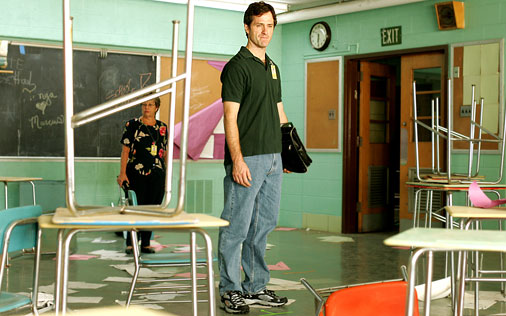
First, you need to know that teaching middle school is the stuff of heroes. At very best, middle school kids are dealing with those raging hormones of adolescence. They can’t sit still. They are so full of energy, and sitting and reading is the last thing they want to do.
New teacher “Prez” suffers total loss of control over his class on his first day, but slowly finds ways to engage their attention – such as teaching them to use math to figure odds rolling dice. Once they understand the value of the new information, they are enthusiastic learners . . . or at least, they co-operate with the boring stuff because he finds ways to reward them with interesting information, relevant to helping them cope with their lives. The teachers learn from the students – to keep it real, keep it relevant.
The teachers in Tilghman Middle School are HEROES. Most of the children they deal with have huge problems outside the school, poverty being the smallest of the problems. For many, their parents are their worst problems, literally stealing the food out of their mouths for another fix. The kids bring their baggage into the schools every day, their anger, their acting out. The teachers have to be a mix of tough, compassionate and flexible. They know they are going to lose some of them, and they have to keep on, hoping a few will make it. It is truly a war zone, and the teachers are the stand-up soldiers in this season.

We follow a tough race for the Mayor’s office, the rise of a drug lord, two stone-cold killers who figure out how to “disappear” their victims, and one very clever schemer who manages to pull off a major drug heist, and then sells the product back to his victims. It’s an amazing show.
If you follow this season via DVD, choose to use the subtitles. A lot of the language is slang, much of it is street talk, mumbled, garbled – real speech. It helps to use the subtitles.
BBC 9-11 Third Tower
I am not much on conspiracy theories. This is on today’s BBC – a slow Saturday, I don’t imagine it will get a lot of attention.
9/11 third tower mystery ‘solved’ |
|
|
|
The final mystery of 9/11 will soon be solved, according to US experts investigating the collapse of the third tower at the World Trade Center.
The 47-storey third tower, known as Tower Seven, collapsed seven hours after the twin towers.
Investigators are expected to say ordinary fires on several different floors caused the collapse.
Conspiracy theorists have argued that the third tower was brought down in a controlled demolition.
Unlike the twin towers, Tower Seven was not hit by a plane.
The National Institute of Standards and Technology, based near Washington DC, is expected to conclude in its long-awaited report this month that ordinary fires caused the building to collapse.
That would make it the first and only steel skyscraper in the world to collapse because of fire.
The National Institute of Standards and Technology’s lead investigator, Dr Shyam Sunder, spoke to BBC Two’s “The Conspiracy Files”:
“Our working hypothesis now actually suggests that it was normal building fires that were growing and spreading throughout the multiple floors that may have caused the ultimate collapse of the buildings.”
‘Smoking gun’
However, a group of architects, engineers and scientists say the official explanation that fires caused the collapse is impossible. Architects and Engineers for 9/11 Truth argue there must have been a controlled demolition.
 |
The founder of the group, Richard Gage, says the collapse of the third tower is an obvious example of a controlled demolition using explosives.
“Building Seven is the smoking gun of 9/11… A sixth grader can look at this building falling at virtually freefall speed, symmetrically and smoothly, and see that it is not a natural process.
“Buildings that fall in natural processes fall to the path of least resistance”, says Gage, “they don’t go straight down through themselves.”
Conspiracy theories
There are a number of facts that have encouraged conspiracy theories about Tower Seven.
- Although its collapse potentially made architectural history, all of the thousands of tonnes of steel from the skyscraper were taken away to be melted down.
- The third tower was occupied by the Secret Service, the CIA, the Department of Defence and the Office of Emergency Management, which would co-ordinate any response to a disaster or a terrorist attack.
- The destruction of the third tower was never mentioned in the 9/11 Commission Report. The first official inquiry into Tower Seven by the Federal Emergency Management Agency was unable to be definitive about what caused its collapse.
- In May 2002 FEMA concluded that the building collapsed because intense fires had burned for hours, fed by thousands of gallons of diesel stored in the building. But it said this had “only a low probability of occurrence” and more work was needed.
But now nearly seven years after 9/11 the definitive official explanation of what happened to Tower Seven is finally about to be published in America.
The National Institute of Standards and Technology has spent more than two years investigating Tower Seven but lead investigator Dr Shyam Sunder rejects criticism that it has been slow.
My comment:
If you go to the BBC News Link (this if filed under Conspiracies) you can watch a video of the third tower going down. It looks pretty controlled to me, too.
Khadra and The Swallows of Kabul

While waiting for our luggage to be offloaded, we were passing time, visiting with our greeter / expediter, asking about his family, his life in Zambia.
“How does this work, travelling with your son and your daughter-in-law?” he asked us. “Do you like her?”
Nothing on earth could disguise the delight on our faces as we both said “Yes!” We truly adore her.
When our son was only seven years old, a Christian speaker passing through said that if you have children, it is likely that their mates have also been born, so to start praying now for the unknown mate your child would choose, and we did.
When our son called us from university, and told us there was someone he wanted us to meet at graduation, and graduation was still months away, we knew, we just knew, that this might be THE ONE.
We were so delighted when we met her, we liked her immediately. What parent isn’t happy to see his/her son/daughter happy, and choosing well?
“But!” our meeter/greeter added, “how do you like her family?”
And we laughed again! We love her family! Her father is smart and very funny, and her mother is kind and practical, and we all share the same values on family and friends and living our lives. She comes from a large rowdy family that gathers when they can, and so do we.
And YOU are thinking “what does all this have to do with The Swallows of Kabul?” but I am getting there.
On the trip, we all had books for our quiet time, and I could see EnviroGirl deeply engrossed in this book. When I asked her, she said she had gotten it from her father’s wife, a woman with whom I often talk books, and that she (EnviroGirl) was trying to finish it so that she could leave it with me.
And thank goodness that she did! I couldn’t put it down!
First, you think it is written by Yasmina Khadra, but that is a pseudonym. The real author, Mohammed Moulessehoul, was Algerian army officer, and he used the pseudonym to avoid having to submit the manuscript for approval by military authorities. That got my attention right away.
The book is about Taleban era Afghanistan, and starts out with utter hopelessness, describing the deterioration in life brought about by the arbitrary imposition of religious rule, as interpreted by men who have memorized the Qur’an, but have a poor understanding of what they have memorized. Women lead a dismal, limited life, at the mercy of men who treat them as detestable if they are seen in public, even totally cloaked.
His language is beautiful, poetic and compelling, even describing despair and desolation.
We meet two couples, Atiq, a jailer, and his wife, Musarrat, who risked her own life to save his life back when he was seriously wounded and left for dead, and Mohsen, former member of a moderately successful merchant family, married to the love of his life, Zunaira, who is beautiful, educated and from a wealthy background. These men love their wives, and have a strong, genuine connection to them. Their ability to maintain that connection, and to stay connected to their own values, withers in the dry, dusty context of fundamentalist rule.
Their lives and relationships have been changing gradually, increasingly limited and undignified under the stress of Taleban rule, and the novel follows a rapid spiral of deterioration and folly. The steady decline of their lives speeds when Mohsen makes a terrible impulsive decision, has to live with the consequences, and confesses to his wife.
Atiq, too, faces dismal consequences. Even though we know he is limited, he becomes a sympathetic character. His hardness of heart covers a genuine grief that his wife is dying, and he can do nothing to stop it, nor to alleviate her pain.
We all face hard times. In our family, when someone lashes out unjustly, we often ask “is it something I have done, or am I just the nearest dog to kick?” It always gets a laugh, and it puts things back in perspective, puts us on the same side. Sometimes we can’t always vent our frustrations against those people or events creating the frustration, so we take it out on those we love – and who love us. It’s not right, it’s not fair or just, but it is very human, and once you get that out on the table, it is easier to discuss the real issue.
When Zunaira ends up in jail, Atiq’s world is shattered as if by an earthquake – the earth moves under his feet, all his understanding of life is shaken.
“As he cleans up, he cautiously lifts his eyes to the roof beam looming over the cell like a bird of evil augury, and his gaze lingers on the anemic little lightbulb, growing steadily dimmer in its ceiling socket. Screwing his courage to the sticking point, he walks back to the lone occupied cell, and there, in the very middle of the cage, the magical vision: the prisoner has removed her burqa! She’s sitting cross-legged on the floor. Her elbows are on her knees, her hands are joined under her chin. She’s praying. Atiq is thunderstruck. Never before has he seen such splendor. With her godess’s profile, her long hair spread across her back, and her enormous eyes, like horizons, the condemned woman is beautiful beyond imagination. She’s like a dawn, gathering brightness in the heart of this poisonour, squalid, fatal dungeon.
Except for his wife’s, Atiq hasn’t seen a woman’s face for many years. He’s even learned to live without such sights. For him, women are only ghosts, voiceless, charmless ghosts that pass practically unnoticed along the streets; flocks of infirm swallows – blue, yellow, often faded, several seasons behind – that make a mournful sound when they come into the proximity of men.
And all at once, a veil falls and a miracle appears. Atiq can’t get over it. A complete, solid woman? A genuine tangible woman’s face, also complete, right here in front of him? He’s been cut off from such a forbidden sight for so long that he believed it had been banished even from people’s imaginations. . . ”
Atiq has a friend, Mirza, who thrives under Taleban rule, as a soldier, and also running illegal businesses highly profitable under the current regime. He encourages Atiq to abandon his cancer-striken wife, to get rid of her and to find a fresh, young wife. He offers Atiq shady business opportunities, and tells him a wise man bends with the wind. Ignorance and chaos benefit Mirza, and he has no wish to see the good old days return.
In spite of the bleakness, the desolation, the crushing arbitrariness and inhumanity, there is hope, love, and compassion in a thin, steady stream throughout the book.
Once I started reading, I had to finish. It was a great book for the long trip back to Kuwait, one I am eager to pass along to the next avid reader.
Japan, Seeking Trim Waists, Measures Millions
This article, from The New York Times (you can read the entire article by clicking here) gives me a big grin.
I can’t imagine American lining up because the government says we will have our waists measured, and be expected to meet a certain standard or lose weight and be penalized. Can you imagine Kuwaitis allowing the government to tell them how big their waists can be?
Japan is one of the most law-abiding nations on earth – I guess you have to be, when you have so many people occupying so little space. When you think of the Japanese, you think of politeness, courtesy. Outbreaks of rage are an anomoly.
And the government is right – obesity causes more and more expense down the road because it exacerbates other conditions. But someone’s weight is a very personal thing!
By NORIMITSU ONISHI
Published: June 13, 2008
A poster at a public health clinic in Japan reads, “Goodbye, metabo,” a word associated with being overweight. The Japanese government is mounting an ambitious weight-loss campaign.
Summoned by the city of Amagasaki one recent morning, Minoru Nogiri, 45, a flower shop owner, found himself lining up to have his waistline measured. With no visible paunch, he seemed to run little risk of being classified as overweight, or metabo, the preferred word in Japan these days.
But because the new state-prescribed limit for male waistlines is a strict 33.5 inches, he had anxiously measured himself at home a couple of days earlier. “I’m on the border,” he said.
Under a national law that came into effect two months ago, companies and local governments must now measure the waistlines of Japanese people between the ages of 40 and 74 as part of their annual checkups. That represents more than 56 million waistlines, or about 44 percent of the entire population.
Those exceeding government limits — 33.5 inches for men and 35.4 inches for women, which are identical to thresholds established in 2005 for Japan by the International Diabetes Federation as an easy guideline for identifying health risks — and having a weight-related ailment will be given dieting guidance if after three months they do not lose weight. If necessary, those people will be steered toward further re-education after six more months.
To reach its goals of shrinking the overweight population by 10 percent over the next four years and 25 percent over the next seven years, the government will impose financial penalties on companies and local governments that fail to meet specific targets. The country’s Ministry of Health argues that the campaign will keep the spread of diseases like diabetes and strokes in check.
The ministry also says that curbing widening waistlines will rein in a rapidly aging society’s ballooning health care costs, one of the most serious and politically delicate problems facing Japan today. Most Japanese are covered under public health care or through their work. Anger over a plan that would make those 75 and older pay more for health care brought a parliamentary censure motion Wednesday against Prime Minister Yasuo Fukuda, the first against a prime minister in the country’s postwar history.
Jody Shields and The Fig Eater
This is one of those books I picked up off the staff recommendations shelf at Barnes and Noble – one of the very best sources for cult classics like Wicked: The Life and Times of the Wicked Witch of the West, books that don’t get a lot of press hype but whose readership grows slowly by word-of-mouth.
The cover caught my eye. This woman is dressed modestly enough, all the important parts are covered, but look at her eyes – there is a sultriness there, and a challenge that I find intriguing. This shows signs already of being an-out-of the-ordinary book.

The book opens in the early 1900’s with a murder. We follow the investigations of the chief Inspector, and we follow the parallel investigations of his wife, a Hungarian, Erszebet, and her ally, the English Wally. It’s a mystery, and in this exquisite book, the process of solving the mystery is so much more interesting than who actually did it, or even why.
The most fascinating character in The Fig Eater is the nature of fin de siecle Vienna, it’s customs, it’s caste system, it’s manners, and the fusion of East and West. Entire meals are described, cafe’s, cakes, cooking methods. Clothing is described in loving detail, and we visit a tuburculosis sanitarium as well as an insane asylum.
We study Kriminalistics with the Inspector and his assistant, we learn the fundamentals of early photography from an three fingered photographer. We experience early Viennese medical practices.
We learn all kinds of Hungarian superstitions and beliefs, we dance at the Fasching Balls of Vienna, and we simmer with the repressed sexuality of the times. We mourn with the bereaved, we shiver in the cold winter, and we steam in the brutal heat of an extended summer.
The end is so totally unexpected that I had to go back and read it again. My bet is, that if you accept the challenge of reading this book, you will have to, too. Even after you have read it again, you will not be totally sure what has happened, and yet . . . it is a satisfying ending.
This was a wonderful read.
I will leave you with a quote:
The Inspector has always prided himself on his ability to listen, as a good Burger is confident of his business acumen. During interrogations, he can distinguish the different qualities of the witnesses silence, as if it were a tone of voice.
He had admonished Franz more than once for interrupting him. Don’t be so hasty. Slow down and listen. In the Pythagorean system, disciples would spend five years listening before they were allowed to ask a single question. That was in the 4th Century BC. Another philosopher, Philo of Alexandria, wrote about Banquets of Silence, where even the correct posture for listening was determined.
In Kriminalistic there is a text on the subject. He orders Franz to read it as part of his lesson. “To observe how the person question listens is a rule of primary importance, and if the officer observes it he will arrive at his goal more quickly than by the hours of examination.”
Recent Comments
intlxpatr on Shampoo Ginger tigerbutterya0c5ff1d… on Shampoo Ginger intlxpatr on British Soldier Kidnapped, Esc… John on British Soldier Kidnapped, Esc… intlxpatr on British Soldier Kidnapped, Esc… Wikipedia Donate Button

Amazina


Early Voting in Florida


