Security Check
I’ve never seen this before in the United States. We used to go through checks like this in Germany, in Doha, in Kuwait, but not in the United States. This trip, we went through several, all across our southern border.
All the trucks, and all the cars, pulled over to go through security checks, dogs sniffing the cars, men going through an entire truck here and there, or having a family stand to one side as they thoroughly inspect the car.
I love our retired military id’s.
The sign on the left tells us they have caught more than 7,000 illegal immigrants so far this year, and have confiscated more than 12,000 something. . . dollars worth of goods? Individual goods, like cars? I know if you get caught doing something illegal, you lose your property, even if it is a car or a house.
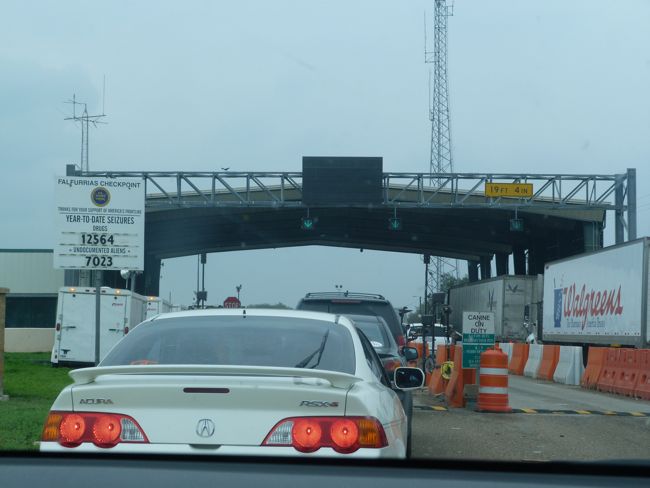
Homeland Security: Your Tax Dollars At Work
This is a difficult post to write. I’m a patriot. We served our country many years, Cold Warriors. We believe in the United States of America.
What I saw on our southernmost border on the Rio Grande makes me uncomfortable. We have put a lot of money into making sure illegal aliens don’t get through.
I can see a lot of good reasons for good border security. And having said that, what I saw stepped right over the line of “good border security” and teetered precariously on “oppressive.”
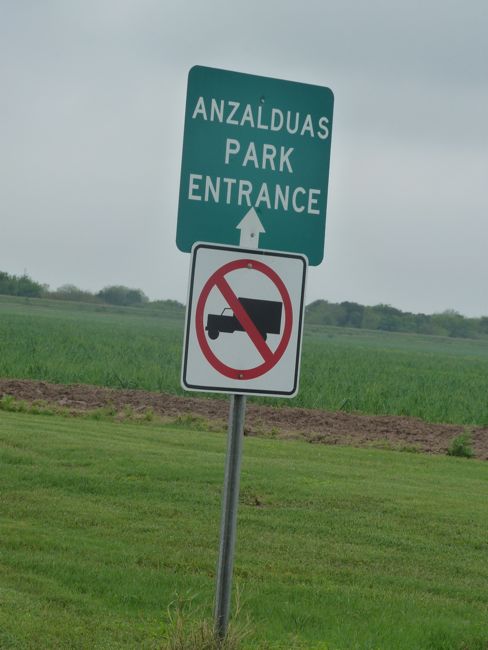
One of the Benson-Rio Grande Valley Park employees told us that if we want to see the Rio Grande, go to (some restaurant that has a view of the Rio Grande) or to this County Park called Anzalduas Park, and he told us how to get there. We drove and drove, couldn’t find it, but there was a cop parked on the road, so we asked him and he told us we were almost there.
As we reached Anzalduas Park (which is right under the Anzalduas Bridge, which goes over into Mexico; no, we didn’t have our passports, so we didn’t cross, maybe next time) and approached the park, it was a very odd park. It’s all excavated out, with a very very bare landscape, and some steep climbs. At the gate are some really heavy duty sliding guard gates. It’s not a very welcoming park.
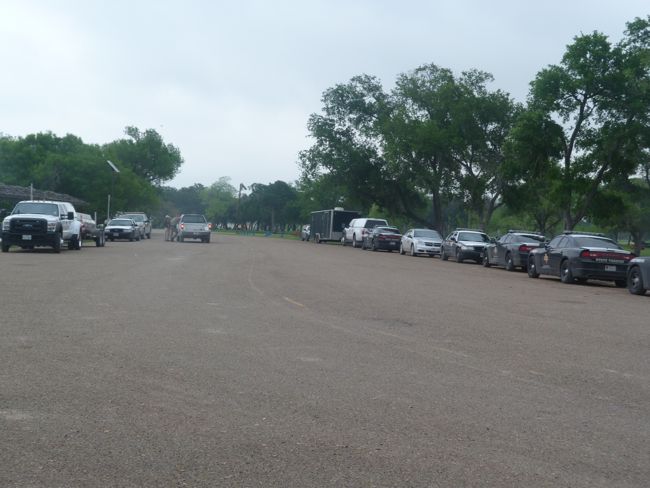
We got down into the park, drove down to the boat landing, and there were about twenty cars parked there, and they were all security vehicles. There was a big party going on, it was a Friday and some families and children were playing and the loudspeaker was all in Spanish. I couldn’t see any Homeland Security guards, only the cars, maybe the guards were sitting inside. Maybe they were at the party 🙂

The Park employee at Benson – Rio GRande Valley Park had told us that on weekends, across the Rio Grande, is a swim club, and the Mexicans are swimming all the time, just feet away from the American side, but there are all these signs saying the waters are dangerous. The waters seemed very calm, but sometimes there are dangers that are not so obvious.

That’s just a lot of cars providing border security in this park.
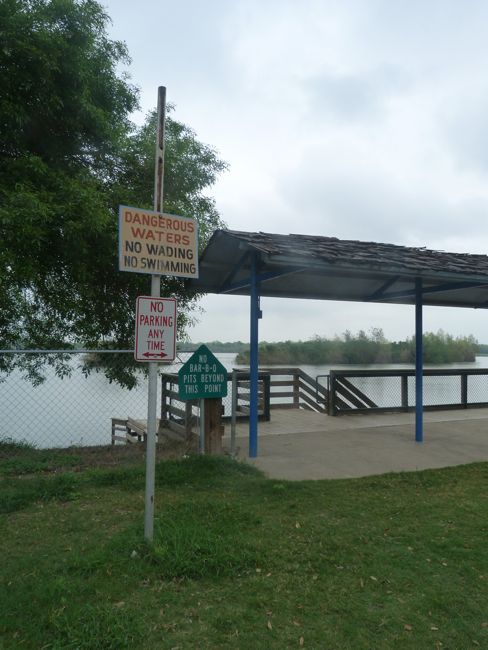

You can see the Mexican side swimming club; just yards across a very narrow Rio Grande:
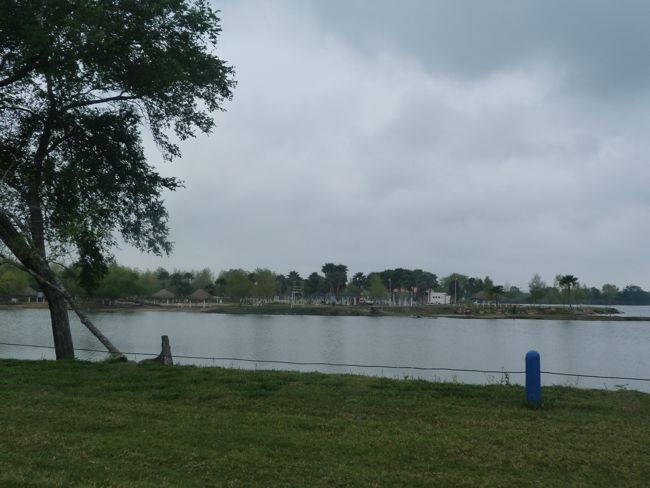
Here is another view of those heavy gates that bar the park in off hours.

We had been told this is a very popular park, full of people all the time. I am glad to hear it, glad that people are not intimidated, and use this beautiful little park for parties and celebrations, just as we use parks all over the USA.
The Hunting Ground: Campus Rape Victims Speak Out in New Movie
From AOL News via Sports Illustrated
When I lived in Kuwait and Qatar, I was appalled by the way rapes were treated, it was like this huge wave of abductions and violations, and nothing was done. As it turns out, things are changing a lot slower in my own country than I thought. This new film, The Hunting Ground, is by the same person who documented violence and rape in the US military, spurring then Secretary of Defense Leon Panetta, a truly decent man, to put the fear of God into the military leaders who were covering up the many rapes and blaming the victims. We have the same problem on college campuses.
There is only one cure. We have to raise our sons to respect women. We have to continue raising the bar for equality in our country until women have equal access to jobs, health treatment, legal proceedings, etc. Films like The Hunting Ground are painful, and at the same time, help us to face, and to overcome our societal short comings.
I love it that this film is “giving voice to those who have no voices;” that these courageous women speaking out have bravely named their rapists and described their circumstances. It can’t be comfortable, but it is their right. I am proud that they are not intimidated by fear of the ‘blame the victim’ mentality they have endured on their college campuses. When did colleges and universities begin placing money-making and winning teams before the well-being of their students?
New film gives chilling account of sexual assault on college campuses
Sexual assaults on college campuses have reached alarming levels and the issue has drawn the attention of Congress and even President Obama himself. The latest research indicates that one in five college women will be sexually assaulted and as many as 90% of reported assaults are acquaintance rapes. It is believed that more than 100,000 college students will be sexually assaulted during the current school year. Nowhere is the deck stacked more against sexual assault victims than in college athletics. In just the last few years alone there have been cases at Florida State, Michigan, Oregon, Vanderbilt andMissouri.
All of this is a backdrop to a harrowing new film that premiers in theaters on Friday in New York City and Los Angeles. The Hunting Ground is a jarring exposé that shines a bright light on the epidemic number of sexual assaults taking place on college campuses each year.
The Hunting Ground features a group of survivors who faced harsh retaliation and harassment for reporting that they had been raped. The film focuses on institutional cover-ups and the brutal backlash against survivors at campuses such as Harvard, Yale,Dartmouth, the University of North Carolina at Chapel Hill, USC and the University ofCalifornia-Berkeley, among others.
Some of the most vexing stories featured in the film involve women who were assaulted by athletes. While The Hunting Ground isn’t all about sports, the most dramatic moment in the film occurs two-thirds of the way through when the woman who accused former Florida State quarterback Jameis Winston—who after a strong showing in last week’s Combine is projected by many to be the No. 1 pick in this spring’s NFL draft—appears and tells her story publicly for the first time. The woman, who is named in the film but SI.com has chosen to protect her identity, is shown on camera and gives her life-changing account of what she says happened the night in December 2012 she left a Tallahassee bar with Winston.

A high school honor student who planned to attend medical school, the woman is articulate and attractive. She looks like the girl next door, a person you would trust to babysit your children. It is uncomfortable to watch—yet impossible to look away—when she describes being beneath Winston on his bathroom floor, repeatedly telling him “no” before being physically overpowered.
“We’re grateful it’s the first time people will get to hear [her] story,” said The Hunting Ground director Kirby Dick. “It’s her first-hand testimony. Up to this point it hasn’t been in a public space.”
The woman’s parents also appear in the film. Her father talks about driving to Tallahassee Memorial Hospital with his wife to be with their daughter hours after the incident.
There is nothing easy about retelling these stories for the world to see. But the attorney for the woman who says she was raped by Winston, John Clune, said his client decided to break her silence in the film because she felt it was the right venue to tell her story.
“The film was a once-in-a-lifetime opportunity,” Clune said. “The work by these filmmakers is nothing less than groundbreaking. It took tremendous courage, but our client and all of the incredibly brave women in the film have advanced the cause of rape survivors everywhere.”
The Hunting Ground also examines a sexual assault accusation against a Notre Damefootball player in 2010. Tom Seeberg, whose daughter committed suicide after she says she was sexually assaulted by a Fighting Irish starter, tells a heartbreaking account of school officials thwarting the investigation into his daughter’s complaint. A former Notre Dame police officer reveals that he and his colleagues were not allowed to approach or question an athlete on athletic properties.
The film also mentions rape cases involving football players at Missouri and Vanderbilt, as well as basketball players at Oregon.
The testimonials of rape survivors are wrapped between raw footage that is both gut-wrenching and disturbing. A small mob of unruly fraternity pledges at Yale are captured on film outside a freshman dorm for women, chanting: “No means yes. Yes means anal.” All the while a guy with a bullhorn is shouting: “Louder.”
In another scene we see drunken frat boys spilling out of a house where there is a sign out front that says: “THANKS FOR YOUR DAUGHTERS.” It’s enough to outrage any parent with a daughter heading off to college.
The film is directed by Dick and produced by Amy Ziering, the team behind the Oscar-nominated film The Invisible War, which revealed systemic sexual assaults and cover-ups within the U.S. military. That movie prompted Secretary of Defense Leon Panetta to announce significant policy changes and inspired the passage of the Military Justice Improvement Act.
Dick and Ziering started looking into the situation on college campuses shortly after the release of The Invisible War. “We were astonished that the problem was as serious in higher education as it was in the military,” Dick said.
Full disclosure: I appear in The Hunting Ground as an expert. Two of the cases in the film—Lizzy Seeberg’s alleged assault at Notre Dame and running back Derrick Washington’s sexual assault of a student at the University of Missouri—are featured in my book The System: The Glory and Scandal of Big-Time College Football, which I wrote with 60 Minutes correspondent Armen Keteyian.
Some of my research is also featured in the film, including the statistic that student-athletes are responsible for 19% of the reported sexual assaults on campus, despite the fact that they comprise just 3.3% of the male student population. Those figures arose from a first-of-its-kind study I conducted with researchers at the University of Massachusetts in the mid-90s when we were granted access to judicial affairs records and police reports at colleges across the country.

Over the past 20 years I have researched hundreds of cases of sexual assault involving athletes. During that time I’ve interviewed countless sexual assault victims. The thing I found most telling was what prosecutor Willie Meggs did not say in the film. Meggs was asked if he thought a rape took place in Winston’s apartment. It was a perfect opportunity for the man who chose not to prosecute Winston to say no. Instead, he said something “bad” happened in that apartment that night. He just didn’t have sufficient evidence to prove it.
That’s not unusual. That’s typical. Only about 20% of rapes reported to the police in the U.S. are prosecuted. Yet at least 92% of reported sexual assault claims are found to be true. The problem is that date rape cases are very difficult to prove beyond a reasonable doubt, especially when alcohol is involved and the incident occurs in the perpetrator’s apartment, dorm or hotel room. The doubts raised by those factors are amplified when the accused is a star athlete.
The greatest achievement of The Hunting Ground is that it empowers rape victims to team up with each other and come forward. It’s fair to say that for the first time in many years, women like Jameis Winston’s alleged victim have powerful allies.
By the time the NFL draft takes place in May, the film will be in theaters around the country, the name of Winston’s accuser will be everywhere and more details about the night in question will likely come out. All of this brings to mind the legal maxim caveat emptor, which essentially is a warning that means let the buyer beware.
Jason Licht, the general manager for the Tampa Bay Buccaneers, ultimately has to decide whether to use the first pick on Winston. He’s on record saying: “This is the most important pick, potentially, in the history of the franchise.”
Memo to Licht: Watch The Hunting Ground.
The ramifications in this instance are equally big for the NFL, whose image took a beating over the last year after Ray Rice was caught on tape knocking out his then-fiancé in an elevator. The controversy erupted after Commissioner Roger Goodell imposed a two-game suspension without bothering to obtain and watch the video.
Memo to the Commissioner: Watch The Hunting Ground.
No matter what happens with Winston, the film succeeds in its main goal: to shine a light on sexual assault on college campuses. It’s an important issue that isn’t going away, and if something drastic isn’t done immediately, it will only get worse.
Jeff Benedict is a lawyer and has written five books on athletes and violence against women, including Public Heroes, Private Felons: Athletes and Violence Against Women, and Out of Bounds: Inside the NBA’s Culture of Rape, Violence and Crime.
Houston Backlog of 6,663 Rape Kits Tested, Resulting in 850 DNA Hits
In the category of ‘you can run, but you can’t hide’ is the fact that hundreds, thousands of rape kits have gone untested in police departments all over the United States. Too expensive, or so they say, to process them all, but the force of public opinion is relentless, and the result is that some of these kits are finally producing results and convictions that, at long last, give the rape victims some satisfaction.
I worked with one of the very first Rape Crisis Lines, back in the beginning when it was all new, in, of course, California. We worked with the victims, but we also worked with emergency workers and with police. It was a team. Most of the police I worked with were merciful and compassionate, but there are other places where the police culture is harsh, and rape victims are not well-treated. There are still those people who believe that somehow a victim asked for it in some way.
I learned some surprising things as I worked with the victims. I learned how strong and how smart victims (they’re not all women) can be. They did what they had to do to stay alive, and they memorized everything they could to be able to tell the police. Many made it a point to leave DNA in the car, or to save the rapist’s DNA. It was less about the physical violation than finding oneself in a position of utter powerlessness, and not knowing if you were going to survive. I didn’t pity the victims; I admired their courage and resilience.
JUAN A. LOZANO, Associated Press
HOUSTON (AP) — Evidence from more than 6,600 rape kits that went untested for years in Houston have turned up 850 hits in the FBI’s nationwide database of DNA profiles, marking a major step in the city’s $6 million effort to address the backlog, officials announced Monday.
Charges have been filed against 29 people, six of whom have been convicted, since the city launched an effort in 2013 to test 6,663 rape kits — some of which dated back nearly three decades. Testing was completed in the fall, and the results have now been uploaded to a database used by investigators nationwide to compare DNA profiles of possible suspects, Mayor Annise Parker said.
“This milestone is of special importance to rape survivors and their families and friends because it means their cases are receiving the attention they should have years ago,” Parker said at a news conference, where she joined local law enforcement officials to announce the results.
Police are continuing to review the matches to see if charges can be filed in other cases. In the cases where prosecutors have won convictions, defendants have received sentences ranging from 2 to 45 years in prison. One case was dismissed after the victim decided not to pursue the case.
Rape kits include biological samples and physical evidence gathered from sexual assault victims that are later processed to see if they match a suspect’s DNA. Testing results are uploaded to the FBI’s Combined DNA Index System, or CODIS.
Harris County District Attorney Devon Anderson said there were some cases where suspects committed other crimes while rape kits that could have identified them sat untested.
“Now that the testing of these kits is complete, we know that it’s up to us to finish the job and to seek justice for these victims. The ball is in our court and we will do our best to put the people who are responsible for these heinous crimes behind bars for as long as possible,” she said.
Experts say Houston’s backlog — and similar backlogs in other U.S. cities — are due in part to the high cost of testing which can run from $500 to $1,000 per kit, though advocates argue that the lack of testing signals that sex crimes haven’t always been law enforcement priorities.
More than 12,000 kits went untested for years in Memphis, Tennessee, which is facing a lawsuit from rape victims as it tries to test the kits. In Detroit, prosecutors discovered more than 11,000 rape kits in an abandoned police warehouse in 2009, and Cleveland prosecutors have sent their entire 4,700-kit backlog for testing.
“This is not a Houston problem. It’s not a Texas problem. It’s a nationwide issue that built up over years and years,” Parker said.
___
Follow Juan A. Lozano on Twitter at http://www.twitter.com/juanlozano70
Saudi Blogger Flogged 50 Times For Criticizing Muttawa
This man, a father of three, had the nerve to criticize the arbitrary morality police in Saudi Arabia. He wasn’t criticizing Islam; he was criticizing the ignorance and irregular actions of the muttawa. When flogged, he did not make a peep. Another blow to freedom of speech.
Witness: Convicted Saudi blogger flogged in public 50 times
AYA BATRAWYJan 9th 2015 2:08PM
DUBAI, United Arab Emirates (AP) – A Saudi blogger convicted of insulting Islam was brought after Friday prayers to a public square in the port city of Jiddah and flogged 50 times before hundreds of spectators, a witness to the lashing said.
The witness said Raif Badawi’s feet and hands were shackled during the flogging but his face was visible. He remained silent and did not cry out, said the witness, who spoke to The Associated Press on condition of anonymity fearing government reprisal.
Badawi was sentenced last May to 10 years in prison and 1,000 lashes. He had criticized Saudi Arabia’s powerful clerics on a liberal blog he founded. The blog has since been shut down. He was also ordered to pay a fine of 1 million riyals or about $266,600.
Rights activists say Saudi authorities are using Badawi’s case as a warning to others who think to criticize the kingdom’s powerful religious establishment from which the ruling family partly derives its authority.
London-based Amnesty International said he would receive 50 lashes once a week for 20 weeks. Saudi Arabia’s close ally, the United States, had called on authorities to cancel the punishment.
Despite international pleas for his release, Badawi, a father of three, was brought from prison by bus to the public square on Friday and flogged on the back in front of a crowd that had just finished midday prayers at a nearby mosque. His face was visible and, throughout the flogging, he clenched his eyes and remained silent, said the witness.
The witness, who also has close knowledge of the case, said the lashing lasted about 15 minutes.
Badawi has been held since mid-2012 after he founded the Free Saudi Liberals blog. He used the blog to criticize the kingdom’s influential clerics who follow a strict and ultraconservative interpretation of Islam known as Wahhabism, which originated in Saudi Arabia.
He was originally sentenced in 2013 to seven years in prison and 600 lashes in relation to the charges, but after an appeal, the judge stiffened the punishment. Following his arrest, his wife and children left the kingdom for Canada.
Rights groups argue that the case against Badawi is part of a wider crackdown on freedom of speech and dissent in Saudi Arabia since the 2011 Arab Spring uprisings. Criticism of clerics is seen as a red line because of their prestige in the kingdom, as well as their influential role in supporting government policies.
According to Amnesty, the charges against Badawi mention his failure to remove articles by other people on his website. He was also accused in court of ridiculing Saudi Arabia’s morality police.
In a statement after the flogging, Amnesty called the flogging a “vicious act of cruelty” and said that Badawi’s “only ‘crime’ was to exercise his right to freedom of expression by setting up a website for public discussion.”
State Department spokeswoman Jen Psaki has called the punishment an “inhumane” response to someone exercising his right to freedom of expression and religion.
In New York, Farhan Haq, deputy spokesman for the U.N. secretary-general, told reporters on Friday that the U.N. human rights office was “very concerned about the flogging” and that it has previously raised concerns about harsh sentences in Saudi Arabia for human rights defenders.
___
Associated Press writer Cara Anna contributed to this report from the United Nations.
Freedom of Speech: Je Suis Charlie
In our country, in the West, open discussion is a part of life. Your point of view may be ignorant, or repugnant to me, but I will defend to the death your right to express your opinion. One of the great weapons of freedom of speech is humor. It’s hard to maintain a dignified moral high-ground when one of the cartoonists piques with a cartoon showing the emperor has no clothes. Or at least the emperor has flaws, as do we all.
Pensacola is blessed with such an editorial cartoonist, Andy Marlette. Andy Marlette is controversial, and in a state with lax gun laws and pistol-packin-mamas, he risks his life daily, skewering the pomposity of us all. Occasionally, he is outrageous. Occasionally, he is offensive. That’s OK. If an editorial cartoonist isn’t skewering someone, or all of us at once, he isn’t doing his job. His job is to elicit discussion.

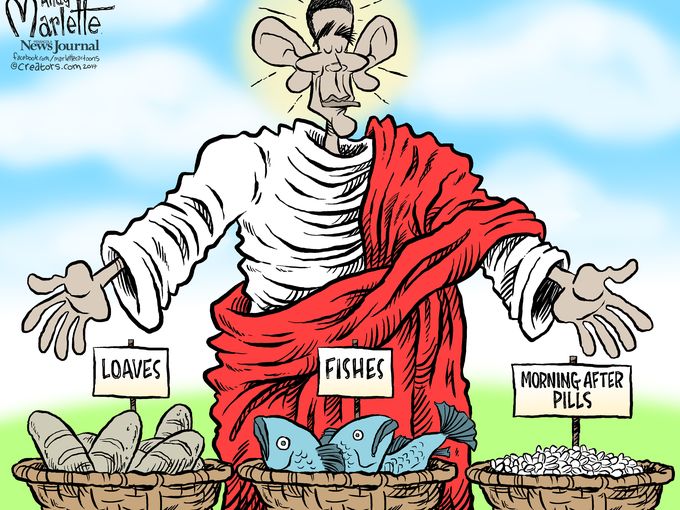

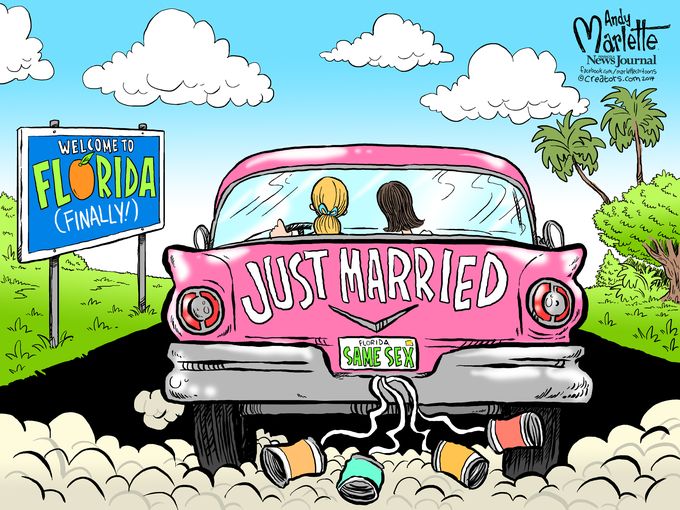
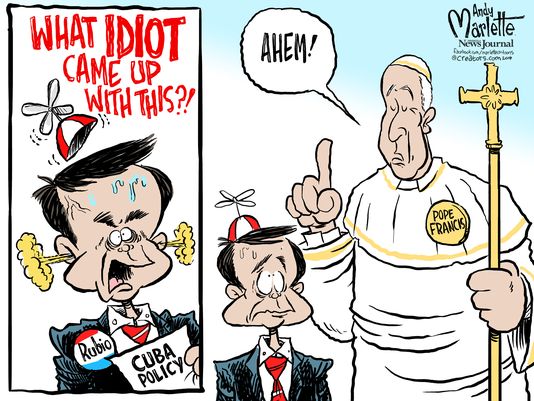
I have lived for so long in Moslem world that I take a risk now, offending my Moslem friends, by printing the cartoon of Mohammed weeping. It’s the cartoon that touched me to the bone. I have listened and learned in the Moslem world, and I have never met with hatred. The Mohammed I have read about in the Qu’ran and in hadith, and heard about in legend and stories from my Moslem friends portrayed a prophet who, like Jesus, was all about loving and serving the one true God. He would weep at what has been done in his name, as Jesus weeps for us, when we kill others in his service.

Kuwait Has Test To Detect LBGT?
This is a very odd article from The Middle East Eye:
Kuwaiti police have busted a “wild party” and arrested 23 “cross-dressers and homosexuals” at a chalet in the south of the country on Sunday.
“The vice police received a tip about the party and a warrant was issued by the public prosecution to take action against the cross dressers and homosexuals,” a security source told local daily Al Rai.
“The police encircled the chalet to make sure no one escaped and proceeded to arrest the people participating in the party. Some of them tried to escape by using the backdoor of the chalet and heading to the sea, but they were caught,” the source added.
The daily said that investigations revealed the party was exclusively for “cross-dressers and homosexuals” who would face the charges of “engaging in immoral activities.”
Lesbian, Gay, Bisexual and Trans (LGBT) rights receive no protection in Kuwait and homosexual acts between two male adults can result in a six-year prison sentence, though there are no laws against sexual acts between two women. Cross-dressing is also illegal.
In 2013, Public health official Yousuf Mindkar announced the introduction of a screening process at Kuwait’s International Airport to prevent LGBT expatriates from entering Kuwait or other Gulf Cooperation Council (GCC) countries.
“Health centres conduct the routine medical check to assess the health of the expatriates when they come into the GCC countries,” he said.
“However, we will take stricter measures that will help us detect gays who will be then barred from entering Kuwait or any of the GCC member states.”
The same paper later showed the minister appearing to backtrack on the move saying it was a “mere proposal.”
“It may or may not be accepted,” he said.
“The debate will reflect the keen interest of the GCC countries in human rights, taking into consideration the teachings of our religion and international agreements.”
Some suggested that concerns over the hosting of the FIFA 2022 World Cup in Qatar, and the potential controversy that would ensue were fans to be screened, may have led to the backtrack.
Where is Lafia, Nigeria?
Today the church prays for Lafia, Nigeria, which is near Abuja, in the part of Nigeria where Boko Haram runs rampant, and where over 250 girls were kidnapped from their school in 2014. Some few escaped, most were married off to poor young Boko Haram soldiers into hardship and near-slavery. Boko Haram does not believe in educating women. The Nigerian government at one point announced that Boko Haram had agreed to return the girls, but nothing happened. The Nigerian military and police do nothing to get them back.

Pensacola Christmas Parade
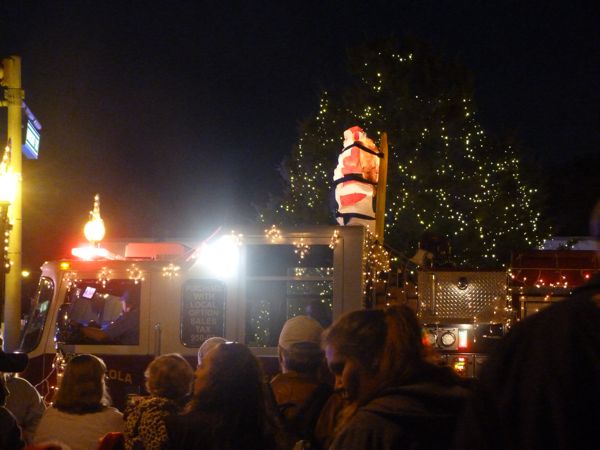
Why do they groan? Why do they grumble and look annoyed when I say it’s time for the Christmas Parade?
Once they get there, they have the best time! Who wouldn’t? It’s all noise and flash, great floats and loud bands, dancing in the street, dancing on the sidewalk, seeing all our friends from church and school and waving to friends on the floats – throwing BEADS!
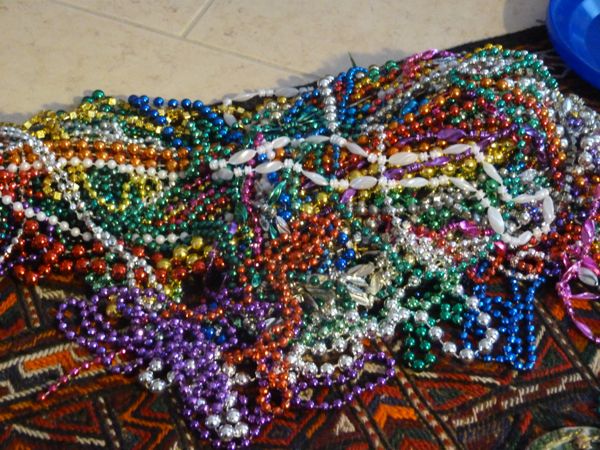
Even 1 year old baby N totally gets into the beads! “Beads! Beads!” she shouts and holds out her hands. She marvels at their sparkle as they hang around her neck.
Here is what I love about Pensacola. It’s been a bad month, with Ferguson, with New York, and in Pensacola 50,000 people gather peacefully and party on the streets. It’s New Orleans with our clothes on, it’s Christmas/Mardi Gras Family Style. We dance, we party, we jump for those beads – and then we pass them along to the children. It’s a long, happy parade, with every school marching band and Mardi Gras group, a local radio station or two, the homeless, the counter culture, drinks in open containers, church groups, neighborhood meet-ups, Jesus is there, with Mary and Joseph – it’s all cool.
When the parade ends, we all go home. Peacefully.
Some may grumble, but for me, they show up, every year, and we celebrate a family tradition, the Pensacola Christmas Parade.

AdventureMan and his helper went down early Sunday morning and pulled a great Bead harvest out of the trees. Little grandson Q carefully sorted them into piles for his friend Chris, his mama and daddy, his two other sets of grandparents and for his room upstairs in our house.
ISIS in Mosul Unable to Sustain Economy
From AP via Kuwait Times:
High prices, shortages pressure IS – Black markets abound – Strict social laws bad for business
 BAGHDAD: Saadi Abdul-Rahman was recently forced to pull his three children out of school in the Iraqi city of Mosul, where Islamic State militants have ruled with an iron fist since June. The cost of living has soared there, and the family is barely able to make ends meet, even after putting the kids to work. “We are not able to pay for cooking gas, kerosene and food,” laments the 56-year-old retired government worker. “The situation in Mosul is miserable.”
The economy in the self-styled “caliphate” declared by the Islamic State group bridging Iraq and Syria is starting to show signs of strain. Prices of most staples have more than doubled as coalition airstrikes make it difficult for products to move in and out of militant strongholds, leading to shortages, price-gouging and the creation of black markets.
Resentment has grown among residents under the rule of the extremists, who initially won support with their ability to deliver services. In the early days of its rule, the Islamic State group subsidized food and gas prices through the wealth it accumulated from oil smuggling, extortion and ransom demands. They sold their smuggled oil at a discount – $25 to $60 a barrel for oil that normally cost $100 a barrel or more, according to analysts and government officials.
But in recent weeks, prices have soared in militant-held cities. Items like kerosene, used for heating and cooking, are in short supply, while others, such as alcohol and cigarettes, strictly banned by the group, are making a comeback at higher prices on the black market. Smoking is a punishable offense in militant-held Mosul. But at a warehouse on the outskirts of the city, cigarettes, as well as hard-to-come-by essentials like kerosene, can be found at hugely inflated prices on a black market run by the extremists. There, a pack of cigarettes sells for 30,000 dinars – the equivalent of $26 – more than double the pre-caliphate price, according to residents who spoke on condition of anonymity for fear of reprisals.
‘Unsustainable Economy’
The militants “are developing an unsustainable economy,” said Paul Sullivan, an expert on Middle East economies at the National Defense University in Washington. “Eventually the costs of keeping the subsidies and price controls going will overpower their smuggling funds, which are also used for offensive and defensive actions. They can collect taxes, extort money, and so forth,” he said. “But that will likely not be enough in the long run to keep such an unbalanced economic system going.”
In the Syrian city of Raqqa, the extremists’ so-called capital, the breakdown of security along the border with Iraq in areas under Islamic State control has led to flourishing trade with Mosul. Trucks are also able to access the city from Turkey, allowing for a steady supply of fruit and vegetables, wheat and textiles. However, the cost of living has surged since US-led airstrikes began in September, and power and water cuts grew more frequent, residents said.
In addition, the strict social laws imposed by the group have been very bad for business, said Bari Abdelatif, an activist in the Islamic State-controlled town of al-Bab in Syria’s northern Aleppo province. But, he said, foreign fighters were bringing with them lots of hard currency, making up somewhat for the shortfall. Last month, Abu Bakr Al-Baghdadi, the leader of the Islamic State group, decreed the minting of gold, silver and copper coins for the militants’ own currency the Islamic dinar – to “change the tyrannical monetary system” modelled on Western economies. But trade in most militant-held cities continues to be in Iraqi dinars and US dollars.
The start of winter has led to serious shortages of gasoline and kerosene. The official price for a liter of gas in government-controlled areas of Iraq is 450 dinars (40 cents) – but in Mosul, it sells for four times that. Two hundred-liter barrels of kerosene are now sold in Mosul for 250,000 dinars ($220), versus the official price of 30,000 dinars. In the western Iraqi city of Fallujah, under militant control for almost a year, residents have started cutting trees for firewood because kerosene is in such short supply. The city is surrounded by government troops and near-daily shelling often make parts of town too dangerous to visit.
Food and fuel prices have risen sharply as a result – a 50-kilo sack of rice costs 75,000 dinars ($65), up from 10,000 ($9) three months ago. A cylinder of cooking gas goes for 140,000 dinars ($115). That has put many staples out of reach for Abdul-Rahman and his family in Mosul, even with the additional money brought in by his sons, who left school to drive a taxi and work in a restaurant.
Decline in Business
A number of factors are driving the shortages and price hikes, according to residents in Mosul and Fallujah, the group’s biggest Iraqi strongholds. The militants have imposed a tax on vehicles entering their territory, leading to a decline in business. Deliveries are also subject to militant theft, and coalition airstrikes and military operations make many roads impassable. As a result, the trip from the Turkish border to Mosul took four hours prior to the militant takeover. Now, a delivery truck can spend as much as a week traveling the same road, and will pay a tax of as much as $300 for entry into Mosul, residents said.
According to Luay Al-Khateeb, director of the Iraqi Energy Institute and a visiting fellow at the Brookings Doha Center, the population of the areas under Islamic State control in Iraq and Syria is 6.5 million to 8 million people. “They need 150,000 barrels (of crude) a day just to meet local consumption,” he said. “And that is the bare minimum to meet the demands for transportation, bakeries, power generation. That doesn’t mean they have access to such supply,” he added.
Last month, the militants shut down cell phone service in Mosul, claiming that residents were tipping off US-led airstrikes to their whereabouts. Cell signals have not been restored, causing the city to come to a virtual standstill. Workshops, factories and markets are closed and bitterness is growing among business owners. “Most money-transfer operations are done by mobile calls,” said Osama Abdul-Aziz, the owner of a money-transfer office in Mosul. “We have the option of using the Internet, but this method is very slow and sometimes the Internet does not work at all, which causes big delays to our work.” At Mohammed Abdullah’s shop in Mosul, the pile of cell phone scratch cards is growing higher by the day. “Our business and means for living are in ruins now,” he said. – AP
Recent Comments
ExpatAlien on What Country am I Living … intlxpatr on Yellowstone: Old Faithful to C… Michelle on Yellowstone: Old Faithful to C… Cathy on No Grown-Ups in Charge intlxpatr on Waiting for Snow Wikipedia Donate Button

Amazina


Early Voting in Florida


 Here There and Everywhere