. . . And they put together a movie to show how it was done. Wow. If our police could do this, cases would clear courts a lot faster. Here is the story:
From AOL News:
DUBAI, United Arab Emirates (AP) — The United Arab Emirates’ interior minister says police have arrested a suspect in the killing of an American schoolteacher in the capital, Abu Dhabi.
State news agency WAM says Interior Minister Saif bin Zayed Al Nahyan said on Thursday that the suspect also planted a makeshift bomb outside the house of an American doctor. He says the device was successfully dismantled.
Police say the teacher was stabbed to death by an attacker wearing the full black veil commonly worn by women throughout the Gulf Arab region.
When I watched it YouTube, it showed sponsorship by No Nonsense, LOL, which I thought ironically appropriate.
Go figure. In spite of admonitions to the contrary, young people have sex. Problems arise when someone isn’t old enough to consent, isn’t coherent enough to have sex or is forced to have sex or participate in a sex act they don’t consent to.
I love this idea. It takes a little of the “he says – she says” out of the classic dilemma of who did what to whom and who should be held accountable? Was it consensual? Was it rape? Were both parties in a sober enough state to make that decision?
Last June, Reason’s Robby Soave called for an iPhone app that would clear up pesky he-said, she-said rape cases by recording “mutual consent” to engage in sexual activity before two people do the deed: “Maybe they would have to input a password and then touch phones, or something?” he proposed. Last week, his prayers were answered: The Good2Gosexual consent app isn’t as touch-and-go as the app of Soave’s dreams, but it does encourage sex partners to assess their mutual interest in sex and record their intoxication levels before getting busy.
Here’s how it works: After deciding that you would like to have sex with someone, launch the Good2Go app (free on iTunes and Google Play), hand the phone off to your potential partner, and allow him or her to navigate the process to determine if he or she is ready and willing. “Are We Good2Go?” the first screen asks, prompting the partner to answer “No, Thanks,” “Yes, but … we need to talk,” or “I’m Good2Go.” If the partner chooses door No. 1, a black screen pops up that reads “Remember! No means No! Only Yes means Yes, BUT can be changed to NO at anytime!” If he or she opts instead to have a conversation before deciding—imagine, verbally communicating with someone with whom you may imminently engage in sexual intercourse—the app pauses to allow both parties to discuss.
If the partner—let’s assume for the purposes of this blog post, partner is a she—indicates that she is “Good2Go,” she’s sent to a second screen that asks if she is “Sober,” “Mildly Intoxicated,” “Intoxicated but Good2Go,” or “Pretty Wasted.” If she chooses “Pretty Wasted,” the app informs her that she “cannot consent” and she’s instructed to return the phone back to its owner (and presumably, not have sex under any circumstances, young lady). All other choices lead to a third screen, which asks the partner if she is an existing Good2Go user or a new one. If she’s a new user, she’s prompted to enter her phone number and a password, confirm that she is 18 years old, and press submit. (Minors are out of luck—the app is only for consentingadults.) Then, she’ll fill out a fourth prompt, which asks her to input a six-digit code that’s just been texted to her own cellphone to verify her identity with that app. (Previous users can just type in their phone number—which serves as their Good2Go username—and password.) Once that level is complete, she returns the phone to its owner, who can view a message explaining the terms of the partner’s consent. (For example, the “Partner is intoxicated but is Good2Go.”) Then, the instigator presses a button marked “Ok,” which reminds him again that yes can be changed to “NO at anytime!”
Then you get to have sex.
Easy, right? When I tried this process out with a partner, it took us four minutes to navigate through all the screens, mostly because he kept asking, “Why are we using an app for this?” and “Why do I have to give them my phone number?” (More on that later.) I was confused, too: As the instigator, I wasn’t asked to confirm that I wanted to have sex or to state my own intoxication level for my partner’s consideration. (A promotional video modeling the process begins by announcing how “simple” it is, then snaps out instructions for three minutes, but questions remain.) Perhaps the process is deliberately time-consuming: The app provides the “opportunity for two people to pause and reflect on what they really want to do, rather than entering an encounter that might lead to something one or both will later regret,” the app’s FAQ reads. Or maybe I’m just old: At 29, I find it much easier to just talk about sex than to use an app for that.
Lee Ann Allman, a creator of the app, says she was inspired to make it after talking with her college-aged kids about sexual assault on campuses across the country. They “are very aware of what’s happening, and they’re worried about it, but they’re confused about what to do. They don’t know how they should be approaching somebody they’re interested in,” she told me. Meanwhile, “kids are so used to having technology that helps them with issues in their lives” that Allman believes the app will help facilitate necessary conversations, encourage them to consider their level of intoxication, and remind young people that consent to sex should be affirmatively given and can be revoked at any time.
“Good2Go” is obviously a euphemism for sexual activity, but it’s not clear what that means exactly—is it making out, oral sex, vaginal intercourse, or anal sex, and with protection or not? (I guess you could always pause, grab phones, and start the process over to consent to another specific sexual activity—but at some point, you’d actually have to verbally explain what you’re agreeing to be Good2Go4.) The message that people need to consent to sex, and that they can withdraw consent, and they probably shouldn’t be totally wasted while they do it is one that college campuses are already administering to their students upon orientation. It may not always be getting though, but it’s not clear how the app (which is now being promoted through campus ambassadors) advances the cause.
In fact, Good2Go could contribute a dangerous new element to those he-said she-said rape cases. What Good2Go doesn’t tell users is that it keeps a private record of every “I’m Good2Go” agreement logged in its system, tied to both users’ personal phone numbers and Good2Go accounts. (Records of interactions where users say “No” or just want to talk are not logged in this way.) Allman says that regular users aren’t permitted access to those records, but a government official with a subpoena could. “It wouldn’t be released except under legal circumstances,” Allman told me. “But it does create a data point that there was an occasion where one party asked the other for affirmative consent, that could be useful in the future … there are cases, of course, as we know, where the accused is an innocent party, so in that case, it could be beneficial to him.”
That record may help the falsely accused, but it’s unlikely to aid a real victim. Good2Go may remind its users that consent can be revoked at any time, but there are still judges and juries that will take evidence that a person said “yes” to sex at one point, and conclude that they were asking for whatever happened later that night (or the next). Compared to that scenario, talking about sex doesn’t seem so scary.
From yesterday’s USA Today, a very brief article in the USA Round Up:
Alaska: Fairbanks
The number of security cameras in Alaska schools is going up. The Fairbanks Daily News-Mirror reported video cameras are being installed in Fairbanks middle and elementary schools and it’s part of a statewide trend aimed at making schools safer.
As I raised our son, I was – well, most of the time – an attentive parent. I would listen, and when necessary, I would correct. It’s a mother’s job to help her children navigate the pitfalls of life, and to have a tool-box full of resources with which to cope.
Perhaps I did my job too well. Our son became a lawyer, and he is very particular about the things I say, especially when I use a term incorrectly, such as irony.
Here is what Wikipedia says irony is:
event characterized by an incongruity, or contrast, between what the expectations of a situation are and what is really the case, with a third element, that defines that what is really the case is ironic because of the situation that led to it.
I am about to use the term “irony” correctly. 🙂
When I read the above article, I remembered the horror of Orwell’s 1984, the book, and then the movie. The movie was terrifying, the presence of cameras everywhere, hidden, not hidden, just knowing they were everywhere and everything you did could be monitored.
The irony comes in that here we are, with cameras everywhere, and we are glad for it. The irony is that our society has slipped so far from its ideal that we cannot trust our neighbor to behave him or herself, and we protect ourself by placing cameras so as to encourage people to behave.
I am not so sure that our moral codes have ever worked well; I think it seems to be the nature of humanity to claim a moral code, but not to adhere strictly to it. I think of people who talk about the safety of the ’50’s, but I don’t believe that safety was truly that safe. I think children disappeared. I think wives were beaten, women raped. I think robberies and assaults happened, and I think the law was more lax than it is today.
But it is an irony, IMHO, that we welcome cameras today as a low-cost policing of ourselves, our neighbors, and those we fear will hurt us or take our property. We trust ourselves and one another so little that we are increasingly installing cameras. We’ve been considering installing them through our home security company; we have motion detectors, cameras are just the next upgrade. Have we exchanged a high value on privacy for a heightened perceived need for protection of life and property?
Wooo HOOOO Pensacola, getting those dealers off the streets. It’s not like its permanent, but it’s a start. There is one funny thing you will spot in this write-up in the Pensacola News Journal, that the next to last man named had charges that include selling cocaine within 1000 feet of a place of worship.
If you’ve ever been to Pensacola, you will understand how hilarious that is. You can’t go 1,000 feet away from one house of worship and not be within 1,000 feet of the next. It’s just like the mosques in Qatar and Kuwait, if you are lost, you can’t call someone and when they ask where you are, you can’t say “I’m by the big mosque/church on the corner!” because there are mosques/churches on EVERY corner! Pensacola has churches everywhere! I just think that’s interesting, that it seems to be an additional charge on the sheets in Pensacola.
An approximate 4-month-long investigation targeting street-level drug dealers resulted in the arrests of 13 people for selling crack cocaine to undercover Pensacola Police officers Friday.
Warrants for selling cocaine also have been issued for an additional 20 people, said Sgt. Marvin Miller, who supervises the department’s Vice & Narcotics Unit. Miller said the investigation targeted areas notorious for narcotics sales.
All of the charges are third-degree felonies punishable by up to five years in prison. Additional prison time can be added for selling within 1,000 feet of a specified area such as convenience stores, schools, and places of worship, or if the person is a repeat offender.
Officers from various units within the Pensacola Police Department spent approximately 12 hours today making the arrests.
Arrested today and charged with sale of cocaine and conspiracy to sell cocaine were:
Alfred Peasant, 34, of 1300 block of North Sixth Avenue, Pensacola
Sharon Pickett, 49, of 100 block of North J Street, Pensacola.
David Jones, 24, of 3600 block of Swan Lane, Pensacola.
Demarko Weathers, 21, of 2000 block of West Chase Street, Pensacola.
Minnie Mae Sapp, 54, of 100 block of South N Street, Pensacola.
Terry Crenshaw, 28, of 1000 block of West Hillary Street, Pensacola.
Larry Dornall Knight, 52, of 3600 block of North Ninth Avenue, Pensacola.
Antoine Booker, 34, of 1100 block of West Hope Drive, Pensacola.
Also arrested today were:
Donte A. Brazile, 36, of 3000 block of Torres Avenue, Pensacola. Charged with sale of cocaine.
Dominique Blackwell, 19, of 600 block of North B Street, Pensacola. Charged with possession of cocaine with intent to sell within 1,000 feet of a place of worship.
Kernist Ferrell, 57, address unavailable; Robert Lee Watts, 23, address unavailable; and Michael Coleman, 33, of 600 block of North A Street, Pensacola.
All three, who are currently in jail, were charged with sale of cocaine.
This guy is a disaster. So sad, nuts with guns, and who suffers? He claims his dog jumped out of the truck, causing the accident (dog died) and then his truck rolls over and all these legal and illegal weapons fall out, and fifteen chickens??? IED’s???
Officers responding to a single-SUV crash Friday in West Virginia found bombs, drugs, guns and more than a dozen chickens inside the vehicle – and may have thwarted a domestic terror attack.
Seth Grim, 21, somehow managed to roll the SUV off a highway about 40 miles northeast of Charleston. Police found four improvised explosive devices, two AK-47s, a rifle and about 15 chickens inside the vehicle, police said. They also uncovered a large amount of marijuana.
Authorities also found about 10 loaded magazines and body armor, they could possibly have halted a major tragedy. Two of the bombs were six inches long, two were four inches long, police said.
Grim’s Ford Explorer rolled off Interstate 79 at around 3:30 a.m., police told the West Virginia Gazette.
Grim apparently blamed the wreck on his rottweiler, which he told police jumped out the window while he was speeding down the highway, Office of Emergency Services Director Melissa Gilbert told AOL.
The dog was found dead several yards away, Roane County Sheriff’s Office spokesperson Mike King told AOL.
West Virginia State Police arrived on the scene shortly after and found the chickens inside a cage, said Gilbert.
A number of the chickens were dead on the road and a few others escaped, said King. They were not recovered. Also scattered on the road were a few of the loaded magazines.
Cops also found multiple improvised explosive devices, assault rifles and several loaded clips stashed inside with the chickens, according to Gilbert.
King shot down reports Grim was on the run from police in Pennsylvania. Police are not clear where he was heading or what his intentions were. Several agencies are waiting to speak with him, according to the officer.
Grim suffered minor upper body injuries but was immediately arrested. The potentially dangerous man also declared himself a “sovereign citizen” upon his incarceration, according to Gilbert.
A bomb squad took the bombs to a secure location to be detonated out of harm’s way, Gilbert said.
Sovereign citizens often refuse to pay taxes as a form of protest against the federal government. They are seen by the FBI as domestic terrorists.
Terry Nichols, who helped plan the 1995 Oklahoma City bombing, is the most infamous sovereign citizen.
A call to local police seeking further information about the charges filed against Grim and to find out why he was running from police in Pennsylvania was not immediately returned.
Only the marijuana and IEDs are illegal in West Virginia, according to King. Grim faces four felony counts for possessing them.
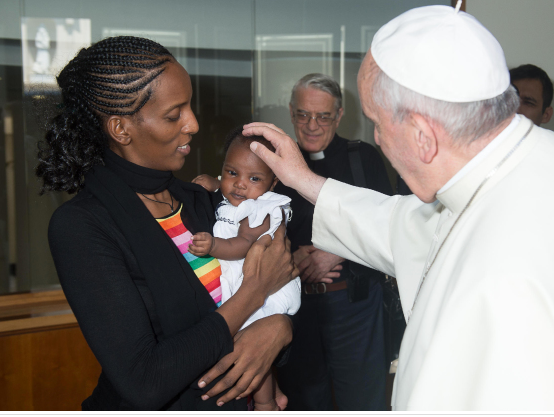
I am not Catholic, but what I love about this humble Pope shines through in these photos – the Pope, the revered leader of the Christian world, is standing, while the family sits in his presence. His loving actions speak loudly. You can see all the photos on AOL News by clicking here.
ROME (AP) – Pope Francis met privately Thursday with a Sudanese woman who refused to recant her Christian faith in the face of a death sentence, blessing the woman as she cradled her infant born just weeks ago in prison.
The Vatican characterized the visit with Meriam Ibrahim, 27, her husband and their two small children as “very affectionate.”
The 30-minute encounter took place just hours after the family landed at Rome’s Ciampino airport, accompanied by an Italian diplomat who helped negotiate her release, and welcomed by Italy’s premier, who hailed it as a “day of celebration.”
Vatican spokesman the Rev. Federico Lombardi said the pope “thanked her for her faith and courage, and she thanked him for his prayer and solidarity” during the half-hour meeting Thursday. Francis frequently calls attention to the suffering of those persecuted for their religious beliefs.
Lombardi said the presence of “their wonderful small children” added to the affectionate tone of the meeting. Ibrahim was presented with a rosary, a gift from the pope.
Ibrahim held her sleeping infant as she stepped off the plane from Sudan, which had blocked her from leaving the country even after the country’s highest court overturned her death sentence in June. An Italian diplomat carried her 18-month-old son and they were followed by her husband, Daniel Wani, who is a citizen of the United States and South Sudan.
Ibrahim and her family are expected to spend a few days in Rome before heading to the United States.
Ibrahim, whose father was Muslim but whose mother was an Orthodox Christian from Ethiopia, was sentenced to death over charges of apostasy. She married her husband, a Christian, in a church ceremony in 2011. As in many Muslim nations, Muslim women in Sudan are prohibited from marrying non-Muslims, though Muslim men can marry outside their faith.
The sentence was condemned by the United States, the United Nations and Amnesty International, among others, and both the United States and Italy – a strong death penalty opponent with long ties to the Horn of Africa region – worked to win her release.
Sudan’s high court threw out her death sentence in June, but she was then blocked from leaving the country by authorities who questioned the validity of her travel documents.
Lapo Pistelli, an Italian diplomat who accompanied the family from Sudan, said Italy was able to leverage its ties within the region. “We had the patience to speak to everyone in a friendly way. This paid off in the end,” he said.
She is also charged with adultery, for marrying a Christian man and (gasp) having sex with him. Now pregnant with her second child, Mariam claims she has never been a Muslim, was raised Christian, but the judge is applying new and strict Sharia laws.
International outrage grows for Sudanese woman sentenced to death for apostasy
Published May 16, 2014FoxNews.com
Meriam Ibrahim and Daniel Wani married in a formal church ceremony in 2011. The couple has an 18-month-old son, Martin, who is with Meriam in jail.
International outrage is mounting over the death sentence a Sudanese judge ordered for the pregnant wife of an American citizen — all because she refuses to renounce her Christian faith.
Meriam Ibrahim, 26, was sentenced Thursday after being convicted of apostasy. The court in Khartoum ruled that Ibrahim must give birth and nurse her baby before being executed, but must receive 100 lashes immediately after having her baby for adultery — for having relations with her Christian husband. Ibrahim, a physician and the daughter of a Christian mother and a Muslim father who abandoned the family as a child, could have spared herself death by hanging simply by renouncing her faith.
“We gave you three days to recant but you insist on not returning to Islam,” Judge Abbas Khalifa told Ibrahim, according to AFP. “I sentence you to be hanged to death.”
But Ibrahim held firm to her beliefs.
“I was never a Muslim,” she answered. “I was raised a Christian from the start.”
Ibrahim was raised in the Christian faith by her mother, an Orthodox Christian from Ethiopia. She is married to Daniel Wani, a Christian from southern Sudan who has U.S. citizenship, according to sources who spoke on condition of anonymity.
“I was never a Muslim. I was raised a Christian from the start.”
– Meriam Ibrahim
The cruel sentence drew condemnation from Amnesty International, the U.S. State Department and U.S. lawmakers.
“The refusal of the government of Sudan to allow religious freedom was one of the reasons for Sudan’s long civil war,” Rep. Chris Smith, R-N.J., chairman of the House congressional panel that oversees U.S. policy in Africa, said in a statement. “The U.S. and the rest of the international community must demand Sudan reverse this sentence immediately.”
Amnesty International called the sentence a “flagrant breach” of international human rights law and the U.S. State Department said it was “deeply disturbed” by the ruling, which will be appealed.
Khalifa refused to hear key testimony and ignored Sudan’s constitutional provisions on freedom of worship and equality among citizens, according to Ibrahim’s attorney Al-Shareef Ali al-Shareef Mohammed.
“The judge has exceeded his mandate when he ruled that Meriam’s marriage was void because her husband was out of her faith,” Mohammed told The Associated Press. “He was thinking more of Islamic Shariah laws than of the country’s laws and its constitution.”
Ibrahim and Wani married in a formal ceremony in 2011 and have an 18-month-old son, Martin, who is with her in jail. The couple operate several businesses, including a farm, south of Khartoum, the country’s capital. Wani fled to the United States as a child to escape the civil war in southern Sudan, but later returned. He is not permitted to have custody of the little boy, because the boy is considered Muslim and cannot be raised by a Christian man.
Sudan’s penal code criminalizes the conversion of Muslims into other religions, which is punishable by death. Muslim women in Sudan are further prohibited from marrying non-Muslims, although Muslim men are permitted to marry outside their faith. Children, by law, must follow their father’s religion.
Islamic Shariah laws were introduced in Sudan in the early 1980s under the rule of autocrat Jaafar Nimeiri, whose decision led to the resumption of an insurgency in the mostly animist and Christian south of Sudan. An earlier round of civil war lasted 17 years, ending in 1972. In 2011, the south seceded to become the world’s newest nation, South Sudan.
Sudanese President Omar Bashir, an Islamist who seized power during a 1989 military coup, said his county will implement Islam more strictly now that the non-Muslim south is gone. A number of Sudanese have been convicted of apostasy in recent years, but they have all escaped execution by recanting their faith. Religious thinker and politican Mahmoud Mohammed Taha — a vocal critic of Nimeiri — was sentenced to death after his conviction of apostasy and was executed at the age of 76 in 1985.
Ibrahim’s case first came to the attention of authorities in August, when members of her father’s family complained that she was born a Muslim but married a Christian man. They claimed her birth name was “Afdal” before she changed it to Meriam. The document produced by relatives to indicate she was given a Muslim name at birth was a fake, Mohammed said.
Ibrahim refused to answer the judge when he referred to her as “Afdal” during Thursday’s hearing.
Ibrahim was initially charged with having illegitimate sex last year, but she remained free pending trial. She was later charged with apostasy and jailed in February after she declared in court that Christianity was the only religion she knew.
The US-based Center for Inquiry is demanding that all charges against Ibrahim be dropped, saying the death sentence is a clear violation of the International Covenant on Civil and Political Rights, which forbids persecution or coercion of religious beliefs and the right to marry.
“Religious belief must never be coerced and free expression must never be punished, through threat of imprisonment, violence, or any other means,” the group wrote in a letter to Sudan’s UN ambassador, H.E. Hassan Hamid Hassan. “This cannot go unanswered, and the world will not stand for it.”
Fox News’ Joshua Rhett Miller and The Associated Press contributed to this report.
Sudanese woman may face death for choosing Christianity over Islam
KHARTOUM: A Sudanese court gave a 27- year-old woman until today to abandon her newly adopted Christian faith and return to Islam or face a death sentence, judicial sources said on Monday. Mariam Yahya Ibrahim was charged with apostasy as well as adultery for marrying a Christian man, something prohibited for Muslim women to do and which makes the marriage void. The final ruling will be announced today.
Ibrahim’s case was the first of its kind to be heard in Sudan. Young Sudanese university students have mounted a series of protests near Khartoum University in recent weeks asking for an end to human rights abuses, more freedoms and better social and economic conditions.
The authorities decided on Sunday to close the university indefinitely. Western embassies and Sudanese activists sharply condemned the accusations and called on the Sudanese Islamist-led government to respect freedom of faith. “The details of this case expose the regime’s blatant interference in the personal life of Sudanese citizens,” Sudan Change Now Movement, a youth group, said in a statement.
President Omar Hassan Al-Bashir’s government is facing a huge economic and political challenge after the 2011 secession of South Sudan, which was Sudan’s main source of oil. A decision by Bashir last year to cut subsidies and impose austerity measures prompted violent protests in which dozens were killed and hundreds were injured. — Reuters
This is what I love about New Yorker magazine: they print stories no one prints, they follow stories that need following. They lead, and they do their job, alerting us to issues that matter. My heart goes out to the families, Christian and Muslim, of these girls who were abducted because they were being educated. Boko Haram believes educating women goes against Islam. Someone should read them a Quran.
“I thought it was the end of my life,” Deborah Sanya told me by phone on Monday from Chibok, a tiny town of farmers in northeastern Nigeria. “There were many, many of them.” Boko Haram, an Islamist terrorist group, kidnapped Sanya and at least two hundred of her classmates from a girls’ secondary school in Chibok more than two weeks ago. Sanya, along with two friends, escaped. So did forty others. The rest have vanished, and their families have not heard any word of them since.
Sanya is eighteen years old and was taking her final exams before graduation. Many of the schools in towns around Chibok, in the state of Borno, had been shuttered. Boko Haram attacks at other schools—like a recent massacre of fifty-nine schoolboys in neighboring Yobe state—had prompted the mass closure. But local education officials decided to briefly reopen the Chibok school for exams. On the night of the abduction, militants showed up at the boarding school dressed in Nigerian military uniforms. They told the girls that they were there to take them to safety. “They said, ‘Don’t worry. Nothing will happen to you,’ ” Sanya told me. The men took food and other supplies from the school and then set the building on fire. They herded the girls into trucks and onto motorcycles. At first, the girls, while alarmed and nervous, believed that they were in safe hands. When the men started shooting their guns into the air and shouting “Allahu Akbar,” Sanya told me, she realized that the men were not who they said they were. She started begging God for help; she watched several girls jump out of the truck that they were in.
It was noon when her group reached the terrorists’ camp. She had been taken not far from Chibok, a couple of remote villages away in the bush. The militants forced her classmates to cook; Sanya couldn’t eat. Two hours later, she pulled two friends close and told them that they should run. One of them hesitated, and said that they should wait to escape at night. Sanya insisted, and they fled behind some trees. The guards spotted them and called out for them to return, but the girls kept running. They reached a village late at night, slept at a friendly stranger’s home, and, the next day, called their families.
Sanya could not tell me more after that. She is not well. Her cousins and her close friends are still missing, and she is trying to understand how she is alive and back home. All she can do now, she said, is pray and fast, then pray and fast again.
The day after the abduction, the Nigerian military claimed that it had rescued nearly all of the girls. A day later, the military retracted its claim; it had not actually rescued any of the girls. And the number that the government said was missing, just over a hundred, was less than half the number that parents and school officials counted: according to their tally, two hundred and thirty-four girls were taken.
In the wake of the military’s failure, parents banded together and raised money to send several of their number into the forest to search for the girls. The group came across villagers who persuaded the parents to turn back. They told the parents that they had seen the girls nearby, but the insurgents were too well armed. Many of the parents had just bows and arrows.
***
The circumstances of the kidnapping, and the military’s deception, especially, have exposed a deeply troubling aspect of Nigeria’s leadership: when it comes to Boko Haram, the government cannot be trusted. Children have been killed, along with their families, in numerous Boko Haram bombings and massacres over the past five years. (More than fifteen hundred people have been killed so far this year.) State schools and remote villages in the north have borne the brunt of Boko Haram’s violence this year. The group is believed to be at least partly waging a campaign against secular values. The kidnapped girls were both Christian and Muslim; their only offense, it seems, was attending school.
Last June, I visited Maiduguri, the capital of Borno state and the birthplace of Boko Haram, to report on the insurgency and the Nigerian government’s counteroffensive, a security operation that placed three northeastern states, including Borno and Yobe, under a state of emergency as troops launched attacks on terrorist hideouts and camps. The military cut phone lines and Internet access, and, while residents were glad for the intervention, there was a sense of living in the dark. Gunshots, a bomb blast: was it Boko Haram or a military attack? Were the hundreds of men disappeared by the military actually terrorists—even the young boys? And was the government, as it claimed, really winning the war?
The military has restored phone lines in Borno. But the sole airline that flew to Maiduguri cancelled the route at the end of last year. The road to Chibok is so hazardous that Borno’s governor visited the town with a heavy military escort. Much of the northeast is now physically isolated. What is happening there that we cannot see?
Nigerians in the rest of the country had, until recently, been able to ignore the deaths. The general mood has been one of weary apathy—from a government waging a heavy-handed crackdown on northerners to civilians far removed from the chaos. That mood may finally change.
***
Sanya’s father, a primary-school teacher named Ishaya Sanya, is struggling with conflicting emotions: gratitude that his daughter has returned to him; guilt that the daughters of his siblings, friends, and neighbors are still somewhere in the bush; and an angry frustration that there seemed to be no effort to rescue the girls.
“We don’t know where they are up until now, and we have not heard anything from the government,” he told me. “Every house in Chibok has been affected by the kidnapping.” The only information that the families had been able to gather about the kidnapped girls, he went on, was from the girls who had escaped.
He remembers the exact time that Deborah appeared in front of him after her escape—4:30P.M.—and how he felt: “very happy.” But his despair soon returned. “Our area has been affected very seriously,” he told me. Parents had fallen physically ill, and some were “going mad.”
The military’s current plans are unclear; the Chibok parents hope that it is acting swiftly and cautiously. There is worry, too, that a rescue operation could result in the deaths of many of the girls; this happened during a previous attempted rescue, of two Western engineers kidnapped by Boko Haram. Last week, a military spokesman, Brigadier-General Chris Olukolade, said only that the search for the girls had “intensified.”
In the meantime, as in so many other ways in Nigeria, each community has to fend for itself. For a while after the abduction, girls trickled back into town—some rolled off trucks, some snuck away while fetching water. That trickle has stopped. “Nobody rescued them,” a government official in Chibok said of the girls who made it back. “I want you to stress this point. Nobody rescued them. They escaped on their accord. This is painful.”
A pastor in Chibok whose daughter is missing told me that he set out with friends on the morning after the abduction to find the girls. “I was forced to come home empty-handed,” he told me by phone. “I just don’t know what the federal government is doing about it. And there is no security here that will defend us. You have to do what you can do to escape for your life.”
I asked the pastor about rumors that Boko Haram has taken the girls outside of Nigeria’s borders, into Cameroon and Chad, and forcibly married them. He paused, and then said, “How will I be happy? How will I be happy?”
Four students walk in Chibok following their escape from Boko Haram. Photograph by Haruna Umar/AP.
This kind of gives me the shivers. I guess it is supposed to make everyone safer, but it feels so intrusive. It may be a generational thing; my understanding is that people today have lower expectations of privacy . . . I wonder how their upkeep will be; sand and humidity being hard on security cameras, not to mention deliberate interference with their use?
Qatar’s Ministry of Interior is apparently stepping up enforcement of a law that requires businesses around the country to install closed-circuit camera surveillance on their premises.
Law No. 9 of 2011 mandates that surveillance cameras be installed in residential compounds, hospitals, malls, banks, hotels, warehouses and other locations, and is enforced by the MOI’s Security Systems Department (SSD).
The SSD was not immediately available for comment, but Qatar Tribune reports that the MOI has recently made the widespread installation of these cameras a priority.
Speaking to Doha News, a staffer at Lulu Hypermarket on D-Ring said that the store was previously told to install CCTV in its parking lot, but has now been asked to increase the number of cameras to cover the entire parking area.
Meanwhile, an employee at Lulu Gharafa said they are still in the process of installing some 300 ministry-approved cameras, following an instruction from last year. When asked why the extra surveillance was needed, he said it could help aid police investigations into incidents such as thefts from vehicles.
Additionally, the Peninsula reports the owner of a jewelry shop in the Gold Souq as saying:
“This year when I went for company registration renewal was asked of CCTV cameras are installed. Also inspectors are supposed to come to our shops and inspect if the surveillance cameras are functioning properly.
There are only very few places from which we should buy the CCTV cameras, they are very expensive and it cost me more than QR60,000 to purchase and fix the surveillance system,” he added.
However, City Center mall’s director told Doha News that though the SSD consistently comes to inspect the surveillance system, there have been no new requests for additional cameras in the past few months.
Requirements
A law governing the use of CCTV surveillance was passed in 2011. According to the legislation:
Businesses must have a control room and operate surveillance 24/7;
Recordings must be kept for 120 days, and cannot be altered before being handed over to competent government departments upon request;
Recording is prohibited in bedrooms, patient rooms, toilets and changing rooms for women; and
Those who violate the law could face up to three years in jail and fines of QR50,000, as well as the suspension or cancellation of their business license.
Last year, the law was brought back into the spotlight when the Supreme Council of Health reminded healthcare facilities to comply with the legislation and install cameras within three months, or face the loss of their business licenses.



 “I thought it was the end of my life,” Deborah Sanya told me by phone on Monday from Chibok, a tiny town of farmers in northeastern Nigeria. “There were many, many of them.” Boko Haram, an Islamist terrorist group, kidnapped Sanya and at least two hundred of her classmates from a girls’ secondary school in Chibok more than two weeks ago. Sanya, along with two friends, escaped. So did forty others. The rest have vanished, and their families have not heard any word of them since.


 Here There and Everywhere