Some dry, but fascinating reading. This is an excerpt from US Report On Human Rights In Kuwait State Department Issues Annual Assessment from the Arab Times: Kuwait. You can read the entire report by clicking on the blue hypertext which will take you to the Arab Times Website.
Women
Rape and Domestic Violence: Violence against women continued to be a problem. Rape carries a maximum penalty of death, which the country occasionally imposed for the crime; spousal rape is not a crime. The media reported hundreds of rape cases, but government statistics indicated that only 34 cases were reported to the police. Social stigma associated with publicly acknowledging rape likely resulted in underreporting. Many victims were noncitizen domestic workers. Police occasionally arrested alleged rapists. The courts tried and convicted three rapists during the year, but authorities did not effectively enforce laws against rape, especially in cases of noncitizen women raped by their employers.
The law does not specifically prohibit domestic violence, but courts try such cases as assault. A victim of domestic violence may file a complaint with police requesting formal charges be brought against the alleged abuser. Each of the country’s 83 police stations reportedly received complaints of domestic abuse. Victims, however, did not report most domestic abuse cases, especially outside the capital. Police officials rarely arrested perpetrators of domestic violence even when presented with documented evidence of the abuse, such as eyewitness accounts, hospital reports, and social worker testimony, and treated such reports as social instead of criminal matters. Individuals also reportedly bribed police officials to ignore assault charges in cases of domestic abuse. Although courts found husbands guilty of spousal abuse in previous years, those convicted rarely faced severe penalties. Noncitizen women married to citizens reported domestic abuse, and inaction or discrimination by police during the year.
A woman may petition for divorce based on injury from abuse, but the law does not provide a clear legal standard regarding what constitutes injury. Additionally, a woman must provide at least two male witnesses (or a male witness and two female witnesses) to attest to the injury. There were no shelters or hotlines specifically for victims of domestic violence, although a temporary shelter for domestic workers housed victims during the year. The government completed construction of a high-capacity shelter for domestic workers in 2012, but the shelter was not fully operational by year’s end.
Harmful Traditional Practices: The penal code penalizes honor crimes as misdemeanors. The law states that a man who sees his wife, daughter, mother, or sister in the “act of adultery” and immediately kills her or the man with whom she is committing adultery will face a maximum punishment of three years’ imprisonment and a fine of 225 dinar ($790), slightly less than a month’s earnings at the public-sector minimum wage. Sentencing guidelines for honor crimes do not apply to Bidoon. In February the court convicted and sentenced five foreign residents to life in prison for the June 2012 “honor killing” of a 19-year old female family member.
Sexual Harassment: No specific law addresses sexual harassment, but the law criminalizes “encroachment on honor,” which encompasses everything from touching a woman against her will to rape, and police strictly enforced this law. The government deployed female police officers specifically to combat sexual harassment in shopping malls and other public spaces. Perpetrators faced fines and jail time. Nonetheless, human rights groups characterized sexual harassment against women in the workplace as a pervasive and unreported problem.
Reproductive Rights: There were no reports of government interference in the right of couples and individuals to decide freely the number, spacing, and timing of children. Decisions regarding access to contraceptives, family size, and procedures involving reproductive and fertility treatments required the consent of both husband and wife. The information and means to make those decisions, as well as skilled attendance during prenatal care, essential obstetric care, childbirth, and postpartum care were freely available. While the government did not provide any formal family planning programs, contraceptives were available without prescription to citizens and noncitizens.
Discrimination: Women have many political rights, including the right to vote and serve in parliament and the cabinet, but they do not enjoy the same rights as men under family law, property law, or in the judicial system. Sharia (Islamic law) courts have jurisdiction over personal status and family law cases for Sunni and Shia Muslims. Sharia discriminates against women in judicial proceedings, freedom of movement (see section 1.d.), marriage, and inheritance. Secular courts allow any person to testify and consider male and female testimony equally, but in the sharia courts, the testimony of a man equals that of two women.
The law prohibits marriage between Muslim women and non-Muslim men. The law does not require a non-Muslim woman to convert to Islam to marry a Muslim man, but many non-Muslim women faced strong economic and societal pressure to convert. In the event of a divorce, the law grants the fathers custody of children of non-Muslim women who fail to convert. A non-Muslim woman who fails to convert is also ineligible for naturalization as a citizen and cannot inherit her husband’s property unless specified as a beneficiary in his will.
Inheritance is also governed by sharia, which varies according to the specific school of Islamic jurisprudence followed by different populations in the country. In the absence of a direct male heir, a Shia woman may inherit all property while a Sunni woman inherits only a portion, with the balance divided among brothers, uncles, and male cousins of the deceased.
In June the National Assembly passed an amendment that gave divorced and widowed women additional house ownership and rent allowance rights and allocations, but authorities had not implemented the law by year’s end. In July the Ministry of Social Affairs and Labor granted a “housewife allowance” to nonworking women age 55 and older.
Female citizens remain unable to pass citizenship to their noncitizen husbands or their children; exceptions were made for some children of widowed or divorced female citizens. Male citizens married to female noncitizens did not face such discrimination.
The law states a woman should receive “remuneration equal to that of a man provided she does the same work,” although it prohibits women from working in “dangerous industries” and in trades “harmful” to health. According to international assessments, the average working woman earned 6,600 dinar ($23,385) annually, compared with 18,691 dinar ($66,231) for the average working man. Only 14 percent of managers, legislators, and senior officials were women. Educated women maintained the conservative nature of society restricted career opportunities, although there were limited improvements. Women comprise 72 percent of annual college graduates, according to statistics from 2011, but account for just 53 percent of the 270,000 citizens working in the public sector and 44 percent of the 60,000 citizens working in the private sector.
The law requires segregation by gender of classes at all universities and secondary schools. Public universities enforced this law more rigorously than private universities.
Two members of the 50-seat parliament elected in July were women. By early December a parliamentary committee for women’s and family affairs had not yet been established or staffed, although such a committee existed in previous parliaments. Some women attained prominent positions in business as heads of corporations. Two women served as ministers in the cabinet.
There were no female judges. For the first time, however, the Judicial Institute accepted 22 women during the year. Graduation from the institute is a prerequisite for employment as a prosecutor or judge.
April 11, 2014
Posted by intlxpatr |
Kuwait, Law and Order, Living Conditions, Marriage, Social Issues, Women's Issues |
2 Comments
From todays Arab Times Kuwait:
‘Wasta’ Major Setback In Battle Against Crime; Some Police Not Keen To Tackle Issues
In this week’s online poll, the Arab Times probed the factors that are blunting the efforts to fight crime in Kuwait. A majority of the voters felt that Wasta is a major setback to the fight against crime. About 56% of the voters felt this way.
Speaking to the Arab Times, respondents said criminals use Wasta to escape the long arm of the law. “I know a citizen who routinely cuts red lights. He pats his back and says that he has Wasta to dodge penalties. This is a traffic offence, and may not be considered a crime. However, if this is possible in the case of traffic offences, it should be possible in major crimes too.” Another respondent shared a personal experience when one of his neighbors had a conflict with the landlord.
The neighbor decided to go to the court, and he was asked to pay the rent there. However, the person in charge of collecting the rent in the court gave lame excuses and avoiding collecting the amount in time. The landlord used this as a pretext to procure an ejection notice from the court. “It looks like some authorities in the court were in cahoots with the landlord to deny justice to my neighbor.”
About 13% of the voters felt that law keepers themselves become law breakers, and that’s why it becomes hard to fight crimes. Respondents cited the example of the recent case that made headlines when cops raped a woman in her flat, entering her flat under the pretext of looking for residence violators. “This is an example of policemen stooping to the lowest level, becoming worse than criminals.” Others brought up a report that Arab Times had published some time back about the ‘Trolley Mafia” in the airport. “The workers in the airport literally extort money from the passengers forcing the trolley service on them for a charge of 500 fils.
They do not let us take the trolley.” Respondents said it’s highly improbable for this mafia to work in this fashion without the knowledge and blessings of the concerned authorities in the airport, especially after the report coming in the newspapers several times. One of the respondents said that he had an altercation with one of the workers in the airport over the trolley. “I used an expletive in the course of the heated exchange, and the worker complained to a policeman in duty.
The cop came over to me to inquire if I had used the bad word, but as he didn’t speak our language I told him that it was only an impolite word, and not a bad word. The officer went to the extent of calling another passenger, who spoke our language, to verify if what I was saying was true. To my good luck, the passenger concurred with me.
The officer let me go, but then I complained to him about the worker who was trying to extort money from me. The officer walked away as if he couldn’t care less.” The trolley mafia is continuing to operate without any hassles, and people suspect the tacit support of the authorities.
About 16% of the voters said that the police are not very keen on solving crimes, and that is encouraging criminals. Other reasons for the increase in crime in the society, according to the poll, included unemployed youth wanting to make quick money, corrupt politicians and crime getting accepted as a part of life. However, these only won very small percentage of votes. A very tiny fraction of voters felt that criminals are getting smarter.
By: Valiya S Sajjad Arab Times Staff
April 11, 2014
Posted by intlxpatr |
Community, Crime, Cultural, ExPat Life, Kuwait, Law and Order, Living Conditions, Local Lore |
8 Comments
From Doha News:

At this time last year, Alison Patterson was celebrating Mother’s Day in the UK with two of her three children. Her eldest daughter Lauren was working in Qatar, and sent a gift and a card home, as she always did when she was away.
Today, things are very different for the Patterson family. Daughter Lauren was killed in October by acquaintances in Doha, and on Thursday, a criminal court here found two Qatari men responsible for the 24-year-old teacher’s murder.
One of the defendants, 22-year-old Badr Hashim Khamis Abdullah Al-Jabar, was given a death sentence.

The other, 24-year-old Muhammad Abdullah Hassan Abdul Aziz, was handed a three-year jail term for helping Al-Jabar burn Patterson’s body, which was considered damaging and erasing evidence.
At the time of the sentencing, Alison Patterson told media that “justice was served” in the case of Al-Jabar, but that she was deeply upset with Abdul Aziz’s lighter sentence.
In an interview with Doha Newstoday, Patterson said she is worried that neither of the convicted men will pay for what they did to her daughter.
“Is it something that’s just been said – and that’s never going to happen?” she asked.
At the root of her doubts is a scene she witnessed after Thursday’s verdict inside the courthouse. Patterson had gone in search of her two younger children, and ended up passing a sitting area where the defendants were being held.
“They were just laughing and joking with each other,” she said. “It just almost makes me feels that they were laughing at what happened. They have no respect for the sentence they’ve been given.”
Another issue that troubles her is that Qatar has not executed any prisoners in more than a decade, according to Amnesty International.
Prior to her daughter’s death, Patterson said she never gave the death penalty much thought. But after being told that Al-Jabar sexually assaulted her daughter, stabbed her to death and then attempted to burn her remains at a farm outside of Doha, she said she supported the punishment.
“Lauren came home in a box the weighed 7 kilos,” Patterson said with regards to her daughter’s remains. “She weighed 50 kilos when she died.”
Other questions
Patterson has also been unable to shake an argument she read on a recent blog post about her daughter’s case on “Muslims Worldwide,” which she found while googling Lauren’s name.
The site appears to be full of hate speech about Islam and its adherents, but the post on Patterson struck a chord with Lauren’s mother because it questioned whether the quick sentencing of Al-Jabar was done so that officials could close the book on this crime, which the prosecutor called “heinous, foreign and shocking to a society as conservative as Qatar’s.”
The blog post reads:
“Sharia gives no justice to a kafir (non-Muslim/non-believer). And it never gives a death sentence to a Muslim over a crime committed against a non-Muslim…
So why would they announce the ‘death penalty’ if it is not given out? To appease the media. This case has been circulating all over the world. Arabs can’t stand negative media attention…These Arab countries make bogus claims of justice only to get the media off their back. In reality they keep them in prison and release them after 1-2 years.”
The last sticking point is that the verdicts must pass through two appellate courts here before they’re officially final, meaning closure could be some ways off for Patterson and her family.
Waiting
Speaking to Doha News, Patterson’s partner Kevin Crotty said they were grateful for all the Qatari government has done to ensure a speedy trial.
“They’ve been more than generous and more than reasonable,” he said. “Everything’s been done that should have been done. But them (the defendants) smiling – and the lighter sentence for the second one… Ultimately, we’ve always felt the political angle was there. Is there something that we should worry about?”
The Pattersons’ lawyer, Sami Abu Shaikha, has said he plans to appeal Abdul Aziz’s three-year sentence, asking for a more severe penalty.
Meanwhile, Alison Patterson, who has started smoking again after 15 years due to the stress of all that’s happened, said she knows that whatever the outcome, the pain will likely never go away.
“There will never be peace. (But) I just really don’t want to be let down,” she said.
April 6, 2014
Posted by intlxpatr |
Crime, Cultural, Doha, ExPat Life, Law and Order, Living Conditions, Safety |
12 Comments
I’ve always loved statistics. You can use statistics, shuffle them, re-arrange them and they can help you see the same old things in new ways (or they can be used to point you in the wrong direction entirely, admittedly). Tracking the money, Atlanta is ranked #1 primarily because of the number of conventions Atlanta attracts. Conventions attract sex traffickers. They plan, they co-ordinate, they follow the conventions.
Which U.S. City Ranks No. 1 in Sex Trafficking?
A new federal study looked at the sex economies of several major U.S. cities.
Posted by Brian Slupski , March 13, 2014 at 05:57 PM
By Deb Belt
A study of sex trafficking around the United States ranked the metro Atlanta area No. 1, in part because of the many conventions held in the city.
The report, conducted by Washington D.C.’s Urban Institute for the U.S. Justice Department, looked at the sex trade in eight major American cities and found that Atlanta had the largest sex trade between 2003 and 2007.
“Atlanta went from $232 million to $290 million over that five year span,” Meredith Dank, the lead author for the report, told WSB Radio. As a comparison, $290 million is more than the revenue generated by metro Atlanta’s illegal drug and gun trade combined.
Atlanta’s revenue also was far above any other city studied, with Miami second at $200 million. Denver’s sex trade was worth $40 million, San Diego’s $97 million and Dallas’ $99 million. Seattle came in at $112 million and Washington, D.C. at $103 million.
Why is Atlanta No. 1? Dank says the many events and conventions bring people to town with lots of time and money. Some escorts charge more than $1,000 per hour.
One pimp the researchers spoke with in Atlanta made, on average, about $33,000 a week, according to the WSB story.
According to FBI statistics, Atlanta ranks among the top 14 cities in the United States for domestic minor sex trafficking. And some 300 girls across Atlanta are lured into trafficking every month.
Trending on Patch is a category showcasing popular stories from across Patch’s network of 900 local news sites.
March 16, 2014
Posted by intlxpatr |
Bureaucracy, Counter-terrorism, Crime, Law and Order, Social Issues, Statistics |
Leave a comment
“What are manners?”
“What is ‘nice’, what does it mean?”
“What is ‘kind’?” the most adorable little boy in Pensacola asked me. It was bath time, a time when we have some of our best conversations, and you never know where the conversation will go.
I love these conversations because I have to think, too, but most of all, because I love to watch this little boy’s mind grow in grasping concepts and perceptions. He is four; his class in school is on the letter “U” this coming week, and already he can sound out words in the books we read together. He knows what a globe is, and how it differs from a map. He knows his address, and he can point to Pensacola on the globe.
He knows things because we talk to him, and because he goes to school and his teachers talk to him. His mind is wide open and he is eager to learn, and he asks the most wonderful questions.

Donna Leon’s Commissario Guido Brunetti has a new case that troubles him. He knows the dead man, not well, but he would see him in his quarter, and he often saw him helping out at the local laundry. He assumed the man was deaf and retarded, everyone knew that. When the dead man has no papers, in bureaucratic Italy, no birth certificate, no medical records, no finance records, no record of social aid (he is poor as well as disabled) Brunetti is troubled. How could such a familiar figure be so undocumented?
His mother is no help; her stories are transparent lies about travel to France and her son having grown up in the country with people whose name she cannot remember.
It is a troubling book. If you read Donna Leon, you will understand how close and wonderful and articulate Brunetti’s family is, how loved and cherished their children. We eat meals with them, we understand how the Venetian vernacular distinguishes those to whom one speaks more frankly and those to whom one lies. Brunetti’s a detective; the things he sees often trouble him, but this case troubles him more than most.
I can’t tell you more without spoiling the ending. All I can tell you is that it will encourage you to love your children, hold them closely, and give them all the benefits in their life-toolbox of attention, instruction and loving discipline that a parent (and grandparent!) can give.
March 16, 2014
Posted by intlxpatr |
Books, Bureaucracy, Character, Circle of Life and Death, Civility, Communication, Community, Crime, Cultural, Detective/Mystery, Family Issues, Fiction, Interconnected, Italy, Law and Order, Living Conditions, Mating Behavior, Parenting, Relationships, Values, Venice, Words |
Leave a comment
This is what I love about reading Kuwait newspapers. It is a society full of contradictions, and a population not afraid to point out and comment on those contradictions. I remember the first time AdventureMan yelled at me for stopping at a stop sign; he was not being abusive, he was afraid someone would hit me from behind because NO ONE stops at the stop sign. It was LaLa Land driving:
Only in Kuwait – 2
 This is the second episode of the things you see happening in Kuwait even though our country is considered a “modern state”.
Maybe the honorable reader thinks I am being pessimistic, of course when I compare Kuwait with other countries in the region.
1- Only in Kuwait you could be run over when you cross the road on the pedestrian crossing. Always wait till there are no cars because they don’t care.
2- Only in Kuwait please, please don’t stare at anyone even if you admire him or her otherwise you could put yourself in trouble and end up in a fight.
3- Only in Kuwait the stop sign means GO. If you stop you could be hit from behind or encounter angry faces from maniacs who do not respect the law.
4- Only in Kuwait you see public bus drivers race and compete on the roads and they may not stop for you.
5- Only in Kuwait when many people see a sign saying ‘do not enter’, they do the opposite.
6- Only in Kuwait doctors are beaten just because they want to organize the queue.
7- Only in Kuwait you see people who had been fighting outside continue their contest inside the hospital.
8- Only in Kuwait policemen guard hospitals.
9- Only in Kuwait housemaids get kidnapped when they go out to throw the garbage.
10- Only in Kuwait teachers who don’t help students pass get their cars damaged by paint, punctures or even fire.
11- Only in Kuwait when you approach the traffic light you must be extra careful if your side of the light is green because some maniacs run the red light from the other corner.
12- Only in Kuwait our soaps are full of crying and beatings in order to prove it is real drama.
13- Only in Kuwait public bus passengers have to wait under the searing sun for their bus ride without having a decent shade or bus stop.
14- Only in Kuwait many Kuwaiti plays and soaps put down other nationalities and make fun of them, not knowing that people from those countries possess nuclear weapons and we only use what other nations invent for us.
15- Only in Kuwait we call the tea boy sharekah, meaning company, without even respecting his name. I have seen this a lot in police stations and at various state institutions.
16- Only in Kuwait drivers ride their cars close to 200 km per hour thinking this speed will take them to heaven fast.
17- Only in Kuwait we build apartment buildings without adequate parking.
18- Only in Kuwait we enjoy parking on the yellow/black zone and occupy the bus stop area.
19- Only in Kuwait a 400 sq m empty land is worth KD 300,000 while in Khafji in Saudi Arabia, it’s KD 20,000 only for a 500 sq m piece of land.
20- Only in Kuwait contractors do projects inefficiently and once these are done, they find out that something is missing and have to do it all over again
By Talal Al-Ghannam
local@kuwaittimes.net
March 15, 2014
Posted by intlxpatr |
ExPat Life, Humor, Kuwait, Law and Order |
6 Comments
From AOL News:
BY SAMEER N. YACOUB AND SINAN SALAHEDDIN
BAGHDAD (AP) — A contentious draft law being considered in Iraq could open the door to girls as young as nine getting married and would require wives to submit to sex on their husband’s whim, provoking outrage from rights activists and many Iraqis who see it as a step backward for women’s rights.
The measure, aimed at creating different laws for Iraq’s majority Shiite population, could further fray the country’s divisions amid some of the worst bloodshed since the sectarian fighting that nearly ripped the country apart after the U.S.-led invasion. It also comes as more and more children under 18 get married in the country.
“That law represents a crime against humanity and childhood,” prominent Iraqi human rights activist Hana Adwar told The Associated Press. “Married underage girls are subjected to physical and psychological suffering.
Iraqi law now sets the legal age for marriage at 18 without parental approval. Girls as young as 15 can be married only with a guardian’s approval.
The proposed new measure, known as the Jaafari Personal Status Law, is based on the principles of a Shiite school of religious law founded by Jaafar al-Sadiq, the sixth Shiite imam. Iraq’s Justice Ministry late last year introduced the draft measure to the Cabinet, which approved it last month despite strong opposition by rights groups and activists.
The draft law does not set a minimum age for marriage. Instead, it mentions an age in a section on divorce, setting rules for divorces of girls who have reached the age of 9 years in the lunar Islamic calendar. It also says that’s the age girls reach puberty. Since the Islamic calendar year is 10 or 11 days shorter than the Gregorian calendar, that would be the equivalent of 8 years and 8 months old. The bill makes the father the only parent with the right to accept or refuse the marriage proposal.
Critics of the bill believe that its authors slipped the age into the divorce section as a backhanded way to allow marriages of girls that young. Already, government statistics show that nearly 25 percent of marriages in Iraq involved someone under the age of 18 in 2011, up from 21 percent in 2001 and 15 percent in 1997. Planning Ministry spokesman Abdul-Zahra Hendawi said the practice of underage marriage is particularly prevalent in rural areas and some provinces where illiteracy is high.
Also under the proposed measure, a husband can have sex with his wife regardless of her consent. The bill also prevents women from leaving the house without their husband’s permission, would restrict women’s rights in matters of parental custody after divorce and make it easier for men to take multiple wives.
Parliament must still ratify the bill before it becomes law. That is unlikely to happen before parliamentary elections scheduled for April 30, though the Cabinet support suggests it remains a priority for Prime Minister Nouri al-Maliki’s administration. Al-Maliki is widely expected to seek a third term.
Baghdad-based analyst Hadi Jalo suggested that election campaigning might be behind the proposal.
“Some influential Shiite politicians have the impression that they should do their best to make any achievement that would end the injustice that had been done against the Shiites in the past,” Jalo said.
The formerly repressed Shiite majority came to power after the 2003 U.S.-led invasion that ousted Saddam Hussein’s Sunni-led regime. Since then, Shiite religious and political leaders have encouraged followers to pour in millions into streets for religious rituals, a show of their strength.
Iraqi Justice Minister Hassan al-Shimmari, a Shiite, has brushed off the criticism of the bill. His office introduced a companion bill that calls for the establishment of special Shiite courts that would be tied to the sect’s religious leadership.
Al-Shimmari insists that the bill is designed to end injustices faced by Iraqi women in past decades, and that it could help prevent illicit child marriage outside established legal systems.
“By introducing this draft law, we want to limit or prevent such practices,” al-Shimmari said.
But Sunni female lawmaker Likaa Wardi believes it violates women’s and children’s rights and creates divisions in society.
“The Jaffari law will pave the way to the establishments of courts for Shiites only, and this will force others sects to form their own courts. This move will widen the rift among the Iraqi people,” Wardi said.
New York-based Human Rights Watch also strongly criticized the law this week.
“Passage of the Jaafari law would be a disastrous and discriminatory step backward for Iraq’s women and girls,” deputy Middle East director Joe Stork said in a statement. “This personal status law would only entrench Iraq’s divisions while the government claims to support equal rights for all.”
It is unclear how much support the bill enjoys among Iraqi Shiites, but Jalo, the analyst, believes that it would face opposition from secular members of the sect.
Qais Raheem, a Shiite government employee living in eastern Baghdad, said the draft bill contradicts the principles of a modern society.
“The government officials have come up with this backward law instead of combating corruption and terrorism,” said Raheem who has four children, including two teenage girls. “This law legalizes the rape and we should all reject it.”
March 14, 2014
Posted by intlxpatr |
Civility, Community, Crime, Cultural, ExPat Life, Family Issues, Law and Order, Leadership, Living Conditions, Marriage | Child marriage, Iraq, Jaafari Personal Status Law, Shiite |
Leave a comment
Qatar makes some great laws – like fining those who go through red lights, or who drive near the speed of light. . . but when the violators turn out to be mostly young Qattari men, who pays the fines? Does anyone pay the fines?

From Doha News:
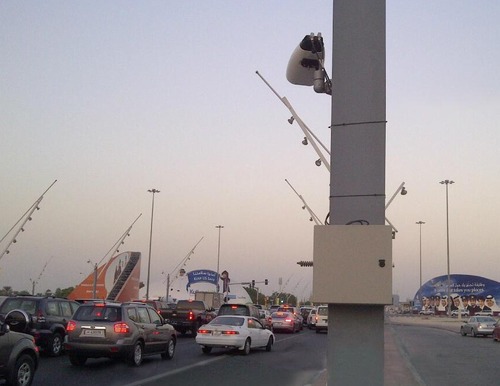
In an effort to tackle bad driving in Qatar, the Ministry of Interior plans to set up speed radars every two to four kilometers on major roads, Traffic Department Director Brig. Mohamed Saad Al Kharji has said.
Additionally, some 120 radars are being installed to catch drivers who overtake others from the right lane, the Qatar Tribune reports Al Kharji as saying.
He added that the software of speed radars that are already installed on the roads would be updated so that they could also catch such violators.
No timeline for when the cameras would be installed was disclosed. But last fall, the MOI announced it would be rolling out radars to catch queue-jumpers.
Using the “slow” right lane to overtake vehicles in the left lane is a traffic violation punishable by a QR500 ticket, but among one of several rules flouted by motorists here.
Enforcement
In Qatar, traffic violators are rarely pulled over by police officers, despite brief campaigns to step up enforcement. In 2012, plainclothes police officers began ticketing drivers who overtook other vehicles on the right.
And at the end of last year, the traffic department began a three-month campaign to ticket those who violate road rules, including drivers who hadn’t fastened their seat belts, used their phones while driving, and rode without a license.
Both initiatives were lauded by many residents who said enforcement is key to improving safety on the roads, but neither seem to have lasted.
March 9, 2014
Posted by intlxpatr |
Bureaucracy, Character, Community, Doha, Education, ExPat Life, Law and Order, Living Conditions, Qatar, Safety |
Leave a comment
This is disgusting. We’ve all known it’s true. The warrior culture protects those cowards who impose themselves sexually on both men and women. God willing, things will change. It’s already started, with the relieving of those in power who have imposed themselves on women who came forward with their complaints. Let there be more, until this culture is wiped clean of their disgrace.
Rape isn’t about sex. It’s about power. Rape is a personal violation.
It’s time for the good men and women in the military to police this up, to stop the outrage. Expose those bullies and cowards who prey on others.
Military Sex Abuse Investigation: Documents Reveal Chaotic Punishment Record
AP
by RICHARD LARDNER and YURI KAGEYAMA
TOKYO (AP) — At U.S. military bases in Japan, most service members found culpable in sex crimes in recent years did not go to prison, according to internal Department of Defense documents. Instead, in a review of hundreds of cases filed in America’s largest overseas military installation, offenders were fined, demoted, restricted to their bases or removed from the military.
In about 30 cases, a letter of reprimand was the only punishment.
More than 1,000 records, obtained by The Associated Press through the Freedom of Information Act, describe hundreds of cases in graphic detail, painting a disturbing picture of how senior American officers prosecute and punish troops accused of sex crimes. The handling of allegations verged on the chaotic, with seemingly strong cases often reduced to lesser charges. In two rape cases, commanders overruled recommendations to court-martial and dropped the charges instead.
Even when military authorities agreed a crime had been committed, the suspect was unlikely to serve time. Of 244 service members whose punishments were detailed in the records, only a third of them were incarcerated.
The analysis of the reported sex crimes, filed between 2005 and early 2013, shows a pattern of random and inconsistent judgments:
—The Marines were far more likely than other branches to send offenders to prison, with 53 prison sentences out of 270 cases. By contrast, of the Navy’s 203 cases, more than 70 were court-martialed or punished in some way. Only 15 were sentenced to time behind bars.
—The Air Force was the most lenient. Of 124 sex crimes, the only punishment for 21 offenders was a letter of reprimand.
—Victims increasingly declined to cooperate with investigators or recanted, a sign they may have been losing confidence in the system. In 2006, the Naval Criminal Investigative Service, which handles the Navy and Marine Corps, reported 13 such cases; in 2012, it was 28.
In two cases, both adjudicated by the 1st Marine Aircraft Wing, the accusers said they were sexually abused after nights of heavy drinking, and both had some evidence to support their cases. One suspect was sentenced to six years in prison, but the other was confined to his base for 30 days instead of getting jail time.
Taken together, the cases illustrate how far military leaders have to go to reverse a spiraling number of sexual assault reports. The records also may give weight to members of Congress pushing to strip senior officers of their authority to decide whether serious crimes, including sexual assault cases, go to trial.
“How many more rapes do we have to endure to wait and see what reforms are needed?” asked Sen. Kirsten Gillibrand, D-N.Y., chair of the Senate Armed Services personnel subcommittee. She leads a vocal group of lawmakers from both political parties who argue that further reforms to the military’s legal system are needed.
Air Force Col. Alan Metzler, deputy director of the Defense Department’s Sexual Assault Prevention and Response Office, said the department “has been very transparent that we do have a problem.” He said a raft of changes in military law is creating a culture where victims trust that their allegations will be taken seriously and perpetrators will be punished.
The number of sexual assault cases taken to courts-martial has grown steadily — from 42 percent in 2009 to 68 percent in 2012, according to DOD figures. In 2012, of the 238 service members convicted, 74 percent served time.
That trend is not reflected in the Japan cases. Out of 473 sexual assault allegations within Navy and Marine Corps units, just 116, or 24 percent, ended up in courts-martial. In the Navy, one case in 2012 led to court-martial, compared to 13 in which commanders used non-judicial penalties instead.
The authority to decide how to prosecute serious criminal allegations would be taken away from senior officers under a bill crafted by Gillibrand that is expected to come before the Senate this week. The bill would place that responsibility with the trial counsel who has prosecutorial experience.
Senior U.S. military leaders oppose the plan.
“Taking the commander out of the loop never solved any problem,” said Sen. Lindsey Graham, R-S.C., the personnel subcommittee’s top Republican. “It would dismantle the military justice system beyond sexual assaults. It would take commanders off the hook for their responsibility to fix this problem.”
Gillibrand and her supporters argue that the cultural shift the military needs won’t happen if commanders retain their current role in the legal system.
“Skippers have had this authority since the days of John Paul Jones and sexual assaults still occur,” said Lory Manning, a retired Navy captain and senior fellow at the Women in the Military Project. “And this is where we are.”
___
Lardner reported from Washington. Associated Press writer Leon Drouin-Keith in Bangkok and AP researcher Rhonda Shafner in New York contributed to this report.
February 9, 2014
Posted by intlxpatr |
Bureaucracy, Character, Community, Counter-terrorism, Crime, Cultural, Law and Order, Living Conditions, Political Issues, Relationships, Social Issues, Statistics, Survival, Values |
Leave a comment
This is big news for people in my area, because they often flash lights to warn of speed traps ahead.
Warning Drivers Of Speed Traps With Flashing Headlights Is Free Speech
A federal judge in St. Louis has set the benchmark
A federal judge in St. Louis ruled Monday that a driver flashing their lights to warn other drivers of an impending speed trap is protected free speech.
On November 22, 2012 Michael Elli received a ticket for flashing his lights to warn fellow drivers of a speed trap, according to Fox 2. The American Civil Liberties Union helped Elli fight the $1,000 ticket all the way to federal court.
Judge Henry Autrey of St. Louis ruled a driver has the right to flash their lights under the First Amendment. Autrey issued an injunction to stop Ellisville Police from enforcing the policy.
“If you’re at the gas station on the corner and someone says ‘Hey be careful over there, there’s a speed trap,’ that’s protected speech. You can’t be ticketed for that. This is no different,” Tony Rothert, an attorney for the American Civil Liberties Union, told Fox 2.
A lawyer for the police in Ellisville said the department isn’t affected by the ruling, as this kind of ticket has only been issued five or so times in the last decade. Across the country, however, the ruling will be considered the benchmark for such cases.
February 5, 2014
Posted by intlxpatr |
Communication, Community, Crime, Cultural, ExPat Life, Financial Issues, Free Speech, Law and Order, Safety, Social Issues | speed traps |
Leave a comment




 Here There and Everywhere