The War We are Losing: Assault of American Servicewomen
Shocking, and sad. What can be worse than serving your country and to be assaulted by a member of your own team? To double that shock and betrayal, to have the team captains bury your injury for the sake of the team?? I thank God for the gals that are taking their cases to civil court and making a stink. Sometimes, that is what it takes to make people pay attention.
I have a friend, a friend in her sixties. She has served in Iraq and Afghanistan as a civilian, and she has had senior officers stalk and attack her. She is disgusted that senior leaders could feel so entitled, and so free from constraints.
I can’t print this whole article here, but it is fascinating. You can read the entire article from Huffpost: HERE.
Active-duty female personnel make up roughly 14.5 percent — or 207,308 members — of the more than 1.4 million Armed Forces, according to the Department of Defense.
One in three military women has been sexually assaulted, compared to one in six civilian women, according to Defense. According to calculations by The Huffington Post, a servicewoman was nearly 180 times more likely to have become a victim of military sexual assault (MSA) in the past year than to have died while deployed during the last 11 years of combat in Iraq and Afghanistan.
According to the most recent report by the Pentagon’s Sexual Assault Prevention and Response Office, 3,192 sexual assaults were reported out of an estimated 19,000 — roughly 52 a day — between Oct. 1, 2010, to Sept. 31, 2011. The department estimates that only roughly 14 percent of the assaults were reported. The majority of sexual assaults each year are committed against service members by service members, SAPRO reports. While MSA does not affect only women, the office characterizes the “vast majority” of victims as female junior enlists under the age of 25, and the “vast majority” of perpetrators as male, older (under the age of 35) and generally higher-ranking.
Last Tuesday, Defense Secretary Leon Panetta ordered a sweeping review of all initial military training across the services: Army, Navy, Air Force, Marine Corps and Coast Guard. The move resulted in part from mounting pressure at Lackland Air Force Base in Texas, where at least 43 women have recently come forward as victims of sexual assault. Every aspect of training, from the selection of instructors who directly supervise trainees to the number of female instructors, is under consideration. And a day after Panetta issued the directives, Defense officials revealed that Jeffrey A. Sinclair — a brigadier general with five combat tours behind him — is facing possible courts martial on charges ranging from inappropriate relationships with female subordinates to forcible sodomy.
On Friday, Panetta called the military’s record on prosecuting MSA an “outrage.”
Panetta’s refrain for years has been heartening: “One sexual assault is too many.”
To which Havrilla responds, “This whole concept of ‘zero tolerance,’ it’s just words and no action.”
“You can’t leave. You can’t quit. You can’t walk away.”
We were in the military when the first women were sent to serve with formerly all-male battalions. There was a lot of controversy, and a lot of chagrin among the men. I think those first women were some of the bravest women ever. Almost forty years later, the battle is still being fought. Militaries attract the guys with high testosterone, the guys who don’t think the rules, laws and boundaries apply to them – and slowly, slowly, they have to be brought to understand that yes, the rules apply to them, and that forcible sex with another woman – or man – is OFF LIMITS. Bravo to those brave women who go public and create awareness and disgust for this problem. Evil whens men get away with this despicable crime.
Iran to Isolate Iranians from the Internet?
Engaget publishes the information that Iran intends to isolate Iranians in Iran from the global ‘net. Makes sense to me . . . if I am running a country where I don’t want my people exposed to what is happening in the rest of the world, when I want to create my own perceptions of reality, if I don’t want people adopting ways contrary to my own beliefs AND I have the power to enforce it . . . But does anyone in the world truly have the power to isolate a population?
It seems to me that the quickest way to encourage people to find a new way to do something is to try to make it impossible for them to do it. Forbidding access incites clever minds to find work-arounds . . .
So what kind of “Spring” happens in a country where strict fundamentalists have already taken over . . . ?
Iran announces plans to create isolated local internet system, fate of global access unknown
By Sean Buckley posted Sep 23rd 2012 6:07PM
Iranians have been having trouble accessing YouTube, Gmail and other Google services for some time now, but their digital world may be growing even smaller — Iran announced today that it plans to shuffle citizens onto its own domestic version of the web. Reuters reports that officials plan to connect citizens to the national information network that’s currently in use at government agencies. Iran hopes to complete the transition by March of next year, and is already taking steps to isolate its population from certain international services. “Google and Gmail will be filtered throughout the country until further notice,” an Iranian official added, noting that the ban would commence in “a few hours.”
Some locals, such as the Iranian Students’ News Agency, are attributing the ban to recent protests sparked by a trailer for an anti-Islamic film on YouTube called Innocence of Muslims, but the government has made no official comment on the reason behind the ban. The state isn’t clear on the fate of the global internet in Iran, either — although it has talked about creating an isolated national network before. Here’s hoping the new network will be a compliment to the Persian web, and not a substitute.
She Cried

“I wanted to thank you,” I said to my son’s sixth grade teacher “I can’t imagine how hard it was to get 30 sixth graders to go through the paper-writing process, but I know my son learned from it and he will use the skills you taught him for many years to come. One day he will thank you in his heart, but I wanted to thank you now.”
It was one of those small expat military communities, where your child’s teacher also goes to the same church you go to and shops in the same commissary. We were at a church benefit, chatting before dinner.
She started crying.
She told me that every year, she teaches the sixth graders to write papers, and they hate it. She started with library research, making bibliography cards on little index cards, formal writing, footnotes and a formal bibliography at the end with a formal title page at the beginning.
I was the first one who had ever thanked her. She believed in what she was doing, but it was so hard, and she never got any positive feedback.
Imagine. Do you remember what sixth graders are like? This lady had courage, and persistence. She gave these students (in spite of themselves) a skill which would take them through the rest of high school and into college. They learned to do it right, so they never had to embarrass themselves by turning in an inferior, poorly-done paper. It was a great gift she gave these students – and no one thanked her.
Well, it would be a rare, very rare sixth grader who has the maturity to understand that while it was a difficult and demanding section in their school year, it was a tool in their tool box of life, a gift that just kept on giving.
Thank you. Thank you, all the teachers out there who knock themselves out to give our children (and grandchildren) the tools they need to be good students and good citizens.
Wooo HOOO, Saudi Arabia Allowing Female Olympic Athletes
It hasn’t been so long in our own country since Title IX made it possible for more and more women to participate in athletic events, making funding possible, giving women in the United States an opportunity to participate in healthy athletic activities.
RIYADH, June 25 (Reuters) – Saudi Arabia will allow its women athletes to compete in the Olympic Games for the first time ever in London this summer, the Islamic kingdom’s London embassy said on its website.
Human rights groups had called on the International Olympic Committee to bar Saudi Arabia from competing in London, citing its failure ever to send a woman athlete to the Olympics and its ban on sports in girls’ state schools.
Powerful Muslim clerics in the ultra-conservative state have repeatedly spoken out against the participation of girls and women in sports.
“I think this is a victory for Saudi sportswomen and hopefully it will promote sports and women’s health awareness for the Saudi society,” said Lina al-Maeena, co-founder of Jeddah United Sports Company, a rare women’s exercise club that runs a female basketball team.
In Saudi Arabia women have a lower legal status than men, are banned from driving and need a male guardian’s permission to work, travel or open a bank account.
Under King Abdullah, however, the government has pushed for them to have better education and work opportunities and will allow them to vote in future municipal elections, the only public polls held in the kingdom.
Saudi women will be able to compete in the London Olympics only if they reach the qualifying standard for their event, and the Games opens in just over one month, on July 27.
“The kingdom of Saudi Arabia is looking forward to its complete participation in the London 2012 Olympic Games through the Saudi Arabian Olympic Committee, which will oversee the participation of women athletes who can qualify for the Games,” said a statement published on the embassy website.
The woman most likely to compete under the Saudi flag in London, show jumper Dalma Malhas, was ruled out on Monday when the World Equestrian Federation (FEI) said the 20-year-old’s mare Caramell KS had been sidelined by injury for a month during the qualifying period and had missed a June 17 deadline.
“Regretfully the Saudi Arabian rider Dalma Rushdi Malhas has not attained the minimum eligibility standards and … will not be competing” at the London Olympics, FEI secretary general Ingmar De Vos told the FEI website (www.fei.org).
Malhas won individual bronze at the junior Olympics in Singapore in 2010, but without official support or recognition.
In April the head of the General Presidency of Youth Welfare, which regulates sport in Saudi Arabia, said it would not prevent women from competing but they would not have official government endorsement.
The government’s role would be limited to ensuring that Saudi women’s participation “is in the proper framework and in conformity with sharia”, he said.
The IOC said on Monday that talks with the Saudis were “ongoing” and that “we are working to ensure the participation of Saudi women at the Games in London”.
The head of the kingdom’s Olympic mission, Khalid al-Dakheel, told Reuters on Sunday that he was unaware of any developments allowing women to participate.
Top Saudi clerics, who hold government positions and have always constituted an important support base for the ruling al-Saud royal family, have spoken against female participation in sports.
In 2009 a senior cleric said girls risked losing their virginity by tearing their hymen if they took part in energetic sport.
Physical education is banned in girls’ state schools in the kingdom, but Saudi Arabia’s only female deputy minister, Noura al-Fayez, has written to Human Rights Watch saying there is a plan to introduce it. (Reporting by Angus McDowall and Asma Alsharif; editing by Tim Pearce)
Qatar’s Balancing Act (from National Post)
Fascinating article on Qatar – thank you, John Mueller, who sends me these great news articles.

From the National Post
Qatar’s balancing act
Fadi Al-Assaad, Reuters Files
Qatar’s Emir, Sheikh Hamad bin Khalifa Al-Thani, has steadily built a reputation for mediation and seeks to be regarded as an “honest broker” in the Middle East.
TwitterEmail
inShare
Peter Goodspeed, National Post · Feb. 25, 2012 | Last Updated: Feb. 25, 2012 5:16 AM ET
The tiny country of Qatar used the slogan “Expect the Amazing” when it successfully bid to host soccer’s 2022 World Cup.
It’s a phrase that could summarize the reign of Emir Sheik Hamad bin Khalifa Al-Thani, who in just 17 years has turned a small Arabian peninsula of salt and sand flats, once one of the poorest countries in the Persian Gulf, into the world’s richest country and possibly the Middle East’s most influential state.
A former British protectorate, which was noted for its declining pearl fishery when it became independent in 1971, Qatar was once described by the Lonely Planet Travel Guide as “possibly the most boring place on Earth.”
Now, according to the World Bank, its 250,000 citizens and 1.5 million foreign workers have the highest per capita income in the world (US$84,000, twice that of the United States) and an economy that outstripped China by growing 15.8% last year.
Since 2006, Qatar has been the world’s largest exporter of liquefied natural gas and the kingdom is transforming its new wealth into worldwide influence.
Qatar recently led the Arab League’s expulsion of Syria and, on Friday, called for the creation of an Arab military force to open humanitarian corridors to protect civilians in Syria.
Last month, it allowed Afghanistan’s Taliban to open an office in Doha to facilitate peace talks with the U.S.
And in the spring, it was the first Arab country to recognize the rebel government in Libya.
The emirate sent six Mirage fighters to Crete to help NATO enforce a no fly zone over Libya.
It also supplied rebels with the fuel, weapons, cash and the training they needed to overthrow dictator Muammar Gaddafi. Qatari special forces provided basic infantry training in the Nafusa Mountains, west of Tripoli and some helped lead the final assault on Col. Gaddafi’s compound in the capital.
They were so proud of their achievement, they hung a Qatari flag from the wreckage of his palace.
“The Qataris have really adopted a kind of adventurous foreign policy in the last couple of years and shown a willingness to send special forces to these kind of areas of conflict,” said Andrew McGregor, senior editor of the Global Terrorism Monitor for the Jamestown Foundation.
“They’ve used their considerable wealth to supply arms and whatever else is needed.
“I would be keeping a close eye on what they are doing [in Syria]. They are rapidly emerging as a real power in the Arab League, despite their size. They are very influential and very wealthy, and they have shown a willingness to be engaged.”
The Emir, Sheikh Hamad bin Khalifa Al-Thani, sometimes referred to disparagingly as the “Arab World’s Henry Kissinger,” has steadily built a reputation for mediation and seeks to be regarded as an “honest broker” in the Middle East.
“Since the mid-1990s, Qatar has pursued an activist foreign policy, using its affluence, unthreatening military position and skills as a mediator to interject itself in conflicts around the Middle East and beyond,” said David Roberts, deputy director of the Royal United Services Institute’s Doha Centre.
In recent years, Sheikh Hamad has carefully inserted himself in conflicts in Libya, Lebanon, Gaza and the West Bank, Sudan, Syria, Yemen and Afghanistan.
In 2008, an agreement negotiated in Doha averted another civil war in Lebanon by establishing a power sharing agreement between the country’s different factions. Around the same time, Qatar helped negotiate a short-lived ceasefire in Yemen, mediated a border dispute between Djibouti and Eritrea, and hosted peace talks between Sudan and rebel groups in Darfur.
A regional actor with international reach, Sheikh Hamad has pursued a foreign policy that is ripe with conflicts and contradictions.
Qatar maintains good relations with Iran, while still offering the U.S. its biggest and most important air base in the Middle East at al-Udeid, a few kilometres outside Doha.
Unlike most Arab states, Qatar has generally had good relations with Israel and allowed the Israelis to maintain a commercial office in Doha until the 2009 Gaza invasion.
At the same time, it has warm relations with Israel’s enemies Hamas and Hezbollah, and provides safe haven to hardline Islamists from all over the Arab world.
Leaders of the Muslim Brotherhood in Egypt and Syria fled to Qatar in the 1960s and 1970s, even though the kingdom’s rulers frown on organized political Islam and ban all political parties.
Qatar “has a reputation for ‘omni-balancing’ between seemingly incompatible policies,” said Kristian Coates Ulrichsen, a Gulf expert at the London School of Economics.
“Qatar’s rise, seemingly from nowhere, is rooted in deeper political, economic and security shifts and, in turn, is reconfiguring the balance of regional power.”
Those changes highlight Sheikh Hamad’s own rise to power and his reign in Qatar, where his family has ruled since the 19th century.
Raised by a maternal uncle’s family, after his mother died young, the Emir attended the Royal Military Academy at Sandhurst, west of London, graduating in 1971, the year Qatar won its independence and when its first natural gas field was discovered.
He was made a lieutenant colonel in Qatar’s army and, after his father deposed an uncle to become emir in 1972, he rapidly rose to become commander-in-chief of its armed forces.
As crown prince, Sheikh Hamad was gradually given the power to run the country day-to-day, while his father cultivated a taste for extravagance and spent most of his time on the French Riviera.
Sheikh Hamad oversaw development of Qatar’s oil and gas industry and carefully planned an economy that provides Qataris with free education, health care, housing and utilities – and no taxes.
But when his father returned home briefly in 1995 and arbitrarily demoted another son from his position as prime minister, Crown Prince Sheikh Hamad staged a bloodless coup. He informed his father by telephone while he was holidaying in Switzerland.
The old emir returned to the Gulf the following year, publicly disowning his son and trying to drum up support for a countercoup, but Sheik Hamad snuffed out the plot by freezing billions of dollars in his father’s overseas bank accounts.
Then, just 44 and the youngest ruler in the Gulf, he set about to reform and redefine Qatar.
Surrounding himself with young, Western-educated advisors, he drew up a longterm plan to develop a post-oil knowledge-based economy.
He has allocated 40% of Qatar’s budget between now and 2016 to massive infrastructure projects, including an $11billion international airport, a $5.5-billion deep-water seaport and a $1-billion transport corridor in Doha, as well as $20billion in new roads.
He has also invited foreign universities to establish Middle East campuses in a $100-billion Education City in Doha.
Without an elected parliament to advise him, the Emir has final say in the disposition of the country’s $70-billion to $100-billion sovereign wealth fund, which has made it a financial powerhouse internationally by investing heavily in everything from German carmakers Porsche and Volk-swagen to the Agricultural Bank of China, Harrods department store in London, a Brazilian bank, Chinese oil refineries, a Spanish soccer team and a French fashion house.
The Emir’s most influential investment was his creation of the 24-hour Arab-language Al Jazeera television network in 1996.
Granted a level of editorial independence unheard of in the Arab world, Al Jazeera is encouraged to report freely and aggressively on everything but Qatari politics, and is the most watched TV network in the Middle East.
The broadcaster was widely regarded as one of the driving forces behind the spread of the Arab Spring.
“Qatar hopes to insert itself as the key mediator between the Muslim world and the West,” Mr. Roberts said.
“Qatar sees its role as a highly specialized interlocutor between the two worlds, making – from the West’s point of view – unpalatable but necessary friendships and alliances with anti-Western leaders.”
Sheikh Hamad Bin Jasem Al-Thani, Qatar’s Prime Minister and a distant cousin of the Emir, likes to say his country is small and has to be proactive to protect its interest and avoid being run over by more powerful neighbours.
“Our policy is to be friendly with everybody,” the Emir said recently in a television interview. “We are looking for peace. It doesn’t mean if two parties turn against each other, we have to go to one party. No, we would like to stick with the two parties.”
– Formerly a British protectorate, Qatar has been ruled by the Al-Thani family since the mid-1800s. The current Emir, Hamad bin Khalifa Al-Thani, overthrew his father in a bloodless coup in 1995.
– Oil and natural gas revenues have enabled Qatar to attain the highest per-capita income in the world (US$84,000 according to a report this year by Global Finance).
– Oil output at current levels should last 57 years, according to the CIA World Factbook.
– It has a zero unemployment rate and zero percentage below the poverty line.
– The mostly flat and desert land is 11,586 square kilometres – only slightly larger than Jasper National Park.
– It has a population of 848,016 – similar to the population of Edmonton.
SOURCE: NATIONAL POST NEWS SERVICES
JONATHON RIVAIT / NATIONAL POST
pgoodspeed@nationalpost.com
Malek Jandali Freedom Qashoush Symphony مالك جندلي حرية سيمفونية القاشوش
We have spent many happy hours and days in Syria. We grieve for our Syrian friends, for those living in Homs and Hama, and all those seeking freedom from tyranny.
Houston CC: Qatar Unable to Credit Coursework?
TThe western universities in Qatar have fought long and hard to have accountability and enforced standards . . . and there are always challenges. Here is a hilarious article about one such newer university facing significant challenges (thanks, John! )
Faulty planning may be to blame for HCC Qatar campus’s problems
By Jeannie Kever, Houston Chronicle
Updated 09:01 p.m., Saturday, February 4, 2012

As top officials at Houston Community College were collecting awards and publishing papers about their international ventures last year, their effort in Qatar was struggling with disagreements over accreditation, high faculty turnover and growing worries that the dean hired by the Qataris to lead the effort was working against them.
The problems, detailed in emails and internal documents obtained through a public records request, raise questions about whether HCC was prepared for the ambitious foreign undertaking.
The dean chosen by the Qatari government was replaced in November by a veteran HCC employee, Butch Herrod, as part of an administrative overhaul. Enrollment has reached 750 students, less than two years after HCC signed an agreement with the Qatari government to create that nation’s first community college.
But students have not received HCC credits for their classes there – a cornerstone of the promises made when the partnership was announced – and for now it appears unlikely their coursework will transfer to the six U.S. universities with operations in Qatar. After months of student protests, a deal signed last month will allow graduates of the new community college to enroll in Qatar University.
Things were so bad last spring an HCC administrator in Qatar wrote HCC Chancellor Mary Spangler that Community College of Qatar, or CCQ, had become known as “the Crazy College of Qatar.”
From the beginning, Spangler said the Qatar contract was a way to earn money as state funding dropped and property tax revenues remained flat. HCC records indicate the college has collected $640,034 from the deal; it projects a profit of $4.6 million by 2015, slightly more than expected.
Deputy Chancellor Art Tyler said in a recent interview that things now are running smoothly, and that misunderstandings are unavoidable in any international operation.
“The world is not exactly flat,” he said. “It may have gotten smaller over the years, thanks to technology, but when you’re dealing with people, with communities, you can’t know everything.”
Women taught separately
Among the things HCC didn’t know until just before classes began in September 2010: The Qatari government decided male and female students would be educated separately, contrary to the five-year, $45 million contract, which called for coeducational classes.
Former employees say that was just one of the surprises when they arrived in Qatar, ranging from delays in getting textbooks to worries over their exit visas.
“Things did not go smoothly at all,” said Randi Perlman, hired to teach English to Arabic-speaking students. “There were a lot of issues that came up … that I think didn’t need to happen.”
Overseas campuses
With more than 70,000 students, HCC is one of the nation’s largest community college systems, offering lower division academic classes and workforce training.
Over the past decade, it has become increasingly involved in international ventures, as well, with projects in Vietnam, Saudi Arabia, Brazil and Qatar.
Tyler said Qatar, located on the Persian Gulf, is a natural match for a Houston institution: energy industry ties, Qatar Airlines’ nonstop flights and the presence of the Qatar Consulate here. Six U.S. universities have campuses there, including Texas A&M.
The Methodist Hospital System has an office in the United Arab Emirates and is helping to build an ambulatory care center in the capital city of Doha.
Visa requirement
The first wave of HCC faculty and staff discovered after being hired – in some cases, after arriving in Doha – that their visas required them to get permission before leaving the country.
“That seemed to me to be a human-rights violation,” said Jan McNeil, a veteran English teacher who had previously worked in Singapore.
HCC offered interviews with three employees who worked in Qatar last year, all of whom said the visas posed no problem.
David Ross, chairman of the English as a second language and English departments in Qatar, said the system worked but acknowledged the six-day window to use the visas made timing tricky and the lack of multiple exit visas – standard for U.S. employees of American universities and companies there – provoked anxiety.
Internal emails also detail delays in preparing apartments for the expatriate employees, paying tuition at schools for their children and complaints about spotty Internet service.
“That whole piece of helping faculty and staff feel at home … was a challenge,” Tyler said.
‘A matter of learning’
Perlman, who now teaches at Texas A&M in College Station, attributed many of the challenges to poor planning, including hiring administrators – many of whom transferred from Houston – without experience working in a foreign country.
“You need people on the ground there, to help you get things done,” said Perlman. “They didn’t have that.”
Mark Weichold, dean and CEO of Texas A&M’s Qatar campus and a member of an interim board appointed last fall to govern CCQ, said missteps are to be expected.
“Watching HCC help get the community college established, some of the bumps are similar to what I’ve seen the other branch campuses (in Qatar) experience,” he said. “It’s a matter of learning how to do things in a different part of the world.”
Little control at top
But former employees and internal documents suggest HCC’s biggest problem came from a contract that authorized the Qatari government to hire the school’s chief academic official, giving HCC little control over decisions at the top.
Judith Hansen was hired by Qatar’s Supreme Education Council and served as dean until late last year.
Tyler declined to discuss the circumstances that led to Hansen’s departure in November.
Hansen, who had been forced out of the president’s job at Southwestern Oregon Community College in 2008 following three no-confidence votes by faculty and staff groups, did not respond to requests for comment.
But she was at the center of disputes over accreditation and whether CCQ could change HCC’s curriculum or claim it as its own.
She insisted on independence in an email to Tyler last winter: “The request for no assistance with (Southern Association of Colleges and Schools) accreditation means there is no need for HCC to be concerned about CCQ organizational chart,” she wrote.
‘Crazy College of Qatar’
Not so fast, Spangler said after Tyler passed on the message.
“We will not accept this response,” the HCC chancellor wrote to Tyler. “She is not calling the shots.”
Cheryl Sterling, an HCC administrator now in Qatar, wrote Tyler and Spangler last spring after Tyler acknowledged no HCC credit would be awarded for the spring 2011 semester.
“If students do not receive HCC credits this Spring, we will have a major crisis (all out war),” she wrote. “The Dean has held several forums assuring them of credits. … we are known as CCQ, the Crazy College of Qatar.”
At about the same time, faculty members issued a “no confidence” vote against Hansen.
John Moretta, a faculty member now in Qatar, was in contact with Spangler before the vote.
“She avoids me because she knows … that I know what she is doing is in direct contravention of so many HCC policies,” he wrote of Hansen. “Should we proceed with the faculty-senate vote of no confidence? … Please advise.”
Spangler replied the same day.
“The short answer is yes, and we didn’t have this conversation,” she told him.
Who Gets Into Heaven?
Today at Christ Church in Pensacola, when Father Neal Goldsborough gave the sermon, I had a very un-churchlike urge to get up and dance for joy. He was preaching on Matthew 25: 31 – 46, where Christ the King sits in majesty and judges who will have the kingdom of heaven, and who will burn in the lake of fire.
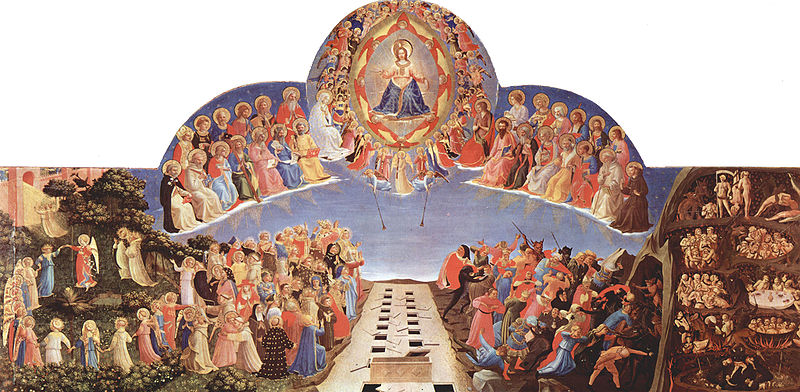
Here was today’s reading:
Matthew 25:31-46
New International Version (NIV)
The Sheep and the Goats
31 “When the Son of Man comes in his glory, and all the angels with him, he will sit on his glorious throne. 32 All the nations will be gathered before him, and he will separate the people one from another as a shepherd separates the sheep from the goats. 33 He will put the sheep on his right and the goats on his left.
34 “Then the King will say to those on his right, ‘Come, you who are blessed by my Father; take your inheritance, the kingdom prepared for you since the creation of the world. 35 For I was hungry and you gave me something to eat, I was thirsty and you gave me something to drink, I was a stranger and you invited me in, 36 I needed clothes and you clothed me, I was sick and you looked after me, I was in prison and you came to visit me.’
37 “Then the righteous will answer him, ‘Lord, when did we see you hungry and feed you, or thirsty and give you something to drink? 38 When did we see you a stranger and invite you in, or needing clothes and clothe you? 39 When did we see you sick or in prison and go to visit you?’
40 “The King will reply, ‘Truly I tell you, whatever you did for one of the least of these brothers and sisters of mine, you did for me.’
41 “Then he will say to those on his left, ‘Depart from me, you who are cursed, into the eternal fire prepared for the devil and his angels. 42 For I was hungry and you gave me nothing to eat, I was thirsty and you gave me nothing to drink, 43 I was a stranger and you did not invite me in, I needed clothes and you did not clothe me, I was sick and in prison and you did not look after me.’
44 “They also will answer, ‘Lord, when did we see you hungry or thirsty or a stranger or needing clothes or sick or in prison, and did not help you?’
45 “He will reply, ‘Truly I tell you, whatever you did not do for one of the least of these, you did not do for me.’
46 “Then they will go away to eternal punishment, but the righteous to eternal life.”
When he started out, I was a little nervous, because I was afraid he was going to talk about the fat sheep and the thin sheep, but that was the reading from Ezekiel:
(Ezekiel 34:11-16
New International Version (NIV)
11 “‘For this is what the Sovereign LORD says: I myself will search for my sheep and look after them. 12 As a shepherd looks after his scattered flock when he is with them, so will I look after my sheep. I will rescue them from all the places where they were scattered on a day of clouds and darkness. 13 I will bring them out from the nations and gather them from the countries, and I will bring them into their own land. I will pasture them on the mountains of Israel, in the ravines and in all the settlements in the land. 14 I will tend them in a good pasture, and the mountain heights of Israel will be their grazing land. There they will lie down in good grazing land, and there they will feed in a rich pasture on the mountains of Israel. 15 I myself will tend my sheep and have them lie down, declares the Sovereign LORD. 16 I will search for the lost and bring back the strays. I will bind up the injured and strengthen the weak, but the sleek and the strong I will destroy. I will shepherd the flock with justice.
20 “‘Therefore this is what the Sovereign LORD says to them: See, I myself will judge between the fat sheep and the lean sheep. 21 Because you shove with flank and shoulder, butting all the weak sheep with your horns until you have driven them away, 22 I will save my flock, and they will no longer be plundered. I will judge between one sheep and another. 23 I will place over them one shepherd, my servant David, and he will tend them; he will tend them and be their shepherd. 24 I the LORD will be their God, and my servant David will be prince among them. I the LORD have spoken.
Since I might be mistaken for one of the fatter sheep, you can understand why I was a little nervous. Also, I had a huge “AHA!” moment living in Jordan, as the shepherd and his sheep and goats passed by my house daily. The sheep were incredibly stupid, but they trusted their shepherd, and the shepherd took good care of them. While they were excavating channels to put in underground pipes in our area, I watched the shepherd carry each sheep across the little wooden walk way, because they were too afraid to do it on their own. The goats would do it, but I still wouldn’t want to be a goat. I don’t really want to be a sheep either.
And I digress.
Here’s what Father Neal said about our gospel reading. He said Jesus doesn’t say you have to have invited him into your heart. He said that if you feed the hungry, give some water to the thirsty, welcome the stranger, clothe the needy, look after the sick and visit those in prison, ypu’re in. You’re righteous.
It’s exactly what I’ve been looking for, something scriptural to support what my heart knows – that there are those who are not Christians who are going to be in the kingdom of heaven, too. It’s not a matter of saying these words or those words, or believing exactly as “they” tell us we must believe, it is a matter of serving the king by tending to and serving his sheep. He LOVES the least of these. It gives me hope; even I might have a chance of inclusion.
Veteran’s Day: Honor Your Veterans
We will be paying for these last two wars for a long time. Veterans of these wars, many seriously, but not fatally injured by IED’s, traumatized by the activities of war are walking among us. Many of our newest vets have been in the war zones more than once.

AdventureMan is a war vet. Strong and courageous as he is, there are still times he will tear up at some of the things he witnessed in Vietnam. War is an event which resounds throughout the rest of your life.
One of the things we love about living here in Pensacola is that there are a lot of vets here, and there is a culture which honors the Veteran’s sacrifices. When we show our military ID cards in Lowe’s or Home Depot, people say “thank you for your service.” The first time it happened to me, I was caught so by surprise that my eyes leaked tears. Several restaurants are offering active duty and veterans free meals today, reduced prices, and there are many ceremonies honoring Veterans.
The military culture doesn’t like to admit that the warrior life can cause severe problems, mentally, emotionally, with the family, finding a purpose in life after military service, finding relevance in a peaceful society – our men and women come home having seen and experienced sheer horror, and find themselves alien in their own culture. Recovery can be a long, slow process. More of our severely injured vets have survived, but live with brain injuries, lost limbs, and mental wounds.

Welcome them back. Bind their wounds, be patient with their sufferings. War veterans have a high rate of suicide, often related to inability to find a job, so if you are in such a position – hire a veteran. Honor their service, shake their hand, and value their sacrifice.
Law and Order SVU: How Did They Know and When Did They Know It?
What a tragedy. Joe Paterno, fired in disgrace. Joe Paterno, the much admired, the Penn State football coach who embodied integrity, fired, disgraced. “What did he know and when did he know it?” people ask.
What astonishes me is that the situation almost exactly parallels a recent episode of Law and Order SVU about which I recently blogged, in September.
In that episode, a much-admired football coach is reported to be preying on young men in his foundation, young men for whom he gave an opportunity to ‘be someone;’ he trained them, gave them motivation and the possibility of a lot of money, fame and good things for their very poor families. His victims were burdened by a debt of gratitude, combined with the shame of male-on-male sex, which they did not want to become public knowledge. The combination of gratitude and shame kept them silent, until one spoke out. It took a lot of courage, but finally, a big star who had come through this depraved coach’s program went public, appeared before the grand jury, and set the example.
The similarities are eerie. In Law and Order, however, the coach who had preyed on young players in the showers and locker rooms did not bring down a highly regarded top-ranking program director, and a university president.
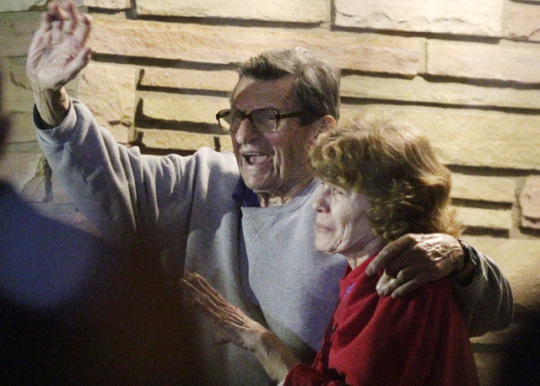
Joe, we are so sorry this has happened to you, and we hope that posterity will recognize that one poor decision is counter-balanced by a lifetime of integrity. We pray that young men victimized by Defensive Coach Jerry Sandusky will come forward, have their voices heard, and be able to move on with their lives, knowing that Sandusky will be punished. We pray for their families, who had no idea what was happening in their sons’ lives. It’s a sad time all the way around.
And thanks be to God, we live in a society where the trustees made the right decision, they fired the men who looked the other way as Sandusky victimized his young men. Thank God, this dirty laundry was not buried away to be forgotten, but brought forward, the perpetrator arrested and shamed publicly. There are times, in this world, when in the interest of the God of football, or the respect of position, when a scandal victimizing the poor and voiceless is shoved under the table, ignored, the victims sent the message that they don’t matter. As bitter as this pill is, I thank God for it, and for the increasing transparency in our society which begins to equalize justice for rich and poor.
Recent Comments
ExpatAlien on What Country am I Living … intlxpatr on Yellowstone: Old Faithful to C… Michelle on Yellowstone: Old Faithful to C… Cathy on No Grown-Ups in Charge intlxpatr on Waiting for Snow Wikipedia Donate Button

Amazina


Early Voting in Florida


 Here There and Everywhere