Your Calls – Every One – Reported to the Government
I found this on AOL News/Tech Crunch this morning. Post 9/11, did we know that the Homeland Security legislation would give the government so much power? To gather so much information on individual citizens who are not remotely suspected of committing a crime against the United States seems excessive to me.

Report: NSA Secretly Collecting Phone Records Of All U.S. Verizon Calls
Gregory Ferenstein
The National Security Administration is secretly collecting phone record information for all U.S. calls on the Verizon network. “Under the terms of the blanket order, the numbers of both parties on a call are handed over, as is location data, call duration, unique identifiers, and the time and duration of all calls,” reports The Guardian, which broke the story of the top-secret project after it obtained record of a court order mandating Verizon hand over the information.
The contents of the call are not recorded and it is also not known whether Verizon is the only cell-phone carrier complying with the massive spying project. The court order concerns all calls to, from, and within the United States.
With this so-called “metadata,” the government knows “the identity of every person with whom an individual communicates electronically, how long they spoke, and their location at the time of the communication,” explains the Guardian.
The Senate’s tech-savviest member, Ron Wyden (CrunchGov Grade: A), has been discretely warning citizens of these kinds of secretive government projects. “There is now a significant gap between what most Americans think the law allows and what the government secretly claims the law allows,” wrote Wyden and Senator Mark Udall to embattled Attorney Eric Holder.
The order apparently draws from a 2001 Bush-era provision in the Patriot Act (50 USC section 1861). The revelation dovetails similar exposes on massive government spying projects, including one project to combine federal datasets and look for patterns on anything which could be related to terrorism.
The Lord Laughs at the Wicked
When I start to fret about those in high places who oppress the poor and the workers, whose lives are so far from worrying about a roof over their head and food to eat that they will pass still laws further oppressing the poor and homeless, I take consolation in this psalm.

The Pensacola City Council is passing a draconian measure against the homeless. I’ve been so proud of Pensacola, and the citizen response to the homeless, the beds Pensacola provides, the meals the citizens, through a variety of church and social agencies, hand out. Their response is humane, and compassionate.
The homeless are attracted by the moderate climate; they are here in droves. They panhandle at the intersections, they approach you at downtown attractions. They often have dogs. For the most part, they greet people cheerfully or respectfully, and they aren’t aggressive.

They are, in truth, a kind of plague on Pensacola, but as a traveler, I have brushed my teeth in many a restroom, changed my clothes, even had to rise out a coffee stained outfit before my next flight once – these are things for which the homeless will be charged with an offense against the law. If I were without a place for the night, I might look for a safe public restroom in which to sleep, especially if I had a child with me, as so many women did when I worked with homeless women.
I understand the problem.
But I also understand the desperation of those who have little, and that very little – a public restroom, a safe place to sleep outdoors – are being taken away from them by this statute. It’s heartless, and if there is truly an accounting at the end of our lives, and an afterlife, I fear for those who put additional burdens on the poorest of the poor.
Psalm 37
Of David.
1 Do not fret because of the wicked;
do not be envious of wrongdoers,
2 for they will soon fade like the grass,
and wither like the green herb.
3 Trust in the Lord, and do good;
so you will live in the land, and enjoy security.
4 Take delight in the Lord,
and he will give you the desires of your heart.
5 Commit your way to the Lord;
trust in him, and he will act.
6 He will make your vindication shine like the light,
and the justice of your cause like the noonday.
7 Be still before the Lord, and wait patiently for him;
do not fret over those who prosper in their way,
over those who carry out evil devices.
8 Refrain from anger, and forsake wrath.
Do not fret—it leads only to evil.
9 For the wicked shall be cut off,
but those who wait for the Lord shall inherit the land.
10 Yet a little while, and the wicked will be no more;
though you look diligently for their place, they will not be there.
11 But the meek shall inherit the land,
and delight in abundant prosperity.
12 The wicked plot against the righteous,
and gnash their teeth at them;
13 but the Lord laughs at the wicked,
for he sees that their day is coming.
14 The wicked draw the sword and bend their bows
to bring down the poor and needy,
to kill those who walk uprightly;
15 their sword shall enter their own heart,
and their bows shall be broken.
16 Better is a little that the righteous person has
than the abundance of many wicked.
17 For the arms of the wicked shall be broken,
but the Lord upholds the righteous.
18 The Lord knows the days of the blameless,
and their heritage will abide for ever;
19 they are not put to shame in evil times,
in the days of famine they have abundance.
20 But the wicked perish,
and the enemies of the Lord are like the glory of the pastures;
they vanish—like smoke they vanish away.
21 The wicked borrow, and do not pay back,
but the righteous are generous and keep giving;
22 for those blessed by the Lord shall inherit the land,
but those cursed by him shall be cut off.
23 Our steps* are made firm by the Lord,
when he delights in our* way;
24 though we stumble,* we* shall not fall headlong,
for the Lord holds us* by the hand.
25 I have been young, and now am old,
yet I have not seen the righteous forsaken
or their children begging bread.
26 They are ever giving liberally and lending,
and their children become a blessing.
27 Depart from evil, and do good;
so you shall abide for ever.
28 For the Lord loves justice;
he will not forsake his faithful ones.
The righteous shall be kept safe for ever,
but the children of the wicked shall be cut off.
29 The righteous shall inherit the land,
and live in it for ever.
30 The mouths of the righteous utter wisdom,
and their tongues speak justice.
31 The law of their God is in their hearts;
their steps do not slip.
32 The wicked watch for the righteous,
and seek to kill them.
33 The Lord will not abandon them to their power,
or let them be condemned when they are brought to trial.
34 Wait for the Lord, and keep to his way,
and he will exalt you to inherit the land;
you will look on the destruction of the wicked.
35 I have seen the wicked oppressing,
and towering like a cedar of Lebanon.*
36 Again I* passed by, and they were no more;
though I sought them, they could not be found.
37 Mark the blameless, and behold the upright,
for there is posterity for the peaceable.
38 But transgressors shall be altogether destroyed;
the posterity of the wicked shall be cut off.
39 The salvation of the righteous is from the Lord;
he is their refuge in the time of trouble.
40 The Lord helps them and rescues them;
he rescues them from the wicked, and saves them,
because they take refuge in him.
League of Women Voters
My friends and I had an animated conversation about Florida politics as we sat around the table having a late breakfast at Adonna’s Bakery, down on Palafox in Pensacola. We were explaining how in the last election, if it were not for the voters handbook the League of Women Voters published, explaining exactly what a yes or no vote would mean for each proposed amendment, Florida would be stuck with constitutional amendments voters never intended to approve.

The League of Women Voters cuts through all the baloney and explains the issues, clearly and objectively. Without their clear, cool voice of reason, voters would be blown to and fro by the turbulent election rhetoric which blows at hurricane force during each election in Florida, obscuring the clearest issues. The League is neither liberal nor conservative, but contains members of all parties. Their goal is getting people to vote, and to understand the issue on which people are voting.
So grown up. So mature. So wise and clear sighted. Way too grown up for me, all these years, until, after that conversation, one of these friends sent me an invitation she had received for an upcoming League of Women Voters annual luncheon. As an added attraction, a local NPR reporter would be the speaker.

I hate meetings. It brings out the ADD child in me; I fidget, I wish I were anywhere but in the meeting.
And yet . . . this is a group I have long admired, and I want to support them. So I agreed, and we attended.
It was so much fun. These women – and men, about a fifth of the attendees were men – are people focused on ISSUES. They have study groups for how juveniles in the local area are arrested and treated in our jails and custodial facilities. They have groups which study the impact on the environment of legislative and local government decisions. They go to civic meetings, speak out, and report back to the League. This is a group of people who take positions and recommend actions! Exciting stuff.
You know I am a believer, so I might see things differently from you, or others, but I met some really cool members, people I believe I was meant to meet. One said wonderful things about my son as he practices his profession. There is no Mother’s Day gift on earth that means as much as the words she spoke, praising his ethics and integrity.
An elderly man sitting next to me was leaving this week to go to Heidelberg.
“Are you going for the closing down?” I asked, and told him I had graduated from Heidelberg American high school, lo, these many years ago. “Yes,” he replied, he has family who have lived there many years, and he has been back many times. It led to a discussion around the table, where I discovered two other women who had been in DoDs schools in Germany. What an unexpected blessing!
Every now and then, as you lead your life, you get the feeling you are exactly where you are meant to be at this very moment, and I had that feeling as I left the meeting. I am so thankful for the serendipity that led me there, and for the rush of blessings the meeting provided.
LOL, the group I thought might be stuffy and staid played this wonderful Lady Gaga video:
Mayor Emory Valentine Doesn’t Get His Way

It all started with a conversation with my Mom, during which, in a hushed voice, she told me about a neighbor “who had gotten a blue card.” A blue card? I had never heard of a blue card.
“It meant she had to leave the state!” Mom said.
Such a small thing, and such a journey it has led me on, trying to find out about the blue card and how it functioned. It led me to The History of the Juneau Alaska Police Department, and reading through that led to an hour of hilarity reading through the struggles of a small frontier town trying to bring order out of chaos and fight the battles of sewers, garbage, untethered horses, bawdy houses, and law enforcement.
Here are some examples of early actions:
1904
September, 1904 – George Kyrage (“George the Greek”) was elected to the Council and served with Mayor George Forrest, Councilmen Henry Shattuck, John Reck, Louis Lund, J.P. Jorgenson, and Henry States. Kyrage was named chairman of the Police Committee and found himself squarely between those who wanted prosperity through a wide open town, and those who demanded strict enforcement of a new ordinance prohibiting women loitering in saloons.
1910
January 7, 1910 – The conduct of a man named Al Graham was discussed and the Council ordered that he be given a “Blue Ticket”.
April 15, 1910 – The applicants for City Marshal were as follows: Charles Biernoth, W.G. Harris, Charles Meline, Mike McKenna, William Steinbeck, John Sweeney, Fred LaMarche Holmberg, and J.T. Martin. Charles Biernoth received the majority of the votes and was elected.
May 6, 1910 – City Marshal Charles Biernoth was asked to resign.
1913
April 18, 1913 – Mr. Nolan appeared before the Council and protested that the women of ill fame were allowed to live in the vicinity of the saw-mill outside of the restricted district, and the matter was referred to the Police Committee and the Chief of Police.
1914
January 2, 1914 – The City Attorney was instructed to prepare an ordinance against expectorating on the sidewalks of the City of Juneau.
-An ordinance was passed that provided punishment for pimps and moques to be set at not more than one hundred dollars.
City refuses to clean up red light district
February 6, 1914 – Councilman H.J. Raymond said that the last Grand Jury: wanted the City of Juneau to do something about cleaning up the red light district in the City. It was moved that the Chief of Police be ordered to close up every bawdy house in the City; but the motion died for lack of a second. It was then moved that the Chief of Police be instructed to stop the sale of liquor in all houses of prostitution in the City of Juneau; and again the motion died for lack of a second. It was then moved and seconded that a letter be forwarded to John Rustgard, US District Attorney, First Division of Alaska, stating that the City authorities of Juneau will be glad to lend all the aid they can in the enforcement of the law in the sale of liquor in houses of prostitution in the City of Juneau.
May 14, 1914 – A day’s labor in the Municipality of Juneau was set at eight (8) hours, common laborers were paid 35 cents per hour, and could work any number of additional hours at the same rate per hour.
1915
January 27, 1915 – A special meeting was called to hear charges of misconduct in office that have been made against Chief of Police William McBride. The Council requested that witnesses give their testimony. Harry Grove was duly sworn and testified and Charles Freegrove, Helen, and J.H. Gilpatrick were called and questioned by different councilmen. The hearing was then continued to a subsequent meeting of the Council.
January 29, 1915 – The Clerk read the resignation of William McBride from the office of the Chief of Police of the City of Juneau which took effect on February 1, 1915.
-A proposed ordinance was presented entitled “An ordinance requiring horses to be tied”.
July 7, 1916 – S.A. Judd protested that the Chief of Police had ordered him to leave town.
It makes for fascinating reading. Then I came across this sequence of reports, but for all my Googling, I cannot find out what the charges were against Chief of Police W.S. Harding:
1917
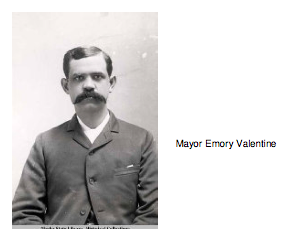
April 11, 1917 – Mayor Valentine declared that grave and serious charges have been made against W.S. Harding, Chief of Police, and that proofs are now in his possession. He further declared that an emergency existed, ordered that the office of Chief of Police be declared vacant, and stated that he will in due time appoint an emergency Chief of Police.
Councilman King asked Mayor Valentine the nature of the charges, to which Mayor Valentine replied that Mr. Harding would be given an opportunity to answer them, and that he would call a special meeting for that purpose.
April 12, 1917 – It was moved and seconded that W.S. Harding be elected to the position of Chief of Police for the coming year, to which Mayor Valentine declared out of order and stated that Mr. Harding had been suspended under the rules. Councilman Blomgren called for a vote on the adoption of the motion, and all six councilmen vote aye.
April 20, 1917 – The Clerk read the following demand: To Emory Valentine, Mayor and Common Council of the City of Juneau:
Whereas, Emory Valentine Mayor of the City of Juneau did at a public meeting held in the City of Juneau on the night of the 19th day of April, 1917, read certain affidavits purporting to contain certain charges against me as Chief of Police of Juneau, and that Emory Valentine publicly announced on the streets and public places of the Town of Juneau that he had other charges against me, I hereby demand that affidavits and all charges made against me as a public official and against my conduct, if committed and filed with the Common Council of the City of Juneau, or the Clerk of the City, and that a hearing be had immediately. Respectfully submitted, dated Juneau, Alaska, April 20, 1917. (signed) W.S. Harding
-An Executive Session was scheduled for Monday, April 23, 1917, at the hour of eight o’clock p.m. for the purpose of having the charges against W.S. Harding formally filed or presented.
-The Mayor called for the election of a person to fill the position of Chief of Police for the coming year. The Clerk read the following names as persons who had filed their applications: W.S. Harding, W.D. McMillan, E.J. Sliter, and Capt. E. Harrigan. W.S. Harding received six votes and the other applicants received none. The Mayor declared a veto on the election of W.S. Harding as Chief of Police.
-Harding appointed Dan Harrington, W.D. McMillan, and Emil Mullenbeck, to serve as police officers under him and asked for approval of the Council which was given. The Mayor declared a veto to the action of the Council.
April 27, 1917 – The Common Council of the City of Juneau, Alaska, convened in the Council Chambers of City Hall at the hour of eight o’clock p.m. on Friday, April 27, 1917, for the purpose of trying the charges against W.S. Harding, Chief of Police.
-The trial of the charges was to be heard by affidavit, and W.S. Harding was given until Monday night to file his answering affidavits, with the trial continued to Thursday, May 3, 1917 at the hour of eight o’clock p.m.
May 3, 1917 – The Common Council of the Town of Juneau, Territory of Alaska, convened in the Council Chambers of the City at the hour of eight o’clock p.m. on Thursday, May 3, 1917 – Mayor Valentine presiding. A resolution calling for the reading of the charges against W.S. Harding, Chief of Police accusing him of misconduct in office and the answering affidavits from the Chief was read.
-Affidavits of Walter Johnson, Frank Morrison, Jack Ivey, Fred Alexander, Mrytle Mercer, J.W. Felix, D. DeBlaser, F.J. Breezee, L.N. Ritter, and E. Valentine supported the charges.
-Affidavits of W.S. Harding, Emil Mullenbeck, Louise Dejonghe, E.W. Pettit, L.O. Sloane, C.O. Lindsey, Carl R. Brophy, W.D. MacMillan, A.C. Williams Jr., Frank E. Sargent, Glen C. Bartlett, H.H. Post, D.J. Harrington, George C. Burford, Edith Johnson, John B. Marshal, Harry Ellingen, and E.A. Naud were read in answer to the charges.
-The Council took a ten minute recess to consider the charges, and Mayor Valentine left the meeting.
-Following the recess, the following resolution was read: Be it resolved that W.S. Harding, Chief of Police of the City of Juneau, whom certain charges have been filed against, has been exonerated and it is the wish of the Council that he continue as Chief of Police.
May 4, 1917 – The electric light at the end of the garbage dump was out, causing trouble for boats navigating up and down the channel.
-Mayor Valentine objected to the claim of Chief Harding for his full monthly salary, saying that he was only entitled to pay for the first eleven days in April, because Harding was relieved from office on that date.
-The Clerk read Mayor Valentine’s veto message to the action of the Council electing W.S. Harding as Chief of Police on April 20, 1917, and to the action of the Council confirming the appointments of W.S. Harding, Patrolman Harrington and Mullenbeck. The following resolution was then read: Be it resolved that the veto of Mayor Valentine to the action of the Council in electing W.S. Harding, Chief of Police of the City of Juneau, Alaska on April 20, 1917, be overruled and held for naught. And be it further resolved that the veto of Mayor Valentine to the action of the Council in confirming the appointment of Patrolman Harrington and Mullenbeck on April 20, 1917, be overruled and held for naught.
Mayor Valentine served as Mayor for six terms, according to Wikipedia, and organized the volunteer fire department and designed the city’s first water system. For some reason, he really didn’t like the Chief of Police, but Harding and a lot of support among the council members, and retained his position. Fascinating stuff; brings history to life.
And you thought history was dull?
The Church Remembers Bede the Venerable
I found this while reading the daily meditation at Forward Day by Day:
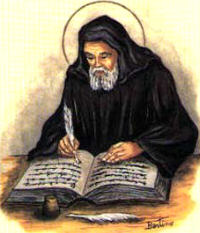
Today the church remembers Bede, the Venerable, Priest, and Monk of Jarrow, 735.
When the monks of Jarrow sang, “Lord, leave us not as orphans,” it is said that Bede would often weep. As a child he was left orphaned in a dark, hostile, and dangerous land. He was cared for and reared by kindly monks. When he was but a youngster, plague struck the monastery, almost wiping it out. The only surviving souls were Bede and the old abbot. Bede naturally had a strong sense of the importance of community, of the fine line between life and death, and of our utter dependence upon the Creator.
He rarely ventured outside the walls of Jarrow monastery, yet his knowledge of theology, geography, and language was worthy of the most sophisticated of his time in Western Europe. He wrote a number of excellent books on various subjects, but he is best remembered for his Ecclesiastical History of the English People. This work has justly earned for him the title “Father of English History.” Unlike some of the careless historians of his day, he was meticulous in listing his authorities and sources. He took care to separate known fact from hearsay, but his descriptions are lively and dramatic.
Bede thought of himself as a teacher, and he seems to have built most of his teaching around the Divine Offices which the monks read daily. It is altogether fitting that he was pronounced a “Doctor of the Church” by Pope Leo XIII. Bede’s remains rest in Durham.
May the riches of Bede’s scholarship inspire us to fill our minds with the story of your work among us, O God. Amen.
Heavenly Father, you called your servant Bede, while still a child, to devote his life to your service in the disciplines of religion and scholarship; Grant that as he labored in the Spirit to bring riches of your truth to his generation, so we, in our various vocations, may strive to make you known in all the world; through Jesus Christ our Lord, who lives and reigns with you and the Holy Spirit, one God, for ever and ever. Amen.
Bloggers Create Freedom Friday in Oppressed Eritrea
I heard whispers of this on National Public Radio, and found this write up on The International Business Times website. The message is simple – in a country where even a glance can be interpreted as treason, express your non-support of the government by STAYING AT HOME ON FRIDAY, the day Ethiopians usually go out and visit with friends, gather together and mingle. Ghandi would smile; this is civil expression at it’s most civil 🙂
Let the empty streets speak for you. LOL @ a tyrant making staying at home a crime against the government!
Eritrean bloggers outside of Ethiopia started it, smuggling an old Eritrean phone book out of the country and making calls to acquaintances – and strangers – in Eritrea. People didn’t even have to respond. they could just listen . . . then they developed a robo-call to help them enlarge the number they could reach.
Eritrea is considered one of the continent’s most opaque countries. National elections have not been held in the Horn of Africa country since it gained independence in 1993. Torture, arbitrary detention and severe restrictions on freedom of expression remain routine.
President Isaias Afwerki does not tolerate any independent media, the internet is strictly controlled and Reporters without Borders recently named it 179th out of 179 countries for freedom of expression.
It is illegal to criticise the government, prompting the Eritrean diaspora to set up a campaign to reverse the Arab-style call to take to the streets every Friday by emptying the streets in protest.

“We made phone calls from diaspora to Eritrea,” Meron Estefanos toldIBTimes UK. “We have a phone catalogue and called random numbers every Friday, telling them to stay at home and think about problems in our country.”
The phone calls “give them [Eritreans within the country] an opportunity to protest without risking too much”, according to Freedom Friday’s coordinator in the UK Selam Kidane.
The activists turned to a computerised auto-dialer called robocall to spread hundreds of thousands of taped messages to Eritrean phones. “It is time to restore our liberty and dignity” messages were sent automatically.
In another message, the mother of renowned political prisoner Aster Yohannes recalls the fate of her daughter, who was arrested in 2003 and has disappeared.
After two years, the movement is finally gaining momentum inside the country.
“Now they trust us inside the country, we have our team in Eritrea that puts out posters and leaflets late at night,” Estefanos said.
“The plan now that we have their trust is asking them to go out and demonstrate.”
About 1,500 Eritreans leave their country every month, according to the United Nations, paying up to 30,000 euros ($39,500) each to seek a new life free of grinding poverty and repression.
Earlier this year, Amnesty International put the spotlight on Eritrean asylum-seekers who are kidnapped from Sudanese refugee camps by the local Rashaida tribe, sold to Bedouin criminals in Egypt’s Sinai peninsula and severely abused while they are held for ransom.
One thousand refugees are held captive in the Sinai, according to reports. About 7,000 people in total may have been tortured and 4,000 may have died as a result of the people-trafficking in humans from 2009 to October 2012, according to recent data. A total of 3,000 people disappeared from 2007-11.
Maldives President Urges Patience in Lashing Sentence of Rape Victim
Little drops of water, little grains of sand, make the mighty ocean and the beauteous land . . .
Little drops of water, in the form of expressions of international outrage against the sentence of 100 lashings for a 15 year old girl, impregnated by her stepfather, who bore his still-born babe, and was ordered punished by the court system for immorality. A call to express outrage by boycotting travel to the Maldives seems to have gotten the attention of the government. It appears they will try to find a way to avoid this grueling punishment . . . thanks to the attention being paid.
From the English edition of Haveeru Online:
President Dr Mohamed Waheed Hassan Manik on Tuesday urged patience from the international community in the case of the 15 year old alleged rape victim who received a flogging after being convicted of adultery in a separate incident.
The conviction had sparked an international outcry and condemnation from rights groups such as Amnesty International. While an online petition condemning the Maldives over the sentencing has received over two million signatures. The petition, started by New York-based campaign group avaaz.org, calls on President Waheed to intervene and has been signed by over two million users.
“We appreciate the international compassion for this young woman and ask for your patience as this case moves through the judicial system,” President Waheed said in a statement.
“Currently the case is being appealed and I have urged the judiciary to resolve this matter as quickly as possible.”
“This case should never have been presented in the courts and we are working to ensure that cases like this are never brought to the courts again.”
In the statement, President Waheed also assured that the young woman remains under the care of the Gender Ministry and is receiving the appropriate physical and psychological counseling at this time.
“As both the President and as a father, I am fully committed to protecting and advancing the rights of women and girls in the Maldives and throughout the world and share your deep concern about this young victim.”
In its attempt to pressure the Maldives government to overturn the sentence, Avaaz had called for tourism to be boycotted.
“Tourism is the big earner for the Maldives elite, including government ministers. Let’s build a million-strong petition to President Waheed this week, then threaten the islands’ reputation through hard-hitting ads in travel magazines and online until he steps in to save her and abolish this outrageous law,” Avaaz said on its website.
In that regard, President noted that the Maldives is a young democracy working to balance religious faith with new democratic values and asked the international community to support as partners as the country works through this challenge.
“A boycott on tourism will only serve as a setback to the economic opportunities and rights we are all striving to uphold for women, girls and the hardworking Maldivian people in general,” Waheed stressed.
The 15 year old girl who gave birth and buried the baby in Shaviyani Atoll Feydhoo had been sentenced to eight months under house arrest and 100 lashes after the Juvenile Court found her guilty of pre marital sex.
Prosecutors have maintained that the 15 year old was charged with adultery over another case which came to light during the investigation of the buried baby.
The baby born last June was found buried in the bath house of the girl’s home. The child delivered out of wedlock was dead at the time of discovery. Charges have been filed against the 15 year old’s mother and step-father over the deliberate murder of the baby.
Shadrach, Meshach and Abednigo Survive the Test of Fire
Some of the stories you come across in the Bible are so horrifying – and so human – that they still have a compelling immediacy. People do the most horrible things to one another, it mystifies me. This King, Nebuchadnezzar, is so incensed that his Jewish bureaucrats won’t bow down and worship his statue that he orders them cast into a furnace, which he heats seven times hotter than normal. That’s pretty angry!

Daniel 3:19-30
19 Then Nebuchadnezzar was so filled with rage against Shadrach, Meshach, and Abednego that his face was distorted. He ordered the furnace to be heated up seven times more than was customary, 20and ordered some of the strongest guards in his army to bind Shadrach, Meshach, and Abednego and to throw them into the furnace of blazing fire. 21So the men were bound, still wearing their tunics,* their trousers,* their hats, and their other garments, and they were thrown into the furnace of blazing fire.
22Because the king’s command was urgent and the furnace was so overheated, the raging flames killed the men who lifted Shadrach, Meshach, and Abednego. 23But the three men, Shadrach, Meshach, and Abednego, fell down, bound, into the furnace of blazing fire.
24 Then King Nebuchadnezzar was astonished and rose up quickly. He said to his counsellors, ‘Was it not three men that we threw bound into the fire?’ They answered the king, ‘True, O king.’
25He replied, ‘But I see four men unbound, walking in the middle of the fire, and they are not hurt; and the fourth has the appearance of a god.’* 26Nebuchadnezzar then approached the door of the furnace of blazing fire and said, ‘Shadrach, Meshach, and Abednego, servants of the Most High God, come out! Come here!’
So Shadrach, Meshach, and Abednego came out from the fire. 27And the satraps, the prefects, the governors, and the king’s counsellors gathered together and saw that the fire had not had any power over the bodies of those men; the hair of their heads was not singed, their tunics* were not harmed, and not even the smell of fire came from them.
28Nebuchadnezzar said, ‘Blessed be the God of Shadrach, Meshach, and Abednego, who has sent his angel and delivered his servants who trusted in him. They disobeyed the king’s command and yielded up their bodies rather than serve and worship any god except their own God. 29Therefore I make a decree: Any people, nation, or language that utters blasphemy against the God of Shadrach, Meshach, and Abednego shall be torn limb from limb, and their houses laid in ruins; for there is no other god who is able to deliver in this way.’ 30Then the king promoted Shadrach, Meshach, and Abednego in the province of Babylon.
When I read this, I think of the recent legislation proposed in Kuwait against insulting God or his prophets. Let men insult. Let them build their gods, their statures, let them pursue their little gods of vanity, power and wealth. The one true God laughs. He holds all the true power. He doesn’t need our protection; he is in charge.
In Florida, some friends complain about “the law that says our kids can’t pray in school.” There is no law that says kids can’t pray in school. Kids pray in school all the time! I did, specially when I had a really hard test I hadn’t prepared adequately for 🙂 What the law says is that no one can make all pray together, using the same words, as we did at one time. It’s not such a bad thing; even as Christians, we don’t all share the same beliefs. You might not want your children praying a prayer I might compose 🙂 because I might have a dogmatic belief a little different from your own. Our job is to teach our children to pray; the Holy Spirit will be with them, and put the words in their hearts.
Pierre Teilhard de Chardin
Today in our Lectionary, the church honors Pierre Tielhard do Chardin, a man who thought about God and the nature of the world and tried to figure out a logical explanation for the state of the world. He was condemned by the church for some of this thoughts, which were not in line with Catholic dogma. I’ve always thought that people who, like the Apostle Thomas, need to seek an explanation and need to see the evidence, are at pondering God and his ways, and in my mind, God must dance with joy – or with amusement – to be so pondered.
PRAYER
Eternal God, the whole cosmos sings of your glory, from the dividing of a single cell to the vast expanse of interstellar space: We bless you for your theologian and scientist Pierre Teilhard de Chardin, who perceived the divine in the evolving creation. Enable us to become faithful stewards of your divine works and heirs of your eternal kingdom; through Jesus Christ, the firstborn of all creation, who with you and the Holy Spirit lives and reigns, one God, for ever and ever. Amen.

PIERRE TEILHARD DE CHARDIN
SCIENTIST AND MILITARY CHAPLAIN, 1955
Pierre Teilhard de Chardin (May 1, 1881 – April 10, 1955) was a French philosopher and Jesuit priest who trained as a paleontologist and geologist and took part in the discovery of Peking Man. His theological and philosophical works came into conflict with the Catholic Church and several of his books were censured.
Pierre Teilhard de Chardin was born in Orcines, close to Clermont-Ferrand, in France on May 1, 1881. When he was 12, he went to the Jesuit college of Mongré, in Villefranche-sur-Saône, where he completed baccalaureates of philosophy and mathematics. Then, in 1899, he entered the Jesuit novitiate at Aix-en-Provence where he began a philosophical, theological and spiritual career. Teilhard studied theology in Hastings, in Sussex (UK), from 1908 to 1912. There he synthesized his scientific, philosophical and theological knowledge in the light of evolution. From 1912 to 1914, Teilhard worked in the paleontology laboratory of the Musée National d’Histoire Naturelle, in Paris, studying the mammals of the middle Tertiary period.
Mobilised in December 1914, Teilhard served in World War I as a stretcher-bearer in the 8th Moroccan Rifles. For his valour, he received several citations including the Médaille militaire and the Legion of Honour.
In 1923 he traveled to China with Father Emile Licent, who was in charge in Tianjin of a laboratory collaborating with the Natural History Museum in Paris. Licent carried out considerable basic work in connection with missionaries who accumulated observations of a scientific nature in their spare time. Teilhard would remain there more or less twenty years. From 1926 to 1935, Teilhard made five geological research expeditions in China. They enabled him to establish a first general geological map of China. He joined the ongoing excavations of the Peking Man Site at Zhoukoudian as an advisor in 1926 and continued in the role for the Cenozoic Research Laboratory of the Geological Survey of China following its founding in 1928. During this tima and after, he also made a great number of travels throughout the world, studying and lecturing.
Teilhard died on April 10, 1955 in New York City, where he was in residence at the Jesuit church of St Ignatius of Loyola. He is buried on what is now the grounds of the Culinary Institute of America, in Poughkeepsie, NY.
In 1925, Teilhard was ordered by the Jesuit Superior General Vladimir Ledochowski to leave his teaching position in France and to sign a statement withdrawing his controversial statements regarding the doctrine of original sin. Rather than leave the Jesuit order, Teilhard signed the statement and left for China. This was the first of a series of condemnations by certain ecclesiastical officials that would continue until long after Teilhard’s death. The climax of these condemnations was a 1962 monitum (reprimand) of the Holy Office denouncing his works. It states:
“The above-mentioned works abound in such ambiguities and indeed even serious errors, as to offend Catholic doctrine… For this reason, the most eminent and most revered Fathers of the Holy Office exhort all Ordinaries as well as the superiors of Religious institutes, rectors of seminaries and presidents of universities, effectively to protect the minds, particularly of the youth, against the dangers presented by the works of Fr. Teilhard de Chardin and of his followers.”.
Teilhard’s writings, though, continued to circulate — not publicly, as he and the Jesuits observed their commitments to obedience, but in mimeographs that were circulated only privately, within the Jesuits, among theologians and scholars for discussion, debate and criticism. As time passed, it seemed that the works of Teilhard were gradually becoming viewed more favourably within the Church. However, the 1962 statement remains official Church policy to this day.
In his posthumously published book, The Phenomenon of Man, Teilhard writes of the unfolding of the material cosmos, from primordial particles to the development of life, human beings and the noosphere, and finally to his vision of the Omega Point in the future, which is “pulling” all creation towards it. He was a leading proponent of orthogenesis, the idea that evolution occurs in a directional, goal driven way, argued in terms that today go under the banner of convergent evolution. Teilhard argued in Darwinian terms with respect to biology, and supported the synthetic model of evolution, but argued in Lamarckian terms for the development of culture, primarily through the vehicle of education.
Teilhard makes sense of the universe by its evolutionary process. He interprets complexity as the axis of evolution of matter into a geosphere, a biosphere, into consciousness (in man,) and then to supreme consciousness (the Omega Point.)
Teilhard himself claimed his work to be phenomenology. Teilhard studied what he called the rise of spirit, or evolution of consciousness, in the universe. He believed it to be observable and verifiable in a simple law he called the Law of Complexity / Consciousness. This law simply states that there is an inherent compulsion in matter to arrange itself in more complex groupings, exhibiting higher levels of consciousness. The more complex the matter, the more conscious it is. Teilhard proposed that this is a better way to describe the evolution of life on earth, rather than Herbert Spencer’s “survival of the fittest.” The universe, he argued, strives towards higher consciousness, and does so by arranging itself into more complex structures.
Teilhard here proposed another level of consciousness, to which human beings belong, because of their cognitive ability; i.e. their ability to ‘think’, and to set things to purpose. Human beings, Teilhard argued, represent the layer of consciousness which has “folded back in upon itself”, and has become self-conscious. So in addition to the geosphere and the biosphere, Teilhard posited another sphere, which is the realm of human beings, the realm of reflective thought: the noosphere. The noosphere has been compared to C. G. Jung’s theory of the collective unconscious.
Finally, the keystone to his phenomenology is that because Teilhard could not explain why the universe would move in the direction of more complex arrangements and higher consciousness, he postulated that there must exist ahead of the moving universe, and pulling it along, a higher pole of supreme consciousness, which he called Omega Point.
Teilhard re-interpreted many disciplines, including theology, sociology, metaphysics, around this understanding of the universe. A main focus of his was to re-assure the converging mass of humanity not to despair, but to trust the evolution of consciousness as it rises through them.
Recent Comments
intlxpatr on Shampoo Ginger tigerbutterya0c5ff1d… on Shampoo Ginger intlxpatr on British Soldier Kidnapped, Esc… John on British Soldier Kidnapped, Esc… intlxpatr on British Soldier Kidnapped, Esc… Wikipedia Donate Button

Amazina


Early Voting in Florida


