Where Great Decisions are Made
Today, on my way home from a marathon-fun day, even though it was full of errands, I got to thinking great thoughts – in my car. Some of my best ideas come when I am sitting in traffic, something about the enforced nothing-to-do frees up my unconscious to tackle things I don’t otherwise think about.
One of the things I was thinking about was what, when I studied it, was called The Decision Making Process. It’s something you study in Political Science, and, although I can’t say this for sure because I haven’t specialized in these other areas, I am betting you would also study the process in Business, in Economics, in Engineering . . . when you know the process by which decisions are made, so the theory goes, you can get better at predicting how the decision making will go, what people will decide.
Or so the theory goes. . .
My personal observation is that human beings are highly unpredictable, and sometimes will make an opposite decision, even an irrational decision, in order not to be so predictable. I hate to be so cynical, but I think we are not so rational as we like to think we are.
In my Kuwait life, I remember being at a not-so-important meeting, more just a gathering, but at one point, I saw four people – influential people – meeting off in a corner, very casually, probably no one else even noticed, but they were deciding an outcome of an election, I realized later that day. OOps – not THE Kuwait election, my friends, no no no, a much lesser election. But that was where the decision was really made. These four quiet people were people who had the respect of others, and once they decided, they quietly shared their opinion with others, who shared their opinion with others and on it went, until the deed was done.

I have seen decisions made in a swimming pool. I know decisions are made on golf courses. I was hired for one job once after attending a concert, and for another because I had a responsible position in my church (it had nothing to do with the job I was hired for, but the skills were transferable.) I was hired once because my hair and eyes matched another woman working in the front office, and the boss wanted a “matched pair.” (I didn’t know that until later.)
I know that at one time AdventureMan helped lay out a military base. He said they were in a truck, and as they drove along someone dropped big stones out the back to mark the boundaries. Don’t you love it?
Gulf women tell me that weddings are important; young women are often spotted by future mother-in-laws, so moms try to make sure that their daughters are well appointed for major weddings, major events where they may be on display . . . and then they ask around checking on character and personality and suitability. But I wonder on what basis those decisions are really made, deep down? Family alliances? Securing a future? Business connections? I know there are rare alliances based on true and lasting love; I wonder how often that happens?
I know there are matrixes, and even simple two-column + – lists by which people can rationally work out what to decide. What I am cynical about – after all the matrixes are filled out, after all the plusses and minuses are totaled – I think that the decision can go counter to rationality, because we are – if not irrational – then intuitive, we are people who make decisions with other than our conscious minds. I think our hearts get involved, and you KNOW that feelings/emotions get involved. Sometimes we have “a gut feeling”; sometimes we know something on an unconscious level that we don’t know on a conscious level. If we all acted in our own rational self interest, there would not be young drivers dying on our roads, people would not be irrationally exuberant about investments, young people would not fall in love with the wrong people and life would sure a lot more dull, wouldn’t it?

I am cynical even about decisions made at the highest levels, because even decisions made by boards and after studies – even these decisions are ultimately based by human beings, and sometimes on “hunches.”
So I am wondering if YOU have had similar experiences? Have you seen major decisions made irrationally?
All this because I was stuck in traffic . . . .
Driving Safety to Improve in Kuwait
I used to read a lot of science fiction. I can’t always remember the stories, but sometimes the concepts stick with me. I remember one story about a guy who gets to the future to discover nobody is as bright as they are in our time. One of the things they do to prevent the not-so-bright drivers from hurting themselves is to make the cars very rubbery and very slow, but the cars all make whoooooshing noises like they are going really really fast, so all the drivers are happy.
Kuwait loses a lot of young men, particularly, but also young women, to car accidents. Many pedestrians in Kuwait lose their lives, some stepping right in front of cars.
From today’s Arab Times: Kuwait
Strategy needed to counter hike in Kuwait’s road accidents: minister
KUWAIT CITY, Oct 11: Making our roads safer is in the interest of the nation’s progress as most of the deaths in traffic accidents involve youngsters and children, who are the future of our nation, said Kuwait’s Minister of Interior Sheikh Jaber Khaled Al-Sabah on behalf of HH the Prime Minister Sheikh Nasser Al-Mohammed Al-Sabah at the International Conference on Traffic in Kuwait Sunday.
The conference, held under the patronage of the prime minister at Holiday Inn Hotel, was organized by Kuwait Society for Traffic Safety, and was attended by delegates from the US, Turkey, UAE, Bahrain, Saudi Arabia, Lebanon, Jordan and other countries. Some of them also gave lectures. The Deputy Minister of Interior of Ukraine, Brigadier Oleksandr Savchenko, was a special guest at the conference.
The interior minister stressed the need for strategies to tackle the crisis of increasing road accidents in Kuwait based on the experiences of countries that have successfully handled the issue. “The lessons learnt from the conference must be implemented in Kuwait and all the government departments must cooperate with one another for bringing about positive changes in this direction.”
He also urged people from all walks of life to contribute to make roads safer “as it is the responsibility of the whole community.”
In the key note address, the chief of Kuwait Society for Traffic Safety said that road accidents in Kuwait have taken away more than 300,000 lives in the past, and caused severe disabilities. “The average age of those dying in accidents is 20. Between 1995 and 2008, more than 5000 people lost their lives in traffic accidents in Kuwait.”
Giving further statistics, he noted that 2.5 percent of Kuwait’s GDP is lost in accidents, “while in countries like the US it is only 0.1 percent of their GDP.
“According to WHO’s report, there are over 2 million accidents taking place every year, incurring losses to the tune of $2 billion.
“Kuwait Society for Traffic Safety will be soon launching a five-year program in Jan 2010 to bring about a change in the attitudes of people towards driving.”
Prof Fernand Cohen of Drexel University, USA, was the first speaker at the conference. He spoke on the topic, “How much can technological advancement increase traffic safety?”
He began by saying that the issue of traffic safety begins with man’s attitude. “To change traffic safety, we have to address that issue first.”
Prof Cohen said that technological advancement can reduce traffic accidents by up to 32 percent. He based his arguments on reliable studies in the field. “When you compare this percentage against the total number of accidents in the US every year, 5.8 million, it makes a significant difference.
“Basic safety features like seat belts and airbags have all become a standard feature in our cars, and have contributed to making our cars safer. But we have to go beyond that.”
Estimate
The professor mentioned studies estimate that deaths due to traffic accidents in the US will go down to 25,000 by 2020. “In 2004, the total number of road kills in the US was 43,000.
“We are moving more and more towards hybrid navigation system in car involving man-machine interaction. The car will make up for the shortfalls in the driver.
The professor said that the new technological approach to making roads safer must have a preventive rather than a punitive approach. “The focus should be crash avoidance technology. There should also be ‘Psychological Impact Technology.’
The emerging technologies, he noted, “looks at solutions such as a visual or audio alert signal for corrective action to avoid an imminent crash. There could be measures to make the car intervene and apply brakes when needed.”
Under crash avoidance technology, the professor presented technologies such as blind-spot detection, which provide greater visibility to drivers. “Rear view cameras can eliminate threat to pedestrians, children or animals while a car is backing.
“Lane Departure Warning can tell you if you are too fast to change lanes. It can prevent you from wandering out of lane.
Monitors
“The Wake-You-Up feature monitors a driver’s eyes, heart rate and other factors and gives a signal if the driver shows a tendency to fall asleep.”
He also touched upon other technologies such as sensors to indicate approaching vehicles, monitors to check tyre pressure, adaptive headlights that turn when the car is negotiating a curve and rollover prevention systems among others.
The professor then discussed technologies that can be incorporated on the road to make driving safer: warning signs prior to the red lights to warn cars to slow down; sensors at red lights to measure the speed of an oncoming car and prolong the duration of the signal if need be to allow a speeding car to pass; and encouraging drivers to drive at a particular speed, which would allow them to have green lights at every signal.
Some of the other topics handled during the conference were: The Lebanese Experience in Traffic Awareness; State of Road Safety Research in the US; Traffic Strategy for Kuwait.
By Valiya S. Sajjad
Arab Times Staff
Drive to Reduce Traffic Deaths in Qatar
I am a great admirer of Brig Mohamed Abduallah al-Malki. I remember once, when Qatar was much smaller, when he printed his phone number in the paper and told people to call him when they saw drivers misbehaving. What a brave man, a committed man, and a courageous man.
I admire his persistence, his sincere desire to bring down traffic deaths in Qatar.
Yesterday, as I was driving, I noticed most drivers slowing down – when that happens, you know there are new speed cameras set up, and you slow down too. You slow down – or most of us do. There are a visible few who seem to believe that the rules do not apply to them.
There is a persistent rumor that traffic fatalities fell dramatically when the new laws were introduced – and enforced – equally – against all law breakers. As long as laws are enforced equally against ALL nationalities, the death rate will lower.
To me, it is a huge national tragedy that so many young Qatteri men lose their lives, or are seriously physically damaged, in traffic accidents that could have been prevented. It is like a huge national resource, just wasted, all that potential, gone.
This is from today’s Gulf Times
Drive to raise students’ road safety awareness
Traffic department and IBQ officials at the launch of the campaign yesterday
By Riham el-Houshi
The ‘Schools without Accidents’ campaign launched yesterday for the second year running by the Traffic Department is aimed at cutting the number of road accidents in Qatar by half, a top official has said. The campaign aims at raising awareness about road safety among students.
Traffic Department expert and general co-ordinator of the National Campaign for Road Accident Prevention, Brig Mohamed Abduallah al-Malki, said “there has been a decrease in the number of deaths in 2009 but a final picture will emerge only by December.”
The number of road accident deaths in the country fell by 20% in 2008 compared to the previous year. The total number of road accidents last year was 20,455, with approximately 200 deaths, according to the Traffic Department.
The initiative, launched within the framework of the ‘National Campaign for Road Accidents Prevention,’ is a programme to raise awareness on the importance of road safety among students across Qatar.
Al-Malki added that 35% of road accident victims were pedestrians who were usually expatriates.
“Therefore the campaign this year will focus on expatriate schools as well as local ones,” al-Malki pointed out.
The campaign will be funded by the International Bank of Qatar (IBQ), who has given QR500,000 to the Traffic Department. The bank donated QR250,000 to the cause last year. According to al-Malki, the money will be spent on brochures, signboards, and competitions.
“Too many of our young people never have the chance to realise life’s opportunities as their lives are cut tragically short by preventable road accidents,” said IBQ managing director George Nasra.
“We can and must do even more to reduce the number of traffic accidents and fatalities – especially among our youth.”
A recent survey conducted by Gulf Times had shown that 41% of the respondents feel that Qatar was the worst country to drive because of the number of accidents caused by reckless driving.
Digging Up the Saudi Past
By DONNA ABU-NASR
Associated Press Writer
RIYADH, Saudi Arabia —
Much of the world knows Petra, the ancient ruin in modern-day Jordan that is celebrated in poetry as “the rose-red city, ‘half as old as time,'” and which provided the climactic backdrop for “Indiana Jones and the Last Crusade.”
But far fewer know Madain Saleh, a similarly spectacular treasure built by the same civilization, the Nabateans.
That’s because it’s in Saudi Arabia, where conservatives are deeply hostile to pagan, Jewish and Christian sites that predate the founding of Islam in the 7th century.
But now, in a quiet but notable change of course, the kingdom has opened up an archaeology boom by allowing Saudi and foreign archaeologists to explore cities and trade routes long lost in the desert.
The sensitivities run deep. Archaeologists are cautioned not to talk about pre-Islamic finds outside scholarly literature. Few ancient treasures are on display, and no Christian or Jewish relics. A 4th or 5th century church in eastern Saudi Arabia has been fenced off ever since its accidental discovery 20 years ago and its exact whereabouts kept secret.
In the eyes of conservatives, the land where Islam was founded and the Prophet Muhammad was born must remain purely Muslim. Saudi Arabia bans public displays of crosses and churches, and whenever non-Islamic artifacts are excavated, the news must be kept low-key lest hard-liners destroy the finds.
“They should be left in the ground,” said Sheikh Mohammed al-Nujaimi, a well-known cleric, reflecting the views of many religious leaders. “Any ruins belonging to non-Muslims should not be touched. Leave them in place, the way they have been for thousands of years.”
In an interview, he said Christians and Jews might claim discoveries of relics, and that Muslims would be angered if ancient symbols of other religions went on show. “How can crosses be displayed when Islam doesn’t recognize that Christ was crucified?” said al-Nujaimi. “If we display them, it’s as if we recognize the crucifixion.”
In the past, Saudi authorities restricted foreign archaeologists to giving technical help to Saudi teams. Starting in 2000, they began a gradual process of easing up that culminated last year with American, European and Saudi teams launching significant excavations on sites that have long gone lightly explored, if at all.
At the same time, authorities are gradually trying to acquaint the Saudi public with the idea of exploring the past, in part to eventually develop tourism. After years of being closed off, 2,000-year-old Madain Saleh is Saudi Arabia’s first UNESCO World Heritage Site and is open to tourists. State media now occasionally mention discoveries as well as the kingdom’s little known antiquities museums.
“It’s already a big change,” said Christian Robin, a leading French archaeologist and a member of the College de France. He is working in the southwestern region of Najran, mentioned in the Bible by the name Raamah and once a center of Jewish and Christian kingdoms.
No Christian artifacts have been found in Najran, he said.
Spearheading the change is the royal family’s Prince Sultan bin Salman, who was the first Saudi in space when he flew on the U.S. space shuttle Discovery in 1985. He is now secretary general of the governmental Saudi Commission for Tourism and Antiquities.
Dhaifallah Altalhi, head of the commission’s research center at the governmental Saudi Commission for Tourism and Antiquities, said there are 4,000 recorded sites of different periods and types, and most of the excavations are on pre-Islamic sites.
“We treat all our sites equally,” said Altalhi. “This is part of the history and culture of the country and must be protected and developed.” He said archaeologists are free to explore and discuss their findings in academic venues.
Still, archaeologists are cautious. Several declined to comment to The Associated Press on their work in the kingdom.
The Arabian Peninsula is rich, nearly untouched territory for archaeologists. In pre-Islamic times it was dotted with small kingdoms and crisscrossed by caravan routes to the Mediterranean. Ancient Arab peoples – Nabateans, Lihyans, Thamud – interacted with Assyrians and Babylonians, Romans and Greeks.
Much about them is unknown.
Najran, discovered in the 1950s, was invaded nearly a century before Muhammad’s birth by Dhu Nawas, a ruler of the Himyar kingdom in neighboring Yemen. A convert to Judaism, he massacred Christian tribes, leaving triumphant inscriptions carved on boulders.
At nearby Jurash, a previously untouched site in the mountains overlooking the Red Sea, a team led by David Graf of the University of Miami is uncovering a city that dates at least to 500 B.C. The dig could fill out knowledge of the incense routes running through the area and the interactions of the region’s kingdoms over a 1,000-year span.
And a French-Saudi expedition is doing the most extensive excavation in decades at Madain Saleh. The city, also known as al-Hijr, features more than 130 tombs carved into mountainsides. Some 450 miles from Petra, it is thought to mark the southern extent of the Nabatean kingdom.
In a significant 2000 find, Altalhi unearthed a Latin dedication of a restored city wall at Madain Saleh which honored the second century Roman emperor Marcus Aurelius.
So far, there has been no known friction with conservatives over the new excavations, in part because they are in the early stages, are not much discussed in Saudi Arabia, and haven’t produced any announcements of overtly Christian or Jewish finds.
But the call to keep the land purged of other religions runs deep among many Saudis. Even though Madain Saleh site is open for tourism, many Saudis refuse to visit on religious grounds because the Quran says God destroyed it for its sins.
Excavations sometimes meet opposition from local residents who fear their region will become known as “Christian” or “Jewish.” And Islam being an iconoclastic religion, hard-liners have been known to raze even ancient Islamic sites to ensure that they do not become objects of veneration.
Saudi museums display few non-Islamic artifacts.
Riyadh’s National Museum shows small pre-Islamic statues, a golden mask and a large model of a pagan temple. In some display cases, female figurines are listed, but not present – likely a nod to the kingdom’s ban on depictions of the female form.
A tiny exhibition at the King Saud University in Riyadh displays small nude statues of Hercules and Apollo in bronze, a startling sight in a country where nakedness in art is highly taboo.
In 1986, picnickers accidentally discovered an ancient church in the eastern region of Jubeil. Pictures of the simple stone building show crosses in the door frame.
It is fenced off – for its protection, authorities say – and archaeologists are barred from examining it.
Faisal al-Zamil, a Saudi businessman and amateur archaeologist, says he has visited the church several times.
He recalls offering a Saudi newspaper an article about the site and being turned down by an editor.
“He was shocked,” al-Zamil said. “He said he could not publish the piece.”
—
Associated Press Writer Lee Keath contributed from Cairo.
China Trusts Prostitutes More than Chinese Politicians
LLLOOOLLLL, thank you, BBC News for livening up the deadly August news scene:
China ‘trusts prostitutes more’
China’s prostitutes are better-trusted than its politicians and scientists, according to an online survey published by Insight China magazine.
The survey found that 7.9% of respondents considered sex workers to be trustworthy, placing them third behind farmers and religious workers.
“A list like this is at the same time surprising and embarrassing,” said an editorial in the state-run China Daily.
Politicians were far down the list, closer to scientists and teachers.
Insight China polled 3,376 Chinese citizens in June and July this year.
“The sex workers’ unexpected prominence on this list of honour… is indeed unusual,” said the China Daily editorial.
“At least [the scientists and officials] have not slid into the least credible category which consists of real estate developers, secretaries, agents, entertainers and directors,” the editorial said.
Soldiers came in fourth place.
I can’t help but wonder how the same survey would result in other countries?
“Whip Me if You Dare” Sudan Woman Wears Pants
This woman doesn’t have to take the whipping – she was a UN employee, and could claim diplomatic immunity. She wears a headscarf, she wears modest clothing. She could have quietly escaped. But like Rosa Parks, the black woman in segregated America, who refused to give up her seat and move to the back of the bus, Lubna Hussein has chosen to take a stand, even take a whipping, rather than back down.
Do you think it is un-Islamic for women to wear pants?
‘Whip me if you dare’ says Lubna Hussein, Sudan’s defiant trouser woman
Lubna Hussein, the Sudanese woman who is daring Islamic judges to have her whipped for the “crime” of wearing trousers, has given a defiant interview to the Telegraph.

As the morality police crowded around her table in a Khartoum restaurant, leering at her to see what she was wearing, Lubna Hussein had no idea she was about to become the best-known woman in Sudan.
She had arrived at the Kawkab Elsharq Hall on a Friday night to book a cousin’s wedding party, and while she waited she watched an Egyptian singer and sipped a coke.
She left less than an hour later under arrest as a “trouser girl” – humiliated in front of hundreds of people, then beaten around the head in a police van before being hauled before a court to face a likely sentence of 40 lashes for the “sin” of not wearing traditional Islamic dress.
The officials who tried to humiliate her expected her to beg for mercy, as most of their victims do.
Instead she turned the tables on them – and in court on Tuesday Mrs Hussein will dare judges to have her flogged, as she makes a brave stand for women’s rights in one of Africa’s most conservative nations.
She has become an overnight heroine for thousands of women in Africa and the Middle East, who are flooding her inbox with supportive emails. To the men who feel threatened by her she is an enemy of public morals, to be denounced in the letters pages of newspapers and in mosques.
As she recounted her ordeal in Khartoum yesterday Mrs Hussein, a widow in her late thirties who works as a journalist and United Nations’ press officer, managed cheerfully to crack jokes – despite the real prospect that in a couple of days she will be flogged with a camel-hair whip in a public courtyard where anyone who chooses may watch the spectacle.
Her interview with The Sunday Telegraph was her first with a Western newspaper.
“Flogging is a terrible thing – very painful and a humiliation for the victim,” she said. “But I am not afraid of being flogged. I will not back down.
“I want to stand up for the rights of women, and now the eyes of the world are on this case I have a chance to draw attention to the plight of women in Sudan.”
She could easily have escaped punishment by simply claiming immunity as a UN worker, as she is entitled to under Sudanese law. Instead, she is resigning from the UN – to the confusion of judges who last Wednesday adjourned the case because they did not know what to do with her.
“When I was in court I felt like a revolutionary standing before the judges,” she said, her eyes blazing with pride. “I felt as if I was representing all the women of Sudan.”
Like many other women in the capital, Mrs Hussein fell foul of Sudan’s Public Order Police, hated groups of young puritans employed by the government to crack down on illegal drinkers of alcohol and women who, in their view, are insufficiently demure.
Despite their claims of moral superiority, they have a reputation for dishonesty and for demanding sexual favours from women they arrest.
Mrs Hussein was one of 14 women arrested at the Kawkab Elsharq Hall, a popular meeting place for the capital’s intellectuals and journalists, who bring their families. Most of them were detained for wearing trousers. The police had difficulty seeing what Mrs Hussein was wearing under her loose, flowing Sudanese clothes. She was wearing green trousers, not the jeans that she said she sometimes wears, and wore a headscarf, as usual.
“They were very rude,” she said. “A girl at a table near mine was told to stand up and told to take a few steps and then turn around, in a very humiliating way. She was let off when they ‘discovered’ she was not wearing trousers.”
After her arrest, on the way to a police station, she tried to calm the younger girls.
“All the girls were forced to crouch on the floor of the pick-up with all the policemen sitting on the sides,” she said. “They were all very terrified and crying hysterically, except me as I had been arrested before during university days by the security services.
“So I began to try to calm the girls, telling them this wasn’t very serious. The response of the policeman was to snatch my mobile phone, and he hit me hard on the head with his open hand.
“On the way I felt so humiliated and downtrodden. In my mind was the thought that we were only treated like this because we were females.”
Christian women visiting from the south of Sudan were among the 10 women who admitted their error and were summarily flogged with 10 lashes each. But Mrs Hussein declined to admit her guilt and insisted on her right to go before a judge.
While waiting for her first court appearance, she said she was surprised to find herself held in a single cramped detention cell with other prisoners of both sexes. “How Islamic is that?” she asked. “This should not happen under Sharia.”
Mrs Hussein is a long-standing critic of Sudan’s government, headed by President Omar al-Bashir, the first head of state to face an international arrest warrant for war crimes. Sudan has been accused of committing atrocities in the Darfur region.
Before her arrest she had written several articles criticising the regime, although she believes she was picked at random by the morality police.
The regime has often caused international revulsion for religious extremism. In 2007 British teacher Gillian Gibbons was briefly imprisoned for calling the classroom teddy bear Mohammed.
The government is dominated by Islamists, although only the northern part of the nation is Muslim. Young women are frequently harassed and arrested by the regime’s morality police.
Mrs Hussein said: “The acts of this regime have no connection with the real Islam, which would not allow the hitting of women for the clothes they are wearing and in fact would punish anyone who slanders a woman.
“These laws were made by this current regime which uses it to humiliate the people and especially women. These tyrants are here to distort the real image of Islam.”
She was released from custody after her first court appearance last week, since when she has appeared on Sudanese television and radio to argue her case – which has made headlines around the world.
She is not only in trouble with police and judges. A day after her court appearance she was threatened by a motorcyclist, who did not remove his helmet. He told her that she would end up like an Egyptian woman who was murdered in a notorious recent case.
Since then she has not slept at home, moving between the houses of relatives. She believes her mobile telephone has been listened to by the security services using scanners.
But she has pledged to keep up her fight. “I hope the situation of women improves in Sudan. Whatever happens I will continue to fight for women’s rights.”
Sharing Your Faith in Qatar Gets Leader Deported
I heard a very strange tale and while there is nothing in the paper about it, I wonder where the truth lies. This week, the leader of the local Phillipine evangelical church (I don’t know the exact name) and his wife and three daughters and grandson were visited by the CID one morning and told that they had to be out of the country by night, that they needed to go back to the Phillipines. The person who told me could not imagine what might have caused this.
These are good people, she told me, and we are just about to do a performance about Joseph and his dreams, and his wife was making the costumes.
I thought about it, and said that well, it is an evangelical church, meaning you seek actively to bring souls to Jesus, and it is forbidden by law, in Qatar, to share our faith with Moslems. Is there any chance he was trying to convert Moslems?
She told me that people attending the church were expected to bring visitors, and that when visitors came, they were welcomed to the front of the church, where they were baptized.
I was horrorified. “Do they have any understanding of what is happening?” I asked her, and she replied no, and that most of the baptized visitors never come back. But, she added, the director still gets credit for all those baptisms, and his statistics look pretty good when he reports back to the church in the Phillipines.
In addition to her tithe (Christians are supposed to give 10% of their income to the church and charities) she said members of the congretation were tasked extra monies to pay the rent on the villa, to pay for food and travel of visitors who stayed there, etc, and she said it put a great burden on those who didn’t have sufficient income to contribute the extra. She said it wasn’t a voluntary contribution; if you didn’t contribute the extra, it was like you weren’t really a part of the church.
Last weekend, among those baptized, was a new Nigerian Moslem family who had been invited to visit. I can only imagine how I would feel, visiting a church, invited to the front to be welcomed, and then receiving a baptism I neither asked for nor wanted. I would never come back, but if I were Moslem, I might be horrified enough – and angry enough – to report it to the authorities. To me, at the very least, it is disrespectful.
There may be more to this story than the few details I was given. I expect the entire story is fascinating.
The Appeal by John Grisham
One of the things I like about John Grisham is that he really likes the underdog. In his books, the person often the least likely to prevail does so, usually because he has a smart attorney, one who is paying attention and taking good care of the client. Warning – this book review contains a spoiler, so don’t go any further if you don’t want to know too much about the plot and resolution.
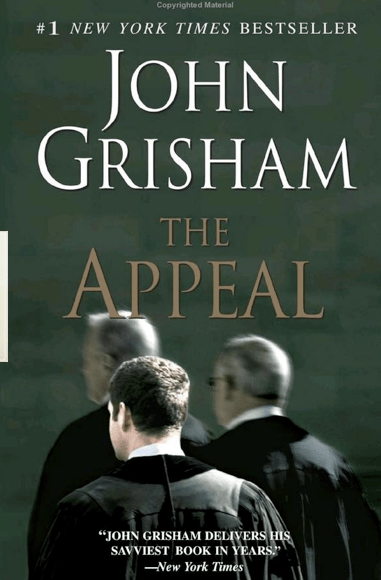
The Appeal is the exception. No one wins, not even the apparent winner, who sails off in the end with his empty, unsatisfying life. He schemes, he exploits, he lies, he buys elections, and he makes a fortune – and he isn’t satisfied. He is married to a woman who sounds more like a greyhound, all skin and bones and self-absorption.
The subject matter is a case where a chemical company has dumped toxic wastes into the ground in Mississippi, it has penetrated into the groundwater, and polluted the entire water system of a small fictional town. Two lawyers, married to one another, sacrifice everything and face bankruptcy to win a case for their client who has lost both husband and son to cancer caused by the toxic chemicals dumped. They win.
There is an appeal.
What this book is about isn’t just about groundwater contamination, or even about buying elections in Mississippi – it is an indictment of every state that elects judges. The core of the novel is about how big money, big corporations, pick candidates and fund them, legally and illegally, and insure that they win. They pack the courts with judges who are opposed to large settlements.
God bless John Grisham. With all his great legal thrillers, he has made a bundle and can take risks like writing a book like The Appeal, which should be an eye opener, and should be read by every caring citizen.
Judges should not be elected. When the judiciary are elected, they have to think about their next election, with every legal decision. It taints objectivity. It corrupts objectivity. It eliminates objectivity. Without an objective judiciary – why bother? They will always rule on the side whose interests are the most powerful and profitable.
Here are a couple quotes that tell you where the novel is going. My Kuwaiti friends are going to love this – I have taken so many shots at Kuwait corruption – so here it is, my friends, exposure of the institutionalized corruption in my country:
Barry laughed and crossed his legs. “We do campaigns. Have a look.” He picked up a remote and pushed the button, and a large white screen dropped from the ceiling and covered most of the wall, then the entire nation appeared. Most of the states were in green, the rest were in a soft yellow. “Thirty-one states are in the green. The yellow ones have the good sense to appoint their courts. We make our living in the green ones.”
“Judicial elections.”
“Yes. That’s all we do, and we do it very quietly. When our clients need help, we target a supreme court justice who is not particularly friendly, and we take him, or her, out of the picture.”
“Just like that.”
“Just like that.”
“Who are your clients?”
“I can’t give you the names, but they’re all on your side of the street. Big companies in energy, insurance, pharmaceuticals, chemicals, timber, all types of manufacturers, plus doctors, hospitals, nursing homes, banks. We raise tons of money and hire the people on the ground to run aggressive campaigns.”
* * * * * * * *
The Senator did not know who owned the jet, not had he ever met Mr. Trudeau, which in most cultures would seem odd since Rudd had taken so much money from the man. But in Washington, money arrives through a myriad of strange and nebulous conduits. Often those taking it have only a vague idea of where it’s coming from; often they have no clue. In most democracies, the transference of so much cash would be considered outright corruption, but in Washington the corruption has been legalized. Senator Rudd didn’t know and didn’t care that he was owned by other people. He had over $11 million in the bank, money he could eventually keep if not forced to waste it on some frivolous campaign. In return for such an investment, Rudd had a perfect voting record on all matters dealing with pharmaceuticals, chemicals, oil, energy, insurance, banks and on and on.
I like almost every book I read by John Grisham. He is a man with a conscience, and he is trying to raise our awareness of corruptive factors before our system goes entirely under. I couldn’t put this book down, and I can hardly wait to read the next one.
Recent Comments
intlxpatr on Shampoo Ginger tigerbutterya0c5ff1d… on Shampoo Ginger intlxpatr on British Soldier Kidnapped, Esc… John on British Soldier Kidnapped, Esc… intlxpatr on British Soldier Kidnapped, Esc… Wikipedia Donate Button

Amazina


Early Voting in Florida


