Who Is My Neighbor?
We just finished our year in EfM, Education for Ministry, and the overall theme was a multi-cultural world, where we confront our own assumptions and prejudices. It has been a grand journey.
We have friends, friends whose son is our son’s best friend for lo, these many years, and they know how to be good neighbors. They are the soul of hospitality. They take in immigrants, fresh-off-the-boat, and teach them how to survive, help them find furniture, apartments, and a living. They welcome visitors, and care for them and their children. They are helpful. They do all this because it is the right thing to do, and they do it tirelessly. I am in awe of these friends; they are the essence of the Good Samaritan.
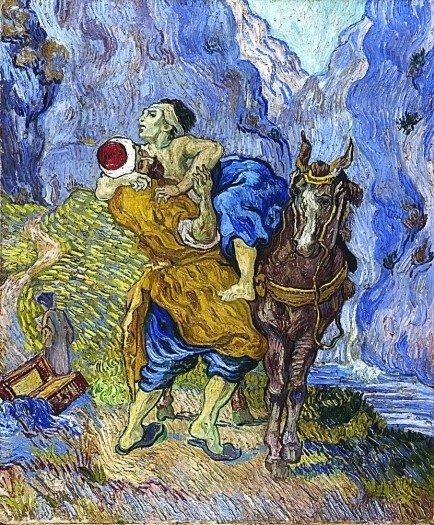
This is Vincent Van Gogh’s painting of The Good Samaritan
THURSDAY, May 21 (from Forward Day by Day)
Luke 10:29 And who is my neighbor?
This beloved parable is about more than being kind to our neighbor. It’s about the grace that is shared and the miracle that is manifested each time we help each other, and each time we allow ourselves to be helped. Both of the main characters in this story, the man who is beaten and left for dead and the man who rescues him and has him cared for, had to humble themselves in order to be in relationship.
Mutual distrust and mutual prejudice could have cost the injured man his life, either by the Samaritan refusing to stop, or in the injured man refusing help from such a suspicious source. Jesus asks us to look past the natural lines of religious creed, racial and ethnic identities, socioeconomic status, and all the other words we use to separate “us” from “them,” and to see his face in the man in the ditch. Jesus is asking us to look up and see his face in the man who is saving someone who cannot save himself.
We are invited to see the face of Jesus on each of these men—to realize that when we reach out in love or when we are being helped, Jesus is always present. Are you willing to be humbled in that way? Who or what can you help, today? Who or what can help you?
PRAY for the Diocese of North West Australia (Western Australia, Australia)
Ps 105:1-22 * 105:23-45; Ezekiel 18:1-4, 19-32; Hebrews 7:18-28; Luke 10:25-37
When I think of the Good Samaritan, I think too of a very pregnant friend, pregnant with triplets, a Jewish woman working in Qatar, whose car broke down. In this day of cell phones, she called her husband for help, but in the time she waited for him to arrive with help, many many Qatari men and families stopped to offer assistance, insisted on giving her bottles of cold water, stopped and waited with her until her husband came and she was safe. They saw a stranger in distress, and they didn’t hesitate, they stopped. Good neighbors 🙂
Where is Mbeere District, Kenya?
Today the church prays for the diocese in Mbeere, in Kenya. It is north of Nairobi, mountainous, farming area.

“Plus ça change, plus c’est la même chose”
Last week, we were in Atlanta, and stayed near a small town called Smyrna. We wondered several times where ancient Smyrna was, guessing Greece or Turkey. We were both right.
Today, the church remembers Polycarp, Bishop and Martyr of Smyrna. It is timely. There is a saying, the more things change, the more they stay the same (“plus ça change, plus c’est la même chose” – Alphonse Kerr) – and today, too, we are seeing people killed for what they believe, when they do not fall into step with the specific style of belief of the crowd. Oh, the things we do in God’s name!
The Liturgical Calendar: The Church Remembers
Today the church remembers Polycarp, Bishop and Martyr of Smyrna, 156.
Polycarp, Bishop of Smyrna in what is now called Turkey, did not seek martyrdom and did not encourage others to do so. When persecution broke out, Polycarp made every honorable effort to protect his flock and himself. He even hid in the country but, eventually, the authorities found him.Since Christians worshiped Jesus Christ, an “unauthorized god,” and since they refused to worship the Roman gods or the “Divine Caesar,” they were considered atheists and subversives.
Where is the Diocese of Manicaland, Zimbabwe?
Today the church prays for the troubled and sometimes controversial diocese of Manicaland, in Zimbabwe.

Zambia: “What is it like where you live?”
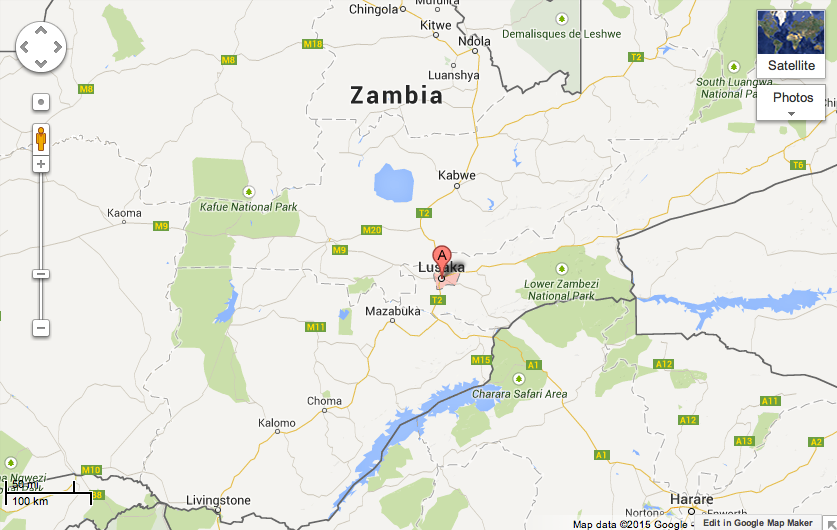
Today the church prays for the diocese of Lusaka, and I smile as I pray for my Zambian friends. We have stayed in Lusaka several times, and visited schools and clinics in remote parts of Zambia. Zambia is an amazing country – something like 70 different peoples and languages, and training in all the schools to help them learn how to live together.
One young Zambian told us that when they come into contact, it is normal to feel strange; the “other” doesn’t speak the same dialect, may be a traditional enemy, is just different, uncomfortable. They are trained to ask “What is it like where you live?” and to listen to the response.
I have used that phrase so many times; it is so useful. When you listen to an “other” talk about his or her life, you connect. You find similarities, and differences, and you learn the joys and challenges of this different life. It is a wonderful question. I used it the first time in Zambia, at a dinner with a lot of people we didn’t know. The woman next to me seemed stuffy, but sometimes that can be shy, so I asked “What is it like where you are from?” and she looked at me with concern and said, very sharply, “What do you mean?” I said “what is your life like, tell me about what you do in a day?” and she said “That is a very odd question!” but she went on to tell me about her life, her country house and her passion for riding. By the end, we were having a great conversation.
May God bless you richly, Zambia. May your peoples live together in God’s peace!
From Whom Every Tribe in Heaven and On Earth Takes Its Name
I’ve been looking for this line forever, but it is no wonder that I couldn’t find it, I remembered it wrong, or I was using a different translation. When Father Ian at Church of the Epiphany in Doha would begin the prayers, he began with that invocation, reminding us that we, too, are tribal in our passions and affiliations. He used that word, tribal, instead of family. It is probably more true to the original intent.
Once people start drawing and adhering to lines between them and us, things get ugly in a hurry. I liked what Pope Francis said about Freedom of Speech being fine but it had to include respect for the religions of others, and self restraint. We all need to remember that it is the one true God who is the father of us all, and he will be the only one to judge us in the end.
We all get a lot of things wrong. Let’s hope He is truly the all-merciful and all-compassionate.
Ephesians 3:14-21
14 For this reason I bow my knees before the Father,* 15 from whom every family* in heaven and on earth takes its name. 16 I pray that, according to the riches of his glory, he may grant that you may be strengthened in your inner being with power through his Spirit, 17 and that Christ may dwell in your hearts through faith, as you are being rooted and grounded in love. 18 I pray that you may have the power to comprehend, with all the saints, what is the breadth and length and height and depth, 19 and to know the love of Christ that surpasses knowledge, so that you may be filled with all the fullness of God.
20 Now to him who by the power at work within us is able to accomplish abundantly far more than all we can ask or imagine, 21 to him be glory in the church and in Christ Jesus to all generations, for ever and ever. Amen.
Where is Lafia, Nigeria?
Today the church prays for Lafia, Nigeria, which is near Abuja, in the part of Nigeria where Boko Haram runs rampant, and where over 250 girls were kidnapped from their school in 2014. Some few escaped, most were married off to poor young Boko Haram soldiers into hardship and near-slavery. Boko Haram does not believe in educating women. The Nigerian government at one point announced that Boko Haram had agreed to return the girls, but nothing happened. The Nigerian military and police do nothing to get them back.

A Prayer for the Innocents
Today the church remembers King Herod’s slaughter of all infant boys in his territory to put to rest these rumors of a newborn king of the Jews. The prayer for today is for all innocents killed by those who seek their ends through violence and oppression.
We remember today, O God, the slaughter of the holy innocents of Bethlehem by King Herod. Receive, we pray, into the arms of your mercy all innocent victims; and by your great might frustrate the designs of evil tyrants and establish your rule of justice, love, and peace; through Jesus Christ our Lord, who lives and reigns with you and the Holy Spirit, one God, for ever and ever.
Isaiah: the desert shall rejoice and blossom

The Lectionary reading in the Old Testament today is from Isaiah, one of my favorite books in the bible, and when I read it, I think of all my time in the Arabian peninsula, in Saudi Arabia, Qatar, and Kuwait. I think of this land, on the route from the rift valley in Kenya where man is supposed to have originated, how earliest humans would have crossed through these countries as they moved slowly away from their origins.
My Qatari and Kuwaiti friends tell me that legends say that these countries were once lush, green and beautiful. They are still beautiful, but the lushness and the greeness is only in small pockets when and where the arid land has water. I think nothing is impossible for God, and how wonderful it would be to see these countries lush and green and fertile once more.
The King is coming, coming as a tiny baby in human form to live with us and turn us away from our wickedness. He sees things differently. He tells us to love one another, to love our enemies, to take care of one another. He makes the blind to see, the lame to leap, and the deaf to hear. Come! Come, Emanuel!
Isaiah 35:1-10
35 The wilderness and the dry land shall be glad,
the desert shall rejoice and blossom;
like the crocus 2it shall blossom abundantly,
and rejoice with joy and singing.
The glory of Lebanon shall be given to it,
the majesty of Carmel and Sharon.
They shall see the glory of the Lord,
the majesty of our God.
3 Strengthen the weak hands,
and make firm the feeble knees.
4 Say to those who are of a fearful heart,
‘Be strong, do not fear!
Here is your God.
He will come with vengeance,
with terrible recompense.
He will come and save you.’
5 Then the eyes of the blind shall be opened,
and the ears of the deaf unstopped;
6 then the lame shall leap like a deer,
and the tongue of the speechless sing for joy.
For waters shall break forth in the wilderness,
and streams in the desert;
7 the burning sand shall become a pool,
and the thirsty ground springs of water;
the haunt of jackals shall become a swamp,*
the grass shall become reeds and rushes.
8 A highway shall be there,
and it shall be called the Holy Way;
the unclean shall not travel on it,*
but it shall be for God’s people;*
no traveller, not even fools, shall go astray.
9 No lion shall be there,
nor shall any ravenous beast come up on it;
they shall not be found there,
but the redeemed shall walk there.
10 And the ransomed of the Lord shall return,
and come to Zion with singing;
everlasting joy shall be upon their heads;
they shall obtain joy and gladness,
and sorrow and sighing shall flee away.
Recent Comments
ExpatAlien on What Country am I Living … intlxpatr on Yellowstone: Old Faithful to C… Michelle on Yellowstone: Old Faithful to C… Cathy on No Grown-Ups in Charge intlxpatr on Waiting for Snow Wikipedia Donate Button

Amazina


Early Voting in Florida


 Here There and Everywhere