It’s a wonderful world we live in, where, in the midst of doing my Lectionary readings, I can at a moment ask this wonderful machine with its access to collective knowledge: “When do you use exalt and when do you use exult?”
They sound so alike, don’t they?
And a wonderful website, Grammarist, gives me this answer:
Exalt vs. exult
To exalt is to raise in rank, to glorify, or to increase the effect or intensity of. In all its definitions, exalt is transitive, meaning it takes a direct object (i.e., you can’t just exalt, period; you have to exalt someone or something). The word’s past participle, exalted, is often used to mean elevated in rank or lofty
To exult is to rejoice greatly or to be jubilant or triumphant. It is always intransitive, meaning it does not have a direct object (i.e., you can’t exult someone or something; you just exult). The most common derivative of exult is the adjective exultant, which means marked by great joy or jubilation.
In spoken language, that one little vowel probably doesn’t make that much difference, but in written language, if you know the difference (I now do, and so do you!) it could be glaring. So I will no longer write “exaltations!” but “Exultations!” when I am expressing enormous joy.
And now, back to my Lectionary readings, which start with Psalms; here is the Psalm that interrupted my readings in search of the above. I will share it with you. I love that the author uses both exalt and exult in the same Psalm. Can you spot them?
21 Domine, in virtute tua
1 The king rejoices in your strength, O Lord; *
how greatly he exults in your victory!
2 You have given him his heart’s desire; *
you have not denied him the request of his lips.
3 For you meet him with blessings of prosperity, *
and set a crown of fine gold upon his head.
4 He asked you for life, and you gave it to him: *
length of days, for ever and ever.
5 His honor is great, because of your victory; *
splendor and majesty have you bestowed upon him.
6 For you will give him everlasting felicity *
and will make him glad with the joy of your presence.
7 For the king puts his trust in the Lord; *
because of the loving-kindness of the Most High, he
will not fall.
(8 Your hand will lay hold upon all your enemies; *
your right hand will seize all those who hate you.
9 You will make them like a fiery furnace *
at the time of your appearing, O Lord;
10 You will swallow them up in your wrath, *
and fire shall consume them.
11 You will destroy their offspring from the land *
and their descendants from among the peoples of the earth.
12 Though they intend evil against you
and devise wicked schemes, *
yet they shall not prevail.
13 For you will put them to flight *
and aim your arrows at them.
14 Be exalted, O Lord, in your might; *
we will sing and praise your power.)
August 27, 2016
Posted by intlxpatr |
Lectionary Readings, Words | Exalt, Exult |
Leave a comment
Following the nomination of Hilary Clinton, the first female nominee of a major political party, we have this reading in the Lectionary from Judges. As I read it, I am thinking “I wonder why we don’t have more daughters named Deborah? Or Jael? And I am also thinking this is not – yet – a story for our 6 year old grandson and almost three year old granddaughter.
Love it that the Lord’s general was Barak, blessing in both Aramaic and Arabic, brother languages, brother cultures, divided by a dismal and long lasting fight about inheritance. Alas, there is no fight as bitter as a family fight.
Judges 4:4-23
4 At that time Deborah, a prophetess, wife of Lappidoth, was judging Israel. 5She used to sit under the palm of Deborah between Ramah and Bethel in the hill country of Ephraim; and the Israelites came up to her for judgement. 6She sent and summoned Barak son of Abinoam from Kedesh in Naphtali, and said to him, ‘The Lord, the God of Israel, commands you, “Go, take position at Mount Tabor, bringing ten thousand from the tribe of Naphtali and the tribe of Zebulun. 7I will draw out Sisera, the general of Jabin’s army, to meet you by the Wadi Kishon with his chariots and his troops; and I will give him into your hand.” ’ 8Barak said to her, ‘If you will go with me, I will go; but if you will not go with me, I will not go.’ 9And she said, ‘I will surely go with you; nevertheless, the road on which you are going will not lead to your glory, for the Lordwill sell Sisera into the hand of a woman.’ Then Deborah got up and went with Barak to Kedesh. 10Barak summoned Zebulun and Naphtali to Kedesh; and ten thousand warriors went up behind him; and Deborah went up with him.
11 Now Heber the Kenite had separated from the other Kenites,* that is, the descendants of Hobab the father-in-law of Moses, and had encamped as far away as Elon-bezaanannim, which is near Kedesh.
12 When Sisera was told that Barak son of Abinoam had gone up to Mount Tabor, 13Sisera called out all his chariots, nine hundred chariots of iron, and all the troops who were with him, from Harosheth-ha-goiim to the Wadi Kishon. 14Then Deborah said to Barak, ‘Up! For this is the day on which the Lord has given Sisera into your hand. The Lord is indeed going out before you.’ So Barak went down from Mount Tabor with ten thousand warriors following him. 15And the Lord threw Sisera and all his chariots and all his army into a panic* before Barak; Sisera got down from his chariot and fled away on foot, 16while Barak pursued the chariots and the army to Harosheth-ha-goiim. All the army of Sisera fell by the sword; no one was left.
17 Now Sisera had fled away on foot to the tent of Jael wife of Heber the Kenite; for there was peace between King Jabin of Hazor and the clan of Heber the Kenite. 18Jael came out to meet Sisera, and said to him, ‘Turn aside, my lord, turn aside to me; have no fear.’ So he turned aside to her into the tent, and she covered him with a rug. 19Then he said to her, ‘Please give me a little water to drink; for I am thirsty.’ So she opened a skin of milk and gave him a drink and covered him. 20He said to her, ‘Stand at the entrance of the tent, and if anybody comes and asks you, “Is anyone here?” say, “No.” ’ 21But Jael wife of Heber took a tent-peg, and took a hammer in her hand, and went softly to him and drove the peg into his temple, until it went down into the ground—he was lying fast asleep from weariness—and he died. 22Then, as Barak came in pursuit of Sisera, Jael went out to meet him, and said to him, ‘Come, and I will show you the man whom you are seeking.’ So he went into her tent; and there was Sisera lying dead, with the tent-peg in his temple.
23 So on that day God subdued King Jabin of Canaan before the Israelites.
July 28, 2016
Posted by intlxpatr |
Cross Cultural, Cultural, Faith, Lectionary Readings, Middle East, Political Issues, Relationships, Women's Issues |
2 Comments
Today the church remembers St. Ephraim, a very good man, a solid contributor to the early church. At a time when many seem to be in fear that Syrians are coming to our shore, I think a reading about Saint Ephraim is timely. He wrote some of the earliest church hymns. He very likely contributed some of the verbiage in our Nicene creed.
I also smile; I remember my Arabic instructors at the Qatar Center for the Presentation of Islam, truly gentle women who knew the bible better than I did, and inspired me to know it better in self defense. While they didn’t expect me to cover, i.e. to wear a scarf over my hair, or to wear an abaya, they could point out to me verses in the bible where women are instructed to cover, and they could show me biblical pictures in which the women were cloaked and their hair covered.
They also pointed out the many places in the Bible where praying was done by prostrating oneself face down before God, as Ephraim instructs in the prayer at the bottom of the reading.
I never felt pressured. They were like my Mormon sisters, my Baptist sisters; they only wanted me to have what they had found, the best way to worship.
EPHREM OF EDESSA
DEACON AND HYMN-WRITER (10 JUNE 373)
 Ephrem (or Ephren or Ephraim or Ephrain) of Edessa was a teacher, poet, orator, and defender of the Faith. (To English-speakers, the most familiar form of his name will be “Ephraim.” It is the name of the younger son of Joseph, son of Jacob (see Genesis 41:52), and is thus the name of one of the largest of the twelve tribes of Israel.) Edessa (now Urfa), a city in modern Turkey about 100 kilometers from Antioch (now Antakya), was a an early center for the spread of Christian teaching in the East. It is said that in 325 he accompanied his bishop, James of Nisibis, to the Council of Nicea. Certainly his writings are an eloquent defense of the Nicene faith in the Deity of Jesus Christ. He countered the Gnostics’ practice of spreading their message through popular songs by composing Christian songs and hymns of his own, with great effect. He is known to the Syrian church as “the harp of the Holy Spirit.”
Ephrem retired to a cave outside Edessa, where he lived in great simplicity and devoted himself to writing. He frequently went into the city to preach. During a famine in 372-3 he worked distributing food to the hungry, and organizing a sort of ambulance service for the sick. He worked long hours at this, and became exhausted and sick, and so died.
Of his writings there remain 72 hymns, commentaries on the Old and New Testaments, and numerous sermons.
Several hymns are available at:
http://www.voskrese.info/spl/XefremSyria.html
Among Orthodox he is best known for a fasting prayer:
THE PRAYER OF ST EPHRAIM THE SYRIAN
O Lord and Master of my life, do not give me the spirit of laziness, meddling, self-importance and idle talk. (prostration)
Instead, grace me, Your servant, with the spirit of modesty, humility, patience, and love. (prostration)
Indeed, my Lord and King, grant that I may see my own faults, and not condemn my brothers and sisters, for You are blessed unto ages of ages. Amen. (prostration)
(Twelve deep bows, saying each time: O God, be gracious to me, a sinner.)
[Translation by Fr James Silver, Drew University; posted on the Orthodox list]
by James Kiefer
June 10, 2016
Posted by intlxpatr |
Character, Cultural, Doha, ExPat Life, Faith, Interconnected, Lectionary Readings, Living Conditions, Qatar, Relationships |
Leave a comment
One of the disciplines available to those of the Episcopal faith is the reading of the Lectionary. Every day of the year are short readings from the Psalms, Old Testament, New Testament and Gospels. Every three year the cycle repeats itself. There are also additional readings on the “Saints” or remarkable people who have served God and his church.
Leviticus is not my favorite chapter, but today, I love Leviticus. As if the words were freshly spoken, I read Leviticus 19: 33-34:
33 When an alien resides with you in your land, you shall not oppress the alien. 34The alien who resides with you shall be to you as the citizen among you; you shall love the alien as yourself, for you were aliens in the land of Egypt: I am the Lord your God.
There are many references to the alien in the Bible, one of the earliest being Father Abraham, who is told to leave (what is now the current Iraq) and head for Canaan. When he arrives, peacefully, the local tribes are kind to him. They are good neighbors. Later, when Moses kills an Egyptian and flees to the desert tribes, he describes himself as “a stranger in a strange land.”
It’s who we are. It’s what our book tells us. We are to welcome the stranger. We are to leave wheat in the edges of our fields (yesterday’s reading) that he might not starve. We are not to oppress the alien, nor put up walls to fence them out. We are all aliens on this earth; waiting for the glory of the heavenly kingdom where we belong.
April 28, 2016
Posted by intlxpatr |
Civility, Community, Cross Cultural, Cultural, ExPat Life, Faith, Interconnected, Lectionary Readings, Living Conditions, Political Issues, Quality of Life Issues, Relationships, Social Issues, Work Related Issues | Abraham, Leviticus, Moses |
Leave a comment
In one of my Baptist-oriented bible study classes, one of my classmates once said “You don’t make converts by running after people and hitting them over the head with a bible!” As People of the Book, we struggle to find ways to carry the message without bludgeoning our intended recipient with it.
Have you ever been on the receiving end? I lived for so many years in the Middle East, where my truly believing Moslem friends would tell me about the Prophet Mohammed and all the good he did, and would look at me expectantly, hoping I would have that blinding flash that Paul experienced on the road to Damascus, and come over from the dark side to the one true religion. It made a believer out of me, not a Moslem, but a believer in the goodness and sincerity of all who are holy, and of the near impossibility of convincing anyone with words.
So this morning, the reading in the Lectionary from Paul’s letter to the Corinthians sings to my soul:
2 Corinthians 2:14-3:6
14 But thanks be to God, who in Christ always leads us in triumphal procession, and through us spreads in every place the fragrance that comes from knowing him. 15For we are the aroma of Christ to God among those who are being saved and among those who are perishing; 16to the one a fragrance from death to death, to the other a fragrance from life to life. Who is sufficient for these things? 17For we are not peddlers of God’s word like so many;* but in Christ we speak as persons of sincerity, as persons sent from God and standing in his presence.
3Are we beginning to commend ourselves again? Surely we do not need, as some do, letters of recommendation to you or from you, do we? 2You yourselves are our letter, written on our* hearts, to be known and read by all; 3and you show that you are a letter of Christ, prepared by us, written not with ink but with the Spirit of the living God, not on tablets of stone but on tablets of human hearts.
4 Such is the confidence that we have through Christ towards God. 5Not that we are competent of ourselves to claim anything as coming from us; our competence is from God, 6who has made us competent to be ministers of a new covenant, not of letter but of spirit; for the letter kills, but the Spirit gives life.
We carry the Spirit, and our lives are the message.
March 16, 2016
Posted by intlxpatr |
Cross Cultural, Cultural, ExPat Life, Faith, Interconnected, Lectionary Readings, Quality of Life Issues, Relationships, Spiritual | 2 Corinthians |
Leave a comment

Happy New Year! Thank you for continuing to visit and read here all these years, and thank you for your comments and e-mails.
Today, reading my morning meditations, the Lectionary and my daily e-mail from Dr. Richard Rohr, I come across this paragraph in Father Rohr’s message:
| The Christian vision is that the world is a temple. If that is true, then our enemies are sacred, too. Who else created them but God? The ability to respect the outsider is probably the litmus test of true seeing. And it doesn’t stop with human beings and enemies and the least of the brothers and sisters. It moves to frogs and pansies and weeds. Everything becomes enchanting with true sight. One God, one world, one truth, one suffering, and one love. All we can do is participate. I hope you enter the New Year with this awareness and an intention to join in with all your heart, mind, and body! |
 |
Trying to be a Christian is so hard. To learn to love the stranger, I was sent to strange countries. Many countries. Many years. Until I could see that the commonality of humanity was greater than the differences in our dogma, I was sent. It didn’t have to do with carrying a message. It had to do with keeping my eyes and ears open, and most of all, keeping my heart open, to learn what I was meant to learn.
When I finally “got” it, our years of living overseas stopped. Now I have a new challenge, living in my own culture and feeling like “the other.”
I get the part about seeing God in all humanity. It’s not like I can do it, but it is important to God that I try. Today Father Rohr has also mentioned frogs and pansies and seeds, and then he says EVERYTHING. Ummm. Everything includes cockroaches.
I have no control over my reaction to cockroaches. They are dirty, and they skitter. One time, we had one in the house that flew – and HISSED! (I disabled him with a spray of Pledge, then disposed). We have a pest control man who makes sure my visitors are far and few between, but . . . this is Florida. Florida has cockroaches. The secret is to keep them to a minimum. Unfortunately, they just give me the creeps, and I can’t rest comfortably until the world has one less cockroach.
My first thought when I read today’s message, seeing God in his infinite glory in EVERYTHING, is that I have a huge challenge. The cockroach. The slug. The mosquito. The snake. There are so many creations that give me the creeps. How am I going to practice this? Is giving them space enough?
January 1, 2016
Posted by intlxpatr |
Character, Cultural, ExPat Life, Faith, Lectionary Readings, Pensacola, Quality of Life Issues, Relationships, Spiritual | cockroach, Fr. Richard Rohr, Happy New Year, mosquito, slug, snake |
2 Comments
Today’s Gospel reading from The Lectionary brings up so many questions! Jesus gives a parable, a story to help explain what he is saying, but what, exactly, is the parable saying?
Luke 19:11-27
11 As they were listening to this, he went on to tell a parable, because he was near Jerusalem, and because they supposed that the kingdom of God was to appear immediately. 12 So he said, ‘A nobleman went to a distant country to get royal power for himself and then return. 13 He summoned ten of his slaves, and gave them ten pounds,* and said to them, “Do business with these until I come back.” 14 But the citizens of his country hated him and sent a delegation after him, saying, “We do not want this man to rule over us.” 15 When he returned, having received royal power, he ordered these slaves, to whom he had given the money, to be summoned so that he might find out what they had gained by trading. 16 The first came forward and said, “Lord, your pound has made ten more pounds.” 17 He said to him, “Well done, good slave! Because you have been trustworthy in a very small thing, take charge of ten cities.” 18 Then the second came, saying, “Lord, your pound has made five pounds.” 19 He said to him, “And you, rule over five cities.” 20 Then the other came, saying, “Lord, here is your pound. I wrapped it up in a piece of cloth, 21 for I was afraid of you, because you are a harsh man; you take what you did not deposit, and reap what you did not sow.” 22 He said to him, “I will judge you by your own words, you wicked slave! You knew, did you, that I was a harsh man, taking what I did not deposit and reaping what I did not sow? 23 Why then did you not put my money into the bank? Then when I returned, I could have collected it with interest.” 24 He said to the bystanders, “Take the pound from him and give it to the one who has ten pounds.” 25 (And they said to him, “Lord, he has ten pounds!”) 26 “I tell you, to all those who have, more will be given; but from those who have nothing, even what they have will be taken away. 27 But as for these enemies of mine who did not want me to be king over them—bring them here and slaughter them in my presence.” ’
We know, by his own words, this was a harsh man and we know many of his citizens – not slaves – did not want him to rule over them. Why did Jesus use this man to illustrate his point? What about the other seven slaves who were given the money; how did they invest or protect the money? When I look at this parable, I am not so sure I would want to be one who was given more to administer over; the master is harsh. Perhaps those who protected the talent and kept their heads down fared better in the long run under this harsh man’s rule? What if one had taken the money and used it to make the lives of the people better – provided medical care or built a safe-haven for abused women? I shudder to think what the harsh ruler might have done with a slave who used the funds for the good of the people.
June 10, 2015
Posted by intlxpatr |
Bureaucracy, Cultural, Experiment, Financial Issues, Lectionary Readings, Living Conditions, Money Management, Poetry/Literature, Quality of Life Issues, Social Issues |
Leave a comment
i will confess Deuteronomy, with all it’s rules and admonitions, is not my favorite book in the bible, and yet I love the words about bribery found in today’s Old Testament reading from the Lectionary:
Deuteronomy 16:18-20,17:14-20
18 You shall appoint judges and officials throughout your tribes, in all your towns that the Lord your God is giving you, and they shall render just decisions for the people. 19 You must not distort justice; you must not show partiality; and you must not accept bribes, for a bribe blinds the eyes of the wise and subverts the cause of those who are in the right. 20 Justice, and only justice, you shall pursue, so that you may live and occupy the land that the Lord your God is giving you.
14 When you have come into the land that the Lord your God is giving you, and have taken possession of it and settled in it, and you say, ‘I will set a king over me, like all the nations that are around me’, 15 you may indeed set over you a king whom the Lord your God will choose. One of your own community you may set as king over you; you are not permitted to put a foreigner over you, who is not of your own community. 16 Even so, he must not acquire many horses for himself, or return the people to Egypt in order to acquire more horses, since the Lord has said to you, ‘You must never return that way again.’ 17 And he must not acquire many wives for himself, or else his heart will turn away; also silver and gold he must not acquire in great quantity for himself.
18 When he has taken the throne of his kingdom, he shall have a copy of this law written for him in the presence of the levitical priests. 19 It shall remain with him and he shall read in it all the days of his life, so that he may learn to fear the Lord his God, diligently observing all the words of this law and these statutes, 20 neither exalting himself above other members of the community nor turning aside from the commandment, either to the right or to the left, so that he and his descendants may reign long over his kingdom in Israel.
June 4, 2015
Posted by intlxpatr |
Faith, Lectionary Readings | corruption, FIFA |
Leave a comment
We have guests in town from another country who are living with Americans and visiting many others.
One of them asked her host “Do all Americans worship idols?” and the host was flummoxed.
We have been in private houses of the most religious Muslims, and their houses look very different from ours. They have nothing on the walls, except perhaps a picture of the Kaaba in Mecca, or a beautiful calligraphy in Arabic with one of the Surahs. To us, the houses look very plain, but they are being careful to observe carefully the word of the Lord.
We don’t consider the objects in our homes idols because we don’t worship them. When I read today’s Lectionary reading from Deuteronomy, I have to rethink what God might thing idols are.
Deuteronomy 4:15-24
15 Since you saw no form when the Lord spoke to you at Horeb out of the fire, take care and watch yourselves closely, 16 so that you do not act corruptly by making an idol for yourselves, in the form of any figure—the likeness of male or female, 17 the likeness of any animal that is on the earth, the likeness of any winged bird that flies in the air, 18 the likeness of anything that creeps on the ground, the likeness of any fish that is in the water under the earth. 19 And when you look up to the heavens and see the sun, the moon, and the stars, all the host of heaven, do not be led astray and bow down to them and serve them, things that the Lord your God has allotted to all the peoples everywhere under heaven. 20 But the Lord has taken you and brought you out of the iron-smelter, out of Egypt, to become a people of his very own possession, as you are now.
21 The Lord was angry with me because of you, and he vowed that I should not cross the Jordan and that I should not enter the good land that the Lord your God is giving for your possession. 22 For I am going to die in this land without crossing over the Jordan, but you are going to cross over to take possession of that good land. 23 So be careful not to forget the covenant that the Lord your God made with you, and not to make for yourselves an idol in the form of anything that the Lord your God has forbidden you. 24 For the Lord your God is a devouring fire, a jealous God.
May 26, 2015
Posted by intlxpatr |
Cross Cultural, Cultural, ExPat Life, Faith, Friends & Friendship, Interconnected, Lectionary Readings, Saudi Arabia, Spiritual, Venice | Idols |
Leave a comment
We just finished our year in EfM, Education for Ministry, and the overall theme was a multi-cultural world, where we confront our own assumptions and prejudices. It has been a grand journey.
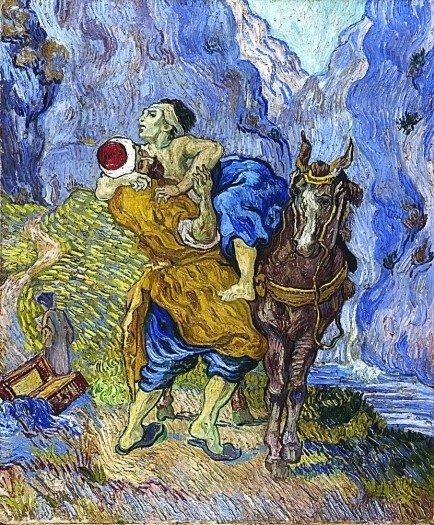
We have friends, friends whose son is our son’s best friend for lo, these many years, and they know how to be good neighbors. They are the soul of hospitality. They take in immigrants, fresh-off-the-boat, and teach them how to survive, help them find furniture, apartments, and a living. They welcome visitors, and care for them and their children. They are helpful. They do all this because it is the right thing to do, and they do it tirelessly. I am in awe of these friends; they are the essence of the Good Samaritan.

This is Vincent Van Gogh’s painting of The Good Samaritan
THURSDAY, May 21 (from Forward Day by Day)
Luke 10:29 And who is my neighbor?
This beloved parable is about more than being kind to our neighbor. It’s about the grace that is shared and the miracle that is manifested each time we help each other, and each time we allow ourselves to be helped. Both of the main characters in this story, the man who is beaten and left for dead and the man who rescues him and has him cared for, had to humble themselves in order to be in relationship.
Mutual distrust and mutual prejudice could have cost the injured man his life, either by the Samaritan refusing to stop, or in the injured man refusing help from such a suspicious source. Jesus asks us to look past the natural lines of religious creed, racial and ethnic identities, socioeconomic status, and all the other words we use to separate “us” from “them,” and to see his face in the man in the ditch. Jesus is asking us to look up and see his face in the man who is saving someone who cannot save himself.
We are invited to see the face of Jesus on each of these men—to realize that when we reach out in love or when we are being helped, Jesus is always present. Are you willing to be humbled in that way? Who or what can you help, today? Who or what can help you?
PRAY for the Diocese of North West Australia (Western Australia, Australia)
Ps 105:1-22 * 105:23-45; Ezekiel 18:1-4, 19-32; Hebrews 7:18-28; Luke 10:25-37
When I think of the Good Samaritan, I think too of a very pregnant friend, pregnant with triplets, a Jewish woman working in Qatar, whose car broke down. In this day of cell phones, she called her husband for help, but in the time she waited for him to arrive with help, many many Qatari men and families stopped to offer assistance, insisted on giving her bottles of cold water, stopped and waited with her until her husband came and she was safe. They saw a stranger in distress, and they didn’t hesitate, they stopped. Good neighbors 🙂
May 21, 2015
Posted by intlxpatr |
Arts & Handicrafts, Biography, Character, Charity, Civility, Community, Counter-terrorism, Cross Cultural, ExPat Life, Lectionary Readings, Living Conditions, Qatar, Quality of Life Issues, Spiritual, Values | Education for Ministry, EfM, Good Samaritan |
Leave a comment