The Season of Isaiah
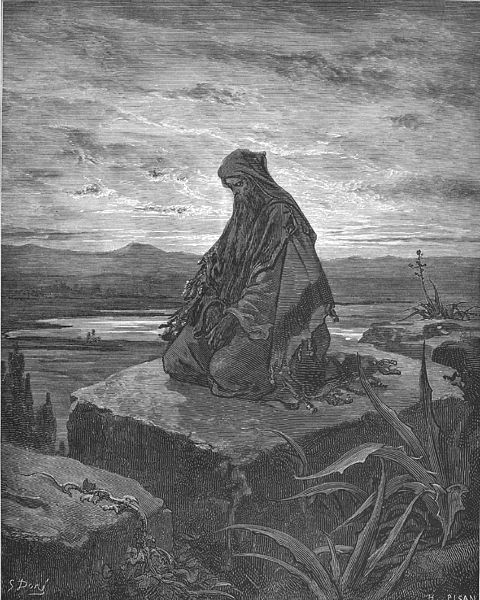
Advent started yesterday, and our readings in The Lectionary begin with Isaiah, that prophet of sorrow for our sinfulness, and hope for a future redeemer:
Isaiah 1:10-20
10 Hear the word of the Lord,
you rulers of Sodom!
Listen to the teaching of our God,
you people of Gomorrah!
11 What to me is the multitude of your sacrifices?
says the Lord;
I have had enough of burnt-offerings of rams
and the fat of fed beasts;
I do not delight in the blood of bulls,
or of lambs, or of goats.
12 When you come to appear before me,*
who asked this from your hand?
Trample my courts no more;
13 bringing offerings is futile;
incense is an abomination to me.
New moon and sabbath and calling of convocation—
I cannot endure solemn assemblies with iniquity.
14 Your new moons and your appointed festivals
my soul hates;
they have become a burden to me,
I am weary of bearing them.
15 When you stretch out your hands,
I will hide my eyes from you;
even though you make many prayers,
I will not listen;
your hands are full of blood.
16 Wash yourselves; make yourselves clean;
remove the evil of your doings
from before my eyes;
cease to do evil,
17 learn to do good;
seek justice,
rescue the oppressed,
defend the orphan,
plead for the widow.
18 Come now, let us argue it out,
says the Lord:
though your sins are like scarlet,
they shall be like snow;
though they are red like crimson,
they shall become like wool.
19 If you are willing and obedient,
you shall eat the good of the land;
20 but if you refuse and rebel,
you shall be devoured by the sword;
for the mouth of the Lord has spoken.
Called by Name
I’ve always loved this story. Imagine, being a hated tax collector, and probably taking your cut. Imagine, a famous person coming to town, and being short, you climb a tree so you can see him pass by. And imagine that as he is passing, he notices you, he really sees you, he calls you by name and asks to stay at your place (how did he even know my name, I might wonder)?
The Lord Jesus turns everything upside down. He says we do wrong, and if we follow him (which I understand means that we do as he says and does) that the price for our sins is paid by him. He says the rules on earth are not the rules in the heavenly kingdom, and he calls Zacchaeus, as he calls you and me.
Luke 19:1-10
19He entered Jericho and was passing through it. 2A man was there named Zacchaeus; he was a chief tax-collector and was rich. 3He was trying to see who Jesus was, but on account of the crowd he could not, because he was short in stature. 4So he ran ahead and climbed a sycomore tree to see him, because he was going to pass that way. 5When Jesus came to the place, he looked up and said to him, ‘Zacchaeus, hurry and come down; for I must stay at your house today.’ 6So he hurried down and was happy to welcome him. 7All who saw it began to grumble and said, ‘He has gone to be the guest of one who is a sinner.’ 8Zacchaeus stood there and said to the Lord, ‘Look, half of my possessions, Lord, I will give to the poor; and if I have defrauded anyone of anything, I will pay back four times as much.’ 9Then Jesus said to him, ‘Today salvation has come to this house, because he too is a son of Abraham. 10For the Son of Man came to seek out and to save the lost.’
Faithful Friends
Today’s reading in the Lectionary is from Sirach, one of the books of the Apocrypha, and features wisdom on faithful friends. I especially love “let your advisors be one in a thousand.” I have been greatly blessed to have found a few of those, and they stick with you for a lifetime.
Bless you, bless you, faithful friends!
Sirach 6:5-17
5 Pleasant speech multiplies friends,
and a gracious tongue multiplies courtesies.
6 Let those who are friendly with you be many,
but let your advisers be one in a thousand.
7 When you gain friends, gain them through testing,
and do not trust them hastily.
8 For there are friends who are such when it suits them,
but they will not stand by you in time of trouble.
9 And there are friends who change into enemies,
and tell of the quarrel to your disgrace.
10 And there are friends who sit at your table,
but they will not stand by you in time of trouble.
11 When you are prosperous, they become your second self,
and lord it over your servants;
12 but if you are brought low, they turn against you,
and hide themselves from you.
13 Keep away from your enemies,
and be on guard with your friends.
14 Faithful friends are a sturdy shelter:
whoever finds one has found a treasure.
15 Faithful friends are beyond price;
no amount can balance their worth.
16 Faithful friends are life-saving medicine;
and those who fear the Lord will find them.
17 Those who fear the Lord direct their friendship aright,
for as they are, so are their neighbours also.
Where is Susa?
We have had a choice of Old Testament readings this week in the Lectionary readings, either Esther or Judith, (Judith is in the Apocrypha). I like both stories 🙂 Judith is a tale to curl your hair, a tale not for children, but an amazing story within that culture, and telling. Meanwhile, I wondered, where is Susa?
As it turned out, I lived almost next door to Susa. So close I could spit across the Gulf. I wonder if I will ever have a chance to visit Iran? As hopeless as the current situation(s) in the Middle East look, I have seen amazing and wondrous things in my life – the fall of the Berlin Wall and the unification of South Africa sans apartheid – and I believe, by God’s grace, anything is possible.
Here is Susa:

Bringing Great Good from the Evil of 9/11

A reading from today’s Forward Day by Day helps us to cope with the resonating horrors of that monstrous day. We are living in a world where we are more and more inextricably interconnected. Where I am living, I often hear people talk about how “Moslems are killing Christians all over the world!” and my heart breaks, thinking of the wonderful friends I have lived among is so many Moslem countries, their kindness, their hospitality, our long pleasant conversations. I learned so much.
I am glad we believe in a God who knows our hearts. I am thankful for grace, and forgiveness. When we talk about killing, we also need to take account for all the civilians we have killed, trying to bring about peace, trying to eradicate Al Qaeda, Al Shebaab, those who would harm us.
God asks us to love one another. He doesn’t say “Christians, you love just the Christians.” He shows us how to love the Samaritans, the lame, the blind, the mentally ill, the “other”. He tells us, clearly, to love our enemies. The Gospel that speaks the loudest is the gospel of our lives lived to honor him.
THURSDAY, September 11
Acts 15:8-9 [Peter said], “And God, who knows the human heart, testified to them…and in cleansing their hearts by faith he has made no distinction between them and us.”
Thirteen years ago, this day became one of those days that divide time into what life was like before, and after; one of those days when you will remember, always, where you were, what you were doing—this time when you heard the news that airplanes had crashed into the World Trade Center and thousands of people had died.
Job asks, “Does not calamity befall the unrighteous?” (31:3), but we learned, vividly, on September 11, 2001, that the righteous and the innocent suffer too.
Psalm 59:6 exhorts God to “show no mercy to those who are faithless and evil.” The terrorists who flew the planes on 9/11 forced us to confront the power of evil and challenged us to find a way to respond with forgiveness. Perhaps we can learn something about that in Peter’s response to the heated discussions about Jews and Gentiles, about who could be saved, and how: “God, who knows the human heart…has made no distinction between them and us” (Acts 15:8-9).
Then, as now, there were good people and evildoers on all sides, religions, and races. Now, as then, judgment and salvation comes only through the mercy and grace of God.
Psalm 75; A Psalm For Today
After a month like July, with all it’s tragedy, all its self-inflicted injuries, all the blood and the death of innocents, I thank God that he is holding the pillars steady.
Psalm 75
To the leader: Do Not Destroy. A Psalm of Asaph. A Song.
1 We give thanks to you, O God;
we give thanks; your name is near.
People tell of your wondrous deeds.
2 At the set time that I appoint
I will judge with equity.
3 When the earth totters, with all its inhabitants,
it is I who keep its pillars steady.
Selah
4 I say to the boastful, ‘Do not boast’,
and to the wicked, ‘Do not lift up your horn;
5 do not lift up your horn on high,
or speak with insolent neck.’
6 For not from the east or from the west
and not from the wilderness comes lifting up;
7 but it is God who executes judgement,
putting down one and lifting up another.
8 For in the hand of the Lord there is a cup
with foaming wine, well mixed;
he will pour a draught from it,
and all the wicked of the earth
shall drain it down to the dregs.
9 But I will rejoice* for ever;
I will sing praises to the God of Jacob.
10 All the horns of the wicked I will cut off,
but the horns of the righteous shall be exalted.
Al this turmoil over boundaries, people not sharing. All the blood shed, and horrific acts, all so wasteful in the greater scheme of things. Lord God, hold the pillars steady.
Rehab, An Unlikely Hero
I love this story. When you start reading the bible, you come across the most human of our race, you have the dramas of sibling rivalry, disobedience, and murder, the heartbreak of childlessness, slavery, and terrible loss, you have marriages and wars . . . the full spectrum of human behavior is there. And you have Rehab, a prostitute, who has heard of this God, but is not a Hebrew. She will help them in return for safety for her family. All who shelter in her small apartment, protected by a red ribbon (or rope), live.

In a later chapter of the bible, we learn how Rehab figures in the family line of Jesus.
Joshua 2:1-14
2Then Joshua son of Nun sent two men secretly from Shittim as spies, saying, ‘Go, view the land, especially Jericho.’ So they went, and entered the house of a prostitute whose name was Rahab, and spent the night there. 2The king of Jericho was told, ‘Some Israelites have come here tonight to search out the land.’ 3Then the king of Jericho sent orders to Rahab, ‘Bring out the men who have come to you, who entered your house, for they have come only to search out the whole land.’
4But the woman took the two men and hid them. Then she said, ‘True, the men came to me, but I did not know where they came from. 5And when it was time to close the gate at dark, the men went out. Where the men went I do not know. Pursue them quickly, for you can overtake them.’ 6She had, however, brought them up to the roof and hidden them with the stalks of flax that she had laid out on the roof. 7So the men pursued them on the way to the Jordan as far as the fords. As soon as the pursuers had gone out, the gate was shut.
8 Before they went to sleep, she came up to them on the roof 9and said to the men: ‘I know that the Lord has given you the land, and that dread of you has fallen on us, and that all the inhabitants of the land melt in fear before you. 10For we have heard how the Lord dried up the water of the Red Sea* before you when you came out of Egypt, and what you did to the two kings of the Amorites that were beyond the Jordan, to Sihon and Og, whom you utterly destroyed. 11As soon as we heard it, our hearts failed, and there was no courage left in any of us because of you. The Lord your God is indeed God in heaven above and on earth below. 12Now then, since I have dealt kindly with you, swear to me by the Lord that you in turn will deal kindly with my family. Give me a sign of good faith 13that you will spare my father and mother, my brothers and sisters, and all who belong to them, and deliver our lives from death.’ 14The men said to her, ‘Our life for yours! If you do not tell this business of ours, then we will deal kindly and faithfully with you when the Lord gives us the land.’
No matter who we are, no matter what we have done, the love of God follows us everywhere, with the free gift of salvation, if only we see it, as Rehab did, and ask for it. God is great!
“The Love of Many Will Grow Cold”
Towards the end, as Jesus talks about the end-of-times, he says that because of lawlessness, the love of many will grow cold. (Deep sigh) We even have a name for it now, compassion fatigue, where good people get tired of trying and giving in the face of so much need. In Pensacola, we have children dying from negligence, young men dying from street violence, many dying from car accidents, and many suicides. It is stunning and it is discouraging.
Jesus tells us to hang in there, not to give up. Only with his help can we hope to do this.
This is from our Lectionary Readings for today:
Matthew 24:1-14
24As Jesus came out of the temple and was going away, his disciples came to point out to him the buildings of the temple. 2Then he asked them, ‘You see all these, do you not? Truly I tell you, not one stone will be left here upon another; all will be thrown down.’
3 When he was sitting on the Mount of Olives, the disciples came to him privately, saying, ‘Tell us, when will this be, and what will be the sign of your coming and of the end of the age?’ 4Jesus answered them, ‘Beware that no one leads you astray. 5For many will come in my name, saying, “I am the Messiah!”* and they will lead many astray. 6And you will hear of wars and rumours of wars; see that you are not alarmed; for this must take place, but the end is not yet. 7For nation will rise against nation, and kingdom against kingdom, and there will be famines* and earthquakes in various places: 8all this is but the beginning of the birth pangs.
9 ‘Then they will hand you over to be tortured and will put you to death, and you will be hated by all nations because of my name. 10Then many will fall away,* and they will betray one another and hate one another. 11And many false prophets will arise and lead many astray. 12And because of the increase of lawlessness, the love of many will grow cold. 13But anyone who endures to the end will be saved. 14And this good news* of the kingdom will be proclaimed throughout the world, as a testimony to all the nations; and then the end will come.
All Who Exalt Themselves Will Be Humbled
Today’s Gospel reading makes me squirm; it does not come naturally to me, a first-born, to be humble. I love being special. I love to be honored, to be given a seat of honor, to get that upgrade. And I think I am very human, so I imagine the reaction this radical teaching received among his own people, and among the scribes and Pharisees who also loved being special . . .
Matthew 23:1-12
23Then Jesus said to the crowds and to his disciples, 2‘The scribes and the Pharisees sit on Moses’ seat; 3therefore, do whatever they teach you and follow it; but do not do as they do, for they do not practise what they teach. 4They tie up heavy burdens, hard to bear,* and lay them on the shoulders of others; but they themselves are unwilling to lift a finger to move them. 5They do all their deeds to be seen by others; for they make their phylacteries broad and their fringes long. 6They love to have the place of honour at banquets and the best seats in the synagogues, 7and to be greeted with respect in the market-places, and to have people call them rabbi. 8But you are not to be called rabbi, for you have one teacher, and you are all students.* 9And call no one your father on earth, for you have one Father—the one in heaven. 10Nor are you to be called instructors, for you have one instructor, the Messiah.* 11The greatest among you will be your servant. 12All who exalt themselves will be humbled, and all who humble themselves will be exalted.
Zombies and Me and Romans
A very long time ago, I loved scary movies, and then a friend told me to see ‘Night of the Living Dead’ and scary movies lost all their charm for me. I was young, to get to my job I walked eight blocks to the bus stop, and I was living in Seattle, where early morning is still very dark. Rationally, I know zombies of the kind in ‘The Night of the Living Dead’ do not exist; irrationally, those were eight long dark blocks and my heart jumped with every movement caught out of the corner of my eye.

Why is it that zombies are so terrifying to me? I have always thought it was because they exemplify the worst in us, the kinds of things we do when we are in mobs fueled by passion and violence, or even smaller groups where we go places and do things we would never do on our own.
As I read todays Lectionary readings, however, I realized that the reasons zombies have such a visceral horror for me is that they are the hidden me, the appetites and hungers I won’t even acknowledge to myself; the urge to kill when someone treats me rudely or cuts me off in traffic, the appetites I yearn to indulge, zombies epitomize everything we are without the saving grace of a loving God.
Romans 8:1-11
8There is therefore now no condemnation for those who are in Christ Jesus. 2For the law of the Spirit* of life in Christ Jesus has set you* free from the law of sin and of death. 3For God has done what the law, weakened by the flesh, could not do: by sending his own Son in the likeness of sinful flesh, and to deal with sin,* he condemned sin in the flesh, 4so that the just requirement of the law might be fulfilled in us, who walk not according to the flesh but according to the Spirit.* 5For those who live according to the flesh set their minds on the things of the flesh, but those who live according to the Spirit* set their minds on the things of the Spirit.* 6To set the mind on the flesh is death, but to set the mind on the Spirit* is life and peace. 7For this reason the mind that is set on the flesh is hostile to God; it does not submit to God’s law—indeed it cannot, 8and those who are in the flesh cannot please God.
9 But you are not in the flesh; you are in the Spirit,* since the Spirit of God dwells in you. Anyone who does not have the Spirit of Christ does not belong to him. 10But if Christ is in you, though the body is dead because of sin, the Spirit* is life because of righteousness. 11If the Spirit of him who raised Jesus from the dead dwells in you, he who raised Christ* from the dead will give life to your mortal bodies also through* his Spirit that dwells in you.
Recent Comments
intlxpatr on Shampoo Ginger tigerbutterya0c5ff1d… on Shampoo Ginger intlxpatr on British Soldier Kidnapped, Esc… John on British Soldier Kidnapped, Esc… intlxpatr on British Soldier Kidnapped, Esc… Wikipedia Donate Button

Amazina


Early Voting in Florida


