“Great is Your Faith!”
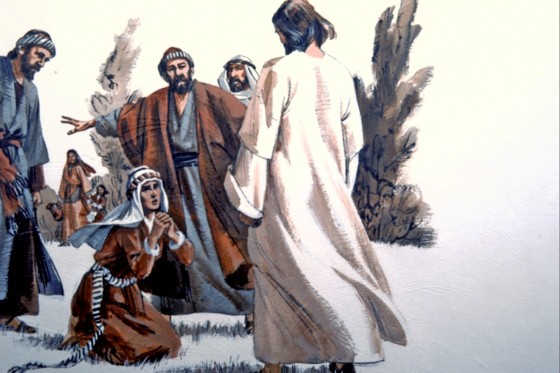
Jesus only commented positively on a person’s faith three times, and two of those times the supplicant was not Jewish, but other, in this case, a Canaanite woman. All she cared about was her daughter. He even says no, he won’t help her, he is there for the Jews. As she persists, as she argues with Jesus and makes her case, he relents, he feels enormous compassion for this woman in her plight, and as he heals her daughter, he makes this extraordinary statement calling attention to her belief. No legalistic requirements, he just heals.
Matthew 15:21-28
21 Jesus left that place and went away to the district of Tyre and Sidon.22Just then a Canaanite woman from that region came out and started shouting, ‘Have mercy on me, Lord, Son of David; my daughter is tormented by a demon.’ 23But he did not answer her at all. And his disciples came and urged him, saying, ‘Send her away, for she keeps shouting after us.’ 24He answered, ‘I was sent only to the lost sheep of the house of Israel.’ 25But she came and knelt before him, saying, ‘Lord, help me.’ 26He answered, ‘It is not fair to take the children’s food and throw it to the dogs.’ 27She said, ‘Yes, Lord, yet even the dogs eat the crumbs that fall from their masters’ table.’ 28Then Jesus answered her, ‘Woman, great is your faith! Let it be done for you as you wish.’ And her daughter was healed instantly.
Clean or Unclean?
This is one of my favorite readings in the Lectionary. People often ask where it is that Jesus declared all foods “clean” and this is one of the scriptures. To me, it is the why of it that makes it interesting – and convicting. There is enough in my heart to make me unclean without worrying about food rules.
Matthew 15:1-20
15 Then Pharisees and scribes came to Jesus from Jerusalem and said,2 ‘Why do your disciples break the tradition of the elders? For they do not wash their hands before they eat.’ 3 He answered them, ‘And why do you break the commandment of God for the sake of your tradition?4 For God said,* “Honour your father and your mother,” and, “Whoever speaks evil of father or mother must surely die.” 5 But you say that whoever tells father or mother, “Whatever support you might have had from me is given to God”,* then that person need not honour the father.* 6 So, for the sake of your tradition, you make void the word* of God. 7You hypocrites! Isaiah prophesied rightly about you when he said:
8 “This people honours me with their lips,
but their hearts are far from me;
9 in vain do they worship me,
teaching human precepts as doctrines.” ’
10 Then he called the crowd to him and said to them, ‘Listen and understand: 11 it is not what goes into the mouth that defiles a person, but it is what comes out of the mouth that defiles.’ 12 Then the disciples approached and said to him, ‘Do you know that the Pharisees took offence when they heard what you said?’ 13 He answered, ‘Every plant that my heavenly Father has not planted will be uprooted. 14 Let them alone; they are blind guides of the blind.* And if one blind person guides another, both will fall into a pit.’ 15 But Peter said to him, ‘Explain this parable to us.’ 16 Then he said, ‘Are you also still without understanding?17 Do you not see that whatever goes into the mouth enters the stomach, and goes out into the sewer? 18 But what comes out of the mouth proceeds from the heart, and this is what defiles. 19 For out of the heart come evil intentions, murder, adultery, fornication, theft, false witness, slander. 20 These are what defile a person, but to eat with unwashed hands does not defile.’
Where is Terekeka, South Sudan?

Today the church prays for the diocese of Terekeka, in the South Sudan. I have never heard of Terekeka – have you?
When I looked for it on Google Maps, it didn’t have any information. When I went to The South Sudan and then googled Terekeka, it came up with a reference, and I had to go to this website to find it – they had a map.
The organization who put up the map, Harvesters Reaching Nations, has two locations in the southernmost part of South Sudan, the newest nation on earth. They are building hospitals, and taking in orphans. If I hadn’t gone looking, I would never have heard of the good works they are doing, saving lives, changing lives.
This is what they say:
We currently serve more than 190 orphans in two locations in South Sudan – Yei and Terekeka. Our school in Yei provides a Christian education to more than 500 students. In addition to our school-age orphans, more than 400 children from surrounding villages attend our school.
The Harvesters campus in Yei consists of 90 acres of land donated by the South Sudan government. Since our beginning in 2001, we have built homes, dorms, classrooms and other facilities within a fenced-in campus. We use the land we own beyond the fencing for planting and growing corn, tomatoes and other vegetables for use in the orphanage.
Harvesters’ campus in Terekeka, South Sudan opened in 2010. At this campus, we currently provide care for 44 orphans, but will grow to 80 in the near future. We have built homes, dorms and a clinic within a five acre, fenced-in campus. Additional facilities, including a church and school classrooms, will be built in the near future as the needs and resources dictate.
To do this, they sold everything they owned, and moved to the South Sudan, and used the proceeds from selling everything to build the hospitals and schools. I bet they are the happiest they have ever been, and the most thoroughly engaged in life they have ever been.
God Vs. Worry; God Wins
One of the things that adds texture to my life, and helps keep me on the straight and narrow (and that takes a LOT) is reading the daily lectionary every single morning of the year, before I do anything else. Normal days, I access it from my computer, traveling or appointment days, I can access it from my iPad or iPhone. It’s like a little extra fence that helps keep me safe from myself and my own creativity when it comes to evil.
There is another side, the blessing side. In one of the bible studies I attend, we learn, over and over that God blesses the believer. You don’t have to be perfect – and it’s a good thing, because none of us are. If you want to see how much God can love a sinner, just read your bible. Sin is one of the main characters, right along side Abraham and Sarah, Job, Lot, and especially King David.
But in my life, I have seen wondrous things, and I have had some totally WOW moments when God has blessed me beyond any prayer I could have raised. One of those moments was showering under a waterfall near an oasis in the Tunisian desert. Two others happened this year, and these were blessings that stopped me in my tracks with their timing and aptness. First, we got an unexpected tax refund which arrived in our account just in time to cover the big expensive air conditioning system on the main floor when it broke and had to be replaced.
Second, when we were looking for the last few thousand dollars to help us buy a new car (we prefer to pay cash) we got another tax refund – we had asked that they re-look taxes for a move, and they allowed the moving expenses. We had waited almost a year for that decision; we had waited so long we had pretty much forgotten and given up on it. I mean tax refunds – it’s a never-never land, it all seems so arbitrary. You can have a perfect case, and it can be denied for a reason you’ve never heard of.
God’s timing is perfect. His sense of humor is breath-taking. The funds we needed poured into our hands just when we needed them, in just the right amount.
Matthew 6:25-34
25 ‘Therefore I tell you, do not worry about your life, what you will eat or what you will drink,* or about your body, what you will wear. Is not life more than food, and the body more than clothing? 26Look at the birds of the air; they neither sow nor reap nor gather into barns, and yet your heavenly Father feeds them. Are you not of more value than they? 27And can any of you by worrying add a single hour to your span of life?* 28And why do you worry about clothing? Consider the lilies of the field, how they grow; they neither toil nor spin, 29yet I tell you, even Solomon in all his glory was not clothed like one of these.
30But if God so clothes the grass of the field, which is alive today and tomorrow is thrown into the oven, will he not much more clothe you—you of little faith? 31Therefore do not worry, saying, “What will we eat?” or “What will we drink?” or “What will we wear?” 32For it is the Gentiles who strive for all these things; and indeed your heavenly Father knows that you need all these things. 33But strive first for the kingdom of God* and his* righteousness, and all these things will be given to you as well.
34 ‘So do not worry about tomorrow, for tomorrow will bring worries of its own. Today’s trouble is enough for today.
“Open His Eyes That He May See”
Some of the historical books of the bible have the most amazing stories. What I love about this one is that when the servant’s eyes are opened, he sees the unseen heavenly beings which surround us. Imagine, too, the King of Israel preparing a feast for the warrior force sent against him, and sending them peacefully on their way back after eating and drinking. This is the old testament reading from today’s Lectionary:
2 Kings 6:1-23
6Now the company of prophets* said to Elisha, ‘As you see, the place where we live under your charge is too small for us. 2Let us go to the Jordan, and let us collect logs there, one for each of us, and build a place there for us to live.’ He answered, ‘Do so.’ 3Then one of them said, ‘Please come with your servants.’ And he answered, ‘I will.’ 4So he went with them. When they came to the Jordan, they cut down trees. 5But as one was felling a log, his axehead fell into the water; he cried out, ‘Alas, master! It was borrowed.’ 6Then the man of God said, ‘Where did it fall?’ When he showed him the place, he cut off a stick, and threw it in there, and made the iron float. 7He said, ‘Pick it up.’ So he reached out his hand and took it.
8 Once when the king of Aram was at war with Israel, he took counsel with his officers. He said, ‘At such and such a place shall be my camp.’ 9But the man of God sent word to the king of Israel, ‘Take care not to pass this place, because the Arameans are going down there.’ 10The king of Israel sent word to the place of which the man of God spoke. More than once or twice he warned such a place* so that it was on the alert.
11 The mind of the king of Aram was greatly perturbed because of this; he called his officers and said to them, ‘Now tell me who among us sides with the king of Israel?’ 12Then one of his officers said, ‘No one, my lord king. It is Elisha, the prophet in Israel, who tells the king of Israel the words that you speak in your bedchamber.’ 13He said, ‘Go and find where he is; I will send and seize him.’ He was told, ‘He is in Dothan.’ 14So he sent horses and chariots there and a great army; they came by night, and surrounded the city.
15 When an attendant of the man of God rose early in the morning and went out, an army with horses and chariots was all around the city. His servant said, ‘Alas, master! What shall we do?’ 16He replied, ‘Do not be afraid, for there are more with us than there are with them.’ 17Then Elisha prayed: ‘O Lord, please open his eyes that he may see.’ So the Lord opened the eyes of the servant, and he saw; the mountain was full of horses and chariots of fire all around Elisha. 18When the Arameans* came down against him, Elisha prayed to the Lord, and said, ‘Strike this people, please, with blindness.’ So he struck them with blindness as Elisha had asked. 19Elisha said to them, ‘This is not the way, and this is not the city; follow me, and I will bring you to the man whom you seek.’ And he led them to Samaria.
20 As soon as they entered Samaria, Elisha said, ‘O Lord, open the eyes of these men so that they may see.’ The Lord opened their eyes, and they saw that they were inside Samaria. 21When the king of Israel saw them he said to Elisha, ‘Father, shall I kill them? Shall I kill them?’ 22He answered, ‘No! Did you capture with your sword and your bow those whom you want to kill? Set food and water before them so that they may eat and drink; and let them go to their master.’ 23So he prepared for them a great feast; after they ate and drank, he sent them on their way, and they went to their master. And the Arameans no longer came raiding into the land of Israel.
Homecoming and Judgement
Home again, home again and the daily grind recommences. Giving up a vacation is hard for me. Part of it is my compulsiveness; my mind whirls with my must-do’s and almost all the things I really like to do are not on the must-do’s list. Must do’s include things like laundry and dishes, tasks which are mindless and I don’t really mind too much, but they get in the way of what I want to do, which is to tell you about our Alaska adventure 🙂 Before I can do that, in addition to the must do’s, I also have to transfer all my photos from my iPad to my computer, which makes blogging so much easier, so once again – something hard before something fun.
Am I grumbling? Sorry if it sounds that way. I love vacations. I love other people doing the cooking and cleaning and me just responsible for putting clothes on and figuring out what I want from the menu. I love the stimulation of seeing new things, smelling new smells, walking new paths.
As soon as we got home, we dropped our bags and zipped as fast as we could over to our son’s house to visit with him and his family. I got to hold my new little granddaughter for the entire visit – oh, so such a sweet tiny baby.
Yesterday, I hit the early service, hit the commissary, put all the groceries away and then AdventureMan and I took our little grandson to Red Robin, where . . . . in a momentary loss of my senses, I ordered a hamburger, my second of the year. It didn’t taste as good as my 4th of July hamburger, serves me right. But we had such a fun time, and here is the grand triumph – our grandson is using a napkin! He is wiping his hands and mouth with a napkin, not with his hand or arm! Wooooo HOOOOOO! He chats and makes conversations, oh, he is so much fun.
So today, on! On! Get that laundry done! Get those files transferred!
Yesterday’s sermon was on the tendency of the most Christian of Christians to want to sit in the highest seats, and Jesus’ words to choose the lower seat and allow the host to move you up, giving you honor, rather than choosing a high seat and being asked to move lower so that someone of higher distinction can have your seat. Father Neal Goldsborough mentioned that he sees the saving-of-the-seats, the tipped chairs, the stretched out handbags all the time, and we were all squirming. We’re all guilty. It was a great sermon.
From today’s Forward Day by Day readings on the daily lectionary:
James 2:1-13. Mercy triumphs over judgment.
It’s easy to pass judgment—she’s too liberal or too conservative, his clothes are too cheap or too rich, she doesn’t believe the “right” theology, his values aren’t properly aligned, etc. As easy as passing judgment is, it can do a lot of damage.
All too often, this judgment happens in churches. Comparisons and assessments pop up, and the pews that should be a safe haven for all people become trial benches. A 2007 Barna Group survey found that 87 percent of young non-Christians perceive present-day Christianity as judgmental—and half of their churchgoing counterparts answered the same. I’d be surprised by these numbers if they didn’t ring so true with perceptions among my own friends and acquaintances.
Putting mercy above judgment does not mean moving into a slippery relativism. It means embracing the radical Good News of Jesus and living as a conduit of Christ’s love to the world. Today’s passage from the book of James precedes tomorrow’s familiar proclamation, “So faith by itself, if it has no works, is dead” (2:17). An act of mercy is a work of faith, a witness putting Christianity in its rightful place.
Touched the Hem of His Garment
Today’s meditation from Forward Day by Day touches on one of my very favorite stories – and its opposite. It’s all about the power of belief. The woman, suffering from bleeding, would have lived a terrible life, considered unclean, untouchable, and trying everything to be cured without success. Just a touch – one touch – and her illness is gone. Jesus is astonished and tells her that her faith has made her well.
In contrast, the people in his own village are skeptical. How can good ole Jesus, son of Mary and that carpenter, how can he be anything special? In the face of such callous disbelief, Jesus can do little.
SATURDAY, July 27
Mark 6:1-13. And he could do no deed of power there, except that he laid his hands on a few sick people and cured them.
What a contrast, in just a few verses. Yesterday the bleeding woman merely touched Jesus’ garment, and Jesus’ power streamed into her. Today he is home, and those who watched him grow up ask, “Just who do you think you are?” and the Son of God is stopped in his tracks, like Superman when he is exposed to kryptonite.
My field education rector preached on this passage a year ago, and I was spellbound by his ending. He asked, “If Jesus came to All Saints, would he be able to do deeds of power?” Then the rector got even more personal, asking, “If Jesus came to you, would he be able to deeds of power?”
Oh, how I hope so. I’m not sure how to have the faith that allows Jesus to perform deeds of power, but I can see what kind of behavior does. It is hopeful, brave actions that seem to open the way for Jesus to work; and it is arrogant, fear-based behavior that seems to block the way.
Lord, teach us not to fear the change you bring. Teach us to reach out to touch your garment.
When my Mother was still living on her own, there was a revolving guest room, and my sister left a CD for me there, as she departed and I arrived, which contained the song above. I want it sung at my funeral. It is a succinct statement of faith; it is the song of the bleeding woman who believes and is cured, and nothing is ever the same.
Name that Country: A Most Difficult Challenge
This morning, as I was praying for Panama – there is always a diocese listed in the daily lectionary to be prayed for somewhere in the world – I was thinking how I know where Panama is. When we are praying for Nigeria, there are names I haven’t heard of. I now Lagos, and Port Harcourt, but where is Abuja? Owerri? I go to GoogleEarth and look them up.
I struggle with how little the average American knows about geographical location. It’s just embarrassing. Through all the years I lived abroad, most of the time, unless it was Germany, people couldn’t quite place where I was living. Many had heard of Tunisia; we had troops there in World War II, and Saudi Arabia, because they had seen it often enough on the news, but the rest of the Arab Gulf, Jordan, Syria, North Africa – beyond them.
Then, on the first night of one of my grad classes, the professor handed us this map and gave us ten minutes to put in the appropriate country names. He did not, thanks be to God, ask us to put in capitals. Not a single one of us got them all, and this was a class full of nation-oriented people.
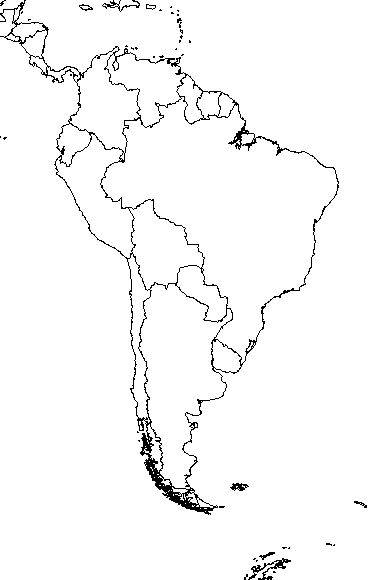
It was also on the final exam, three months later, and most of us got them all right – thanks to some fervent cramming and study groups.
Here are a couple more maps, in case you are feeling cocky. See if you can accurately fill in the name of each country:
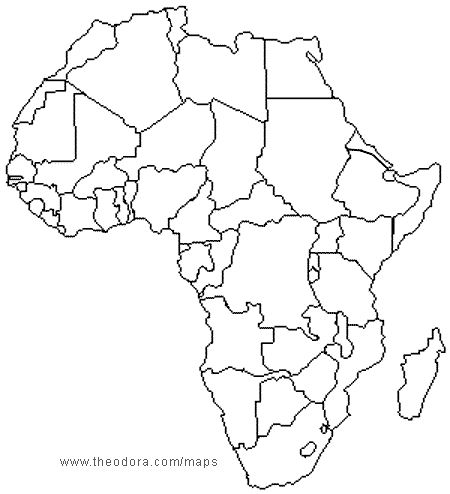

Bonne chance!
St. John the Baptist and the Holy Spirit

This entry is a totally Here There and Everywhere moment; the impetus of which is today’s reading from Luke about the birth of John the Baptist, or as he is known in the Moslem world, the Prophet Yahya. We visited his tomb in Damascus; at our church in Kuwait on the Feast of the Nativity of St. John the Baptist, one of the readings was from the Quran. I love it when our worlds intersect and we can discover what we can learn from one another, to the advantage of all.
I also love it that each meditation from Forward Day by Day lists at the bottom the area of the world we are to include in our daily prayers. I love praying for Nigeria. I have old friends from my Kuwait church living there, and also a neighbor from Doha, a sweet book-club friend who lived across the street, who now lives in Lagos.
When I pray for Nigeria, I see the tiny flame of the holy spirit entering into each heart, and then I see God blowing lightly on each person, so that the flame grows. The flame helps them reach out and encourage one another, and others see, and are attracted, and thus the holy spirit spreads. I imagine it covering Nigeria, all believers, seeing one another as fellow believers, not as Ibo or Christian or village or . . . you get the drill. I pray that the light spreads through all Africa, and tiny embers spread out to join, and then further, so that sparks unite all over the world.
I pray, too, for Damascus, and for Syria, and all our friends there; I think of all the wonderful adventures and times we have shared in Syria, and I know and trust with all my heart that our good and loving God can bring good out of this horror. I pray for it to happen sooner rather than to allow this suffering to endure.
. . . And that was just ONE synapse connecting early on a Monday morning, LOL. Have a great day. 🙂
MONDAY, June 24 The Nativity of Saint John the Baptist
Luke 1:57-80.
On the eighth day they came to circumcise the child, and they were going to name him Zechariah after his father. But his mother said, “No; he is to be called John.”
Most of us don’t receive such pointed visions that show us the fork in the road—“this way, not that way”—but all of us are constantly cultivating either a disposition of “my will be done” or of “thy will be done” that will suddenly show up in those crossroads moments. It may appear like divine intervention, but it is long-term divine cultivation.
Living into a larger pattern is both exciting and terrifying, because it means letting go of convention and stepping into new territory. Like Elizabeth and Zechariah, we do not step forward blind but with a promise: God remembers, and God is gracious.
The Widow’s Mite
Today’s meditation is on the Gospel reading from the Lectionary found in Forward Day by Day. I’ve always loved this image, this humble, poor woman who gives what little she has.

THURSDAY, June 20
Luke 20:41—21:4. Jesus looked up and saw rich people putting their gifts into the treasury; he also saw a poor widow put in two small copper coins. He said, “Truly I tell you, this poor widow has put in more than all of them; for all of them have contributed out of their abundance, but she out of her poverty has put in all she had to live on.”
There is something about generosity that is compelling. Jesus says that the poor widow has given out of her poverty, but in reality it is only she who has given out of her abundance—an inner abundance of the heart that allows her to behave almost recklessly, as if she had more than enough.
I was taught to save those pennies, to save them for a rainy day, and it can still keep me looking to the horizon for any sign of clouds. My spouse, admittedly, has a much better relationship to money: it’s not about having or not having, but about knowing the relative value of wealth; it is energy to be moved around, rather than bankable power or security. Above all, it is a potent way to extend and manifest generosity.
As we see in the widow’s mite, it’s not the amount, but the heart’s intention behind it that matters. That is where the real power lies.
Recent Comments
intlxpatr on Shampoo Ginger tigerbutterya0c5ff1d… on Shampoo Ginger intlxpatr on British Soldier Kidnapped, Esc… John on British Soldier Kidnapped, Esc… intlxpatr on British Soldier Kidnapped, Esc… Wikipedia Donate Button

Amazina


Early Voting in Florida


