AdventureMan is hollering from his office to mine “Can I read you something?”
We all find ways to express our indignation. He writes directly to our president, our representative (he calls him Trump’s butt-boy, to me, not to him), to Pruitt. He tells them, in acceptable language, exactly what he thinks.
“I’d say ( . . . . ), but as a retired army officer, I think I am still subject to the UCMJ (Uniform Code of Military Justice),” he says, and censors himself so that he is within civil boundaries.
How did we come to this, when our own national leader lies, again and again, even in the same day, and we have come to accept this as “normal?” How can we accept his calling people who are brown, and seeking a safer, better way of life “vermin” and their countries as “s-tholes?” The unthinkable has become our daily reality. It is not only the children, separated from their parents, who are becoming traumatized, it is also normal every-day Americans who believe that the American Dream is for everyone.
I think the American president is afraid of a world in which our nation is more brown than white, which it is well on it’s way to becoming. I think the thought of losing power terrifies him. I can’t imagine any other rational reason for his behavior towards the “other,” the stranger, those he labels as enemies.
So while I am startled when AdventureMan tells me he self-censors, I also understand. The unimaginable had manifested itself daily since this man was elected, and he will stop at no ends to complete his agenda. His cronies and fellow thugs will thrive, while we drink polluted water, and watch oil seep on to our shores from the off-shore drilling. We will watch our public schools fail, and our jails overflow. My heart breaks on a daily basis, watching what we, as a nation, are becoming.
I used to think the ACLU were a bunch of wackos. When the first travel ban went into effect, and we watched the stunned travelers arrive only to be told they must go back, the ACLU had tables in the airports offering free legal services. I sent my first check that night. I DO protest, via RESISTBOT (text Resist to 50409) wondering if my voice even matters. Sending checks to those who are resisting successfully gives me greater satisfaction. Reaching out my hands to “the other” gives me greater satisfaction. Building bridges and connections feeds my feelings of resistance, that together we can make a difference.
I don’t have a bucket list. There are things I would like to do, and to the best of my ability, I just keep doing them, but I don’t worry about checking things off. If I don’t do it, I must not have cared enough. At the same time I am following in the Wake of the Vikings, my best friend from college is walking more than 100 miles on a trip. 100 miles! She showed me her Fit-bit readings, and she is doing like 38,000 steps a day!
You go, friend! (Not me!) There are days I do 10,000 steps, and once I even did 20,000 but I don’t expect those to happen often. I am proud for my friend to do this, and I have other challenges 🙂
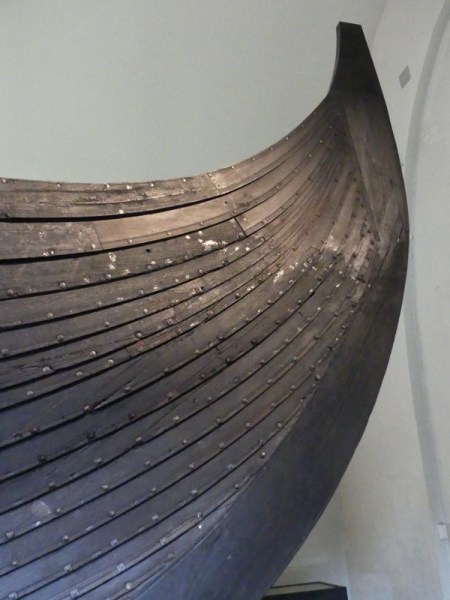
Having said that, I really wanted to see the Viking Ship Museum, oh yeh, me and ten thousand other visitors in Oslo, and how on earth do we all end up at the museum at the same time? By deserting my group, and waiting patiently, I was able to get some people-less shots. You can’t imagine how hard that is.
I really like this one, above, because of the parallel shadow; the influences of the early Norse culture live on.
Imagine the patience and artistry it took to carve this piece!
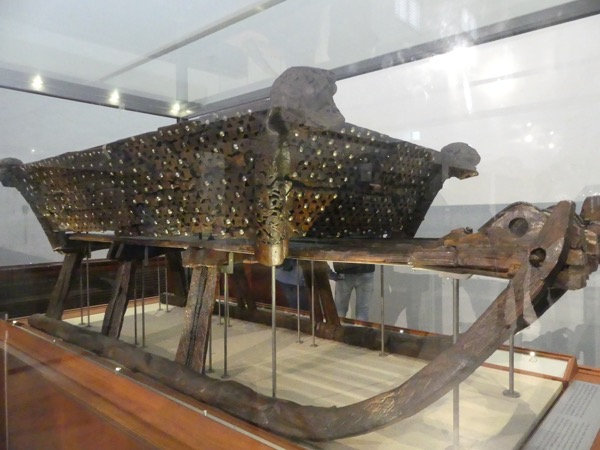
This is a wagon; sorry for the reflection but it is encased in plastic to protect it from all the people (like me) who might like to touch . . . It was interesting to me to see a wheel built out of sections held together with metal clips.
This is a carved sled – imagine all that trouble for an item of daily use. Must be the long, cold, dark winters gave them the time to imagine and bring to reality.
Another sled. So beautiful.
This is a small museum, but inspiring. There is also a movie, which I missed because I wanted to take photos without other people in them.
I find Oslo beautiful. I find their traditional buildings beautiful, even those with grass roofs. How practically beautiful! And the new buildings they are doing knock my socks off! Look at the “iceberg” and at their new Opera and Ballet center!
This might look like the same photo as the above, but the above is to show some of the new high rises going up, where below is to highlight the statue called She Lies. I love this collection of statues. This is another one I would give to high school students and ask them to tell me the story. The body language is so ambivalent, I am sure that there are as many possibilities as there are viewers!
More traditional Oslo; less daring, equally beautiful.
This morning we got another phone call from the “IRS” saying it was our final notice that they were filing a suit against us. We are actually in pretty good contact with the IRS ourselves, and this scam phone call doesn’t even give our hearts a tiny flutter.
But it does make me angry, thinking of the vulnerable people who may panic, who may fall for this and call them back, who may even, in all good faith, believe that this is the way the IRS operates and end up sending them money.
Those of you who have time on your hands might want to call the number and tell them what you think. If you are an IRS official, even better. People who prey on other people for their livelihood need to find another way to earn a living.
You all know me – I read. I especially read newspapers and reliable news magazines, and I read even the small articles. I get two wonderful news services that alert me to sometimes obscure stories, or stories the bigger news channels aren’t carrying.
On social media, I often check a story one of my friends has posted. I use Snopes, by preference.
Today, in Digg, is a lengthy article you will want to read – about Snopes.
Here is the leading quote:
Can mythbusters like Snopes.com keep up in a post-truth era?
The fact-checking website was launched to correct urban legends and false rumours. Now, with even presidential candidates repeating fake stories from the web, its co-founder David Mikkelson says ‘the bilge is rising faster than you can pump’
“We had a phone call from the IRS,” I told AdventureMan as he headed upstairs for reading time with the Grandson.
“Oh, I forgot to tell you, I got one too, this morning,” he replied. “Is this about the lawsuit?”
“Yep.” I said calmly, continuing with my Honey Cake.
We’ve had a long relationship with the Internal Revenue Service. As with any long relationships, sometimes there are misunderstandings, miscommunications, even face-to-face meetings with questions, answers and resolutions. Our taxes are complicated by investments and a variety of retirement vehicles, and years and years of overseas living and earnings. It’s complicated. It’s a very normal long-term relationship.
I am posting this because this phone call is a SCAM. The phone call sounds very threatening:
THIS IS YOUR LAST WARNING. THE IRS WILL FILE A LAWSUIT AGAINST YOU IMMEDIATELY! YOU NEED TO CALL 302-766-2673 IMMEDIATELY!
This is not the way the IRS communicates with taxpayers.
Please warn those vulnerable to deception about this scam.
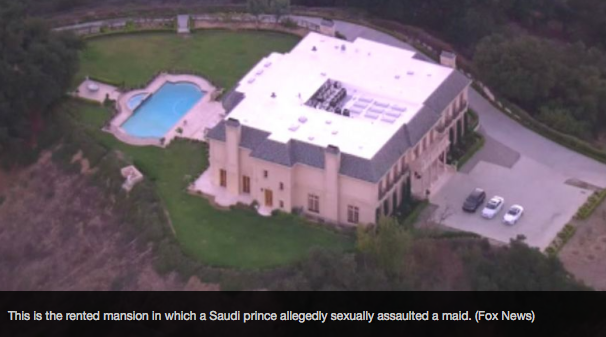
Not only did Sheikh Khalid bin Hamad al Thani rent this house before he fled the USA fearing arrest for reckless driving, but now Saudi Prince Majed Abdelaziz Al-Saud rents the same house and is arrested after forcing some young woman to have oral sex. She was seen escaping the house and crawling over the wall to get away. Sorry guys. You may get away with these things in Qatar and Saudi Arabia, but not in the USA. And it’s just embarrassing to claim diplomatic immunity when it’s so easy to prove you have none. We have to play by your rules when we live in your country. It’s called being a good guest. Please pay us the same courtesy. It’s our country.
A Saudi prince was arrested Wednesday at a compound near Beverly Hills in connection with an alleged sex crime after a bleeding woman was seen trying to flee the grounds.
Majed Abdulaziz Al-Saud, 28, was arrested on suspicion of forced oral copulation of an adult, according to the Los Angeles Times. Police were called to the gated compound after a caretaker at the home reported the disturbance. The Times, citing jail records, reports Al-Saud was freed on $300,000 bail Thursday afternoon. LAPD officer Drake Madison told the newspaper the suspect was booked after 4 p.m.
Capt. Tina Nieto said the police department has a consul liaison that checks with foreign nations’ consulates regarding a certain person’s diplomatic immunity. Nieto said Al-Saud doesn’t have immunity in this case.
Tennyson Collins, a neighbor, told the Times he saw a bleeding woman trying to scale the property’s 8-foot wall on Wednesday. When Collins returned home from work, police followed his car through the gates and then onto the property. He said officers escorted about 20 people out of the compound, most of them staff members.
Police said Al-Saud was renting the home, which Zillow values at $37 million. Collins said different foreign nationals have been renting out the home for weeks at a time over the past year.
Earlier this month, a Qatari prince, Sheikh Khalid bin Hamad al Thani, was videotaped racing a yellow Ferrari through Beverly Hills at speeds of up to 100 miles per hour, blowing through stop signs and frightening residents. Al Thani later denied driving recklessly and claimed he had diplomatic immunity, Beverly Hills police said. Authorities consulted with the State Department and the Qatar consulate and determined he did not have diplomatic immunity, police Chief Dominick Rivetti said during a Sept. 17 news conference.
Al Thani reportedly flew back to Qatar before he could be arrested.
When I lived in Kuwait and Qatar, I was appalled by the way rapes were treated, it was like this huge wave of abductions and violations, and nothing was done. As it turns out, things are changing a lot slower in my own country than I thought. This new film, The Hunting Ground, is by the same person who documented violence and rape in the US military, spurring then Secretary of Defense Leon Panetta, a truly decent man, to put the fear of God into the military leaders who were covering up the many rapes and blaming the victims. We have the same problem on college campuses.
There is only one cure. We have to raise our sons to respect women. We have to continue raising the bar for equality in our country until women have equal access to jobs, health treatment, legal proceedings, etc. Films like The Hunting Ground are painful, and at the same time, help us to face, and to overcome our societal short comings.
I love it that this film is “giving voice to those who have no voices;” that these courageous women speaking out have bravely named their rapists and described their circumstances. It can’t be comfortable, but it is their right. I am proud that they are not intimidated by fear of the ‘blame the victim’ mentality they have endured on their college campuses. When did colleges and universities begin placing money-making and winning teams before the well-being of their students?
New film gives chilling account of sexual assault on college campuses
Sexual assaults on college campuses have reached alarming levels and the issue has drawn the attention of Congress and even President Obama himself. The latest research indicates that one in five college women will be sexually assaulted and as many as 90% of reported assaults are acquaintance rapes. It is believed that more than 100,000 college students will be sexually assaulted during the current school year. Nowhere is the deck stacked more against sexual assault victims than in college athletics. In just the last few years alone there have been cases at Florida State, Michigan, Oregon, Vanderbilt andMissouri.
All of this is a backdrop to a harrowing new film that premiers in theaters on Friday in New York City and Los Angeles. The Hunting Ground is a jarring exposé that shines a bright light on the epidemic number of sexual assaults taking place on college campuses each year.
The Hunting Ground features a group of survivors who faced harsh retaliation and harassment for reporting that they had been raped. The film focuses on institutional cover-ups and the brutal backlash against survivors at campuses such as Harvard, Yale,Dartmouth, the University of North Carolina at Chapel Hill, USC and the University ofCalifornia-Berkeley, among others.
Some of the most vexing stories featured in the film involve women who were assaulted by athletes. While The Hunting Ground isn’t all about sports, the most dramatic moment in the film occurs two-thirds of the way through when the woman who accused former Florida State quarterback Jameis Winston—who after a strong showing in last week’s Combine is projected by many to be the No. 1 pick in this spring’s NFL draft—appears and tells her story publicly for the first time. The woman, who is named in the film but SI.com has chosen to protect her identity, is shown on camera and gives her life-changing account of what she says happened the night in December 2012 she left a Tallahassee bar with Winston.
Photo: Getty Images
A high school honor student who planned to attend medical school, the woman is articulate and attractive. She looks like the girl next door, a person you would trust to babysit your children. It is uncomfortable to watch—yet impossible to look away—when she describes being beneath Winston on his bathroom floor, repeatedly telling him “no” before being physically overpowered.
“We’re grateful it’s the first time people will get to hear [her] story,” said The Hunting Ground director Kirby Dick. “It’s her first-hand testimony. Up to this point it hasn’t been in a public space.”
The woman’s parents also appear in the film. Her father talks about driving to Tallahassee Memorial Hospital with his wife to be with their daughter hours after the incident.
There is nothing easy about retelling these stories for the world to see. But the attorney for the woman who says she was raped by Winston, John Clune, said his client decided to break her silence in the film because she felt it was the right venue to tell her story.
“The film was a once-in-a-lifetime opportunity,” Clune said. “The work by these filmmakers is nothing less than groundbreaking. It took tremendous courage, but our client and all of the incredibly brave women in the film have advanced the cause of rape survivors everywhere.”
The Hunting Ground also examines a sexual assault accusation against a Notre Damefootball player in 2010. Tom Seeberg, whose daughter committed suicide after she says she was sexually assaulted by a Fighting Irish starter, tells a heartbreaking account of school officials thwarting the investigation into his daughter’s complaint. A former Notre Dame police officer reveals that he and his colleagues were not allowed to approach or question an athlete on athletic properties.
The film also mentions rape cases involving football players at Missouri and Vanderbilt, as well as basketball players at Oregon.
The testimonials of rape survivors are wrapped between raw footage that is both gut-wrenching and disturbing. A small mob of unruly fraternity pledges at Yale are captured on film outside a freshman dorm for women, chanting: “No means yes. Yes means anal.” All the while a guy with a bullhorn is shouting: “Louder.”
In another scene we see drunken frat boys spilling out of a house where there is a sign out front that says: “THANKS FOR YOUR DAUGHTERS.” It’s enough to outrage any parent with a daughter heading off to college.
The film is directed by Dick and produced by Amy Ziering, the team behind the Oscar-nominated film The Invisible War, which revealed systemic sexual assaults and cover-ups within the U.S. military. That movie prompted Secretary of Defense Leon Panetta to announce significant policy changes and inspired the passage of the Military Justice Improvement Act.
Dick and Ziering started looking into the situation on college campuses shortly after the release of The Invisible War. “We were astonished that the problem was as serious in higher education as it was in the military,” Dick said.
Full disclosure: I appear in The Hunting Ground as an expert. Two of the cases in the film—Lizzy Seeberg’s alleged assault at Notre Dame and running back Derrick Washington’s sexual assault of a student at the University of Missouri—are featured in my book The System: The Glory and Scandal of Big-Time College Football, which I wrote with 60 Minutes correspondent Armen Keteyian.
Some of my research is also featured in the film, including the statistic that student-athletes are responsible for 19% of the reported sexual assaults on campus, despite the fact that they comprise just 3.3% of the male student population. Those figures arose from a first-of-its-kind study I conducted with researchers at the University of Massachusetts in the mid-90s when we were granted access to judicial affairs records and police reports at colleges across the country.
Photo: Don Juan Moore/Getty Images
Over the past 20 years I have researched hundreds of cases of sexual assault involving athletes. During that time I’ve interviewed countless sexual assault victims. The thing I found most telling was what prosecutor Willie Meggs did not say in the film. Meggs was asked if he thought a rape took place in Winston’s apartment. It was a perfect opportunity for the man who chose not to prosecute Winston to say no. Instead, he said something “bad” happened in that apartment that night. He just didn’t have sufficient evidence to prove it.
That’s not unusual. That’s typical. Only about 20% of rapes reported to the police in the U.S. are prosecuted. Yet at least 92% of reported sexual assault claims are found to be true. The problem is that date rape cases are very difficult to prove beyond a reasonable doubt, especially when alcohol is involved and the incident occurs in the perpetrator’s apartment, dorm or hotel room. The doubts raised by those factors are amplified when the accused is a star athlete.
The greatest achievement of The Hunting Ground is that it empowers rape victims to team up with each other and come forward. It’s fair to say that for the first time in many years, women like Jameis Winston’s alleged victim have powerful allies.
By the time the NFL draft takes place in May, the film will be in theaters around the country, the name of Winston’s accuser will be everywhere and more details about the night in question will likely come out. All of this brings to mind the legal maxim caveat emptor, which essentially is a warning that means let the buyer beware.
Jason Licht, the general manager for the Tampa Bay Buccaneers, ultimately has to decide whether to use the first pick on Winston. He’s on record saying: “This is the most important pick, potentially, in the history of the franchise.”
Memo to Licht: Watch The Hunting Ground.
The ramifications in this instance are equally big for the NFL, whose image took a beating over the last year after Ray Rice was caught on tape knocking out his then-fiancé in an elevator. The controversy erupted after Commissioner Roger Goodell imposed a two-game suspension without bothering to obtain and watch the video.
Memo to the Commissioner: Watch The Hunting Ground.
No matter what happens with Winston, the film succeeds in its main goal: to shine a light on sexual assault on college campuses. It’s an important issue that isn’t going away, and if something drastic isn’t done immediately, it will only get worse.
Jeff Benedict is a lawyer and has written five books on athletes and violence against women, including Public Heroes, Private Felons: Athletes and Violence Against Women, and Out of Bounds: Inside the NBA’s Culture of Rape, Violence and Crime.
The good news is that Saudi women know better. They don’t buy this line any more than we do. They visit America, they go to school in America. And oh yes, they DRIVE in America. The second part of the good news is that the younger generation buys this line a whole lot less than our parent’s generation, and change is coming. It’s coming faster than this historian thinks.
Saudi Historian Says U.S. Women Drive Because They Don’t Care If They’re Raped
Saleh al-Saadoon claimed in a recent TV interview that women can be raped when a car breaks down, but unlike other countries, Saudi Arabia protects its women from that risk by not allowing them to drive in the first place, according to a translation posted online by the Middle East Media Research Institute.
“They don’t care if they are raped on the roadside, but we do,” al-Saadoon said on Saudi Rotana Khalijiyya TV.
“Hold on. Who told you they don’t care about getting raped on the roadside?” asked the host, a woman who is not named in the transcript.
“It’s no big deal for them beyond the damage to their morale,” al-Saadoon replied. “In our case, however, the problem is of a social and religious nature.”
Two other guests on the show — a man and a woman — appeared to be in shock over his comments. Al-Saadoon said they were out of touch.
“They should listen to me and get used to what society thinks,” al-Saadoon said.
Since the rape argument didn’t seem to be convincing anyone, al-Saadoon tried another approach, claiming that women are treated “like queens” in Saudi Arabia because they are driven around by the men of the family and male chauffeurs. That led the host to ask if he wasn’t afraid that women might be raped by their chauffeurs.
Al-Saadoon agreed.
“There is a solution, but the government officials and the clerics refuse to hear of it,” he said. “The solution is to bring in female foreign chauffeurs to drive our wives.”
That caused the female host to laugh and cover her face with her palm.
“Female foreign chauffeurs?” she said. “Seriously?”
Go figure. In spite of admonitions to the contrary, young people have sex. Problems arise when someone isn’t old enough to consent, isn’t coherent enough to have sex or is forced to have sex or participate in a sex act they don’t consent to.
I love this idea. It takes a little of the “he says – she says” out of the classic dilemma of who did what to whom and who should be held accountable? Was it consensual? Was it rape? Were both parties in a sober enough state to make that decision?
Last June, Reason’s Robby Soave called for an iPhone app that would clear up pesky he-said, she-said rape cases by recording “mutual consent” to engage in sexual activity before two people do the deed: “Maybe they would have to input a password and then touch phones, or something?” he proposed. Last week, his prayers were answered: The Good2Gosexual consent app isn’t as touch-and-go as the app of Soave’s dreams, but it does encourage sex partners to assess their mutual interest in sex and record their intoxication levels before getting busy.
Here’s how it works: After deciding that you would like to have sex with someone, launch the Good2Go app (free on iTunes and Google Play), hand the phone off to your potential partner, and allow him or her to navigate the process to determine if he or she is ready and willing. “Are We Good2Go?” the first screen asks, prompting the partner to answer “No, Thanks,” “Yes, but … we need to talk,” or “I’m Good2Go.” If the partner chooses door No. 1, a black screen pops up that reads “Remember! No means No! Only Yes means Yes, BUT can be changed to NO at anytime!” If he or she opts instead to have a conversation before deciding—imagine, verbally communicating with someone with whom you may imminently engage in sexual intercourse—the app pauses to allow both parties to discuss.
If the partner—let’s assume for the purposes of this blog post, partner is a she—indicates that she is “Good2Go,” she’s sent to a second screen that asks if she is “Sober,” “Mildly Intoxicated,” “Intoxicated but Good2Go,” or “Pretty Wasted.” If she chooses “Pretty Wasted,” the app informs her that she “cannot consent” and she’s instructed to return the phone back to its owner (and presumably, not have sex under any circumstances, young lady). All other choices lead to a third screen, which asks the partner if she is an existing Good2Go user or a new one. If she’s a new user, she’s prompted to enter her phone number and a password, confirm that she is 18 years old, and press submit. (Minors are out of luck—the app is only for consentingadults.) Then, she’ll fill out a fourth prompt, which asks her to input a six-digit code that’s just been texted to her own cellphone to verify her identity with that app. (Previous users can just type in their phone number—which serves as their Good2Go username—and password.) Once that level is complete, she returns the phone to its owner, who can view a message explaining the terms of the partner’s consent. (For example, the “Partner is intoxicated but is Good2Go.”) Then, the instigator presses a button marked “Ok,” which reminds him again that yes can be changed to “NO at anytime!”
Then you get to have sex.
Easy, right? When I tried this process out with a partner, it took us four minutes to navigate through all the screens, mostly because he kept asking, “Why are we using an app for this?” and “Why do I have to give them my phone number?” (More on that later.) I was confused, too: As the instigator, I wasn’t asked to confirm that I wanted to have sex or to state my own intoxication level for my partner’s consideration. (A promotional video modeling the process begins by announcing how “simple” it is, then snaps out instructions for three minutes, but questions remain.) Perhaps the process is deliberately time-consuming: The app provides the “opportunity for two people to pause and reflect on what they really want to do, rather than entering an encounter that might lead to something one or both will later regret,” the app’s FAQ reads. Or maybe I’m just old: At 29, I find it much easier to just talk about sex than to use an app for that.
Lee Ann Allman, a creator of the app, says she was inspired to make it after talking with her college-aged kids about sexual assault on campuses across the country. They “are very aware of what’s happening, and they’re worried about it, but they’re confused about what to do. They don’t know how they should be approaching somebody they’re interested in,” she told me. Meanwhile, “kids are so used to having technology that helps them with issues in their lives” that Allman believes the app will help facilitate necessary conversations, encourage them to consider their level of intoxication, and remind young people that consent to sex should be affirmatively given and can be revoked at any time.
“Good2Go” is obviously a euphemism for sexual activity, but it’s not clear what that means exactly—is it making out, oral sex, vaginal intercourse, or anal sex, and with protection or not? (I guess you could always pause, grab phones, and start the process over to consent to another specific sexual activity—but at some point, you’d actually have to verbally explain what you’re agreeing to be Good2Go4.) The message that people need to consent to sex, and that they can withdraw consent, and they probably shouldn’t be totally wasted while they do it is one that college campuses are already administering to their students upon orientation. It may not always be getting though, but it’s not clear how the app (which is now being promoted through campus ambassadors) advances the cause.
In fact, Good2Go could contribute a dangerous new element to those he-said she-said rape cases. What Good2Go doesn’t tell users is that it keeps a private record of every “I’m Good2Go” agreement logged in its system, tied to both users’ personal phone numbers and Good2Go accounts. (Records of interactions where users say “No” or just want to talk are not logged in this way.) Allman says that regular users aren’t permitted access to those records, but a government official with a subpoena could. “It wouldn’t be released except under legal circumstances,” Allman told me. “But it does create a data point that there was an occasion where one party asked the other for affirmative consent, that could be useful in the future … there are cases, of course, as we know, where the accused is an innocent party, so in that case, it could be beneficial to him.”
That record may help the falsely accused, but it’s unlikely to aid a real victim. Good2Go may remind its users that consent can be revoked at any time, but there are still judges and juries that will take evidence that a person said “yes” to sex at one point, and conclude that they were asking for whatever happened later that night (or the next). Compared to that scenario, talking about sex doesn’t seem so scary.














 Here There and Everywhere