Unexpected and Delightful – Dancing Outbreak
My Kuwait friend sent me this – it delighted my day! I hope you love it as much as I do – wouldn’t you love to be there when one of these events happen?
I told her I would love to see this in Kuwait! A group who dances, unexpectedly, here and there . . . even at a traffic light. Can you see the look on people’s faces? Some would get it, and share the joy. Some would think that men and women dancing together is the end of the moral world as we know it, LLLOOOLLL! A little outbreak of high spirits might be a good thing now and then . . . 😉
Precautions during Oil Spill Hazards
MEDIA ADVISORY: TUESDAY, MAY 4, 2010
CONTACT: PUBLIC INFORMATION (ESF 14): (850) 921-0217
Thanks, EnviroGirl, for the update. 🙂
FLORIDA DEEPWATER HORIZON RESPONSE MAY 4, 2010
TALLAHASSEE – The State Emergency Response Team, in support of the Department of Environmental Protection (DEP) as the lead response agency for the state of Florida, is actively monitoring the Deepwater Horizon response.
The following is a summary of state and BP response actions to date, as well as tips for residents and visitors to take precautions both pre and post-landfall.
Landfall Predictions:
Deepwater Horizon continues to discharge an estimated 5,000 barrels (210,000 gallons) per day.
BP has completed construction of a dome, expected to be in place as early as next weekend, which will be used in an attempt to contain the oil discharge. BP has also begun drilling a relief well to eliminate the discharge.
Currently, there are no impacts to the state projected in the next 72 hours; however, Florida continues to make preparations to safeguard the state’s shoreline.
The state of Florida reminds its residents and visitors that the state’s coastline has not been impacted at this time and remains open for public enjoyment.
State Actions:
Governor Charlie Crist confirmed that Florida will receive a $25-million block grant from BP for initial state and local preparation and response costs.
In the last 24 hours, the State Emergency Response Team sent several team members to Mobile to assist with Deepwater Horizon preparation and response.
The State Emergency Operations Center remains activated at a Level 2 or Partial activation.
On April 30, 2010, Governor Charlie Crist declared a state of emergency (Emergency Order 10-99) for Escambia, Santa Rosa, Okaloosa, Walton, Bay and Gulf Counties.
On May 3, 2010, Governor Charlie Crist extended a state of emergency declaration (Emergency Order 10-100) for the coastal counties of Franklin, Wakulla, Jefferson, Taylor, Dixie, Levy, Citrus, Hernando, Pasco, Pinellas, Hillsborough, Manatee and Sarasota.
Florida Governor Charlie Crist, Congressman Allen Boyd, Attorney General Bill McCollum and Chief Financial Officer Alex Sink were briefed at the Emergency Operations Center on the state’s Deepwater Horizon response efforts on Monday, May 3.
DEP has conducted water and sediment sampling to use as a baseline for ongoing monitoring.
DEP is continuously monitoring air quality data. The public can view this data at http://www.airnow.gov/ or http://www.epa.gov/bpspill/.
DEP, the Florida Fish and Wildlife Conservation Commission (FWC), county governments, water management districts and several federal agencies continue to conduct pre-impact assessments, including sampling of water, fish, shellfish and habitats along the Florida coastline and into the Gulf of Mexico.
Statewide monitoring is ongoing in coordination with the U.S. Environmental Protection Agency. Panhandle-specific data is expected to be completed early this week.
Emergency Support Function 15, Volunteers and Donations, successfully spearheaded pre-impact beach cleanups over the weekend of May 1-2. More than 1,200 volunteers participated in cleanups in Escambia, Santa Rosa and Wakulla counties to minimize the effect of the Deepwater Horizon incident. Volunteer Florida offers guidance for conducting safe pre-impact beach cleanups at http://www.volunteerflorida.org.
Florida residents are encouraged not to sign any documents provided to them in return for money from BP or anyone else until they know the extent of their loss, which may be significantly higher than the money being paid. These may be fraudulent or premature.
The Attorney General’s fraud hotline is open to receive any reports of fraud or price gouging. The hotline is 1-866-966-7226.
Boom Placement:
There is approximately 91,300 feet of boom placed along Florida’s panhandle in the Pensacola region.
An additional 35,000 feet is expected to be placed today.
Currently 50,700 feet of boom is staged in Pensacola. An additional 17,000 feet is staged at Panama City and 45,000 feet of boom is on order.
The Panama City staging area will be fully operational on Wednesday, May 5.
Placement of boom will be based on tides and where the oil is threatening and according to the Coast Guard Sector Mobile Area Contingency Plan. To view the plan visit Plan, visit http://ocean.floridamarine.org/ACP/MOBACP/StartHere.html.
The booming strategy focuses on identified environmentally sensitive areas.
Estuaries and inlets are at the top of the list, not the beach areas.
This is to protect sensitive habitat that support wildlife and fish.
If the oil washes on the beach, the sand can be cleaned.
Note that booms are not a failsafe solution.
They can become ineffective in high seas, strong winds, or currents over one knot.
Florida’s counties are working through the State Emergency Operations Center. Each county provides input, but the operational decisions are made through the Unified Command. The State Emergency Response Team is working with the counties, BP as well as the federal agencies to maximize protection and minimize impacts.
Health Effects:
At this time, there are no indications of any health risks to Floridians due to the Deepwater Horizon incident. The Department of Health (DOH) and DEP are closely monitoring health and environmental impacts to Florida’s beaches and will notice an advisory if conditions become unsafe.
Consider the following tips for avoiding negative health impacts from an oiled shoreline:
Avoid entering areas where oil can be seen or smelled.
Avoid direct skin contact with oil, oil-contaminated water and sediments.
Do not swim or ski in areas affected by the oil spill, and if traveling through the area by boat, take precautions when hoisting the boat anchor. If oil makes contact with skin, wash it off with soap and water.
Do not fish in oil spill-affected waters.
Do not harvest or eat dead fish, fish with oily residue or fish that have a petroleum odor.
Avoid boating through oil slicks or sheens.
Young children, pregnant women, people with compromised immune systems, and individuals with underlying respiratory conditions should avoid the area.
Prevent pets from entering oil-contaminated areas.
Impacts to Florida’s coastline could include tarballs – fragments or lumps of oil weathered to a semi-solid or solid consistency. Tarballs feel sticky, and are difficult to remove from contaminated surfaces. Impacts could also come in the form of an oil sheen or tar mat – a sheet of oil that is thicker than a sheen. Should individuals observe tarballs or other evidence of oil on Florida’s coastline, they should leave the area and report the incident to (866) 448-5816.
Those near Florida’s Gulf Coast may detect an odor because of the oil spill. Some people are more sensitive to these odors and may experience nasal irritation and feelings of nausea. In combination with seasonal allergies, such as sensitivity to pollen or pre-existing respiratory conditions such as asthma, some people may experience more severe symptoms.
Individuals experiencing symptoms that are aggravated by the odors from the oil spill should consider:
Staying indoors, in air conditioning, and avoiding strenuous outdoor activity.
If symptoms do not improve, contact a primary care physician or other health care provider for medical advice.
Individuals who have pre-existing medical conditions, such as asthma or other respiratory illness should contact their health care provider if feeling symptomatic.
Fisheries & Seafood:
On May 3, 2010 NOAA restricted fishing for a minimum of ten days in federal waters most affected by the BP oil spill, largely between Louisiana state waters at the mouth of the Mississippi River to waters off Florida’s Pensacola Bay. Details can be found here: http://sero.nmfs.noaa.gov/.
Fishermen who wish to contact BP about a claim should call (800) 440-0858.
There are no seafood alerts at this time.
FWC is working with DEP, county governments, water management districts and several federal agencies including NOAA and the U.S. Fish and Wildlife Service to conduct pre-impact wildlife assessments.
These assessments include samples of water, sediments, fish, shellfish and habitats along the Florida coastline and into the Gulf of Mexico. Assessments are needed to provide baseline information prior to the anticipated impact.
Examples of the assessments include the following:
FWC and the University of South Florida College of Marine Science are designing a multi-day scientific research study to obtain information on fisheries resources and plankton in the Gulf of Mexico near the Florida Panhandle.
Aerial surveys also are planned to identify locations of marine mammals.
Groups are marking the location of bird and sea turtle nesting sites along the beach. Nests are marked to help prioritize response with real-time information.
FWC urges citizens to report oiled wildlife to the Joint Information Center by calling 1-866-557-1401.
For the safety of the public as well as the safety of animals, rescues should be conducted by trained responders. Untrained rescuers may cause more harm than good.
Closures:
Currently there are no Florida State Park or beach closures. For more information about Florida State Parks, visit: http://www.floridastateparks.org.
Volunteer Opportunities:
The Governor’s Commission on Volunteerism and Community Service is encouraging Floridians and visitors to watch for oiled wildlife, vegetation, and beaches by becoming a Coast Watch volunteer.
The “Coast Watchers” will assist BP, the state of Florida and partnering organizations in identifying beaches that need attention.
Coast Watchers will work within the coastal communities where they live or visit and commit to do the following:
Report injured or oiled animals to the Wildlife Distress Hotline: 1-866-557-1401.
Report oiled shoreline to: 1-866-448-5816.
Report a change in Air Quality to: http://www.epa.gov/bpspill/.
For information on scheduled beach cleanups and other volunteer opportunities, visit http://www.VolunteerFlorida.org.
BP has established a volunteer program and set up a toll-free number for those interested in volunteering. When calling, interested parties should communicate what activities they are volunteering and locations in which they are available to work. In addition, potential volunteers may call this line to learn about the training that is required to work in oil spill clean-up operations. For information on assisting with the response efforts, please contact BP’s community information line at (866) 448-5816.
Learn More:
Today, DEP launched a Twitter account, @FLDEPalert, dedicated to providing updates on Florida’s response to the Deepwater Horizon Oil Spill. Visit http://www.Twitter.com/FLDEPalert.
On May 3, the Florida Emergency Information Line was activated in response to deepwater horizon incident. The hotline, which provides Floridians information regarding the Deepwater Horizon Response, will operate from 8:00 a.m. to 6:00 p.m. until further notice. The number for residents to call is: (800) 342-3557.
For more information DEP established an email sign-up for information alerts on its website as well as a resources page containing fact sheets and tips pertaining to health, safety, wildlife, and pre and post-landfall preparations. To view tips and sign up for email updates, visit http://www.dep.state.fl.us/deepwaterhorizon.
The following is a link to the State Emergency Response Team Situation Report for Tuesday, May 4, 2010: http://www.dep.state.fl.us/deepwaterhorizon/files/situation_report6_050410.pdf.
Joint Information Center Public Information Resources and Hotlines:
Environment/community hotline: to report oil on the beach or shoreline or other environment or community impacts and access the Rapid Response Team – (866) 448-5816.
Wildlife: to report and access care for impacted, i.e., oiled, wildlife (866) 557-1401.
Volunteers: to request volunteer information (866) 448-5816.
Services – to register as consultant, contractor, vendor, or submit information on alternative response technology, services, products or suggestions (281) 366-5511.
Vessels of Opportunity – to report and register boats available to assist with response (281) 366-5511.
Claims – All claims regardless of amount should be routed through the Claims line for assignment of Claim Number. Claims will be tracked so status can be provided. (800) 440-0858.
Twitter: http://twitter.com/RobertLAJIC.
Facebook: Deepwater Horizon Response.
Joint Information Center website: http://www.deepwaterhorizonresponse.com.
###
Oil Spill Moving Towards Land
You can follow the oil spill movement on this interactive map from usatoday.com

There are lots of meetings. The answer to most questions is the same “I don’t know.” “We don’t know.” Fishing has been banned in the Gulf areas where the oil spill may have effect.
The Shrimp Basket
Even though The Shrimp Basket has specials like 25 cent oysters all day on Tuesdays, and even though the first time, I really did order the steamed shrimp, it is hard to walk into the Shrimp Basket and not to order something fried.
I can go for years most of the time and never eat anything deep fried. It just isn’t that important to me. I can see that living in Pensacola, it is going to be a serious challenge, because so much is deep fried, and holy tomole, it all smells so good. Fried onion rings. Fried fish. Fried shrimp. Fried seafood platters. Fried grouper sandwiches. Stop! Stop! You’re killing me!
Pensacola is a real military town, and loves their Blue Angels, the Navy stunt flying team. The Blue Angels practice on Tuesday and Wednesday mornings, and have autograph signings after the practice and anyone in Pensacola can go and it’s FREE!
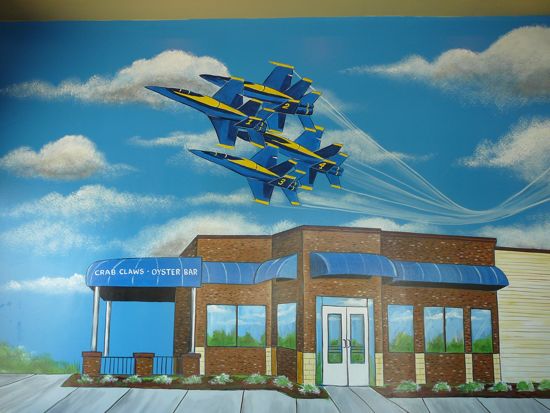
There is often a waiting line to get into the Shrimp Basket because of their specials. On Fridays, the special is all you can eat Fried Fish for $7.99.

When you finish the first batch, you just tell the waitress you want some more. We ordered it, but we could only eat the first batch, there was so much fish. They also have very cool and colorful T-shirts for Shrimp Basket fans:

Roses Love Sun and Rain
The last two weeks in Pensacola have been gorgeous, and then, Friday afternoon, all hell breaks loose in huge, windy wild thunderstorms and torrential rains.
My roses are thriving. All of a sudden, there are roses everywhere, gorgeous, full happy roses!





Can’t take any credit; these were planted long ago by the original owner, and the good Lord provides the sun and rain. 🙂
Oil Slick Barriers in Pensacola
Last night while we ate at Billy Bob’s, we watched the weather station showing a huge weather system blowing up from Mexico towards the east coast of the US. It wouldn’t be so bad except there is that huge oil slick sitting out there, and no matter where it hits, it is going to be bad.
The beaches here are sugary white beaches, and the sand is like powder. If oil hits these beaches, they will be damaged for years and years to come.
Worse, there are all kinds of wetlands that can be damaged, and shrimp farming, and shell fish of all kinds, not to mention the water birds and the marine life. It is one huge, horrible mess.
We saw the barriers going up along the Pensacola Coast, and shudder at how small and ineffective they seem against the gallons of oil spewing into the Gulf on an hourly basis. It is a horror.


In our church, we pray for “this fragile earth, our island home . . . ”
God of all power, Ruler of the Universe
you are worthy of glory and praise.
Glory to you for ever and ever.
At your command all things came to be:
the vast expanse of interstellar space,
galaxies, suns, the planets in their courses,
and this fragile earth, our island home.
By your will they were created and have their being.
(Eucharistic Prayer C, Book of Common Prayer, p. 370)
Please, when you are praying, give a little prayer for all the communities along the Gulf Coast threatened with this man-made tragedy.
One Moment in Time
I would have told you if I had known about it long enough in advance. The New York Times had a photo . . . not contest . . . opportunity. They asked people all around the world to shoot a photo at 1500 Greenwich Mean Time, which is 1000 Pensacola time.
As we were leaving for the Episcopal Lite service (0800; it is amazing, they do a processional, recessional, sermon, prayers of the people and communion in 45 minutes flat, amazing!) and I told AdventureMan I needed to take a photo.
It is what I love about AdventureMan. No matter what I propose, he is up for it. OK, sometimes I get a little foot dragging, but for the most part, he is Gung Ho. We hit church, we even had time for a little breakfast at the Shiny Diner, and then we went to take photos. This is what the New York Times instructions were:
Where will you be on Sunday, May 2, at 15:00 hours (U.T.C.)?
Wherever you are, we hope you’ll have a camera — or a camera phone — in hand. And we hope you’ll be taking a picture to send to Lens that will capture this singular instant in whatever way you think would add to a marvelous global mosaic; a Web-built image of one moment in time across the world.
Please keep your photos under 5MB in size.
I didn’t read the instructions. I sent them three photos. I was only supposed to send one.


AdventureMan is going down tomorrow to volunteer with the Fish and Wildlife service; they are going to need a lot of volunteers when the oil slick hits, Tuesday or Wednesday. It is going to be a horror.
Billy Bob’s Barbecue in Gulf Breeze
We had heard many people saying Billy Bob’s Barbecue was THE BEST, so when we saw that it was located near the Gulf Breeze Cinema Four, we decided it was meant to be. We’d give it a try.

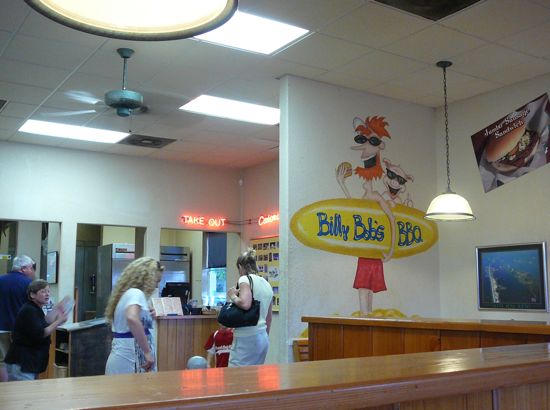
First off, they have Beer Batter Onion Rings, and AdventureMan and I have been searching for many years for the world’s best onion rings, so we started off with them. When they came, hot out of the oil, they were real fresh onion rings (that scores big with us) and the batter was light and crisp. They were good, right up there with the best we have had so far:


When our dinners came, we groaned. We though we had ordered light. The portions here – for the price – were HUGE.
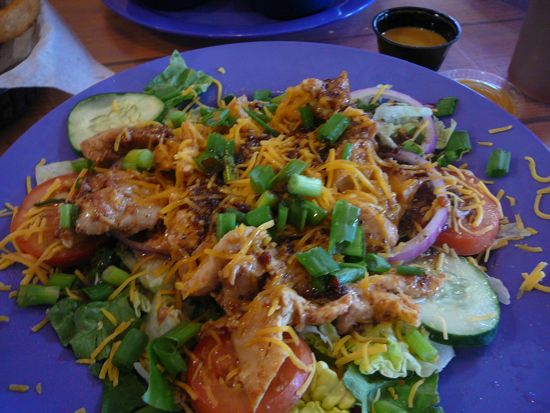
I had the dinner salad with smoked chicken, and I chose the balsamic vinaigrette salad dressing – it was fabulous:
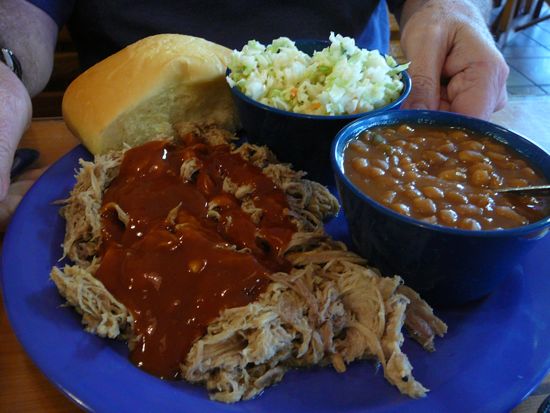
AdventureMan had to try the pulled pork platter, and for his two sides, he chose the sweet and sour slaw and the baked beans (the two sides we think are critical to truly good BBQ, although we sometimes try other things, if the slaw and beans aren’t right, it isn’t BBQ). His platter was enormous, and delicious:
I like Sonny’s, and I like Dave’s Famous BBQ; they have good food. What I like about Billy Bob’s is that is has a real family feel about it, not a chain feel. The food feels more real and no less delicious, and the service feels more personal and like they take pride in their food and their work. You can tell the difference between hired help and people who really care whether you like the food or not. I give Billy Bob’s a big plus because I believed they really cared about what they serve. 🙂
We will definitely be going there again.
A Normal, Wonderful Day
Yesterday, Friday, AdventureMan and I had our first “normal” day in Pensacola, a day where we are living in our normal house doing very normal things. Normally, I find normal kind of boring, but after the last month, I find normal very comforting. I was beginning to wonder if life would ever be normal again, and what normal would look like.
Here is what normal looked like: We got up and went to our water aerobics class, which was really HARD (hard is good; we want to be living healthier lives, it was hard in the way that it was challenging, not hard in the way that is discouraging.) On our way home we saw a coffee shop we had heard about, and on an impulse, we decided to have breakfast on the way home.
I had an egg sandwich on a biscuit, and AdventureMan had biscuits and gravy. We were in and out in about 20 minutes, eating food that was probably not good for us, but it gave us all the energy we needed for what came next.
We cleaned house.
That may not sound like a fun normal day to you, and no, we don’t get a lot of joy out of cleaning house, but when you have lived in a chaos of boxes, and everything is put away, but it is all messy and disorderly still, you can see how dirty the floors have gotten. AdventureMan took the upstairs vacuum and he READ THE MANUAL (I know, I know, I am still in shock) and he vacuumed upstairs AND mopped the bathroom floors. (!) (!) (!)
I finished getting most things put away downstairs and then vacuumed and mopped all the tile and wood floors, and holy smokes, that is hard work. And when you finish, it feels so good!
AdventureMan worked in his office. I read the newspaper.
Our son and grandson came by for a few minutes to drop off some tickets to the Chocolate Fest Benefit for the Gulf Coast Kids House, a local facility that helps kids who have been abused, investigating and prosecuting offenders and helping provide children with a safe place to tell their experience. We got to see Baby Q grin at us. It’s for these moments that we moved here; we don’t need to be living in their pockets, but a few minutes now and then is heaven.
Then we headed off for Date Night. We went to dinner and a movie – a Swedish movie called The Girl With The Dragon Tattoo which was playing in Gulf Breeze. The Girl with the Dragon Tattoo is based on a book by Stieg Larsson, and is a very unusual mystery book with deeply flawed characters. I’ve now read the follow-up, The Girl Who Played with Fire, and I am hooked. There is only one more, and I am waiting for it to come out in paperback.
The movie was exceptional. Although it was in color, because so much of it was Sweden in winter, it seemed very black and white, very documentary. Even when spring came, the colors were muted. Somehow it made it more real, more gritty. The movie was very true to the book. There were things left out, but not things that impacted greatly on the sense of the movie. All in all, it was a very satisfying, if disturbing, movie, which leaves you itching for a follow-up. Isn’t that the sign of a good movie?
We stopped for dinner at Billy Bob’s BBQ, and I will write that up next.
That’s it. That’s our wonderfully normal day. It may not sound like much to you, but for a normal day, it wasn’t bad, in fact, it was a pretty good day.
We’ve had two weekends of stormy winds and heavy rains. My rosebushes were sparse, and all of a sudden, there are buds – and petals – everywhere!

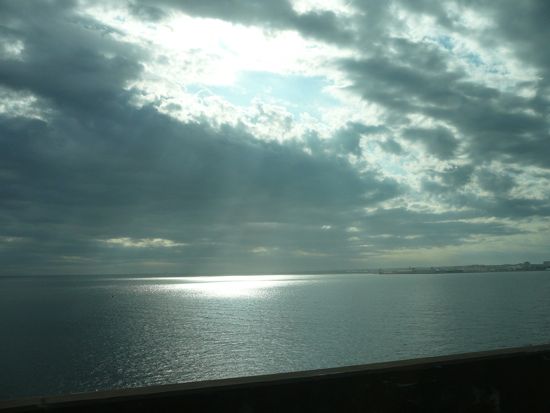
And here, just for you, is a view of the sunset through the heavy thunderclouds over Pensacola on a Friday night:
Missing Dottie
My Mom sent an e-mail today about an old friend, she’s not doing well. She lived next door to us in Alaska, and would take care of me and my sister when Mom needed to leave us with someone. She was older, so we weren’t really friends then, but we became friends as adults, years later, when AdventureMan and I moved to the Tampa Bay area and my friend and her husband lived just blocks away.
I’ve been missing my old friend; twice when I moved, she was there, the big-sister-I-never-had, helping me to move in while AdventureMan was far away. The first time, she loaned us her truck for several weeks while we settled and searched for another car. When I moved back to Seattle, she cleared out my overgrown garden, and then unpacked all the china and crystal and washed it and put it away in the cabinet. She was so much fun.
Through the years, she loved life and lived it to it’s fullest. She loved her time living in Egypt, and in Ramallah, and she travelled and sailed just about everywhere in the world. She exercised and watched her weight. She passed all the best books along to me, and kept up with the news. She was fit and active, and engaged with the world around her.
Statistically, and in all probability, she would never have seemed a risk for Alzheimer’s. I’m still angry about it. This should never have happened to her. It isn’t fair. She should be laughing, enjoying her grandchildren, dancing, swimming, sailing, running, biking, cooking, entertaining – all the things she loved. She DESERVES better. And I guess I am angry because I am selfish, and I want her to be around for ME. And I know that all this is stupid and childish, I should just accept and be calm, but it’s just so unfair and it makes me so angry. She is still in this world, although we don’t know for how long, but then again, she isn’t, not really, she is not a part of this world any longer, she just exists. It’s not right and it’s not fair and Alzheimer’s is a robber and a thief.
Recent Comments
intlxpatr on Shampoo Ginger tigerbutterya0c5ff1d… on Shampoo Ginger intlxpatr on British Soldier Kidnapped, Esc… John on British Soldier Kidnapped, Esc… intlxpatr on British Soldier Kidnapped, Esc… Wikipedia Donate Button

Amazina


Early Voting in Florida


