Real Age and Boost Your Immunities
A while back, there was a blogger, Fonzy, who was more here there and everywhere than . . . Here There and Everywhere. He found some of the most amazing resources, and Real Age was one of them.
I took the Real Age test, and got a shock; there were things I really needed to do to keep my health and fitness at peak. I hadn’t been doing them, thought I could slide. Real Age won’t let me.
Every week I get bulletins from them on new findings in health issues. They are always packed with valuable information. Here is one of the most recent ones:
Boost Your Natural Immunity
June 30, 2009 3:14 PM by Mehmet Oz, MD and Michael Roizen, MD
New flu strains. Antibiotic-resistant tuberculosis. Germs in and on the foods we buy in supermarkets and in restaurants. Flesh-eating bacteria. Feels like you’re in the midst of a scary twenty-first century germ invasion. And while you try your best to keep from meeting the nastiest bugs, there’s only so much you can do without living in a bubble. That means boosting your immune system matters more than ever.
And steps you take to boost your immunity may also protect you from the chronic diseases associated with aging. See, immune busters — everything from aging and stress to lack of sleep, too little exercise, and not-so-smart eating — can pull the plug on how well your white blood cells, natural killer cells, and chemical messengers can attack and destroy foreign invaders. Didn’t know you had an army of defenders, did you? Well, you do. And the very same actions that lessen their ability to fight off bugs also cause trouble by encouraging chronic inflammation — a hot-button health risk now linked with asthma, heart disease, diabetes, and even some types of cancer.
Keeping your own personal security force strong and disciplined is easy:
Feast on fin food. EPA (eicosapentaenoic acid), the essential omega-3 fatty acid found in fatty fish (and fish oil, of course), limits several cellular processes (involving dendritic cells and interleukin 12; aren’t you glad you asked?) associated with inflammation, so they can’t do their dirty work. Serve yourself salmon or trout at least twice a week, or get 2,000 milligrams of EPA plus DHA, another omega-3, from supplements daily. Don’t like the fishy taste or the size of the pill? Just get the DHA from pills made from algae — that’s where the fish get it.
See red or go nuts. Red wine, red grapes, and peanuts are great sources of resveratrol, a compound that protects against immune system aging and inflammation.
Learn the art of ahhhh. Your nervous system and your immune system are linked more closely than fraud and Bernard Madoff. Extreme stress reduces your natural killer cell count — one reason widows and widowers are more likely to get sick after the death of a spouse. Even periods of short stress (say, road rage) can boost levels of proinflammatory chemicals called cytokines. Set aside 10 minutes a day for relaxation, whether it’s meditation, intimacy, a walk, or the pure bliss of playing with your kids or grandkids. And learn some coping skills that help you talk your stress level down while you’re still in traffic or whatever situation gets on your nerves.
Tuck yourself in. Sleep deprivation torpedoes immunity and increases levels of proteins associated with inflammation. Stop shortchanging yourself and jump into the sack a half hour earlier tonight . . . and every night this week. Add another half hour next week, and keep going until you’re getting 7 1/2 to 8 hours of shuteye per night. Every night!
Take a walk today. Regular physical activity can help keep immunity where it should be. You don’t have to be a gym rat: When a group of overweight couch potatoes started exercising five times a week, they gained a definite cold-fighting edge over nonexercisers.
Pop some vitamin D. This vitamin can’t do its immunity-boosting job if you don’t get enough of it . . . which includes at least 30% to 40% of us. Since it’s difficult to get what you need from food alone, get 1,000 international units a day from a supplement if you’re younger than 60, 1,200 if you’re 60 or older.
Munch apples, broccoli, and red onions. All are bursting with quercetin, a flavonoid that shores up immunity, even when you’re fatigued. The fiber and antioxidants in these natural goodies also help reduce or mute inflammation instigators.
Think zinc. Go to the end of the alphabet for a mineral that supports immunity (it may also thwart cancer cells). You can get the zinc you need — 12 milligrams a day — from crab, oysters, pork, poultry, beans, cashews, and yogurt. Or find a good multivitamin with less than 15 milligrams. Too much of the stuff could stop other important minerals from doing their jobs.
Don’t forget classic “C.” This vitamin helps you produce more bullets to kill invading germs. Bell peppers are chock-full of vitamin C; other good C options include strawberries, cantaloupe, and broccoli. Or take 400 milligrams of vitamin C as a supplement three times a day.
Parking Mayhem
This is a view trying to leave the Souq al Waqef around nine o’clock on a date-night Thursday evening. There are two exit booths. Maybe one of the cashiers needed to go drink tea and never came back; only one booth is open. Those who are too important (or think they are) to wait in line edge, edge, edge slowly in front of you. It took forever to get out.

You will note that there are two lines formed to exit – through one booth!
Some of these guys are so important that in trying to get into your line, they block traffic in the oncoming lanes, too, so then things really get gridlocked.
The good news is that parking is relatively inexpensive – less than a dollar for an hour, maybe up to a buck fifty, two bucks for four – five hours. The drawback is that the system really isn’t working smoothly yet.
Al Maharah, Souk al Waqif Hotel
I got it half right. I was good taking photos until our main courses arrived, but when we got to Al Maharah, there were only a few groups. I took all the photos before there were a lot of people there. But the truth is, when our main courses – the seafood skewers – arrived, they were so good, I forgot to photograph them.
The secret is out. The food is SO good!
It was one of those wonderful nights in Doha when it isn’t so hot anymore, there is a breeze blowing. No, not a cool breeze, a comfortable breeze, and all of a sudden, all you want is to be outside. We roamed the souqs, making a purchase here and there, until we got to the hotel. We had actually intended to eat somewhere else, but the food in the hotel just looked so good.
The service is friendly and attentive, without being intrusive. They get five stars right off the top for striking that balance.
The menu is in Arabic and English, and has beautiful photos to help you decide what to order. We were totally tempted by the soups, but knowing we will be back, we both ordered the salad bar and the Mixed Seafood Grill Skewers. Oh WOW.

The restaurant is beautiful and serene. Several tables were reserved, and pre-ordered arrangements of hors d’oeuvres were being set out in beautiful serving dishes. We were so tempted to snatch a bite on our way back from the salad bar – the arrangements were artistic and tempting.
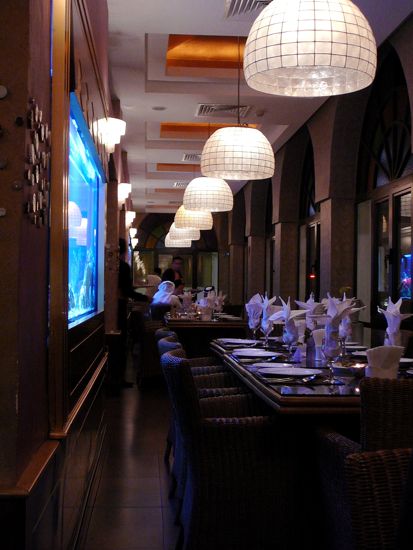
The Seafood Bar:

Part of the Salad Bar:

Our salad plates – they had so many good things!

They also had piping hot fresh out of the oven bread, Yumm!

The only problem is that the restaurant is right by one of the souk exits, where you pay for parking. Because everyone is so important, and jockeys for non-existent places in the line which has formed, it can be a little exciting sitting next to the window, not knowing if the yahoo who is trying to edge his way into the line even has a driving license. There is a fabulous terrace on this hotel; I wish the restaurant were up on the terrace area!
After dinner, there is also a dessert bar, or you can order a la carte. We couldn’t eat another thing, but it sure is tempting:
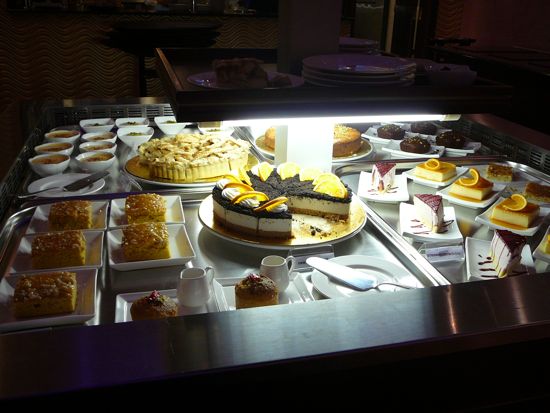
Not only will we go back, we will take our friends, especially now when being outside is so divine! It was a lovely, elegant evening, the food is reasonably priced. We didn’t see any wine being served, so if that is important to you, you will probably be better off at one of the more western hotels. And – get there early if you don’t have reservations. By eight, every table was taken.
Doha or USA?
On the homeward drive, I saw this sight, and laughed. There is a clue as to where this is, but it sure looks a lot like a street in the USA:

The Carrefour Majlis
Hubby and I were at a mall which is one of the Qatar see-and-be-seen places tonight, not to see nor to be seen, but looking for a special end table. As it turns out, we can probably get it, but not until January. No problem.
AdventureMan wanted to pick up some teas for his office and I needed skim milk so we headed for the Carrefour before leaving.
“Oh! How totally cool!” I said to AdventureMan, “Look! They have provided a tent majlis for guys waiting for their wives to grocery shop!” (A majlis, sometimes called diwaniyya, is a place where people gather – usually men, but not always, sometimes women also gather in a majlis but usually separately from men)
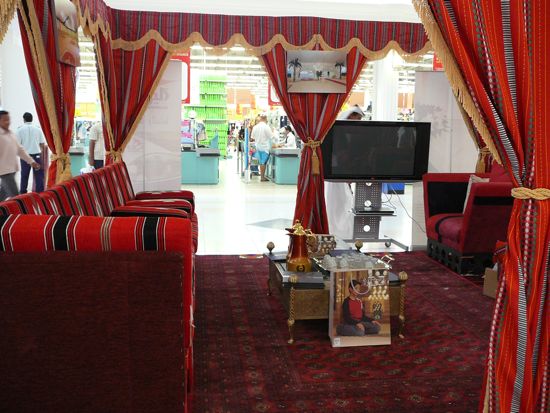
“I think that is one of the Islamic Center places,” AdventureMan said.
On our way out of Carrefour with our purchases, the majlis was packed, and everyone was drinking Arabic coffee in graceful little cups, even one western couple. It is a lovely, hospitable oasis, full of soft surfaces in a hard surface mall.
Qatari Police Balloon?
I thought this was so cute when I passed it on B-ring today:
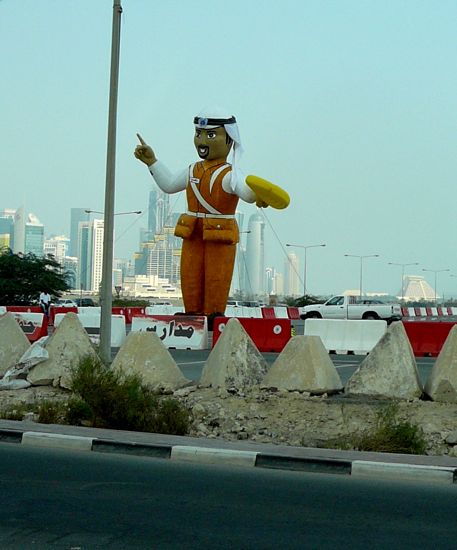
I don’t know what it’s all about, but I like it that he has on bright clothing and a reflector vest to help him be safe while he is directing traffic. 🙂
Doha: Keep Your Camera Handy
Today I had one of those experiences I have so often in Doha, a “no-one-would-believe-me” moment, but I have learned to keep my camera handy, and fortunately we were stopped in traffic so I could snap this one without endangering any lives, especially my own.
Traffic is steady, busy, but pretty mellow. Yeh, there are the normal “I’m-going-to-make-a-left-turn-from-the-right-lane” guys; I’ve lived here for so long it doesn’t even rate a roll of the eyes. It’s part of the Doha / Kuwait driving culture.
This, however, I only see in Qatar. Mr. I’m-So-Important-I-Can’t-Wait is this guy in the white Land Cruiser.
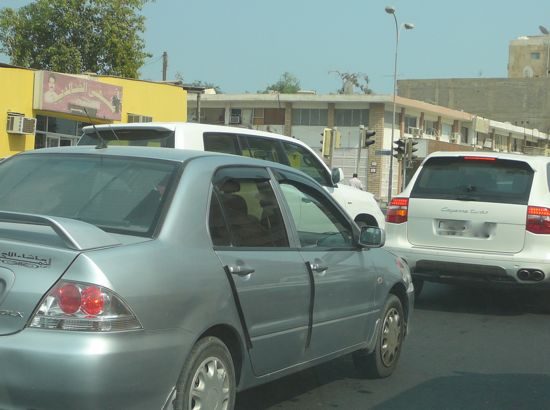
He is sitting half on top of the street median, trying to get back into traffic going in his direction. To get there, he drove down the wrong way down the street on the other side of the divider. At first, there was no traffic, but when traffic came, he got up on the divider so he was only HALF blocking traffic from the other direction, and he is bullying his way back into the line he was too important to wait in.
I carry my camera now, every day, in my purse, because I know if I just tell you about these things, you won’t believe them.
I have seen this also at major roundabouts. Some yahoo drives up the other side of the road to the roundabout to avoid waiting in the line. Up over the medians, facing oncoming traffic. I know, I know, what are they thinking?
In Kuwait, I was sickened by the number of young men killed on the roads every week, every month. If it were an epidemic killing young men, people would do something about it, but tell these guys to obey the law? Make them pay fines for reckless driving? Make them wear seat belts? Their behavior tells me that no one has ever held them accountable for their arrogant and dangerous driving habits.
While we are told that “no one is above the law” somehow the message hasn’t made it to these guys.
Truthful Visitor on Doha Press
Do you ever visit QatarLiving.com? It’s one of those places where you can end up passing a lot of time, and it is also a place where there is both a lot of information and a lot of misinformation. There are some very good posts, and then there are some poseurs.
A recent Forum discussed the statement by Qatar Attorney General Dr Ali bin Futais Al Marri that “no one is above the law.” As forums often do, the threads segued into a discussion of freedom of the press in Qatar.
I almost split my sides, I was laughing so hard. I asked Truthful Visitor if I could print his post on this blog, and he gave me permission. I hope you enjoy it as I did. 🙂
Don’t you folks know that all the newspapers in Qatar are screened by the Ministry of Interior every evening before publication for the following day? Anything that doesn’t fit the required image is cut out.
Hence you always get the presence of evil (there’s always an Asian gang being deported for doing something dreadful like burglary or selling liquor) page 1, bottom of the page, that covers the Evil In Our Midst; then the sycophantic article about HH who has just made some pithy pronouncement on The Necessity For Mutual Understanding And Education Across The World, page 2; some phony figures about how much more the Pearl property or other investments have increased pages 3 – 5; some baloney about how safe the country is for investment, page 6; then the gushing op-ed about how the best societies in the world are so great because they have been enforcing Islamic values, pages 6 – 8; Qatar Airways wins award for best in-flight hot towels, page 9, and a new order for 500 Airbus aircraft (thanks to the strategic profitability of the airline! ha!) . And not to forget, Gulf Escapes Economic Downturn for the fourth week in a row, page 10 ad infinitum.
The Filipina maids found dead and decayed in the desert? The photos of the police when they turn the water cannons on the labour camps outside the Industrial Area? Oh no. Those photos were seized under duress. These things are just not family -friendly, now are they?
If it doesn’t fit the great narrative of Qatar, it’s not really news!
Thank you, Truthful Visitor. (truthfulvisitor/-a-t-/me.com)

Debate on Media Freedom in Doha, Qatar
From today’s Gulf Times:
Debate on Qatari press law
The Doha Centre for Media Freedom (DCMF) will hold a roundtable discussion on the Qatari press law that dates back to 1979, on Wednesday, at The Ritz-Carlton Doha, an official said yesterday.
According to the official, under the discussion will be the need for a Qatari media, and the view concerning modification and changes to the accrual Press Law, in order for it to match the requirements of the current era.
Discussions will be moderated by DCMF deputy director general Maryam al-Khater, while senior media officials of the country, editor-in-chiefs, senior journalists, heads of media organisations and others are expected to be in attendance.
After an introductory presentation of the most-recent study prepared by DCMF on the Press Law, comprising recommendations, suggestions, and analyses, the floor will be opened to what is expected to be a “vigorous debate”, the official said.
“The DCMF calls on all media specialists to exercise their right of expression by participating in this gathering and sharing their thoughts about the possibility of amending the negative provisions of the law for journalists’ rights as well as adding provisions which respond to their ambitions,” the official added.
The event coincides with the National Day for Human Rights, which falls on November 11 every year.
There was an earlier report, on June 24th, that most of the original members of the DCMF had resigned:
Media Freedom Centre team leaves office
DOHA: Robert Ménard, director- general of the Doha Centre for Media Freedom and his team have left the Centre.
“We no longer have either the freedom or the resources to do our work,” said Menard, in a statement issued yesterday.
The heads of the assistance, research and communications departments have also left the Centre, said the statement.
The Center was set up on the initiative of H H Sheikha Mozah bint Nasser Al Missned and Reporters Without Borders in December 2007.
Ménard, who became director-general on April 1, 2008, was the founder of Reporters Without Borders, which he headed for 23 years.
I imagine this is going to be a very interesting “vigorous” debate, of interest to all those who write – or blog – on Qatar. One of the things I notice in both Kuwait and Qatar is that in the interest of self-preservation, the newspapers self-censor. For example, when a crime is committed, if it is an Asian, or even, rarely, a westerner, the name of the criminal can be printed. If it is a local citizen, they do not print the names, not ever, unless it is a rare case where the defendant is convicted and appeals – on rare occasions, the name will appear then. In order to spare the family the embarrassment, I have been told, but I would think that the fear of embarrassing the family would have a strong deterrent effect on young men, for example, who think it is OK to abduct, rape and humiliate young men and women, without fear of having their crime made public.
In Kuwait, they publish the crimes committed, at least. In Qatar, you would think from reading the papers, that these crimes don’t exist. They do. They aren’t reported.
I think it is very cool that in Qatar, many of these issues are opened for public debate, as in this media debate, and in the ongoing Doha Debate series.
Recent Comments
intlxpatr on Shampoo Ginger tigerbutterya0c5ff1d… on Shampoo Ginger intlxpatr on British Soldier Kidnapped, Esc… John on British Soldier Kidnapped, Esc… intlxpatr on British Soldier Kidnapped, Esc… Wikipedia Donate Button

Amazina


Early Voting in Florida


