Gigantic Sunrise
It’s not photoshopped, or any kind of shopped – it’s the “light haze” that makes this rising sun appear so gigantic. I can’t even focus as I try to shoot it, there is so much refracted light. I just have to trust, as I snap the shutter, that the camera can figure out how to manage it. Once again, I focused on the reflection; it was the only line the camera could focus on; the rest is just a blur. I am using my smaller Lumix, it doesn’t have a viewfinder, so it is much harder to see what you are shooting.

It’s going to be HOT today. For me, anyway, anything above 22°C / 72°F is getting a little heated up. 😉

Have a great day, Kuwait.
Diwaniyya Where No Candidates are Welcome
LOL, he is making his point in such a gentle and delightful way!
Staff Writer
From today’s Al Watan

KUWAIT: Kuwait”s newspapers have been covering the opinions of various former MPs and candidates about the elections and their programs, but the real news and discussions are available in one Kuwait”s oldest traditions, the diwaniya.
Diwaniyas are frequently targeted by political hopefuls to discuss various issues of concern. However, not Bu Hamad”s diwaniya, a retired Kuwaiti customs official who worked at the Salmi and Abdali ports.
Bu Hamid says that that politics is no longer a concern of his after so much disappointment, so it is little wonder that in his own diwaniya in Bayan, Bu Hamid has a large poster clearly saying” “Welcome honorable guests and apologies for not receiving any candidates. May God bless Kuwait. Bu Hamid”s Diwaniya.”
One cannot ignore the sign and equally not be intrigued by its curious message.
Asked about the reasons behind his ban of candidates, Bu Hamid said that in the previous election he discussed an issue of traffic safety near his home, which many candidates promised to sort out.
“I had previously asked candidates who became MPs later to set up speed bumps and traffic lights in front of my diwaniya which overlooks the highway in Bayan, which is notorious for traffic accidents.
“None had carried out their promise after they became MPs. They were only seeking their own interests and the interests of their close circle,” he explained.
“They are good for nothing. They are good for nothing,” he declared.
Bu Hamid expressed his amazement at the MPs whom he has voted for since the 1960’s that continually failed to meet the public’s demands. He is now “fed up with them and their tactics,” adding that when candidates need the voters they are available, “but the minute they become MPs they hardly recognize voters or even bother to meet them, as if they don”t remember them.”
He therefore decided to keep away from candidates and their campaigns.
“I will not cast my vote. I will never vote for any candidate. I have been casting my vote since 1960 and I have seen nothing from them.”
Last updated on Monday 6/4/2009
Brilliant Sunrise, 5 Apr 09
Goooooooooooood Morning, Kuwait! 🙂
It is going to be another gorgeous day in Kuwait. Don’t let this “heavy fog” deter you. When I got up, the sunrise was so bright, I couldn’t see the sun, it was refracted all over the sky. I was only able to get the shot by focusing on the reflection of the sun on the water.

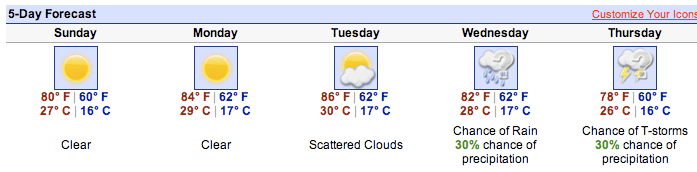
It is going to be a fantastic week – sweet warm days and cooling off evenings, perfect for sitting outside and drinking coffee, visiting with friends – and a little later in the week, a chance of more rain:
AdventureMan and I saw Journey to Mecca yesterday, along with about 500 others living in Kuwait. The movie is still packing people in! The audience was about 3/4 full with children, and I thought “oh this is going to be great, crying children and people talking on their cell phones.” I was SO wrong. Although the movie theater was full, I did not hear a single phone, I did not hear a single crying child – the movie held us all spellbound. We loved the movie, and we loved seeing it in the IMAX theatre.
(There are special headsets for non-Arabic speakers, with the dialogue in English. We didn’t know; they just spotted us as probably-non-Arabic and handed us the headsets.)
Sometimes, I am just slow. My niece, Little Diamond, had recommended a book called Travels with a Tangerine: From Morocco to Turkey in the Footsteps of Islam’s Greatest Traveller, but it was not until yesterday that I got it – that Ibn Batuta was from Tangiers! Sometimes, I am just slow . . . sometimes I can grasp subtleties but the obvious escapes me totally.

You can buy this book from Amazon.com for a mere $10.17 plus shipping. Yes, I own stock in amazon.com.
You can also probably find it at the Kuwait Bookstore, that amazing store in the bottom of the Al Muthanna Mall, near the Sheraton Circle downtown.
Coming Straight Down
While you are still snuggled safe in your beds, we are having a steady downpour in Kuwait. I didn’t get up until almost 0630 this morning, it was coming down then. It is still coming down steadily more than an hour later. It is not sheets of rain, there is none of the drama we had earlier in the week, but it is steady, and it is exactly what Kuwait needs, a good, soaking rain.
Wooo HOOOOO, Kuwait!
Honestly, there is nothing to photograph. It is just varying shades of grey, melting into one another. Nothing even for the camera to focus on.
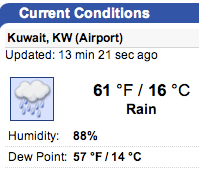
The roads are slick with accumulated grease. If you don’t have to drive, just cuddle up, stay home, stay safe.
Having Sisters Make People Happy
This is from todays BBC Health News; you can read the entire article by clicking on the blue type.
(Here’s to you, Sparkle and Big Diamond! I am so glad I have you for sisters!)
Sisters spread happiness while brothers breed distress, experts believe.
Researchers quizzed 571 people aged 17 to 25 about their lives and found those who grew up with sisters were more likely to be happy and balanced.
The Ulster University team said having daughters in a family made people more open and willing to discuss feelings.
They said the influence of girls was particularly important after distressing family events such as marital break-ups.
. . .
Lead researcher Professor Tony Cassidy said:”Sisters appear to encourage more open communication and cohesion in families.
“However, brothers seemed to have the alternative effect.
“Emotional expression is fundamental to good psychological health and having sisters promotes this in families.”
Clever Solution: When Men Refuse to Salute Women
That gives me a huge grin – for every subordinate who refuses to salute a female superior officer, she gets an extra KD50 in her paycheck! This is a very clever solution.
Kuwaiti policemen refusing to salute female officers
Published Date: April 02, 2009
KUWAIT: Only shortly after the graduation of the first batch of female police officers, a large number of their male colleagues have put the Ministry of Interior (MoI) in an awkward position by insisting that they will refuse to salute any female officer, no matter how superior her rank to their own. The male officers cited local social values, cultural norms and traditions to justify their stance, reported Al-Jarida.
The ministry must now decide whether to strictly implement the law and force these officers to perform their duties in a professional manner or to take the policemen’s concerns into account and accept their refusal. A recent fatwa issued by Dr Ajil Al-Nashmi which stated that saluting a woman is contrary to local and tribal traditions, is believed to have aggravated the situation, making the male officers’ determination to accept no compromise on the issue even stronger.
One MoI official said that the ministry is considering the options of paying female officers an additional KD 50 on top of their wages for every salute which male colleagues refuse to give them or imposing administrative penalties on the male police officers in question.
56,660 Kuwait Car Accidents: 2008
This is a totally breathtaking statistic. Kuwait just isn’t that big. That is more than one thousand car accidents, every week, in Kuwait.
We had three accidents in front of my house this morning. One included a school bus. Thank God, there were no children on board.
I would love to see a statistical breakdown on age groups, nationality, whether speed was involved, and whether the person was using a mobilephone while driving when the accident occurred.
One of my readers reported she had been in a car accident shortly after her arrival in country. A car going too fast rear-ended them. In almost every country in the world, if someone hits you from behind, they are charged, immediately, with following too closely and inattentive driving. You are supposed to be driving carefully enough to anticipate the car in front of you slowing down. Here, after six months, and several trips to the police station, it was determined that her husband was at fault. Unbelievable.
She adds that thanks be to God, no harm came to the infant traveling in the front seat of the car that hit them, on his mother’s lap, or they would have been liable for that, too. Unbelievable.
56,660 car accidents in 2008 alone
Staff Writer Al Watan
KUWAIT: Head of the Traffic Safety Department Bader AlـMatar has warned that the number of annual traffic accidents is on the rise. An estimated 56,660 car accidents and 410 cases of accident related fatalities occurred in 2008. AlـMatar added that the United Nations reports that car accidents claim more than 1,300,000 fatalities around the world each year, most of whom are young men.
Apache Sunrise
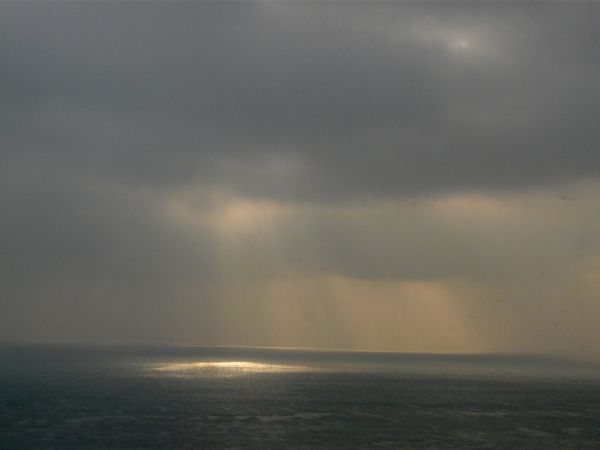
Just a patch of sunrise this morning, as we awake to more of the same – heavy clouds and it looks like the continued possibility of rain. I didn’t hear thunder and lightning last night, but the roads are damp, so I am guessing we had some rain, if not a lot.
Palestinian Handicrafts Cultural Exhibit at Bayt Lothan
Wooo HOOOOO, courtesy of Al Watan another event BEFORE it is over! This time, before it even happens! Woo HOO, see you there. I can hardly wait; I think Palestinian embroidery is gorgeous.
Nonprofit Palestinian Cultural Handicrafts Exhibition at Bayt Lothan
Handicrafts reـaffirm the Palestinian national identity and support needy children and families

KUWAIT: The Palestinian Culture Center will hold the first of its two annual exhibitions for 2009 at Bayt Lothan. The show includes a large collection of textileـbased traditional handmade crossـstitch, as well as pottery from Hebron, books about Palestine in English and Arabic, posters, slide shows, Palestinian food and family oriented activities.
The Palestinian Culture Center is a nonـprofit organization that was established in Jordan in 1993. It aims to preserve the rich heritage and culture of Palestine and help support women and their families in the Palestinian refugee camps become economically independent.
This year was an active year for the Center due to the affects of the global financial crisis placing a further strain on the poor, as well as the violent and aggressive Israeli military onslaught on Gaza. As a result, the Center worked hard to increase the salaries of the 500 or so women who do the embroidery work, as well as pay for their transportation from the camps, and motivate them by granting bonuses for quality work.
Exhibition Highlights
* Traditional crossـstitch embroidery of dresses, linens, shawls, cushions, table runners, cards, coasters, belts, purses, bookmarks and more
* Handmade ceramics from Hebron
* Books, posters, cards, key chains, kafiyas and DVDs
* Paintings from Palestinian artists from Jerusalem and other occupied areas
* Multimedia slideshows on Palestine
* Food sale of traditional Palestinian food such as thyme and sumaq, and on Thursday only baked goods and other traditional plates
Palestinian embroidery using needles and silk thread is a manifestation of the Palestinian identity as it has evolved over the ages. An age old art, all Palestinian ladies, young and old, would spend hours embroidering their trousseau, dresses, shawls and cushions. Using geometrical shapes at first, and then evolving to depict images from nature surrounding them, the dresses are famous for their flowery designs and bold natural colors of indigo and red. Symbols of the ubiquitous cypress trees surrounding the orange groves, roses, jasmine and the famous olive tree are typical motifs in these dresses.
The exhibition is being held at Bayt Lothan in Salmiya, which is next to Marina Mall and facing the Arabian Gulf Road.
It will be held for four days starting Monday, April 6, 2009, through Thursday, April 9. It is open to the public from 10:00 am to 1:30 pm and 4:30 pm to 8:30 pm on Monday through Thursday.
The Palestinian Culture Center thanks Bayt Lothan for their generosity in providing the premises free of charge.
Last updated on Monday 30/3/2009
Drama Drama Drama
Last night, around one, I could see the flash of lightning reflected through the curtains, and hear the loud thundering boom, and I couldn’t resist getting up to see all that was going on. Wow! Earth in all her glory, a truly magnificent thunderstorm, with sound and light and magnificent bursts of rain – drama drama drama.
This morning, we have a wonderful sky, full of light and shadows, a day that can go either way – or both ways!
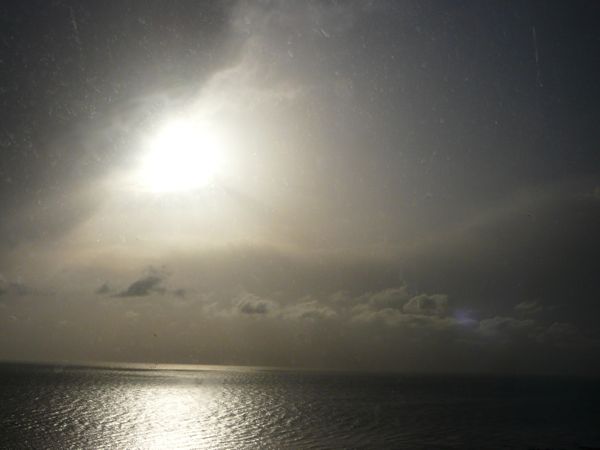
The day is dramatically cooler from yesterday, and the rest of the week is also supposed to be cooler, quite a change from earlier forecasts.

You can see all the way to the horizon today. The air is clean and breathable. My newly washed windows are spotted – there was a lot of dust brought down by this storm, thanks be to God. I can breathe!
Recent Comments
intlxpatr on Shampoo Ginger tigerbutterya0c5ff1d… on Shampoo Ginger intlxpatr on British Soldier Kidnapped, Esc… John on British Soldier Kidnapped, Esc… intlxpatr on British Soldier Kidnapped, Esc… Wikipedia Donate Button

Amazina


Early Voting in Florida


