College Level Classes for Older Adults
AdventureMan and I fantasize about what retirement will look like, even though it is a few years ahead of us. It helps to think about what is coming and how we are going to handle it.
We have a house near my Mom, and Mom sent AdventureMan a clipping from the local paper about classes being taught for “older adults” (WHEN did THAT happen, we wonder, when did we become “older” adults???) with the sweet note that AdventureMan could teach a few classes.
Here are some of the classes offered at the college near us:
Africa: A Closer Look
The Canterbury Tales, Part I and Part II
Civil Liberties and Security
Current Issues Forum
End of Life Decisions
Geology of National Parks
The History of the Supreme Court
Jazz: Can You Dig it?
The Many Faces of Hinduism
Native Basketry of the columbia Plateau, Northwest Coast and Arctic Alaska
The Poetry of Billy Collins
The War of 1812
He’s excited about the idea. So as we were planning to pray together before he left for the day, we were chatting excitedly.
“You could teach some classes on buying hand woven carpets! or on Arabic culture! or you could teach about some aspect of Africa!” I suggest. (I have my own projects that keep me very busy.)
“I was thinking more about organizational classes – managing organizations, financial management, that kind of thing . . ” he responded, “You know, like organizing your life . . .”
(I can see that manic gleam come into his eye and I know what is coming next might well be something I don’t want to hear. . .)
“I’ve got it!” he exclaims, and he starts laughing, because he is already cracking himself up. “I can teach a class called . . . HOW TO ORGANIZE YOUR WIFE! Ha ha hahahahahahahahahhahahahahhahahahahhahahhahahah.”
I can’t help it. I am laughing too. But it’s not THAT funny, AdventureMan.
Sunrise 10 March 08
Morning is coming earlier and earlier, and we haven’t even hit the Spring Solstice yet. I fell asleep too early last night, so I was wide awake when the sun started rising this morning. It looks like another beautiful, glorious Spring day, no clouds, just that troublesome layer of haze off there in the distance.

It is 55°F / 13°C at 0730.
Old Mosque Near Mubarakiyya
I really wanted to include this photo just to show you how very blue the sky was yesterday. The white of this mosque’s minaret provides contrast:

Just as the Sabille is placed on the street to provide water for the thirsty, the local mosques usually have a place to wash before prayers.This washing is required and is called Wudu. Some places are very utilitarian, but the mosque above, and the nearby women’s mosque, have a beautiful place for washing:
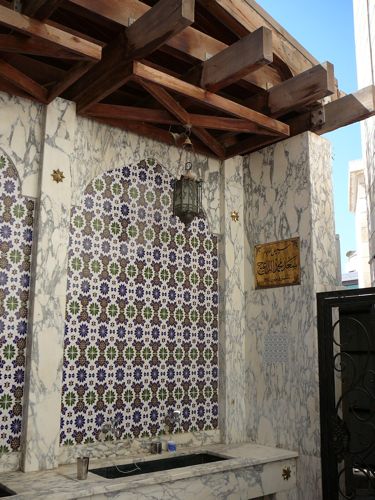
The tile pattern is intricate:

Cell Phone or Drunk?
From AOL News:
Using Cell Phone While Driving Akin to Driving Drunk, Say Researchers
Posted Mar 7th 2008 11:24AM by Evan Shamoon
According to a new study, talking on your cell phone while driving could be as dangerous as being under the influence of alcohol. Carnegie-Mellon University researchers used brain imaging to show how mobile phone use alone reduces 37 percent of brain activity engaged in driving. The findings were published in the latest gotta-have-it issue of the journal ‘Brain Research,’ and also suggest that using a hands-free headset doesn’t make much of a difference.
Basically, the study found that drivers who spoke on their phones while driving tended to make many of the same driving mistakes as those who just got finished speaking to the bottle.
So to speak.
Comment: I always thought using a headset solved the problem – guess I was wrong. 😦 The Kuwait Ministry of Traffic is currently considering a law against using cell phones while driving in Kuwait. If enforced, it’s going to make a big difference in the lives of a lot of people in Kuwait. I wonder if it will mean fewer pedestrians killed?
Twilight 7 Mar 2008
Last night had to be one of the most beautiful nights I have seen in Kuwait. The weather was perfect. The haze lifted – have you noticed that Fridays are often the least hazy day of the week?
Is it less automobile traffic? Is it some factory not active on Fridays which pours out pollutants during the week? For some reason, if there is a really clear day in Kuwait – and that is a big “if” – it will be a Friday.
People were eating outside everywhere it was possible. The weather was warm, without being hot. It had a different feel to it; it felt like living in a more European country. Last night, when it got dark, you could even see stars in the sky – 90% of the nights in Kuwait, it is too hazy to see all but one or two of the very brightest stars with the naked eye.
Here is what it looked like at twilight:
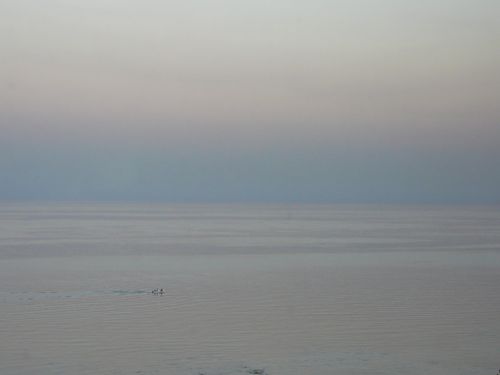
Yes, there is still that worrisome band of thick hazy something on the horizon, but at twilight, it goes that lovely purple grey color, surrounded by bands of pink in the water and the sky as the sun is setting. A total WOW.
Cauliflower Salad
With the warm weather coming back in, it’s time for nice cool salads again. Cauliflower is expensive in Kuwait – most countries where I have made this, it is reasonable, but in Kuwait, I guess it is very special. Probably because it is more of a cold weather vegetable. You can get it here, but even in the markets, it is dear.
Ladies seem to like this one a lot more than men do, or at least AdventureMan doesn’t like it, but it disappears in a heartbeat at a ladies lunch:
1 head lettuce
1 head cauliflower, broken into small pieces
1 lb bacon, fried crisp and crumbled (in Kuwait, use beef or turkey, and make sure it is crisp!)
6 green onions, sliced, especially the green parts
Blend together:
2 cups mayonnaise
1/4 cup sugar
1/3 cup Parmesan cheese, grated
Layer lettuce, cauliflower, bacon and onion in large salad bowl. Spread dressing over the top. Seal with Saran-type wrap and refrigerate overnight. Toss just before serving.
(In the interest of waistlines, I usually use a cup of non-fat yoghurt in place of one cup of mayonnaise; it isn’t quite so rich but the difference is barely discernible.)
(In Kuwait, mix up the mayonnaise, sugar, parmesan cheese first, and give it plenty of time for the sugar to melt; sugar in Kuwait is not refined as finely as in the US, and sugar grit in the salad dressing is too distracting!)
Goat Grope
I love living in Kuwait. Just when you start to take everything for granted, you get a little jaded, you even start driving a little like a Kuwaiti, something happens that reminds me I’m really not in Kansas, and I get a big grin. The other day, on a back highway, we came across a whole herd of camels. We used to see these all the time in Qatar, but this is my first time seeing camels just out roaming in such large numbers in Kuwait. Just reminds me how amazing life is, this little girl from Alaska is out watching a camel herd in Kuwait. Just too amazing for me.
In the middle of the most opulent housing areas in town, you will hear roosters crowing. Sometimes, near the Eid festivals, you will hear sheep baaaaaahhhhhh-ing.
Leaving a local store recently, I heard a very very loud, desperate cry, like “NNNNNAAAAAAAAAAAAAAAAAAAAAAaaaaaaHHHHHHHHHHHHHHHHHHHHHHHHHHHHHHHHH” and I looked around and there was a woman, and her son, and a very reluctant, very large, totally freaked out goat. The little lady has one of those camel whips, and she is whipping the hell out of the goat, the son is pulling on the muzzle, the goat has his feet dug in and is rearing back and howling for dear life.
Goats really are not my favorite creatures. I find them very . . . hmmmm.. . . . goaty. They have these filthy beards that always have stuff caught in them, they have these weird cold eyes that sort of pop out of their heads, and there is nothing cute about them, but this goat’s screaming really got me. At the same time, watching these two grown-ups with this very very stubborn goat made me laugh. To get the goat across the road, the son had to pull with all his strength, and the little old woman had to get behind and push. I wish I could have taken that photo, but I was busy turning my car around to go back and get any shot I could get.
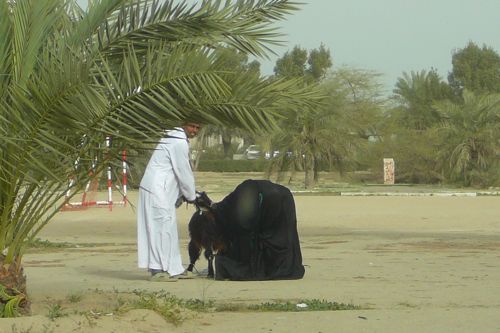
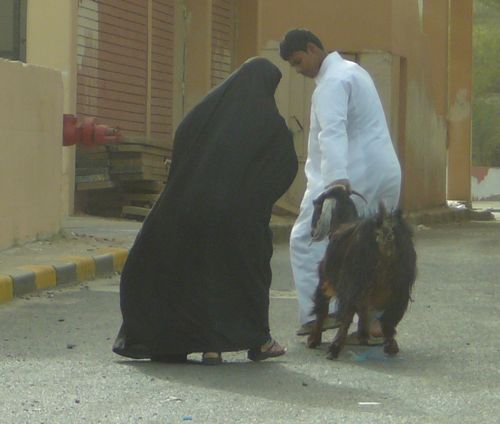
And THAT is why I tell you to always carry your cameras in your car!
Sweet and Clear

The morning dawned sweet and clear, it is 50°F / 10°C and there is no dust! No dust! If there is one thing a dust storm is good for, it is that it makes us truly appreciate how sweet it is when there is NO dust storm.
Looking at the forecast for the rest of the week, it is soon approaching 90°F – March is the great transition between winter and summer. It happens too fast for me, I wish for a few more weeks of the temperate weather, when we can go out and walk and breathe the cool air (when it is not a dust storm.)
People are already talking about putting away their winter clothing.
Al Ahmadi Minaret
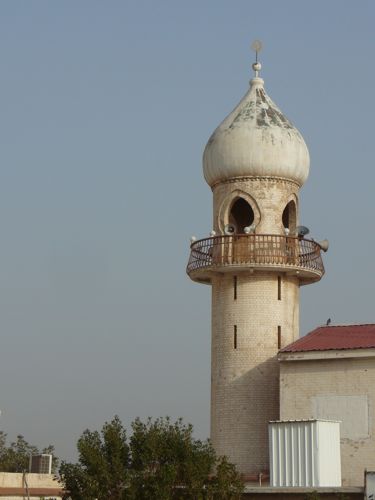
I see a lot of new mosques going up in Kuwait, and I see a lot of renovations. I just wish someone would spruce up this beautiful old minaret in Al Ahmadi. Looks to me like it is well-built, just needs a new coat of paint. And then I start to wonder, do mosques have committees, like churches do? We have the committee for the church grounds, the committee to take care of the altar, the committee to welcome new members, the committee to work with church school programs for the children . . . it goes on and on!
Do mosques have citizens committees?
Cell Phone Terrorist
I have my own personal terrorist. Somehow, somewhere, he got my phone number. If I forget to turn my cell phone off, he calls at around 2 in the morning. If I just hang up, he calls again.

He called me last night, again. After two calls (I wasn’t awake enough the first time to think about turning my phone off) I did turn the phone off and first thing this morning, cup of coffee in hand, I called him back.
He answered, sounding very confused and sleepy, and maybe Bangladeshi.
“I think you have the wrong number,” I said, and hung up.
Fifteen minutes later, he called again.
“Wrong number,” I said, and hung up.
AdventureMan asks me why I don’t put the phone on silent. I guess I could, but I would probably forget to put it back on ring the next day. I could leave the phone in another room at night, and I probably will.
Recent Comments
intlxpatr on Shampoo Ginger tigerbutterya0c5ff1d… on Shampoo Ginger intlxpatr on British Soldier Kidnapped, Esc… John on British Soldier Kidnapped, Esc… intlxpatr on British Soldier Kidnapped, Esc… Wikipedia Donate Button

Amazina


Early Voting in Florida


