History of Architecture in Old Kuwait City
When I came to live in Kuwait, my resourceful niece, Little Diamond went online and found all kinds of fabulous books about Kuwait, books you can’t find in Kuwait. Five interesting books, mostly about an earlier era in Kuwait, when my Kuwaiti friends tell me it was still one community.
“It was like paradise” they say, and they sigh.
I found another book recently, a book I have never seen before, although it was published in 1994, so it is not old. It is The History of Architecture in Old Kuwait City (and the influence of it’s elements on the Architect) by Saleh Abdulghani Al-Mutawa.
Although I intend to give this book as a gift to a friend, I couldn’t resist taking a peek inside, first. Should have resisted – I ended up reading the whole book.

This man loves architectural details the way I do, but he has studied them, and he is on a mission to bring back elements of uniquely Gulf architecture to the Gulf. One reason I love this book is that I know the buildings he has designed; I had a friend who lives in one, and we all marveled at it’s architectural elements.

I particularly love the wind towers.
I lived in Jordan for two years with no air conditioning. I don’t know why, but we didn’t miss it. We had our windows open all night and early mornings, we had rolled down shutters to keep the harsh sunlight out and we had ceiling fans – we managed.
Life would be different without A/C; life styles would change, but it would be manageable.
I want to quote from this book for you. Kuwaiti readers, you probably know all these things, but my readers in other parts of the world – like me – may find this fascinating.
Architecture and Building Materials in Old Kuwait City
Building materials were taken from materials available in nature: sea rock, mud, limestone and gypsum. As old Kuwait’s economy depended on the two journeys for diving and travel to Africa and India, Kuwaitis imported teakwood from India, and jandal (trunk) and basajeel (bamboo) from Africa (Mombassa – Kenya). These completed the elements of the construction. The shape of the old Kuwaiti architecture came to suit the environment and circumstances. Houses were adjacent in a manner that indicated the unity and cooperation of the people. Streets were narrow in such a way that the sun did not fall on the full street, and that made the streets cool and shaded. Mosques were the places for prayers, where they pray five times a day, were near the houses. There was a mosque in each district to enable the elders from walking to it without trouble. Kuwaitis care much for their religion.
Construction depended on Kuwaitis themselves. The engineer, called “ustad’ at that time, supervised the building and the laborers of Kuwaitis prepared for it. They carried rocks, prepared mud bricks, and started building.
Kuwait city was spontaneously and simply divided. In this it is similar to many old world cities, like London. There were three districts: Sharq (east), where the sun rises, Qibla, where the sun sets, and Wosta, which lies between them. The three districts were surrounded by their fence which the Kuwaitis built to defend their city.
By jandal, the author means trunks of trees, which you will see incorporated in the illustration above, painted black. When he talks about the fence around old Kuwait, he is talking about the wall which once existed. You can still find the (re-creations) of the gates to the city, except we can’t fine the one that is supposed to be around B’naid al Gar.
More to follow!
National Day Crazies
How was I to know?
Where was I last year on Liberation Day?
Yesterday, I was finishing up a project around 6 and heading to my next appointment when I turned onto Gulf road. Big mistake. I should have taken my clue from the barriers guarding entry to the left on Gulf road, but as I was turning right, I didn’t give it more than a second thought.
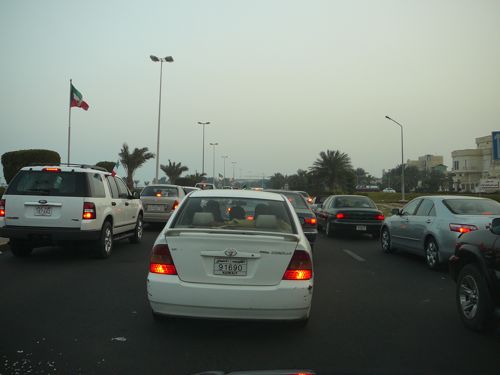
Big mistake. Suddenly I am caught in semi-gridlock, and the worst kind, gridlock with gangs of adolescents wandering the sidewalks on both sides of the car, gridlock with main routes being barred, gridlock with people in adjacent cars spraying each other with high arching streams of foam – it’s like suddenly being in the middle of a nightmare.

Except this is a very contained nightmare. These people are having a lot of fun. Although we are inching along, children are hanging out of windows, I suddenly realize – yes, their parents know where they are – their parents are driving.
No one sprays foam at me. There seem to be rules; the only spray I see exchanged is between people foaming at each other; they leave me alone. As we inch along, horns start the beep-beep beep-beep-beep of weddings and soccer cup wins,
and people seem to be relaxed, not anxious, not speeding and aggressive. Although it takes me about half an hour to make my turn on to the expressway (the turn lane is blocked by celebrants) I eventually get through.
Later, I get a desperate call from AdventureMan.
“The roads are blocked! I can’t get through! I have to get over to the right turn lane and I don’t think I can get through all these cars! It’s gridlock!”
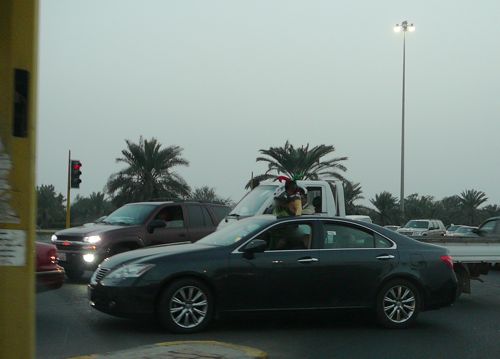
He is in a different part of the city, but same problem.

Where were we last year on National Day/Liberation Day? We don’t remember the traffic being so heavy, so gridlocked! And at the same time, it is fun seeing everyone having such a great time.
Liberation Day Sunrise
It is already 61°F / 16°C at 0800 in the morning – looks like another fabulous February spring day ahead . . . but maybe a little grey. It was grey at sunrise, grey an hour later, and grey even now. Do you think it might burn off?
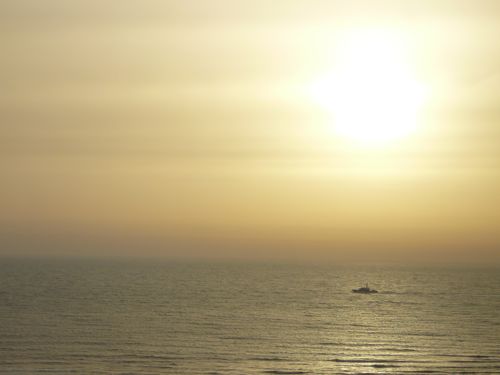
Drama Queen Sunrise
Drama drama drama – there was a thick band of something on the horizon today, and then gorgeous fluffy clouds above. The sun couldn’t even fight it’s way through the sludge of the thick band, but finally, it began to rise above:
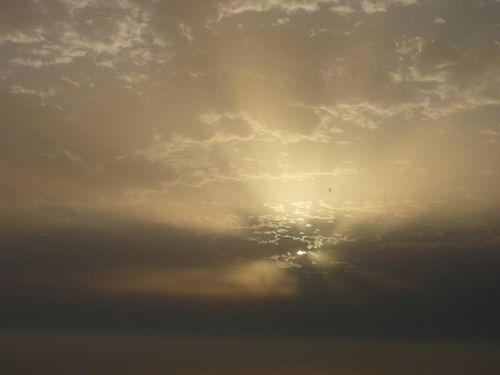
It is a warm 54°F/12°C early this morning and going up to 77°F/25°C at its peak today. Just warm enough – nor warmer, please!
Kuwait Tradition?
Last night, out along Gulf road, we got to see first hand all the celebrations for Kuwait National Day and Kuwait Liberation Day. I’m like a kid; I love to see the bright lights! Sorry if these are a little fuzzy, but there is no place to stop when you are dragging along Gulf Road. There are some fabulous lights in downtown Kuwait, sparkling and BRIGHT but impossible to photograph while you are driving along, and – well, you know what it is like to try to find a parking spot, right? Ho ho hohohohho!
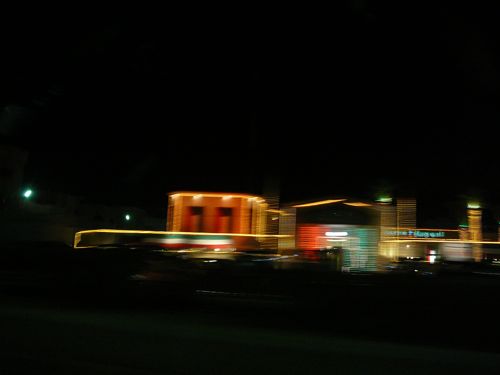

I love to see people out having a good time, I love all the cars covered with Kuwaiti flags – even motorcycles with flags. It’s like one continuous long parade. I love all the decorated buildings, I love the atmosphere of celebration and gaiety. . .
And I found myself wondering how this one particular “traditon” started? How does it get to be something you expect? Those skinny little adolescent boys with their cans of spray foam? People driving with their children hanging out the windows? People in convertibles with their kids sitting on the back seats, goofing off? Where are their parents???
Where traffic is jammed up I can understand that the kids aren’t really in any danger, but once traffic gets going, parents, please, pull your children into the seats where they belong!
Also, I have never seen such a huge police presence. While everyone else is having a five-day holiday, these guys must all be on duty! There were police everywhere, trying to make sure the jubilation didn’t get out of hand. They were polite, they were kind to the youngsters, and they kept a highly visible presence which, I am convinced, is probably necessary. I think they are doing a great job. I like it a lot when protection is gently provided. 🙂
Saudi Men Arrested for Flirting
This is in today’s BBC News.
Saudi men arrested for ‘flirting’
Relations between the sexes outside marriage is against the law
Prosecutors in Saudi Arabia have begun investigating 57 young men who were arrested on Thursday for flirting with girls at shopping centres in Mecca.
The men are accused of wearing indecent clothes, playing loud music and dancing in order to attract the attention of girls, the Saudi Gazette reported.
They were arrested following a request of the Commission for the Promotion of Virtue and Prevention of Vice.
The mutaween enforce Saudi Arabia’s conservative brand of Islam, Wahhabism.
Earlier in the month, the authorities enforced a ban on the sale of red roses and other symbols used in many countries to mark Valentine’s Day.
The ban is partly because of the connection with a “pagan Christian holiday”, and also because the festival itself is seen as encouraging relations between the sexes outside marriage, punishable by law in the kingdom.
You can read the whole article HERE.
I wonder . . . is this what is going to happen in Kuwait? So like they segregate the university. . . then they segregate all the schools, EVEN THE PRIVATE SCHOOLS, so there is no choice. . . then they start patrolling the malls?
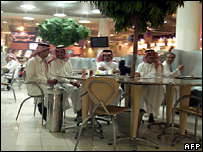
I lived in Saudi Arabia, and I remember the mutawaaeen were NOT police, but sometimes they took on the prerogatives of the police. So I have to wonder, like who made the arrest in the malls? Was it the police? Was it the mutawa hitting the boys with their little sticks? Did they call the boys parents? I have SO many questions!
Cold February Morning Sunrise
It is a shivery 5°C/45° F in Kuwait this morning, made more shivery by a brisk wind that blows and makes all the flags along the roads, hanging from apartments, decorating villas, etc. flap dramatically in the wind. I am hoping that National Day and Liberation Day holidays will make the roads less travelled as I zoom around, but I have been warned to steer clear of the Gulf Road, where youngsters are spraying cars with colored spaghetti and foam.
No more sandstorm, thank God, although there still seems to be grit in the air; your face feels dry and covered with an invisible coating when you come inside.
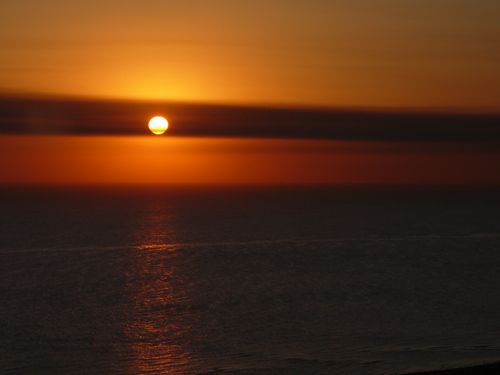
The sunrise this morning was beautiful – sharp, clear and, when I ran to get the camera, it was pink, but by the time I got back 15 seconds later, it had gone more orange:
While You Were Sleeping
It’s not that I’m that good, that obsessive, that I would get up every morning to photograph the sunrise. No, AdventureMan has to get to work, I have projects I am working on – AND there is the Qatteri Cat.
His little pea-brain doesn’t know it’s Friday morning. All he knows is that his food dish is empty. He goes around the house, pulling over the trash bins (they are small, they don’t make a lot of noise) and then he scratches at boxes and closets, thinking somewhere there might be food. I am guessing it goes back to some deep instinct, looking for food, from his street days.
I had forgotten to fill his dish last night.
I was so tired, I kept falling asleep over my latest Donna Leon book. Finally, around nine, I turned out my light. When the Qatteri can started sniffing around, pulling over trash cans, opening cupboards (what you hear is thump. thump. thumpthumpthump as he tries to paw it open) and scratching at boxes, I was mostly ready to get up, even though it wasn’t quite six.
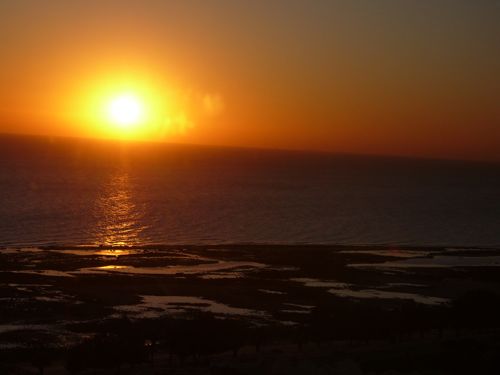
Good thing! Cold, clear morning, no sand, not a cloud in the sky and just look at that sunrise:
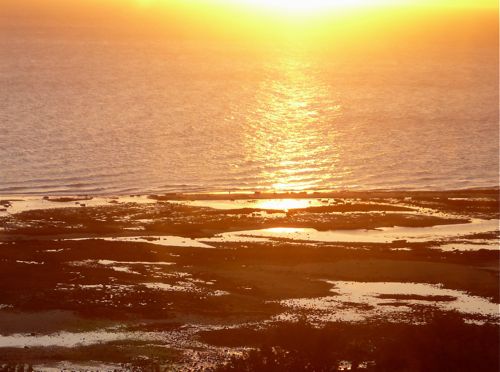
It is 46°F/8°C this morning. There is a wind, and it feels colder.
Sunrise 21 February 2008

This morning, the sand storm is gone, but there is still a very stiff breeze, keeping everything cool. It is 9°C / 48°F at 7:00 in the morning.
I don’t know if it has anything to do with the lunar eclipse, but as I got up – about an hour ago – I saw one of the lowest of all the low tides I have ever seen in Kuwait. I was tempted to go out on the beach and look for shells, but I don’t go on the beach alone, and I don’t have any dogs to protect me. The Qatteri cat has tried the leash – we call it ‘taking the cat for a drag,’ and he just isn’t fierce enough to protect me.
Kuwait has a LONG weekend! Friday and Saturday are the normal weekend, Monday and Tuesday are Liberation Day and Kuwait Day, so the government also declared Sunday to be a holiday, giving a nice 5 day break. The sandstorms have gone, at least for now, and it looks like it is shaping up to be a beautiful weekend.
Aidan Hartley’s Zanzibar Chest
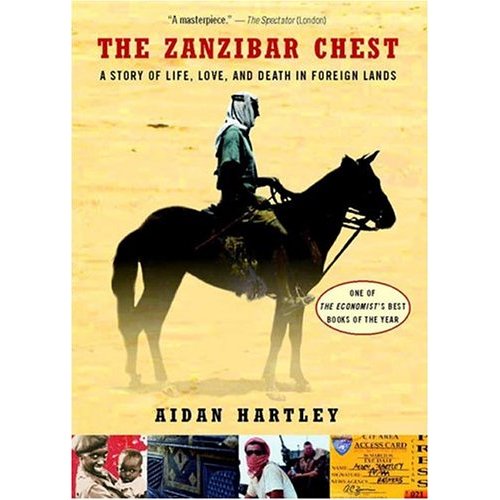
I started Zanzibar Chest in December, and could not get into it. It was interesting, but at first the tone was . . . I don’t know, maybe pompous? Something in the tone put me off, and yet I didn’t put it back on the bookshelves, nor did I give it away. It sat on my bed table while I attacked lesser works, more enjoyable fare. Then, one day, I just knew it was time to try it again, and this time, I could hardly put it down.
Born in Kenya, just before the rebellion, Aidan Hartley spent his life mostly in Africa. He skillfully interweaves three main story lines – the life of his mother and father, the life of his father’s best friend and his own life as a news correspondent.
This is not a joyful book. It is not inspirational. It is a tough, hard look at the people who cover the news, and the toll it takes on their lives. It is a story of drugs and alcohol to numb the pain of what they are observing, the comraderie of gallows humor and surviving the intensity of living through life-threatening moments together.
He covers some truly awful events. He covers the wars in Somalia, and in Rwanda. He covers Kosovo and Serbia. He is sent into some of the most dangerous and awful of places. He pays the price.
In his Zanzibar Chest, he takes us with him.
I will share a couple quotes with you, and if you are sensitive, please stop reading now. This book is not for you. It is almost not for me, except that sometimes I think we need to come face to face with just how awful reality can be to put our own lives right, to set appropriate priorities.
“I can’t put my finger on exactly how death smells. The stench of human putrefecation is different from that of all other animals. It moves us as instinctively as the cry of a newly born baby. It lies at one extreme end of the olfactory register. Blood from the injured and the dying smells coppery. After a cadaver’s a day old, you smell it before you see it. From the odor alone, I could tell how long a body had been dead and even, depending on whether brains or bowels had been opened up, where it had been hacked or shot. A body would quickly balloon up in the tropical heat, eyes and tongue swelling, flesh straining against clothes until the skin bursts and fluids spill from lesions. Flies would get in there and within three days the corpse might stink. It became a yellow mass of pupae cascading out of all orifices and the flesh literally undulated beneath the clothes. The tough bits of skin on the palms of their hands and the soles of their feet were the parts of the body that always rotted away last. As living people, these had been peasants who had walked without shoes and worked hard in the fields. A man who had been dead seven days reeks of boiling beans, guava fruit, glue, blown handkerchiefs, cloves and vinegar. After that he starts to dry out into a skeleton until he’s almost inoffensive . . .
The dead accompanied me long after Rwanda. It was months before I could order a plate of red meat served up in a restaurant. I smelled putrefaction in my mouth, or in my dirty socks, or as sweat on my body. I imagined what people I met would look like when dead. . . “
These guys all suffer from Post traumatic stress syndrome, they deaden themselves with drug and alcohol, and they are totally addicted to the adrenalin rush their job gives them. Living on adrenalin takes a huge toll – on their health, on their mental health, on their relationships, on their belief in goodness. They are the witnesses to the enormity of man’s inhumanity against one another.
In another quote, the author tells us:
“It was impossible for latecomers to comprehend the evil committed here but the British military top brass were still so scared of what their soldiers might see and what it would do to their minds that they sent a psychiatrist to accompany the forces to Rwanda. Bald Sam and I were amazed at that. We laughed about it. A shrink! It seemed extravagant. But the truth is that we stuck close to that man for days. We said it was all for a story, but really it was about us. The psychiatrist, whose name was Ian, told us his special area of interest was the minds of war correspondents. I could see Bald Sam squirming with happiness at all the attention, and I felt quite flattered myself. . . .
. . . for years I did endure some sort of payback. I have to try every day to prevent the poison that sits in my mind to spread outward and hurt the people I love. Sometimes I can’t stop it and I wonder if in some way the corruption will be passed on from me to my children.”
Toward the end of the book, the author tells us how hard it is to give up this adrenalin-news-junky life:
“Whenever I see a news headline to this day I half feel I should board the next flight into the heart of it. I’d love to get all charged up again and I could write the story with my eyes closed. I’m sure the sense that I’m missing out while others get in on a great story will never completely pass. . . The sight of people committing acts of unspeakable brutality against others fills a hole in some of us. The activity is made respectable by being paid a salary to do it, but there is a cost.”
This is not a book I really wanted to read, but it is a book I will never forget. Hartley doesn’t spare himself in the telling of this tale. He takes us with us and shows us all of it, and all of his own warts along with the tale. Would I recommend this book? Not for the sensitive, not for those who don’t want to look at the dark side. Between idyllic sequences on the beaches near Mombasa, in the hills of Kenya and Tanzania, in the dusty deserts of Yemen, there are some very intense and bloody moments. This is non-fiction, it is a documentary, it is a slice of the real life one man has seen, and that to which he has been witness. Read the book, and like him, you pay a price. You carry images in your head that you can’t forget, and a sorrow for our inability to solve our differences peaceably.
(Available in paperback from Amazon.com for $10.88. Disclosure: Yes, I own stock in Amazon.com.)
Recent Comments
intlxpatr on Shampoo Ginger tigerbutterya0c5ff1d… on Shampoo Ginger intlxpatr on British Soldier Kidnapped, Esc… John on British Soldier Kidnapped, Esc… intlxpatr on British Soldier Kidnapped, Esc… Wikipedia Donate Button

Amazina


Early Voting in Florida


