Woo Hooo Al Ahmadi
Great sign, Al Ahmadi!

I would love to see a Keep Kuwait Clean sign, maybe a series of them. The one I see features one of the beautiful, pristine beaches, and then the green green of the gulf. That contrast always takes my breath away, and it breaks my heart to see them filthy with fast-food wrappers, and detritus washed up from the boats.
Nicole B / Rainmountain, who has a photography and blog site has a one woman campaign to keep her segment of the beach clean in Mahboula. God bless you, Nicole!I think many of the schools also have beach clean-up days, and some clubs, too.
What would your sign feature? I’m not very artistic – those of you who are, would you do a sign, link to this blog entry so we can come visit?
New Minarets in Fehaheel
I love going out to Fehaheel; it’s kind of got a wild west feeling, with no regard to traffic lanes, no regard to traffic laws, it’s just not the city – it’s a step back in time, even with the beautiful Al Koot and Al Manshar Malls.
Two years ago, they tore down the old minaret on the mosque in the center of town on the Gulf Road, and the wrecker that tried to knock the minaret down got tangled – and fell over! It took months to clean that mess up, and then for the last two years they have been building the new “> twin minarets.
Recently the scaffolding came down. Here is how they look now – a serious facelift for a delightful old lady.

How Work Stress Changes Your Body
From yesterday’s BBC Health News:
Work stress ‘changes your body’
Stress seems to produce biochemical changes
A stressful job has a direct biological impact on the body, raising the risk of heart disease, research has indicated.
The study reported in the European Heart Journal focused on more than 10,000 British civil servants.
Those under 50 who said their work was stressful were nearly 70% more likely to develop heart disease than the stress-free.
The stressed had less time to exercise and eat well – but they also showed signs of important biochemical changes.
The studies of Whitehall employees – from mandarins to messengers – started in the 1960s, but this particular cohort has been followed since 1985.
As well as documenting how workers felt about their job, researchers monitored heart rate variability, blood pressure, and the amount of the stress hormone cortisol in the blood.
They also took notes about diet, exercise, smoking and drinking.
Then they found out how many people had developed coronary heart disease (CHD) or suffered a heart attack and how many had died of it.
Lead researcher Dr Tarani Chandola, of University College London, said: “During 12 years of follow up, we found that chronic work stress was associated with CHD and this association was stronger both among men and women aged under 50.
“Among people of retirement age – and therefore less likely to be exposed to work stress – the effect on CHD was less strong.”
You can read the rest of the study HERE,
Yesterday and Today
Yesterday, as I was blogging early in the morning, everything suddenly went wonky and I discovered I was no longer blogging as the blogger, but as a guest. I did everything I could think of, and nothing worked. All day long, srom time to time I would try to log in and it would tell me I was not a valid user. I even changed passwords – nothing doing, the password was not the problem, I was the problem.
Finally, late last night just before bed, I could get on again. I was concerned whether I could get on today, but so far so good, only it doesn’t want to publish my posts. (and as a blogger, like what’s the point, if you can’t post???)
For my not-living-in-Kuwait readers, yesterday we had rain. I suspect rain may be part of the problem – rain has always screwed things up in Florida, in Seattle, in Germany . . .
Here is a photo of the gently falling rain on local vegetation:
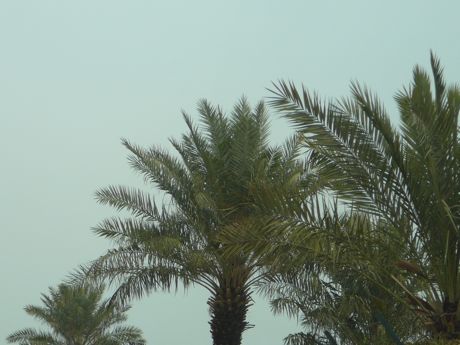
Yeh, I don’t know why the sky looks sort of blue-green, it was really cloudy, but I was shooting toward the sea and maybe the sea reflected green on the clouds (?)
And here is the sunrise from this morning – all two seconds of it. It’s a good thing I was waiting with my camera, this is all I got:
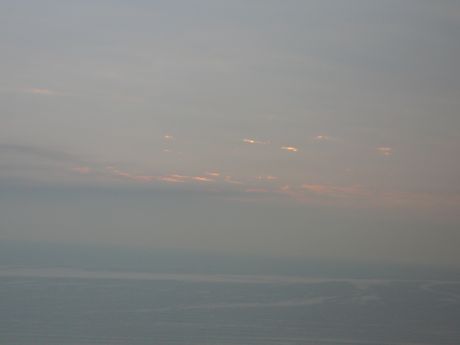
Two seconds later, it was gone. Here is what we have now:
It seems to be brightening, even though we still have cloud cover. Kuwait is a dry country, and desperately needs the rain. This is the dryest, coldest rainy season in memory.
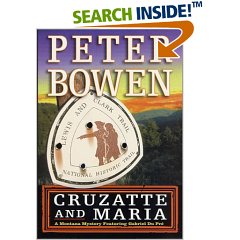
Bowen: Cruzatte and Maria
Peter Bowen’s tales of Montana in transition are an acquired taste. When I first started reading them, at my sister’s recommendation, I had a hard time getting past the dialect. The main character, Gabriel DuPre, speaks English differently; he is Metis, a mixture of French, Indian and who knows what, here before America was America, as he says “long time gone.”
You get used to it. It still makes me think he should be in New Orleans, speaking as he does, it sounds very Cajun, but you get used to it.
Peter Bowen’s Gabriel DuPre is another treat to myself (like Donna Leon.) Reading the latest book I bought, saved for just this time, a cold wintery January, brightened my outlook considerably.
The first book I read, Wolf, No Wolf had to do with environmentalists putting wolves back into the mountains where once they had flourished, but where now, for a couple centuries, people have been raising cattle. Guess what? Hungry wolves love cattle. It makes for some very hostile feelings.
That theme – local culture against intruding environmentalists – continues in this book, where DuPre is hired as a consultant on a film being made about Lewis and Clark. The locals in the Coronado area are no happier with all the film crews and tourists than the ranchers were with the wolves – and people end up dead.
In addition, DuPre’s friend Benetsee and his daughter Maria spend time together in the sweat lodge, and later, his daughter, Marie, sees a mound and is revisited by a vision she had. She tells her dad, DuPre, to dig, and he uncovers a trove of treasures cached by the Lewis and Clark expedition. Partly, it is the incursion of the spiritual and supernatural that I find so intriguing in these books; there is a reality, and then a greater reality, and they co-exist. Bowen makes it seem and feel entirely natural. I love it.
The book has some highly entertaining, laugh-out-loud moments, takes great pokes at the eco-tourist, and at the same time deals with some serious issues. We get to hear DuPre fiddle his old Voyageur songs, we get to hear what people are saying at the local bar, where cheeseburgers are the plat du jour. It is a great way to pass a winter’s day.
Stop Means Stop!
From time to time, we can hear the police pulling people over outside our residence. It gives us a big grin. One of the things they say, in English, is:
“Hey Buddy! Pull over!”
And the other thing they say is:
“Stop means STOP!”
We hear these two phrases over and over, so it must be part of their training.

The Qatteri Cat Sleeps Through Winter
You’ve been asking about QC. There isn’t much to tell you. He decided it was too cold, and all he does is sleep. Occasionally, he will wake up, take a walk to the food bowl and water dish, make a visit to the kitty litter, but then it’s back to sleep – waiting for warmer weather.
Yesterday, as I was working, he was following me around, “miaow, miaow” which meant “please sit down and provide a warm place for me to fall asleep” so I made him a little bed in the work room, and it wasn’t his first choice, but he made do, keeping me company while he sleeps through winter.

Scary Sunrise 20 January 2008
When I got up this morning, the sky was all pink, the water was all pink, it was a world of pink haze, very beautiful. Within moments, the light had shifted, the pink haze was gone and the sun began to rise, very dramatically, lighting up the clouds like you see on the ceilings of Renaissance chapels.
But wait! What is this? The sky is lit, the clouds are illuminated, but the brilliance of the sun is having a hard time breaking through the sludge hanging just over the horizon. I have a bad feeling, whatever it is that is strong and thick enough to block the sun, we are also breathing it.

It’s about 5°C warmer at 0800 than the last few days, with forcast of clouds and possible rain through Wednesday.
Leon: Friends in High Places

After reading two stinkers, I needed a read I could rely on for a good fix. I needed escape, mixed with good food, good clothes and some social awareness. I needed Guido Brunetti, Donna Leon’s Venetian detective, and his smart, savvy wife Paula, and his family meals of pasta with soft shell crabs and risi e bisi, his children, his disgust for the politics that impinge on his doing his job.
If you think Kuwait has “wasta” (doing business by connections, influence, calling in favors), you aint’ seen nuthin’ till you’ve seen how Byzantine Venetians operate.
Friends in High Places opens with Commissario Brunetti lying on his couch re-reading Anabasis when he receives a visit from a building inspector, who determines that the apartment he owns, on the very top of a building in Venice, was probably built illegally – there are no plans or restoration approvals on file at the bureaucracy regulating residential buildings in Venice – and may have to be torn down.
Wouldn’t that be a shock? It’s a shock to Brunetti and to his family, just as it would be to us. We learn all the ins and outs of housing codes, the impact of becoming part of the EEC, and how the clever Venetians devise ways around the codes, all while Brunetti is investigating one murder – and then three other murders.
It is a VERY satisfying book. I will share with you a lengthy quote from Friends in High Places as Guido and Paola discuss how to deal with the problem:
At no time did it occur to him, as it did not occur to Paola, to approach the matter legally, to find out the names of the proper offices and officials and the proper steps to follow. Nor did it occur to either of them that there might be a clearly defined bureaucratic procedure by which they could resolve this problem. If such things did exist or could be discovered, Venetians ignored them, knowing that the only way to deal with problems like this was by means of conoscienze: acquaintances, friendships, contacts and debts built up over a lifetime of dealing with a system generally agreed, even by those in its employ, perhaps especially by those in it’s employ, prone to the abuses resultant from centuries of bribery, and encumbered by a Byzantine instinct for secrecy and lethargy.
I am sorry to tell you that the only copy of this I could find on Amazon.com cost $99.98. I must have bought this one in England, where, I promise you, it was the normal cost of a paperback book.
I will warn you in addition, I was looking forward to reading a second Leon novel, Quietly in their Sleep, only to discover when I started that I had already read it, as The Death of Faith. The books published by Leon in England are often retitled for the American market. Leon fans, beware!
Sunrise and Widget
I wasn’t sure there was going to be a sunrise this morning, when I woke up and the sky was full of clouds and DARK! At around sunrise (I can check on Weather Underground Kuwait when that is going to happen) I started clicking. When I looked at my results, it looked like two different mornings, but it is all today, Saturday, January 18th, 2008.
Will we really have a sunrise?

I guess so! (5 minutes later)

I hope you have all noticed the new weather widget on my closest right hand column, giving the current temperature in Fahrenheit and Centigrade. After more than a year of blogging, it occurs to me that other people using WordPress have widgets from outside WordPress, so there MIGHT be a way. (Yeh, I’m slow, but I’m slow.) Now that I have figured out how to do that, I am getting all excited about maybe changing format. (Maybe around June; I have a list of things to get done first. 😉 )
Recent Comments
Kitchen on Isiais: Winding Down intlxpatr on Shampoo Ginger tigerbutterya0c5ff1d… on Shampoo Ginger intlxpatr on British Soldier Kidnapped, Esc… John on British Soldier Kidnapped, Esc… Wikipedia Donate Button

Amazina


Early Voting in Florida


