Breaking 90 in Kuwait
As I stood on my balcony this morning, drinking my coffee and relishing the sweet coolness of the morning, watching the string of fishing boats out on the horizon, I had one of those moments when you are happy and you know it (clap your hands!) (oops, there comes the pre-school teacher back to haunt me! My first job as a married lady.)
Checking WeatherUnderground for Kuwait I could see that it was a bare 64°F / 18°C, and that this coming Friday, the high temperature for the day will NOT be above 90°F/ 32°C.
You who don’t live here can’t imagine the difference it makes. Right now, you can spend evenings walking around, freely, it is like being let out of jail to have the crushing heat gone. And daily, it is getting easier to be outside for longer and longer periods of time. All kinds of migrating birds are coming back, it is a lovely time of the year in Kuwait.
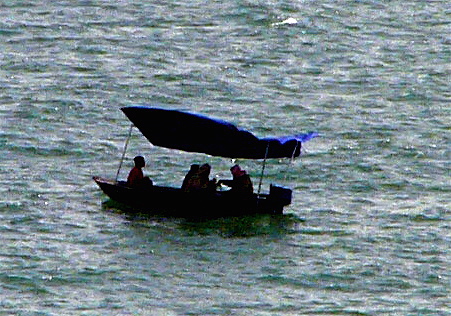
The fishermen are making full use of the sweet weather:
Al Fresco in Kuwait
I have had several requests to know what we were eating when we eat in the open courtyard at the Mubarakiya. You Kuwaitis can skip this entry; to you this is not exciting or exotic. To my stateside, European and African readers, this is how it goes:
As soon as you are seated, the waiter brings a little charcoal stove to the table with a steaming hot pot of tea. There is a row of restaurants behind you, one of which has huge gold colored pots of tea brewing at all times. Our Kuwaiti friends tell us that the reason the tea is so strong is that they never wash the pots, just keep brewing tea in them. The tea is STRONG, served in tiny glasses on saucers, and is usually drunk with a good amount of sugar.
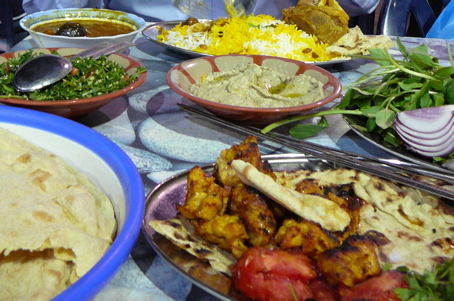
Then a plate of greens and onions arrive. The greens taste a lot like basil, very licorice-y, but they don’t look like basil.
You order. We don’t always have the same thing, but what you are seeing here is an order of shish ta-ook (chicken chunks, marinated and grilled, served on a skewer), fresh bread (comes with every order) tabouli ( a salad made mostly of chopped parsley and lemon), muttabel (a salad/dip made of roasted eggplant, tahina and olive oil), roasted lamb with rice, and a sauce made of okra, with a great big ball in it that is some kind of spice we don’t usually use, but enjoy in this sauce.
There are people at all the surrounding tables; usually one adult comes first, or maybe two, and tables get moved together or apart, depending on the size of the family coming. Then more women come drifting in, laden with shopping bags. They all greet one another and sit, and finally when the food comes, the children show up, eat a few bites, and then are up playing while the adults finish and drink their tea.
Adventure Man has a little black cat friend who likes the fatty pieces of the lamb he doesn’t eat. When he is finished with one offering, he will pat AM’s leg with his little paw, and AM will give him another piece. This is not a skinny, scrawney little cat, but a plump little cat with shiny fur. Guess he gets enough to eat!
At some point during your meal, you will hear the call to prayer, which we like even better now that we know that the muezzins (the ones who do the call to prayer) are all live, not recorded.
A lavish meal for four – more food than you can eat – with tea, and with excellent service, comes to around 8KD – around $30. How is that for a night on the town?
More Mubarakiya Art
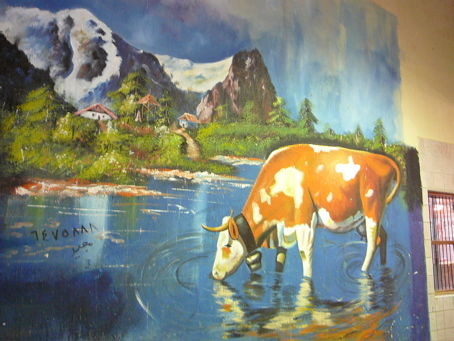
I think this is a total hoot! Along with the Pacific Coast scenery and fish, we have a Swiss Cow, with a bell, and Alpine scenery.
Here is one I love, a genuine Kuwaiti butcher – I love the glasses! Faces and hands are hard to do, and this artist caught his individuality. I wonder if he is still in one of the smaller meat market shops? Also note the bloodstains on the cutting table!

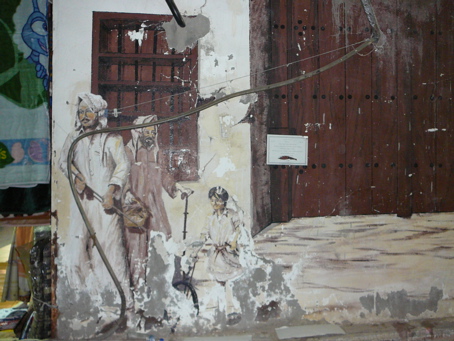
And here is a treasure, just outside the older section, near the date souk, badly damaged, and someone has strung a power cord across it, but one of the best pieces in the market. Love the colors, and look at the stone entry – the artist truly captured the feeling of stone. Look at the depths in the door and the window, the shadows and highlights. Look at the folds in the men’s thobes. This artist had some training.
Olive Oil Scandal Comment
This is a response to my recent post on The Olive Oil Scandal. I am so delighted when I get a thoughtful and enlightening response like this that I want to give it a separate entry so that it won’t be overlooked by all you bloggers with little time and short attention spans. 😉
It certainly is disgusting. One might note that, though, that none of the above named diluters of olive oil come from Spain, by far the largest producer and exporter of the product.
Currently, in fact, the Andalucian regional government (Andalucía, in which I am an olive grower, produces over 30% of the world’s olive oil) is currently funding a project intended to identify through mass spectometry analysis the molecular ‘signature’ of all the different regional denominations of extra virgin olive oil, enabling bottlers to include this information on barcode-like labels on every bottle marketed and against which the contents could be tested. The systematic adoption of this system, when it is completed, would go along way to protect consumers from the present situation, brought on partly through the fraudulent business practices of various Italian and American producers and sellers.
Also, considering that IOOC olive oil standards have no legal force in the United States, effectively permitting virgin or lampante oil to be sold as EVOO (but not diluted with other oils), the seemingly imminent adoption of international nomenclature by the USDA would be a very positive move. It can’t come soon enough.
Charles Butler’s website, The Olive Oil Gazette, is an absolutely fascinating resource, with all kinds of listings for Olive Oil sites and all kinds of olive oil information, including an article on October 21 about the proposal for the DNA “fingerprinting” of olive oil. Here is what it says about author Charles Butler McKay:
The Olive Oil Gazette is published in Cazorla, Jaén, Spain by Charles Butler Mackay, whose Spanish birth certificate states, correctly, that he was born in Toronto, Canada. Aside from editing this news source, he owns and oversees an olive plantation that has been in his family for a century and a half.
Thank you for your input!
Meanwhile, I don’t want to be sceptical. For a very good price, I found the below olive oil at the Sultan Center, and the lable says all the right things:
Cholesterol Free
Less than 1% acidity
Cold Pressed
It even has an expiration date
And it says it is a product of Syria. Because I am sceptical, I bought it because I thought it had a pretty label:

Fish Market Public Art
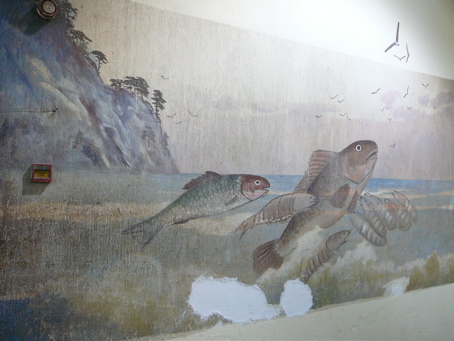
There are so many things I like about the Mubarakiya market. I believe it suffered enormous damage during the Iraqi invasion, and was substantially rebuilt. They did it nicely. The ceilings are high and spacious, and there are beautiful decorations in unlikely places. I found some Fish Market paintings I hadn’t photographed before.
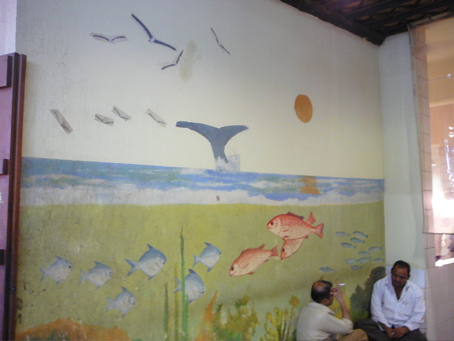
One thing is kind of funny – wouldn’t you think in Kuwait you would have dhows or showies, the Arab Gulf fishing boats? To me, this looks like the Oregon Coast, with the big boulders and rocky coastline! I am thinking those look like Pacific Coast fish, and isn’t that a whale with the seagulls? Are there whales in the Gulf?

I couldn’t take this one without the two guys taking a break, so I just included them – they ARE part of the Mubarikiya scenery:
Mubarakiya Evening
The weather has definitely cooled. We grab out friends and head for one of our very favorite places, the Mubarakiya market downtown, one of the few places still in existence with a flavor of old Kuwait.
We’ve visited in recent months, but the heat defeated us. Last night, our closest 4,000 friends were down there with us, shopping in the markets, having a bite to eat in the outdoor restaurant area (you can only tell which restaurants are which by the different colors of the chairs and tables) relaxing, visiting, just enjoying a beautiful mild weekend evening.
And it was beautful. We have eaten there in the heat, with cooling fans to keep things bearable, we have eaten there in the cold of winter, with little stoves on the table to keep the tea hot and to warm our hands (a little) but this night was utterly perfect. Warm enough, cool enough, and fresh, well prepared local food – it was a perfect evening.
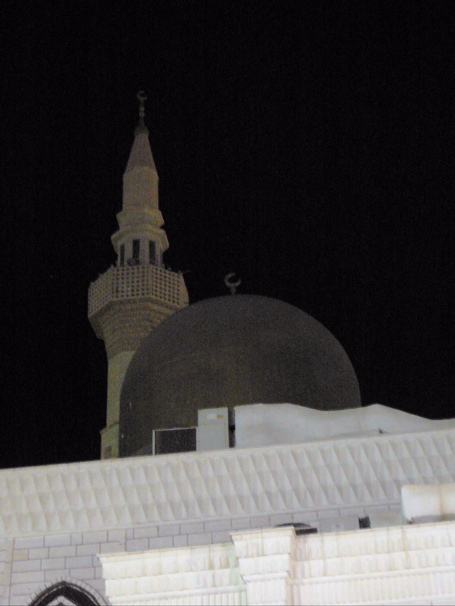
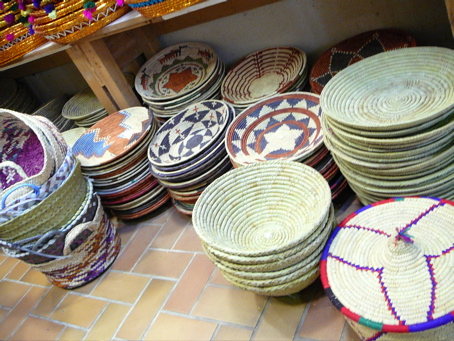
Some new Mubarakiya photos:

WoooooHooooooo CO-OP!
It’s hot. It’s humid. I drive to the co-op for a few small things and holy smokes! I see a spot to park, and it’s near the door! I start to park, and I see the handicapped sign, so I go around again, and find another spot about a million miles away. It’s ok, the walk is good for me.
But as I pass the handicapped spots, a car drives in and out pops a perfectly non-handicapped young woman and her two non-handicapped, fully capable daughters!
If looks could kill!
I don’t want to waste a lot of my time on resentment, so I move on.
This week, here is what I see at the co-op:

Wooooo Hoooooooo! Handicapped spots RESERVED for those who have special needs! Blocked off, so as not to tempt the rest of us! Wooooo HOOOOOOOOO, way to go, Co-op!
Accident Aftermath
This time the crunch was different. This time, the initial BLAM crunch was followed by a heart-sickening series of crunches. I was on the phone dialing 777 even before I got to the window.
They have lovely women working for emergency services now, women who can stay calm and switch languages easily. Just hearing her voice calms me down as I report the accident, tell them to send an ambulance. The upside down car door is flipping open, and people are running to help the victim out. It’s a woman, and she is beautiful. She is also bleeding, and once they get her out, she is very still, too still.
The traffic police call me back and I tell them where the accident is, but thank God the woman is still on the phone and when he doesn’t understand, she fills in efficiently and accurately.
It takes them 21 minutes to arrive. The traffic police send one car, and on a busy street, they all gather around the woman and stare. The MOI also send a car. Not one of these police set up any kind of traffic control, cars on both sides of the road are stopping, people come running, just to look.
The ambulances take 22 minutes. When they leave, there are no sirens. I don’t think she survived. The medics appeared knowledgeable and efficient.
It’s the aftermath that bothers me now. On the ground, they left all the medical waste.

The last thing the medic did as he got into the ambulance was to throw his bloodied gloves on the ground:
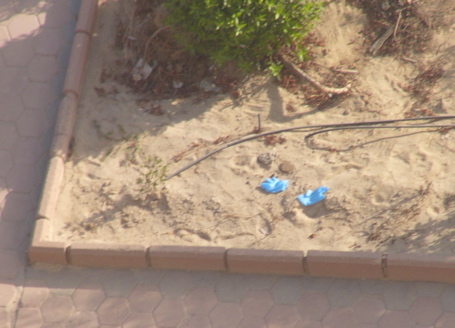
And then . . .the traffic cops left! There are two wrecks on one of the busiest thoroughfares in town, and no protection from the next speeding car! The wrecks are in the fast lane!
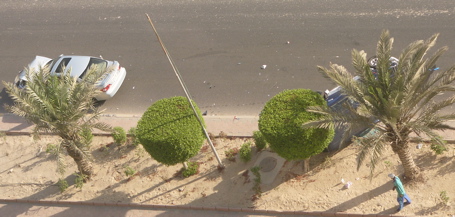
Don’t get me wrong. You know how I feel – police, ambulance medics, firemen – they are all heroes in my book. They risk their lives every day for the common good. The save lives, and they take pride in what they do.
They need a little training in accident management. When there is an accident, there needs to be a priority on getting there fast, and controlling the crowd, and routing traffic by efficiently. The medics need to pick up their waste.
There needs to be after-accident care, ensuring that someone stays until the wreckage is removed.
I had a house guest once who sat in my window and said “Oh my God. Oh my God! Oh! Oh! Oh!”
There are three separate u-turns we can see. Each one is another accident just waiting to happen. When the turn lanes back up, sometimes some people start honking, putting pressure on the lead person to make an unsafe turn. Please – resist the pressure. Take your time. Wait for a safe, truly safe interval.
Please, my friends, do one thing for me. Please, buckle your seat belts. And please, buckle up your children, put them in car-seats made to protect them, teach them from an early age to buckle-up, help it become so automatic they don’t even think about it.
Fintas Observatory
You know me, I’m a newspaper addict. Maybe even a news addict. I read many of the articles to the very end; I read some of the filler articles. Life is a mystery to me, in some of the exotic countries I live in (No, not exotic to YOU, but exotic to a little Alaska girl who finds herself in the fairy-tale lands of Arabia!).
So here is the real question. Every now and then, I find a reference to the Fintas Observatory.
I’ve looked on maps – no Observatory.
I’ve GoogleEarthed Fintas – some parts are still pretty vague, but I see nothing that looks like an Observatory.
The Kuwait sky is often murky with haze – the clear nights we are currently having are a fabulous rarity – but maybe they were more common in the past?
Do you know where the Fintas Observatory is? Do they allow visitors, or is it invitational only?
“Can You Help Me Get to Bangladesh?”
I have a dilemma. I don’t know how to handle it.
I carry small bills with me, because I am often asked for money. I keep it so I always have money to give to the people who help me get groceries to my car, the people who deliver propane, people who give good service – I don’t mind. Part of the blessing of having work is the obligation to pass that blessing along to others. We know that God Almighty knows where there is real need, and he moves us to give where giving is needed; he gives us a little shove in our hearts.
Yesterday, a well dressed man with a steady job told me he wants to go home to Bangladesh to see his parents. Could I help him?
I understand about aging parents. I’ve made a few trips myself. I totally understand what it is like to be far away when crises strike. We have always had funds set aside for emergency trips, and, by the grace of God, we haven’t had to dip into those funds often.
“How can I help you?” I asked.
“I need money,” he responded.
Money for a ticket to Bangladesh – that’s not small change. Along with that thought is the thought that were I to “help” this man, word would get around, and I would have many people knocking on my door for serious help with funds.
I don’t think he wants the kind of help I could easily give – showing how to set up an account and contribute to it faithfully, letting the money accumulate until you reach your goal. I don’t think he wants to do what my parents did with me, and what we did with our son – matching funds. (You save up half and we will match your savings dollar for dollar.) He wants an outright big gift.
In our church, we sing a song that says “Freely, freely, you have received, Freely, freely give.” I’ve always believed that with all my heart, it is like a magnified spiritual Locard Exchange Principal especially for blessings; what you have received you give, and it comes back to you doubled, tripled, magnified.
We tend to give larger charitable donations to organizations that make the money work hard – Medicins Sans Frontiers, African schools, our church fund. I consider a ticket to Bangladesh a relatively large charitable donation, large especially for one individual, one individual who is well employed.
So I ask for your prayers for clear guidance. I am not feeling that shove in my heart.
Recent Comments
intlxpatr on Shampoo Ginger tigerbutterya0c5ff1d… on Shampoo Ginger intlxpatr on British Soldier Kidnapped, Esc… John on British Soldier Kidnapped, Esc… intlxpatr on British Soldier Kidnapped, Esc… Wikipedia Donate Button

Amazina


Early Voting in Florida


