Seattle Overcast
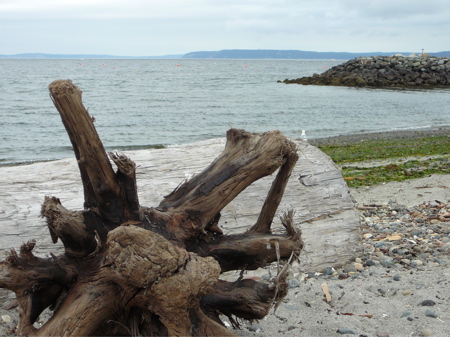
August in Seattle – while a day may dawn bright and sunny, the majority of days dawn with an overcast, even some rain, and slowly during the morning the clouds thin and dissipate. I found a wonderful photo on a forum like skyscraper city:
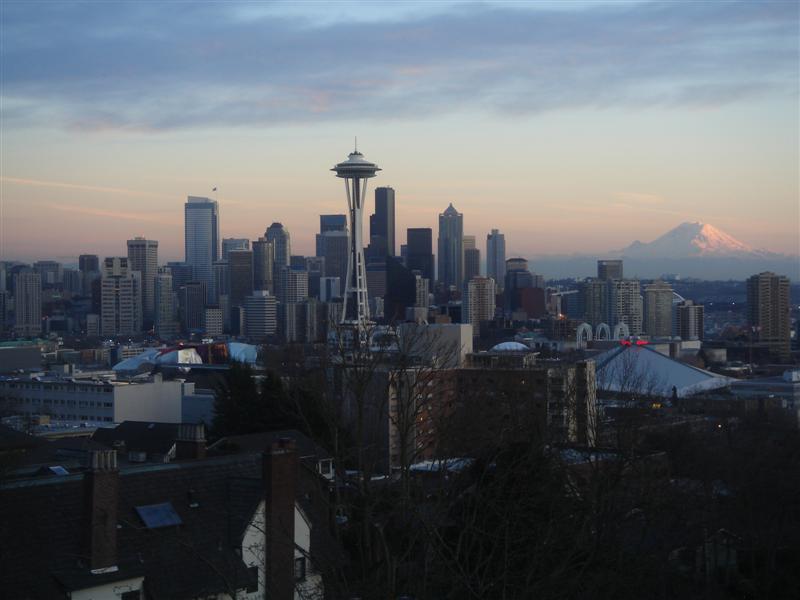
Isn’t that gorgeous? It’s from a website called City-Data.com. The photo above is by Pwright, and there are several more equally gorgeous photos you can look at by clicking the City Data site.
Cost Cutter
The store I was going to wasn’t open, and I knew we needed a couple groceries, so I headed across the parking lot to the Cost Cutter (yep, it’s raining):

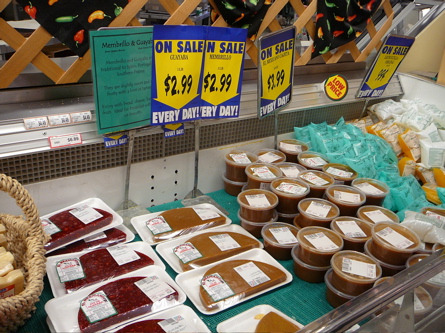
As soon as I got inside, I knew this was not just any old grocery store. The cashiers, the manager and the butchers all looked Mexican! And when I got to the deli section, the specialities were things like Dulce de Leche, all packaged up for people who eat a LOT of dulce de leche:
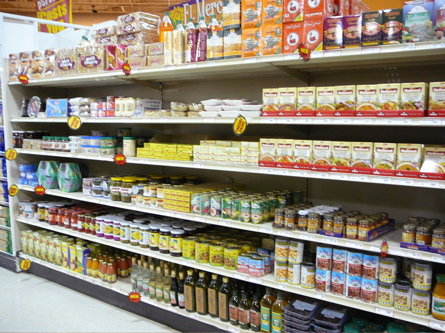
To my delight, there was an aisle labled Middle East foods, with tabbouleh, canned hummus and muttabel, foul, and Lebanese olive oil:
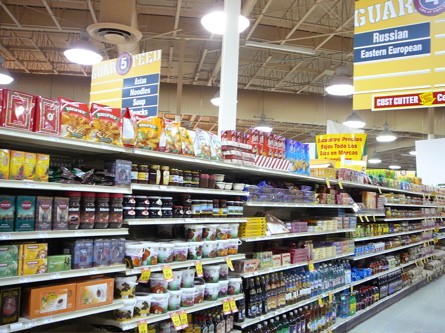
And a huge aisle with East European foods (I am not sure what East European foods are!)
And, while most stores hide their beer selection in some dark corner of the store, Cost Cutter has a huge aisle down the center of the store, with all kinds of neon signage – it looks very festive:
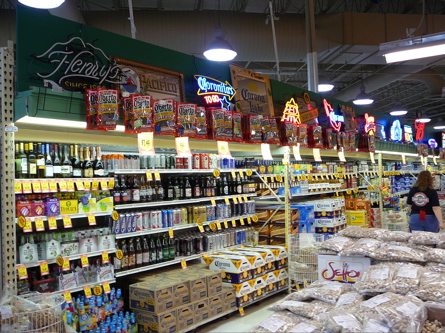
Stores like Cost Cutter, that serve the large and varied population of immigrants are one of the reasons I love Seattle.
Ivar’s Acres of Clams
In Seattle, there are three restaurants, Ivar’s Acres of Clams (the original, established in 1938), Ivar’s Salmon House and Ivar’s Landing in Mukilteo, and several smaller, more casual, fast-food kind of Ivars, famous for fish and chips.
This was one very smart man. The first Ivar’s Acre of Clams was built next to the ferry terminal in Seattle and provided both oceanfront dining and a quick place to grab some fish and chips coming to and from the ferries. It was a Seattle landmark; everyone knew Ivar’s Acres of Clams.
He also did a lot of promotions, appearing on TV in his own ads, often singing. The ads were very very bad, so bad that everyone remembered them, so in fact . . . they were so bad that they were good.

(Photo courtesy Paul Dorpat from the HistoryLink.org collection of Pacific Northwest History.)
(Kuwait needs this Wikipedia kind of historical page, gathering data and stories before the old Kuwaitis are all gone, and their stories with them. This would be a great thesis program, getting this set up and running.)
Some of my earliest memories are meals at Ivar’s. As a child, visiting from Alaska, the whole of my father’s clan, aunts, uncles, cousins, would all gather at Ivar’s for a grand dinner. Later, as a starving college student, from time to time a kind aunt would invite us to dinner or lunch there, taking us out of the university environment. As a young married, it was the restaurant where my husband-to-be met my extended family for the first time. Ivar’s is full of memories, as well as good food!
To this day, I often meet my old friends at Ivar’s. The food standards remain high – good Pacific Northwest Seafood, prepared so that their flavors come through. Dungeness crab Louis, salmon and chips, prawns and chips, halibut and chips – even plain old fish and chips, fresh out of the deep fryer. Even Ivar’s fast food is delicious, and as well as the fish and chips you can get their great clam chowder, also smoked salmon chowder, and a salmon ceasar salad, or a shrimp or crab cocktail – at the fast food Ivars. Great quality food, not the supersize me kind of food.
These are photos of the original Ivar’s Acre of Clams:

This is what their seafood cocktails look like (YUMMMMMMM!)

This is one of their dine-in fast food places; there is a long line of people ordering!:
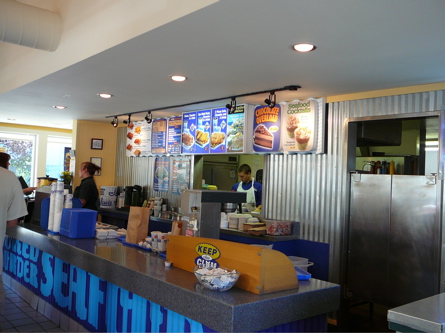
This is the Ivar’s motto:

The Mukilteo Landing Ivars suffered so much damage in a recent storm that they were closed for over a year as they remodeled to be able to seat more people:

This big fish is part of the interior:

You sit in this beautiful restaurant, inside or outside, and watch the Mukilteo ferry come in and out of the dock. The restaurant is right next to the dock, and also has a fast-food Ivars outside to sell fish and chips or chowder to all the people in line waiting for the next ferry.
Ivar Hagland isn’t alive anymore, but his restaurants live on, thriving, after all these years. The concept holds true – have a great product in a great location and the profits will follow. You can read more about his restaurants, and even look at their menus by clicking Ivar’s.
Anthony’s Beach Cafe, Edmonds, WA
These are the bathroom doors at Anthony’s Beach Cafe, in Edmonds, Washington. I am not going to show you any of their delicious food – they already have too many customers, and a long line of people waiting to get in and eat there, especially in this gorgeous summertime weather. Even in winter, Anthony’s is packed.
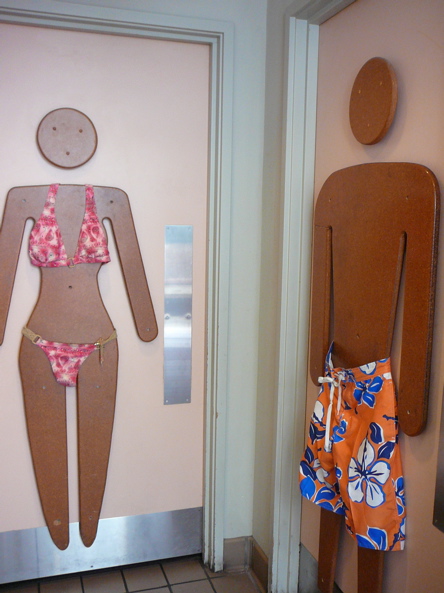
You would never see bathroom doors like this in Kuwait. But it would be fun to see a door with an abaya, and another with a dishdasha and gutra. 🙂
A Room with a View
Kinan and I have been having an ongoing desultory conversation about views. He likes my view in Kuwait and he loves a good view in general.
I have challenged him to close his eyes, sit back and envision HIS perfect view.
And so I challenge you, my readers. Even if you have never commented before, yield to this temptation. Commenting is easy – you don’t even have to give your name, just choose any old pseudonym.
Close your eyes. Lean back in your chair. Think of what you would like to have outside your window, to look at day after day. And then – tell us about it.
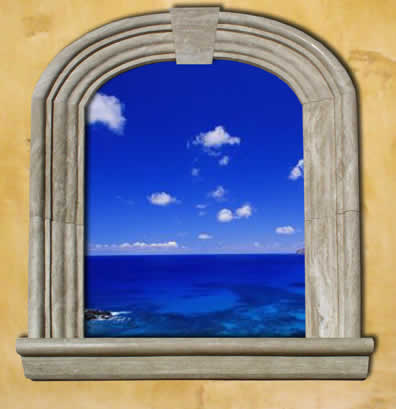
(Window frame courtesy of castelli marble)
I will tell you, for me it has to do with water, and even better, water and mountains. I love my Kuwait view, and chose a smaller living space just to have the breathtaking view. I have never, not for a heartbeat, regretted that choice. The view out over the Arabian Gulf thrills my heart, and I can lose hours watching ships, watching beachcombers, even watching fish jumping out of the Gulf waters. A beautiful view is a precious gift to the soul.
For my husband, I am would guess it would be Zambia, looking out over a hippo pool, watching elephants cross, watching the lions come down to drink – or to feed.
What view would feed your soul? What would you love to look at day after day? Speak now!
Long Sleeves in Seattle
The weather is back to Seattle’s normal for late July – early August – absolutely gorgeous. At sundown, we watch the light shift over the mountains and the sound, watch the cruise ships coming and going, watch the clouds change colors until they go that bright smokey fushia just before all color disappears. The sky does not actually become dark until after nine at night.
And it can be chilly! My first day here, I got to wear a little long sleeved hoodie I haven’t worn since February! It was overcast and rainy, and there was an occasional chill wind blowing . . . brrrr! I love it! Even though it can be cold, it isn’t really cold, just a tiny bit cold, just enough to make you move a little faster and get the blood going, and you will be warm enough. I love it.
The weather is shifting, and should be like spring in Kuwait – in the high 70’s, low 80’s Fahrenheit.
My Mom is looking great. We did a little shopping, had a great lunch . . . it has been a hard year for her, with my father’s death, and she is still recovering. Today she will have her hair trimmed up; she knows her birthday is coming and that will mean PHOTOS. My entire family is as camera-happy as I am, and an event like a birthday means a minimum five cameras. I am amazed at how good she looks!
BBQ in Memphis
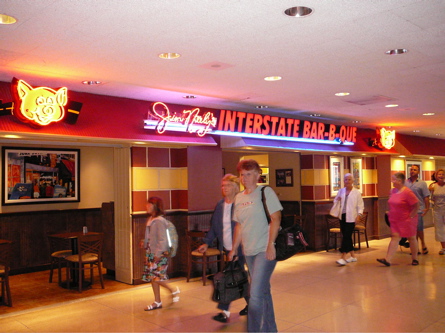
I love the Memphis airport. We sometimes arrive from Kuwait via Amsterdam at o-dark-thirty and the BBQ places are already open. Even if we are running for our next flight, there is usually one on the way where we can buy a quick BBQ sandwich to eat on the plane.
The Memphis airport is sometimes a scramble, our flight out leaving from the farthest gate from our flight in; we always get enough exercise to work off that sandwich in a heartbeat. And, for some reason, we often get upgrades out of Memphis, upgrades we haven’t even asked for. The flights are overbooked, and they just bump us up. No wonder I love Memphis! They treat us like old friends!
I just had to share the photo above with you – it’s taken at 7:30 in the morning, they already have customers lined up for BBQ and there are guys in the bar drinking beer. Memphis.
Cactus Flower in Pensacola
The Cactus Flower in Pensacola is usually the first place we go when we get to Pensacola. They have some of the best Mexican food you can find, freshly prepared, and you better get there early or you’ll have to wait a while for a table – the secret is out!
Located in a small strip mall undergoing some serious renovation, the Cactus Flower serves lunch and dinner. You’ll see all your friends there – we can’t go there without running into someone we know.
This is the chicken quesadilla. It is more than one person can eat! We took the rest home for another meal.
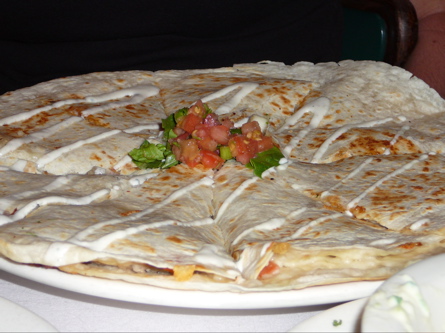
This is the three taco dinner; you can choose chicken, beef or pulled pork, or any combination of the above. It comes with a choice of beans (these are the smashed beans) and rice, too. Usually, I order this a la carte, because I can eat the three tacos, but not all the beans and rice, too, and I hate to waste.

This is the tostada dinner, which also comes with beans and rice. Delicious!

As for gaining weight, so far so good. Haven’t done a scale check, but the clothes still seem to fit and the waists aren’t too tight, so I guess I am keeping it off by lugging my baggage here and there, and keeping moving.
Pensacola Treehouse
The tree house is an old American tradition, but most treehouses are fairly primitive things, more like a raft high in the tree branches with sticks nailed into the tree to climb up. Few have walls, if it has walls, Daddy probably helped. But look at this house, and it’s magnificent tree house! I think it must have been built by a builder! And I wonder if it has air conditioning?

McGuire’s for Steak
“I just have a yearning for a steak,” I said to my son’s wife, as we sat in the kitchen chatting and thinking about what to do for dinner. “I know you want to go for a run tonight, but maybe tomorrow night.”
Here is what I have loved about staying with them. Five minutes later she came back to me and said she had talked with her husband and they thought going out for steak tonight would be a very GOOD idea, and they could run tomorrow night.
And the best steaks, they both recommended, were at McGuire’s.
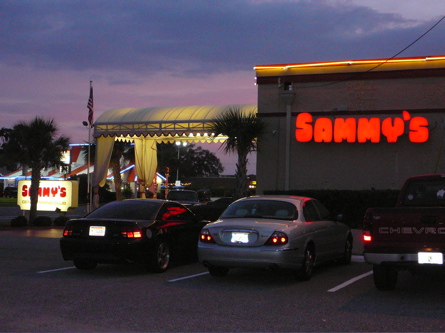
When we got there, the huge parking lot was already full. The street parking all around McGuire’s was full. We dropped off my son and his wife and I went to park in one of the few places they have heard cars are never towed from: Sammy’s Club for Gentlemen. It was still early, and we didn’t get towed.
Because it was their weekly fun-run night, we had to wait for a table. As we waited, runners finishing the run were running past us. Run six runs and you are eligible for the McGuire’s coveted green fun run shirt, with a shamrock on it. Woo hoooooo! I have heard there is a Hash House Harrier group in Kuwait that does something similar, but they change locations every run, whereas the McGuire sponsored runs all end up at – Maguire’s! They have free eats for the runners, who have to rehydrate in the McGuire’s bar.
There is another tradition at McGuires; customer write their name in felt pen on a dollar bill and staple it to the ceiling. The bar has an estimated $500,000 in dollar bills stapled to it’s ceilings, walls, pass throughs, etc. It is an amazing sight.

The steaks were magnificent. I had the peppercorn steak, and it was so big I took half of it home for the next day. It came with sides – your choice – garlic mashed potatoes, grilled vegetables, asparagas (my choice) and several others. The steaks were perfect, and the entire meal was worth every penny. They also have a good variety of seafood selections, and Irish selections, and a great selection of beer and wines.
Recent Comments
intlxpatr on Shampoo Ginger tigerbutterya0c5ff1d… on Shampoo Ginger intlxpatr on British Soldier Kidnapped, Esc… John on British Soldier Kidnapped, Esc… intlxpatr on British Soldier Kidnapped, Esc… Wikipedia Donate Button

Amazina


Early Voting in Florida


