Family Beach
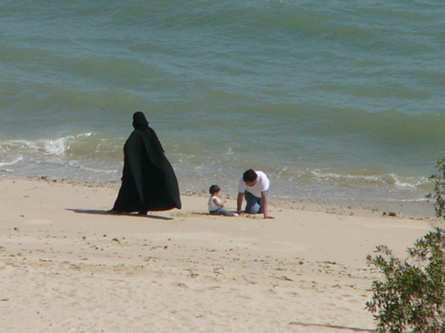
Every now and then, I get a good giggle. Usually it is a European family, and it only happens once . . . they go to our local beach. They are in normal beach attire – swimsuits. And they head for the “Family Beach.”
They haven’t been here long enough to know that “Family” is a little different here, it means mostly women in abayas and scarves, or some form of head covering.Even for those not in abayas, it means body parts are modestly covered, at the very least, with a Tshirt. You will see women swimming in abayas and scarves, floating in inner tubes, fully covered.
There is usually a wide circle of empty space around the European family; people regarding them with fascinated horror. I rarely see them come back. I am hoping they find other beaches, maybe more private.

Best Dates in Kuwait
I often look at the Search Engine Terms part of my Blog stats to see what searches brought people to my blog. Some of them are hilarious, and some of them – I wish I had the answers!
One of yesterday’s questions was “What are the best dates in Kuwait?”
I am not an expert on dates. I remember our first visit in a Kuwaiti house, and how at the end of dinner, the host brought out dates. There must have been ten different kinds, some dry, some moist, one very soft sugary one that I adore) it probably has about 10,000 calories in each date, but oh my, what a taste!) All the dates were from his own trees – he has a date plantation all his own! What luxury!
I remember that when I lived in Qatar, and had a date tree in my yard, the date harvest usually occurred somewhere around now – or maybe July.
So I ask my Kuwaiti readers and fellow bloggers, on this lazy Friday, to help me out. And not just me, but the likes of me, people who read my blog because they are fascinated with life in another country and learning more about different ways of life – What is your very favorite Kuwaiti date, and why?
Dusk in Kuwait
Dusk anywhere is one of my favorite times of day. In Riyadh, my husband and I would head down to the Dira’a souk, usually arriving just before the Isha call to prayer. We would buy a couple felafel sandwiches and a juice drink and sit in the large courtyard by the fort and eat our sandwiches while all the shops were closed for prayers. The sky would go from deep blue to a very deep blue purple, and it was that moment we waited for – the stars just visible and this just-before-black incredible color.
In my mind there is also a hush, but that is unlikely, as there were usually women and their children waiting in the same area for the men to finish their worship, and the children would be playing.
We are still looking for felafel sandwiches that taste that good. We would laugh; eating out for under $2 and it felt like such luxury.
In Kuwait, we are usually on our way to meet up with friends or somewhere around dusk. I always have my camera handy – you just NEVER know what you might see.
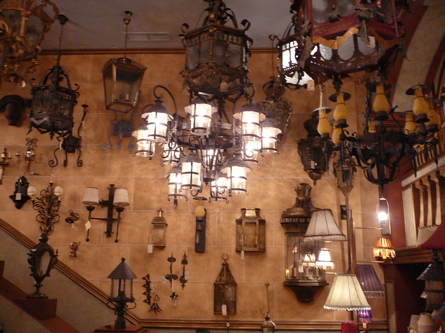
This isn’t really dusk, but it is dusky, in the interiors/exteriors shop as you enter the Free Trade Zone in Shwaikh – I can’t help it, I love this shop:
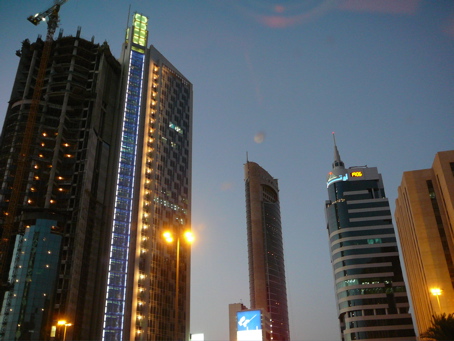
Not crisp, but the skyline is so eccentric:

Dwarfed in downtown Kuwait:
Almost dark – the mosque in the circle, downtown Kuwait:

Donna Leon Crossing Cultures
I’m in the middle of a Donna Leon read-fest. When I wrote the reviews the last time, I saw three books by her I had never seen – and I comb the aisles of Barnes and Noble when I am in the US, and Half Price Books, looking for titles by her. I am guessing some of her books haven’t been printed in the US, but I was able to find them from the UK Amazon.com.
The two latest books I have read by Donna Leon are timely. The first, Fatal Remedies, starts out being about Commissario Guido Brunetti’s wife, Paola’s crusade against the sex tours to undeveloped countries, her outrage against trips that allow grown men to exploit the poverty and need that the poorest of families will sell their own daughters and even young children to satisfy these men’s uncontrolled lusts. Her outrage leads her to a jail cell in her own husband’s precinct.
But just when you think you know where this story is going, it turns, as many of Leon’s books do, and tackles another subject, one very much in the eye of the news – falsified medications. There is a huge profit to be made, and huge wrongdoings in the medical supplies field, as expired medications are shipped to the most needy countries, and prescription and over-the-counter medications contain ingredients that are at best, harmless, and at worst – poisonous!
Guido Brunetti follows the money, and exposes the cheats.
In the second book, The Death of Faith, the issue – corruption in the church – comes close to home, as Brunetti’s daughter gets a low grade from her religious education instructor for asking questions, logical questions, about the dogma of the Catholic faith. Leon also tackles the issue of the order of Opus Dei, the same mysterious order featured in The DaVinci Code, an order that does exist, but about which solid knowledge is murky. What is known is that the order, in jihadist fashion, seeks to establish the Catholic church as the supreme guide to behavior on earth, it’s own version of sharia law to be the ruling principle in every country.
This is an anethema to Commissario Brunetti, and to all thinking Italians who savor the separation of church and state. He asks the eternal question – who decides? Who decides what behavior is acceptable, what questions are allowable? Religious belief, or the lack of it, is so very personal – this is a very timely issue that all nations are struggling with. Religious rule? Secular rule?
Underlying all the Donna Leon books is the sweetness of daily life with Brunetti’s family, his beautiful and principled wife, his teenaged children, the food they eat, the family discussions they have, the flowers he brings home and the strength of the connection they have with one another. The Venetian setting weaves its own magical thread through every novel, as we ride with Brunetti in the vaporetto on the canals, as we sit with him in a local bar for a quick coffee – or something stronger – and as he walks the streets from home to office, or to talk with a witness.
And last, but not least, the utter corruption in the Venetian system reminds us that veniality is not restricted to the United States, or to Kuwait, or to Nigeria, or Italy, or to any one country, but wherever man seeks to impose order, the chaos of corruption must be slowly and surely overcome by the building of an honest bureaucracy, people like you and me, serving in seemingly hopeless situations, but doing our best, day by day, like Guido Brunetti, to build a better world for our children.
No Accounting for Taste
My Mother once joked that the definition of good taste was someone whose taste agreed with your own. Her house is all smooth, modern, elegant lines, while mine is all old, antique and semi-antique. She has clean lines and clear surfaces, and I am guessing that to her, my decor is cluttered. (Not that she criticizes me.) We just have different tastes.
My husband and I also have different tastes. Often, his eye will alight on something, say like a Masai shield 7 feet long, and he will say “wouldn’t that be great in our house?” and my response is “yes! In your den!” He calls his den The Adventure Man Museum, and says that the only thing the Tarek Rejab has on him is that they have had a couple more decades of collecting. But he is still working on it!
He LOVES these trees. He keeps threatening to buy a couple for our yards back home. I mention little things like shipping expenses. . . . or maybe he is pulling my leg – ya think?
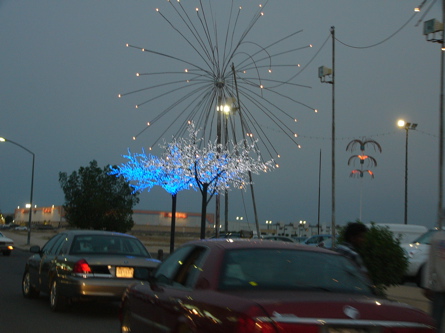

So far, we agree that they look great in context. I am not so sure they would do so sell in a rainy climate.
And this is what I love:
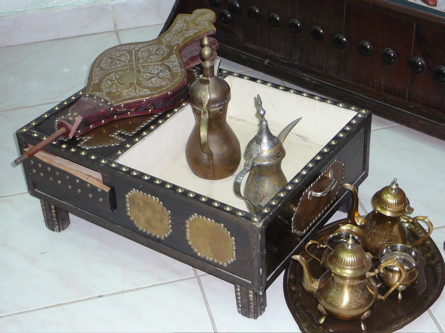
You used to find these everywhere in the Gulf, even in the cities you would find them in the diwaniyyas. This is the only one I have seen since I came to Kuwait, and it is in a museum. I remember being out in the beit-as-shar in the desert (for my non-Arabic speaking friends: tents, literally, House of Hair because the tenting was woven of goat and camel hair.) I remember the sound of the metal clanging as the coffee was ground in the morter, I remember the smell of the wood fire when the coffee was brewing, and I remember the coffee being poured through branches that kept (some of) the grounds out. I miss that ceremony; I miss the sounds and smells and taste, because out in the desert coffee tastes different. It wasn’t that long ago – but I never see them anymore.
Do you?
Kuwait Beauty (2)
Public art in the Souk Mubarakiyya parking:

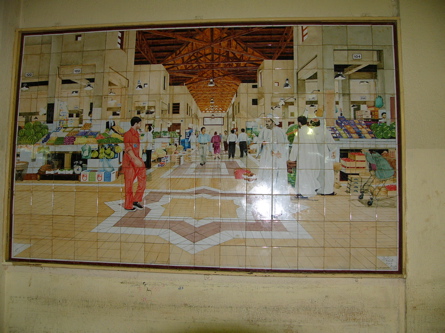
Mubarakiyya Market:
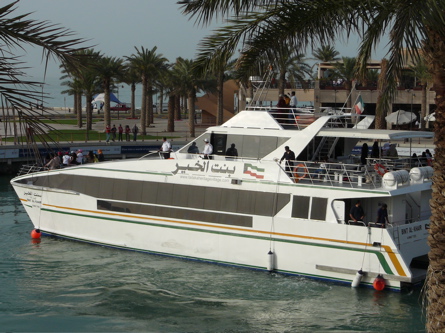
The Marina Crescent:
Kuwait Beauty
“If you but have the eyes to see . . .”
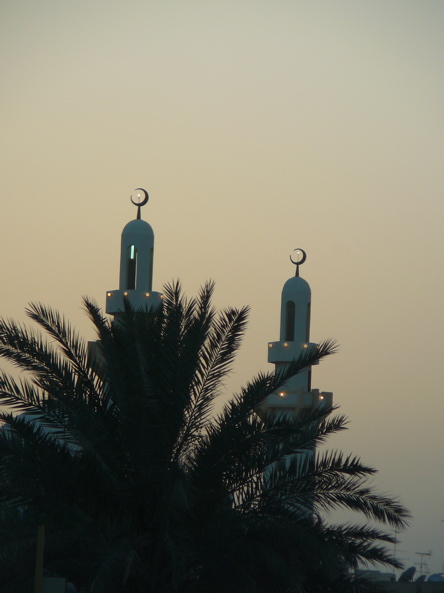
There is great beauty in Kuwait. Here is the spire of a mosque I found in Hawalli when I got lost. (Yes, people look at me like I am out of my mind when I stop and take photos of these things they see everyday.)
Here is detail from the spire:
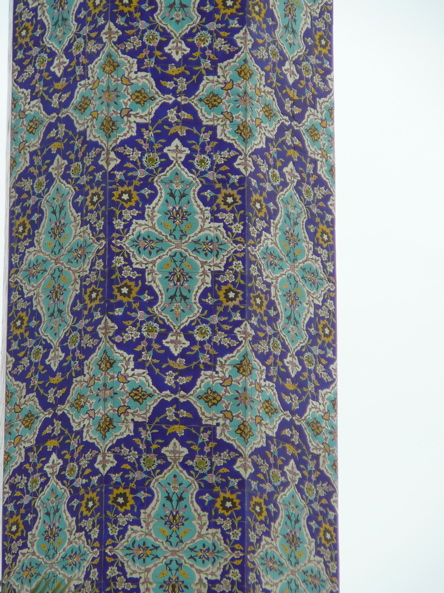
Here is an old-fashioned meshrabiyya window at the home standing over the Tarek Rajab Museum. Who can believe that such a museum treasure is open to the public for free, thanks to the graciousness of a private family, who sees the beauty in the Gulf Heritage, collects and preserves it.

Here is the globe near the entrance to Kuwait University, reminding us always that we are all connected in this world:

Dusk is my favorite time in Kuwait – the glare of the sun softens, and the colors glow:
Paris Hilton in Jail Video
A friend sent me this link this morning, and I died laughing. I don’t like Paris Hilton, I don’t like the vacuous life she leads, and I wouldn’t post this at all if it weren’t very cleverly done.
And, of course, it is Thursday, and many of you will have the time to waste on a good laugh:
Power Stations in Kuwait
I love public art. My little village in the US holds an annual Arts Festival, and part of the proceeds from this highly successful festival goes to fund public art. You can see some examples here: Public Art – October
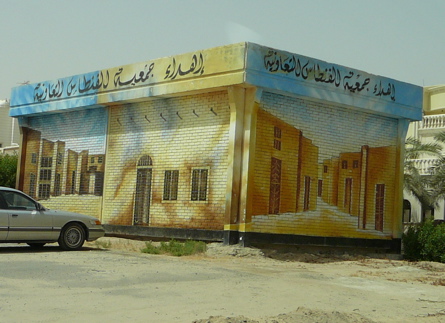
Kuwait also has public art. I believe these squatty, square, non-descript buildings are power relay stations – and look what they have become! Once you start seeing them, you see them everywhere, and every one is different.
I love it that they are whimsical, and that some artist gets paid to design and paint all these stations! They reflect a respect and reminder for Kuwaiti traditions.


Kuwait Skyline (1)
Kuwait in the 1970’s was called the Paris of the Gulf. People who lived here then talk about it with great nostalgia, they call it paradise. Kuwait was an old trading city, full of merchants and traders. Kuwaiti men went out on fishing boats, and pearling boats, and the love of the sea is still deep in the Kuwaiti soul. The women were strong and adventurous, and took care of all the family business while the men were out to sea.
Kuwait had a tradition of tolerance and sophistication found nowhere else in the Gulf.
So many changes since then, and so much building since the capture of Saddam Hussein. I will try to post photos of some of the changes for distant viewers:
An old favorite:

Changing skyline:


Recent Comments
Kitchen on Isiais: Winding Down intlxpatr on Shampoo Ginger tigerbutterya0c5ff1d… on Shampoo Ginger intlxpatr on British Soldier Kidnapped, Esc… John on British Soldier Kidnapped, Esc… Wikipedia Donate Button

Amazina


Early Voting in Florida


