500,000 in Kuwait Banned from Travel
From the Kuwait Times:
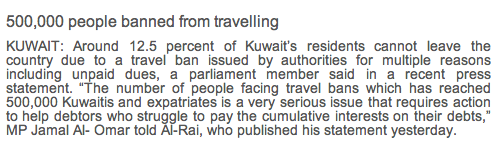
Mostly for people who have not paid interest on their loans? The banks have that much power, that they can put a travel ban on their customers?
More Radar on Qatar Roads to Trap Violators
Qatar makes some great laws – like fining those who go through red lights, or who drive near the speed of light. . . but when the violators turn out to be mostly young Qattari men, who pays the fines? Does anyone pay the fines?

From Doha News:
In an effort to tackle bad driving in Qatar, the Ministry of Interior plans to set up speed radars every two to four kilometers on major roads, Traffic Department Director Brig. Mohamed Saad Al Kharji has said.
Additionally, some 120 radars are being installed to catch drivers who overtake others from the right lane, the Qatar Tribune reports Al Kharji as saying.
He added that the software of speed radars that are already installed on the roads would be updated so that they could also catch such violators.
No timeline for when the cameras would be installed was disclosed. But last fall, the MOI announced it would be rolling out radars to catch queue-jumpers.
Using the “slow” right lane to overtake vehicles in the left lane is a traffic violation punishable by a QR500 ticket, but among one of several rules flouted by motorists here.
Enforcement
In Qatar, traffic violators are rarely pulled over by police officers, despite brief campaigns to step up enforcement. In 2012, plainclothes police officers began ticketing drivers who overtook other vehicles on the right.
And at the end of last year, the traffic department began a three-month campaign to ticket those who violate road rules, including drivers who hadn’t fastened their seat belts, used their phones while driving, and rode without a license.
Both initiatives were lauded by many residents who said enforcement is key to improving safety on the roads, but neither seem to have lasted.
The Last True Detective
Every now and then AdventureMan and I find a series we really like, and True Detective, Sunday nights on HBO, is one of those. From the first notes of the melancholy theme song playing over shots of rural Louisiana sights, cane processing plants, bayous, angst-ridden detectives, and shots of the crime scenes, you know this is not going to be your typical detective series.

It is pure HBO, not-suitable-for-children kind of stuff. The two detectives investigating the murder in episode one are damaged, flawed men, each haunted by different but equally destructive demons. These are the good guys, trying to get the job done in spite of all the barriers thrown up to prevent them digging too deeply where it might inconvenience the bad guy(s).
Tonight is episode 8, the last episode. We have been waiting all week, hoping they will tie all the dangling, intriguing threads together. Hoping that neither of these two detectives, whom we have grown to like and maybe even admire, are involved with the crime.
It’s HBO. You never know.
“Why Do Americans Do This?”
AdventureMan and I were with a group of delegates from Iraq yesterday, taking them on a visit to a variety of Pensacola sites. They are here visiting through the GCCDC, on the IVLP program, studying elections and campaign strategies in the USA.
One stop we make with many delegates is the First Methodist program Serving the Hungry. Two days a week, led by Jerry Vititow and supported by many happy, willing volunteers, they serve a hot lunch to the hungry, varying in numbers but never less than fifty or so.
The delegates learn about the program, then don aprons and serve up the trays. It is often one of the highlights of the trip.
One delegate raises his hand to ask a question.
“We see this everywhere,” he starts, “Americans who are working for nothing and smiling. Why do they do this?” He was genuinely perplexed.
Jerry explained that it wells up from many sources, a yearning to give back some of the blessings we have received, an eagerness to serve those who have less, maybe just an eagerness to serve. “It’s part of what we believe in,” he sums it up.
The delegates had a wonderful time.
Pensacola Grand Mardi Gras Parade 2014
We love having a grandson, not that we need an excuse, but it’s always more fun to go to a parade when you have a youngster with you. Today was particularly fun, he is four and totally gets the whole parade thing, we found a great parking place with no driving around and we had a great place to watch the parade from. Some kids sitting in front of us knew our grandson, and we were all invited “up front” to be with them.
Parades are always more fun with fun people, and these people were fun. The parade was fun. This is a family parade, lots and lots of children, and the bead throwers and gift givers are most generous to the children. While grown-ups compete to catch the beads, they turn around and give them to the little ones almost immediately. It’s a gentle spirit, and everyone has fun.
Our favored place is very near our church. You can see how crowded it is as the parade begins. It only gets worse; Mardi Gras parades attract more than 50,000 people. Imagine, 50,000 people all behaving themselves, families, children, and when it ends, the street looks normal within an hour or so. Thank God for civility.
Our church and the Mardi Gras revelers waiting for the parade. If you look closely, you can see beads hanging in the tree from the Krewe of Lafitte Parade the night before. Pensacola has LOTS of parades 🙂 :

I watched this guy in this crazy-wonderful horse head get LOTS of beads during the parade:

Everyone has a gimmick to try to get more beads, but it is a FAMILY parade, so there are no drunks (not that I saw anyway) and no one lifting up their shirts for beads. Several people had “targets” for bead throwers:



McGuires throws green beads, and our grandson got one with a medallion, very special 🙂 We’ve hung them all – all this treasures – in his room at our house so his little baby sister doesn’t chew on them by accident and he can visit them every time he stays 🙂 :

As you can see, it was a fabulous day for a parade, maybe 70 degrees F. and a slight breeze. We say “when March comes in like a lamb, it goes out like a lion” so we are expecting that the end of March may be cold and dreary, perfect Lent weather.
MERS Virus Found to be Widespread
Thank you, John Mueller, for this fascinating article from Science NOW:
Middle Eastern Virus More Widespread Than Thought
 Bernard Gagnon/Wikimedia CommonsTrail of infection. Scientists have found MERS virus in camels from Sudan and Ethiopia, suggesting the virus is more widespread than previously thought.
It’s called Middle East respiratory syndrome, or MERS, after the region where almost all the patients have been reported. But the name may turn out to be a misnomer. A new study has found the virus in camels from Sudan and Ethiopia, suggesting that Africa, too, harbors the pathogen. That means MERS may sicken more humans than previously thought—and perhaps be more likely to trigger a pandemic.
MERS has sickened 183 people and killed 80, most of them in Saudi Arabia. A couple of cases have occurred in countries outside the region, such as France and the United Kingdom, but those clusters all started with a patient who had traveled to the Middle East before falling ill.
Scientists have uncovered more and more evidence implicating camels in the spread of the disease. They found that a large percentage of camels in the Middle East have antibodies against MERS in their blood, while other animals, such as goats and sheep, do not. Researchers have also isolated MERS virus RNA from nose swabs of camels in Qatar, and earlier this week, they showed that the virus has circulated in Saudi Arabian camels for at least 2 decades.
Malik Peiris, an infectious disease researcher at the University of Hong Kong, and colleagues expanded the search to Africa. In a paper published last year, they showed that camels in Egypt carried antibodies against MERS. For the new study, they took samples from four abattoirs around Egypt; again they found antibodies against MERS in the blood of 48 out of 52 camels they tested. But the most interesting results came from taking nose swabs from 110 camels: They found MERS RNA in four animals that had been shipped in from Sudan and Ethiopia.
Peiris cautions that it is unclear whether the infected camels picked up the virus in Sudan and Ethiopia or on their final journey in Egypt. Abattoirs could help spread MERS just like live poultry markets do for influenza, he says. “You cannot point the finger exactly at where those viruses came from,” he says. “But I would be very surprised if you do not find the virus in large parts of Africa.”
If so, that changes the picture of MERS considerably. No human MERS cases have been reported from Egypt or anywhere else in Africa, but if camels are infected, they may well occur, says Marion Koopmans, an infectious disease researcher at Erasmus MC in Rotterdam, the Netherlands. “It would be important to look systematically into that,” she writes in an e-mail. “Health authorities really need to test patients with severe pneumonia all across Africa for MERS,” Peiris says.
The researchers were able to sequence the virus of one of the camels almost completely, and it is more than 99% identical with viruses found in people. “I would be very surprised if this virus cannot infect humans,” says Christian Drosten, a virologist at the University of Bonn in Germany. But the virus also shows a few intriguing differences from known camel samples, he says. “We have to analyze this carefully in the next few days, but it looks like this sequence broadens the viral repertoire found in camels,” he says. If the viruses found in camels show more genetic variation than those isolated from humans, that is further strong evidence that camels are infecting humans and not the other way around.
Anthony Mounts, the point person for MERS at the World Health Organization in Geneva, Switzerland, says that it is very likely that human MERS cases occur in Africa. “Wherever we find [infected] camels, there is a good chance we’ll find [human] cases if we look closely,” he says. And humans may be exposed to camels in Africa much more often than in the Middle East: There were about 260,000 camels in Saudi Arabia in 2012, but almost a million in Ethiopia and 4.8 million in Sudan, according to the U.N. Food and Agriculture Organization. The more human cases there are, the higher the risk that the virus will one day learn how to become easily transmissible between people, which could set off a pandemic.
The researchers also looked at the blood of 179 people working at the camel abattoirs for antibodies against MERS virus, but found none. That shows that the virus is only rarely successful in infecting human beings, Peiris says. “What we need to find out now is the reason for these rare transmissions.”
Idaho Legislators to Vote on Ag-Gag Bill

In this April 22, 2010 file image from video provided by the United States Humane Society, a Hallmark Meat Packing slaughter plant worker is shown attempting to force a “downed” cow onto its feet by ramming it with the blades of a forklift in Chino, Calif. (Humane Society of the United States via AP)
Idaho’s legislature is considering what’s been dubbed the “ag-gag bill” that would impose penalties for trespassing and filming without permission in farming facilities.
What prompted the push is a video by animal activists, showing workers stomping on cows, beating and dragging them at the Bettencourt Dairy in Hansen, Idaho in 2012.
The bill’s sponsor says this video is the work of “agri-terrorists” bent on harming the industry. The activists counter that they’re just exposing animal abuse.
The penalty would be a misdemeanor charge punishable by a year in jail and a $5,000 fine.
Scott Graf of Boise State Public Radio in Idaho joins Here & Now’s Jeremy Hobson with details.
I will tell you truthfully, I cannot even watch this video, taken by Mercy for Animals. They are doing brave and compassionate work, check out all their films on YouTube. People being cruel or negligent to those who cannot defend themselves – children or animals, prisoners, the elderly – make me physically sick. The Idaho bill would prohibit anyone filming – under threat of penalty of law – under false pretenses.
So like people who KNOW they are being filmed are going to abuse the animals? Abuse occurs when there is no penalty, or when no one will know. I know Mercy for Animals will continue their work, but will be fined, heavily, if caught and prosecuted.
NPR reports that the owner had no idea about the abuse and himself was sickened when he saw the film, immediately firing five people. He has installed his own video cameras to monitor his employees.
Who are we? What is in our hearts that would allow us to cause hurt and pain to the helpless?
Hilarious Pensacola Blog: Dicksblog
Note to my Qatar, Kuwait and Saudi Arabian readers – YES. This is legal. This is what free speech looks like. This anonymous blogger can poke fun – and does – at everyone. He probably will want to remain anonymous because he does not discriminate in who he pokes and won’t have any friends if people figure out who he is, but yes. Yes. YES. This is legal, this is freedom of speech. He won’t go to jail.
Poking fun at appearance-over-substance Mayor Ashton Hayward, who made national news this week as he prayed, and rethought his ban on homeless people using blankets in Pensacola: Dicksblog goes viral:

Rape Goes Unpunished in US Military
This is disgusting. We’ve all known it’s true. The warrior culture protects those cowards who impose themselves sexually on both men and women. God willing, things will change. It’s already started, with the relieving of those in power who have imposed themselves on women who came forward with their complaints. Let there be more, until this culture is wiped clean of their disgrace.
Rape isn’t about sex. It’s about power. Rape is a personal violation.
It’s time for the good men and women in the military to police this up, to stop the outrage. Expose those bullies and cowards who prey on others.
Military Sex Abuse Investigation: Documents Reveal Chaotic Punishment Record
AP
by RICHARD LARDNER and YURI KAGEYAMA
TOKYO (AP) — At U.S. military bases in Japan, most service members found culpable in sex crimes in recent years did not go to prison, according to internal Department of Defense documents. Instead, in a review of hundreds of cases filed in America’s largest overseas military installation, offenders were fined, demoted, restricted to their bases or removed from the military.
In about 30 cases, a letter of reprimand was the only punishment.
More than 1,000 records, obtained by The Associated Press through the Freedom of Information Act, describe hundreds of cases in graphic detail, painting a disturbing picture of how senior American officers prosecute and punish troops accused of sex crimes. The handling of allegations verged on the chaotic, with seemingly strong cases often reduced to lesser charges. In two rape cases, commanders overruled recommendations to court-martial and dropped the charges instead.
Even when military authorities agreed a crime had been committed, the suspect was unlikely to serve time. Of 244 service members whose punishments were detailed in the records, only a third of them were incarcerated.
The analysis of the reported sex crimes, filed between 2005 and early 2013, shows a pattern of random and inconsistent judgments:
—The Marines were far more likely than other branches to send offenders to prison, with 53 prison sentences out of 270 cases. By contrast, of the Navy’s 203 cases, more than 70 were court-martialed or punished in some way. Only 15 were sentenced to time behind bars.
—The Air Force was the most lenient. Of 124 sex crimes, the only punishment for 21 offenders was a letter of reprimand.
—Victims increasingly declined to cooperate with investigators or recanted, a sign they may have been losing confidence in the system. In 2006, the Naval Criminal Investigative Service, which handles the Navy and Marine Corps, reported 13 such cases; in 2012, it was 28.
In two cases, both adjudicated by the 1st Marine Aircraft Wing, the accusers said they were sexually abused after nights of heavy drinking, and both had some evidence to support their cases. One suspect was sentenced to six years in prison, but the other was confined to his base for 30 days instead of getting jail time.
Taken together, the cases illustrate how far military leaders have to go to reverse a spiraling number of sexual assault reports. The records also may give weight to members of Congress pushing to strip senior officers of their authority to decide whether serious crimes, including sexual assault cases, go to trial.
“How many more rapes do we have to endure to wait and see what reforms are needed?” asked Sen. Kirsten Gillibrand, D-N.Y., chair of the Senate Armed Services personnel subcommittee. She leads a vocal group of lawmakers from both political parties who argue that further reforms to the military’s legal system are needed.
Air Force Col. Alan Metzler, deputy director of the Defense Department’s Sexual Assault Prevention and Response Office, said the department “has been very transparent that we do have a problem.” He said a raft of changes in military law is creating a culture where victims trust that their allegations will be taken seriously and perpetrators will be punished.
The number of sexual assault cases taken to courts-martial has grown steadily — from 42 percent in 2009 to 68 percent in 2012, according to DOD figures. In 2012, of the 238 service members convicted, 74 percent served time.
That trend is not reflected in the Japan cases. Out of 473 sexual assault allegations within Navy and Marine Corps units, just 116, or 24 percent, ended up in courts-martial. In the Navy, one case in 2012 led to court-martial, compared to 13 in which commanders used non-judicial penalties instead.
The authority to decide how to prosecute serious criminal allegations would be taken away from senior officers under a bill crafted by Gillibrand that is expected to come before the Senate this week. The bill would place that responsibility with the trial counsel who has prosecutorial experience.
Senior U.S. military leaders oppose the plan.
“Taking the commander out of the loop never solved any problem,” said Sen. Lindsey Graham, R-S.C., the personnel subcommittee’s top Republican. “It would dismantle the military justice system beyond sexual assaults. It would take commanders off the hook for their responsibility to fix this problem.”
Gillibrand and her supporters argue that the cultural shift the military needs won’t happen if commanders retain their current role in the legal system.
“Skippers have had this authority since the days of John Paul Jones and sexual assaults still occur,” said Lory Manning, a retired Navy captain and senior fellow at the Women in the Military Project. “And this is where we are.”
___
Lardner reported from Washington. Associated Press writer Leon Drouin-Keith in Bangkok and AP researcher Rhonda Shafner in New York contributed to this report.
Recent Comments
ExpatAlien on What Country am I Living … intlxpatr on Yellowstone: Old Faithful to C… Michelle on Yellowstone: Old Faithful to C… Cathy on No Grown-Ups in Charge intlxpatr on Waiting for Snow Wikipedia Donate Button

Amazina


Early Voting in Florida


 Here There and Everywhere