As a kid growing up in Alaska, I learned to respect bear, and all wildlife. I don’t think they are cute. I think they are creatures like us, who struggle to survive, and who will hurt, maim or kill us if we get in their way. It’s not personal; it’s just the way it is. I’ve seen the damage bear can do; I steer clear.
I did not go with AdventureMan on his bear safari. Hmmm. Let’s see, spend a lot of money to tromp around on a stony beach, maybe cold, often wet, fighting mosquitos and no-place to potty with dignity? Hmmm . . . No thank-you!
But he did get some spectacular bear photos, one I absolutely love, it looks like bears doing the polka, it makes me laugh. I am hoping he will share with me so I can post some bear photos for you later on the blog.
It’s one of those wonderful mornings, we are still on Pensacola time and wide awake. LO, why not, we hit the sack the night before around seven, unable to stay awake another minute. Quick breakfast in the lobby – we brought our own home-mix cereal, but there is milk and fruit we can add, grab a quick cup of coffee, then out to the glacier. When you say ‘the glacier’ you mean the Mendenhall. People havre been coming for years to visit this glacier.
When I was a kid, it was bigger, farther out, and there were only little trails to take out to get closer. Now, it is built up – a place to watch bear catch salmon as they swim up the stream to spawn, and several built up places where tourists can view the glacier, nice paths to walk on. Normally, there are bus loads of people, and I mean that literally. This morning – holy smokes – we are the only car in the parking lot at almost seven ayem.
There are blue places in the sky between white fluffy clouds. There is sunlight filtering through, lighting up the glacier, and making the icebergs glisten.
While AdventureMan shoots shots of Alaskan terns for his birding friends, I shoot icebergs. We listen to the silence, the utter peace of being alone out in this majestic location.
We spend about an hour, hiking around the various viewpoints, feeling so luxurious, the luxury of sheer privacy. As we leave, the buses start arriving. We take the Mendenhall Loop around the lake to Tongass National Forest campgrounds, to see the glacier from another viewpoint.
As we near Skater’s Cabin, full of old memories of my Mom tying up my ice skates and giving us hot chocolate out of a thermos, our old friend calls. We used to go out fishing and berry picking with them on their big former Coast Guard boat, Dad would go hunting with her husband. She is now 90, and she is on the phone inviting us to dinner the next night.
We are so honored. We don’t want to put her out, we don’t want her to have to fix dinner, but we always have such wonderful conversations with us (she asks us things like ‘tell me what it is like grocery shopping in Tunis?’) and we get her to tell tales of life in early Juneau, so we accept.
It’s been a wonderful morning. We know just where we want to have lunch, a place we haven’t tried before. And tonight is the opening parade for Celebration 2014!
Airports are so much more interesting and varied than they used to be (except the Pensacola ‘International’ Airport that went in the opposite direction, with chains instead of local specialties . . . )
If you are familiar with Seattle, you wii know Uwajumaya, a wonderful supermarket in the International district. Now, you can get your favorite to-go from Waji’s, wooooo hoooooo.
We’ve had an unconventional road, AdventureMan and I, with all our moves, and most of our lives spent outside our own country. We celebrate 41 years this weekend, and AdventureMan asked me where I wanted to go.
“How about Alaska?” I joked, since we have a trip planned there, and we will be going to lots of fun places. He’s used to my answers, my non-sequitors. He asked me if I wanted a diamond, and I laughed and said, “no, just let me buy houses.” We’ve done well.
“No! To eat on our anniversary!” AdventureMan protests, knowing I can draw a celebration out for days or even weeks.
He named off a couple really nice restaurants and I said “I want to go out to Nine Mile Road.”
He just laughed. We both love this little seafood restaurant he discovered, the Seafood Platter Deli, sometimes called the Gulf Coast Seafood Deli. It is unique, the food is fantastic, it’s this genuine little place not like any other place I have ever been. It has a podium by the huge chalkboard menu on the wall, and on the podium is a book where clients write their prayer requests. Every morning, before they open the restaurant, the staff prays together.
I am awed by this. It blows me away. We live in such earthly times; few people are really focused on practicing their faith. We are all so tempted by the bread and circuses offered by our consumer-driven culture.
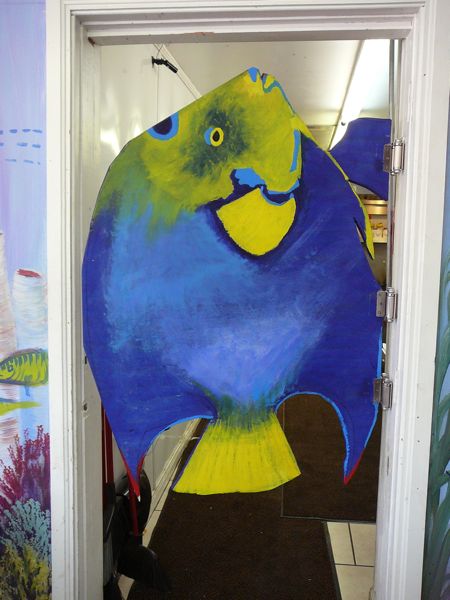
The last time we were there, they had added new doors to the kitchen. No, I wouldn’t want them in my house, but for a seafood restaurant? They are perfect, somebody went to a lot of trouble to make these doors.
“I was hoping you would want to go there,” AdventureMan admitted, and we grinned. There’s a reason we’ve been married this long; we take the road less travelled – together.
Here’s the truth – we were really headed to 5 Sisters, but when we got there and saw all the people lined up and waiting for tables, we thought “uh-uh, not for us” and headed on down the street. We’d wanted to try the new Nick’s Boathouse for a while, and this was the perfect opportunity.
We like the interior. It has different areas where you can sit, not one great big interior where everyone can see everyone. We like the privacy.
This is a view of the bar area:
The outside area looks like a great place to sit on a nicer day, breezy and covered, or to have a party or celebration of any kind.
I’m a sucker for seafood bisque, and Nick’s has a really good seafood bisque
AdventureMan says the gumbo is also awesone 🙂
The grilled chef salad was a total win for AdventureMan 🙂
And I adored the grilled salmon Ceasar
On such a day, having such a good time, we can’t resist dessert, the molten chocolate, LOL and sadly, we tucked right in, neglecting to photograph it first. This is all that remains. Yes, we would do it again. 🙂
Nick’s Boathouse | 455 W Main Street Pensacola FL | (850) 912-8775
Nick’s is relatively undiscovered, so far. It’s not the see-and-be-seen kind of place that other downtown places – The Fish House, Jackson’s Steak House, Jaco’s, Global Grill – have become. . . yet. As of now, it is still quiet and private with great service. Go now, go quickly, before it changes into a go-to place with a line outside!
AdventureMan and I have a soft spot for South Africa, not the least of which for the dramatic and radical way they transformed from apartheid government to democratic government. It is not to say South Africa has been without problems – there are still problems. But the manner in which they confronted and dealt with their past and then moved on allows change to happen, change in the heart.
Today’s meditation from Forward Day by Day:
FRIDAY, May 30
Psalm 85:3. You withdrew all your wrath; you turned from your hot anger. (NRSV)
But for the grace of God and the work of extraordinary leaders such as Nelson Mandela and Desmond Tutu, the fall of apartheid in South Africa could have been marked by one of the worst bloodbaths ever seen.
The incendiary ingredients were all present: a repressive minority regime that ruled by violence, fear, and fiat over a majority population denied fundamental human rights and forced to live a subservient existence.
There was upheaval, but the nation never fell into anarchy as it radically changed its government, thanks largely to the Truth and Reconciliation Commission.
Chaired by Tutu, then the Anglican Archbishop of Cape Town, the commission held hearings throughout the country. Victims told their stories of torture, killing, and degradation, sometimes confronting the accused.
The goal was not vengeance or justice but truth-telling to clear a path for healing. Powerful emotions were released. There were tearful confessions and apologies. There was forgiveness. The people of South Africa managed to turn from their hot anger and begin building a new nation.
Can we do the same? Where can we forsake our anger for the liberating power of forgiveness?
LONDON (AP) — Almost a third of the world is now fat, and no country has been able to curb obesity rates in the last three decades, according to a new global analysis.
Researchers found more than 2 billion people worldwide are now overweight or obese. The highest rates were in the Middle East and North Africa, where nearly 60 percent of men and 65 percent of women are heavy. The U.S. has about 13 percent of the world’s fat population, a greater percentage than any other country. China and India combined have about 15 percent.
“It’s pretty grim,” said Christopher Murray of the Institute for Health Metrics and Evaluation at the University of Washington, who led the study. He and colleagues reviewed more than 1,700 studies covering 188 countries from 1980 to 2013. “When we realized that not a single country has had a significant decline in obesity, that tells you how hard a challenge this is.”
Murray said there was a strong link between income and obesity; as people get richer, their waistlines also tend to start bulging. He said scientists have noticed accompanying spikes in diabetes and that rates of cancers linked to weight, like pancreatic cancer, are also rising.
The new report was paid for by the Bill & Melinda Gates Foundation and published online Thursday in the journal, Lancet.
Last week, the World Health Organization established a high-level commission tasked with ending childhood obesity.
“Our children are getting fatter,” Dr. Margaret Chan, WHO’s director-general, said bluntly during a speech at the agency’s annual meeting in Geneva. “Parts of the world are quite literally eating themselves to death.” Earlier this year, WHO said that no more than 5 percent of your daily calories should come from sugar.
“Modernization has not been good for health,” said Syed Shah, an obesity expert at United Arab Emirates University, who found obesity rates have jumped five times in the last 20 years even in a handful of remote Himalayan villages in Pakistan. His research was presented this week at a conference in Bulgaria. “Years ago, people had to walk for hours if they wanted to make a phone call,” he said. “Now everyone has a cellphone.”
Shah also said the villagers no longer have to rely on their own farms for food.
“There are roads for (companies) to bring in their processed foods and the people don’t have to slaughter their own animals for meat and oil,” he said. “No one knew about Coke and Pepsi 20 years ago. Now it’s everywhere.”
In Britain, the independent health watchdog issued new advice Wednesday recommending that heavy people be sent to free weight-loss classes to drop about 3 percent of their weight. It reasoned that losing just a few pounds improves health and is more realistic. About two in three adults in the U.K. are overweight, making it the fattest country in Western Europe.
“This is not something where you can just wake up one morning and say, ‘I am going to lose 10 pounds,'” said Mike Kelly, the agency’s public health director, in a statement. “It takes resolve and it takes encouragement.”
Pregnant Pakistani woman stoned to death by family
May 27th 2014 3:29PM
Pakistan
Mohammad Iqbal, right, husband of Farzana Parveen, 25, sits in an ambulance next to the body of his pregnant wife who was stoned to death by her own family, in Lahore, Pakistan, Tuesday, May 27, 2014. Nearly 20 members of the woman’s family, including her father and brothers, attacked her and her husband with batons and bricks in broad daylight before a crowd of onlookers in front of the high court of Lahore, police investigator Rana Mujahid said. (AP Photo/K.M. Chaudary)
LAHORE, Pakistan (AP) – A pregnant woman was stoned to death Tuesday by her own family outside a courthouse in the Pakistani city of Lahore for marrying the man she loved.
The woman was killed while on her way to court to contest an abduction case her family had filed against her husband. Her father was promptly arrested on murder charges, police investigator Rana Mujahid said, adding that police were working to apprehend all those who participated in this “heinous crime.”
Arranged marriages are the norm among conservative Pakistanis, and hundreds of women are murdered every year in so-called honor killings carried out by husbands or relatives as a punishment for alleged adultery or other illicit sexual behavior.
Stonings in public settings, however, are extremely rare. Tuesday’s attack took place in front of a crowd of onlookers in broad daylight. The courthouse is located on a main downtown thoroughfare.
A police officer, Naseem Butt, identified the slain woman as Farzana Parveen, 25, and said she had married Mohammad Iqbal, 45, against her family’s wishes after being engaged to him for years.
Her father, Mohammad Azeem, had filed an abduction case against Iqbal, which the couple was contesting, said her lawyer, Mustafa Kharal. He said she was three months pregnant.
Nearly 20 members of Parveen’s extended family, including her father and brothers, had waited outside the building that houses the high court of Lahore. As the couple walked up to the main gate, the relatives fired shots in the air and tried to snatch her from Iqbal, her lawyer said.
When she resisted, her father, brothers and other relatives started beating her, eventually pelting her with bricks from a nearby construction site, according to Mujahid and Iqbal, the slain woman’s husband.
Iqbal said he started seeing Parveen after the death of his first wife, with whom he had five children.
“We were in love,” he told The Associated Press. He alleged that the woman’s family wanted to fleece money from him before marrying her off.
“I simply took her to court and registered a marriage,” infuriating the family, he said.
Parveen’s father surrendered after the attack and called his daughter’s murder an “honor killing,” Butt said.
“I killed my daughter as she had insulted all of our family by marrying a man without our consent, and I have no regret over it,” Mujahid, the police investigator, quoted the father as saying.
Mujahid said the woman’s body was handed over to her husband for burial.
The Human Rights Commission of Pakistan, a private group, said in a report last month that some 869 women were murdered in honor killings in 2013.
But even Pakistanis who have tracked violence against women expressed shock at the brutal and public nature of Tuesday’s slaying.
“I have not heard of any such case in which a woman was stoned to death, and the most shameful and worrying thing is that this woman was killed outside a courthouse,” said Zia Awan, a prominent lawyer and human rights activist.
He said Pakistanis who commit violence against women are often acquitted or handed light sentences because of poor police work and faulty prosecutions.
“Either the family does not pursue such cases or police don’t properly investigate. As a result, the courts either award light sentences to the attackers, or they are acquitted,” he said.
TEHRAN: The arrest of six Iranian youths for dancing to US singer Pharrell Williams’ hit “Happy” in a video that went viral highlights the rift between conservatives and youths fascinated by the West. Recorded on a smartphone and uploaded multiple times on YouTube, the clip shows three girls dancing and singing along to the song in a room, on rooftops and in secluded alleys with three young men. For the youths, the homemade video now watched one million times was merely an “excuse to be happy”, but for the Iranian authorities it was “vulgar” breach of the Islamic republic’s values. Originally posted online in April, the clip gradually spread online before it led to the arrest of the dancers and their director on Tuesday for having “hurt” the country’s strict moral codes, according to Tehran police chief Hossein Sajedinia.
The youths appeared on state television repenting for appearing in the clip, after the girls failed to properly observe hijab, a series of rules that oblige women in Iran to cover their hair and much of their body when outside.
Their arrest sparked international fury and criticism in the media and online, with many Iranians expressing shock and some observers questioning whether it was a “crime to be happy in Iran”. Supporting the young Iranians, Williams himself chimed in and hit out at their treatment, saying on Twitter and Facebook: “It’s beyond sad these kids were arrested for trying to spread happiness.” Reports emerged Wednesday night that the dancers were released on bail, with one of the arrested girls, Tehranbased fashion photographer Reihane Taravati, saying on Instagram: “Hi I’m back.” The arrests came after President Hassan Rouhani-a selfdeclared moderate who claims to be for more social freedomsreiterated in a weekend speech his calls for a relaxation of Internet censorship. Rouhani’s statements have irked the conservatives, who have long imposed limitations on the Internet, blocking millions of websites particularly social media platforms, including Facebook and Twitter, as well as YouTube. — AFP
She is also charged with adultery, for marrying a Christian man and (gasp) having sex with him. Now pregnant with her second child, Mariam claims she has never been a Muslim, was raised Christian, but the judge is applying new and strict Sharia laws.
International outrage grows for Sudanese woman sentenced to death for apostasy
Published May 16, 2014FoxNews.com
Meriam Ibrahim and Daniel Wani married in a formal church ceremony in 2011. The couple has an 18-month-old son, Martin, who is with Meriam in jail.
International outrage is mounting over the death sentence a Sudanese judge ordered for the pregnant wife of an American citizen — all because she refuses to renounce her Christian faith.
Meriam Ibrahim, 26, was sentenced Thursday after being convicted of apostasy. The court in Khartoum ruled that Ibrahim must give birth and nurse her baby before being executed, but must receive 100 lashes immediately after having her baby for adultery — for having relations with her Christian husband. Ibrahim, a physician and the daughter of a Christian mother and a Muslim father who abandoned the family as a child, could have spared herself death by hanging simply by renouncing her faith.
“We gave you three days to recant but you insist on not returning to Islam,” Judge Abbas Khalifa told Ibrahim, according to AFP. “I sentence you to be hanged to death.”
But Ibrahim held firm to her beliefs.
“I was never a Muslim,” she answered. “I was raised a Christian from the start.”
Ibrahim was raised in the Christian faith by her mother, an Orthodox Christian from Ethiopia. She is married to Daniel Wani, a Christian from southern Sudan who has U.S. citizenship, according to sources who spoke on condition of anonymity.
“I was never a Muslim. I was raised a Christian from the start.”
– Meriam Ibrahim
The cruel sentence drew condemnation from Amnesty International, the U.S. State Department and U.S. lawmakers.
“The refusal of the government of Sudan to allow religious freedom was one of the reasons for Sudan’s long civil war,” Rep. Chris Smith, R-N.J., chairman of the House congressional panel that oversees U.S. policy in Africa, said in a statement. “The U.S. and the rest of the international community must demand Sudan reverse this sentence immediately.”
Amnesty International called the sentence a “flagrant breach” of international human rights law and the U.S. State Department said it was “deeply disturbed” by the ruling, which will be appealed.
Khalifa refused to hear key testimony and ignored Sudan’s constitutional provisions on freedom of worship and equality among citizens, according to Ibrahim’s attorney Al-Shareef Ali al-Shareef Mohammed.
“The judge has exceeded his mandate when he ruled that Meriam’s marriage was void because her husband was out of her faith,” Mohammed told The Associated Press. “He was thinking more of Islamic Shariah laws than of the country’s laws and its constitution.”
Ibrahim and Wani married in a formal ceremony in 2011 and have an 18-month-old son, Martin, who is with her in jail. The couple operate several businesses, including a farm, south of Khartoum, the country’s capital. Wani fled to the United States as a child to escape the civil war in southern Sudan, but later returned. He is not permitted to have custody of the little boy, because the boy is considered Muslim and cannot be raised by a Christian man.
Sudan’s penal code criminalizes the conversion of Muslims into other religions, which is punishable by death. Muslim women in Sudan are further prohibited from marrying non-Muslims, although Muslim men are permitted to marry outside their faith. Children, by law, must follow their father’s religion.
Islamic Shariah laws were introduced in Sudan in the early 1980s under the rule of autocrat Jaafar Nimeiri, whose decision led to the resumption of an insurgency in the mostly animist and Christian south of Sudan. An earlier round of civil war lasted 17 years, ending in 1972. In 2011, the south seceded to become the world’s newest nation, South Sudan.
Sudanese President Omar Bashir, an Islamist who seized power during a 1989 military coup, said his county will implement Islam more strictly now that the non-Muslim south is gone. A number of Sudanese have been convicted of apostasy in recent years, but they have all escaped execution by recanting their faith. Religious thinker and politican Mahmoud Mohammed Taha — a vocal critic of Nimeiri — was sentenced to death after his conviction of apostasy and was executed at the age of 76 in 1985.
Ibrahim’s case first came to the attention of authorities in August, when members of her father’s family complained that she was born a Muslim but married a Christian man. They claimed her birth name was “Afdal” before she changed it to Meriam. The document produced by relatives to indicate she was given a Muslim name at birth was a fake, Mohammed said.
Ibrahim refused to answer the judge when he referred to her as “Afdal” during Thursday’s hearing.
Ibrahim was initially charged with having illegitimate sex last year, but she remained free pending trial. She was later charged with apostasy and jailed in February after she declared in court that Christianity was the only religion she knew.
The US-based Center for Inquiry is demanding that all charges against Ibrahim be dropped, saying the death sentence is a clear violation of the International Covenant on Civil and Political Rights, which forbids persecution or coercion of religious beliefs and the right to marry.
“Religious belief must never be coerced and free expression must never be punished, through threat of imprisonment, violence, or any other means,” the group wrote in a letter to Sudan’s UN ambassador, H.E. Hassan Hamid Hassan. “This cannot go unanswered, and the world will not stand for it.”
Fox News’ Joshua Rhett Miller and The Associated Press contributed to this report.


















 Here There and Everywhere