“Heavyweight Saudi Arabia” Influence Counters “Over-Stepping” Qatar?
From the Kuwait Times, a fascinating comparative analysis of the influence of Saudi Arabia and Qatar on Islamic countries in transitions:
Qatar losing ground to Saudi diplomacy

DUBAI: Qatar, a key supporter of Islamists who rose to power in Arab Spring countries, is losing ground in regional politics to Saudi Arabia which appears to have seized the reins on key issues, notably Egypt and Syria. The decline in Qatar’s regional diplomacy comes as its powerful emir Sheikh Hamad bin Khalifa Al-Thani unexpectedly abdicated in favor of his son Tamim last month.
The wealthy Gulf state had transformed itself into a key regional player but began to retreat as heavyweight Saudi Arabia re-entered the political arena after lagging behind in the immediate period following the eruption of the Arab Spring uprisings in December 2010. The ouster of Egypt’s Islamist president Mohamed Morsi last week by the army and the election by the Syrian opposition of Saudi-linked Ahmad Assi Jarba as new leader stripped Qatar of strong influence in both countries.
“Qatar had tried to take a leading role in the region but overstepped its limits by openly backing the Muslim Brotherhood in Egypt, Syria, and other Arab Spring states,” said Kuwaiti political analyst Ayed Al-Manna. Jonathan Eyal, head of international relations at Britain’s Royal United Services Institute, argued that Qatar’s regional politics have failed.
“Qatar’s Middle Eastern diplomacy now lies in ruins: it failed to produce dividends in Libya, backfired in Syria and has now collapsed in Egypt,” local Emirati daily The National quoted him on Tuesday as saying. Realizing the damaging effects of their policies, Manna noted, “the Qataris sought to cut down on their commitments” which were already affected by the emir’s abdication and the sidelining of the influential prime minister Sheikh Hamad Bin Jabr Al-Thani.
As a result, “Saudi Arabia, a historical regional US ally, regained its role” in coordination with other oil-rich Gulf monarchies, said Manna. Saudi Arabia’s King Abdullah was the first foreign head of state to congratulate Egypt’s interim president Adly Mansour, hours after he was named to replace Morsi. And on Tuesday, the kingdom pledged $5 billion in assistance to Egypt. The United Arab Emirates, which has cracked down on the Muslim Brotherhood in the past few months, offered Egypt an aid package of $3 billion.
“Saudi Arabia wants to ensure stability in Arab Spring countries, regardless of its ideological interests,” said analyst Abdel Aziz Al-Sagr, head of the Gulf Research Centre. “It had supported the Muslim Brotherhood in Egypt but reconsidered this support after the Brotherhood failed to run the country wisely,” he argued. But the Saudi researcher downplayed the rivalry between Saudi Arabia and Qatar, both of which have been looking to expand their influence during the Arab Spring uprisings and prevent any potential revolt against their own autocratic regimes.
“The Saudi-Qatari harmony still exists and there is no battle for influence between the two countries,” said Sager. And as proof, “Riyadh was the first to be informed of the political change in Qatar, six months before it took place. And it welcomed it.” But the two countries, whose relations have been historically tense or at least marked by mistrust, support two different approaches of political Islam that emerged strongly in the wake of the Arab Spring.
Qatar sides with political parties linked to the Muslim Brotherhood, whose experience was cut short despite the strong media support they enjoyed from the influential Doha-based Al-Jazeera news channel. Meanwhile, Saudi Arabia promotes Salafist groups that focus less on politics and more on implementing Shariah Islamic law on daily life matters such as forcing women to wear a veil and prohibiting the mixing between sexes. Saudi King Abdullah has reiterated his country’s stance against using Islam for political purposes.
“Islam rejects divisions in the name of one party or another,” he said in a statement marking the start Wednesday of the Muslim holy month of Ramadan. The kingdom will never accept” the presence of political parties, that “only lead to conflict and failure.” But regardless of the political agendas of Saudi Arabia or Qatar, the people who rose up during the Arab Spring revolts will have the final word on their own political futures, argued former Bahraini cabinet minister Ali Fakhro. “It is the Arab people, not Qatar nor Saudi Arabia, who will determine the political future of the region.” – AFP
The Hot Spot BBQ in Pensacola
“Have we seen that place before?” AdventureMan asked as we headed down 9th Avenue en route to the beach.
“I think it’s new!” I responded.

The next day was his day to choose where we would go for lunch, and without hesitation, he said “that new place over on 9th.”
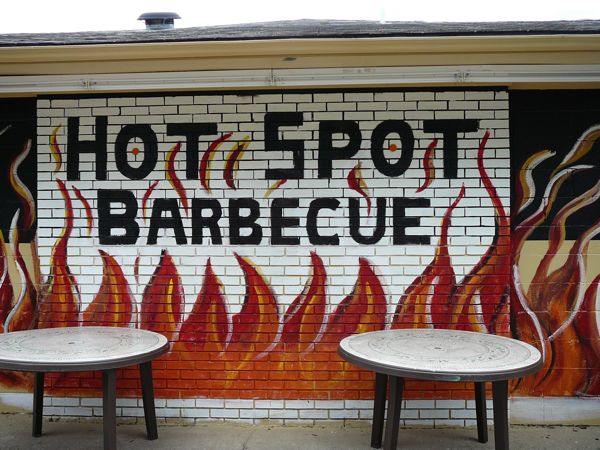

When we got there, we discovered that while the Hot Spot may be news to us, it was well discovered by others – we got the last table. It’s a family owned place, they make their own sauces, smoke their own meats – just the kind of place we like to find and support.
I had the chicken sandwich, AdventureMan had the pulled pork. We split a piece of that homemade lemon pie. The service was great, so attentive that I could not discretely take any photographs of the food. Prices are reasonable.
Get to the Hot Spot early if you want a table! They are at 901 East LaRua; you can go south on 9th off of Cervantes to get there easily.
Florida Man Shot in Case of Mistaken Identity
U.S. News
Suspect denied bond in I-4 shooting death in Florida
-
Published: July 2, 2013 at 9:32 PM
TAMPA, Fla., July 2 (UPI) — The suspect in the Interstate 4 shooting death in Florida was denied bail Tuesday and authorities now say it’s a case of mistaken identity, not road rage.
Jerome Edward Hayes will have another bail hearing next week, WFTS-TV, Tampa, reported.
Hayes is charged with first-degree murder in the slaying of Fred Turner, 47, Saturday. He turned himself in Monday.
His attorney described Hayes as a “soft-spoken, nice guy.”
“You take a look at him, you talk to him, he does not seem like the kind of person that could possibly commit this kind of crime,” Nick Matassini Jr. said.
The TV station said police have obtained the gun and car involved in the shooting. Investigators say Turner was in the wrong place at the wrong time.
“The victim was mistaken for an individual who was involved in an altercation with the suspect’s friend inside the Gold Club,” Col. Donna Lusczynski said.
Hayes and a friend allegedly were in a fight at the strip club and waited outside for their opponent. But they mistakenly followed the wrong person, who had been in an adjacent business.
“Mr. Turner was followed from the location by the suspect to the interstate, where he was shot several times,” Lusczynski said.
Turner was on the phone with a 911 operator, telling the dispatcher he was being followed and had not done anything to precipitate a confrontation when he was shot, she said.
“It’s Just Like Living in Alaska, Mom . . . or Kuwait . . . “

My Mom was concerned; the temperatures are approaching 90°F in Seattle, and most of Seattle does not bother with air conditioning. At night, the temperatures go down into the fifties, cooling everything off, but the day time highs can be more than a little uncomfortable.
“How do you manage?” she asks. “I see the temperatures in (nearby) Mobile are in the 90’s almost every day.”
“It’s not that hard; it’s like living in Alaska – or Kuwait,” I tell her. “When it gets cold in Alaska, you dress warmly, you turn on the heat, you stay inside, and when you need to go out, you get into your car in the heated garage, go in your heated car to a heated store, and you come back home. You don’t spend a lot of time outside.”
I do pretty much the same thing I did in Qatar and Kuwait. I get up and do my devotional readings, and on some days I go to my aqua-aerobics class. on other mornings I volunteer. If I need something, I stop at a store on the way home. Sometimes, I clean house, or do laundry. We often go out for lunch, from the air conditioned car to the air conditioned restaurant and back 🙂 In the afternoons, I quilt or I read, or I quilt and I read.
AdventureMan grew up in the South, he is comfortable with the heat and the humidity. He works out in his gardens; once the temperatures go over 80° I rarely even visit the gardens, maybe when October comes and the temperatures drop. Yesterday morning I looked out as the sun was rising over the gardens and all I could see was swarms of insects rising. I don’t think they were mosquitoes, they looked like little no-see-up kind of things, all speeding around in the rising sun. I don’t do insects, the same way I really don’t do heat and humidity.
The Qatari Cat loves the heat. Part of his daily routine is to eat, then to go into the garage and sleep on one of the cars. It’s like an oven in the garage; it must remind him of living on the streets of Qatar when he was just a tiny thing. He is no longer a tiny thing. When we have international guests over for dinner, they always ask to take photos of him; he has grown to be a very long, tall cat, kingly but gracious.
Yesterday morning, as I headed out, there was a hint of – well, it was not coolness, but it was just not blasting me with heat. It was a respite from the relentless heat. I don’t begin to think it was a hint of winter to come; the summer torment has really just begun and is unlikely to end before late October, but I treasure even a hint of “not a blast of heat.”
AdventureMan asks me if I miss Seattle. Not so much, really, traffic has gotten so bad there, but I miss the climate. I feel energized by the cool mornings, even rain doesn’t bother me. I love the sound of the wind whistling around, I love taking a walk along the waterfront after lunch or dinner. I don’t find it at all surprising that diabetes is associated highly with countries with hot climates; heat makes you lethargic, inactive, all the things that encourage sloth.
Torrential rains are forecasted for this 4th of July weekend; in Pensacola there is a possibility they will diminish just in time for the fireworks. Hmmm. Heat. Humidity. Mosquitoes . . . I love fireworks . . . weighing my options 🙂
Jeannette Walls and The Silver Star and Negligent Mothers

The first time I read anything by Jeannette Walls, I had not read her autobiographical best-seller, The Glass Castle. If I had, when I read the opening pages of one of my all-time-favorite books, Half Broke Horses , three young children out checking on the cows in America of the mid-1800’s, I would have said “Oh, yes, this is Jeannette Walls” instead of being so shocked that these three children were so far from home with a storm approaching. Not only does the storm approach – the oldest sister pushes her younger sister and brother up a tree and they are stuck there through a violent storm all night. No adult comes looking for them.
“Where is their mother?” in shock I thought, “a mother with three children out in the storm goes looking for them!”
Not if you are a Jeannette Walls mother. To ‘get’ Jeannette Walls, you really have to start with The Glass Castle, and learn about how she and her siblings are at the mercy of an alcoholic mother and father, both big liars, maybe with some attendant mental problems. Half Broke Horses is fiction, based on her own grandmother, who, at 15 rides 28 days across Indian territory to teach at a far-away school (What mother lets her 15 year old DAUGHTER ride for a month across dangerous country ALONE??)
I was on the send-as-soon-as-it’s-published list for Silver Star. And even once it arrived, I waited until I knew I might have a few free hours in the evening to read it – once you start Jeannette Walls, you can’t put it down. Her heroines in this novel are 15 year old Liz and 12 year old Bean (Jean) whose mother ran away from her hometown in Virginia to pursue a career in music. The mother has a small inheritance to sustain them; when life sours, as it often does for her, she packs the girls into her worn Dodge Dart and takes off. She isn’t always good about paying her bills. She talks to her girls about what a great team they are, and then takes off for a day or two, usually with some man, leaving them to eat chicken pot pies. Then, she abandons them with no sign of when she will be back.
The girls are pistols. They are survivors, much like Jeannette Walls grandmother in Half Broke Horses. When social services start coming around asking where their mother is, they take off headed for their Mom’s old home town, across the continent, in Virginia.
The heart of the story finds the girls living in the old family mansion, scouting for odd jobs, learning more about themselves and their heritage, and learning how a small community can smother, judge and support their community members in unexpected ways.
If you are a negligent, man-oriented, self-absorbed mother, you don’t want to have a writer for a daughter. Jeannette Walls is having a ball; her books are both sad and hilarious, and she has utter scorn for mothers who do not take the reins of motherhood and behave like grown-ups.
Language of Flowers by Vanessa Diffenbaugh

I didn’t expect to like this book as much as I did; from the first chapter I was hooked, so hooked I didn’t want to go to water aerobics of go to sleep until I had finished it. The title sounds girly and romantic, big yawn, but the book is anything but. The book is tough, and edgy, and tackles the foster care system without using sexual assault or out-of-the-ordinarily-cruel foster parents to bludgeon the point. She botches her one great chance at happiness when she sabotages her adoption by Elizabeth, who loves her dearly. The system can even be caring, but the effect of warehousing unwanted and neglected children damages their ability to trust, and to form relationships. We watch her as a child, self-destructive, angry, undermining her own chances of happiness.
Victoria even has a girly name to go with the title, but she is tough, and self-reliant, and very, very vulnerable, in spite of her toughness. Aging out of the system, she emerges a waif, with a hunger that stems more from emotional needs than physical.
She is greatly blessed to cross paths with people who look at her and truly see her, see her possibilities and her vulnerabilities, people who are willing to work with her, even to love her patiently, in spite of her prickliness and tendency to push people away. One of these is a florist, Renate, who recognizes in Victoria a gift for floral arrangement and is willing to work around her eccentricities. She gives Victoria a part-time job, in which Victoria flourishes.
In her emotional life, however, Victoria still has a lot of unresolved issues, stemming back to the very beginning when she was given up by a mother who, for whatever reason, didn’t want her. While she is hungry for love, she fears it as much as she wants it. Relationships overwhelm her. She abandons the love of her life, and then has to live with the consequences.
Watching her resolve her issues is cliff-hanging. You can’t stop reading. It’s not like watching a train-wreck; you know this girl has inner resources she has not yet tapped; you can read it in the loving evaluation of those who surround her. Every page of the way you are rooting for her to succeed.
Police Know Where We Are and Where We Go
This is not good news for people who don’t want other people knowing where they have been. I don’t see how it’s any different from cameras in big cities that are used by the police to see what cars went through at a time of a crime, for example. If you don’t have anything to hide, is this invasive? Where property crimes are increasing, where there is an increase in violent crime or assaults, these re tools to keep the majority of the population safer from the predators – in my opinion. Can you change my mind?

From AOL Auto News:
Police License Plate Scanners Record Driver’s Locations
Unregulated cameras store information indefinitely
Government surveillance isn’t just in our phone records and search engine history, but on our roads as well.
That’s what the Center For Investigative Reporting found when researching the small cameras popping up on police cars across the country known as license plate scanners. License plate scanners allow police officers to quickly scan thousands of license plates a day, looking for runaway criminals or stolen cars. In California there are very few limits on these readers and almost no transparency. These cameras record time and place of your vehicle, and even can store a picture record of your whereabouts.
Michael Katz-Lacabe, a security consultant, requested the records from the San Leandro, Calif., police department of every time his car was scanned. He was amazed at the frightening amount of information police had recorded. His two cars were scanned 112 times since 2009, and average of about twice a week. There was even a picture of him and his two daughters getting out of his Toyota Prius in their driveway.
The Center For Investigative Reporting points out that the use of license plate scanners has been growing quickly and quietly across the country. Read their fascinating story here to learn more.
Arabs wary of expressing their opinions online
Fascinating study results published in Qatar’s Gulf Times:

Northwestern University in Qatar has released new findings from an eight-nation survey indicating many people in the Arab world do not feel safe expressing political opinions online despite sweeping changes in the aftermath of the Arab Spring.
From over 10,000 people surveyed in Lebanon, Tunisia, Egypt, Saudi Arabia, Bahrain, Qatar, Jordan and the UAE, 44% expressed some doubt as to whether people should be free to criticise governments or powerful institutions online.
Over a third of Internet users surveyed said they worry about governments checking what they do online.
According to the report, “The implied concern (of governments checking what they do online) is fairly consistent in almost all countries covered, but more acute in Saudi Arabia, where the majority (53%) of those surveyed expressed this concern.”
The study – titled ‘Media Use in the Middle East – An Eight-Nation Survey’ – was undertaken by researchers at NU-Q to better understand how people in the region use the Internet and other media. It comes as the university moves towards a more formalised research agenda and is the first in what will be a series of reports relating to Internet use.
The survey includes a specific chapter on Qatar, the only country where those surveyed regarded the Internet as a more important source of news than television. “We took an especially close look at media use in the State of Qatar – a country with one of the highest Internet penetration rates in the Arab world—and internationally,” said NU-Q dean and CEO Everette Dennis.
These findings follow a preliminary report NU-Q released last April that showed web users in the Middle East support the freedom to express opinions online, but they also believe the Internet should be more tightly regulated. “While this may seem a puzzling paradox, it has not been uncommon for people the world over to support freedom in the abstract but less so in practice,” Dennis explained.
Among other findings, the research shows: 45% of people think public officials will care more about what they think and 48% believe they can have more influence by using the Internet.
Adults in Lebanon (75%) and Tunisia (63%) are the most pessimistic about the direction of their countries and feel they are on the ‘wrong track.’
Respondents were far more likely to agree (61%) than disagree (14%) that the quality of news reporting in the Arab world has improved in the past two years, however less than half think overall that the news sources in their countries are credible.
Online transactions are rare in the Middle East, with only 35% purchasing items online and only 16% investing online.
The complete set of results from the survey is available online at menamediasurvey.northwestern.edu. The new interactive pages hosting the survey on the website have features that allow users to make comparisons between different countries, as well as between different demographics within each country.
Dennis confirmed that the research report is the first in an annual series of reports produced in collaboration with the World Internet Project; one of the world’s most extensive studies on the Internet, in which NU-Q is a participating institution.
NU-Q and WIP signed an agreement earlier in the year, providing a global platform for the current research.
Recent Comments
ExpatAlien on What Country am I Living … intlxpatr on Yellowstone: Old Faithful to C… Michelle on Yellowstone: Old Faithful to C… Cathy on No Grown-Ups in Charge intlxpatr on Waiting for Snow Wikipedia Donate Button

Amazina


Early Voting in Florida


 Here There and Everywhere