First Full Day at Chongwe River Camp
Have you ever thought you might like to be a safari guide in Africa? It sounds so romantic, doesn’t it? What a great life, you take people on drives a couple times a day, tell them about the wildlife, eat meals with them, it’s all fun . . . right?
These guides work hard. First, in order to qualify as a guide, you have to take – and pass – a national exam, an exam in three parts. If you don’t pass any one section, you have to take it again. You have to know the common name for animals, birds, trees, bushes and flowers, and you also have to know the Latin names.
If you are a guide, people will ask you the craziest questions, and expect you to answer. If someone gets sick on the drive, you have to know basic First Aid. If something goes wrong with the car, as a guide, it is your responsibility to fix it, or to get the people you are responsible for back to camp.
If you are a guide, you can go back to where the leopard ALWAYS hangs out, or to where another guide spotted mating lions, and today, with your guests, they won’t be there, and you won’t see any sign of them. If you show them two prides of lion, they will be elated until they hear that the other guests saw mating leopard, and they will be mad at YOU, the guide, because they didn’t see them. If the day is too hot or too cold, you have to find a way to make your guests comfortable.
At the end of a long day driving and trying to make people happy, you have to sit with the same people at dinner, making polite conversation, answering their questions, and you’d be surprised how often it is the same question.
We really admire the guides. They work hard. They can make or break a guest’s perception of a camp. It’s hard work.
Our guide at Chongwe River Camp, Victor, knocks himself out. Although we didn’t show up until after four the day we arrived, he had us out on the river by five 🙂
Early the next morning, we have a campfire by the river, with a pot of porridge, home made hot muffins and a glorious sunrise:

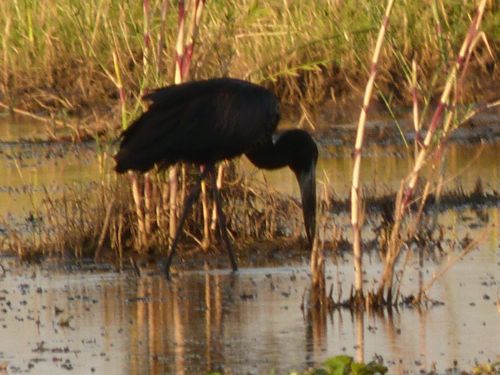
We head out on a game drive, passing the waterbuck once again, and spot a stork fishing for his breakfast:
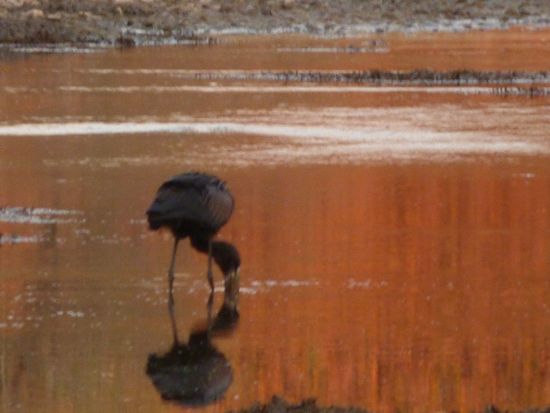
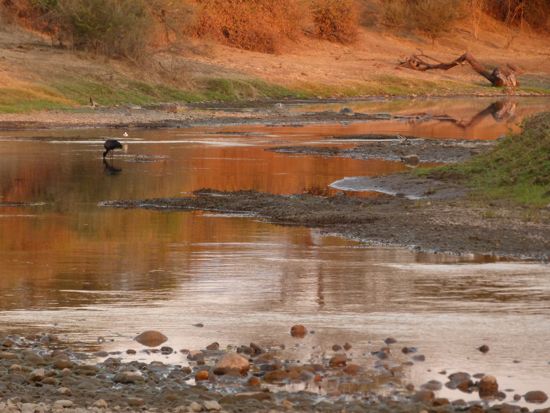
The morning light is achingly beautiful; we can’t stop taking pictures:
Victor is leaning over the side of the car; that is always good news. He’s spotted a lion print:

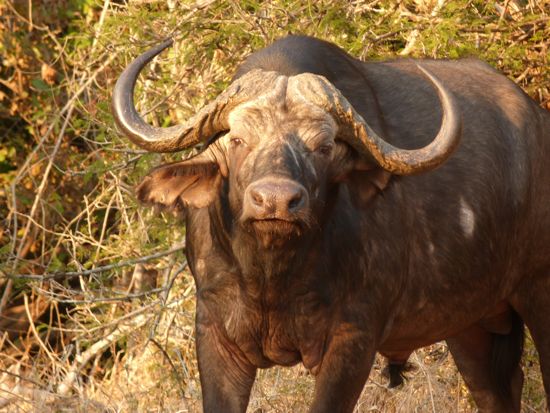
The Cape Buffalo are still sleepy and a little slow, so we get some good photos:
We get to the entrance to the Lower Zambezi National Park:

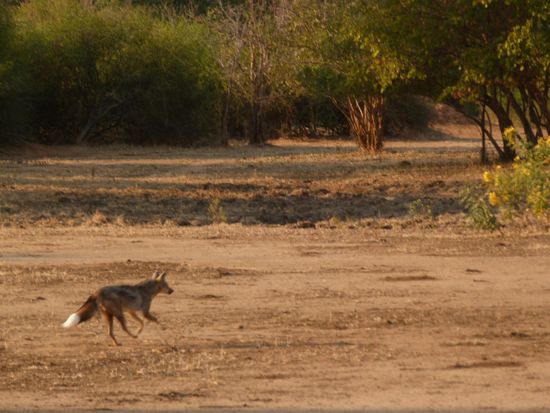
And we see a jackal! The only other jackal we saw as at the salt pan, and that at a distance!
We are driving around looking for lion when suddenly Victor stops the car and backs up. There, on the grass, under a tree, is a leopard, just waiting for us!

Now here’s the thing – I probably took about fifty shots of this leopard, but I am not happy, and this is normal for trying to shoot leopard, or lion – many times they are in grass. Sometimes it can confuse your camera, you think you are shooting the leopard, but your camera focused on the shoot of grass just in front. Or you think you’ve taken the perfect shot, and there is this leaf, or grass, just marring the perfection of your shot. Or the leopard is facing away from you. Or the leopard is walking into the brush! Oh no!

This nice little female leopard put up with us for about half an hour, then leisurely walked away, all of us still snapping, snapping, snapping . . .
I love this elephant, I love this elephant’s ear. We’ve taken a lot of elephant photos, but I really love this elephant:
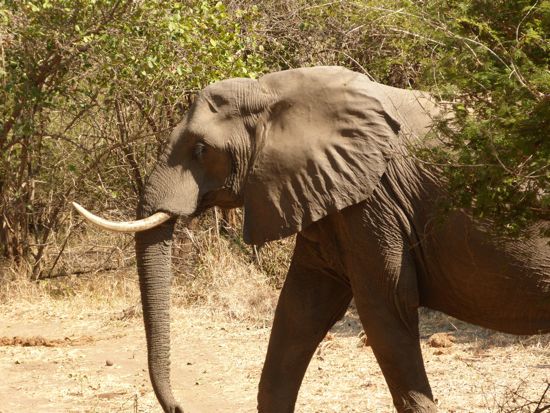
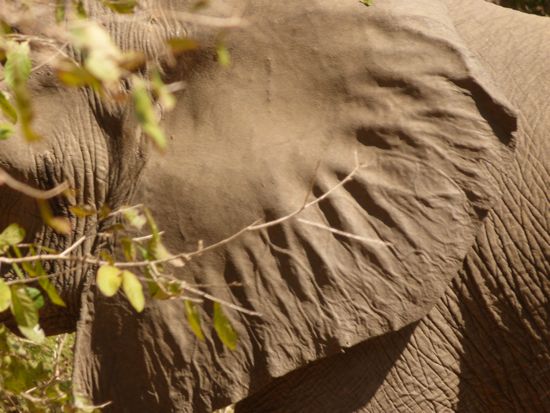
We can’t believe what a wonderful morning we are having, and just as we are feeling life can’t get much better, Victor spots two young lions. He says they are part of a larger group, but the larger lions have gone off hunting and these have been left tagging behind:


Just after the young lions have wandered off stage, we see this big boy coming down the road, and he is terrifying. He has one thought on his mind, find that lady elephant, and we do NOT want to get in his way:

I know, I know, this is a family blog . . .
It’s been quite a morning, and we head back to camp, but we are all too excited to sleep after lunch. I intended to wash my hair, but there is a cold breeze blowing in off the river, and our wonderful open air shower is just a little too shivery for me today.
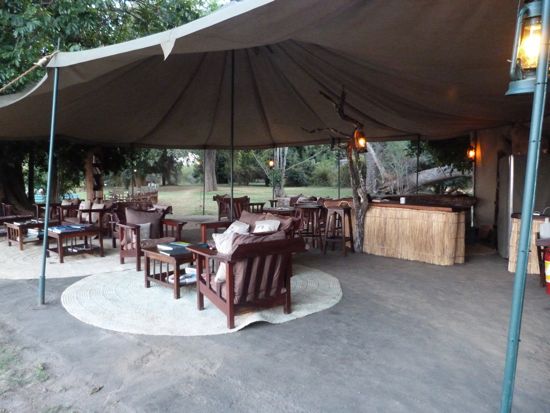
We take a walk into the main camp – here is the main camp lounge:

And the dining table overlooking the Chongwe River:

And overlooking a huge pod of sunning hippo:

We run into Chris, one of the Chongwe River Camp owners, with whom we flew from Lusaka to Royal, the airstrip for Chongwe River camp. He talked about the new direct flight from Dubai to Lusaka and how he wants to market to expats in Dubai, Qatar, Kuwait, etc. to get them to come down to Chongwe for their holidays. We tell him we did most of our Africa travel from Kuwait and Qatar, that it was a piece of cake with a time zone change of only an hour, not 8 hours, and travel time usually just overnight, and the price is a lot cheaper from there, too. It’s a great trip out of the Middle East, and we think he has the right idea, to market the camp to expats and locals there.
After tea, we head back out on the river, three of us, while one goes fishing. What we love about Chongwe is that there are so many things to do, and so much fun!

Victor finds a spot near the White Fronted Bee Eaters for sundowners, and we meet up with the fishermen, who, alas, did not catch anything:


Back at the AlBida Suite (the Family Suite) Steve-the-Butler has laid out a beautiful campfire to welcome us back.

It has been a perfect day. Victor joins us for an early dinner, and as we finish up a chilly breeze starts blowing and we all say goodnight, knowing morning will be coming early once again.

Hilary Mantel: Wolf Hall & Bring Up the Bodies


While it is unusual for me to comment on two books at the same time, Bring Up the Bodies follows so seamlessly the preceding book, Wolf Hall, as to be one book. It is also unusual that I would choose to read a book about Thomas Cromwell, whose great-grandson brings into dictionaries the adjective Cromwellian, and whose morals and values drift so far from my own. Most unusual of all is that I would find myself liking – and understanding – Thomas Cromwell as described and defined by Hilary Mantel.
While reading, if forced away from the book, I couldn’t wait to get back to it. I felt totally immersed in the 1500’s, I felt like I was there. Hilary Mantel uses the senses to bring an immediacy to the story that makes you feel you are there, participating, perhaps one of Cromwell’s clerks.
Thomas Cromwell has a rough beginning, son of a blacksmith and sometimes moonshiner, often beaten to within an inch of his life by his father, Walter, who seems to hate him. He leaves home and the next few years of his life are murky – he fights for the French, he becomes a servant and later a clerk in a high ranking Italian household, he learns the wool trade, and the silk trade, he spends some years in Antwerp and then he finds himself as chief clerk and messenger to Cardinal Wolsey, advisor to Henry VIII.
We experience losing our loved one to the plague. In these two books, through Cromwell’s eyes, we watch that spoiled, self-centered King Henry VIII rationalize his divorce of Katherine, and then the beheading of Anne Boleyn.
Here is something I hate about Thomas Cromwell, no matter how human and humane and lovable Hilary Mantel made him, that his primary value throughout was that whatever Henry wanted, he would work to make it so.
We learn early in Wolf Hall how very dangerous it is to go up against King Henry, we watch Cardinal Wolsey stripped of his honors, his luxuries, humiliated and defeated. We see Thomas More badgered to execution. So we can understand, a little, Thomas Cromwell’s motivation to keep his hard-earned money, honors, position, etc.
What I don’t understand is how a really, very smart man like Cromwell doesn’t see that he needs to be hiding his wealth away, investing in places where Henry can never find it, so that he can leave the King’s service, withdraw from public life and from the dangers that go with it. By the end of Bring Up the Bodies, Cromwell has made a lot of enemies. Such a nice man, such a benign man, but he relentlessly prosecutes the four men who may – or may not – have slept with Queen Anne Boleyn. It’s what the king wants. He does it.
This is a protrait of Thomas Cromwell painted by the famous Hans Holbein:

Wolf Hall won the Man Booker Prize in 2009. Bring Up the Bodies is sometimes referred to as Wolf Hall #2. These are books you can’t stop thinking about, and I am hoping there will be one more.
Another Broken Egg in Pensacola
AdventureMan and I often discuss why one restaurant succeeds and another fails. One restaurant with a high quality food was very successful, moved to a larger location, and soon after a popular Chinese buffet moved in close by and now, he complains the competition is killing him.
These are killing times, highly competitive times, when people have less money to spend on eating out. While we prefer non-chain, local owned places which prepare their own food, many of the success stories are parts of chains where they can maximize standardization and gain benefits from ordering supplies in large quantities.
Another Broken Egg is somewhere in between. It is part of a chain, but a very small, very high quality and successful local chain. The Pensacola owners visited a Broken Egg in Destin multiple times, loved its product, and decided to bring the chain to Pensacola.
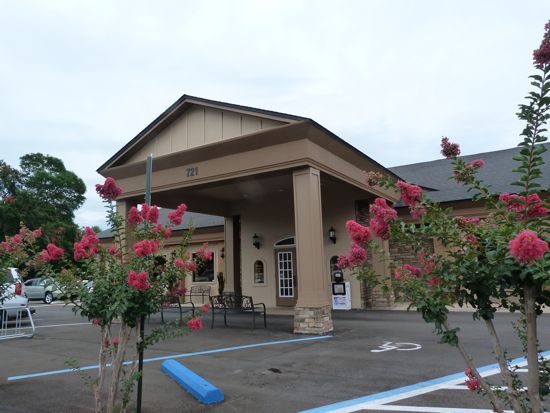
We’re glad they did. First, they serve a really, noticeably GOOD cup of coffee.

Then, they have a menu with a lot of variety. My first time there, I ordered the Popeye, which had lots of spinach, and it was yummy. This time, I tried the Smoked Salmon Eggs Benny, another hit.

Umm . . . err . .. yes, it is half eaten. Sorry. One funny thing, I thought “oooh, that is too much whipped cream cheese” and scraped it off, only to realize that the fluffy white thing was the egg, beautifully and artistically poached. What is not to love, a beautiful poached egg, smoked salmon, an English muffin (hardly any fat)?
AdventureMan had the Greek Wrap; he loved it.
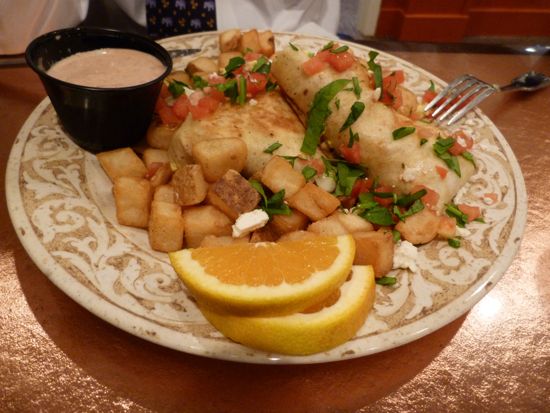
The wait-staff is well trained; they make easy conversation, pay attention to what you need, and the owners/managers come around to make sure you enjoyed your meal.
Another Broken Egg
721 East Gregory Street
Pensacola
(850) 912-8347
Survey Shows Teens Hide True Internet Usage From Parents
This from a REUTERS news story posted on AOL News / Huffpost
It’s a parent’s worst nightmare.
By Gianna Palmer
NEW YORK (Reuters) – More and more teenagers are hiding their online activity from their parents, according to a U.S. survey of teen internet behavior released on Monday.
The survey, sponsored by the online security company McAfee, found that 70 percent of teens had hidden their online behavior from their parents in 2012, up from 45 percent of teens in 2010, when McAfee conducted the same survey.
“There’s a lot more to do on the Internet today, which ultimately means there’s a lot more to hide,” said McAfee spokesman Robert Siciliano.
Siciliano cited the explosion of social media and the wider availability of ad-supported pornography as two factors that have led teens to hide their online habits. The increased popularity of phones with Internet capabilities also means that teens have more opportunities to hide their online habits, he said.
“They have full Internet access wherever they are at this point,” Siciliano said.
The survey found that 43 percent of teens have accessed simulated violence online, 36 percent have read about sex online, and 32 percent went online to see nude photos or pornography.
The survey reported that teens use a variety of tactics to avoid being monitored by their parents. Over half of teens surveyed said that they had cleared their browser history, while 46 percent had closed or minimized browser windows when a parent walked into the room. Other strategies for keeping online habits from parents included hiding or deleting instant messages or videos and using a computer they knew their parents wouldn’t check.
Meanwhile, the survey found that 73.5 percent of parents trust their teens not to access age-inappropriate content online. Nearly one quarter of the surveyed parents (23 percent) reported that they are not monitoring their children’s online behaviors because they are overwhelmed by technology.
Siciliano said that is no excuse.
“Parents can put their foot down and they can get educated,” he said.
“They can learn about the technology at hand. They can learn about their children’s lives,” Siciliano said.
Many of the parents surveyed were already doing just that, with 49 percent of parents using parental controls and 44 percent obtaining their children’s email and social network passwords. Additionally, three in four parents said they’ve had a conversation about online safety with their kids.
The results were drawn from a nationwide online survey completed by 1,004 teens aged 13-17 and 1,013 parents, conducted May 4-29 by TRU of Chicago, a youth research company. Its margin of error was plus or minus 3 percent.
(Editing by Barbara Goldberg and Eric Walsh)
Wooo HOOO, Saudi Arabia Allowing Female Olympic Athletes
It hasn’t been so long in our own country since Title IX made it possible for more and more women to participate in athletic events, making funding possible, giving women in the United States an opportunity to participate in healthy athletic activities.
RIYADH, June 25 (Reuters) – Saudi Arabia will allow its women athletes to compete in the Olympic Games for the first time ever in London this summer, the Islamic kingdom’s London embassy said on its website.
Human rights groups had called on the International Olympic Committee to bar Saudi Arabia from competing in London, citing its failure ever to send a woman athlete to the Olympics and its ban on sports in girls’ state schools.
Powerful Muslim clerics in the ultra-conservative state have repeatedly spoken out against the participation of girls and women in sports.
“I think this is a victory for Saudi sportswomen and hopefully it will promote sports and women’s health awareness for the Saudi society,” said Lina al-Maeena, co-founder of Jeddah United Sports Company, a rare women’s exercise club that runs a female basketball team.
In Saudi Arabia women have a lower legal status than men, are banned from driving and need a male guardian’s permission to work, travel or open a bank account.
Under King Abdullah, however, the government has pushed for them to have better education and work opportunities and will allow them to vote in future municipal elections, the only public polls held in the kingdom.
Saudi women will be able to compete in the London Olympics only if they reach the qualifying standard for their event, and the Games opens in just over one month, on July 27.
“The kingdom of Saudi Arabia is looking forward to its complete participation in the London 2012 Olympic Games through the Saudi Arabian Olympic Committee, which will oversee the participation of women athletes who can qualify for the Games,” said a statement published on the embassy website.
The woman most likely to compete under the Saudi flag in London, show jumper Dalma Malhas, was ruled out on Monday when the World Equestrian Federation (FEI) said the 20-year-old’s mare Caramell KS had been sidelined by injury for a month during the qualifying period and had missed a June 17 deadline.
“Regretfully the Saudi Arabian rider Dalma Rushdi Malhas has not attained the minimum eligibility standards and … will not be competing” at the London Olympics, FEI secretary general Ingmar De Vos told the FEI website (www.fei.org).
Malhas won individual bronze at the junior Olympics in Singapore in 2010, but without official support or recognition.
In April the head of the General Presidency of Youth Welfare, which regulates sport in Saudi Arabia, said it would not prevent women from competing but they would not have official government endorsement.
The government’s role would be limited to ensuring that Saudi women’s participation “is in the proper framework and in conformity with sharia”, he said.
The IOC said on Monday that talks with the Saudis were “ongoing” and that “we are working to ensure the participation of Saudi women at the Games in London”.
The head of the kingdom’s Olympic mission, Khalid al-Dakheel, told Reuters on Sunday that he was unaware of any developments allowing women to participate.
Top Saudi clerics, who hold government positions and have always constituted an important support base for the ruling al-Saud royal family, have spoken against female participation in sports.
In 2009 a senior cleric said girls risked losing their virginity by tearing their hymen if they took part in energetic sport.
Physical education is banned in girls’ state schools in the kingdom, but Saudi Arabia’s only female deputy minister, Noura al-Fayez, has written to Human Rights Watch saying there is a plan to introduce it. (Reporting by Angus McDowall and Asma Alsharif; editing by Tim Pearce)
Leaving Nsefu for Chongwe; The Most Exciting Moment of our Trip
Early, early the next morning we heard a crashing and crunching – sounds we can easily identify as elephant. At first we continue sleeping, our only morning for sleeping in, but I can’t resist, I have to get up, and lo! The elephant is between our cabin and the next, obliviously chomping and breaking and tearing the tree for an early breakfast.
I decide to get up and get dressed so I can get the iPad charged before the generator goes off at 10, but I can’t go out until the elephant has departed, and she heads in the direction of the lodge, which is where I need to be. Deb Tuttle, the walking guide, walks with me once we see the elephant walk a little further down the valley, I’m able to get the iPad charging and grab a cup of coffee so to be able to say farewell to some of the guests whom we will not see again.
Sunrise over Nsefu:

Travel agents heading out on a Robin Pope Walking Safari:

Making Toast is the favorite job in the winter, close to the hot coals:

It is so nice to be able to pack in daylight! My iPad is at 100%; I have finished The Paris Wife and am starting Wolf Hall, which also holds my attention. While carrying books is bulky, this constant underlying awareness of needing to recharge camera batteries and iPad is also a deterrence. I find I am less desperate about the camera batteries, I always carry at least one back-up so I always have a charged spare, but when the iPad goes, it has to be recharged before we can use it again.
A couple of the travel agents who didn’t know each other had to bunk together in Nsefu. I don’t feel sorry for them; they get to come free. It seems to me, though, is hard to come on these trips as a single person and not feel the odd one out when the game drives go out. They say it is no problem, but I’ve been the odd one on trips to Kawazaa, etc., when AdventureMan wanted to do some activity and I wanted to do something else. It is possible, anything is possible, but sometimes it is just a little awkward. Sometimes people are nice; sometimes they are not so happy to have someone else with them. We are finding that the best of all worlds is to come with your own little traveling group.
The first time we came as a small group was with our son and his wife. We were able to do game drives with people who share our preferences, have people to talk to at dinner if everyone else has their group, etc. We like meeting up with other people, and at the same time, it gives you more confidence to have a group with you, if the other people are all absorbed in one another, or not great company.
The most difficult people are those who don’t understand that this is not a predictable experience – that’s why it is an adventure. There is no guarantee that the lion will crawl over the lip of the riverbank just in front of your car. There is no guarantee you will find the same great, shaggy maned lion at the salt pans that the other guests found the day before. There are NO guarantees, and so you have to treasure all the moments, great and small, and if you are blessed with an extraordinary experience, you celebrate, but honestly, just being here is cause for celebration. Those whose noses get out of joint because you might have seen something they haven’t aren’t a lot of fun to be around. We had one experience when a group that had been friendly to us got all sour and disgruntled because we had seen the lions at the salt pan and they had not. Hey! The lion don’t always show up! The leopard are elusive. This experience is one that totally has to be lived in the moment.
You have to love the smell of the campfire in the morning, and be willing to sacrifice your one morning of sleeping in to spot the elephant chomping outside your bathroom wall. You have to love the little elephant shrew as much as the elephant. There are some drives that are just quiet. It’s like you can’t expect Christmas every day, and if it were Christmas every day, it wouldn’t be special any more.
Just before Holly arrives to open up the Bend Over Store (LOL, it’s a trunk full of goodies) we are blessed with one last elephant crossing! Two days earlier, the elephant were crossing back and forth like a street in New York, then yesterday – not an elephant! It was so unearthly quiet! Today, groups are massing once again, and crossing. We love watching the baby elephants as they learn how it is done.
Drinking; getting ready to cross:

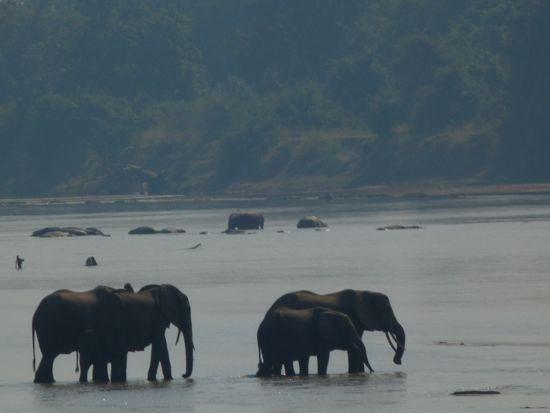

Mom, wait!

On the way to Mfuwe airport, we see Eland – we’ve been looking and looking for these large elk-like ungulates, they are shy and elusive, but Jonah spots them off in the distance, a parting gift from Nsefu.
We have an all-too-brief mad dash through Tribal Textiles, where we ‘invest’ in tablewares, cushion covers and deco for children’s rooms. AdventureMan befriends one of the Tribal Textile cats while I am busy shopping. I have cleared out my backpack so I would have space to put my purchases. 🙂
We have a full flight from Mfuwe to Lusaka, and not a lot of time to spare before our next flight. Smooth flight to Lusaka, just minutes to pick up luggage and transfer to next ProFlight flight, this one is not even on the departure board, only eight passengers, our party of four and a German family from Bavaria. At the very last minute another man comes running, running to catch the plane, we are all busy chatting, it is already a family. They are en route to Chiawa.
It’s a short flight, but here comes the most exciting moment in our day. The pilot is looking at a cheat sheet and the suddenly the plane is saying loudly “Pull Up! Pull Up!Terrain! Terrain!”
The pilots are looking confused and annoyed, one still looking at the instruction sheet, a mountain is rising in front of us, the plane is banking and the loud voice keeps saying “Pull up! Pull up! Terrain!”
I thought I had a movie of all this. I remember making a movie, thinking that if these are my last moments, I will record what happened and try to store the iPad in a place where it might be safely found. Of course, as it turns out, we landed safely and . . . somehow, I don’t have the movie. I must have shut it off too quickly and it didn’t save; I was in a hurry – just in case those were my last moments. I have to admit I am disappointed not to have it to share with you.
Waiting at the airstrip is Victor, our guide, and we rode with him and Chris, who turns out to be one of the owners of Chongwe, to the Chongwe River Camp.
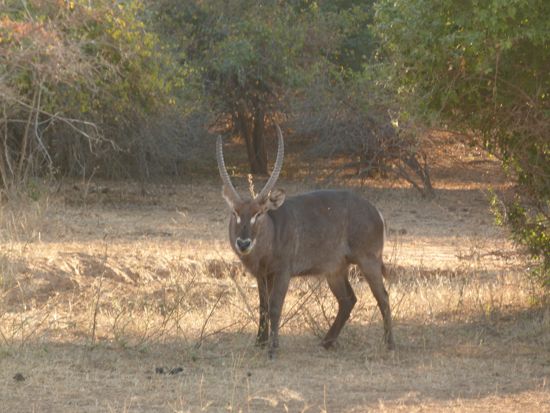
(This is a waterbuck we passed on our way into camp, and again on our way out of camp the next morning; so so sad, part of the circle of life and death, but as we departed Chongwe, his bloated body was in the same field; they suspect he was bitten by a snake and died.)
Arrival is lovely, we are greeted at a tall stand, so we are not climbing in and out of the Land Cruiser, we walk right out onto this stand and down the steps. Flossie greets us and then they tell us that we have been upgraded and put in the family suite.
The Family Suite . . . As soon as we see it, we remember. We had totally forgotten . . . we loved our cabins at Chongwe, we were delighted with all the amenities, and we also remember our first boat trip riding by a place that looked like a fantasy from 1001 Nights, a tented living room and dining room, with carpets and nice furniture and linen tablecloths and gleaming candles – it was so lovely. We remember, it was the family suites. And now, the family suite was ours!
We were a little dazed by our good fortune, we couldn’t believe this lovely place was ours. Our butler, Steve, offered us drinks, Flossie, the camp hostess showed us to our bedroom/bathroom/dressing areas and explained how everything worked, where the electrical outlets and switches were, how the double shower works, where the bath oils were for the claw-footed bathtub, gave us the white cotton pique robes and the fluffy thick Turkish Towels.
This is our sleeping area:
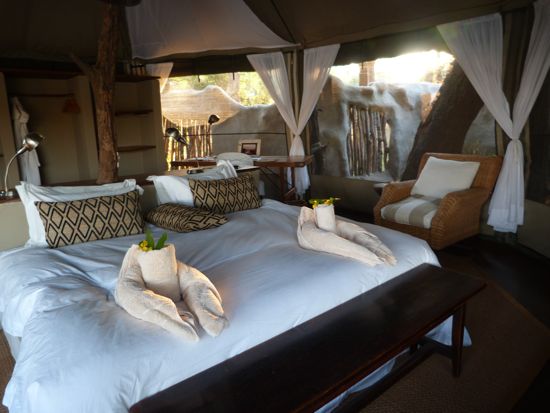
This is our dressing area:
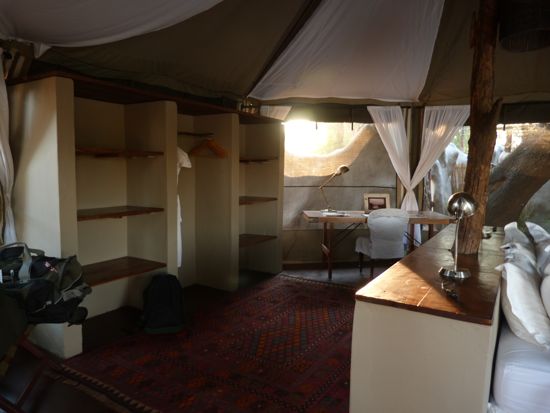
This is the view from our tent toward where the Chongwe River meets the Zambezi River:

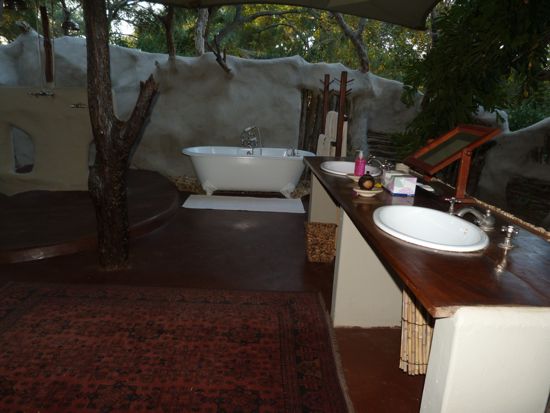
This is our bathroom, with a two-person shower and claw-foot tub 🙂
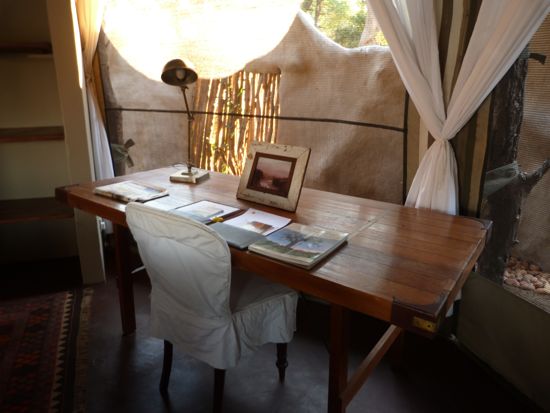
And this is the desk area, also where we can charge our batteries and electronics:
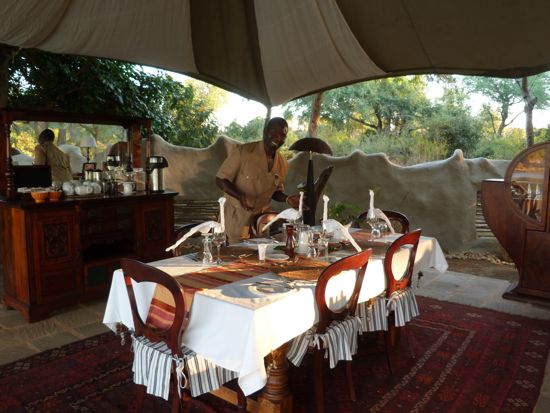
This is our dining room:
The Family Room:

This is the view out over our swimming pool to the Chongwe and Zambezi Rivers, and the hippo pods:
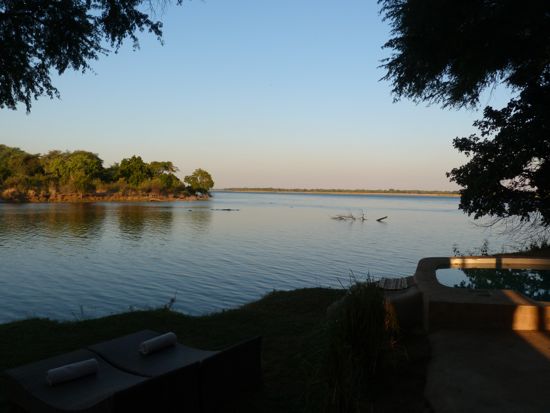
There are woven mats and kelim carpets, and we feel at home, if home can be a huge octagonal tent with an indoor / outdoor feel. Victor comes back, pulling up in a boat next to our swimming pool,to take us for a sundowners up the Chongwe and then back down into the Zambezi.

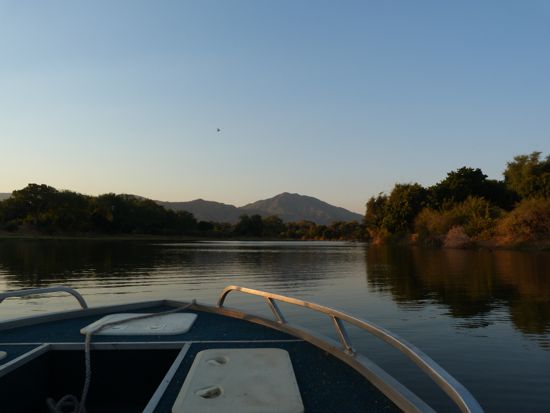
And Victor has fishing equipment with him for the fishing enthusiast in our party. He is able to cast to his heart’s content with a rod and reel trying to hook a Tiger Fish (catch and release) but no luck.

We see lots of animals coming down to drink at dusk, just across the Chongwe:


Our first Chongwe sunset:

Dusk settles on the Zambezi:

After sundowners, we head back and go to our luxurious tents to clean up, then reassemble around the fire to have a glass of wine before dinner.
The ultimate luxury is privacy. We have met such lovely people in the camps, and still, I am who I am, it is hard for me to exert myself to be charming every night at the end of a long day. I do fine at breakfast around a campfire. I manage at lunch, although after an early start and a long game drive, I am usually eager for a quick snooze. But by night, at the end of the game drive, all I want is comfort food, quick, like tomato soup and a cheese sandwich, not so much chit chat and good night, see you all in the morning when I am more chipper.
I recognize there are people who do well later in the day. I recognize that there is this thing called civilized behavior. I do have manners, I know what is important, and . . . yet . . . late in the day, I have the nature of a curmudgeon. I need some quiet. AdventureMan and our friends are out having a great conversation in our living room area, I can hear them, I delight that they are having such a great conversation, and I really, really need to be in here, writing up my notes. By the grace of God, they understand me and have compassion on me. I am able to join them a little later, and we have a lovely laughter-filled dinner in our private dining room and then off to bed – we have a full day tomorrow in Chongwe!
The butler, Steve, does wonderful napkins:

We did nothing to deserve this beautiful upgrade. We loved the spacious tents we had the last time we were in Chongwe River Camp, but this . . . this is a totally unexpected, undeserved blessing, it just fell in our laps, and we are so appreciative. We feel so cherished, so blessed, so beautifully taken care of. We go to sleep with the sound of hippos . . . . .ZZZzzzzzzzzzzzzzzzzzzzzzzzzzz . . . . . .
Maria’s Mermaid
We like Maria’s; we like the variety of seafoods they carry, and we like that the fish is fresh. We often see the fishermen parked with their boats next to Maria’s, hauling out this morning’s catch.
AdventureMan runs into Maria for tonight’s dinner and I notice their mermaid. I think the artist must have had a lot of fun painting this Mermaid, who is not your Starbucks Mermaid:

And doesn’t strike you as sad that this perky little mermaid would be offering up her half-brothers and half-sisters for eating?
Maria’s Fresh Seafood Market
621 East Cervantes Street Pensacola, FL 32501
(850) 432-4999
The Customer from Hell at Target
Me. Today I was the customer from hell at Target.
I like Target. I like it that you can find just about anything you need there. I usually look for a deal, or a good price on things, but when I just need something, I just go buy it at Target. I also like their ad campaign, it’s a little camp but very colorful and always has cool products featured.
So today I went in for hair color stuff. I found it, but then I also found a display containing packages of two together, and it costs a lot less. It says Buy Two for Less!
Yes! Yes! I am buying two! I always buy at least two so I don’t have to go shopping that often; holdover from my days of buying six months worth when I was living in Kuwait and Qatar. It doesn’t go bad, and you have it when you need it.
None of the cellophaned two-packs have the color I need, so I take the ones I need and the two pack to the cashier, and I explain I want the special “Buy Two and Save” price, and she says “Whoa! That’s beyond me!” and sends me to the customer service counter.
At the customer service counter they explain to me that this is a special deal to encourage customers to buy more than one; they buy two and get a special deal. I agree with them, and isn’t this great, I want to buy two! Well no, they explain, Target pays a different price for the package than for the singles, so they can’t sell the singles two for the same price as the two bundled together.
Wait. These are the exact same product. EXACT. Except that these two wrapped in cellophane are 2 for $11.99, and the two exact same product I want to buy are priced at $7.99 EACH. So I am supposed to pay $5 MORE to buy two single ones? Something is not right with this picture. I ask to see a supervisor.
I am quiet and mannerly. I have a secret weapon – it is called pleasant persistence. They keep explaining to me that I can’t buy what I want at the special price and I just smile at them and politely explain how it doesn’t make sense. They are telling me in their explanations to “PLEASE GO AWAY!” and I am smiling and politely telling them in my own way that I am not going anywhere, and I want my product at the two-for price.

Finally, the supervisor says to sell it to me at the two-for price. As she is ringing it up, the customer service rep says “this happens all the time, not with hair products but with all kinds of products when we have the bundle price and the single price.” I suggest she mentions it to management, and that it costs a lot in time and in customer frustration and customer service frustration, and she says “it wouldn’t help.”
I still like Target. I imagine there are a lot of customers who give up and walk away. Not me. It doesn’t make sense to me to pay $5 more for something that they WANT you to buy two of . . .
A Chat With Daudi En Route to Nsefu
“Happy Anniversary to You! Happy Anniversary to You! I Love You! I love you! Happy Anniversary to you! Happy Anniversary to you!” AdventureMan sings me awake to the tune of the Superman theme. He always knows how to make me laugh, and after 39 years, he can still surprise me. We are so delighted to wake up here, in Tena Tena, on our anniversary. Life is sweet.
Morning at TenaTena Camp:


AdventureMan is walking to the next camp, and I am spending the morning catching up on notes, organization, small things, charging up my iPad, etc.
As I was saying earlier, you’d think this would all be very restful, and everything is done for us, but it all revolves around our game drive schedule, and any necessary re-charging depends on the generator schedule (unless you are in Nkwali, where you can re-charge everything in your own rooms; there are lots of electrical outlets) and at the same time, why on earth are we bringing all these electronic devices to the bush???
I’ve discovered a program on the iPad called Notes, and it allows me to write so much more than I would if I were writing by hand. I forget a lot of the smaller details and some of those small details are what makes camping life here so much fun.
The Robin Pope camps pay a lot of attention to detail. One of the things they provide is an insect repellant that is also lotion; it goes on easily, it smells good, and it really seems to keep the insects away, so I gladly use it instead of the Deet we brought with us which melts plastic if it leaks. How can that be good for our cameras?? How can that be good for us? And it is oily, and it smells so bad, and the tsetse flies just ignore it altogether. The insect repellant lotion, on the other hand, seems to work . . . and it smells like lemons.
We are all discovering new ways to use our cameras. I have discovered a program called Night Scenery, which allows me to take spectacular sunsets, and even photograph the essence of a night drive with some clarity – how cool is that? We are a good group in that we can sit patiently and shoot twenty or thirty shots of the lilac breasted roller, experimenting with various shutter speeds, aperatures, and compare them to the automatic function.
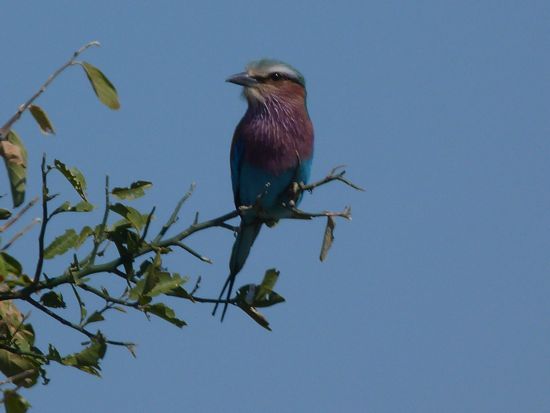
(I love my Lumix. I get great shots, and it takes me close to get the finest detail of a bird feather. It is lightweight, easy to handle, and doesn’t need as much light as many of the longer interchangable lenses on other cameras. I have two batteries, so I can be charging one and using another. I have another, smaller Lumix also with me as a back-up in case the unthinkable happens and something goes wrong with the bigger Lumix. My one gripe – the back-up battery is not a Panasonic battery; it works, but it doesn’t show how much battery is left, so just at the worst moment, my camera can just die if I don’t remember to change the battery out when I think it might be time.)
Our new Scottish friends, Mark and Madolyn, show us photos they took at the salt pan and they saw lion with a big huge bushy dark mane, and she took a photo – are you sitting down? – with her iPhone, that I would have killed to take. It is close, it is detailed, it is every bit as good as a photo taken with a camera. So much for all the control we are trying to develop.
They also ran a rescue mission for all the village men passing on bicycles, telling them of the lion ahead, loading bikes into the Land Cruiser, ferrying them past the lion and dropping them off past the danger zone. Some of the pride of lions have 10 – 20 members. Most avoid humans, but . . . would you want to bet on that, riding by a pride of lion, say . . . hungry lion . . .on a bicycle? (shiver) Not me!
It is approaching deep winter here, so it can be cold, not bitterly cold, but cold enough to make you stupid when you get up in the morning, cold enough that you want a fleece and a scarf for the first few hours of the morning drive. Around mid-morning you start stripping off layers, until around noon when it is very hot and you know the sunscreen won’t be enough; you have to put on some kind of cover against the strong African sun, even approaching mid-winter.
On my way to Nsefu, our last camp in the South Luangwa, I am with our old friend Daoudi, whom we first met twelve years ago, on our first trip to the South Luangwa. We talked of our families, and changes, and I thought to ask him about a conversation I had had the night before, with our Tena Tena guide, Julius. I had asked him how his wife coped with him gone guiding several weeks each month, and he began his response with “She is a well-mannered girl . . . ” going on to discuss how they problem-solve and work with the situation. It’s of interest to me, as a former military wife; military wives also spend time apart from their husbands.
So I pondered this, it was the first thing he said, “she is a well-mannered girl . . . ” and that tells me being well mannered is the most important thing, but well-mannered behavior differs, I have learned, sometimes painfully, from culture to culture.
“Daoudi, when a Zambian girl is said to be well-mannered, what does it mean?” and he explained it meant from her earliest days, her parents had instructed her on proper behavior.
“OK. I understand that. But I might not understand well-mannered the same way you do. Like when we lived in the Middle East, you know I learned to wear clothes that covered me to the elbow and to the knees, and did not have a low necklline . . . ”
“Yes, modest . . .” he said, thoughtfully.
“Yes, exactly,” I affirmed, “but also things very un-American . . . I learned to keep my eyes down, or at least not to look directly at a man and smile – that for us it might be friendly, but there it might seem forward. And I learned to use my quiet voice in public, and not to laugh out loud in the souks. Things like that, things I would not have even known if I had not been told.”
“Ah, yes!” he agreed, “these are also what it is to be a well-mannered Zambian woman. To speak softly with your husband, not to be shouting at him when you disagree, but to talk softly so you can come to agreement. Like that.”
We rode together in a comfortable silence, then I had another question.
“Would it be OK for a Zambian woman to be sitting here in the car with you when she is not your wife or your sister or a closely related woman?” and he laughed and said “Yes, it is helpful! Like you give someone a lift to help her get where she is going, there is nothing improper in that.”
So while some of the manners are like the manners of the Middle East, there are differences, too, and a person could spend a lifetime learning all these little distinctions and still not get it all right. Learning another culture is a never ending task, and it makes you envy those children who are born of two cultures (or more) and can pass fluently from one to another, knowing the subtleties of each.
We have American nieces and nephews who have lived most of their entire lives in a foreign country, and while they are not born of different cultures, they played on the streets, attended social functions, the local culture seeped into them by their daily lives. They are idiomatically fluent and inter-culturally fluent, but it takes a lifetime of bi-cultural living to attain their level without a dual-culture mother and father.
Nsefu Camp, the original Norm Carr camp, has little round plastered bandas set right on the river, where you can watch the elephant families cross the river, entirely lovely.
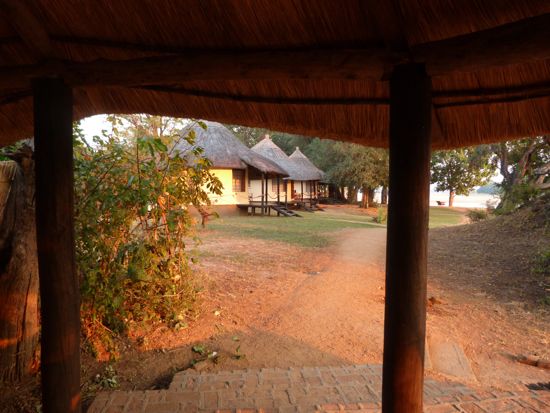

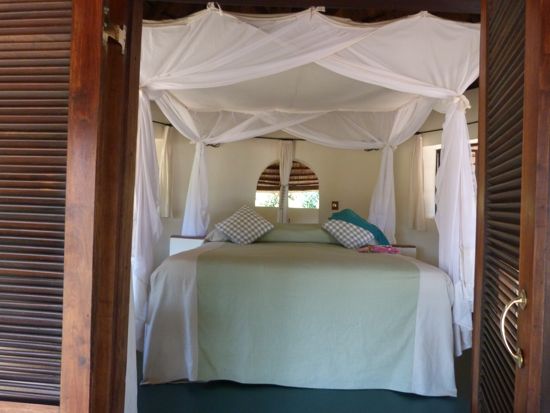


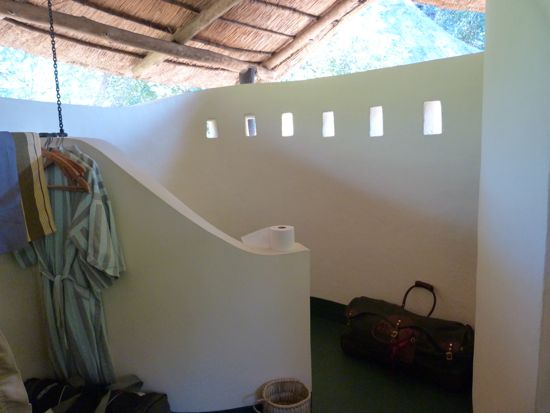
Everyone arrives hot and tired from the walk, and delighted with all they have learned. We have a lovely lunch, and AdventureMan sleeps soundly for an hour before afternoon tea.
Afternoon tea is a lot of fun; the chef has baked a beautiful chocolate cake for our birthday girl, and seven men enter singing “Happy Birthday” with the birthday cake for tea. 🙂

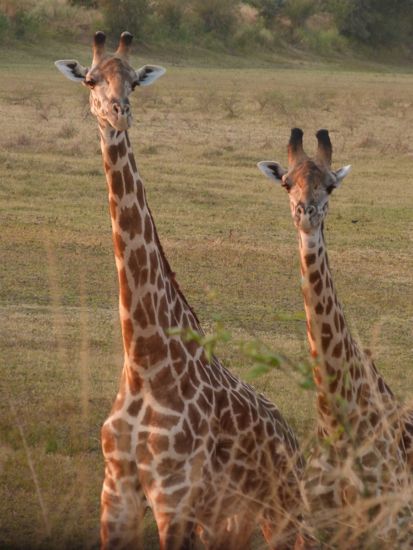

On the afternoon game drive we spot a civet cat, which we have never seen so clearly before,

and we see a porcupine family. When we first spotted them, it looked like the big porcupine was dragging something, but no, it was a little tiny baby porcupine sticking to Mom’s heelslike glue.
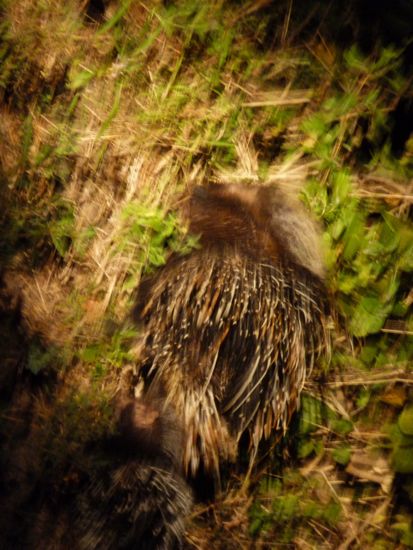
(Sorry, it’s just hard to get good clear sharp shots at night)
Again, a gorgeous night sky and a lot of fun trying to find constellations. Dinner was a Mongolian barbecue, with sparkling wine provided by the Australian honeymooners, who had a true honey moon – the moon rose huge and red in the sky as we were eating our dinner.
Galilee Cafe, Mobile, and Foley AL; Life in Small Adventures
AdventureMan was perusing the Weekend Section of the Pensacola News Journal when he saw the opening of the Farmer’s Market in Foley, AL, and he said “Let’s go!”
“Let’s Go!” and my agreement doesn’t always mean we will really go. The market isn’t until 3 in the afternoon, and a lot can happen. Sometimes we just change our minds.
But at water aerobics, I get a great idea, and I can hardly wait to share it with AdventureMan.
“Let’s go to the Jordan River Cafe for their Friday buffet, then head down toward Foley through Fairhope!” He loves the idea, we run a couple errands on the way home, I call the restaurant to make sure they are still open (It’s been about a year since we last went there) and then hit the road for Mobile:

When we get to the restaurant, we discover it is no longer the Jordan River Cafe; it is now the Galilee Cafe, and I wonder if the food will still be so good as before. As we enter, we are shocked – the Cafe is PACKED. Every table is taken – no, no, there is one small table, over in the back, we can have that one, the welcoming waitress says.
Galilee Cafe
326 Azalea
Mobile
T: 251-304-0297

Lunch was fantastic. Yes, the restaurant has changed hands; the current owner born in Bethlehem, and we are astonished and delighted to see so many people enjoying “Mediterranean” cuisine, which is suspiciously like what we used to eat in Jordan and Syria 🙂 The restaurant stayed busy the entire time we were there, so busy that some people ate outside on the front terrace. The food is delicious, and worth the drive from Pensacola. The Friday buffet (and it appears they also now have a Sunday buffet) is all the usual suspects – hummous, baba ghannoush (some of the best I have tasted), tabouli, fattoush, etc. plus a lot of the home-cooked favorites, lamb, chicken, grains, beans and vegetables, pita bread – all delicious.
The first time AdventureMan went to this restaurant (as the Jordan River Cafe) he went with a Saudi buddy and his son, and he has talked ever since about the route they took, but we never knew how to find it. Yesterday, we experimented, taking a right on Azalea as we left, and driving down to Government and turning left. (These iPhones are great navigational tools) It takes you through an older part of town, with large glorious mansions, and into a rather quiet downtown Mobile.
The good news is, it takes you to another tunnel under the Mobile Bay, closely paralleling the one I-10 uses. We like to have an alternative; I-10 can get clogged going through Mobile. This route serves our purposes as it is Highway 98, and it is the road we want to be on to get to Fairhope and then to Foley.

It is a lovely day for a drive, and while we have taken this drive before, it is never the same twice in a row. As we are on the stretch between Fairhope and Foley, the clouds darken and a few stray drops fall.
“That wasn’t bad!” I said as we arrived in Foley, promptly at three for the opening of the Farmer’s Market. “Great parking, too!”
We got as far as the first booth, which was soaps and toiletries (I love hand made soaps) and AdventureMan walked off to explore the rest of the stalls – and the torrent broke forth. Rain came down in buckets, and lightning came, crackling and booming, one strike after another. It never lasts very long here, so I thought we would just wait it out. The wind is blowing the rain under the canopy, so we gather up all the soaps to try to keep them dry, and we wait. And we wait. AdventureMan comes back, soaked; the wind has blown the rain under his umbrella. We wait another five minutes, and then everyone is starting to pack up – and I never made it beyond the first stall! We quickly made our purchases, ran to the car, and drove home mostly without air conditioning because we were so soaked and shivering.
The Farmer’s Market is held on Friday afternoons, 3 – 6 pm, in Heritage Park:
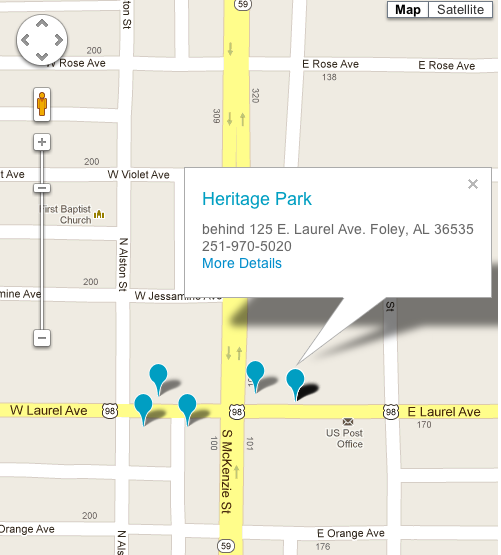
It was a great adventure 🙂 Thank you, Google Maps, for making it so easy to share the small adventure with our friends.
Recent Comments
intlxpatr on Shampoo Ginger tigerbutterya0c5ff1d… on Shampoo Ginger intlxpatr on British Soldier Kidnapped, Esc… John on British Soldier Kidnapped, Esc… intlxpatr on British Soldier Kidnapped, Esc… Wikipedia Donate Button

Amazina


Early Voting in Florida


