Kuwait Time Lapse
My Kuwaiti friend sent this – these young people put together a fabulous video. Gorgeous work, you make Kuwait look so beautiful.
Thelma and Louise in Saudi Arabia
An editorial cartoon from my friend Grammy, in Texas, from today’s paper:

Freedom Greater Factor than Wealth in Happiness
Fascinating study, I found it today on AOL Health News
Freedom More Important to Happiness Than Wealth, Study Finds
Personal independence, autonomy trump money in data from more than 60 countries.
SUNDAY, June 19 (HealthDay News) — Personal independence and freedom are more important to people’s well-being than wealth, a new study concludes.
Researchers at the Victoria University of Wellington in New Zealand analyzed the findings of three studies that included a total of more than 420,000 people from 63 countries and spanned nearly 40 years.
Their key finding: “Money leads to autonomy, but it does not add to well-being or happiness.”
The studies looked at data from three different psychological tests familiar to therapists:
The General Health Questionnaire, which measures distress in terms of anxiety and insomnia, social problems, severe depression and physical symptoms of mental distress, such as unexplained headaches and stomach aches.
The Spielberger anxiety inventory, which evaluates how anxious respondents feel at a particular moment.
The Maslach Burnout Inventory, which screens for emotional exhaustion, depersonalization and lack of personal accomplishment.
The analysis revealed “a very consistent and robust finding that societal values of [freedom and autonomy] were the best predictors of well-being,” wrote psychologists Ronald Fischer and Diana Boer in an American Psychological Association release.
“Furthermore, if wealth was a significant predictor alone, this effect disappeared when individualism was entered,” they added.
“Our findings provide insight into well-being at the societal level,” the researchers concluded.
The study appears in the Journal of Personality and Social Psychology.
Adaobi Tricia Nwaubani: I Do Not Come to You by Chance
This book, the first novel from Adaobi Tricia Nwaubani, is hilarious, with moments of pathos, and a fresh point of view.
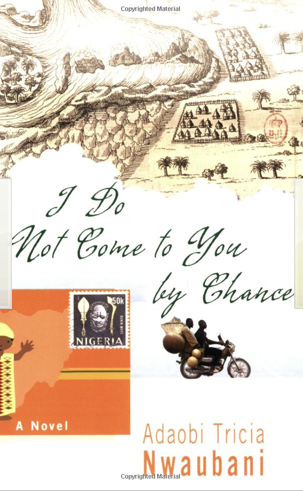
Amazon.com recommended it to me as I was busy buying books by author Chimamanda Ngozi Adichie; I thought ‘OK, I’ll read a series of Nigerian books as part of my summer reading.
Young Kingsley Ibe is the family’s first born male, and with that status goes many privileges – and responsibilities. After graduating with a Masters in Chemical Engineering, he has no success in his search for a job with an oil company in Nigeria, and consequently loses the love of his life, Ola, to another who has secure employment.
Worse, his retired father has a stroke, and the family discovers that with all the fees required, they haven’t enough for his continued care, so Kingsley must approach his uncle, Boniface Mbamalu, more familiarly known as Cash Daddy, for funds to transfer his father to a long term care facility, and, later, for his father’s funeral.
Serious Kingsley’s eyes nearly pop as he sees the life his uncle is living, cars, women, designer watches, shoes, suits and all the trappings of new wealth. Soon, his uncle makes a convincing case for Kingsley coming to work for him, the better to help out his family of mother, brothers and sister, now that he is the senior male in the family.
Kingsley discovers he has a gift for the work – which is writing 419s, those scam letters which I frequently publish in this column. I loved being on the inside, learning how strong possibility e-mail addresses are netted, how response e-mails are massaged – not unlike fund raising techniques by charitable organizations in the US. Kingsley’s education helps him achieve enormous financial success in a very short time – but he finds that all the cash and designer goods in the word do not solve his problems nor make him happy.
I learned a lot about how successful many of these scammers are, and how the money made is spread throughout the Nigerian communities. The author takes a balanced view, balancing the way the cash makes life easier for people – a lot of people, because the rich man has many obligations to his community, balanced against the disgust, and sick fear felt by his religious mother and aunt, and his one time girlfriend, when they learn the work he is doing. They are disappointed that a man of such promise has sunk to making so much money in a dishonest way. The book also does not deal sympathetically with those who have given or lost money to the scammers, nor, in my opinion, does the ending satisfy.
This is one of the funniest parts of the book – a group of Nigerian scammers is about to meet with a representative of a major US investment firm. He thinks he will be meeting with the Nigerian Minister of Transportation to discuss building a new airport; the reality is that Cash Daddy, in disguise, will be pretending to be the minister. Kingsley protests that Cash Daddy looks nothing like the minister, and Cash Daddy responds:
“Let me tell you something . . . Me, I really like these oyibo people. They’re very very nice people. See how they came and showed us that the ground where we’ve been dancing Atilogwu has crude oil under it. If not for them, we might never have found out. But Kings,” he dragged in his dangling foot and sat up in the tub, “white man doesn’t understand black man’s face. Do you know tht I can give you my passport to travel with . . . Even if your nose is ten times bigger than my own, they won’t even notice?”
It was a fascinating book. I understand better now why 419 scams work. (419 is the section of the Nigerian criminal code making scam e-mails a crime; thus the crime is called ‘a 419’) There are some very funny and very insightful moments in the book. It is no where near the level of literature that you experience with Chimamanda Ngozi Adichie, but there is more humor, and the book shows a more modern day Nigeria. Not a bad summer read, but not great literature.
Jeannette Walls: The Glass Castle
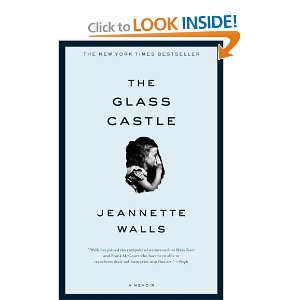
The Glass Castle was a hugely popular best seller in the USA, and it must have been while I was gone. A part of me remembers reading a little bit about it and deciding it wasn’t my kind of book, but after reading Half Broke Horses, I had forgotten what the subject matter was and was excited to have another Jeannette Walls book I could read.
Big mistake. This book is nothing like Half Broke Horses.
Or maybe it is. Maybe what I loved about Half Broke Horses was the voice of an amazing woman, and maybe what kept me reading The Glass Castle is the voice of an amazing child who tells a heart breaking story. Or maybe it isn’t so heartbreaking, because the children survive. They are scarred and damaged, but never so damaged or loony or self-deceived as their parents.
I don’t like reading books about kids whose parents don’t take good care of them. Oprah chose a lot of those books in her book club. These books depress me. I cannot imagine how parents can be so self-absorbed, how they can take on the responsibilities of children and then not put those children first. How can they?
The Glass Castle stars the daughter of Lily Casey Smith, who is the mother of Jeannette Walls, and her husband, who is Jeannette’s father. The book opens with little three year old Jeannette proudly cooking up a hot dog. Her mother is busy painting and has told her to find something to eat. Her nightgown catches fire, and she is terribly burned. She spends a long time in the hospital, which ends with her father taking her out in a hurry, bundling her into the car, already loaded with her family, and “doing the skedaddle” which is leaving town just in front of the bill collectors.
This is her life. From time to time, their alcoholic Dad will take a job and bring home some of the paycheck (he drinks and gambles most of it) and when he won’t work, on rare occasion, their mother will take a teaching job, but the kids have to get her out of bed in the morning, have to grade her papers and make her lesson plans. Often there is not enough for the family to eat. They don’t stay in one place; they ‘skedaddle’ before they are evicted for non-payment of rent. They eat cold food – when they eat – because the parents didn’t pay the electric bill.
The Dad is smart, charming and cajoling, and when he is sober, the kids learn amazing things from him, and educated engineer. Unfortunately, he is not often sober. He chases after alcohol and he chases after women; the people in the towns where they live know it and the children learn to know it, too, to their constant humiliation. When he wheedles money off his kids, and promises to repay, he asks “Have I ever let you down?” The answer is so stunningly obvious as to be heartbreaking – Yes. Yes, again and again and again.
The Mother is equally irresponsible. One time, when the family is starving, she is in bed and occasionally goes under the covers, where Jeannette discovers her mother has a chocolate bar hidden that she can eat – while her children go hungry.
The author’s voice is never self pitying, she just lays it all out and leaves us to draw our own conclusions. Each child escapes the family as soon as possible; the children plan and save their money to get out, first sending off the oldest sister, then Jeannette, then the son. They all head for New York, where they find work and support themselves. Like bad pennies, Mom and Dad show up in New York, cadge meals and money and join the ranks of the homeless in New York, going from food pantry to soup kitchen, and diving dumpsters for their worldly needs.
This is not a feel good novel. The good part about it is that children can survive this kind of criminal neglect, and become a successful author as Jeannette Walls has done. I am so glad I read Half Broke Horses first, because her grandmother is such an admirable character, whereas her parents are scum and I just felt so angry when I read the matter-of-fact descriptions of their behavior that I was glad they were not where I could get my hands on them.
I don’t know any parents as bad as Rose Mary and Rex Walls, but I know I believe this – if you choose to marry, and if you choose to have children, know that children require time, and love, and energy, and patience. Know that if you have grand ambitions, or an addiction, or a character flaw, you won’t be able to provide for your children’s physical, emotional and spiritual needs, unless you are willing to sacrifice your own needs and wants. While the children in the book loved their parents, they recognized that their parents were sadly lacking in the parenting roles. The way these children were neglected will make me remember this book for a long time.
Would I recommend it? Yes. It is a gripping book, at times even horrifyingly humorous, as when Jeannette figures out how to find lunch food in the garbage cans when all the other kids have finished eating. It is not a feel-good book. It is a horrifying indictment of self-absorbed, neglectful parents, parents you will love to hate.
If I sound a little overwrought, it’s because I worked with the homeless. We were able to help many, but I also ran into families like this family, families who would prefer not taking any help if it meant they had to play by the rules, you know, rules like “you have to take care of your children.” We had all kinds of classes and forums and mentors to help with learning skills, like feeding children well on a small budget, learning to discipline, simple skills, survival skills.
The problem is that these skills require self-discipline, and many of the parents would rather not take help than have to exercise self-discipline. I saw women who would sacrifice their children for their current boyfriend, a woman who was severely angry with her daughter for reporting a family member had molested her, a man who didn’t want to take a job that would ‘tie him down’ when his family was starving. I saw this, with my own eyes, and there is no way you can MAKE people take good care of their children. You have to ask if the children are better off with these parents, or ‘in the system.’ Not a pretty choice.
This book, too, is on Amazon.com. Reading it is like watching a disaster on CNN. You don’t want to believe it is happening and you can’t look away.
Jeannette Walls: Half Broke Horses
About a month ago, I picked this up off the stack of “Read Me’s” . . . ummm . . . errr . . . one of the stacks of “Read Me’s.” (If there is some sort of emoticon for mild embarrassment, insert it here; one of my fatal flaws is acquiring book I WANT to read and having more books than I have time to read.)

I think Amazon recommended Half Broke Horses to me, and I didn’t know why. They keep track of what I buy and make recommendations, which over the many years I have been using Amazon.com to buy books has become more and more relevant to the kinds of things I actually buy and read. So I bought Half Broke Horses, and another one recommended by the same author, then put them in the stack. It is only because I had read whatever I put on top of them that I ended up reading.
I casually started reading, without a lot of anticipation. The first chapter starts off in the early early days of our country, in the wilds of West Texas, as a girl and her younger brother and sister are out checking the cows, who suddenly go crazy, even jumping over fences which under almost every circumstance successfully pen them in. The young girl recognized something strange was going on and figured it was a flash flood coming, got her siblings up in the tree and keeps them awake all night, as the flood hits, hoping the tree will hold and not wash away.
What is your first thought, reading that? Mine was – Where are her parents?? No one is out searching for them?
The next day, the flood recedes enough for them to make their way home back to a primitive dwelling hollowed out in the high side of a riverbank, dirt floors, dirt crumbling down on them, dark, small, smokey. Yes, there is a mother and a father, and they love their children, but these are very different times. These are hard times, where there is no grocery store, no nearby doctor, where babies die and children have fatal accidents all the time. Life can be short and brutal. The kids have some schooling, mostly at home, they learn to read and write and add and subtract, so they can keep track of home related business. They also work hard, every child has work around the ranch that needs doing, and work comes first or the family won’t survive.
The heroine, Lily Casey Smith, is a real person, the grandmother of the author, Jeannette Walls. This is called a true-life novel. From all the stories she heard about her grandmother growing up, and from knowing her grandmother, and from all the legends about her grandmother she was able to verify, she built a skeleton, and then filled it in with conversations and even a few events that she had to imagine.
Lily Casey left her family at 15 to ride her horse 25 days across Texas to take a teaching job in a one-room schoolhouse. (My jaw dropped, too!) After several years of teaching, she goes to Chicago to become educated and licensed as a teacher, marries, annuls the marriage, returns home, finds a teaching job, races horses, marries again, has children, has a huge ranch, loses the huge ranch, manages a huge ranch . . . her story is bigger than life, but so is the person of her grandmother, who never falls apart, but looks life in the eye and copes with it. Better than coping, she dominates.
Her major opponents are tough economic times, and dramatic and devastating weather conditions. Rain can fail to fall for months, cattle can die in an unexpected cold snap. At the best of times, you have enough to eat and a roof over your head.
I never wanted the book to end, and, in a sense, it didn’t. Jeannette Walls big best seller, The Glass Castle, takes up with just a little overlap where Half Broke Horses leaves off.
Here is what I loved: I loved the voice of Lily Casey Smith. She’s the kind of woman I want for a friend. She’s smart. She has a sense of how things work in the world. She experiences tragedies, but she doesn’t let them hurt her self-confidence. She can be beaten, but she always gets up again. She’s a problem solver. She never once lets being a woman get in the way of being the person she was born to be. She overcomes. She doesn’t sugar coat; she tells it as she sees it. And you know you can count on what she says to be the truth as she believes it. I truly hated for this book to end.
You can find this book at Amazon.com used under a dollar to new hardcover around $15. It is worth every cent.
Baked Salmon Dijon
We took separate cars to water aerobics this morning as my computer kept telling me I didn’t have an aircard (?????) and AdventureMan had his own errands to run. First, though, I had to make a run to Joe Pattis to pick up some salmon steaks . . . I have a yearning for Baked Salmon Dijon.
So easy to prepare. So good!
Baked Dijon Salmon
Serves 4
Ingredients
• 1/4 cup butter, melted
• 3 tablespoons Dijon mustard
• 1 1/2 tablespoons honey
• 1/4 cup dry bread crumbs
• 1/4 cup finely chopped pecans
• 4 teaspoons chopped fresh parsley
• 4 (4 ounce) fillets salmon
• salt and pepper to taste
• 1 lemon, for garnish
Directions
1. Preheat oven to 400 degrees F (200 degrees C).
2. In a small bowl, stir together butter, mustard, and honey. Set aside. In another bowl, mix together bread crumbs, pecans, and parsley.
3. Brush each salmon fillet lightly with honey mustard mixture, and sprinkle the tops of the fillets with the bread crumb mixture.
4. Bake salmon 12 to 15 minutes in the preheated oven, or until it flakes easily with a fork. Season with salt and pepper, and garnish with a wedge of lemon.
This recipe, like many of the recipes I try comes from allrecipes.com, which sends me an e-mail every day with recipes I might like to try. At least once a week there is something of interest.
Once at the Geek Squad, my computer worked just fine. He mentioned sometimes an aging router can play tricks like that. Oh aaargh. I’m just glad everything is working fine for now. It’s all a mystery to me, why these computers work sometimes and sometimes they don’t, it’s all like smoke and mirrors, or magic.
Atlanta: Ethiopian Adventure and Macy’s
One last entry from our recent trip, a happy ending to a happy trip. This is how sweet my husband is to me.
We find Pensacola a very comfortable place to be, and have only found two things lacking. There is no Macy’s, and I do like Macy’s. There are no Ethiopian restaurants, (remember, I just read Cutting for Stone) and we like Ethiopian food. We know Atlanta has both, so we plotted our return trip with a just-enough-time-for-Ethiopian-food-and-shopping.
Isn’t life funny and wonderful? We know Atlanta has Ethiopian restaurants – several – because an almost-niece who has worked in Ethiopia lives in Atlanta, and could recommend several. Using the handy iPhone, we found a Marriott Residence Inn hidden away in a quiet neighborhood near Macy’s and not far from the Queen of Sheba. Although the hotel was full, they had a wonderful room for us, with a view of downtown Atlanta:

We found the phone number for the Queen of Sheba, called – and they were open for lunch!

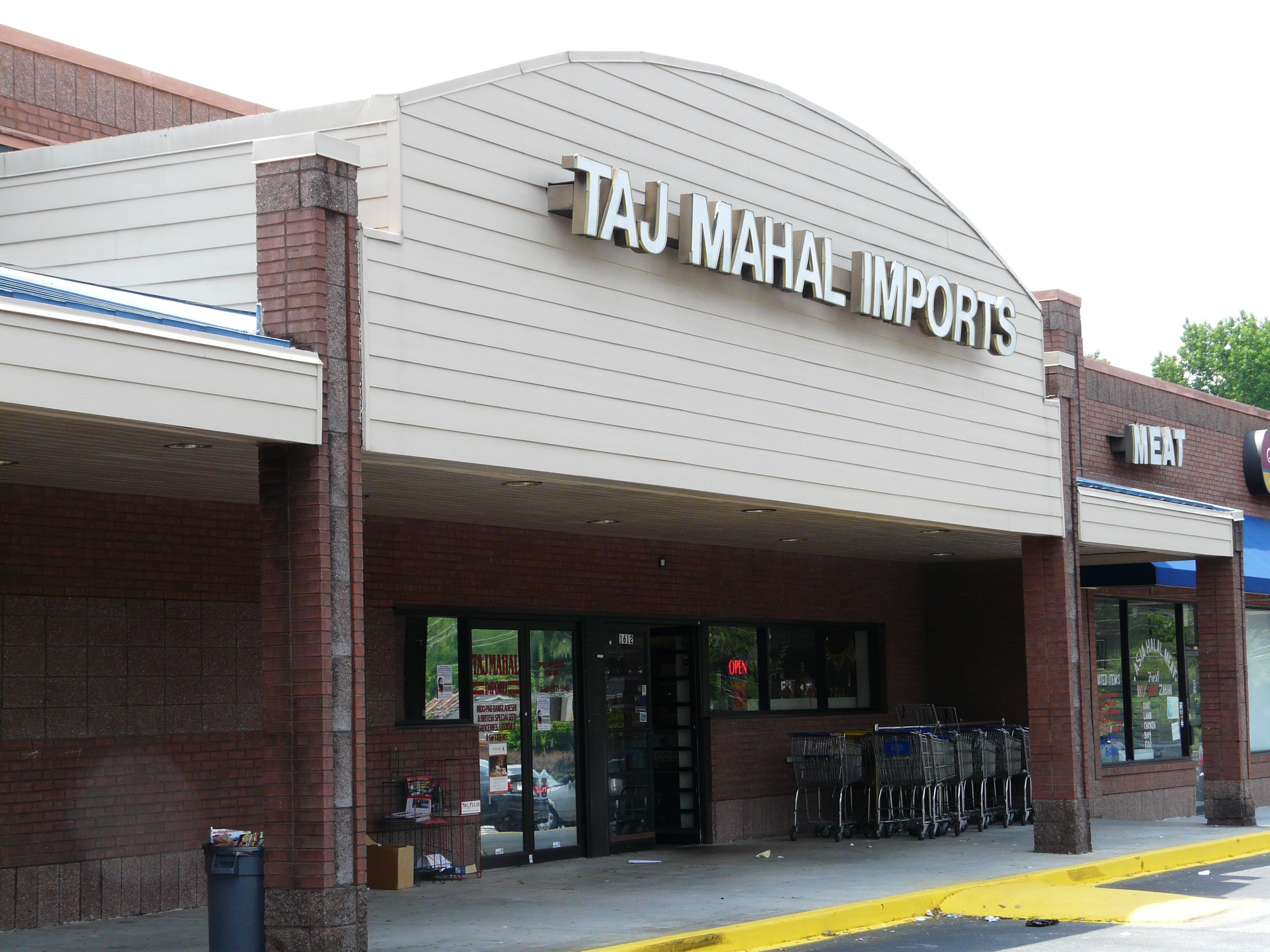
When we got to the plaza where the Queen of Sheba was located, we just laughed. We were back in Kuwait!
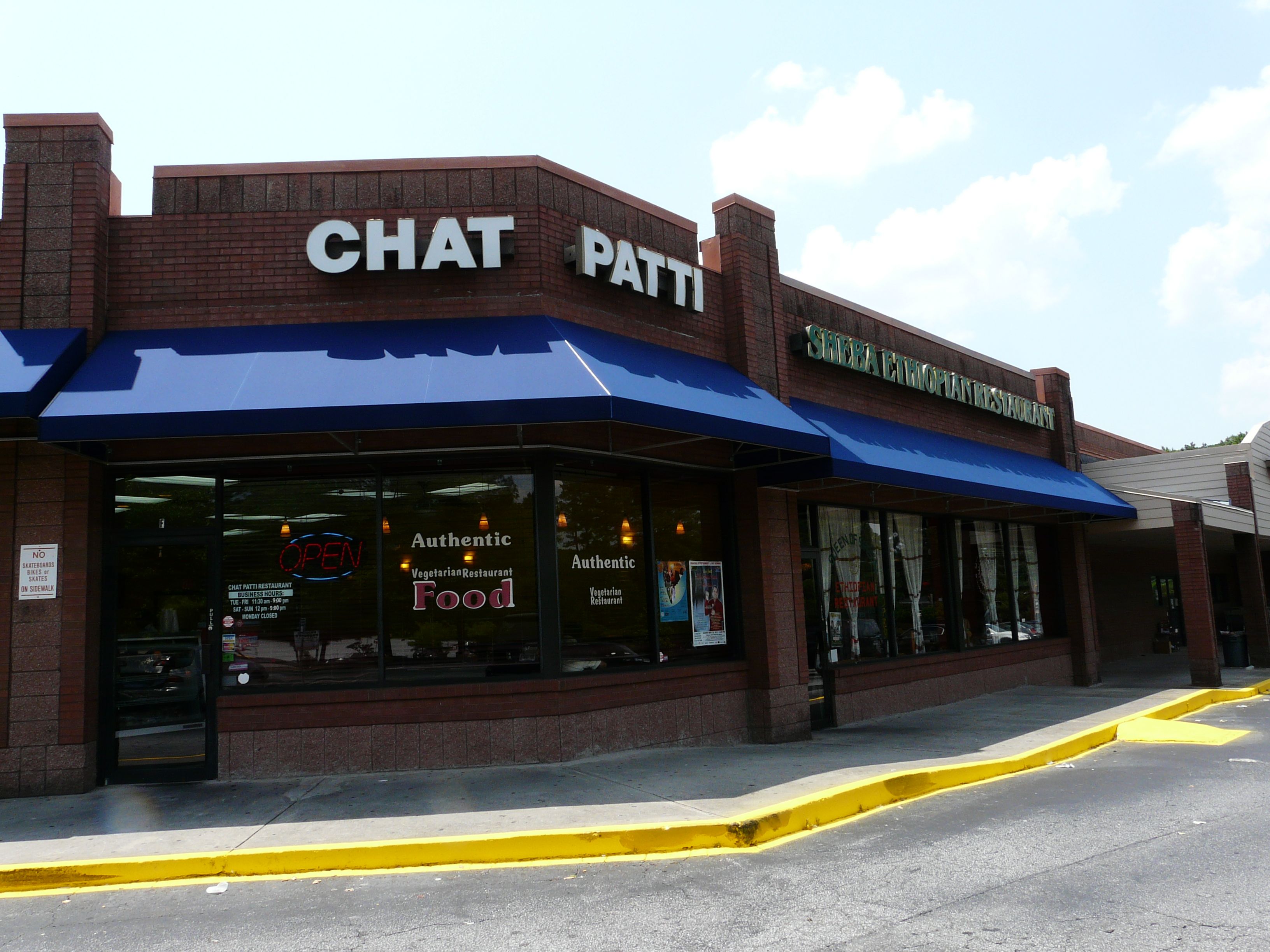
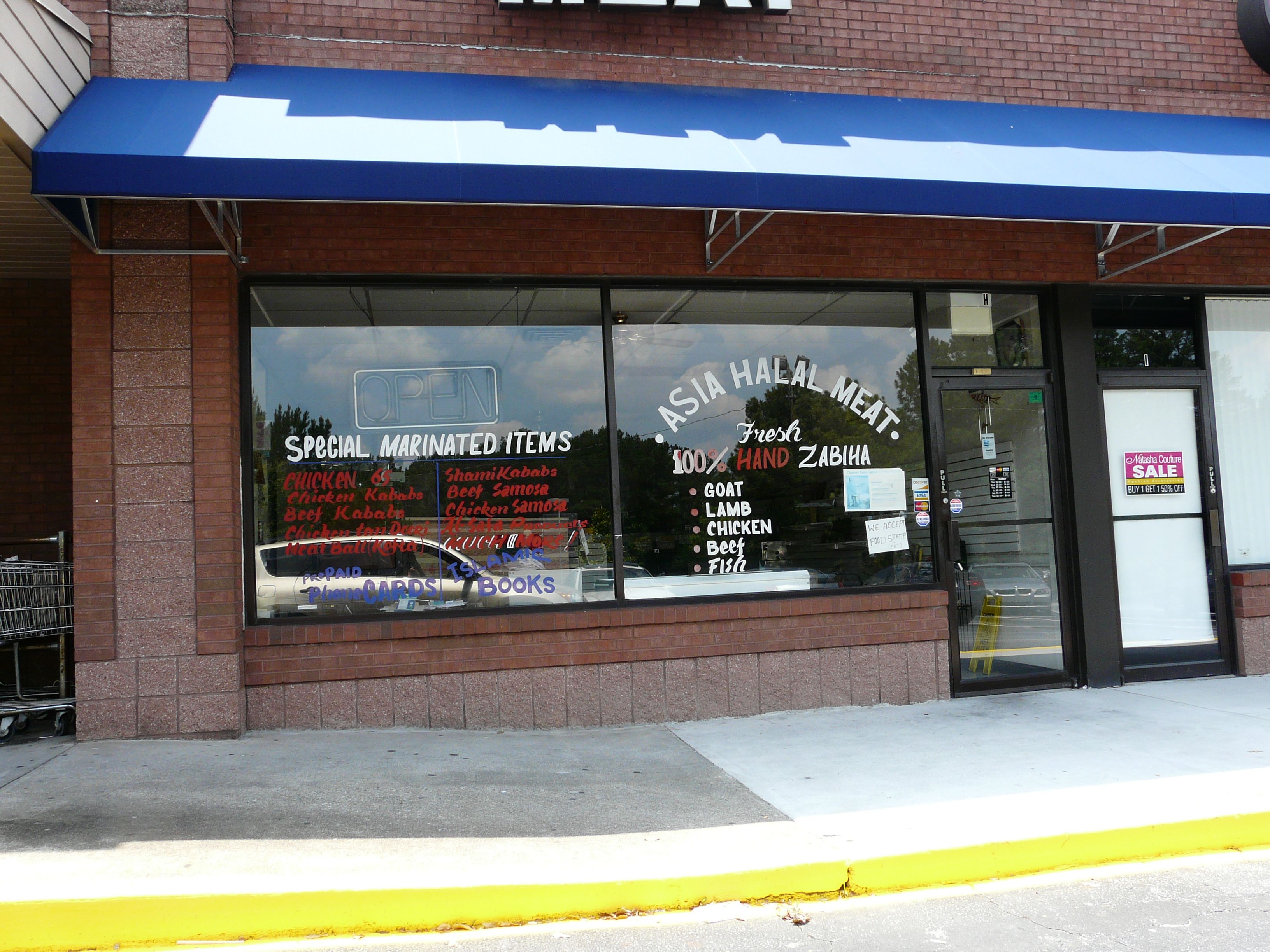

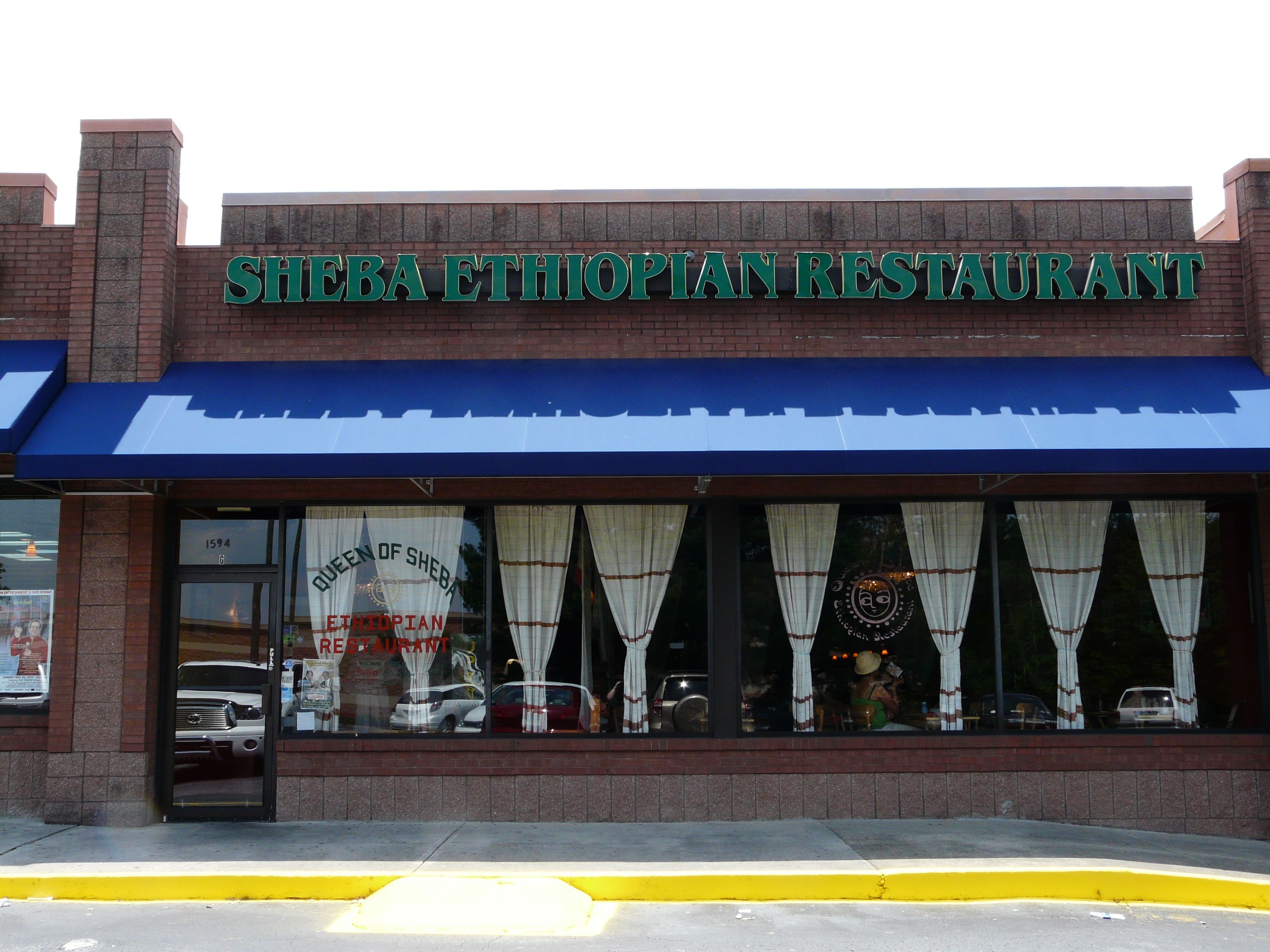
And here is what the Queen of Sheba looks like from the outside:
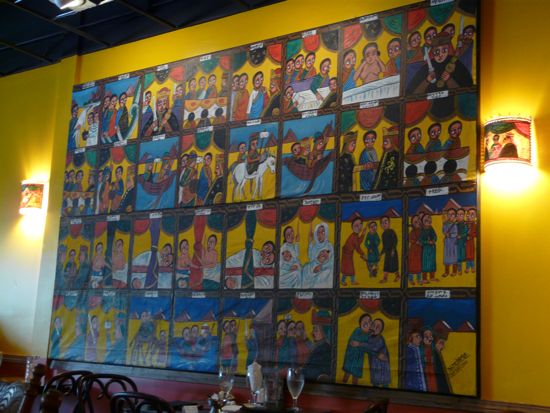
Inside, daytime, the atmosphere is serene:


Nights and weekends, they have jazz and lively evenings:


We ordered the Vegetarian mix, a variety of Ethiopian vegetable/legume based dishes, a variety of tastes and heat, served on Injera, the large, pancake-like bread. When it came, it was beautiful, and it tasted as good as it looked. They gave us a tray of extra injera, and we ate almost all of it!


It was so good. SO good. We decided we would go back for dinner, after shopping. AdventureMan took me to Macy’s, and only called me twice in the hours I was looking and trying on.
Here’s the problem. I have a style, but I am terrified someone is going to recommend me for What Not to Wear, so I try to find a couple little things now and then to update my look. I have a tactic: take armsfull of clothes into the dressing room. Try on quickly. You usually can tell immediately.
Here is what you hear. “No.” “Oh, NO!” “No” “No” “No” “Hmmm, maybe” “no” “Holy Smokes, NO!” “Hmmm, maybe” etc. Then I try on the maybes, and out of twenty or thirty items, I might come out with one or two. Some young styles are just too young, some skirts just too short, some camis just too revealing. I don’t want to be one of those pathetic older women trying to be hot, I just want to look decently attractive, that’s the goal.
Meeting up hours later with AdventureMan (I know, I know, I owe him big time for this) we laugh to discover we are neither of us hungry for dinner. We decide to go back to the hotel, but dinner time comes and we are still so full from lunch that we can’t consider dinner. Even though the dishes were vegetarian, that injera must have swelled in our bellies. We can’t eat another bite!
Dancing and Drinks
Yesterday was our 38 year wedding anniversary, and it was a great day. Last night, we went for dancing and drinks.
LOL.
Our dance class at the YMCA . . . and this month we started the waltz, which we already know how to do, but now we are learning some extras, like turns. It is barely air conditioned in the gym, if at all, so dancing is EXERCISE in the heat we are experiencing – record highs – this year.
And drinks – don’t McDonald’s smoothies count? I totally love the Wild Berry, and I try to tell myself it might even be healthy, it might even have berries, and I try not to think about the sugar. It is only now and then I have one, AdventureMan too, so our anniversary was celebrated in style. Our style, LOL, not exactly the high life, but it works for us.
Meds

I’m going to be one of those cantankerous people who gripe about their medications. I have one friend, God bless her, who when I was feeling depressed because I was going to have to take a daily medication said “You’ve managed to put it off this long??” She always knows just what to say. Somehow, I guess I had hoped for a miracle, I was going to be a person who never had to take anything. It hurt my pride more than anything else to be told that I might live as long, but the quality of my life could be dramatically effected. That made an impression on me.
As retired military, we can get some medications for ‘free.’ So last week, when my prescription had about five pills left, I called in for a refill. It was all automated, so there was no one I could talk with, and the automated voice told me my refill would be ready for pick-up today. Meanwhile, I had five pills, and seven nights to get through.
The next day I went to the Navy Hospital, where the clerk told me that they gave me seven days worth of my medication to get me through to when I could pick up.
This morning, we got there early, 8:30, and it wasn’t open until nine, so we did some commissary shopping, then went back – only forty minutes later, but the line was 19 people long, people older than me, standing in line outside in temperatures in the 90’s (F) and steamy. Almost every other person had a problem. “Sir, we don’t even see your name in the system” they say to one. “Sir, your medication just came in; there was a shortage and we won’t have it ready for you for another couple hours.” “Sir, that medication isn’t available, can you come back in two weeks?”
When my turn came, they told me my prescription had already been refilled, and I could not get another refill until the end of the month. Indeed, when I looked at the bottle the hospital had given me, it was a full refill, but I didn’t know that.
To get this free medication is a lot of work. For only a small amount more, we can have it mailed to our home address. I am thinking that might work better for me.
Recent Comments
intlxpatr on Shampoo Ginger tigerbutterya0c5ff1d… on Shampoo Ginger intlxpatr on British Soldier Kidnapped, Esc… John on British Soldier Kidnapped, Esc… intlxpatr on British Soldier Kidnapped, Esc… Wikipedia Donate Button

Amazina


Early Voting in Florida


