The Guernsey Literary and Potato Peel Pie Society
I don’t know why I didn’t read this book sooner! First, I saw people like me reading it in airports, and it certainly has a memorable title. The people reading looked totally engrossed. I’m not one to strike up conversations in airports, but on occasion, when I see people reading a book I don’t know about and it is the size of the books that book groups usually read, I will ask, and write it down, and bother the person no further.
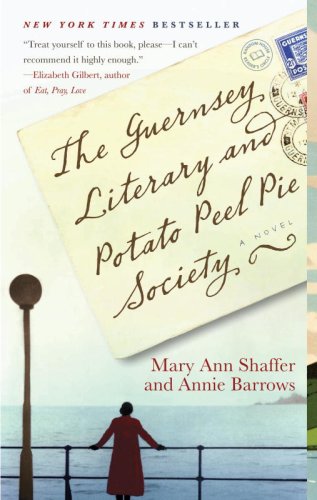
I had ordered it on amazon.com when my son’s wife’s father’s wife (and you thought Gulf relationships were complicated!) mentioned to me in an e-mail that she was reading it and that she could barely tear herself away. She and I often pass really good books and/or recommendations back and forth, so that bumped it up a few notches in priority. When it got here, I had just finished Rutherfurd’s London (oops, I thought I had reviewed it, and I haven’t, so I will,) and I thought it was a southern book, like The Ya-Ya Sisterhood or Sweet Potato Queens, no, you are right, I hadn’t read anything about it, just trusted from all the people I saw reading it that it was good, but because of the name, I thought it would be light.
Wrong!
It isn’t depressingly heavy, like The Little Prisoner was heavy, and it had some totally wonderful laugh-out-loud moments, but the subject matter was the German occupation of the island of Guernsey, in the English Channel, and an author in search of a book topic in post-war London, and a little girl born outside of marriage and cared for by a village of caring people. It is spiced up by a dashing romance, and the process of relationship building that happens in the novel, unlikely relationships, aren’t those the very best kind for spice? 😉
The entire story is told in letters. The primary voice, that of Juliet, a thirty-something author, ties all the letters together, but not all letters are to her or from her. It is a great technique for allowing many different voices and many different perspectives. From the first page, you are captivated. Right now, Guernsey is more real to me than the boxes I need to unpack, and there is a part of me that yearns to flee to Guernsey and find a house near a cliff where I can watch the sun set in the west and the clouds turn colors . . .
Here is one sample of the kind of letters you will find when you read The Guernsey Literary and Potato Peel Pie Society. Don’t wait! This is an unforgettable book!
1st May 1946
Dear Mark,
I didn’t refuse, you know. I said I wanted to think about it. You were so busy ranting about Sidney and Guernsey that perhaps you didn’t notice – I only said I wanted time. I’ve known you two months. It’s not long enough for me to be certain that we should spend the rest of our lives together, even if you are. I once made a terrible mistake and almost married a man I hardly knew (perhaps you read about it in the papers) – and at least in that case, the war was an extenuating circumstance. I won’t be such a fool again.
Think of it: I’ve never seen you home – I don’t even know where it is, really. New York, but which street? What does it look like? What color are your walls? Your sofa? Do you arrange books alphabetically? (I hope not.) Are your drawers tidy or messy? Do you ever hum, and if so, what? Do you prefer cats or dogs? Or fish? What on earth do you eat for breakfast – or do you have a cook?
You see? I don’t know you well enough to marry you.
I have one other piece of news that may interest you: Sidney is not your rival. I am not now nor have I ever been in love with Sidney, nor he with me. Nor will I ever marry him. Is that decisive enough for you?
Are you absolutely certain you wouldn’t rather be married to someone more tractable than I?
Juliet
Written by Mary Ann Shaffer and Annie Barrows, the book will challenge your ideas, will inform you of an obscure episode in World War II, will make your heart sorrow at the inhumanity of which we human beings are capable towards one another, and make your heart sing at the goodness in the human soul. That’s pretty amazing for one book.
Dar Al Thaqafa in Doha, Qatar
I have very special feelings about Dar Al Thaqafa. When I was new in Qatar, as I started to read a very special book, it fell out of the binding. Maybe the heat has melted the glue, I don’t know, but it was not my book! It was loaned to me by the Ambassador to Qatar from Japan, and holy smokes, I had ruined it!
I went ahead and read the book, and then I had to figure out how to get it re-bound. I asked around, no one had any idea. Finally, I asked at one of the Dar al Thaqafa stores (there are several in Doha) and they told me about the Dar al Thaqafa printing plant, which was not far from where I lived.
I took the book there. They said they could rebind it. It would take about a week. I didn’t even ask the cost; it didn’t matter, I had to return the book in good condition.
When I went to pick up the book, they wouldn’t let me pay them. The man who gave it to me – with beautiful bindings and end-papers – had a big prayer bump on his head. He told me he wanted me to remember that not all religious Muslims were terrorists. I almost cried. Maybe I did, a little, when I got back to the car, it is just such a perfect example of God’s grace, and how we are supposed to love one another and be kind to one another.
So this weekend, as I drove around familiarizing myself with my old secret back ways to get places, I came across the first Dar Al Thaqafa book store I ever visited, with Little Diamond, down near the Dira’a fabric souks. You would hardly know it was there, if you didn’t know it was there. We only found it because the toy vendor outside had some dancing Saddam Husseins and Osama bin Ladens – I have never seen them anywhere else. Then we spotted the bookstore – and oh, what heaven, all kinds of books, a bookstore any book lover would love:
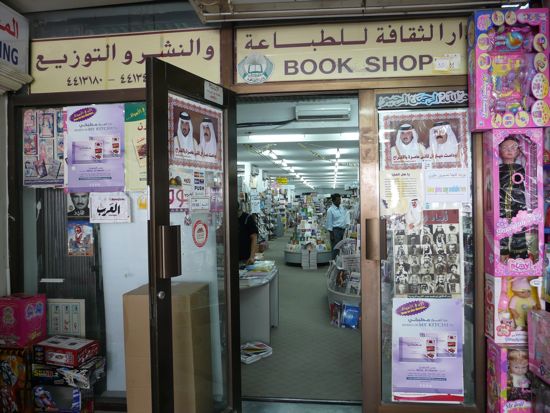
Qatar is a conservative country. You might be wondering how I can take pictures so freely – I always ask.
So I asked if I might take photos of the bookstore.
“Why” asked the man at the desk.
“I love this bookstore,” I responded, “and I take photos of places that might not exist in the next five or ten years. I try to record what was special and unique in a country.”
He beamed with delight!
“This is the oldest bookstore in Qatar!” he exclaimed! “This is the original of all the Dar al Thaqafa bookstores!” He gladly gave me permission to photograph.

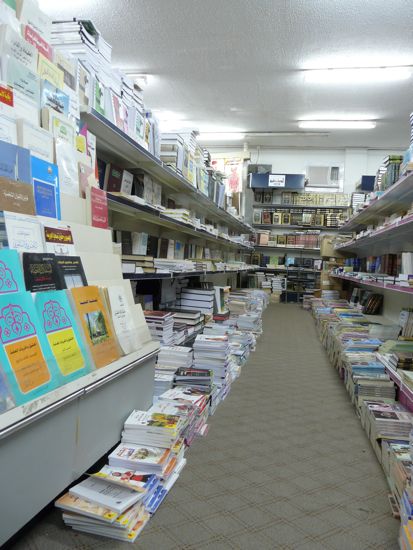
They carry textbooks, reference books, religious books, children’s books, and all kinds of school supplies, from the most elementary grades through the most specialized university courses.
You know I read and write Arabic on a very very basic level. I can proudly say my niece, Little Diamond reads and writes on a fluent level, and as we leave book stores, we are often staggering under the load of the books she buys to take home and read. This store, and the Jarir bookstores, are a couple of our favorite stops.
I had a family cookbook printed with all our best of the best recipes – the Dar al Thaqafa on Merqab did the printing and cover and binding for me. They did a great job.
As much as I like going to a Barnes and Noble, you walk into just about any Barnes and Noble and it is like walking into the same one, whether you are in Pensacola, Seattle, Houston, Charleston – they all pretty much follow the same pattern. It is calculated and more than a little sterile. Not so the Dar al Thaqafa, where books are piled here and there, pens are all in one place, children’s books in piles – you kind of have to search for what you want, but they usually have it, or can find it for you, or tell you where to go for it.
Susan Wittig Albert: Nightshade
In her ongoing China Bayles mystery series, China and her husband investigate the death of China’s father, with some amazing outcomes.
These are not heavy reading. This series features a burned-out criminal defense lawyer, who, sick of the slime and the jockying for power and position, cashes in her retirement plans and buys a shop in the small fictional town of Pecan Springs, Texas, where she opens an herbal shop, Thyme and Seasons, which sells live potted herbs, but also herbal wreaths, herbal soaps, herbal bath bombs, herbal teas, herbal shampoos, etc – and shares space with a new age shop called The Crystal Cave, a tea shop called Thyme for Tea, a catering company called Party Thyme and a personal chef service called Thymely Gourmet. She and her girlfriends have a lot of fun.
And, somehow, even in this idyllic life, mysteries seek out China, and she is often involved in crime-solving outside of her normal business. This time, her brother – the brother she never knew she had, the brother her father had with his secretary while China was growing up, wondering where her father was all the time – is murdered, in what appears to be a hit-and-run accident, but is no accident at all. Her brother was trying to get China involved with finding out how and why their father died – another apparent accident, which was no accident. When China isn’t interested (she is still very angry with her dad for what she perceives as a betrayal of her and her mother), her brother hires China’s husband as a private detective to examine the evidence. Then – her brother is killed. China gets involved.
It’s great escape reading, but you often end up learning something, too. China is an idealist, fighting crime and corruption, and God knows, there is enough of that, all the world around, to keep a legion of fictional crime fighters busy.
“After I grew up and joined the Houston legal fraternity, I began to understand what was common knowledge in that gossip-driven oil company town: Robert Bayles and his partner Ted Stone had built their legal practice on dubious oil and energy deals, questionable land transactions, and political dirty work. Their clients included polluters, looters and influence peddlers. Both Ted Stone and my father were frequent guests of the Suite 8F crowd, the group of influential conservatives who met on the eighth floor of Houston’s Lamar Hotel and collectively decided who was going to run for what political office, at the state level and beyond. To ensure that their picks – LBJ had been one of them – made it to the winner’s circle, Suite 8F slipped wads of campaign cash into the necessary pockets. Their contributions decided which politicians moved into positions of power and influence.
Just as important, their money brought them preferential treatment when the bidding opened on lucrative government contracts for dams, ships and shipyards, oil pipelines, military bases at home and abroad, NASA’s Johnson Space Center in Houston. The Lamar Hotel was demolished in 1983 to make room for a skyscraper, but the political influence of 8F lingers like a foul odor, a dirty fog. It’s the subject of books, of doctoral dissertations, of documentaries. It’s common knowledge.”

Reading Albert is a great escape. Even knowing that sweet little Pecan Springs is a microcosm of the rest of the world, not untouched by human frailty, it is a sweet place with a culture all its own. China’s life, surrounded by her loving husband, her stepson, all their pets, their friends, the places they eat, it’s all comfortable, an herbal scented different world.
Kuwait: Our History Runs in our Blood (Mohammed Ali Dashti)
Kuwaitis showing new interest in the past; Traditions, culture wiped out by ‘change’
From today’s Arab Times; you can read the entire interview by clicking here
A born artist makes it his life’s mission to chronicle the past of Kuwait using his artistic skills and his academic erudition. His brush strokes have brought to life scenes from a Kuwait straddling a dying hidebound order and a modern state taking birth. His passion drove him beyond the pale of his canvas to physically revive some lost traditions for posterity.
Read on to find out more about Mohammed Ali Dashti’s enchanting four-decade long mission and some of the precious values from the past which we have now lost and which he fears we may never recover.
Q: You are involved in a rather enchanting profession of recreating the past. What is your goal?
A: When oil was discovered in Kuwait, the state underwent a rapid transformation. The change was very sudden and very fast. In a short span of time, Kuwait leapt from an ancient system to a very modern state. This change wiped out many elements from our traditions and culture.
Until sometime ago, the people of Kuwait were disposing of the antiquated paraphernalia from their homes. But now, there is a sudden interest in these items, and now they are buying them back to preserve the past. It is the only way of holding fast to our roots and knowing how our forefathers, not from a distant past, conducted their lives. Kuwaitis are buying doors and furniture used in the old Kuwaiti homes.
We, as an organization, are working to preserve our history for posterity to learn and know. We produce ancient household items like the Mubkhar (incense stand) with which our grandparents used to scent clothes and fan fragrant smoke around the house.
In the old days, we had no airplanes or cars. The only way we were connected with other places in the region was the sea. Kuwait, owing to its geographical advantages, became a center for shipbuilding. Kuwaitis were experts in making dhows for different purposes. Boats were built in a variety of sizes and designs based on their use. There were cargo ships, fishing boats and vessels for pearl diving. The size of boats ranged from a meter to up to 6 meters. This is another aspect of history that we are trying to preserve and we have been recreating many of the original models our ancestors voyaged in.
We showcase our creations at universities, malls, schools and other places. Thus we have been able to generate interest in our past. We take our craftsmen along and explain to the present generation about Kuwait’s history.
Q: What do you think has created this new interest in the past among Kuwaitis? Can this be read as a reemergence of old traditional values?
A: Our history actually runs in our blood. It is very difficult to detach ourselves from our cultural roots. And so whenever any nation travels too far away from its true origins, at some point of time, it stops and tends to recall the past. History is what gives our existence contextual relevance. And we often try to find it by clawing back into our past, by remembering the way we came through.
Q: You said you make old-model boats. Aren’t you specialized in Warjiyas, the simplistic fishing boats from the past? Which is the biggest boat you have ever built?
A: The biggest boat I have ever built so far is 6 meters long. I make Warjiyas because it is most symbolic of our old fishing traditions. These boats were very famous among the people on Failaka Island. They used it for fishing and it is very easy to construct.
The specialties of Warjiya are: it is wholly made of palm tree to the last detail. The body is built with spines of palm leaf, which are trussed using ropes made our of palm fiber. It is very light and so easy to carry.
Warjiyas sort of became extinct about 60 years ago with the advent of oil and the independence of the state’s economy from fishing and pearl diving. We can’t return to those ancient livelihoods, and so we are now planning to start an annual Warjiya race to keep the tradition alive. The first race will be held in September this year.
Q: Do you have any plans of reviving even the tradition of fishing along with these boats?
A: No, as I said, we can’t actually go backwards to keep our original traditions alive. So, these things can only happen in a token manner. The aim is to keep the future generations aware about how their grandfathers and people before them lived. We don’t have to make our children live a similar life to make them appreciate the ancient way of life.
Q: All over the world there is great demand for antique items. Is what we are seeing in Kuwait a similar trend — a fascination for antique pieces — or is it more than that?
A: No. It is not just a fad in Kuwait. The people really care for the past and there are efforts at all levels to preserve relics from the past or have their duplicated versions. These efforts have been sincerely undertaken by Kuwait National Museum and other private museums in the country, and between them they share a vast treasure of valuable relics and information about Kuwait’s past.
The government is also giving due encouragement to all of us to help us in our endeavors. The ministry of information is doing everything within its means to promote our traditional and cultural heritage in other Gulf countries and beyond.
Sarrayat (Weather in Kuwait 9 April – 13 May)
I found this at Kuwait Agrifood Website as I was busy looking for Jasmine Farms, who grow some of the world’s greatest spinach. I love knowing that this season has a name, that it is not just me, it really is HUMID from day to day, and that the temperatures fluctuate wildly in this part of “warm Spring.”
SARRAYAT (9thApril – 13 th May )
This is the season of sarrayat ( Local thunderstorms), they usually develop in the afternoon or during night and are occasionally accompanied with severe dust storms during which visibility may fall to zero.
The resulted rain may be very heavy and usually occur during a few minutes (maximum intensity of 38.4 mm during 20 minutes was recorded on 4th April 1967 at Kuwait International Airport ).
The south – easterly winds during this peroid become hot and humid . Air temperature is characterized by sudden changes and may drop to 10C within one minute .
Temperatures from one day to another are changeble by particularly during the period 11th-30th April;they may rise to the summer mean level for a few days then drop to a noticable degree due to the influence of the north – westerly winds .
Seabreeze is predominant during May, shifting the north -westerly winds of the morning to easterly in the afternoon, tremperature mean ranges between 30C at the beginning of this period and 40 C at the end .
Thunderstorms are likely to occur during the intervals : 8 th – 12th , 16th, 22nd, 26th, April and 7th – 10th May .
Barbara Nadel: The Ottoman Cage
I got the recommendation for this book from Little Diamond; we have a long family tradition of trading books back and forth, my sisters, our children, even my mother; we are all sending books and exchanging suggestions all the time. I know I can count on Little Diamond and Sparkle for particularly good recommendations, and they never disappoint me.
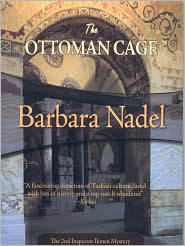
When The Ottoman Cage arrived, I was put off by the cover. “Who’s Likely to Like This?” the cover asked – it seemed like screaming to me – “Fans of Donna Leon and exotic, atmospheric locales”
Remember, I am in a dark time, taxes, turbulence, destabilization. . . I am easily disgruntled when I am vulnerable like this. I don’t want to think I am so predictable. I love reading Donna Leon! So I am predisposed (grumble grumble grumble) NOT to like Barbara Nadel.
I fail miserably. The first five pages I am resisting. By the sixth page, I am ready to stay up all night to read this book (I don’t really, but I did finding myself making more time to read so I could find out what happens next.)
It is like the Donna Leon series in that while the plot is original and interesting, the real focus is on the police inspector, his crew, the relationships with friends and characters, the bureaucracy, and the way systems and institutions function in modern day Turkey.
One particular relationship was of great interest to me, that of Suleyman, who dutifully married his first cousin. They both tried very hard to make it work, but when we meet him, we discover that the marriage has become a painfully dry and desolate place, where each lead their individual lives, with very little of the relationship together.
Another character is detective Cohen, a rare Jew in the police force described as follows:
When one has been known and admired as a prolific womanizer for most of one’s adult life, any change in that situation can come rather hard. Although Cohen had been married since the age of nineteen, he had never let that fact or indeed his rather short stature and dishevelled apearance hold him back from the most ardent pursuit of other women. Jokey charm, of which he possessed copious amounts, had always seen him through. The knowledge that women love a man who can make them laugh had successfully taken him to many bedrooms and had, quite frequently, resulted in his being asked back again. Until this year.
Whether it was because now he was on the ‘wrong’ sied of forty five or just a patch of ill fortune, Cohen didn’t know but the fact was beyond dispute. Women, it seemed, didn’t want him any more. The rbuffs and even in one notable case the cruel sound of mocking laughter were hideously painful for him to bear. Even his long-suffering wife, who had for so many years pleaded with him to leave other women alone and attend to her, had lost interest. He’d tried to find a little comfort in her arms the previous night when he found that he couldn’t sleep, but she, like all the lithe little girls that he still so desired, had just sent him on his way, back to his customary couch, flinging her curses in his unfaithful wake.
It was, Cohen would have been the first to admit, his own fault. Had he bothered to try and be faithful to Estelle he would now, in his middle years, have both a friend and a over with whom he could take comfort as the lines overwhelmed his face and the loose skin around his middle began to sag. His wife was, after all, ageing like himself and, unlike the pretty little tarts he hankered after, unable to point mocking fingers at his inadequacies.
The plot hinges on a dead boy, a beautiful boy, found dead, alone, on a bed in an empty, tasteful but unlived in home. Who is he? Why is he here? Why is he dead?
We meet the gossipy neighbors, we meet the Armenian community, we meet some of the lowest characters you would ever hope to meet, the kind the police deal with every single day. Nothing is simple, one single clue leads slowly, painfully to another. I give credit to Nadel; she relies on good honest police work, chasing down the clues, going through the stacks of old files, interviewing unsavory lowlifes; the things good police really do to solve their cases.
More than the plot, I loved the rich and intricate textures of this mystery novel, I loved the descriptions of the interiors and the interior lives of the characters. Nadel has that in common with the other writers I read serially – Leon, Pattison, Qiu Xiaolon, James Burke and Peter Bowen. It is another rich entry into the genre of the “mystery novel set in exotic, atmospheric locations.”
Definitely worth a read!
In Xanadu: A Quest by William Dalrymple
This book was on my (huge) “Read Me” stack, and I picked it up for a change of pace. As I started reading, I wondered “how did this get there?” My first instinct was it was a recommendation from Little Diamond. As I was reading, however, I came across a segment that was what our priest had read in church around the Feast of the Epiphany about the birthplace of the wise men who came seeking the Christ Child after his birth. I wrote down the title and ordered it from amazon.com (which has some copies used from 72 cents).

William Dalrymple wrote this book when he was a mere 22 years old. He and a travelling companion took off to trace Marco Polo’s journey from Jerusalem to Xanadu, where he was taking oil from the sanctuary lamp to Kubla Khan.
In a world where we have all been taught to be so careful, they take incredible risks. They travel on the cheap – staying in fleabag hotels, sometimes sleeping “rough”, i.e. out in the open. They travel any way they can – an occasional train, but more often a truck, a bus, whatever is going their way. One very long segment they travelled on top of a pile of coal.
They travel from Jerusalem up through Syria and into Turkey, then turn east and cross Iran, Pakistan and Afghanistan to China. They have some amazing adventures, see some astounding scenery and because of their mode of travel, have a lot of time to talk with their travelling companions or people in the cities where they are staying.
I am blown away that an unmarried couple would cross Iran, Pakistan and Afghanistan. I guess they told people they were married to share a room (they were on a budget) and they were only friends, not a couple, but what a risk. I am astonished that they were never asked to produce a marriage license or any proof of marriage when they stayed in hotels. I am astonished at the girls (one left in Lahore and another joined him, but these are girls who are friends, not anything more) would travel on the backs of trucks full of men, and never blink an eye.
The book is occasionally hilarious. Most of the hilarity results from foods they have to eat – sometimes it is the only food available – or from misunderstandings because of lack of a common language, or due to their frequent bouts of diarrhea, what I really liked about the author was that he was rarely pompous, and when he is funny, it is usually about some conversation he has had, or some mistake he has made.
One of my favorite parts of the book happens in Iran:
As we sat waiting for the bus to Tabriz, the next town on Marco Polo’s itinerary, we watched the mullahs speeding past in their sporty Renault 5s. Iran was proving far more complex than we had expected. A religious revolution in the twentieth century was a unique occurence, resulting in the first theocracy since the fall of the Dalai Lama in Tibet. Yet this revolution took place not in a poor banana republic, but in the richest and most sophisticated country in Asia. A group of clerics was trying to graft a mediaeval system of government and a pre-medieval way of thinking upon a country with a prosperous modern economy and a large and highly educated middle class. The posters in the bus station seemed to embody these contradictions. A frieze over the back wall of the shelter spoke out, in the name of Allah, against littering. On another wall two monumental pictures of the Ayatollah were capped with the inscriptions in both Persian and English:
BEING HYGENIC IS DIRECTLY RELATED ON THE MAN’S PERSONALITY
and:
ALLAH COMMANDS THE RE-USE OF RENEWABLE RESOURCES.
We had expected anything of the Ayatollah. But hardly that he would turn out to be an enthusiastic ecologist.
The challenge of this journey is to follow as closely as possible the path Marco Polo took, but two segments of the journey go through off-limits areas. They find a way into one, to discover later it is an atomic testing area, and the second, at the very end, around Xanadu, they find receptive Chinese officers who take them to have a brief glimpse of the ruins of Xanadu while booting them out of the area. As they stand in Xanadu, they repeat a poem that every American child grows up with in English Literature:
In Zanadu did Kubla Khan
A stately pleasure-dome decree:
Where Alph, the sacred river, ran
Through caverns measureless to man
Down to a sunless sea.
So twice five miles of gertile ground
With walls and twoers were girdled round:
And there were gardens bright with sinuous rills.
Where blossom’d many an incense-bearing tree:
And here were forests ancient as the hills,
Enfolding sunny spots of greenery.
(Coleridge)
I liked this book. Dalrymple is a history major, and often quotes from historical – even obscure – texts to illuminate what he observes. I think I may look at a couple more he has written since.
Dewey: The Small-Town Library Cat Who Touched the World
I’ll admit it, I was looking for a quick read, and after resisting this book for months, I picked it up. As much as I love cats, I am not that much into cute, nor am I particularly sentimental, and I don’t like having my emotions manipulated. Just one look at the adorable cat on the cover told me it was going to be one of those slick, fairly superficial feel-good kind of books.
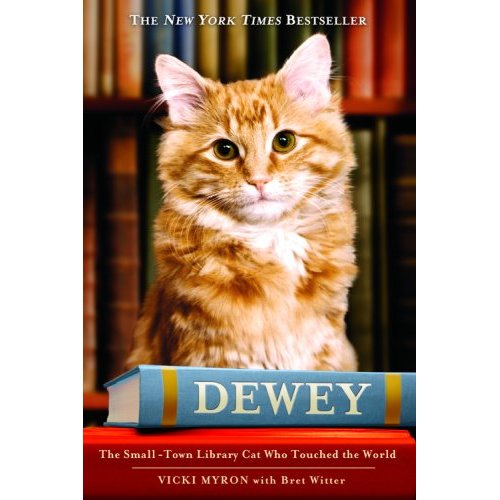
See what I mean? Just look at that cover. Look how that cat just looks right into your eyes. This book is going to suck you in.
This book was a surprise. Yes, it was touching. Yes, it was about a tiny little kitten who almost died, stuffed in a below freezing book-return box in an northern Iowa country library in the middle of one of the coldest nights of the year, and yes, he ends up living in the library for almost 20 years and brightening the life of the people who come into the library. Yes, Dewey is adorable, and funny, and loveable. Yes, the book is an easy read.
It is also, surprisingly, an uncomfortable read. It is not overly sentimentalized. It is also the story of a woman, Vicky Myron, who grew up on one of the northern Iowa farms, and she tells us about the quality of a life that is no longer available in America, how the safe, secure, intertwined family life of rural Iowa has greatly disappeared. The hard times we are working our way through in 2009 is an echo of hard times suffered in rural America, as small farms are gobbled up by the more efficient super-farms, owned by conglomerates, not by families.
She tells us about her physical struggles with a disastrous childbirth, and its two year aftermath, and she tells us about how her marriage to a lovable alcoholic died, almost without her being aware it was dying. She doesn’t spare herself, as she discusses her problems, as a single mother, on welfare, trying to get a college education and raising her daughter, who couldn’t wait to move away from her. She talks about her challenges remodeling an old cement reading library into a modern, airy information resources center serving the town and the surrounding community, at the same time she is working on her Masters in Library Science. She describes her challenges dealing with the town bureaucracy. It is not always comfortable, or feel-good reading. It takes the book out of the superficial, and gives you something to think about.
Intertwined in all of this is Dewey Readmore Books, the cat who comes to live in the Spencer, Iowa, library, and who is eventually featured on TV shows around the world. He responds to requests that he pose, that he perform, he seems to know who needs a little love and is quick to give it – he is a great main character. For me, some of it was also uncomfortable, kind of a stretch – like that the cat would be in the window waving to her every morning when she came to work. Well . . . maybe . . . I’ve almost always had cats in my life, and few have every shown such consistent loyalty. Cats are . . . well, cats. It’s the way God made them. 😉
What I love is that this book is about libraries, and the amazing (mostly) women who run them. These librarians have had a huge influence on my life, and the life of AdventureMan, challenging us to explore outside our boundaries and supporting our aspirations, recommending new ideas and new ways of serving their communities. Librarians are part of the backbone of America.
I read this book in just a few hours. It just isn’t that complicated or challenging; it is an easy read. It has been a #1 New York Times bestseller, and copies of the book are still selling strongly. It currently ranks #105 in all time book sales on Amazon.com – can you imagine how many books that must be? The book is sweet, but #1? I can only imagine so many people are buying and reading it because it looks like 1) a Feel-Good book and 2) an easy read.
Dining in Doha: Khazana
“There’s this new Indian restaurant not to far from here,” said my good friend, Texas Grammy, as we left the Souk Waqif Hotel. “Let’s just walk around and see if we can find it.”
We always love walking around in the souks. We used to back when it was “off-limits”, considered a dangerous place for Western women to be. We always figured if we dressed modestly and kept kind of quiet, we wouldn’t have any problems – and we never did. We rarely saw other Western women down at the Souk Waqif then, but mostly we went early on the hot summer mornings, so we didn’t see much of anyone except the veiled and abaya’d women who shopped there regularly.
We walked around, noting the changes, but eventually had to admit defeat – we couldn’t find the restaurant. As we wandered, we started asking people. You know how once directions take more than like five turns, you can’t remember them all? So we would go one or two turns, then ask again. The last time, the sweet shopkeeper’s assistant walked us all the way there. It was actually only about a block from the hotel, but in the opposite direction from which we had walked.
It was worth the walk!
Khazana is a green oasis in the middle of a dusty souk area.

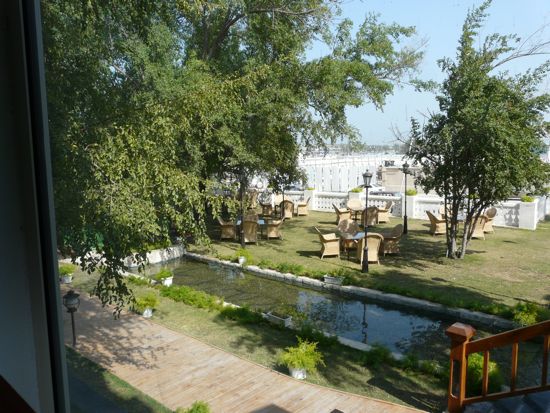
It’s built in one of the historical buildings, so they had to preserve all the original walls and windows. It means there is not one huge dining room, but several small, intimate dining areas:
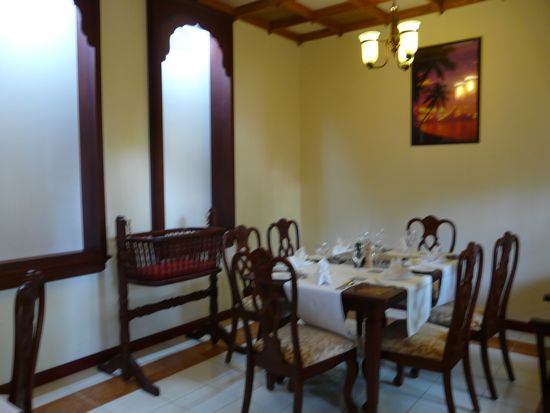
We ordered fabulous foods, and most of them I didn’t get a chance to photograph; we were busy chatting and busy catching up and having such a good time! But the food is FABULOUS. Fresh. Tasty. Spiced just enough to capture your interest, not enough to blow your brains out.


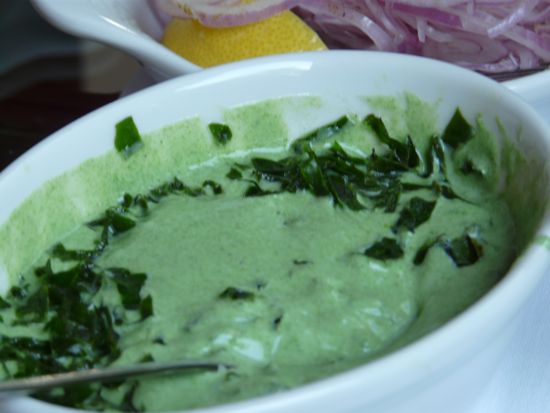

The service was attentive and charming, without being overly intrusive. The tea was excellent. Everything about the meal was refined and delicious – the food, the setting, and the excellent service.
We were told that the restaurant was there because the Amir of Qatar wanted it there. He is a man of excellence, and he wants excellence for Qatar. We asked if he dined there, and the waiter looked around, and his eyes gleamed, and then he whispered “we are not allowed to say.” He had a great big smile on his face as he said it, full of pride.
I would dine there again, in a heartbeat. I am betting we will need reservations the next time. 🙂
Vote Now! The Great Kuwait Market Magic Challenge
We had some thoroughly splendid contributions to one of my favorite challenges of all, the Great Kuwait Market Magic Challenge.
Here are the challengers – please visit their photos before you vote:
DaisyMae
Bu Yousef
ShoSho
TeaGirl
Fewer entries – but every entry a gem. This is going to be a very difficult vote.
Thank you to our great photographer-participants. Your photos were truly Market Magic. 🙂 It was a thrill for me to see each and every one.
Recent Comments
ExpatAlien on What Country am I Living … intlxpatr on Yellowstone: Old Faithful to C… Michelle on Yellowstone: Old Faithful to C… Cathy on No Grown-Ups in Charge intlxpatr on Waiting for Snow Wikipedia Donate Button

Amazina


Early Voting in Florida


 Here There and Everywhere