Leaving Civil Seattle
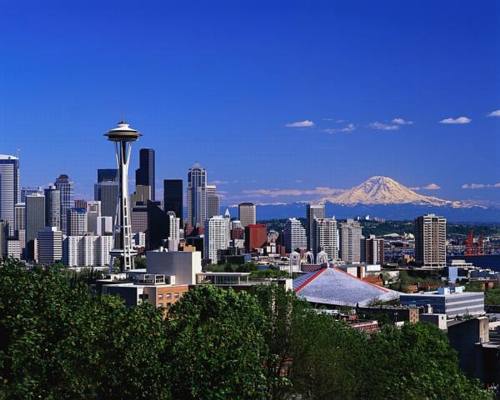
No, I didn’t take that photo, but it was exactly that kind of day. It was beautiful when I got to Seattle, it rained buckets one of the days I took my Mom shopping; she was such a good sport as we raced across the parking lot to the restaurant, both getting soaked, and then it was beautiful again for Mother’s Day and departure day.
Had juicy, laughing, crying visits with two very long time friends, feasted my eyes on all the rhododendrons growing so luxuriously, dancing with their intense colors in the Seattle gardens, watched the ferries coming in and out of little Edmonds. It was heaven.
 This is really a Chihuly rhododendron 🙂
On the way to the airport KUOW, the local National Public Radio station, mentioned, very politely, that there was a huge accident on I-5 going South, blocking all lanes of the freeway, and would I please consider taking an alternate route south, and gave a couple of suggestions.
So so Seattle. So civil.
Rarely do I hear a car beep in Seattle. People actually do the “after you” gesture – all the time. It takes some getting used to. 🙂
As soon as I got there, I opened the window where I was staying and just breathed the fresh sweet air. It always smells like fresh mown grass when I drive into Edmonds, and then the salt air. It is cool and refreshing. When the birds settle in for the night, there are the sounds of a thousand bird voices, loudest of all the seagulls, squawking at one another while the others are all doing sorter nestling sorts of sounds.
There are trains that go through in the middle of the night, but you learn to just wake up a little and say “oh, the train” and you go right back to sleep.
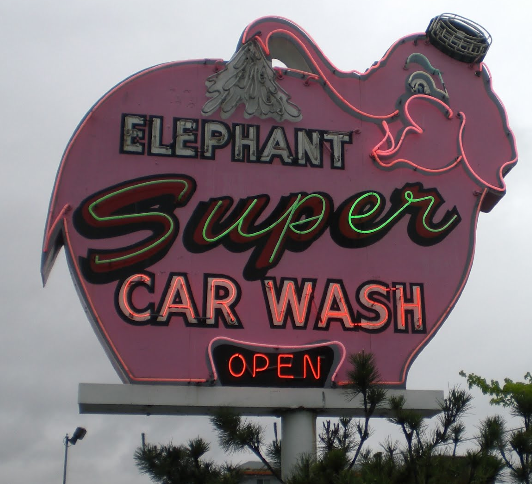
I took highway 99, which at one time was the major north south road, and while it was a little crowded, due to cars like me taking the alternate routes, it was peaceful and steady, with no delays. I haven’t taken the route for a long time, and got to see an old truck-stop my youngest sister mentioned, and I got to see all the things that are no longer there – the teepee pancake house, the elephant car wash sign. Things change. Taking 99 South took me a little longer than normal, but sometimes it can take a long time on the interstate, too, even without a major accident. Seattle, like Kuwait, has outgrown its infrastructure.

It seems to be the story around the United States. Who is paying attention to the decaying bridges, the once smooth and now potholed highways? Who is checking the buildings in the abandoned city centers and malls?
When I turned in my rental car, the little girl checking me in was in hijab and looked Sudanese. She asked me where I was from, and I told her, and I asked where she was from and she told me Cleveland. LOL.
The Seattle Airport is a gem, full of art works, you just have to take the time to look. Off in corners, they also have free wi-fi, free power plugs, Chinese take away and quiet areas where people can read or use the internet. For some reason, I am TSA PreCheck. Someone said it is age related, but AdventureMan looked it up online and there doesn’t seem to be a connection. I love the shorter line, and not taking off my shoes.
I have plane karma. Just before the plane was loaded and ready to go, the two inside passengers for my row arrived – a basketball player and his also-tall Mom. Behind us arrived a Mom and her two babies – in two seats. The doors closed. There were only three empty seats in the plane, and they were across from me. The basketball player jumped into the window seat and the woman sitting in the aisle seat behind me jumped into the aisle seat across from me, and the Mom and her babies had all three seats to themselves, while the rest of us had room for knees and elbows and room to breathe . . . it makes all the difference.
I like Pensacola, and I like our life here. I am already missing the beauty and coolness of Pensacola winter, dreaming of the beauty and coolness of Seattle summer, LOL.
Pensacola Tough @ Grafitti Bridge
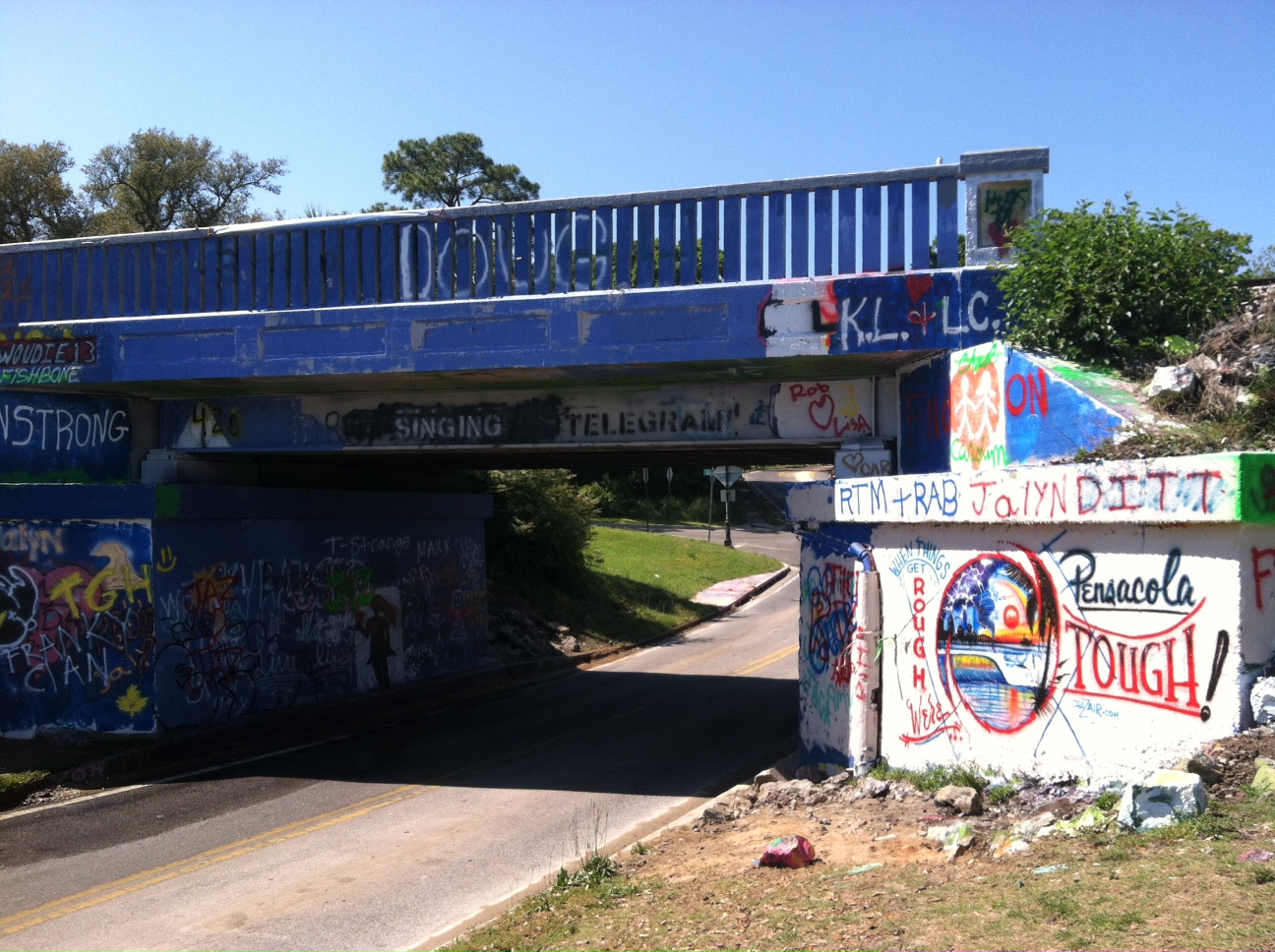
On my way home from a great Algerian pastry treat at SoGourmet, I passed Grafitti Bridge. Grafitti Bridge is one of Pensacola’s quirks. Every month – sometimes every week, even sometimes daily – the bridge is repainted. Sometimes it is that BubbleGum pink of Breast Cancer Awareness, with names of the fallen and names of survivors, sometimes it is Gay Pride, sometimes it is who loves who, or who is a first class jerk, sometimes it is Class of TwoThousandWhatever – it can be whatever someone feels passionate enough about to buy the paint and make it happen. No one gets too bent out of shape about it. Occasionally profanity will show up, but very shortly someone else will spray paint out the offensive word, or, which I love, alter it to have an entirely new meaning.
As I drove past today, I saw a lightning storm, well done, I couldn’t imagine how they had captured what it was like seeing so many strikes at once, and then I saw “Pensacola Tough.” By that time, I was through the bridge, so I had to circle and go back. I had to park, and take a closer look. And then I had to photograph it, and post it here.
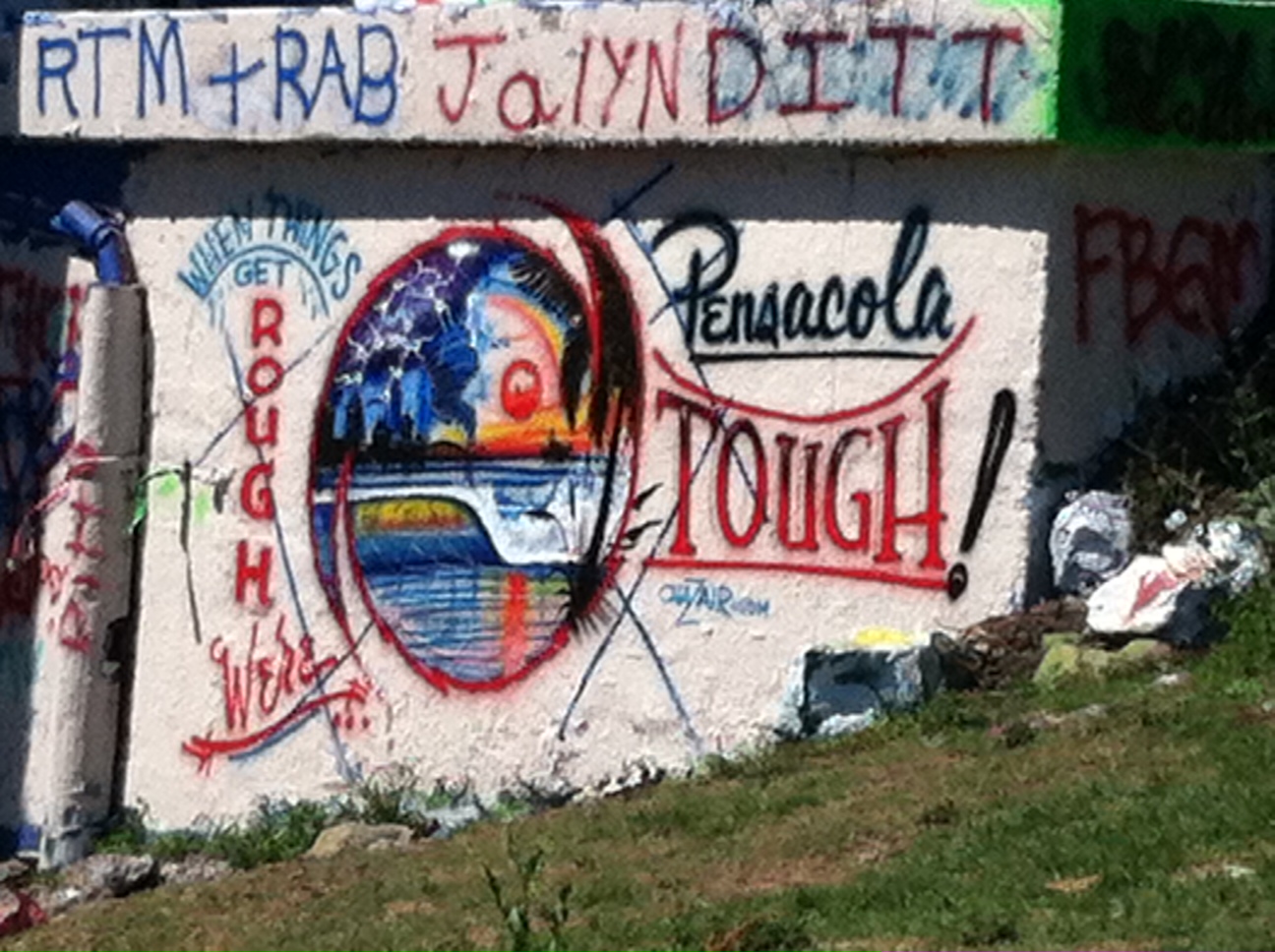
Pensacola Tough. Pensacola got an award as the Toughest City in the USA, based on a criteria that measured percentage of felons in the population (it’s OK, it keeps us humble), sports heros, the number of military personnel, violent crime statistics, etc. It isn’t an award cities run for.
And yet, as the raging water abates, tales of heroism and helpfulness abound. While there have been bands of looters at an apartment complex housing the low-income workers in Pensacola, there have also been bands of volunteers scouring the county, helping clean out houses, pull out sodden carpeting, moving soaked furniture to the curbs for pickup, pulling out drywall and ceilings to prevent black mold. In today’s Pensacola News Journal, there is a story of a man who worked just above where the Escambia County Jail exploded and fell through the floor, breaking legs, ribs and assorted bones. He was paralyzed. His co-worker, also hurt, saw him with his head under water and pulled his head out, and held his head out for over an hour while waiting for help to arrive. She got tired, but the alternative was letting him die. She didn’t let go.
Pensacola Tough.
“When Things Get Rough . . . We’re Pensacola Tough.
You gotta love this place
Kuwait: A Dream Suspended
Thank you, Desert Girl, for making known this wonderful video on earlier times in Kuwait. It brings back so many wonderful memories of our time as a young family in the Middle East and North Africa in the late 70’s and 80’s.
And thank you Ammar Alabbad for a wonderful production. I love this film.

Kuwait Citizens Cite ‘Wasta’ (Undue Influence) as Problem for Crime Prevention
From todays Arab Times Kuwait:
‘Wasta’ Major Setback In Battle Against Crime; Some Police Not Keen To Tackle Issues
In this week’s online poll, the Arab Times probed the factors that are blunting the efforts to fight crime in Kuwait. A majority of the voters felt that Wasta is a major setback to the fight against crime. About 56% of the voters felt this way.
Speaking to the Arab Times, respondents said criminals use Wasta to escape the long arm of the law. “I know a citizen who routinely cuts red lights. He pats his back and says that he has Wasta to dodge penalties. This is a traffic offence, and may not be considered a crime. However, if this is possible in the case of traffic offences, it should be possible in major crimes too.” Another respondent shared a personal experience when one of his neighbors had a conflict with the landlord.
The neighbor decided to go to the court, and he was asked to pay the rent there. However, the person in charge of collecting the rent in the court gave lame excuses and avoiding collecting the amount in time. The landlord used this as a pretext to procure an ejection notice from the court. “It looks like some authorities in the court were in cahoots with the landlord to deny justice to my neighbor.”
About 13% of the voters felt that law keepers themselves become law breakers, and that’s why it becomes hard to fight crimes. Respondents cited the example of the recent case that made headlines when cops raped a woman in her flat, entering her flat under the pretext of looking for residence violators. “This is an example of policemen stooping to the lowest level, becoming worse than criminals.” Others brought up a report that Arab Times had published some time back about the ‘Trolley Mafia” in the airport. “The workers in the airport literally extort money from the passengers forcing the trolley service on them for a charge of 500 fils.
They do not let us take the trolley.” Respondents said it’s highly improbable for this mafia to work in this fashion without the knowledge and blessings of the concerned authorities in the airport, especially after the report coming in the newspapers several times. One of the respondents said that he had an altercation with one of the workers in the airport over the trolley. “I used an expletive in the course of the heated exchange, and the worker complained to a policeman in duty.
The cop came over to me to inquire if I had used the bad word, but as he didn’t speak our language I told him that it was only an impolite word, and not a bad word. The officer went to the extent of calling another passenger, who spoke our language, to verify if what I was saying was true. To my good luck, the passenger concurred with me.
The officer let me go, but then I complained to him about the worker who was trying to extort money from me. The officer walked away as if he couldn’t care less.” The trolley mafia is continuing to operate without any hassles, and people suspect the tacit support of the authorities.
About 16% of the voters said that the police are not very keen on solving crimes, and that is encouraging criminals. Other reasons for the increase in crime in the society, according to the poll, included unemployed youth wanting to make quick money, corrupt politicians and crime getting accepted as a part of life. However, these only won very small percentage of votes. A very tiny fraction of voters felt that criminals are getting smarter.
By: Valiya S Sajjad Arab Times Staff
Saudi Cleric Claims Physical Education Classes First Step Towards Infidelity and Prostitution
Abdullah Al Dawood, Saudi Islamic Cleric, Claims PE Classes For Girls Is First Step To Prostitution
Saudi Arabia is getting closer to adding physical education classes for girls to public schools, but some conservative Islamic clerics are slamming the move as a “Western innovation,” according to the Wall Street Journal.
After the kingdom’s advisory Shoura Council voted 92-18 on Tuesday to advise the Ministry of Education to look into girls’ P.E. classes, conservatives made their ire known on social media — and they got very dramatic.
“If we keep silent about the step of adding PE classes to girls’ schools then we are giving the Shoura Council a green light to continue the steps of Westernization and these steps will end in infidelity and prostitution,” tweeted Abdullah Al Dawood, according to WSJ.
Saudi Arabia is currently facing a health crisis, as a study found that a shocking 44% of Saudi women are obese.
Though gender roles remain traditional in the Islamic nation, Saudi Arabia made history two years ago when it included women on its Olympic team for the first time.
Reuters reports that the Shoura Council asked the Ministry of Education to look into gym for girls with the caveat that all classes conform to sharia regulations regarding attire and gender segregation.
The Last True Detective
Every now and then AdventureMan and I find a series we really like, and True Detective, Sunday nights on HBO, is one of those. From the first notes of the melancholy theme song playing over shots of rural Louisiana sights, cane processing plants, bayous, angst-ridden detectives, and shots of the crime scenes, you know this is not going to be your typical detective series.
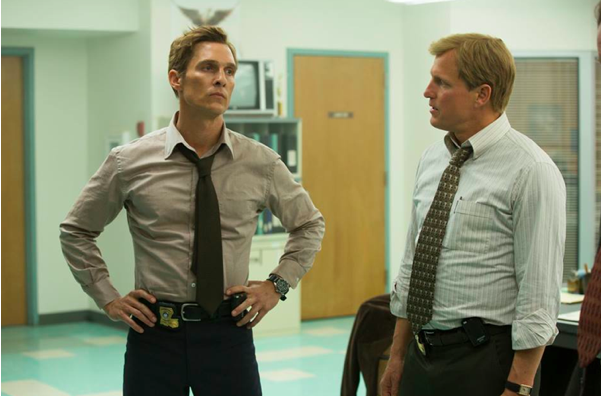
It is pure HBO, not-suitable-for-children kind of stuff. The two detectives investigating the murder in episode one are damaged, flawed men, each haunted by different but equally destructive demons. These are the good guys, trying to get the job done in spite of all the barriers thrown up to prevent them digging too deeply where it might inconvenience the bad guy(s).
Tonight is episode 8, the last episode. We have been waiting all week, hoping they will tie all the dangling, intriguing threads together. Hoping that neither of these two detectives, whom we have grown to like and maybe even admire, are involved with the crime.
It’s HBO. You never know.
Giving Birth to Gun in the South Sudan
This is the newest blog entry from my friend Manyang David Mayar in the South Sudan He visited Pensacola as part of an IVLP program with our Gulf Coast Citizens Diplomacy Council:

Pregnant women fleeing the fighting in Jonglei state, South Sudan.
I was in the town of Bor when fighting broke out last month in South Sudan. I managed to escape the town despite being shot in the arm. But many other people had a far tougher time – people like Nyiel Magot, nine months pregnant and faced with the awful choice of staying in Bor’s hospital or fleeing into the bush.
Against her doctors’ advice, Nyiel decided to escape the immediate danger, and with her five children, took a narrow path out of town which was packed with people also heading to safety.
But, she told me, with every step she took, she grew weaker and more and more people overtook her.
“I was really tired and the pain became really unbearable,” Nyiel said. “I knew the time had come for me to give birth and I had to get out of Bor immediately to escape the attackers.”
Giving birth in the bush
Later that evening, the pain finally forced Nyiel to stop. Instead of a hospital ward, she found an abandoned grass-thatched house.
Luckily, there was a traditional birth attendant nearby who used her bare hands to help Nyiel deliver a healthy baby boy.
But the cold nights and hot days of December in South Sudan soon started to take their toll on the new born and reports of an imminent rebel attack forced Nyiel and her family to leave their hideout.
They walked for days until they crossed the River Nile and came to a large camp for displaced people in Awerial. And then her baby caught diarrhoea and started to vomit.
He was rushed to a hospital in Juba where, after days of treatment, he recovered.
A child of conflict
It was in the hospital in Juba that I met Nyiel and heard her story – and also learned the name of her little baby.
Nyiel had called him Matuor, the Dinka word for ‘gun’, because he was born amid gunfire.
As the conflict continues in South Sudan, I fear he won’t be the last baby born in the bush with such a name.
Babayaga by Toby Barlow

You know how books come your way in coincidental ways? Amazon.com had told me I needed to read Babayaga, so I ordered it. I’ve always loved mythologies, I devoured them like candy when I was young, always looking for more. Babayagas are very old, and exist under many names in most cultures – elderly women who usually deal with concoctions, often medicinal, who live alone. In the west, they were often called witches, in the Slavic countries, babayaga, and it seems to me there is an old woman used to scare children in the Gulf, too. It seems to be a cross-cultural phenomenon.
Here is what Wikipedia has to say about Babayaga:
Baba Yaga is a witch (or one of a trio of sisters of the same name) in Slavic folklore, who appears as a deformed and/or ferocious-looking elderly woman. She flies around in a mortar and wields a pestle. She dwells deep in the forest, in a hut usually described as standing on chicken legs, with a fence decorated with human skulls. Baba Yaga may help or hinder those that encounter or seek her out, and may play a maternal role. She has associations with forest wildlife. Sometimes she frightens a hero (e.g. by promising to eat him), but helps him if he is courageous. According to Vladimir Propp’s folktale morphology, Baba Yaga commonly appears as a donor, a villain, or something altogether ambiguous. In many fairy tales she kidnaps and eats children, usually after roasting them in her oven).
Andreas Johns identifies Baba Yaga as “one of the most memorable and distinctive figures in eastern European folklore,” and observes that she is “enigmatic” and often exhibits “striking ambiguity.”[1] Johns summarizes her as “a many-faceted figure, capable of inspiring researchers to see her as a cloud, moon, Death, Winter, snake, bird, pelican or earth goddess, totemic matriarchal ancestress, female initiator, phallic mother, or archetypal image”.[2]

Barlow’s BabaYaga includes all the backstory, inserted here and there, the Russian purges, revolts, revolutions, the wars, the mud, the snows, following the troops, and several different Babayaga, while focusing one one, the beautiful and mesmerizing Zoya, who lives in a magical post World War II Paris. She in unforgettable – unless, of course, she has woven a spell to muddy your mind and make you forget.
What I love about this book is that if it were true, you would still think it is fiction. If every single thing happened just as Barlow wrote it, you would never believe it. LOL! A wicked sour old babayaga turns a police detective investigating a murder into a flea; he finds it a novel experience and manages to make things come right even as a flea.
A young American man, Will, loving living in Paris, works for an ad agency and also for THE Agency in the heady days of post war Paris, where the rules are not yet in place and lines are fuzzy. Falls for a witch with a long history of loving and killing men, but that’s life. Is it better to love and lose than never to have loved? What if your love is a gorgeous babayaga who helps you live life with a vibrance and intensity you have never experienced?
There is a long, intricate, time-appropriate adventure/spy/industrial-scientific plot which I am not sure I entirely followed, with murders and shootouts and the Paris jazz and club scene, and it didn’t matter one whit whether I could follow the plot line or not, it was a wild ride of a novel and a lot of fun. 🙂
Qatar Wins Guiness Record for Largest Flag

As Qatar goes into National Day frenzy, they capture the title for World’s Largest Flag. Mabruk, Qatar!
As the country gears up for National Day celebrations, a Qatar national flag measuring 101,000+sqm was yesterday recognised by the Guinness World Records as the largest flag in the world, beating current record holder Romania, which created a 79,000sqm flag last year.
The flag, described as the “Flag of Gratitude and Loyalty”, is currently spread across a large area on the outskirts of the capital.
The announcement was made in the presence of a huge gathering of Qatari citizens at a glittering ceremony held at the Katara amphitheatre.
A Guinness World Records official flown in from the UK presented the certificate of recognition to a representative of the “Flag of Gratitude and Loyalty” team at the event.
Speaking about the flag, the Guinness World Records official said: “This is a big challenge and one of the most difficult records I have seen. The record grew many times from 1976 and the current record to break is almost 80,000sqm. It was established in Romania last year with a flag that set the record of 79,000sqm.”
He described the Qatari flag as “a very large engineering project involving a lot of challenges”, which must follow the Guinness World Records guidelines.
“More than 2,000 people have taken part in this project, which is supported by Brooq Qatari Magazine and Katara. Yesterday, I went to see the flag on location and was impressed by the quality of manufacturing, stitching, material and quality of fabric – all were of very high standards, as well as the participation of the people involved as nobody wanted to leave after the work was done. The flag means so much to them than just its size,” he pointed out before announcing the size of the flag.
The audience at the unveiling event were later serenaded by the Qatar Armed Forces orchestra.
Breakfast at CJ’s in Pensacola
We love the early service at our church; it is quiet, it is contemplative and focused. It is also the Episcopal service “lite;” with little music we are in and out in an hour. We occasionally go to the commissary after church, and one morning, on our way there, AdventureMan said “how about THERE for breakfast?” and swerved into the parking lot.
The sign in front says ‘BEIGNETS.’
CJ’s, at the corner of Garden and Pace, is not undiscovered. We have never walked right in and been seated, there is always a wait, but as early as we go, the wait is not too long. There are seats at the bar almost always, but we prefer to wait for a table. Service is excellent; I don’t know how they serve so many customers so quickly and accurately, but everyone leaves happy.
My photos are not representative of the breakfasts most people were eating because AdventureMan and I try not to pig out. We got the smallest breakfasts. Most people had platters laden with eggs and ham and sausages; this is a breakfast feast.
The beignets come in 1, 3 or 5. I am not supposed to eat beignets, so I only ordered one. 🙂

You can shake some of that sugar off. It’s powdered sugar, so there aren’t so many calories. And I shared half of it with AdventureMan. Oh man, these are beignets! These are like light fluffy yeast doughnuts, so light. . . so delicious. They could become a very bad habit if I don’t exert extreme self discipline.
Here is my breakfast, which is the two egg breakfast:

and here is AdventureMan’s omelette breakfast:

I know. It’s a lot of food. You should see the other platters, LOL!
CJ’s is a great value for the money. Delicious local foods at reasonable prices.
CJ’S Kitchen & Grille
2100 W Garden St, Pensacola, FL
(850) 435-9543
Recent Comments
ExpatAlien on What Country am I Living … intlxpatr on Yellowstone: Old Faithful to C… Michelle on Yellowstone: Old Faithful to C… Cathy on No Grown-Ups in Charge intlxpatr on Waiting for Snow Wikipedia Donate Button

Amazina


Early Voting in Florida


 Here There and Everywhere