A Beautiful Apology
Gere apologises over Shetty kiss
The kiss:
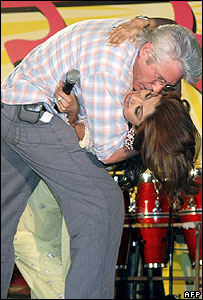
Actor Richard Gere has apologised for causing offence when he kissed Bollywood actress Shilpa Shetty.
The incident, at an Aids awareness event in Delhi, prompted public protests and then an arrest warrant for both stars over the “obscene act”.
Gere, 57, said he had misread Indian customs and that he regretted any problems he had caused Shetty.
You can read the whole story here, at BBC News.
I am guessing both Gere and Shetty got a lot of mileage out of the storm of publicity from his onstage behavior, and now he has graciously and sincerely apologized. Pardon my cynicism, but he has been in India before, I would think he would have been more sensitive.
Nonetheless, he made a beautiful apology. And I wonder why politicians don’t do the same? Why, when you realize you have stepped on someone’s toes, don’t you just make a full and gracious apology? No, it doesn’t change what has happened, but it can sometimes calm the troubled waters.
What if the Danish papers had made a full and gracious apology for publishing the cartoons of the Prophet Mohammed? It would not have changed the fact that they had been published, but it would not have hurt to acknowledge that they had hurt the sensitivities of a large portion of the world, and to apologize for the offence.
Bureaucrats Joke
A Department of Agriculture representative stopped at a farm and said to the old farmer, “I’m here to inspect your farm.” The old farmer said, “You’d better not go out in that field.”
The Ag representative said in a demanding tone, “I have the authority of the U. S. Government behind me. See this card, I am allowed to go wherever I wish on agricultural land.”
So the old farmer went about his chores. In a few minutes, he heard loud screams and saw the Department of Agriculture rep running for his life, headed for the fence. Close behind, and gaining with every step, was the farmer’s prize bull, nostrils flaring, madder than a full nest of hornets.
The old farmer cupped his hands to his mouth and yelled out, “Show Him Your Card! Show Him Your Card!”
Google Earth Hurts American Forces in Iraq?
This morning on the front page of the Kuwait Times is a story about American forces in Iraq finding GoogleEarth print outs of American bases and strongholds, so clear that those targeting these sites can see the difference between tents and barracks, and can get the exact longitude and latitude for targeting purposes.
Information is always a double edged sword. Information is information, in and of itself, it is neutral. How information is used makes it useful or harmful. And “useful” or “harmful” depends totally on where you stand.
So what do you think? Do you try to censor GoogleEarth when it hurts your side, and oppose censorship when it works to your advantage? Or do you say “hands off” and let the information serve all people equally?
Chinese New Year’s
Today I am busy packing for my upcoming trip back for my father’s services, and taking down the Christmas decorations. Why now? I won’t be back until after New Year’s, and I don’t want to have to face it all then.
My son and his wife left late last night, and will be meeting up with me again later this week. As soon as they left, I stripped the bed, threw the sheets in the wash, started taking down the tree. My method of coping with grief is to stay busy.
But I also have another agenda. And I am going to tell you something that may change your life, as it changed mine. So if you are very very happy with your life right now, stop reading NOW. It’s a Locard Principle kind of thing – if you read this, it will leave a trace on you. OK. You’ve been warned.
I have a very good friend, an amazing woman. She was born in Hong Kong, into a wealthy family, and married an American. Not only was he American, but he was in the Navy, and he was a Mormon. So she had to learn three cultures at once – American, Navy/military, and a new religious culture. I tell her I am amazed that she survived; that is a lot of new information and new ways of doing things to do all at once.
Who knows why people become friends? All I know is that friends like this, you keep. From the beginning, we were like sisters. For all our differences, we never had a problem making conversation – we both liked investing, and we talked money, real-estate, stocks endlessly. And we had sons the same age who became – and still are – best friends.
We settled in the same area, and while I am living in Kuwait, she has visited my parents, called them, and frequently sat with my Dad while he was recouperating from his latest debility. She would take him flowers from her own garden, and magazines, and keep him distracted. She has been a blessing to us all.
Several years ago, in one of our conversations, she told me about Chinese New Year. When the New Year comes, your house must be sparkling clean, your bills must all be paid, and you must have money in your pocket, food in the refrigerator, and friends in the house. The way you start your New Year is the way your new year will be. So if you want order and prosperity, you have to be prepared.
I’m not Chinese. I’m not superstitious. And what if she’s right?
Every year, I have to have the tree down and everything put away by New Years. (Traditionally, the tree can stay up until the Feast of the Epiphany, January 6th, when the Wise Men come to visit the Christ child, and should be taken down the next day. Especially when using live trees, you want to anyway, as the tree is dried out, all the needles are dropping and it becomes a fire hazard.)
What if the Chinese are right? I make sure all my bills are paid, and I pay a little extra on the mortgage. I make sure we have money in our pockets, and plans with friends that include good food.
I’m not Chinese. I am not superstitious. But why take chances?
From time to time I think about NOT having everything done by New Year’s, but if I try that, I get too nervous and end up having to do it all on the last day of the year. My friend says you do NOT want to start the New Year cleaning your house!
She told me. I just told you . . . are you starting to get nervous? (wicked gleam)
Secret Santa Unveils
I found this story on AOL news this morning. I am printing the whole story, with full credit to AOL, because I am afraid if I just put in a “click here” thingy, you won’t go to the trouble. This complements a recent blog entry by Jewaira on opportunities for charitable giving locally . . . this man made a career of secretly giving back.
Grave Illness Unmasks Generous ‘Secret Santa’
Man Who Gives Money to the Needy Reveals Himself to Pass Mission on to Others
KANSAS CITY, Mo. (Nov. 17) – The answer to one of the happiest mysteries in the Kansas City area is being revealed this year. A man who has given away millions of dollars and become known as Secret Santa for handing out Christmas cash to the needy is allowing his name to be publicized after 26 years.
In April, doctors told Stewart that he had cancer of the esophagus. It has spread to his liver and he is undergoing treatment.
But the reason for the revelation is an unhappy one. Secret Santa has cancer. He wants to start speaking to community groups about his belief in random acts of kindness, but he can’t do that without telling people who he is.
The man who has spread cheer for 26 years is Larry Stewart, 58, of Lee’s Summit, who made his millions in cable television and long-distance telephone service.
Stewart told The Kansas City Star that he was the man who would walk up to complete strangers, hand them $100 bills, wish them “Merry Christmas” and walk away, leaving astonished and grateful people in his wake. He handed out money throughout the year, but he said it was the Christmas giving that gave him the most joy.
Now, he wants to inspire others to do the same. He said he thinks that people should know that he was born poor, was briefly homeless, dropped out of college, has been fired from jobs, and once even considered robbery.
But he said every time he hit a low point in his life, someone gave him money, food and hope, and that’s why he has devoted his life to returning the favors.
Stewart grew up in Bruce, Miss., reared by his elderly grandparents, who survived on $33 a month and welfare staples. They heated water on the stove for baths and used an outhouse.
After he left home and college, he found himself out of work in 1971. After sleeping in his car for eight nights and not eating for two days, Stewart went to the Dixie Diner in Houston, Miss., and ordered breakfast. When the bill came, he acted as if he’d lost his wallet.
The diner owner came to him.
“You must have dropped this,” the owner said, slipping a $20 bill into the young man’s hand.
He paid, pushed his car to the gas station, and left town. But he vowed to remember the stranger’s kindness, and to help others, when he could.
He arrived in Kansas City because he had a cousin here. He got married and started his own company, with money from his father-in-law.
But the company failed in 1977 and he couldn’t pay the bills. It was the lowest point in his life.
“I was a failure in business. I was a failure as a husband. I was a failure as a father,” he remembers thinking.
He got into his car with a handgun and thought about robbing a store. But he stopped and went home – and got a call from his brother-in-law, offering him money to tide him over.
After being fired from two jobs on two successive Christmases, Stewart stopped at a drive-in. Although he had little money himself, Stewart gave a cold and miserable carhop the change from a $20, much to her delight.
That’s when Stewart’s mission to secretly give away money at the holidays began.
Eventually, Stewart became a success and started Network Communications in 2002. The firm used independent sales agents to enroll customers for Sprint long-distance service.
In 1996, an arbitration panel ordered Sprint to pay Network and its sales agents $60.9 million in commissions it owed. Stewart got $5.2 million.
The poor boy from Mississippi now had a family, lived in a nice house and drove nice cars.
So, he started giving away more money, to dozens of causes. The Negro Leagues Baseball Museum. The Salvation Army. The National Paralysis Foundation. The ALS Foundation. He supports the Metropolitan Crime Commission’s Surviving Spouse and Family Endowment program.
And, all along, he gave away money to needy strangers.
But Christmas was special. He’d distribute thousands of dollars during visits to coin laundries, thrift stores, barbershops and diners.
People shouted with joy, cried, praised the Lord, and thanked Stewart repeatedly.
But Secret Santa moved on quickly to avoid attention.
He did sometimes invite newspaper and TV reporters along, if they promised not to reveal his identity. It was reporters who dubbed him “Secret Santa.”
In 1989, after some people chased his car when they saw the cash he carried, he decided he needed protection. He called Jackson County Sheriff’s Capt. Tom Phillips.
“I thought, ‘OK, this guy’s nuts,”‘ recalls Phillips, now the Jackson County sheriff. “But at the end of the day, I was in tears – literally – just seeing what he did to people.”
Eventually, Secret Santa took his sleigh ride to other places.
In 2001, after the terrorist attacks, he went to New York. The New York cop who accompanied him said he’d never forget the experience.
In 2002, Secret Santa was in Washington, D.C., victimized by the serial snipers. In 2003, it was San Diego neighborhoods devastated by wildfires. And in 2004, he was in Florida, helping thousands left homeless by three hurricanes.
Last Christmas, Secret Santa went back to Mississippi after Hurricane Katrina battered the Gulf Coast.
He stopped in Houston, Miss., where the diner owner had helped him so many years ago. On a previous visit he had surprised the owner, Ted Horn, with $10,000. This time, they stamped $100 bills with the name “Ted Horn,” and gave Horn money to distribute. And Horn took money from his own bank account to give away, too.
Stewart has enlisted “elves” for years – George Brett, the late Buck O’Neil, Dick Butkus. He’s already inspired copycats.
Four other Secret Santas plan to distribute a total of $70,000 of their own cash this year.
And Secret Santa plans to give away $100,000 this year. Since he started, he estimates he’s given out more than $1.3 million in Christmas cash.
But this will likely be the last Christmas for Stewart’s tradition. In April, doctors told Stewart that he had cancer of the esophagus. It had spread to his liver. He needed treatment, fast.
With help from Brett, he got into a clinical trial at the M.D. Anderson Cancer Center in Texas. Doctors tell him the tumors have shrunk, but they can’t say whether the cancer is in remission.
“I pray for that man every single day,” former Kansas City Chiefs star Deron Cherry – one of Stewart’s elves – says. “There’s a lot of people praying for him.”
Learning Opportunities
“Oh! I am so sorry!” I exclaimed. I caught them grinning as we worked on a project, and remembered the article I had read that morning in the Gulf Times.
“Sorry?” they looked puzzled. “Why khalti?”
“I’m humming! I’m so sorry! You are fobidden to hear music during Ramadan!” I apologized.
“No, khalti! Where did you get that idea?”
“In today’s Gulf Times” I replied, and went to get the morning paper. The three of us read through the article, on the religion page, together. It was in English, and I secretly rejoiced – a perfect opportunity!
I hate classroom teaching. I trained as a teacher, and actually, I loved my students, but oh, the classroom just overwhelms me. For one thing, I must be a little ADD (attention deficit disorder) because when the bell rings, and I know I have fifty five minutes in the classroom, I feel TRAPPED. I bet you didn’t know that some teachers feel that way, too!
What I like is living learning, and that is why I think those who are home schooling are enjoying so much success – really small classes, individual attention, and hands-on examples to illustrate what is being taught.
“We have to check with our Mom and Dad, they can tell us why, but we don’t believe this” they said, as we finished reading the article. (Teacher secretly dances for joy! They are reading in English with full comprehension!)
Later they came back to me and explained – in English – that while some believers felt that all music was forbidden at ALL times, not only during Ramadan, other believers felt that it was not forbidden, as long as it did not deal with forbidden things, like sex. This time, I really did dance. They could explain a complex subject to me in English, and I learned something too. This is the best kind of teaching, when the teacher also gets to learn from her students.
Change Two
It’s a continuing theme – the Locard Exchange Principal in every day life. We live in foreign cultures, we pick up foreign ideas. Change 1 was one of the earliest entries in the blog – investment. Investment is not alien to my culture; investing to protect yourself against an uncertain future, as insurance and as protection for your children – that got through to us and accelerated the investment process. Starting early in our married life paid off big dividends.
Change Two came in Jordan. We had finished an amazing dinner at a private home, mezze’s, a mensef (huge platter of rice flavored with leban, spices and sultanas, with meat – in this case, lamb, but we have also had goat or chicken served as mensef). The host was peeling an orange and had that look in his eye that tells you he is thinking about something and isn’t sure whether he should voice it or not. He struggles, and then he goes ahead . ..
“I don’t understand one thing about your culture” he says. I am surprised; this is a very sophisticated man, well educated, holding a high position. He has travelled. . . it will be interesting to see what comes next.
“Why is it you kick your children out of the house at such an early age? You love your children – I just don’t understand.”
We had observed the opposite – that in Jordan, young people lived with their parents, even after graduation from university, sometimes even after being married. . . and it seemed very alien to us, very uncomfortable.
We are raised knowing that the goal is to be independent, to live on our own. It is very very scary, but a rite of passage. You leave school, you find a place to live, you pay rent, you pay your own bills, you look for a mate – all on your own. You are supposed to be educated and wise, but you still feel very young and not at all sure of your own judgement. You can ask your parents for advice, but you are expected to make your own decisions. Eventually, you get the hang of it.
But . . . through the years, that question nagged at us. It opened us up to a new way of thinking. It would come up from time to time. Just that one little question, popping into our minds. Having friends from other cultures who helped their kids out well beyond college gave us some different ideas, a different model.
It’s a fine line. We don’t want to intrude on our son’s privacy; we want to be close without being interfering. And at the same time, he will inheirit everything from us – why should we not be helpful now, during the years of struggle, when he and his wife could use the help?
At the same time, we don’t want to be so generous as to preclude them from developing their own financial strategies, from learning thrift, and the thrill of finding a good buy. We want them to know the thrill of discovering for themselves how to balance spending and savings, investment in major purchases and investment in family.
We are so thankful for that thoughtful friend, a friend with the courage to risk asking a question that might be perceived as impolite.His question caused us to do things a little differently. It wasn’t immediate, but a long term effect; it caused us to question our own way of doing things and moderate it into a more supportive approach.
Breaking Out the Sweaters
This morning, checking the weather forecasts, I exclaimed to my husband “Wow! 100 degree (38 C) maximums for the next five days!”
“Break out the winter sweaters!” he exclaimed.
It’s a family joke. We’re from the same country, but different cultures. I was raised in a very cold climate, he was raised in a very hot climate. I need it to be cold enough to sleep; he sleeps in a nightshirt with an extra blanket.
When we were first married, he looked at me one night and said “Don’t you ever fry anything?”
I looked at him in horror. “No! – and you’ll live a lot longer! We only grill and occasionally saute!”
When I first met his family, they fixed all their best dishes for me.The food was wonderful, but used a lot of cream and lard and butter. Not used to eating such rich foods, I got really sick. Later, I did learn to cook several of the dishes that he grew up with, and he learned to like grilled fish and shrimp.
Although I do not think 100 degrees is “cool,” I am seeing changes in the weather – it is lovely at night, sweet for sitting outside. The color of the sea changed yesterday, from it’s normal jade color to a more blue color. There are huge flocks of birds, landing, resting and taking off – migratory birds? Two days ago, I could see silvery fish jumping in the waters, and last night, late late into the night, there were fishing boats just yards off the shore, with their lights gaily dancing up and down. I grew up on fishing boats – a part of me yearns to be out there with a line in the water.

Think I’d better go pull out the winter boxes.;-)
Get Out of Jail Free Card
Who could be whispering my name?
I was in the Jarir bookstore, on my way to the airport after a three week visit to Saudi Arabia. My husband wanted me to get a feel for the place before moving there to be with him. To my surprise, I really liked Saudi Arabia, what little I had seen of it. And I really wanted to be with my husband. But who could be calling my name?
“I can’t believe it! Is that you, teacher?”
I turned to see a traditionally garbed man, whom I instantly recognized as my former student in classes I had taught back in the US.
“Khalid! Khalid! I am so glad to see you!” I exclaimed, and I was. Khalid was one of my very best students, before he disappeared from classes. He was bright, he studied hard, and from time to time, he would even practice hard and tell a joke in English. He was a student any teacher would remember. He had more maturity than the other students, who treated him with respect, but he also had a delightful sense of humor.
Instantly, my husband and two other men who had come with us to the bookstore were standing between Khalid and me. I knew they were protecting me, so I quickly explained who Khalid was, and introduced him to the men with me.
“You remembered my name!” he said with an astonished look.
“Of course!” I assured him, “You were one of my best students. I missed you when you left.”
“Truly God works in mysterious ways,” Khalid looked dazed. “I never dreamed I would see you again, and here you are, in my country.”
We had to leave. Khalid gave me his card, and asked that I call so his mother could invite me for tea. I told him I wouldn’t be back for a couple months, and he said he was hoping to start legal studies in London in January.
In the car, my husband and the other two guys were cracking up, slapping their knees, almost howling with laughter. I was annoyed; what was so funny about my running into an old friend?
“He’s a muttawa!” they exclaimed, continuing their cackles, “You’re friend is a muttawa!”
The muttawa, the religious police in Saudi Arabia, are kind of the boogeyman, and we scare one another telling Muttawa stories. The problem is that you never know what new rules are going to go into effect, or what old rules they will begin enforcing. Our embassy guidance, for example, was that we were NOT to cover our hair, that it was a choice made by Moslem women, but not a requirement for non-Moslem women. We were also told to carry a scarf and not to argue if a muttawa told us to cover our hair, but to cover, and to take it off again when out of sight.
We were told that if our abaya was too short, a muttawa might hit our legs with sticks. We were told not to laugh, and to keep our eyes lowered to the ground to avoid problems. We were told that sometimes you might be arrested and not even know what you were being arrested for, and to always carry your cell phone with the embassy number on speed dial. In short, we lived in terror of arbitrary powers of the dreaded muttawa.
“Khalid is muttawa?” I couldn’t believe my ears. My husband explained how you could identify muttawa, the short robes, the lack of egal, the sandals, and that Khalid had probably broken the rules he was in Jarir to enforce by having spoken to me.
I never saw Khalid again, not in the Jarir bookstore, not anywhere. I am guessing by the time I returned to live in Riyadh, he was in London studying. But I often think of his amazement, and my own, in that one-time encounter. I often think, as he said, that “God works in mysterious ways.” I wish him well.
For me, I was never again terrified of the Muttawa. Khalid was muttawa, and he was a good man. I carried Khalid’s card with me, and figured if ever I was arrested (never even came close) that I would tell them to call Khalid, and he would help me. I thought of it as my “Get out of Jail Free” card.
Going back to the Locard Exchange Principal . . . knowing Khalid as a student and as a person made a difference to me. It colored my ideas about the muttawa, made me less afraid. If the Locard Exchange Principal works on a social and spiritual level, I wonder if knowing me has colored his perceptions?
Recent Comments
ExpatAlien on What Country am I Living … intlxpatr on Yellowstone: Old Faithful to C… Michelle on Yellowstone: Old Faithful to C… Cathy on No Grown-Ups in Charge intlxpatr on Waiting for Snow Wikipedia Donate Button

Amazina


Early Voting in Florida


 Here There and Everywhere