Qatar National Day Fireworks Spectacular
The problem is, even with the most amazing situation in the world, my wonderful little hand held Lumix can’t begin to capture the awe-inspiring grandeur of the 20 minute Qatar National Day Fireworks spectacular.
Another amazing thing – the fireworks started ON TIME. Suddenly the entire length of the Corniche erupted in white waterfalls. The fireworks were kept relatively close to the ground, and compact, but spread along a couple miles – it was an amazing feat, and the timing was to the second.
Caught in traffic, we decided to try something different. Like the Robert Frost poem, we took a road less travelled by, and it made all the difference. We lucked into a fantastic vantage point.
















I have to add a special thanks here to AdventureMan. He knows how much I love fireworks, and I knew he has to work tomorrow, and still, he took me to see the fireworks. We were stuck in bumper-to-bumper traffic until we took a chance, and by a miracle, found this fantastic, uncrowded vantage point. He love the fireworks as much as I did, but he did it for me, and my heart is full of gratitude. 🙂
Saturday Night Live Does Tiger Woods
There are mixed reviews on this hilarious Saturday Night Live take-off of the Tiger Woods situation. Some people feel it is tasteless, and that if the batterer were a man, it would be seriously unfunny.
They are right. And who on earth expects Saturday Night Live to stay within the boundaries of good taste? Or any boundaries at all?
As for me – I find it tastelessly hilarious.
( I will try to keep posting ones that work until they get taken off)
FYI: How Long is a Generation?
So I get on a track and I can’t get off, like a little hamster running on the wheel. I got to thinking about generations, and how long ago is 10 generations and so I had to ask Google the question: How long is a generation? Don’t you love Google? They always have an answer.
Now I know something new. Now I will share it with you. This comes from Ancestry.com
Research Cornerstones: How Long Is a Generation? Science Provides an Answer
How Long Is a Generation?
By Donn Devine, CG, CGI
We often reckon the passage of time by generations, but just how long is a generation?
As a matter of common knowledge, we know that a generation averages about 25 years—from the birth of a parent to the birth of a child—although it varies case by case. We also generally accept that the length of a generation was closer to 20 years in earlier times when humans mated younger and life expectancies were shorter.
In genealogy, the length of a generation is used principally as a check on the credibility of evidence—too long a span between parent and child, especially in a maternal line, has been reason to go back and take a more careful look at whether the evidence found reflects reality or whether a generation has been omitted or data for two different individuals has been attributed to the same person. For that purpose, the 20- and 25-year averages have worked quite acceptably; birth dates too far out of line with the average are properly suspect.
But now, researchers are finding that facts differ from what we’ve always assumed—generations may actually be longer than estimates previously indicated.
Several recent studies show that male-line generations, from father to son, are longer on average than female-line generations, from mother to daughter. They show, too, that both are longer than the 25-year interval that conventional wisdom has assigned a generation. The male generation is at least a third longer; the female generation is about one-sixth longer.
As early as 1973, archaeologist Kenneth Weiss questioned the accepted 20- and 25-year generational intervals, finding from an analysis of prehistoric burial sites that 27 years was a more appropriate interval but recognizing that his conclusion could have been affected if community members who died away from the village were buried elsewhere.
Why Age Matters
In a more-recent study regarding generation length, sociologist Nancy Howell calculated average generational intervals among present-day members of the !Kung, contemporary hunter-gatherer people of Botswana and Namibia whose lifestyle is relatively similar to that of our pre-agricultural ancestors. The average age of mothers at the birth of their first child was 20 years and at the last birth 31, giving a mean of 25.5 years per female generation—considerably above the 20 years often attributed to primitive cultures. Fathers were six to 13 years older than mothers, giving a male generational interval of 31 to 38 years.
A separate study, conducted by population geneticists Marc Tremblay and Hélène Vézina, was based on 100 ascending Quebec genealogies. Researchers found a generational interval, based on the years between parents’ and children’s marriages, to average 31.7 years, and they determined that male generations averaged 35.0 years while female generations averaged 28.7 years.
Biological anthropologist Agnar Helgason and colleagues used the Icelandic deCODE genetics database to arrive at a female line interval of 28.12 years for the most recent generations and 28.72 years for the whole lineage length. Male line lineages showed a similar difference—31.13 years for the recent generations and 31.93 years overall. For a more mathematically appealing average, Helagason and fellow researchers recommended estimating female generational line intervals at 30 years and male generational intervals at 35 years, based on the Quebec and Iceland studies.
Calculating Ideas
What does this mean to the genealogist? When assigning dates to anthropologically common ancestors 50 or more generations in the past, using the “accepted” 20 or 25 years as a conversion factor can produce substantial underestimates of the time interval.
For my own purposes, however, given the imprecision of the various results and my own need for an estimate that lends itself to easy calculation, I decided that three generations per century (33 years each) for male lines and 3.5 generations per century (29 years each) for female lines, might work better when I needed to convert generations into years.
To check the accuracy of my values, I decided to compare the generational intervals from all-male or all-female ranges in my own family lines for the years 1700 to 2000. I was pleasantly surprised to see how closely the intervals agreed with the estimates I was using. For a total of 21 male-line generations among five lines, the average interval was close to 34 years per generation. For 19 female-line generations from four lines, the average was an exact 29 years per generation.
In genealogy, conclusions about relationships are subject to change whenever better evidence is discovered. Similarly, it’s the nature of the physical and biological sciences that current understandings are subject to change as more data becomes available and that data’s interpretation becomes more certain. So, for now, when genealogists want to convert generations to years and create probable date ranges, using an evidence-based generational interval—like Helagason’s 30 and 35 years or one that you’ve developed based on your own family history research—may be the best solution.
Donn Devine, CGSM, CGISM, a genealogical consultant from Wilmington, Delaware, is an attorney for the city and archivist of the Catholic Diocese of Wilmington. He is a former National Genealogical Society board member, currently chairs its Standards Committee, is a trustee of the Board for Certification of Genealogists, and is the administrator for Devine and Baldwin DNA surname projects.
Only Ten Generations
We were talking about marriage prospects, and I mentioned one young man.
She hesitated, then told me “we don’t marry with this family.”
“Why not?” I asked her. “He’s handsome, and kind, and I am told that they are the richest family in Qatar.”
“They are Iranian,” she said shortly.
“Iranian?” I asked. “They are Qatteri! They have been here more than ten generations!”
She grinned at me.
“It’s not enough,” she said. “They are still Iranian.”
Halloween Baby
You won’t hear all mother-in-laws say things like this, but you’ll hear me say it, and often – we are so lucky. Our son chose a wife who is a true companion, and whose style suits our own, sometimes so much it is scary.
They are expecting a baby – and she is beginning to be “great with child”. She wrote us this morning that she won a Halloween costume contest. We knew they were toying with the concept, but the reality is hilarious. Alien!

Saturday mornings can be depressing for us, as AdventureMan heads back to his job. Not so this morning – we were dying laughing!
Husbands are Husbands
Husbands are husbands
A man was sitting reading his papers when his wife hit him on the Head with a frying pan.
‘What was that for?’ the man asked.
The wife replied ‘That was for the piece of paper with the name Jenny on it that I found in your pants pocket’.
The man then said ‘When I was at the races last week Jenny was the name of the horse I bet on.’
The wife apologized and went on with the housework.
3 days later the man is watching TV when his wife bashes him on the head with an even bigger frying pan, knocking him on the head and the man asked ‘What was that for? Why did u hit me again.?’
The wife replied. ‘Your horse phoned!!’
Shifting Weather Patterns

Last week, we had our first days under 100°F/38°C.
Last night, AdventureMan shivered and moved close to me.
“I’m cold” he said pitifully, putting his cold feet up against me.
It’s OK. I’m used to it. He is often cold, and I radiate heat. We pile the covers up on him and I sleep with just a sheet. I can’t sleep if I am too hot.
“There’s another quilt out on the loveseat” I tell him, referring to a piece of furniture about twenty steps away.
“Will you go get it for me?” he asked, his voice quavering.
We’ve been married a long time. I’m on to his tricks.
“No,” I laughed, “If you want another blanket, you have to go get it.”
“I don’t want to leave the bed,” he complained, and snuggled closely to me to absorb my heat.
This morning, at 0700, it is not even 80°F. Wooo HOOOOOO! There is still some humidity, but the afternoons are balmy, and there are evenings you can sit outside and drink coffee. Wooo HOOOO, my favorite season – Outside Season!
Girls of Riyadh by Rajaa AlSanea
“Have you read Girls of Riyadh?” my friend asked me on the phone, and when I said I had not, she said she would bring it to me.
“It’s an easy read” she said, “it will take you an afternoon.”
Sometimes life intruded. It took me a little longer. I had expected this to be lightweight, along the lines of the shopaholic books, read ’em and forget ’em. Airport reading, stuff you save to read when you know you will have time to kill.
I was surprised. I guess I had gotten the impression it was lightweight because I had seen it discussed on some of the blogs, and there are some light-hearted moments in the book. The four young women are well drawn, and their experiences are handled with sensitivity. She never reveals which character from the book she is, but I have my suspicions. 🙂
Each girl has her own unique experiences as she reaches young womanhood, and mating. Although the experiences are treated deftly, there is a serious undercurrent that belies the light tone. The underlying circumstances surrounding the mating rituals in a country so tradition-bound as Saudi Arabia turn mating into a dark ritual, full of unseen pits and minefields.
The very worst fear during these years is the wagging tongues of others. I have heard this theme over and over in my own dealings with young women in this part of the world.
“You know, khalto, a woman’s reputation is like glass, it is easily shattered,” explained my young-woman Qatteri friend, solemnly.
(for my Western readers, Khalto means ‘aunt’ literally, and is a term used respectfully for family friends, meaning ‘sister of my mother’)
“I don’t want to get married,” she continued, “They come for you as a bride and they are so nice and they make you feel so in love with them, but then, when you are married, they change. Men are . . . men are . . ”
“Dogs?” I asked.
“Yes! Yes!,” she exclaimed, “Dogs!” (pause)
“How did you know, Khalto?”
LLLLOOOOLLLLLLLLLL! It’s one of those moments when you know we are all more alike than we are different.
Girls of Riyadh is a worthy read. It is thought-provoking, and compassion-provoking. You grow to love these girls, and you hope a happy ending for them.
Joke for Women
A sixteen year-old boy came home with a new Chevrolet Avalanche and his
parents began to yell and scream, ‘Where did you get that truck???!!!’
He calmly told them, ‘I bought it today.’
‘With what money?’ demanded his parents. They knew what a Chevrolet
Avalanche cost.
‘Well,’ said the boy, ‘this one cost me just fifteen dollars.’ So the
parents began to yell even louder. ‘Who would sell a truck like that for
fifteen dollars?’ they said.
‘It was the lady up the street,’ said the boy. I don’t know her name –
they just moved in. She saw me ride past on my bike and asked me if I
wanted to buy a Chevrolet Avalanche for fifteen dollars.’
‘Oh my Goodness!,’ moaned the mother, ‘she must be a child abuser. Who knows
what she will do next? John, you go right up there and see what’s going
on.’ So the boy’s father walked up the street to the house where the lady
lived and found her out in the yard calmly planting petunias!
He introduced himself as the father of the boy to whom she had sold a new
Chevrolet Avalanche for fifteen dollars and demanded to know why she did it.
‘Well,’ she said, ‘this morning I got a phone call from my husband.. (I
thought he was on a business trip, but learned from a friend he had run off
to Hawaii with his mistress and really doesn’t intend to come back)
He claimed he was stranded and needed cash, and asked me to sell his new
Chevrolet Avalanche and send him the money.
So I did.’
(Are women good or what?)
Not Happy Ever After
Things are not happy for this brave little girl who took a taxi across town to sit in the judge’s chambers so that – at 10 years old – she could ask for a divorce.
I can imagine her family is NOT happy – she got her divorce, but her proverty-striken family had to compensate her aged husband $200 – a fortune for a poor family.
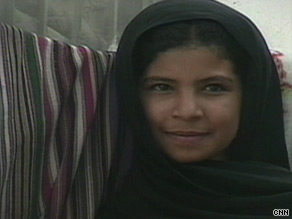
From CNN World News
Yemen (CNN) — It is midday and girls are flooding out of school, but Nujood Ali is not among them.
We find her at the family’s two-room house in an impoverished suburb of the city where Nujood is angry, combative and yelling. Tension surrounds the home like a noose.
After much arguing with family members, Nujood finally grabs her veil and agrees to sit down with CNN. Her presence is grudging, although CNN had got permission in advance to see how the girl who rocked a nation by demanding a divorce was shaping up.
Nujood is very different from the girl we first met nearly two years ago. Then, there was no doubt the 10-year-old was every inch a child. She was the very portrait of innocence: A shy smile, a playful nature and a whimsical giggle.
That picture was very much at odds with the brutal story of abuse she endured as a child bride who fought for a divorce and is now still fighting. Watch as Nujood remains defiant.
Nujood says she remains relieved and gratified that her act of defiance — which led to appearances at awards shows and on TV — had paid off.
The story was supposed to end with the divorce and an innocent but determined girl allowed to fully embrace the childhood she fought so hard to keep.
Instead, there has been no fairytale ending for Nujood.
There was, though, a stunning transformation. Nujood went from being a victim and child bride to a portrait of courage and triumph. Her inspirational story was told and re-told around the world, but at home all was not well.
In the fall of 2008 Nujood was recognized as Glamour Magazine’s Woman of the Year, alongside some of the world’s most impressive women. She even attended the ceremony in New York and was applauded by women from Hillary Clinton to Nicole Kidman.
There is a tell-all book which is to be published in more than 20 languages, and the author says Nujood will receive a good portion of the royalties.
Nujood’s strength was celebrated by complete strangers. But what did all the fame do for the one person it was meant to transform?
“There is no change at all since going on television. I hoped there was someone to help us, but we didn’t find anyone to help us. It hasn’t changed a thing. They said they were going to help me and no one has helped me. I wish I had never spoken to the media,” Nujood says bitterly.
There was never going to be a fortune. Generous people have donated thousands so Nujood could go to a private school, but she refuses to attend, according to Shada Nasser, the human rights lawyer who took on the child’s divorce case.
“I know Nujood was absent from the school. I spoke with her father and her family. And I ask them to control her and ask her to go every day to school. But they said, ‘You know we don’t have the money for the transportation. Don’t have the money for the food,’ ” says Nasser.
She believes Nujood is being victimized by her own family because they believe Nujood’s fame should bring them fortune.
Nujood’s parents say they’ve received nothing, and in the meantime Nujood stews wondering out loud how everything turned out this way.
“I was happy I got divorced but I’m sad about the way it turned out after I went on television,” she said adding that she feels like an outcast even among her family and friends.
Nujood was pulled out of school in early 2008 and married off by her own parents to a man she says was old and ugly. And yet, as a wife, Nujood was spared nothing.
“I didn’t want to sleep with him but he forced me to, he hit me, insulted me” said Nujood. She said being married and living as a wife at such a young age was sheer torture.
Nujood described how she was beaten and raped and how, after just a few weeks of marriage, she turned to her family to try to escape the arrangement. But her parents told her they could not protect her, that she belonged to her husband now and had to accept her fate.
CNN tried to obtain comment from Nujood’s husband and his family but they declined.
Nujood’s parents, like many others in Yemen, struck a social bargain. More than half of all young Yemeni girls are married off before the age of 18, many times to older men, some with more than one wife.
It means the girls are no longer a financial or moral burden to their parents. But Nujood’s parents say they did not expect Nujood’s new husband to demand sex from his child bride.
To escape, Nujood hailed a taxi — for the first time in her life — to get across town to the central courthouse where she sat on a bench and demanded to see a judge.
After several hours, a judge finally went to see her. “And he asked me, ‘what do you want’ and I said ‘I want a divorce’ and he said ‘you’re married?’ And I said ‘yes.'” says Nujood.
Nujood’s father and husband were arrested until the divorce hearing, and Nujood was put in the care of Nasser.
Indeed, it seems the judge had heard enough of the abuse to agree with Nujood that she should get her divorce.
But based on the principles of Shariah law, her husband was compensated, not prosecuted. Nujood was ordered to pay him more than $200 — a huge amount in a country where the United Nations Development Programme says 15.7 percent of the population lives on less than $1 a day.
Khadije Al Salame is working to help Nujood get her life back. Now a Yemeni diplomat, 30 years ago she too was a child bride. But when she left her husband, she did not have to endure the publicity that now haunts Nujood.
She said: “It’s good to talk about Nujood and to have her story come out, but the problem is it’s too much pressure on her.
“She doesn’t understand what’s going on. She’s a little girl and we have to understand as a media people that we should leave her alone now. If we really love Nujood then we should just let her go to school and continue with her life, because education is the most important thing for her.”
To get her divorce, Nujood showed a character and strength not easily expressed by women in Yemen, let alone a 10-year-old child bride. But she will need to muster all that strength and more if she’s to finally reclaim her life.
Nujood told us she thought the divorce would be the end of her struggle and she’s still angry that it turned out to be just the beginning.
Recent Comments
Cathy on No Grown-Ups in Charge intlxpatr on Waiting for Snow intlxpatr on Waiting for Snow Abou Tabblouleh on t… on Waiting for Snow Abou Tabbouleh on in… on Waiting for Snow Wikipedia Donate Button

Amazina


Early Voting in Florida


 Here There and Everywhere