Romance and Money Matters
I found this article in today’s New York Times Business. So here is my question to you – is it different in Kuwait than in the USA? I remember when we wanted a joint checking account here ( Adventures in Banking), one man looked at my husband in disbelief and said “Why? Just give her some money!” We never did get a joint account; it isn’t possible, but I was given a PAO on the account. It seemed bizarre to me, but it makes perfect sense if couples keep their moneys separately.
What do you think? Does this article apply to marriage in Kuwait?
The Key to Wedded Bliss? Money Matters
By TARA SIEGEL BERNARD
Published: September 10, 2008
IF you ask married people why their marriage works, they are probably not going to say it’s because they found their financial soul mate.
But if they are lucky, they have. Marrying a person who shares your attitudes about money might just be the smartest financial decision you will ever make. In fact, when it comes to finances, your marriage is likely to be your most valuable asset — or your largest liability.
Marrying for love is a relatively recent phenomenon. For centuries, marriages were arranged affairs, aligning families for economic or political purposes or simply pooling the resources of those scraping by.
Today, while most of us marry for romantic reasons, marriage at its core is still a financial union. So much of what we want — or don’t want — out of life boils down to dollars and cents, whether it’s how hard we choose to work, how much we consume or how much we save. For some people, it’s working 80-hour weeks to finance a third home and country club membership; for others, it means cutting back on office hours to spend more time with the family.
“A lot of the debates people have about money are code for how we want to live our lives,” said Betsey Stevenson, assistant professor of business and public policy at the University of Pennsylvania’s Wharton School, who researches the economics of marriage and divorce. “A lot of the choices we make in how we want to live our lives involve how we spend our money.”
Making those choices as a team is one of the most important ways to preserve your marital assets, and your union, experts say. But it’s that much easier when you already share similar outlooks on money matters — or when you can, at the very least, find some middle ground.
The economies achieved by pairing up are fairly obvious. However, the costs of divorce can be financially devastating, especially when children are involved. And, not surprisingly, money manages to force a wide wedge between many couples.
“Most people think people break up over sex issues and children issues — and those are issues — but money is a huge factor in breaking up marriages,” said Susan Reach Winters, a divorce lawyer in Short Hills, N.J.
Not everyone is married to a financial twin, and that’s not necessarily a problem. There are several ways that you and your significant other can become more compatible, and ultimately more prosperous, when it comes to money.
These guidelines are compiled from the successfully married and from experts on psychology, divorce and finance:
TALK AND SHARE GOALS Before walking down the aisle, couples should have a talk about their financial health and goals. They should ask each other tough questions: Do we want children? When? Who will care for them? Will they go to public or private school? What kind of life do we want? When will we retire?
This is a fascinating article – read the rest of it HERE.
Marriage Improves With Age
This is from AOL News, and you can read the rest of the interview/ article by clicking here:
Couples Improve With Age, Book Says
By Nanci Hellmich, USA Today
(Sept. 3) – Married couples in their later years often show a great deal of affection, says best-selling author Maggie Scarf, 77, who has spent more than 30 years studying relationships.
“There’s intimacy. There is pleasure in each other’s company. They say to each other, ‘I love you more than ever.’ ” Scarf’s new book is ‘September Songs: The Good News About Marriage in the Later Years,’ released Sept. 3. She has been married for 55 years to Herb Scarf, 78, a Yale professor.
They have three daughters. Scarf shares her insights with USA TODAY.
Q: How would you describe your marriage?
A: Like any other couple, we’ve had our ups and downs at times. We haven’t ridden through 55 years on a cloud of bliss. But the fact is we have always remained committed to each other. We have a lot of fun. My husband has a tremendous sense of humor, and we laugh a lot. He is my best buddy.
Herb is the person who knows everything about me. And I know everything about him. At least we think we do.
Q: What is the U-shaped curve in marriage that you describe in the book?
A: There have been pretty influential studies over the past 40 years that show a couple’s contentment is at its highest in the earliest phase of marriage.
Then you get to know the other person’s foibles and faults. Kids come along and you lose sleep and you want the other person to do more than they are doing. Then you are negotiating on a daily basis with your adolescents, and your sense of contentment and well-being go down during that time.
But as the nest starts to empty, your sense of well-being, contentment and time for intimacy go up. The U-curve begins to rise. You rediscover the person you knew early on.
I like it that she shoots straight that her marriage was not always a bed of roses. Couples whose marriages survive have to work hard to keep a marriage alive. When the kids start coming along, there are so many demands on your time, so many distractions, it is hard to keep a marriage fresh and thriving. The good news is that all the good times come back.
Read the rest of the article HERE.
What a Difference a “D” Makes
AdventureMan called me, laughing, and said “I just have to tell you what just happened to me.”
He was talking with a Kuwaiti woman who said “You speak Arabic amazingly well, except for one little thing – you say the ‘d’ when you should be saying the ‘Dh’.”
It was all he could do not to laugh. Not because of what she had said, but because it reminded him of a conversation we had, repeatedly.
When AdventureMan took Arabic, I took French. We were on our way to Tunis, I had a small baby, and I already spoke a little French. I made arrangements to study half days, and hoped it would be enough. Thanks be to God, together, we did just fine. In Tunis, most Tunisians spoke French and even those who spoke Arabic switched to French for the numbers. (Things are different now; this was many years ago.) The Tunisians called him “That Lebanese guy married to the French woman.” (He is not Lebanese. I am not French. Most Tunisians spoke a Berber dialect, which was not quite the same as Arabic.)
When I finally started formal Arabic classes, years later, I would say things I had learned from my husband and my dear Qatteri teacher would say “No, that is how those Lebanese people say it, not the way we say it.”
When my husband would correct my Arabic, now I could just cooly look at him and say “That is how you Lebanese say it, but we Qatteris say it this way.”
When he would lecture me on Arabic (I can only absorb about one minute of lecture at a time and them my head starts swimming) I would respond with ” ‘Dh’ AdventureMan, ‘Dh’ ” implying that his “Dh” wasn’t hard enough. It would make him laugh every time, totally crack him up. He can’t lecture me when he is laughing.
So here he is on the phone, laughing and laughing, because the Kuwaiti woman told him his Arabic was fine except that his “dh” wasn’t hard enough. God bless you, dear, whoever you are. 🙂
Dick Cheney and Darth Vadar
As I was leaving Barnes and Noble today (they are out of Orphan Pamluk’s My Name is Red) I heard this on National Public Radio:
(Actually I found the exact quote on The Huffington Post.)
Vice President Dick Cheney cracked a number of jokes Wednesday night at the Radio & Television Correspondents’ Dinner In Washington D.C. Cheney got some laughs when he told the audience that he had asked his wife, Lynne Cheney, whether the label Darth Vader applied to his personality. According to Cheney, his wife said it “humanizes you.”
Don’t you just love a woman with a great sense of humor?
Geraldine Brooks: March
Geraldine Brooks knocks my socks off. If she writes a book, fiction or non-fiction, I will buy it and read it. The first one I read by her was Nine Parts Desire: The Hidden World of Islamic Women, and the second most memorable book was her Year of Wonders, a book about how the plague comes to a 17th century English village and how the villagers cope with it – how some survive. She has a knack for keen observations, and for writing so as to place you squarely in the scene she is describing.
So when she came out with a new book extrapolating from the experiences protrayed in Louisa May Alcott’s classic favorite Little Women, why didn’t I rush to buy it? March is described by Publisher’s Weekly as “the Civil War experiences of Mr. March, the absent father in Louisa May Alcott’s Little Women.”

Didn’t you love Little Women when you read it? What’s not to love? Those wonderful sisters, their saintly mother, working together, suffering together, prevailing through sheer grit and determination – we can read that book over and over again, loving it every time.
Geraldine Brooks takes us with Mr. March into the grim realities of the American Civil War, the “war to free the slaves,” the war to keep the United States united, or the war between the states. This is not the idealized world of Little Women, this is not the memory we have of the nice letters he writes home from the field, this is the reality of war and all it’s ugliness. As the book opens, Mr. March is fleeing a massacre, struggling to survive, he is surrounded by the dead and seriously wounded, bullets are flying past him and he has to cross a deep, rushing river. A man grabs him who can’t swim, and he has to push him away to gasp for air. The man drowns, March survives, feeling deep guilt. When he finally finds a group of his men, drying out by the side of the river, he sits down and writes to his girls about the sweet breeze in the air. Not a word about the horrors he has witnessed, not his personal despair about having failed a wounded comrade.
As we experience the horrors of this war with Mr. March, we experience with him the brutality, cruelty, and crudity of all conflict. There are no good guys. There is no “just cause,” just winners and losers, and it’s very hard to tell what they are fighting for. Seeing this war from the point of view of the combatants, we realize that no-one will remain untouched; that this experience will resonate through the rest of their lives.
Geraldine Brooks knows how to grab us and keep us gripped. Every chapter reveals a new facet – how March and Marnee met and married, how they built a life together, how, in their idealism, they lost everything. Most discouraging of all is how, below the surface, they understand themselves and one another and their relationship so little.
I dare you to read this book. It isn’t an easy book, and at the same time, it is a book with timeless qualities, and a book that will get you thinking and keep you thinking for a long time. Isn’t that the definition of a good book?
Grin for Today
I’ve always loved this joke. It is making the rounds again; thank you dear friend for forwarding it to me. 🙂
“The Obedient Wife”
There was a man who had worked all his life, had saved all of his money, and was a real “miser” when it came to his money.
Just before he died, he said to his wife…”When I die, I want you to take all my money and put it in the casket with me. I want to take my money to the afterlife with me.”
And so he got his wife to promise him, with all of her heart, that when he died, she would put all of the money into the casket with him.
Well, he died. He was stretched out in the casket, his wife was sitting there – dressed in black, and her friend was sitting next to her. When they finished the ceremony, and just before the undertakers got ready to close the casket, the wife said,
“Wait just a moment!”
She had a small metal box with her; she came over with the box and put it in the casket. Then the undertakers locked the casket down and they rolled it away. So her friend said,
“Girl, I know you were not fool enough to put all that money in there with your husband.”
The loyal wife replied, “Listen, I’m a Christian; I cannot go back on my word. I promised him that I was going to put that money into the casket with him.”
You mean to tell me you put that money in the casket with him!?!?!?”
“I sure did,” said the wife. “I got it all together, put it into my account, and wrote him a check…. If he can cash it, then he can spend it.”
Love and Money
I love this article, from the July 13 Business Section of the New York Times. The author looks at love from an analytic point of view. Good reading, interesting ideas. Altogether, a delightful and intriguing read.
By BEN STEIN
Published: July 13, 2008
AS my fine professor of economics at Columbia, C. Lowell Harriss (who just celebrated his 96th birthday) used to tell us, economics is the study of the allocation of scarce goods and services. What could be scarcer or more precious than love? It is rare, hard to come by and often fragile.
My primary life study has been about love. Second comes economics, so here, in the form of a few rules, is a little amalgam of the two fields: the economics of love. (I last wrote about this subject 20 years or so ago, and it’s time to update it.)
•
In general, and with rare exceptions, the returns in love situations are roughly proportional to the amount of time and devotion invested. The amount of love you get from an investment in love is correlated, if only roughly, to the amount of yourself you invest in the relationship.
If you invest caring, patience and unselfishness, you get those things back. (This assumes, of course, that you are having a relationship with someone who loves you, and not a one-sided love affair with someone who isn’t interested.)
•
High-quality bonds consistently yield more return than junk, and so it is with high-quality love. As for the returns on bonds, I know that my comment will come as a surprise to people who have been brainwashed into thinking that junk bonds are free money. They aren’t. The data from the maven of bond research, W. Braddock Hickman, shows that junk debt outperforms high quality only in rare situations, because of the default risk.
In love, the data is even clearer. Stay with high-quality human beings. And once you find that you are in a junk relationship, sell immediately. Junk situations can look appealing and seductive, but junk is junk. Be wary of it unless you control the market.
(Or, as I like to tell college students, the absolutely surest way to ruin your life is to have a relationship with someone with many serious problems, and to think that you can change this person.)
•
Research pays off. The most appealing and seductive (that word again) exterior can hide the most danger and chance of loss. For most of us, diversification in love, at least beyond a very small number, is impossible, so it’s necessary to do a lot of research on the choice you make. It is a rare man or woman who can resist the outward and the surface. But exteriors can hide far too much.
•
In every long-term romantic situation, returns are greater when there is a monopoly. If you have to share your love with others, if you have to compete even after a brief while with others, forget the whole thing. You want to have monopoly bonds with your long-term lover. At least most situations work out better this way. ( I am too old to consider short-term romantic events. Those were my life when Lyndon Johnson and Richard Nixon were in the White House.)
•
The returns on your investment should at least equal the cost of the investment. If you are getting less back than you put in over a considerable period of time, back off.
•
Long-term investment pays off. The impatient day player will fare poorly without inside information or market-controlling power. He or she will have a few good days but years of agony in the world of love.
To coin a phrase: Fall in love in haste, repent at leisure.
•
Realistic expectations are everything. If you have unrealistic expectations, they will rarely be met. If you think that you can go from nowhere to having someone wonderful in love with you, you are probably wrong.
You need expectations that match reality before you can make some progress. There may be exceptions, but they are rare.
•
When you have a winner, stick with your winner. Whether in love or in the stock market, winners are to be prized.
•
Have a dog or many dogs or cats in your life. These are your anchors to windward and your unfailing source of love.
Ben Franklin summed it up well. In times of stress, the three best things to have are an old dog, an old wife and ready money. How right he was.
THERE is more that could be said about the economics of love, but these thoughts may divert you while you are thinking about your future.
And let me close with another thought. I am far from glib about the economy. It has a lot of pitfalls facing it. As workers and investors, we know that many dangers lurk in our paths.
But so far, these things have always worked themselves out and this one will, too. In the meantime, they say that falling in love is wonderful, and that the best is falling in love with what you have.
Ben Stein is a lawyer, writer, actor and economist. E-mail: ebiz@nytimes.com.
Georgia Man Kills Daughter for Honor
This is a sad story. When police arrested him, you get the impression he was really sad he did it, and caught up in something he regretted.
Georgia Man Charged in ‘Honor Killing’
CNN
Posted: 2008-07-08 22:21:56
Filed Under: Crime News, Nation News
ATLANTA (July 8) – A Pakistani man is charged with killing his 25-year-old daughter in Georgia because she wanted out of an arranged marriage, police said.
Chaudhry Rashid, 54, of Jonesboro, an Atlanta suburb, appeared in court Tuesday afternoon to face murder charges in the death of Sandeela Kanwal, according to court records.
He was arrested early Sunday, after his wife called police at about 2 a.m. She reported that she had been awakened by screaming but couldn’t understand the language, a Clayton County police report said. She said she was afraid and left the house to call police.
Officers found Kanwal dead in an upstairs bedroom of the home, according to the police report.
Rashid’s wife told authorities Kanwal recently had been married in Pakistan — an arranged marriage, she said. The young woman’s husband was living in Chicago, Illinois, police said, but Kanwal remained at her father’s home and worked at a metro Atlanta Wal-Mart for a brief time.
You can read the rest of the story on AOL News by clicking here.
AIDS and Africa
Listening to BBC yesterday, I learned that in Ghana, men forbid their wives to get HIV testing. If the wife tests positive, it makes public his own shame, carrying HIV, and they don’t want people to know they are infected. They will even resist being treated rather than confess to having HIV.
Recently a Ghanian man divorced his wife for testing positive, even denied he was infected. She states he is the only man she has ever been with. He said she is bringing shame on him, going public.
What tragedy. What folly. Life enhancing, life prolonging drug treatments are available. First, you have to acknowledge you are infected. And, of course, if the women do not get tested, the dreaded disease passes along to the babies.
The newspaper recently published an article that 129 Kuwaitis are HIV positive. I imagine the problems here are similar, that people would prefer it all be kept very private. Is that possible? Is confidentiality respected? Do couples have blood tests before getting married?
Khadra and The Swallows of Kabul
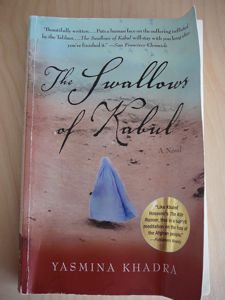
While waiting for our luggage to be offloaded, we were passing time, visiting with our greeter / expediter, asking about his family, his life in Zambia.
“How does this work, travelling with your son and your daughter-in-law?” he asked us. “Do you like her?”
Nothing on earth could disguise the delight on our faces as we both said “Yes!” We truly adore her.
When our son was only seven years old, a Christian speaker passing through said that if you have children, it is likely that their mates have also been born, so to start praying now for the unknown mate your child would choose, and we did.
When our son called us from university, and told us there was someone he wanted us to meet at graduation, and graduation was still months away, we knew, we just knew, that this might be THE ONE.
We were so delighted when we met her, we liked her immediately. What parent isn’t happy to see his/her son/daughter happy, and choosing well?
“But!” our meeter/greeter added, “how do you like her family?”
And we laughed again! We love her family! Her father is smart and very funny, and her mother is kind and practical, and we all share the same values on family and friends and living our lives. She comes from a large rowdy family that gathers when they can, and so do we.
And YOU are thinking “what does all this have to do with The Swallows of Kabul?” but I am getting there.
On the trip, we all had books for our quiet time, and I could see EnviroGirl deeply engrossed in this book. When I asked her, she said she had gotten it from her father’s wife, a woman with whom I often talk books, and that she (EnviroGirl) was trying to finish it so that she could leave it with me.
And thank goodness that she did! I couldn’t put it down!
First, you think it is written by Yasmina Khadra, but that is a pseudonym. The real author, Mohammed Moulessehoul, was Algerian army officer, and he used the pseudonym to avoid having to submit the manuscript for approval by military authorities. That got my attention right away.
The book is about Taleban era Afghanistan, and starts out with utter hopelessness, describing the deterioration in life brought about by the arbitrary imposition of religious rule, as interpreted by men who have memorized the Qur’an, but have a poor understanding of what they have memorized. Women lead a dismal, limited life, at the mercy of men who treat them as detestable if they are seen in public, even totally cloaked.
His language is beautiful, poetic and compelling, even describing despair and desolation.
We meet two couples, Atiq, a jailer, and his wife, Musarrat, who risked her own life to save his life back when he was seriously wounded and left for dead, and Mohsen, former member of a moderately successful merchant family, married to the love of his life, Zunaira, who is beautiful, educated and from a wealthy background. These men love their wives, and have a strong, genuine connection to them. Their ability to maintain that connection, and to stay connected to their own values, withers in the dry, dusty context of fundamentalist rule.
Their lives and relationships have been changing gradually, increasingly limited and undignified under the stress of Taleban rule, and the novel follows a rapid spiral of deterioration and folly. The steady decline of their lives speeds when Mohsen makes a terrible impulsive decision, has to live with the consequences, and confesses to his wife.
Atiq, too, faces dismal consequences. Even though we know he is limited, he becomes a sympathetic character. His hardness of heart covers a genuine grief that his wife is dying, and he can do nothing to stop it, nor to alleviate her pain.
We all face hard times. In our family, when someone lashes out unjustly, we often ask “is it something I have done, or am I just the nearest dog to kick?” It always gets a laugh, and it puts things back in perspective, puts us on the same side. Sometimes we can’t always vent our frustrations against those people or events creating the frustration, so we take it out on those we love – and who love us. It’s not right, it’s not fair or just, but it is very human, and once you get that out on the table, it is easier to discuss the real issue.
When Zunaira ends up in jail, Atiq’s world is shattered as if by an earthquake – the earth moves under his feet, all his understanding of life is shaken.
“As he cleans up, he cautiously lifts his eyes to the roof beam looming over the cell like a bird of evil augury, and his gaze lingers on the anemic little lightbulb, growing steadily dimmer in its ceiling socket. Screwing his courage to the sticking point, he walks back to the lone occupied cell, and there, in the very middle of the cage, the magical vision: the prisoner has removed her burqa! She’s sitting cross-legged on the floor. Her elbows are on her knees, her hands are joined under her chin. She’s praying. Atiq is thunderstruck. Never before has he seen such splendor. With her godess’s profile, her long hair spread across her back, and her enormous eyes, like horizons, the condemned woman is beautiful beyond imagination. She’s like a dawn, gathering brightness in the heart of this poisonour, squalid, fatal dungeon.
Except for his wife’s, Atiq hasn’t seen a woman’s face for many years. He’s even learned to live without such sights. For him, women are only ghosts, voiceless, charmless ghosts that pass practically unnoticed along the streets; flocks of infirm swallows – blue, yellow, often faded, several seasons behind – that make a mournful sound when they come into the proximity of men.
And all at once, a veil falls and a miracle appears. Atiq can’t get over it. A complete, solid woman? A genuine tangible woman’s face, also complete, right here in front of him? He’s been cut off from such a forbidden sight for so long that he believed it had been banished even from people’s imaginations. . . ”
Atiq has a friend, Mirza, who thrives under Taleban rule, as a soldier, and also running illegal businesses highly profitable under the current regime. He encourages Atiq to abandon his cancer-striken wife, to get rid of her and to find a fresh, young wife. He offers Atiq shady business opportunities, and tells him a wise man bends with the wind. Ignorance and chaos benefit Mirza, and he has no wish to see the good old days return.
In spite of the bleakness, the desolation, the crushing arbitrariness and inhumanity, there is hope, love, and compassion in a thin, steady stream throughout the book.
Once I started reading, I had to finish. It was a great book for the long trip back to Kuwait, one I am eager to pass along to the next avid reader.
Recent Comments
Cathy on No Grown-Ups in Charge intlxpatr on Waiting for Snow intlxpatr on Waiting for Snow Abou Tabblouleh on t… on Waiting for Snow Abou Tabbouleh on in… on Waiting for Snow Wikipedia Donate Button

Amazina


Early Voting in Florida


 Here There and Everywhere