Oral Sex More Lethal to Men than Women
This article from AOL Health News makes the point that while all females in the USA are encouraged to be vaccinated against HPV, young men, who are statistically more vulnerable, have not been vaccinated. Many women find themselves unexpectedly at risk when they are exposed to HPV by an unfaithful husband or boyfriend who has picked it up during oral sex.
Research: Oral Sex Puts Men at Risk for Oral Cancer
Mara Gay
Contributor
Rates of oral cancer are on the rise among men, and researchers say the culprit isn’t the devil you might think.
The rising rates of oral cancer aren’t being caused by tobacco, experts say, but by HPV, the same sexually transmitted virus responsible for the vast majority of cases of cervical cancer in women.
Millions of women and girls have been vaccinated against HPV, or human papillomavirus, but doctors now say men exposed to the STD during oral sex are at risk as well and may have higher chances of developing oral cancer.
About 65 percent of oral cancer tumors were linked to HPV in 2007, according to the National Cancer Institute. And the uptick isn’t occurring among tobacco smokers.
“We’re looking at non-smokers who are predominantly white, upper middle class, college-educated men,” Brian Hill, the executive director of the Oral Cancer Foundation, told AOL News by phone.
Tobacco use has declined over the past decade, but rates of HPV infections have risen and affect at least 50 percent of the sexually active American population, according to the Centers for Disease Control.
HPV-16, the strain of the virus that causes cervical cancer in women, has become the leading cause of oral cancer in non-smoking men, Hill said, citing research in the New England Journal of Medicine.
“When the No. 1 cause of your disease goes down [tobacco use], you would expect that the incidence of disease would go down, but that hasn’t happened,” he said. “In our world, this is an epidemic.”
Dr. Jennifer Grandis, the vice chairwoman for research at the University of Pittsburgh and an expert on head and neck cancers, said doctors have been seeing the HPV virus in most oral cancer tumors. She said the massive push to vaccinate girls and women between the ages of 11 and 26 against HPV should have included boys and men from the beginning. Gardasil, one of the two major vaccines used to prevent HPV, wasn’t approved for use in males in the United States until 2009, three years after it was approved for women.
“The thinking is changing,” Grandis told AOL News in a phone interview. “But at the time [the vaccine] was licensed, there wasn’t such an awareness about head or oral cancers or a willingness to accept that males played a part in the transmission of the virus,” she said. “I think this idea that we only protect our daughters with the vaccine is nuts anyway, particularly because they’re having sex with our boys.”
Men have a greater chance of contracting the HPV virus from oral sex than women do from the same behavior, though researchers aren’t exactly sure why. Oral cancer has a low survival rate because it is generally not discovered until it has spread to other areas, according to the CDC. Only half of people who’ve been diagnosed with oral cancer will live longer than five years.
Happy Five Year Anniversary
“How did he sound?” AdventureMan asked about our son.
I smiled.
“Actually, he sounded fine. He sounded like there is nothing in the world he wants to do more than to stay home with his sick baby.”
Everything was planned. Our son and his wife were on their way out to a special dinner, to celebrate five years of successful marriage. We were signed on to babysit, something we do with gladness. We knew how the evening would go. We arrive, HappyBaby runs shrieking with joy to AdventureMan, running right around me if I get in the way. I fix dinner, feed the HappyBaby, AdventureMan takes him down to play, then bathtime, then bed.
Not this time.
Our son called us about an hour before we were scheduled to arrive.
‘It’s all off” he said. “HappyBaby is sick, fever, lethargic. We’re just going to stay home. You can come by if you just want to hang out.”
“Oh! I’m so sorry!” I said, a little in shock. HappyBaby has been having a long spell of wellness. “I’m making spaghetti for us and HappyBaby,” I replied, “but there’s a lot. Can I bring dinner?”
He said yes. We made a salad, AdventureMan found a really good bottle of wine, we headed down. AdventureMan held HappyBaby – not so happy, very tired and a little fussy – while we dished up; I finished and held him so AdventureMan could eat. HappyBaby was fine with coming to me, his arms went around me, his little head went down on my shoulder, and it was like when he was little little, except he is so big now that I can’t sit down, or I can’t easily get up again. He’s a big boy now.
I always joke that I am the grandmother who can bore her grandson to sleep. We stood outside for a while, watching the cars go by, watching the sun set over the Bayou, and when the cool breeze started blowing I took him inside. He was so sleepy, he didn’t complain. We rocked, and I put him down in his crib, fast asleep.
It wasn’t the evening we expected. It was, for us, even better, having a relaxed time with our son and his wife, getting to put HappyBaby to sleep once again. It turned out to be a very sweet evening.
We’ve signed up to do the babysitting again when HappyBaby is well and our son and his wife can go out for that dinner. Five years of marriage is worth celebrating. We are so proud of them and the way they handle life, it’s joys and disappointments, struggles, challenges and triumphs. They are a good team, and we celebrate that they found one another and work so well together.

Alexander McCall Smith and The Saturday Big Tent Wedding Party
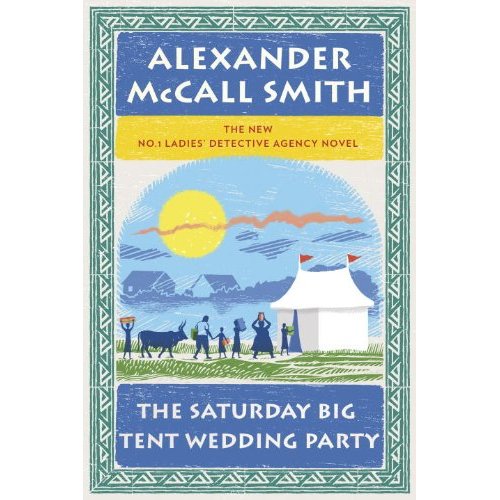
Just back from a wonderful two day trip to Botswana, visiting my dear and beloved friend Precious Ramotswe, who owns the #1 Ladies Detective Agency. For her, I make an exception to the paperback book rule (buy paperbacks because hard covers can hurt you if you fall asleep and they fall over) and get on the pre-publication order list so that Amazon will send me the book as soon as it comes out.
The Saturday Big Tent Wedding Party arrived Wednesday night. My husband was expecting a friend, and when the doorbell rang I thought “oh my, he is really early!” but it was the UPS guy, who had left a book-sized package on my doorstep. I had just finished an easy but fun book (The Map Thief by Heather Terrell) and was at odd ends as to what to read next, and this was an easy answer. As my husband drank Arabic coffee and sweet sweet Arabic tea, and ate delicate Middle Eastern treats downstairs, I got to start The Saturday Big Tent Wedding Party.
You know the books. They aren’t difficult to read, but while you are reading, you are transported to another world. Precious Ramotswe’s Botswana is not a world without problems, but the solutions to the problems are often found in softer gentler ways, ways that would seem counter-intuitive in our culture, but make total sense when you are raised in Botswana. There is a value placed on peaceable interaction, and maintaining relationships, on forgiveness, and going to extra mile. It’s a sweet world, and a great escape.
As usual, there are several intertwining plot lines with ingenious and unexpected solutions. I suspect that is what keeps me glued to this series – I cannot anticipate the solutions. That, and the gentleness of her outlook, the sweetness of life in Botswana, and the dignity and integrity of McCall’s primary characters.
I don’t know how McCall manages to keep the series fresh, but he avoids the formulaic and I find each book a treat. My favorite part of this book is how Mma Potokwane manages to wangle and invitation to Mma Makutsi’s wedding:
Mma Potokwane noticed the other woman’s uncertainty. “Yes,” she continued. “There’s that problem. And then there’s another problem. Problems come in threes, I find, Mma. So the next one – Problem number two, so to speak – is the cooking of food. You know what I find, Mma, it is this: the people doing the cooking never have enough pots. They say they do, but they do not. And right at the last moment they discover that there are not enough pots, or, more likely, the pots they have are too small. A pot may be big enough to cook your meat and pap at home, just for a family, but do not imagine that it will be big enough to cook for a couple of hundred people. You need big, catering-size pots for that.”
She was now warming to her theme. “And the third problem is the food itself. You may think that you have enough for the feast, and you may be right when it comes to the meat. People usually have enough meat – often rather too much, in fact. But they forget that after their guests have eaten a lot of meat, they need something sweet, and often they have made no arrangements for that. A wedding cake? Yes, but there will only be one small piece of that for each guest – usually not enough. So people find themselves wishing that they had had the foresight to get a supply of ordinary cake for the guests to eat with their tea. And where is this cake? Not there, Mma.”
Mma Ramotswe glanced at Mma Makutsi; this was not the way to speak to a nervous bride, she thought. “I’m sure that everything will work out well,” she said reassuringly. “And if there are any problems, they will surely just be small ones – nothing to worry about.”
Mma Potokwane looked doubtful. “I hope so,” she said. “But in my experience, it never works out like that. I think it’s better to be realistic about these things.”
Mma Makutsi picked up her pencil to add something to her list. “You said something about pots, Mma. Where would I be able to get these big, catering-size pots?”
Mma Potokwane examined her fingernails. “Well, we have them at the orphan farm. Each of the house mothers has a very large pot. I’m sure that we could do something . . . ”
Run to your bookstore and buy The Saturday Big Tent Wedding Party!
Cutting for Stone by Abraham Verghese

Someone in my book club in Qatar mentioned this book, Cutting for Stone, a while back, and I bought it, but it has sat for months on my to-read shelf (LOL, there are actually several, but one with the most important books, and another with the ‘guilty pleasures,’ the ones I am addicted to and save as a reward for good behavior, like vacuuming.)
When a good friend said she was reading it, and that it was good, I decided to move it up in priority, sort of like taking medicine, read a book that is good for you.
Oh WOW.
First, it is a great, absorbing story. Twin boys are born, totally unexpected, to an Indian Catholic nun and an English surgeon, working in Addis Ababa. How they were conceived is a mystery. The mother dies in childbirth, the father flees in horror, the children are born conjoined at the head and must be separated. The boys are adopted by an Indian couple, doctors at the hospital, and are raised with love and happiness.
That’s just the beginning!
I’ve always wanted to go to Ethiopia and Eritrea. I want to visit Lalibela, and some of the oldest Christian churches in the world. When my father was sick, he had a home health aid from Ethiopia, Esaiahs, who told me about the customs in his church, and how Ethiopian Christianity is very close to Judaism, with men and women separated in the church, and eating pork forbidden.

Reading this book, I felt like I had lived there, and I want to go back. The author captures the feelings, the smells, the visuals, the sounds, and if I awoke in a bungalow at the MIssing (Mission) Hospital, I would say “Ah yes! I remember this!”
I kept marking sections of this book that I loved. Here is one:
They parked at Ghosh’s bungalow and walked to the rear or Missing, where the bottlebrush was so laden with flowers that it looked as if it had caught fire. The property edge was marked by the acacias, their flat tops forming a jagged line against the sky. Missing’s far west corner was a promontory looking over a vast valley. That acreage as far as the eye could see belonged to a ras – a duke – who was relative of His Majesty, Haile Selassie.
A brook, hidden by boulders, burbled; sheep grazed under the eye of a boy who sat polishing his teeth with a twig, his staff near by. He squinted at Matron and Ghosh and then waved. Just like in the days of David, he carried a slingshot. It was a goatherd like him, centuries before, who had noticed how frisky his animals became after chewing a particuar red berry. From that serendipitous discovery, the coffee habit and trade spread to Yemen, Amsterdam, the Caribbean, South America, and the world, but it had all begun in Ethiopia, in a field like this.
We live inside the hearts and minds of doctors, some practicing under the worst possible conditions, and learn how they make their decisions and why. Verghese is a compassionate author; while his characters may be flawed, they are forgivable and forgiven.
Another section I loved, the man speaking is Ghosh, the man who adopted the twins with Hema, another doctor:
“My genius was to know long ago that money alone wouldn’t make me happy. Or maybe that’s my excuse for not leaving you a huge fortune! I certainly could have made more money if that had been my goal. But one thing I won’t have is regrets. My VIP patients often regret so many things on their deathbeds. They regret the bitterness they’ll leave in people’s hearts. They realize that no money, no church service, no eulogy, no funeral procession no matter how elaborate, can remove the legacy of a mean spirit.”
Things in Ethiopia get sticky, politically, and one of the twins is forced to flee, implicated in an airplane hijacking only because he was raised with a young woman involved. He is spirited into Eritrea, where he awaits his ride out to Kenya, and he helps the Eritrean rebels when large numbers of wounded are brought into his area. When the time comes to leave, his thoughts will strike a chord in anyone who has ever been an expat:
Two days later I took leave of Solomon. There were dark rings under his eyes and he looked ready to fall over. There was no questioning his purpose or dedication. Solomon said “Go and good luck to you. This isn’t your fight. I’d go if I were in your shoes. Tell the world about us.”
This isn’t your fight. I thought about that as I trekked to the border with two escorts. What did Solomon mean? Did he see me as being on the Ethiopian side, on the side of the occupiers? No, I think he saw me as an expatriate, someone without a stake in this war. Despite being born in the same compound as Genet, despite speaking Amharic like a native, and going to medical school with him, to Solomon I was a ferengi – a foreigner. Perhaps he was right, even though I was loath to admit it. If I were a patriotic Ethiopian, would I not have gone underground and joined the royalists, or others who were trying to topple Sergeant Mengistu? If I cared about my country, shouldn’t I have been willing to die for it?
The book has a lot of observations about coming to America; some of which made me laugh, some which made me groan. Coming back is always a shock to people who have lived abroad for a time, but it is a huge shock to those coming for the first time:
The black suited drivers led their passengers to sleek black cars, but myman led me to a big yellow taxi. In no time we were driving out of Kennedy Airport, heading to the Bronx. We merged at what I thought was a dangerous speed onto a freeway and into the slipstream of racing vehicles. “Marion, jet travel has damaged your eardrums,” I said to myself, because the silence was unreal. In Africa, cars ran not on petrol but on the squawk and blare of their horns. Not so here; the cars were near silent, like a school of fish. All I heard was the whish of rubber on concrete or asphalt.
As I neared the end, I read more slowly, unwilling for this book to end. It is one of the most vivid and moving books I have ever read. AdventureMan has gone online to find the nearest Ethiopian restaurant so we can have some injera and wot.
Single Awareness Day
“Oh! What a gorgeous dinner,” I said to our friends, “so romantic, a perfect Valentine’s Day feast.” It truly was – even though it was Valentine’s Eve, every detail was perfect, an outdoor fire, a beautiful red-velvet cake with white chocolate decorations, all in a delicate white and pink icing, a meal to die for . . .
“Happy Valentine’s Day!” we chirped.
“Happy Single Awareness Day,” their son grumped. He is astute and articulate, and AdventureMan and I have been married for so long that we’d forgotten what it is like to have Valentine’s Day without a sweetheart. 😦
Valentine’s Day really is mostly – in my opinion – about marketing. Selling greeting cards, selling flowers, selling candy, selling photos . . . . and it does make one acutely aware of being alone. It also puts pressure on couples to remember each other, oh aaarrgh. (Yes, AdventureMan remembered and bought me a great card. 🙂 ) The marketing mania for Valentine’s Day is not so great if you are in the middle of a fight or the relationship is going through one of those rocky periods. Or single.
Her Fearful Symmetry by Audrey Niffenegger
This was another find passed along by either Big Diamond or Little Diamond, via my Mom, and oh, what a find. Audrey Niffenegger wrote The Time Traveler’s Wife, a highly unusual book which hit the best seller list like a hurricane. This book, Her Fearful Symmetry, solidifies the perception that this author has real talent, thinks way outside the box, and creates characters and situations that, while unlikely, are likable and who become real enough for us to identify with them.
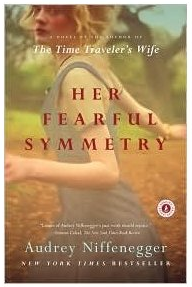
The title is based on a poem by William Blake, a poem I have always liked:
The Tiger
TIGER, tiger, burning bright
In the forests of the night,
What immortal hand or eye
Could frame thy fearful symmetry?
In what distant deeps or skies 5
Burnt the fire of thine eyes?
On what wings dare he aspire?
What the hand dare seize the fire?
And what shoulder and what art
Could twist the sinews of thy heart? 10
And when thy heart began to beat,
What dread hand and what dread feet?
What the hammer? what the chain?
In what furnace was thy brain?
What the anvil? What dread grasp 15
Dare its deadly terrors clasp?
When the stars threw down their spears,
And water’d heaven with their tears,
Did He smile His work to see?
Did He who made the lamb make thee? 20
Tiger, tiger, burning bright
In the forests of the night,
What immortal hand or eye
Dare frame thy fearful symmetry?
While this tale is a great yarn, it helps to know this poem, there are a lot of literary references in the novel and the title is just one of them.
As the story begins, there is a death, a will, and a set of mirror-image twins who inherit a flat in London overlooking a famous cemetery. The flat is in a building and has an upstairs neighbor, a man succumbing to obsessive-compulsive disease, and a downstairs neighbor, an aging bachelor, all a little eccentric in the nicest, English sort of way. The twins, Valentina and Julia, are twenty years old, and waif-like, still dressing alike, doing almost everything together.
There is also a ghost. No, wait! Two ghosts, and a kitten ghost. No, wait! I forgot! Lots of ghosts!
What I love about Audrey Niffenegger is that she takes what we perceive as reality and gives it a twist, and once you buy the twist, you are off on a wild ride. This book is a wild ride, with unforgettable characters and some unexpected kinks and thrills, as well as more than a couple shudders and chills.
A Reliable Wife by Robert Goolrick
You know how wonderful it is when you start a book, and immediately you are hooked? This is not that kind of book. This is a book you start reading and you think “Why am I reading this? I don’t like ANY of the characters!”
And yet, somehow, I kept reading. And slowly, slowly, the hook was set, I could not stop reading.
Actually, I read the book several months ago, and I am still thinking about it. That’s a good book. 🙂
We meet one of the main characters as he stands waiting for a train to arrive, carrying his bride-to-be. As we stand waiting with the man, we discover that he is not very likable. We also learn that winters in his part of the country are long and hard, and very strange things happen to people cooped up together during these long, hard winters. It is a very bleak beginnning.
Then we are riding in the train with a woman who is answering an ad placed by the first man who was advertising for a wife. We get a few clues that she is misrepresenting herself, but . . . isn’t a little misrepresentation part of the mating process? Do we really show all our less attractive features to the person to whom we want to be married? And does she know what she is getting in for with this rather cold and distant man?
Do you really want to read this book?
It gets better. So much better. People are complicated, and they lead complicated lives. Sometimes evil leads only downward, and to more evil, and from time to time, there is a gleam of hope and the slim promise of redemption. It gives a clear slice of time from the early 1900’s, and a much earlier time in America. For anyone with the illusions that life in that turn-of-the-century America was a better, simpler, more moral time, this book is a reality check.
Nothing in the beginning of this book is quite what it seems, and yet every word is finely crafted to give a clue as to where the book is going. Will you be able to figure it out before you get there?
(I did not.)
There are so many good books out there. This one is slow to start, but builds steadily to an unforgettable ending. It is worth a read.
The Disciple Jesus Loved
In today’s gospel reading is this story, a story I love because it tells us, as all our mothers always have, to mind our own business, to look to correcting our own behavior and not that of others.
There is a note to this passage, in The Lectionary: “The most ancient authorities lack 7.53—8.11; other authorities add the passage here or after 7.36 or after 21.25 or after Luke 21.38, with variations of text; some mark the passage as doubtful.”
The story is in the book of John, who is believed to be the disciple Jesus loved the best, and who tends to see into the heart of things. Although his closest followers, the disciples, often got it wrong (like arguing over who would sit at his right hand in heaven), they lived and worked with Jesus while he was here living on earth, and John seemed to know him best of all. To me, this story shows what Jesus expects of us – that we look to our own sins – and also, his compassion towards women.

(This is an image by Dagmar Anders)
John 7:53-8:11
53Then each of them went home, 81while Jesus went to the Mount of Olives. 2Early in the morning he came again to the temple. All the people came to him and he sat down and began to teach them.
3The scribes and the Pharisees brought a woman who had been caught in adultery; and making her stand before all of them, 4they said to him, ‘Teacher, this woman was caught in the very act of committing adultery. 5Now in the law Moses commanded us to stone such women. Now what do you say?’ 6They said this to test him, so that they might have some charge to bring against him.
Jesus bent down and wrote with his finger on the ground. 7When they kept on questioning him, he straightened up and said to them, ‘Let anyone among you who is without sin be the first to throw a stone at her.’
8And once again he bent down and wrote on the ground.* 9When they heard it, they went away, one by one, beginning with the elders; and Jesus was left alone with the woman standing before him.
10Jesus straightened up and said to her, ‘Woman, where are they? Has no one condemned you?’ 11She said, ‘No one, sir.’* And Jesus said, ‘Neither do I condemn you. Go your way, and from now on do not sin again.’]]*
Zachariah, and the Priestly Order of Abijah
When I first started doing readings daily from the Lectionary, I used a Bible, and often I would find myself intrigued and would read past where I was supposed to. Later, I discovered the joys of doing my readings on the internet, where I could instantly look up something I didn’t understand.
Today is a wondrous reading from Luke, where and old rabbi/priest, Zechariah and and his old wife, Elizabeth, who is barren, are to be blessed with a son, long after their young, fruitful years, and it is the Angel Gabriel who brings the news. One of the things I love about this story is that the characters are common to all Abrahamic religions, and I was able to find an article by Shmuel Safrai in The Jerusalem Perspective on what the Priesthood of Abijah would have been all about. If you are interested, just click on the blue type and you can read it, too.
Living in Moslem countries has helped me so much with understanding the human issues in these writings. Elizabeth’s barrenness was more than a personal tragedy; barrenness in a land and culture that highly values children and large families would be endlessly painful. The gift of John/Yahyah in her old age was a wondrous mercy.

Luke 1:5-25
5 In the days of King Herod of Judea, there was a priest named Zechariah, who belonged to the priestly order of Abijah. His wife was a descendant of Aaron, and her name was Elizabeth. 6 Both of them were righteous before God, living blamelessly according to all the commandments and regulations of the Lord. 7 But they had no children, because Elizabeth was barren, and both were getting on in years.
8 Once when he was serving as priest before God and his section was on duty, 9 he was chosen by lot, according to the custom of the priesthood, to enter the sanctuary of the Lord and offer incense. 10 Now at the time of the incense-offering, the whole assembly of the people was praying outside. 11 Then there appeared to him an angel of the Lord, standing at the right side of the altar of incense. 12 When Zechariah saw him, he was terrified; and fear overwhelmed him. 13 But the angel said to him, ‘Do not be afraid, Zechariah, for your prayer has been heard. Your wife Elizabeth will bear you a son, and you will name him John. 14 You will have joy and gladness, and many will rejoice at his birth, 15 for he will be great in the sight of the Lord. He must never drink wine or strong drink; even before his birth he will be filled with the Holy Spirit. 16 He will turn many of the people of Israel to the Lord their God.
17 With the spirit and power of Elijah he will go before him, to turn the hearts of parents to their children, and the disobedient to the wisdom of the righteous, to make ready a people prepared for the Lord.’
18 Zechariah said to the angel, ‘How will I know that this is so? For I am an old man, and my wife is getting on in years.’
19 The angel replied, ‘I am Gabriel. I stand in the presence of God, and I have been sent to speak to you and to bring you this good news. 20 But now, because you did not believe my words, which will be fulfilled in their time, you will become mute, unable to speak, until the day these things occur.’
21 Meanwhile, the people were waiting for Zechariah, and wondered at his delay in the sanctuary. 22 When he did come out, he could not speak to them, and they realized that he had seen a vision in the sanctuary. He kept motioning to them and remained unable to speak. 23 When his time of service was ended, he went to his home.
24 After those days his wife Elizabeth conceived, and for five months she remained in seclusion. She said, 25 ‘This is what the Lord has done for me when he looked favourably on me and took away the disgrace I have endured among my people.’
Marriage Myths
Found this today on AOL News: 10 Myths About Marriage – Marlo Thomas and found it to be full of wisdom.
Marriage is hard. We probably need all those myths (and estrogen and testosterone) or we would never get married, and the human race might fizzle! It helps to know that no matter what a marriage looks like on the outside, on the inside, each and every marriage has its own struggles.
Our moms passed down a lot of old “rules” about marriage. But ask anyone who’s been there and she’ll probably tell you that some of them just don’t apply to her marriage… me included. So I asked relationship expert Dr. Dale Atkins what she thinks about those bits of marital conventional wisdom. Read what she had to say – it turns out the knight in shining armor isn’t the only marriage myth!
Hi Marlo, and thanks for asking about the “rules” of marriage, or, as I call them, the myths! Really, so many of them are just that – they raise unrealistic expectations and can lead to disappointment and frustration.
I encounter people in my practice who think that a good marriage is built on romantic love and luck. One woman recently told me that she thinks a couple shouldn’t have to work at marriage if they are truly in love. The reality is that most successful marriages are built on commitment, respect, and companionship – and, of course, a shared history and a desire to support each other.
Coming to a better understanding of each other is the real key to a successful marriage. Now, let’s debunk some of those marriage myths:
MYTH #1: Your spouse is your other half, and now you are complete.
REALITY: A healthy person is complete in herself. Couples don’t complete each other, they complement each other (and they need to compliment each other, too!)
MYTH #2: Marriage is filled with romance and love.
REALITY: It is – but it’s also filled with anger and frustration, disappointment and confusion. It’s filled with lots of emotions, and couples should expect to experience peaks and valleys. The everyday problems and challenges of married life can often obscure romantic, loving, tender feelings, which is why couples need to remember the commitment that’s at the core of their marriage and realize there are full times and empty times.
MYTH #3: Your marriage should make you happy.
REALITY: You need to make yourself happy! Your spouse is not your source of happiness – that must come from within yourself. Marriage can and should augment a person’s individual happiness, but it’s not what makes you happy.
MYTH #4: You should never go to bed angry.
REALITY: That’s unrealistic – there are times you will go to bed with an unresolved issue, one that still has you fired up at day’s end. It’s not great to be lying next to someone while seething in anger, but it does happen. The best strategy is to table things so you don’t feel like you want to murder him! Remind yourself of all the positive things about him; ideally, you’ll have a fresh eye in the morning. By the way, one of you sleeping on the couch for a night is not the end of the world if you need time to think. If that one night turns into days or weeks at a time, that’s a problem. But taking a break for a night to have a calmer conversation the next day just might be more productive.
MYTH #5: A baby will bring you closer.
REALITY: Parenting together is a wonderfully intimate experience that can indeed make a couple feel closer. But it’s so hard on the body, mind, and emotions! New parents are exhausted and constantly questioning whether they are doing things right. Often the woman feels she is doing waaay more than her fair share and is resentful and disappointed in her partner. Then there are the hormones – a woman’s body goes nuts during and after pregnancy! A couple would be wise to recognize that these are all just normal feelings after having a child, and they shouldn’t feel let down that they’re not head-over-heels in love with each other: Take a deep breath, reserve some baby-free time for one another, and know that this is simply a new stage in your long-term relationship.
MYTH #6: Your husband should be your best friend.
REALITY: If you think this way, you’ll be in for a big disappointment. Over the years, you definitely develop an amazing friendship with your spouse. But it doesn’t necessarily start off that way, and it doesn’t replace the need for friends in your life. A best friend is someone you go to the movies with, someone you have a lot in common with, someone you can talk to. A spouse is the one you can go through life with, depend on forever – that takes time, so don’t expect to be girlfriend-close with him right away. And you may not tell him everything – for some things you want a friend’s help. It doesn’t mean you are not close to your spouse.
MYTH #7: You shouldn’t fight in front of the kids.
REALITY: If you don’t teach your children how to disagree respectfully, who will? I feel strongly about this – it can be frightening for children to observe parents going at it, but it’s instructive for them to see you work out differences in a civil manner. Most people don’t fight fair – they call each other names and diminish each other. Children don’t know what to do and they mimic it – and then what have you accomplished? If you fight fair in front of the kids, then make up in front of them, they’ll see that this is a process. You have a responsibility to teach your children how to interact with others in both good times and difficult ones. As a bonus, if you learn how to fight civilly, you’ll probably fight less – you’ll learn how to come to solutions rather than argue.
MYTH #8: You shouldn’t worry if you’re not having sex.
REALITY: It’s true that people can be so busy, and so tired, that sex becomes just one more thing they have to do. Sometimes in every relationship the couple’s sex life goes on hold for a while. And every couple is different – some make love a lot, some less. But most people who have really good marriages do have a sex life. So if you’re not having sex, it is something to examine. The frequency and intensity may change as you get older, but you still need to get what you need. You don’t want to fall into a boring pattern in which you are no longer interested in your mate or want to share your life with him.
MYTH #9: Your spouse should know what you need without your having to say it.
REALITY: Nobody is a mind reader, and it’s unrealistic (and unkind) to expect someone to know your every thought and feeling. It is imperative to communicate what is going on regarding your thoughts, feelings, and your needs.
MYTH #10: You shouldn’t take your spouse for granted.
REALITY: Well, this is partially true – you don’t want to treat each other like old shoes! But you should be able to take certain things for granted – that’s what trust is all about. After all, if you can’t rely on your spouse, who can you rely on? Just remember that it works both ways: If you want to let your guard down and walk around in sweats, that’s okay – you can take for granted that he’ll still think you’re beautiful. But be sure to keep that in mind when you see him in the dirty T-shirt!
Dale V. Atkins, PhD, has more than 25 years of expertise as a relationship specialist helping couples and families. She runs a private practice in New York City.
Recent Comments
Kitchen on Isiais: Winding Down intlxpatr on Shampoo Ginger tigerbutterya0c5ff1d… on Shampoo Ginger intlxpatr on British Soldier Kidnapped, Esc… John on British Soldier Kidnapped, Esc… Wikipedia Donate Button

Amazina


Early Voting in Florida


