Rape Victim Spends Seven Months in Jail, Framed by her Rapist
This is from the New York Times City Blog:
Man Is Sentenced for Raping Ex-Girlfriend and Then Framing Her
By DAN BILEFSKY
Updated 5:42 p.m. | The Queens private detective who raped his ex-girlfriend and then framed her for a series of fictional crimeswas sentenced to the maximum of 32 years in prison on Wednesday, bringing to a close one of the most bizarre cases to grace a courtroom.
Using knowledge he acquired partly from watching crime dramas like “C.S.I.,” the private detective, Jerry Ramrattan, 39, orchestrated what prosecutors in Queens called one of the most elaborate frame-ups in recent history.
Mr. Ramrattan’s ex-girlfriend, Seemona Sumasar, 36, had accused him of raping her. After she refused to drop the rape charges, he concocted a schemethat landed her in jail for seven months, making it seem as though Ms. Sumasar was the likely perpetrator of a series of brazen armed robberies, for which she was accused of impersonating a police officer.
At his trial in State Supreme Court in Queens, prosecutors produced evidence that Mr. Ramrattan cajoled and extorted witnesses to falsely testify that she had robbed them. He even staged fake crime scenes, prosecutors said, in which he planted evidence, handcuffing one of Ms. Sumasar’s supposed victims to a pole and planting several bullets at the scene of one of the imaginary crimes.
Before Mr. Ramrattan was sentenced on Wednesday, Ms. Sumasar delivered a stinging victim impact statement, noting that he showed no remorse and was so intent on revenge that he would have stopped at nothing to destroy her. “I don’t have words for you,” she said as as he stared ahead, stone-faced, while she spoke. “You are pure evil. You are a sociopath. You need help.”
“Someone needs to put a stop to your madness,” she added.
During her seven months in jail, awaiting a robbery trial, Ms. Sumasar, a former Morgan Stanley analyst, was separated from her young daughter. She lost her business, and her house went into foreclosure. Her bail was set at $1 million, which she could not afford. Mr. Ramrattan, meanwhile, was free until an informant came forward in late 2010 and exposed his plot.
Mr. Ramrattan was convicted in November of a series of charges, including rape, conspiracy and perjury. The nearly monthlong trial offered two opposing plot lines that were seemingly irreconcilable. Prosecutors portrayed Ms. Sumasar as a single mother duped by a wily confidence man intent on malicious vengeance. But the defense characterized her as a dejected lover who had turned on Mr. Ramrattan after he said he was leaving her to return to his wife and family.
Members of the jury said the guilty verdict was predicated on their acceptance of Ms. Sumasar’s account of being bound with duct tape and viciously raped by Mr. Ramrattan, which apparently gave him a motive to create his ruse.
In his plea for leniency, Mr. Ramrattan insisted that he was innocent, saying that he had spent years helping the police solve cases as an informant. “I stand before you with no choice but to accept what is going to happen,” he said. “Think about all the cases I made over the years, the rape victims I assisted. I maintain my innocence.”
Before he was escorted away by police, he added: “There is more to come.” As he spoke, his mother, Shirley Ramrattan, began wailing and was escorted from the courtroom.
His lawyer, Frank Kelly, told the judge that Mr. Ramrattan was not the “monster” he had been made out to be.
But Justice Richard Buchter said Mr. Ramrattan deserved no mercy, calling him a “diabolical conniver and sinister manipulator” who had “shamelessly exploited the criminal justice system.”
The Queens district attorney’s office and the Nassau County district attorney’s office had insisted on Ms. Sumasar’s guilt up until she was freed just weeks before her own robbery trial was set to begin. Ms. Sumasar filed a civil suit in December against the New York City Police Department and the Nassau County Police Department for negligence leading to her wrongful imprisonment..
Justice Buchter railed against the Nassau County police, who had wrongly imprisoned Ms. Sumasar, saying that it did not take “a Sherlock Holmes” to deduce that a 5-foot-2 former Wall Street analyst with no criminal record would not have held people up at gunpoint.
He chastised the police for their egregious handling of the case, saying detectives had “turned a blind eye” to Ms. Sumasar’s protestations that she was innocent and had too easily been taken in by Mr. Ramrattan.
“The police were duped by liars by whom they had a right to be suspicious, and as a result a rape victim was framed by her rapist,” the judge said. “She was victimized by the rapist and then again by the criminal justice system.”
He added: “The defendant is the architect of his own ruin. He deserves no mercy from me, and he won’t get any.”
Language of Flowers by Vanessa Diffenbaugh
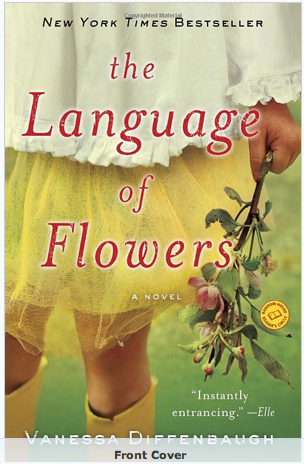
I didn’t expect to like this book as much as I did; from the first chapter I was hooked, so hooked I didn’t want to go to water aerobics of go to sleep until I had finished it. The title sounds girly and romantic, big yawn, but the book is anything but. The book is tough, and edgy, and tackles the foster care system without using sexual assault or out-of-the-ordinarily-cruel foster parents to bludgeon the point. She botches her one great chance at happiness when she sabotages her adoption by Elizabeth, who loves her dearly. The system can even be caring, but the effect of warehousing unwanted and neglected children damages their ability to trust, and to form relationships. We watch her as a child, self-destructive, angry, undermining her own chances of happiness.
Victoria even has a girly name to go with the title, but she is tough, and self-reliant, and very, very vulnerable, in spite of her toughness. Aging out of the system, she emerges a waif, with a hunger that stems more from emotional needs than physical.
She is greatly blessed to cross paths with people who look at her and truly see her, see her possibilities and her vulnerabilities, people who are willing to work with her, even to love her patiently, in spite of her prickliness and tendency to push people away. One of these is a florist, Renate, who recognizes in Victoria a gift for floral arrangement and is willing to work around her eccentricities. She gives Victoria a part-time job, in which Victoria flourishes.
In her emotional life, however, Victoria still has a lot of unresolved issues, stemming back to the very beginning when she was given up by a mother who, for whatever reason, didn’t want her. While she is hungry for love, she fears it as much as she wants it. Relationships overwhelm her. She abandons the love of her life, and then has to live with the consequences.
Watching her resolve her issues is cliff-hanging. You can’t stop reading. It’s not like watching a train-wreck; you know this girl has inner resources she has not yet tapped; you can read it in the loving evaluation of those who surround her. Every page of the way you are rooting for her to succeed.
And The Mountains Echoed by Khaled Hosseini
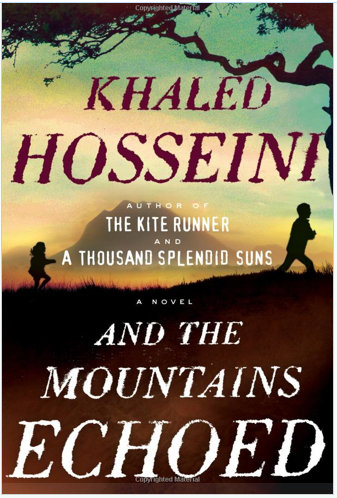
I danced when I saw the Amazon box; rarely do I buy hardcover (hurts too much when they fall over if I fall asleep reading, too bulky to carry on planes) but this one I was on the waiting list for, mail it as soon as it is published! Khaled Housseini, author of Kite Runner and A Thousand Splendid Suns has a new runaway best-seller; thanks to him I’ve just spent three days in Afghanistan, Paris and Los Angeles.
As the book opens, I am big brother to a baby sister whose Mom died in childbirth, living in a remote village in Afghanistan. Life is tough, but through the eyes of these children, life is idyllic, even though food is scarce and winters are cold. We have a huge oak tree with a swing, we play with the other children, and we have each other. Our father’s new wife is kind enough, but is busy with her own children, and the drudgery of cooking, cleaning and making do in a very small, poor Afghan village.
Later, I am Pari, living in Paris with an alcoholic, self-absorbed mother, making a life for myself, but always with a nagging feeling of something just outside my peripheral vision, another life . . .
The tale is told through the eyes of many, and on the way to the end of the tale we meet a wide spectrum of humanity, suffer the ills of war, callousness and unintended cruelties. We find that the man with superficial charm also saves and changes the lives of many, we find a doctor who finds fulfillment serving in the poorly resourced hospitals of Afghanistan, and we feel the agonies of a dutiful daughter watching her father fade into the world of Alzheimer’s.
It’s a wonderful, wild ride, richly textured, and when it finishes, you are not ready for it to end.
The Secret Lives of Baba Segi’s Wives by Lola Shoneyin

I don’t know what it is about summer reading, but now and then I go on a theme-fest; a couple years ago it was Nigerian literature, and, once hooked . . . when my friend who is now living in Lagos recommended The Secret Lives of Baba Segi’s Wives, I ordered it right away, thinking from the title it would be maybe light and sweet and humorous.
From the start, that assumption was blown. This is a direct and edgy Nigeria, darker, rougher and full of family secrets, domestic details and messy relationships.
It is a very Nigerian book – this is a good thing. There are cultural things that are not explained, but it all ends up making sense in the end. There are foods I have never heard of – ekuro with shrimp sauce, asun. There is a rudeness in the way they speak to one another, (“Is this a parking lot?” “Do I look like a parking attendant?”), a crudeness in the constant need to carry small bills for bribes, even on public streets. People speak their minds, with little or no mitigation, depending on the status of the person and their own personal goals and agendas.
At the weekly meeting of wives, the senior wife, Iya Segi, doles out rations of household supplies to the other wives, including chocolate powder and hair conditioner . . . and as the senior wives complain about the new wife thrown in their midst, she says:
“You will trip over in your hate if you are not careful, woman. Your mouth discharges words like diarrhea. Let Bolanle draw on every skill she learned in her university! Let her employ every sparkle of youth! Let her use her fist-full breasts. Listen to me, this is not a world she knows. When she doesn’t find what she came looking for, she will go back to wherever she came from.”
There is a whole other world in that one paragraph – a whole other way of seeing life and expressing thoughts. The culture may be alien, but I thoroughly enjoyed being a tiny mouse in the corner at that meeting – and others – and inside the minds of the wives, of Baba Segi, of the driver – so many good stories, so many points of view, and I learned things from behind those high compound walls and closed and locked doors that I might never otherwise have learned. Alien as it was, for me, this was a very good book, new ways of looking at things, and a great recommendation from my friend in Lagos.
Men Cause Menopause?
I don’t know that this has been studied closely, or that there is any evidence supporting the theory, but it is a hilarious theory – blame men for menopause!
By: Tia Ghose, LiveScience Staff Writer
Published: 06/13/2013 05:04 PM EDT on LiveScience
Ladies, here’s one more thing you can blame on men: menopause. At least, that’s according to a new theory.
Women go through menopause because men have consistently preferred younger women in recent evolutionary history, according to a study published today (June 13) in the journal PLOS Computational Biology.Thus, menopause is not evolutionarily advantageous and may be the result of a series of random, harmful mutations that accumulated in women but weren’t acted on by evolution because the women had already reproduced by the time the mutations affected them.
“Our first assumption is that mating in humans is not random with respect to age, which means men of all ages prefer to mate with younger women,” said study co-author Rama Singh, an evolutionary biologist at McMaster University in Canada. “If mating is with younger women, any deleterious mutations which affect women’s reproduction later in life will accumulate because they are not being acted on by natural selection.”
Menopausal mystery
Menopause, in which women stop menstruating and become infertile, has been a long-standing puzzle for biologists: Why would evolution have led to a trait that essentially reduces the reproductive potential of an animal?
Most other animals don’t go through menopause (although killer whales do). Even chimpanzees, humans’ closest living relatives, seem to reproduce into old age in the wild, and males even prefer older females.
Biologists have proposed the grandmother hypothesis to explain the conundrum. The hypothesis holds that menopause allows a grandmother who is done rearing her own kids to help rear the young of her children, thereby increasing the survival odds of her grandkids, and therefore, her genes.
But grandchildren and grandparents share just a quarter of their genes, versus half for children and their parents, so menopause would have to dramatically boost survival of grandchildren to be evolutionarily advantageous. Past studies have shown that maternal grandmothers boost their grandkids’ survival rates, though exactly how much depends on the society.
Younger women
For thousands of years (at least), men have, on average, mated with younger women, Singh said.
That’s because, if all else is equal, “those who reproduce earlier, their genes are passed on faster,” Singh told LiveScience.
So the researchers created a computer simulation to model that preference.
Early on, both men and women in the model reproduced until death. But over time, the model found, men’s preference for youth reduced older women’s odds of reproducing.
Simultaneously, people accumulated random mutations, some of which decreased later-life reproductive ability. But since older women were left out in the cold anyways, those mutations didn’t impact their reproductive success, whereas mutations in men that could reduce late-life reproduction were weeded out. (Men who stopped reproducing at some point in life would produce fewer offspring than those who didn’t, and the late reproducers would outcompete those who stopped breeding earlier.)
Over 50,000 to 100,000 years, the accumulation of all those mutations could have led to universal menopause, the researchers suggest. Menopause would then be another form of aging akin to graying hair or wrinkles.
If later childbearing becomes the norm, as current societal trends suggest, women who can reproduce at older ages might gain an evolutionary advantage, and menopause could, in theory be pushed later, Singh said.But it’s more plausible that technological changes such as fertility treatments will artificially extend women’s ability to reproduce, Singh said.
Questionable assumptions
But the new model might have the causation reversed, wrote Kristen Hawkes, an anthropologist at the University of Utah, who was not involved in the study, in an email to LiveScience.
As human life spans increased, women might have had many healthy years after fertility. As a result, men grew to prefer younger women because older women couldn’t reproduce.
Supporting that hypothesis, female chimpanzees see their egg reserves decline around the same age as human females, Hawkes noted. But unlike humans, they die shortly after this age, whereas humans have decades of healthy life left.
“The preference men have for young partners is a striking contrast with other primates,” Hawkes said. “My guess about that has been it’s a consequence of our life history.”
More Deaths than Birth for White Americans, a Minority in Three Decades
Don’t you love demographics? Demographics are a great forecasting tool, if you have the courage to use them. Demographics forced change on the United States military, forcing them to include women in more roles, recently increasing their job opportunities as the demographic pool dwindles. The same demographics are hurting the military budget now, as the huge bulge of baby-boomers retires, takes pensions and guaranteed free medical care, living a LONG time with more serious age-related illnesses, while the military struggles to allocate scarce resources.
Here is a fascinating factoid from The New York Times, a journal which notices small – but significant – changes, and gives us a little idea what the impact may be.

Census Benchmark for White Americans: More Deaths Than Births
By SAM ROBERTS
Published: June 13, 2013 232 Comments
Deaths exceeded births among non-Hispanic white Americans for the first time in at least a century, according to new census data, a benchmark that heralds profound demographic change.
The disparity was tiny — only about 12,000 — and was more than made up by a gain of 188,000 as a result of immigration from abroad. But the decrease for the year ending July 1, 2012, coupled with the fact that a majority of births in the United States are now to Hispanic, black and Asian mothers, is further evidence that white Americans will become a minority nationwide within about three decades.
Over all, the number of non-Hispanic white Americans is expected to begin declining by the end of this decade.
“These new census estimates are an early signal alerting us to the impending decline in the white population that will characterize most of the 21st century,” said William H. Frey, a demographer with the Brookings Institution.
The transition will mean that “today’s racial and ethnic minorities will no longer be dependent on older whites for their economic well-being,” Dr. Frey said. In fact, the situation may be reversed. “It makes more vivid than ever the fact that we will be reliant on younger minorities and immigrants for our future demographic and economic growth,” he said.
The viability of programs like Social Security and Medicare, Dr. Frey said, “will be reliant on the success of waves of young Hispanics, Asians and blacks who will become the bulwark of our labor force.” The issues of minorities, he added, “will hold greater sway than ever before.”
In 2010, according to the National Center for Health Statistics, more non-Hispanic whites died than were born in 11 states, including California, Florida and Pennsylvania. White deaths exceeded births in a majority of counties, including Los Angeles, the most populous.
The disparity between deaths and births in the year that ended last July surprised experts. They expected that the aging white population would eventually shrink, as it has done in many European countries, but not for another decade or so.
Nationally, said Kenneth M. Johnson, the senior demographer at the Carsey Institute, a research center based at the University of New Hampshire, “the onset of natural decrease between 2011 and 2012 was not anticipated.” He attributed the precipitous shift in part to the recession, adding that “the growing number of older non-Hispanic whites, which will accelerate rapidly as the baby boom ages, guarantees that non-Hispanic white natural decrease will be a significant part of the nation’s demographic future.”
Professor Johnson said there were 320,000 more births than deaths among non-Hispanic whites in the year beginning July 2006, just before the recession. From 2010 to 2011, the natural increase among non-Hispanic whites had shrunk to 29,000.
Census Bureau estimates indicate that there were 1.9 million non-Hispanic white births in the year ending July 1, 2012, compared with 2.3 million from July 2006 to 2007 during the economic boom, a 13.3 percent decline. Non-Hispanic white deaths increased only modestly during the same period, by 1.6 percent.
The census population estimates released Thursday also affirmed that Asians were the fastest-growing major ethnic or racial group. Their ranks grew by 2.9 percent, or 530,000, with immigration from overseas accounting for 60 percent of that growth.
The Hispanic population grew by 2.2 percent, or more than 1.1 million, the most of any group, with 76 percent resulting from natural increase.
The non-Hispanic white population expanded by only 175,000, or 0.09 percent, and blacks by 559,000, or 1.3 percent.
The median age rose to 37.5 from 37.3, but the median declined in Alaska, Hawaii, Kansas, North Dakota and Oklahoma. It ranged from 64.8 in Sumter, Fla., to 23 in Madison, Idaho.
The number of centenarians nationally neared 62,000.
Men Not Mature Until 43 (!)
From The Business Standard, a recent study verifies that men simply mature later than women do. “Men were nearly twice as likely as women to describe themselves as immature.” (!)
Women often accuse men of being immature – and there may be some truth in it after all!
The age that men mature completely is 43 – which is 11 whole years after women, a new UK study has found.
Women were regarded as being mature at the age of 32, the research commissioned by Nickelodeon UK found.
Eight out of 10 women quizzed in the study believed men ‘never stop being childish’ and said the biggest bug-bears were how they found flatulence amusing, eating fast food in the early hours and playing video games, ‘The Daily Express’ reported.
Staying silent after rows, racing another car at traffic lights, being unable to cook simple meals and sniggering at rude words were also regarded by women as signs of male immaturity.
Men were nearly twice as likely as women to describe themselves as immature.
Also, females were twice as likely as men to feel that they were the ‘grown up’ in a relationship. A third had broken up with a man they thought was too immature.
Men whose mothers still did their washing or cooked them meals rated low in the maturity stakes.
Owning a skateboard or BMX bike was another no-no for women, as was wearing cartoon pyjamas or having a cartoon bedspread.
One in four women felt they were the ones who made all the important decisions in the relationship with the same percentage wishing their partner would talk about themselves and their feelings more often.
Almost 46 per cent of women have had a relationship in which they felt they had to mother their partner a bit too much, the study found.
Forty Years Wedding Anniversary

“You’re going to celebrate your anniversary for three days?” my friend asked incredulously.
“No, no, actually, it’s in two parts, we are celebrating the entire weekend, three days, but it’s because it is too hot to walk around New Orleans; so this is just part one, and in December we will celebrate part two with a trip to New Orleans when we can walk around and enjoy all the Christmas decorations and stay somewhere nice.”
It’s what we do.
There have been some years, particularly years with moves, or new positions, or new contracts in them, when anniversaries have sort of fallen by the wayside. We are enjoying making up for all the missed anniversaries, now that we have the great luxury of time.

We have all kinds of fun plans, a hotel stay, a dinner in a fine restaurant, star gazing out at Ft. Pickens, maybe a dolphin cruise, and a trip up in the very large beach ferris wheel, while it is still at Pensacola Beach. We plan a day in several pools with our son and his wife and our little grandson. All. or part, or some of this may really happen, depending on what the weekend weather looks like. Ft. Pickens has already evacuated all the campers with concerns over this Tropical Storm Andrea coming in, and a dolphin cruise or a trip up on the great wheel may not be such a hot idea at 40 – 50 mph winds, LOL.

AdventureMan and I knew when we married that we were in it for the long haul. We also knew it wouldn’t be easy. We come from different cultures, different life styles. We both had independent lives and responsibilities. We moved a lot. It wasn’t always easy, but then whose life is, when you know that life from the inside? We’ve had some great adventures, and some fabulous, astounding experiences. We’ve met extraordinary people and made very special life-long friends.

When I told AdventureMan our weekend might not be as exciting as planned, he laughed and said “we can bring our books.” He always knows how to make me laugh, and taking books is exactly what we did when we first got married, and would take weekend trips to a lakeside resort called Chiemsee; it would be snowing and cold and we would go into this large old lodge with it’s double doors and double shuttered windows, with it’s eiderdown comforters and huge fireplace, and we would pack books. We would sleep and read, and sometimes go eat. If that’s how this anniversary turns out, it’s a very comfortable and familiar way to celebrate.:-)

AdventureMan loves this blog. He always looks for his name. 🙂 Happy Anniversary, dear husband.
Afghanistan: Such Laws Give Women Ideas . . .
Law Protecting Afghanistan Women Blocked By Conservatives
By KAY JOHNSON 05/18/13 08:03 AM ET EDT 
KABUL, Afghanistan — Conservative religious lawmakers in Afghanistan blocked a law on Saturday that aims to protect women’s freedoms, with some arguing that parts of it violate Islamic principles or encourage women to have sex outside of marriage.
The failure highlights how tenuous women’s rights remain a dozen years after the ouster of the hard-line Taliban regime, whose strict interpretation of Islam kept Afghan women virtual prisoners in their homes.
Khalil Ahmad Shaheedzada, a conservative lawmaker for Herat province, said the legislation was withdrawn shortly after being introduced in parliament because of fierce opposition from religious parties who said parts of the law are un-Islamic.
“Whatever is against Islamic law, we don’t even need to speak about it,” Shaheedzada said.
The Law on Elimination of Violence Against Women has actually been in effect since 2009 by presidential decree. It is being brought before parliament now because lawmaker Fawzia Kofi, a women’s rights activist, wants to cement it with a parliamentary vote to prevent its reversal by any future president who might be tempted to repeal it to satisfy hard-line religious parties.
Among the law’s provisions are criminalizing child marriage and banning “baad,” the traditional practice of selling and buying women to settle disputes. It also criminalizes domestic violence and specifies that rape victims should not face criminal charges for fornication or adultery.
“We want to change this decree as a law and get the vote of parliamentarian for this law,” said Kofi, who is herself running for president in next year’s elections. “Unfortunately, there were some conservative elements who are opposing this law. What I am disappointed at is because there were also women who were opposing this law.”
Afghanistan’s parliament has more than 60 female lawmakers, mostly due to constitutional provisions reserving certain seats for women.
The child marriage ban and the idea of protecting female rape victims from prosecution were particularly heated subjects in Saturday’s parliamentary debate, said Nasirullah Sadiqizada Neli, a conservative lawmaker from Daykundi province.
Neli suggested that removing the custom – common in Afghanistan – of prosecuting raped women for adultery would lead to social chaos, with women freely engaging in extramarital sex safe in the knowledge they could claim rape if caught.
Lawmaker Shaheedzada also claimed that the law might encourage promiscuity among girls and women, saying it reflected Western values not applicable in Afghanistan.
“Even now in Afghanistan, women are running from their husbands. Girls are running from home,” Shaheedzada said. “Such laws give them these ideas.”
Freedoms for women are one of the most visible – and symbolic – changes in Afghanistan since 2001 U.S.-led campaign that toppled the Taliban regime. Aside from their support for al-Qaida leaders, the Taliban are probably most notorious for their harsh treatment of women under their severe interpretation of Islamic law.
For five years, the regime banned women from working and going to school, or even leaving home without a male relative. In public, all women were forced wear a head-to-toe burqa veil, which covers even the face with a mesh panel. Violators were publicly flogged or executed. Freeing women from such draconian laws lent a moral air to the Afghan war.
Since then, women’s freedoms have improved vastly, but Afghanistan remains a deeply conservative culture, especially in rural areas.
___
Associated Press writer Rahim Faiez contributed in Kabul.
Rovaer Norway: The Best Wedding Proposal Ever
The groom-to-be was able to rope the entire village into participating in his proposal to his girlfriend. He knocks her socks off – no matter what the highs and lows of the marriage to come, she will never forget this proposal:
Recent Comments
intlxpatr on Yellowstone: Old Faithful to C… Michelle on Yellowstone: Old Faithful to C… Cathy on No Grown-Ups in Charge intlxpatr on Waiting for Snow intlxpatr on Waiting for Snow Wikipedia Donate Button

Amazina


Early Voting in Florida


 Here There and Everywhere