Hemingway and A Movable Feast

After reading The Paris Wife, I had to read Hemingway’s A Movable Feast. I wanted to see how he saw his Paris years, and how his version integrated with the fiction version of Hadley’s. I was prepared to not like the book.
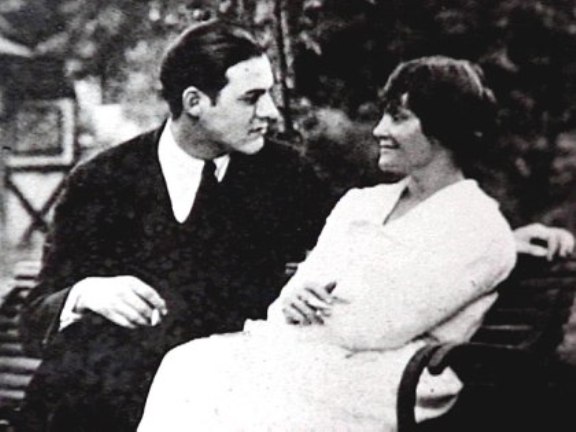
I was not prepared to like it as much as I did. Hemingway writes of the years when he was young, newly married and wildly happy, living a stimulating and lively life with lively friends. They were poor, but he was following his dream. They had a lot of fun.
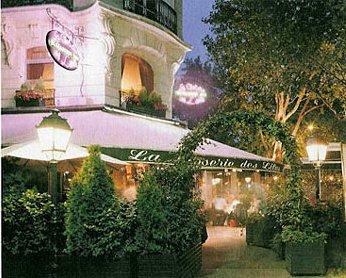
Hemingway wrote this book, full of stories of their Paris life, full of names you know – Ezra Pound, Scott and Zelda Fitzgerald, Picasso, Closerie des Lilas, Les Deux Magots, Brasserie Lipp, the Louvre . . . and as you read it, you are there. He writes in the moment; you are right there experiencing it along with him. He writes of people he likes, and people he doesn’t like. He writes about his own vices – an addiction to horse racing, for example – and he writes with enormous sadness about how he came to be distracted from his marriage and lost the most wonderful relationship that ever happened to him. He blames it on the careless rich. He takes some responsibility.
He also writes very frankly and openly about people he doesn’t like and why. I couldn’t help but think it is a heady thing, being an acclaimed author, where you can take revenge by putting people you dislike in your books. Hemingway uses real names and real people and often portrays them in a distinctly unflattering light. It made me wonder if he was planning to commit suicide all along; that or he just didn’t care what people think, and it seems he might have been the kind just not to care.
Just after finishing this book, and talking one last time with his first wife, Hadly, Hemingway committed suicide. It leaves me wondering if he was driven to suicide by regret, or by fears that his bigger-than-life life of adventure, travel, high life and travel was over, or if he had serious bouts of depression all his life, and this was just another, deeper depression?
It is a great read, especially paired with Paula McLain’s book, The Paris Wife. I thought it might be “he said – she said,” but Hemingway and the fictional Hadley in The Paris Wife both agree that they had a love and marriage that was very special, that Paris was a wonderful stimulating, alive environment, and that it was a great tragedy when the marriage ended. A Movable Feast seems to say that destroying his marriage to Hadley was one of a cocktail of self-destructive behaviors over which he tried to ride herd (gambling on the horse races, drinking, drugs, a coterie of star-struck sex partners outside of marriage, inability to focus on his work, a curmudgeonly nature . . .)

It’s also an easy read. I particularly enjoyed reading it on the iPad because you can do that swirly-finger-thing and find out what words mean or see the street locations as he walks Paris, see whether a cafe or restaurant in Paris still exist. It would be a good airline read – keeps your attention and finishes quickly.
As little as I like Woody Allen, it was fun to see Midnight in Paris, and to have some visuals of this go-go inter-war era.
Two things that stuck out for me: Hemingway loved walking in Paris, as do I. He also talks here and there about the benefits of being hungry. There were times when money was tight; they wore old shabby clothes, and there were times they didn’t have much food. He talks about hunger sharpening your other senses. On the other hand, very quickly when he has money, he has a great meal and a drink – or two – or three.
Bottom line, I’m glad I read this book. It’s given me a lot to think about.
Spy the Lie on the Diane Rehm Show

Thursday, July 24th, Diane Rehm had another wonderful show. Diane Rehm has a gift for asking thoughtful questions, listening carefully, and then following up with another thoughtful question. She treats her guests with great civility, but she never hesitates to ask the tough question.
Thursday, she interviewed Senator Marco Rubio, who did pretty well until she started asking him the tough, revealing questions, and you could actually hear him squirm.
Far more interesting than Senator Rubio was her interview with former CIA employees Philip Houston and Michael Floyd, discussing their new book Spy the Lie. We’ve all heard different ways liars give themselves away, but these two former interrogators told us how to ask questions, and a “cocktail” of responses – not one response, eyes shifting away, but a variety together – which tell you that you are being lied to.
Deflection, change of voice tone, swearing to God, anger at being asked – these and other giveaways work together. Bottom line – if your instincts are screaming “Lie! Lie!” then chances are good you are being lied to.
The truth is, most of us know when we are being lied to. There are times the liar will never admit to it, but you have to work with the knowledge that what he or she is saying is a lie. At least you know. You don’t have to buy into the lie. And you know my position – lying hurts the liar most of all.
Iran Raids Coffee Shops as Un-Islamic

(Starbucks in Dubai Mail)
I always thought coffee shops started in that part of the world – oh wait, right, those were just for men.
LOL, found this on AOL, from Huffpost, from a Reuters report:
DUBAI, July 15 (Reuters) – Iranian police shut down dozens of restaurants and coffee shops over the weekend, Iranian media reported, in a renewed crackdown on what the state sees as immoral and un-Islamic behaviour.
Regular officers and members of the “morality police” raided 87 cafes and restaurants in a single district of the capital Tehran on Saturday and arrested women for flouting the Islamic dress code, according to the Iranian Students’ News Agency (ISNA).
“These places were shut for not following Islamic values, providing hookah to women, and lacking proper licenses,” said Tehran police official Alireza Mehrabi, according to ISNA. Women are not allowed to smoke hookah, water pipes, in public.
Mehrabi said the raid came as part of a plan to provide “neighbourhood-oriented” security, and would continue in other parts of Tehran.
Coffee shop culture has flourished in Iran in recent years, offering wireless Internet, snacks, hot drinks, and a place to hang out for Iranian youth in a country where there are no bars or Western chain restaurants or cafes.
But that trend has been criticised by conservative Iranians who consider it a cultural imposition from the West and incompatible with Islamic values. The government periodically cracks down on behaviour it considers un-Islamic, including mingling between the sexes outside of marriage.
In 2007, Tehran police closed down 24 Internet cafes and other coffee shops in as many hours, detaining 23 people. (Reporting By Yeganeh Torbati; Editing by Robin Pomeroy)
Does the Surf Burger on Pensacola Beach Rock?
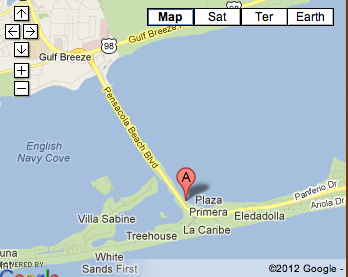
AdventureMan and I disagree about the Surf Burger on Pensacola Beach.
I don’t eat a lot of hamburgers. In fact, I eat about one a year, and it has become a sort of tradition that I go to the Red Robin around the Fourth of July for my annual hamburger quota. Like, if you’re going to do it, do it right. (“YUMMMMMMMMMMMMMMM.”) 🙂
But it was close to the 4th of July when our son called and said they were headed to the beach and did we want to meet them at the Surf Burger for dinner. We said sure, there is always something on the menu we can eat at most places, and we’ve never been to the Surf Burger. How can you live in Pensacola and never eat at the Surf Burger?
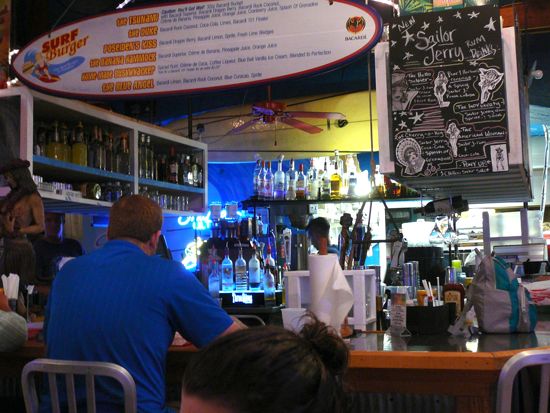
We got there first. There’s a part of me that felt comfortable there right away. It’s a lot like the old Red Robin used to be, the one we used to go to when I was in university, kind of a dive. There is a bar, and semi-sloshed looking people dressed in not-very-much trying to pick each other up, and a very basic menu, mostly hamburgers. And beer. And those mixed drinks with cute names you find at most beaches with 7 or more potentially lethal kinds of alcohol – in each drink.
It is both family friendly and pet friendly. If you are not wearing beach gear, you are overdressed. Service can be slow when they have a lot of customers, and often, they have a lot of customers. It’s very very hard on a Sunday night to find a parking place.
I knew just what I wanted – a Firecracker Burger. When it came, on two slices of toasted bread, I was disappointed, until I bit in. Once I tried it, I was happy. The burger tasted like 100% real meat, none of these chain burgers that you’re not sure how much is meat and how much is ‘special ingredients’ you really don’t want to know. It was SPICY; it was a Firecracker. I enjoyed every bite, and that is a good thing when you only eat one burger a year.

AdventureMan was not so happy. He ordered a SurfBurger. He hated the French Fries. He found his burger not that great. He thought it was greasy.
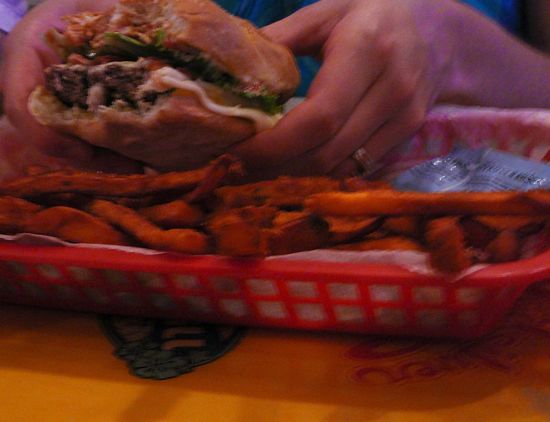
Our Vegan ordered a VeggieBurger, and she was happy, too. She said it tasted like meat, and had a great texture, but it wasn’t meat.

Surf Burger is probably not your destination kind of restaurant. It’s a burger joint. You go there for a hamburger because you are at the beach and you are hungry. You go there maybe to drink and hook up with a new friend. You go there because it is easy and comfortable and you don’t want to get cleaned up or dressed up. All those are good reasons to go to the Surf Burger.
Surf Burger
500 Quietwater Beach Blvd
Pensacola Beach, FL
850-932-1417
TO GO ORDERS WELCOMED
Mon – Thur: 11am – 10pm
Fri: 11am – 11pm
Sat: 8am – 11pm
Sun: 8am – 10pm
Hilary Mantel: Wolf Hall & Bring Up the Bodies


While it is unusual for me to comment on two books at the same time, Bring Up the Bodies follows so seamlessly the preceding book, Wolf Hall, as to be one book. It is also unusual that I would choose to read a book about Thomas Cromwell, whose great-grandson brings into dictionaries the adjective Cromwellian, and whose morals and values drift so far from my own. Most unusual of all is that I would find myself liking – and understanding – Thomas Cromwell as described and defined by Hilary Mantel.
While reading, if forced away from the book, I couldn’t wait to get back to it. I felt totally immersed in the 1500’s, I felt like I was there. Hilary Mantel uses the senses to bring an immediacy to the story that makes you feel you are there, participating, perhaps one of Cromwell’s clerks.
Thomas Cromwell has a rough beginning, son of a blacksmith and sometimes moonshiner, often beaten to within an inch of his life by his father, Walter, who seems to hate him. He leaves home and the next few years of his life are murky – he fights for the French, he becomes a servant and later a clerk in a high ranking Italian household, he learns the wool trade, and the silk trade, he spends some years in Antwerp and then he finds himself as chief clerk and messenger to Cardinal Wolsey, advisor to Henry VIII.
We experience losing our loved one to the plague. In these two books, through Cromwell’s eyes, we watch that spoiled, self-centered King Henry VIII rationalize his divorce of Katherine, and then the beheading of Anne Boleyn.
Here is something I hate about Thomas Cromwell, no matter how human and humane and lovable Hilary Mantel made him, that his primary value throughout was that whatever Henry wanted, he would work to make it so.
We learn early in Wolf Hall how very dangerous it is to go up against King Henry, we watch Cardinal Wolsey stripped of his honors, his luxuries, humiliated and defeated. We see Thomas More badgered to execution. So we can understand, a little, Thomas Cromwell’s motivation to keep his hard-earned money, honors, position, etc.
What I don’t understand is how a really, very smart man like Cromwell doesn’t see that he needs to be hiding his wealth away, investing in places where Henry can never find it, so that he can leave the King’s service, withdraw from public life and from the dangers that go with it. By the end of Bring Up the Bodies, Cromwell has made a lot of enemies. Such a nice man, such a benign man, but he relentlessly prosecutes the four men who may – or may not – have slept with Queen Anne Boleyn. It’s what the king wants. He does it.
This is a protrait of Thomas Cromwell painted by the famous Hans Holbein:

Wolf Hall won the Man Booker Prize in 2009. Bring Up the Bodies is sometimes referred to as Wolf Hall #2. These are books you can’t stop thinking about, and I am hoping there will be one more.
“Nobody wins. We’ve all lost.”
Guilty. A fitting end to a sorry story. A man who used his position to prey on the most vulnerable, poor children. He brought down one of America’s heroes, Joe Paterno, and cast a stain on a stellar football school. Although he is convicted, as one victim’s mother states, there are no winners here – the kids will have to live with his betrayal for the rest of their lives. My guess is he still believes he did nothing wrong. These guys tell themselves that their victims are willing. Put the man away.
BELLEFONTE, Pa.—Jerry Sandusky was convicted Friday of sexually assaulting 10 boys over 15 years, a swift and emphatic end to a case that shattered Penn State University’s Happy Valley image and brought down Hall of Fame football coach Joe Paterno.
Sandusky, a 68-year-old retired defensive coach who was once Paterno’s heir apparent, was found guilty of 45 of 48 counts and is almost certain to spend the rest of his life in prison.
The jury of seven women and five men, including nine with ties to Penn State, deliberated more than 20 hours over two days.
Sandusky showed little emotion as the verdict was read. Judge John Cleland revoked his bail and ordered him taken to the county jail to await sentencing in about three months. Many of the charges carry mandatory minimum sentences.
Sandusky half-waved toward his family in the courtroom as the sheriff led him away. Outside, he calmly walked to a sheriff’s car with his hands cuffed in front of him.
The accuser known in court papers as Victim 6 broke down in tears upon hearing the verdicts, and a prosecutor embraced him and said, “Did I ever lie to you?”
The man, now 25, testified that Sandusky called himself the “tickle monster” in a shower assault. He declined to comment to a reporter afterward, but his mother said: “Nobody wins. We’ve all lost.”
Almost immediately after the judge adjourned the case, loud cheers could be heard from a couple hundred people gathered outside the courthouse as word quickly spread that Sandusky had been convicted. The crowd included victim’s advocates and local residents with their children.
As Sandusky was placed in the cruiser to be taken to jail, someone yelled at him to “rot in hell.” Others hurled insults and he shook his head no in response.
Lead defense attorney Joe Amendola was interrupted by cheers from the crowd on courthouse steps when he said, “The sentence that Jerry will receive will be a life sentence.”
Eight young men testified in a central Pennsylvania courtroom about a range of abuse, from kissing and massages to groping, oral sex and anal rape. For two other alleged victims, prosecutors relied on testimony from a university janitor and then-graduate assistant Mike McQueary, whose account of a sexual encounter between Sandusky and a boy of about 10 ultimately led to Paterno’s firing and the university president’s ouster.
Sandusky did not take the stand in his own defense, which Amendola said was a last-minute strategy change.
Defense attorney Karl Rominger said it was “a tough case” with a lot of charges and that an appeal was certain. He said the defense team “didn’t exactly have a lot of time to prepare.”
Amendola praised the prosecution, the judge and the jury and added: “Jerry indicated he was disappointed with the verdict, but obviously he has to live with it.” He said he would appeal.
Pennsylvania Attorney General Linda Kelly thanked the accusers who testified, calling them “brave men.”
She said she hoped the verdict “helps these victims heal … and helps other victims of abuse to come forward.”
Jerry Sandusky faces up to 442 years in prison. (AP Photo)
“One of the recurring themes in this case was: Who would believe a kid?” she said. “The answer is: We here in Bellefonte, Pa., would believe a kid.”
Sandusky repeatedly denied the allegations, and his defense suggested that his accusers had a financial motive to make up stories, years after the fact. His attorney also painted Sandusky as the victim of overzealous police investigators who coached the alleged victims into giving accusatory statements.
But jurors believed the testimony that, in the words of lead prosecutor Joseph McGettigan III, Sandusky was a “predatory pedophile.”
One accuser testified that Sandusky molested him in the locker-room showers and in hotels while trying to ensure his silence with gifts and trips to bowl games. He also said Sandusky had sent him “creepy love letters.”
Another spoke of forced oral sex and instances of rape in the basement of Sandusky’s home, including abuse that left him bleeding. He said he once tried to scream for help, knowing that Sandusky’s wife was upstairs, but figured the basement must be soundproof.
Another, a foster child, said Sandusky warned that he would never see his family again if he ever told anyone what happened.
And just hours after the case went to jurors, lawyers for one of Sandusky’s six adopted children, Matt, said he had told authorities that his father abused him.
Matt Sandusky had been prepared to testify on behalf of prosecutors, the statement said. The lawyers said they arranged for Matt Sandusky to meet with law enforcement officials but did not explain why he didn’t testify.
Amendola said Sandusky reluctantly agreed not to testify in his own behalf because the son would have been called by the prosecution as a rebuttal witness and the defense feared that would destroy any chance of acquittal.
Defense witnesses, including Jerry Sandusky’s wife, Dottie, described his philanthropic work with children over the years, and many spoke in positive terms about his reputation in the community. Prosecutors had portrayed those efforts as an effective means by which Sandusky could camouflage his molestation as he targeted boys who were the same age as participants in The Second Mile, a charity he founded in the 1970s for at-risk youth.
Sandusky’s arrest in November led the Penn State trustees to fire Paterno as head coach, saying he exhibited a lack of leadership after fielding a report from McQueary. The scandal also led to the ouster of university president Graham Spanier, and criminal charges against two university administrators for failing to properly report suspected child abuse and perjury.
The two administrators, athletic director Tim Curley and now-retired vice president Gary Schultz, are fighting the allegations and await trial.
The family of Paterno, who died exactly five months before Sandusky’s conviction, released a statement saying: “Although we understand the task of healing is just beginning, today’s verdict is an important milestone. The community owes a measure of gratitude to the jurors for their diligent service. Our thoughts and prayers continue to be with the victims and their families.”
In a statement, Penn State praised the accusers who testified and said that it planned to invite the victims of Sandusky’s abuse to participate in a private program to address their concerns and compensate them for claims related to the school.
Sandusky had initially faced 52 counts of sex abuse. The judge dropped four counts during the trial, saying two were unproven, one was brought under a statute that didn’t apply and another was duplicative.
Tena Tena and a Trip to the Salt Pans
When that wake-up call comes, you really need to have everything ready. It’s cold, and while I like colder weather, I find it slows my thinking, especially early in the morning. By the time you load up in the car, you need to be sure you have drinking water with you, your spare camera battery charged, your camera in the backpack, heavier clothing for early in the drive, lighter cover ups for later, when it gets hot. You need sunscreen with you, and insect repellent, and anything else which makes you comfortable, like kleenex tissues, and lip balm (it gets very dry out on the game drives.)
It’s approaching mid-winter, so it is getting colder. If you could see us first thing in the morning, in all our layers, you would laugh, and you would wonder if we are in Africa or Alaska. We are all wrapped up in T-shirts, sweatshirts, sweaters, hats, scarves wrapped around our faces, blankets . . . it is early in the morning, we are in an open vehicle, and it gets COLD in June!
We are on our way out to the salt pans. The last time we did this, four years ago, one of our passengers got really really sick. It was awful. There was nothing we could do for him, except to pretend we didn’t hear him retching in the back, throwing up over the back of the truck. We all felt so sorry for him. We all knew, there but for the grace of God, it could any one of us.
Dawn coming up on the way to the salt pan:

This trip was totally different. We had an unexpected cloud cover much of the morning, which kept things cool. We kept passing villagers, men on bikes coming from the north with baskets of chickens to sell, to buy necessities to take back to their northern villages. Once, we saw an elephant, and warned some of the men on bikes that there was an elephant ahead. We found one man just mounting his bike; he had seen the elephant and had dropped his bike and run. These elephants are massive and if grumpy – or in ‘must’ – they can be lethal, and mean. If the man runs away, the elephant might stomp his basket full of chickens, or his bike, just out of meanness.
We couldn’t resist shooting this herd of impala, just their heads peeking up over the tall golden grass:

As we near the salt pans, we spot lion on the road ahead of us. We can see a mother and her cub.

Julius knows a way around, so we go around to the other side, where we can see four lion – and then six lions! They are all young males, females and cubs, and are resting.

Julius tells us not to be fooled by their sleepy expressions; the lions are actually taking in everything, the sounds we make, the way we smell, and the way we move. Did you know male lions are “tri lobal?”




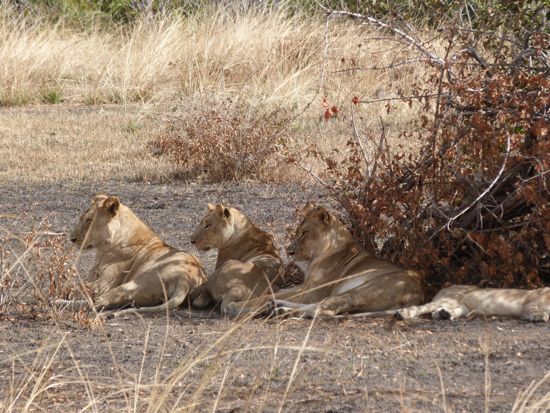
Then the lions decide to hunt, they stand, stretch, and walk off into the tall grass – and we love the way they just disappear, their golden color matching nearly the color of the golden grass:

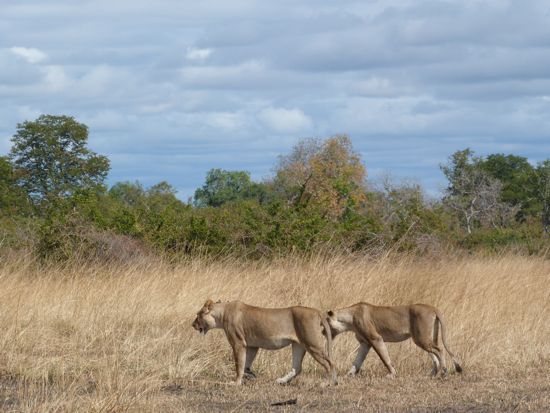
We spend about an hour just enjoying watching the lions, then head for the borehole hotspring for tea. The vista is both bleak and lush – where the water from the borehole has trickled, you can see green. The water is very hot, and you can smell the sulpher.
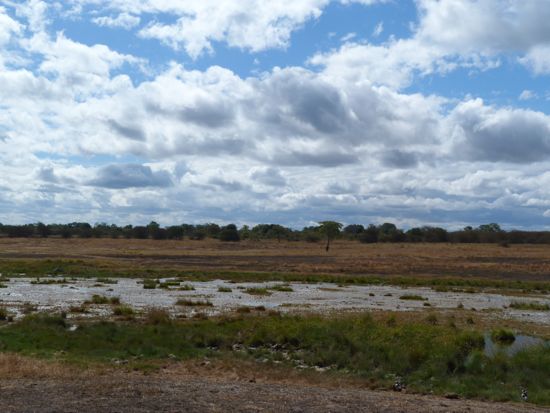
There is a funny story about the bore hole. A lodge was being built, Chichele, which wanted a borehole. The bore hole drillers asked the locals where was “chichele” (which means salty) and they didn’t know about the lodge; they sent the drillers to the old salt pan, also called “chichele.” They drilled a bore hole – out in the middle of nowhere – only to discover they had drilled in the wrong spot. They capped it, and today there is an oasis of green out in the middle of an otherwise fairly barren plain. It attracts a lot of wildlife – and those who prey on wildlife.
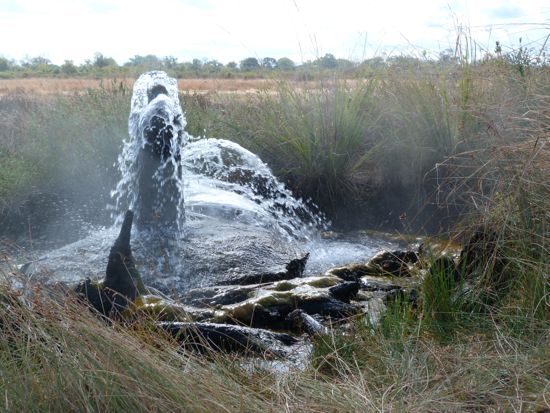

As we leave the hot spring, we spot more lions, maybe ten, a different pride. I say we, but it is really Julius, who sees the vultures circling and thinks there may be a kill in the area. We spot the lions, and then start the long drive back, stopping here and there along the way to take pictures or to learn about a whole lot of things we don’t know much about.
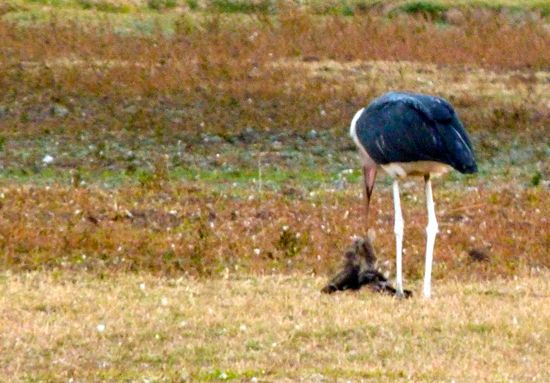
On our way back to Tena Tena, we pass through “The Colony” where the Yellow Billed Storks are nesting, hatching their young and teaching them how to fly. It is noisy, and hilarious; there is a lot going on. We particularly love the ‘flight school’ as young stork hesitate to take off, then practice their take offs and landings. Occasionally, one doesn’t make it, and there are Marabou Storks on the ground, who finish them off quickly.


We are late, and fortunately Claire has had sandwich plates made up for us so we won’t starve (LOL). We eat at the bar, and head for our cabins, but it is not an afternoon for resting – we have a visitor:

Most of the time, these little bushbuck are too shy for us to photograph, but here in the camp, there are a couple who have become used to the smells and noises of us intruders, and is oblivious to our cameras.
The afternoon drive starts off sedately along the Luangwa:

But we find beauty in the small things as we head toward sundown. These are Egyptian Geese settling in the lagoon nearby:

There are also elephant, an entire family, playing in the water:

Sunset is spectacular. I am drinking Campari and Bitter Lemon, and because we are heading back early, I drink the whole drink.
Julius and Davis serve up sundowners:
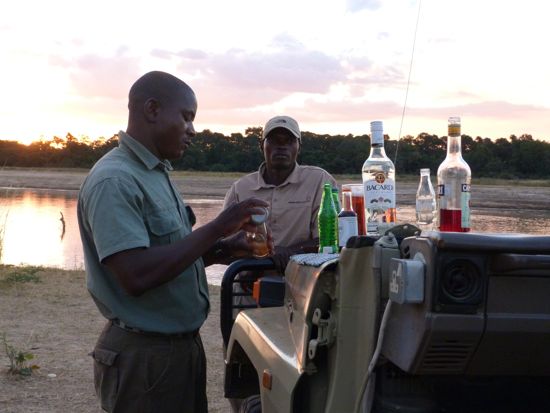

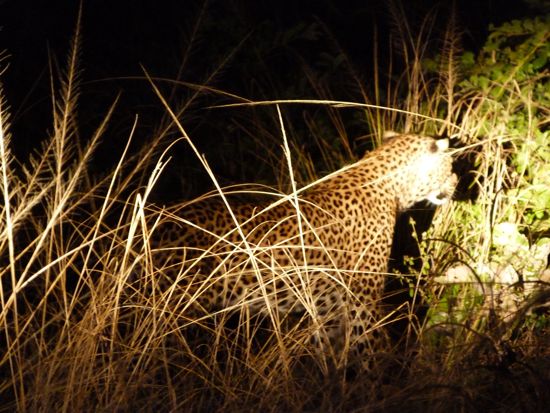
We had asked for a short night drive, but after ‘sundowners’ by the river, we find a pair of mating leopards, and the drive goes on a a lot longer than we intended. Mating leopards are exciting, they make a lot of noise, and are well worth a late drive, especially with a sky full of stars. NOTE TO SELF: No matter how tempting, limit your liquid intake at sundowners! Once the sky is dark, there is no safe bush to step behind and the roads are bumpy!


Julius helps us find the Southern Cross on the way back to camp, and shows us how to identify the Scorpion. The skies of the southern hemisphere are strange to us, but the stars are so bright and the night is so dark we just lie back and revel in the beauty of the heavens.
A very lively dinner, with the Swiss foursome, a new Scottish couple and us, eating ‘gammon’ which is ham, with pumpkin and mashed potatoes. Dessert is an amarula ice cream, which leads us all to the bar for shots of amarula liquer before he head for bed. It’s a lot harder organizing for the next early morning after a glass of wine and a shot of amarula, but we sleep like babies. We do hear lion roaring, but we just go right back to sleep.

Angry Father Beheads Daughter with Sword
I am embarrassed to tell you that my source for this story is Fox News:
JAIPUR, India – Police say a man upset over his daughter’s lifestyle chopped her head off with a sword and then paraded it through his village before surrendering to authorities in western India.
Marble miner Ogad Singh’s 20-year-old daughter had been living with her parents in the Rajasthani village of Dungarji after leaving her husband two years ago.
Police Superintendent Umesh Ojha says Singh was upset by his daughter having affairs with men, and became enraged when she eloped with one of them two weeks ago.
Ojha says Singh forced her to return home Sunday, and beheaded her Monday with a sword.
Rapidly modernizing India faces increasing social clashes as youths resist traditions like arranged marriage or limits on women venturing outside their parents’ or husbands’ homes.
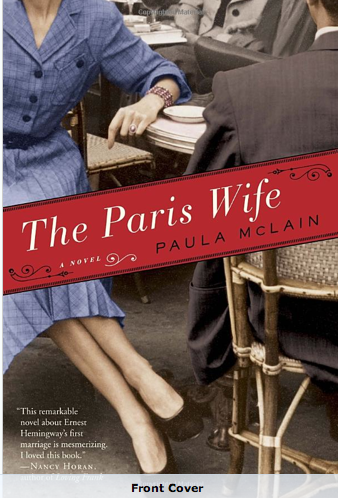
The Paris Wife by Paula McLain
The Paris Wife
Pauline Mclain
“This isn’t going to end well” you tell yourself when you start reading
this book, and you tell yourself not to read any further but you can’t
stop. This is a very good girl who meets a bad boy – what is it about
bad boys, anyway? You know you should go for the serious guy, the one
who will always have a good job, be a good provider for the family, a
good father to your children. You know all this, and you choose the bad
boy anyway. Why?
Hadley Richardson is a good girl at one of those transitional times in
history; world war I had ended, the damaged young men, including Ernest
Hemingway, are back from war, it is the 1920’s and the world is turned
upside down. When they meet, the chemistry is hot and strong. Their
friends warn Hadley against marrying “Hem” but when the attraction is
so hot and high, who can listen?
You know from the beginning that she is just the first wife, so most of
the book is full of dread, waiting to find out just how awful it is all
going to be. The early years, living in Paris, being dirt poor while
Hemingway gets started with his writing, are good years. They meet lots
of interesting expats living in Paris, they drink a lot, they are off
to Spain for the bullfights, and to Austria for the skiing, on the move
a lot, even once the baby comes.
It’s a fascinating book, a snapshot of the roaring 1920’s, of the
transitional era when women started becoming less submissive and more
free, and of a relationship between a nice girl and a talented but
damaged and self-destructive man. You’ll hate having to put it down.
Post review add: I finished this book while in Zambia and wrote the review. I really want to read A Movable Feast, now, Hemingway’s last book before he killed himself, written about this marriage. I understand it is a nostalgic tribute to his first marriage and to Hadley.
We watched Hemingway and Gelhorn last night, and watched him leave Pauline, the false friend who snatched him from Hadley (this is not a spoiler, folks, this is history) for Gelhorn, and then in anger at Gelhorn, turn to the woman who would become his last wife. She is protrayed as a total twit.
The movie, Hemingway and Gelhorn, was only mildly interesting; Kidman was her glorious self but there was zero chemistry, her romance with Hemingway barely believable. And he comes off as a real jerk. The jerk part is consistent with The Paris Wife, but while The Paris Wife is more sympathetic to Hemingway, portraying him as damaged but vulnerable, in Hemingway and Gelhorn, he is just arrogant, egotistic and obnoxious. Still, after you read The Paris Wife, it is interesting to see the rest of the story.
Jesmyn Ward and Salvage the Bones

You are fifteen, poor, black, and motherless as this book opens. Dad drinks, and isn’t around much. You are the only girl in a family of brothers. Having sex is no big deal, and there is one guy you really like, Manny.
Your oldest brother’s pit bull is having puppies, and you are having trouble with throwing up most of what you eat, especially every morning. Dad says a hurricane is coming, but he’s said that before, no big deal.
As this book opens, it has the feel of a myth of the nightmare kind. We know, because we have the benefit of hindsight, that the impending storm, Katrina, will be catastrophic. The Batiste family has already suffered a catastrophic storm with the death of their Mama, just after the birth of her last child. Throughout the book, we watch these children suffer the daily absence of their mother, raising one another, squabbling, but tenderly looking after one another.
If someone had told me about this book, I don’t think I would have wanted to read it. Amazon.com kept telling me I needed to read it, so finally, I did. From the opening page, I was in a world utterly alien from my own, and yet a world I could understand and inhabit. There are worse things than being poor, and one of them is heartless. This family has heart; they are loyal to one another, they look after one another and they sacrifice for one another. For all the violence – and there is a lot of violence – there is also beauty.
There is the familial love, and there is the love between Skeet, the oldest brother, and his dog, China. There is friendship, and good people who give you refuge in the aftermath of the storm. There is the stunning numbness of surviving the worst hurricane ever.
Jesmyn West has a deft touch, with the language, with the interweaving of the Medea myth, with non-verbal communication, with the complexities of families and love. This is a book worth reading.
Recent Comments
ExpatAlien on What Country am I Living … intlxpatr on Yellowstone: Old Faithful to C… Michelle on Yellowstone: Old Faithful to C… Cathy on No Grown-Ups in Charge intlxpatr on Waiting for Snow Wikipedia Donate Button

Amazina


Early Voting in Florida


 Here There and Everywhere