Syria’s Stonehenge
Older than the pyramids . . . desert find in Syria
A mystery city lies in Syria’s deserts, one older than the pyramids — but the war-torn area is preventing archaeologists from decoding its riddles.
Fragments of stone tools, stone circles and lines on the ground, and even evidence of tombs appear to lie in the desert near the ancient monastery of Deir Mar Musa, 50 miles north of Damascus, archaeologist Robert Mason of the Royal Ontario Museum said. He likened the formations to “Syria’s Stonehenge.”
“What it looked like was a landscape for the dead and not for the living,” Mason said Wednesday during a presentation at Harvard University’s Semitic Museum, according to the University publication the Harvard Gazette.
He made the find during a 2009 trip and is eager to return and further explore the site. But he says regional conflicts make such a return trip nearly impossible.
“It’s something that needs more work and I don’t know if that’s ever going to happen.”
‘What it looked like was a landscape for the dead and not for the living.’
– Archaeologist Robert Mason
The monastery itself, also called the Monastery of Saint Moses the Abyssinian, was built in the late 4th or early 5th century, he said, and contains several frescoes from the 11th and 12th century depicting Christian saints and Judgment Day. He told the audience at Harvard that he believes it was originally a Roman watchtower, partially destroyed by an earthquake and rebuilt.
But the desert puzzle is much older.
Bits of tools Mason found nearby suggest the mystery he discovered in the desert is much older than the monastery. It may date to the Neolithic Period or early Bronze Age, 6,000 to 10,000 years ago, the Gazette said.
Egypt’s oldest pyramid, the Great Pyramid of Giza, was built about 4,500 years ago.
Mason also saw corral-like stone formations called “desert kites,” which would have been used to trap gazelles and other animals. The desert around the monastery is hardly a verdant pasture — “very scenic, if you like rocks,” Mason reportedly said — but was probably greener a few millennia ago, the archaeologist explained.
Like Indiana Jones exploring Italy’s museums in “The Last Crusade,” Mason hopes to return to the monastery to excavate under the church’s main altar — he believes he’ll find an entrance to underground tombs there.
He also hopes to return to strange stone formations he found in the desert, which he dubbed “Syria’s Stonehenge.”
Saudi Disinformation on Qatar Coup
Thank you, John Mueller, for contributing this fascinating piece on the reported – and then unreported – ‘coup attempt in Qatar’. We were there when this happened the last time. It was bizarre – there was nothing. No increased military or police presence, just the same quiet and relaxed day-by-day. It was all a lie, created to stir the pot, and to create a perception – based on nothing.
BREAKING; Qatar Military Coup “Rumours” Stir Bad Blood With House of Saud
by Finian Cunningham, April 17, 2012
The rumour mill is churning in the Persian Gulf with unconfirmed reports of a failed military coup against the Qatari ruler.
There were even media reports that American military helicopters had whisked the Emir and his wife to a safe unknown destination in the aftermath of the failed putsch, said to be have been attempted by high-ranking officers.
Saudi news channel Al Arabiya reported earlier today a coup bid against Qatari Emir Hamad Bin Khalifa Al Thani. However, by midday, the story appeared to have been removed from Al Arabiya’s English-language website.
Iranian news channel Press TV toned down its early headlines of a coup and later speculated that Saudi-owned Al Arabiya may have been engaging in disinformation to undermine the Qatari regime, indicating a power struggle between the Houses of Saud and Thani.
The FARS semi-official Iranian news channel, however, insisted that sources within the Qatari royal entourage had confirmed earlier this week that there was a foiled coup in Doha.
Not surprisingly, Qatari-owned Al Jazeera news site ran no information on the alleged plot.
Whether the reports of this week’s failed coup turn out to be rumour or something more sinister, there is nevertheless no disguising the fact of underlying bad blood in the Gulf Arab enclave, both between and within the Gulf monarchies.
That may at first seem at odds with the “thick as thieves” appearance of the six states that form the Gulf Co-operation Council: Saudi Arabia, Kuwait, Bahrain, Qatar, United Arab Emirates and Oman. All are Sunni monarchies that have aligned with the US-led NATO powers’ aggressive policy of isolating Shia Iran.
Saudi Arabia and Qatar have emerged in particular as militant allies of US/NATO geopolitics across the Middle East. They played instrumental roles in paving the way for NATO’s aerial bombardment and regime change in Libya; and they have been most strident in denouncing the Syrian government of Bashar Al Assad, calling for his overthrow and arming mercenary forces that are accused of committing atrocities and sabotage.
But herein lies the potential for rivalry and enmity. Saudi Arabia, the world’s largest oil exporter, and Qatar, the number one exporter of liquefied natural gas, are bankrolling mercenaries and jihadis from Iraq, Libya, Lebanon and elsewhere in a bid to be top dog in a fissile region. The region is being inflamed with sectarian tensions precisely because of self-serving Saudi and Qatari power politicking.
The Gulf monarchs have also been funding election campaigns of Islamist parties in Egypt and Tunisia, aligned to the conservative Muslim Brotherhood, in line with Western powers using these same parties to shunt and blunt popular calls for greater democracy.
The rapid growth of Saudi-backed satellite TV channels broadcasting across the region – several of them spouting Saudi theocratic rhetoric – is indicative of a rivalry for influence with Qatar, which originally pioneered the Arab medium with the Al Jazeera station.
While on the surface, Riyadh and Doha may appear joined at the hip in terms of advancing the US-led Western imperialist agenda for hegemony, that service generates tensions between and within the royal houses.
In Qatar, there are reported tensions within the Al Thani ruling family and other powerful clans over what critics of the Emir call “his excessive alignment with US foreign policy and breaking of Arab ranks”. There are also domestic problems of corruption owing to the Al Thanis monopolising Qatar’s lucrative property market.
And despite the apparent alliance with Saudi Arabia, the present Qatari Emir will be mindful that the Saudi rulers have been implicated in previous suspected coup attempts against him in February 2011, 2009, 2002 and 1996.
The present Qatari ruler came to power after he led a coup against his own father in 1995 while the latter was holidaying in Europe. The following year, the Saudi and Bahraini rulers backed a failed counter-coup to reinstall the older Emir.
In 2010, the coup plotters were released from jail by Emir Hamad after a request was made by Saudi King Abdullah.
So in the Arab enclave of the NATO camp, all is not as cosy as it may seem. Washington and the other Western powers no doubt think they have a clever Arab cover from the Gulf autocrats to redraw the Middle East political map according to their imperialist designs. But in all such intrigues of deception and power lust, the band of thieves have to watch their backs.
Finian Cunningham is Global Research’s Middle East and East Africa Correspondent
cunninghamfinian@gmail.com
It’s All ‘Insh’allah’
(Forgive me if I ramble a little bit; New Year’s Eve day is always something of a day of reflection for me. It’s not something I plan, it’s something I just find myself compelled to do; I do it whether I want to or not.)
I joke with my friends that the Lord kept sending me back to the Middle East until I learned that it was less my mission to share, than to learn. Once I shut up and watched and listened, I began learning, and what I learned contradicted many of my ignorant prejudices. In learning about my friends in the countries of the Middle East, I learned a lot about our Christian culture, and about myself.
When Westerners first get to the Middle East, the phrase ‘Insh’allah’ (God willing, or ‘if God wills it’) makes them want to tear their hair out. When your heat breaks down in the midst of a cold winter (and yes, there are very cold patches in many Middle Eastern countries) and the heat people tell you ‘Insh’allah’ they will be there ‘in the afternoon’ but won’t give you an exact time, it makes us want to slam the phone down. When you make plans to meet up with a friend for coffee, set a time, and then she says she will see us ‘insh’allah’, we don’t know whether she is going to show up or not.
It was only after many many years in the Middle East that we relaxed and accepted ‘insh’allah.’ Now, living back in the USA, we laugh, because life here is insh’allah, too, it’s just that people don’t know it. We’ve had several things done with our house, and whether or not the workers show up – it’s all insh’allah. When making plans with our family, a lot depends on when the baby is awake or sleeping, insh’allah. How much money our investments are worth? It’s all insh’allah. The same factor is there, it’s just cultural as to whether you acknowledge it or not.
Today’s New Testament reading from The Lectionary is all about insh’allah:
James 4:13-17, 5:7-11
13 Come now, you who say, ‘Today or tomorrow we will go to such and such a town and spend a year there, doing business and making money.’ 14Yet you do not even know what tomorrow will bring. What is your life? For you are a mist that appears for a little while and then vanishes. 15Instead you ought to say, ‘If the Lord wishes, we will live and do this or that.’ 16As it is, you boast in your arrogance; all such boasting is evil. 17Anyone, then, who knows the right thing to do and fails to do it, commits sin.
7 Be patient, therefore, beloved,* until the coming of the Lord. The farmer waits for the precious crop from the earth, being patient with it until it receives the early and the late rains. 8You also must be patient. Strengthen your hearts, for the coming of the Lord is near.* 9Beloved,* do not grumble against one another, so that you may not be judged. See, the Judge is standing at the doors! 10As an example of suffering and patience, beloved,* take the prophets who spoke in the name of the Lord. 11Indeed we call blessed those who showed endurance. You have heard of the endurance of Job, and you have seen the purpose of the Lord, how the Lord is compassionate and merciful.
And I think my New Year’s resolution is clear: Not to grumble against one another. 🙂
Flying Out of Pensacola International Airport
No. No, there are not any flights to any cities outside the United States. I thought there was a rule! I remember other small airports that called themselves “international” but they always had at least one flight like to Mexico, or some Caribbean island . . . I didn’t know you could name an airport Pensacola INTERNATIONAL Airport just because you thought it sounded cool. Guess the joke is on me.

(Have you noticed how much more dominant blue bulbs are now? They used to just fade into obscurity, but now they are brilliant. These trees decorate Pensacola International Airport.)
So as I check in – at the curbside, YES! I am appreciating how much easier flying is when you are not flying to Kuwait or Qatar, or even Germany. You can drop your luggage right at the curb, you already have your boarding passes; you checked in and printed them at home (none of this is possible if you are flying to the Middle East) so you can go straight to your gate . . . oh yeh, forgot, you still have to go through security.
There is a LONG line and I overhear one of the security guards say to a Pensacola friend “Yeh, you can’t just get here an hour before your flight any more and expect to catch your flight . . . ” and I am thinking “Holy Smokes! I thought getting there an hour before your flight was overkill in Pensacola!”
As soon as I get through security (no more ‘special’ treatment, now that I am not flying to Kuwait or Qatar, no more pat downs, no more extra questions) I get to my flight, which is already boarding, and both my flights, early early on a Sunday morning are PACKED, every seat is booked. I cannot imagine.
The good news is that every flight leaves on time, lands on time, and the flights are uneventful. I love ‘uneventful.’
I find that I don’t get as much reading done as I used to when I was flying two, three, four times a year from the Middle East to Seattle. I used to be able to read three or four books in each direction, now I am down to one book and maybe a little Sudoku.
Beautiful flight:

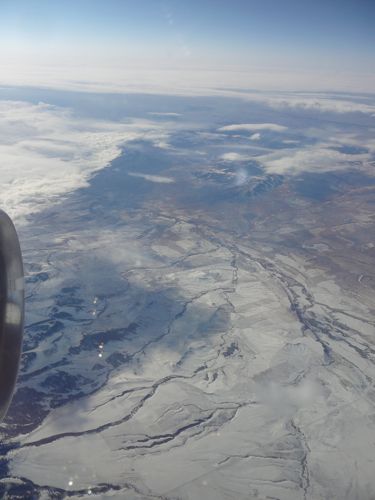
When we get near Seattle, you can see five mountains in a row, from Mount Rainier looking south, including the remains of Mount Saint Helens. The weather in Seattle is cool and brisk, my car is waiting and the roads out Edmonds are clear and dry, Wooo HOOOOO!
Not-So-Real Housewives
Over Thai food, I confessed my guilty secret – I can’t help it, I watch the Real Housewives of Beverly Hills and the Real Housewives of New York. I expected a horrified response from my sweet smart niece, Professor Little Diamond, but she just laughed.

“Oh we all watch them,” she reassured me, “It’s like watching a train wreck, you are appalled, but you can’t look away.”
What makes me really, really nervous about these ‘real’ housewives is that I think that the Bravo station is carried in Qatar and Kuwait and Saudi Arabia. While the more educated have travelled, and know that these ‘real’ housewives are not the norm, there may be many who think that this is the life of the American female.

I remember when I shocked my Qatari friends as I told them I was going home to take care of my Dad while my Mom had a knee replacement and spent a few weeks in rehab. They didn’t know we take care of our parents; they thought we just put them in grim warehouse like nursing homes. How did they know? From television, of course.
So you can understand I have a major concern that these women are representing us normal people in the homes of our friends in the Middle East. These women spend a lot of money on scanty clothing, these women have people who come in and do their make-up before a dinner party, these people have nannies taking care of their children (many of whom are really bratty) and they all seem to be designing handbags or creating make-up lines or (oh-no!) cutting records to try to get a singing career started.
Ask yourself this – who do you know in your own circles who would agree to have camera crews follow them around in their lives, filming their most intimate conversations? Who do you know in your circle who creates drama and conflict? Who do you know who needs the affirmation of an audience to believe her life is worth living? Who in your circle is addicted to plastic surgery or throws charity events to get attention? Those are the women they are filming.
You never see these women go to church. You rarely see them cooking up a normal dinner for their family. You don’t see any of them heading off to an 8 – 5 job. You don’t see them doing all the normal things we normal American housewives do (a lot like our sisters do in every country of the world) like laundry, running the kids to school, doctors appointments, soccer matches, paying the bills, scrubbing the floor, making appointments at the veterinarian, getting the car serviced, buying groceries, going to PTA, or doing their volunteer work. You don’t see them running over to their children’s house to babysit, or going to their exercise classes.
But then again, if they were doing all these things that us REAL housewives do, who would watch, LLLLOOOOOLLLLLLL! I understand there may be some sister Real wives series coming up from foreign countries. It will be interesting to see how their lives look.
Qatar Women Want Dress Code to Maintain Cultural Norms
Every year around this time The Peninsula (Qatar) runs an article reminding other nationalities to respect Qattari values on modesty, and asking women to wear loose clothing, cover arms and shoulders and wear skirts at least to the knees. This year, there are comments about women wearing ‘indecent’ clothing around the hotel swimming pools, and calling for a national dress code with enforcement.

Qatari women lament disregard for norms
By Huda NV
DOHA: Dress code in any country is a very sensitive topic, for, while it protects the rights of many, it may hinder the rights of many others. When France issued ban on Hijab in public places, many Muslims who used the attire had to let it go. Same is the case in Saudi Arabia where all, including non-Muslims have to wear the abaya.
As of now, there is no strict ruling on dress code in Qatar except that it asks for modest dressing in public. The rules are with loose ends, according to some. With the on going development much have changed in dressing over the last 10 years.
Some Qatari women who spoke to The Peninsula said that due to the lack of awareness or mainly due to disregard for local norms, many people flout with the Qatari Penal Code that “prohibits wearing revealing indecent clothing”. Since no action is taken against the violators, rules or laws are being flouted with.
“The law asks one dress decent lyto protect oneself and the society as a whole. We are functioning in a society in various roles and at various levels. We go out, do what we need to do and go home, as other women do. But it pains to see many women bring with them negative influences into the community and dress in a way which is against the discipline of the community,” said Sheikha Al Naimi, a Qatari woman.
“We are not asking them to use hijab or abaya. We just want them to be modest, by which we mean covering the arms and shoulders, wearing skirts at least up to knee length, and wearing loose clothes. We are asking for respect not hindering their personal choices,” said Asma Abdullah.
RIGHTS?
So would not any law or dress code be against personal rights? Then, is not smoking or drinking a personal choice and a law banning these are against the so called rights, ask some.
“There are laws banning smoking and penalties for violating traffic rules, which are issued in public interest and these are strictly followed, for fear of heavy fines on violations. So a dress code is also needed for public security. We all have our own freedom, but in public we need to check the rights of public too. One’s freedom should not hinder other person’s rights and people should realise that rights come along with duties,” said Mariam Al Ali.
However some argued dressing in skimpy clothes is not freedom, but rather lack of self respect. “We would say the western idea of freedom and right is twisted and is not based on truth. For example, when it comes to dressing, the so called right is more or less like what men want to see,” said Tammy, a US expatriate.
“Our policy is you see what we want you to see rather than you decide what you need to see. We choose to whom we show our beauty. It is not for public attention,” one of the Qatari women said
THE WORRIES
One of the key problems, most of the Qatari women who spoke to The Peninsula, was on encroachment on their identity. “We are a minority in our own land; this does not mean we leave our identity. We are trying to pass it over to next generation and all these influences is a threat to our identity as Muslims, Arabs and Qataris,” Al Naimi said.
“All the expats come here for a reason, mainly financial, and hence they need to respect the culture here but now its more on destroying the society,” she laments. “Even in some schools and colleges, teachers dress badly. Even if it’s a girls-only school, it does not mean teachers show their body parts which we ourselves do not show to our children. Wearing translucent dress, shirts which are waist length and short skirts are in no way modest for a teacher,” said Al Ali
PROTECTING IDENTITY
Some Qatari women revealed the measures they take to ensure their children are not influenced by the changes. “My children have gone to the malls or shopping centers only few times. I want them to know what the Qatari identity is. They are not usually taken for shopping here. For their amusement and entertainment, I built a house away from Doha with all the amenities.
“So the question would be how will they learn to live in the society if they are kept isolated? Its just that we do not want these influences at very young age. After they get to know their roots, children will go out and understand the world,” said Asma.
“Earlier, when I was young, we used to go out to the beaches and enjoy as a family. But now we cannot take our children to the beaches as people wear indecent clothing even in public beaches,” said Sara Yousuf.
“Even some of the Qatari media post almost nude pictures, especially when it comes to movies. So we do censoring at home so that our children at young age do not have to distinguish between the right and wrong,” Sara said. “I would love to take my children to hotels here and enjoy time with them in the pool. But how can we do it when many are indecently dressed,” said a Qatari woman.
DRESSING WHEN ABROAD
Even when dress code is debated here, Qataris are much criticised for not abiding to the Qatari customs while abroad. “These are mainly people who are ashamed of their identity. Abaya or hijab is part of culture and our culture is based on Islam, which is same throughout the world. Hence, indecent dressing while abroad tarnishes the whole Qatari community. I have gone abroad, and even recently when I visited Thailand, I was wearing the exact costume – abaya — which I wear here. They should respect laws of other countries when abroad but at the same time try to protect their identity,” said Sara.
“I was educated in the US. I did face few problems but I knew the influences were coming from all directions and made sure I held on to my traditions,” said Asma.
THE CULPRITS
Majority of the Qatari women say that some of the Arab communities themselves are responsible for violating the dress code. “We feel that majority of the westerners and Asians know and understand us and respect the culture. People from sub-continent culturally they have their own modesty which is almost similar to ours. If these people are dressing badly it is because they think ‘if Arabs can do, why not we’,” says Al Ali.
“The sad part is that there are some Arab communities who mock themselves and us wearing skimpy dresses. Also some are so talented that they know how to dress exactly as Qataris and impersonate — they actually tarnish our image. They also talk indecently when faults are pointed out,” said Hessa Al Kuwari.
“Worse is when many dress indecent inside the abaya and pose as Qataris. The very purpose of abaya is to cover, but now it is turning into something that is used for showcasing the body,” Sara said.
SUGGESTIONS
1. Set up a new committee to establish and implement specific regulation with regard to dress code
2. Define exactly what modest dressing means
3. Malls should have individuals to warn people as they have people to keep out bachelors on family days.
4. While issuing visas, embassies should inform people about the dressing. They should also make strict rulings.
5. The existing laws on dresses should be activated by the authorities.
URGENT ACTION
Few of the women say there is an urgent need for a law or enforcement of existent regulations, as the situation is getting worse. “Over last three to four years, we are seeing women wearing very-short shorts in public places. I would ask what next? Will we have to see ladies in bikinis in malls in the next few years? It can happen if there is no enforcement,” said Sara.
“The identity change that we talked is not going to happen today or tomorrow. We will see the effect in some 10 to 20 years — majority of our people will not know what being an Arab or Qatari means. The values what we have will be lost,” Asma said. “We need development, but it should be framed in our identity. It’s not fair to cut our roots and establish on top of us,” she said.
The Peninsula
Very Long Lunar Eclipse June 15
I found this on AOL news/ Huffington post where the article goes on to say that weather permitting, those in the Middle East have a good chance of experiencing the entire eclipse, which will be longer than most lunar eclipses.
LOS ANGELES — The year’s first total eclipse of the moon will last an unusually long time, a rare celestial treat for a wide swath of the globe.
Except if you’re in the United States and Canada. North America will be left out of Wednesday’s lunar spectacle, which will be visible from start to finish from eastern Africa, central Asia, the Middle East and western Australia – weather permitting.

The period when Earth’s shadow completely blocks the moon – known as totality – will last a whopping 1 hour and 40 minutes. The last time the moon was covered for this long was in July 2000, when it lasted 7 minutes longer than that.
You can read the rest of the article HERE
A God of Infinite Mercy
This morning, Father Neal Goldsborough of Christ Church Pensacola gave a sermon that held us all totally spellbound. It had to do with the fundamentalist preacher who – once again – forecast the coming rapture, which he says was scheduled for yesterday. (I wonder what he has to say today? He was wrong once before, in 1994. Or maybe people were raptured yesterday, but all the folk I know are, like me, sinners who didn’t make the cut.)

Father Neal talked about his service in the chaplain corp overseas, and faiths which exclude based on narrow rules, specific rules, churches and religions who say ‘this is the only way and all the rest of you are damned to everlasting fire” whether they use those words or paraphrases. He pointed to Jesus, who broke the rules of his time and flagrantly spent time with sinners, and the unclean, and showed them by his love and by his actions what the infinite love and mercy and forgiveness of Almighty God looks like.
It couldn’t have come at a better time for me.
Soon, I will be meeting up with three women who are particularly dear to me, friends for many years in Qatar, friends who worshipped at the Church of the Epiphany in Doha, Qatar. The new Anglican Church of the Epiphany is being built on land dedicated to church use by His Highness Sheikh Hamad bin Khalifa Al-Thani, the Emir of Qatar, and will be used by many denominations.
My friends and I all returned to the USA within months of one another, and have been sending e-mails with “reply to all” as we struggle with our re-entry into our old church communities. We struggle with the hatreds and prejudices and ignorance about our Moslem brothers and sisters, and we struggle with the narrow strictures imposed by our churches and study groups. I thank God to have these wonderful women among whom we can share our dismay and our hurting hearts, and re-inforce the lessons we learned living in a very exotic, and sometimes alien culture, but which had so many wonderful and mighty lessons to teach us. I often joke that in my life, God kept sending me back to the Middle East (Tunisia, Jordan, Saudi Arabia, Qatar and Kuwait) until he saw that I finally got it. My sisters-in-faith were quicker studies than I was. 🙂
It was a breath of the Holy Spirit I felt this morning, as Father Neal spoke about God’s mercy, his plan to redeem ALL of his creation, God’s desire for our love and our service. I couldn’t help it, it made me weep with relief to know my church is a church that serves God by including, rather than excluding, and which mercifully welcomes sinners like me.
Here is the really cool part. Christ Church Pensacola has recently begun putting the sermons online. If there is one thing Christ Church has, it is great sermons – and if you want to hear Father Neal’s sermon, you can click HERE, in a few days and you can hear his sermon for yourself. 🙂 Look for the May 22 sermon by Father Neal Goldsborough.
Ash Wednesday in Pensacola 2011
Luke 18:9-14
9 He also told this parable to some who trusted in themselves that they were righteous and regarded others with contempt: 10‘Two men went up to the temple to pray, one a Pharisee and the other a tax-collector. 11The Pharisee, standing by himself, was praying thus, “God, I thank you that I am not like other people: thieves, rogues, adulterers, or even like this tax-collector. 12I fast twice a week; I give a tenth of all my income.” 13But the tax-collector, standing far off, would not even look up to heaven, but was beating his breast and saying, “God, be merciful to me, a sinner!” 14I tell you, this man went down to his home justified rather than the other; for all who exalt themselves will be humbled, but all who humble themselves will be exalted.’
(From the Lectionary readings for today)
“I forgot to set my alarm” AdventureMan said, coming down the stairs, “we missed the first service.”
Today is Ash Wednesday, the day Lent begins for Christians. We go to church, the priest puts a cross on our forehead in ash, to remind us “ashes to ashes, dust to dust”, that our life here on earth is only temporary, and that our true home is heaven.
It’s easier to believe that in your gut when you are an expat.
My cousin wrote to me, and in his email, he wrote that I write about my own culture the same way I wrote about Germany, about Qatar, about Kuwait – as an expat, as an outside observer. Pensacola is like my foreign assignments; I could live here for twenty years (God willing) and I will never be a native, I will always be from somewhere else, the kind of person about whom others will say “she must not be from around here.” I am guessing I will get more comfortable, more confident, but I will always be not-quite-right among the natives.
And that is how we are supposed to be living here on earth – as people not-quite-right, as people eager to return to our true heavenly home.
Lent in my own country is odd to me, now. In a foreign country, you are accustomed to thinking of yourself as a minority; your differentness makes you more aware or who you are, and what you value. There is a part of me that thinks Lent would be a lot easier if, like Qatar, and like Kuwait, and like Saudi Arabia, religious practices were state enforced, like everyone in the USA fasted at the same time, maybe nobody would sell meat or chocolate or alcohol. And then, I think “but what is the point?” The point is our own sacrifice. Is it a sacrifice if it is enforced from the outside?
I can’t sacrifice cussing in traffic this year. Pensacola traffic, by the grace of God, is nearly non-existent, and it is mellow. I’m not even tempted. I’m trying to figure out what I will sacrifice.
Father Neal Goldsborough at Christ Church Episcopal told us on Sunday how all the children come in from the Episcopal Day School to have the ashes imposed, and how poignant it is for him, and I can’t help but think of all the soldiers he has been with at their death, mere children, children of God, and how he must see the faces of these soldiers in the faces of these tiny children. My heart would weep, even knowing they are on their way home.
MidEast Turmoil Creates New Kind of Scams
From AOL Wallet Pop
Scammers Take Advantage of Middle East Crisis with Email Cons
Rita R. Robison
Feb 25th 2011
Unrest in the Middle East is spawning a flood of emails from scammers seeking to fool consumers into sending them money.
Two scams are coming from Egypt, both variations on time-tested themes. In the first, a Mohammed Hammad, claiming to be a “consultant” to the Egyptian Past-President Muhammad Hosni Mubarak, asks recipients for help in moving money and investments out of Egypt following recent changes in the country’s government.
The email could load viruses or tracking software onto the recipient’s computer.
Many, but not all, scam letters and emails include misspellings and grammatical errors that should immediately make consumers suspicious. This Egyptian email contains several misspellings in the former Egyptian president’s name.
Consumers in Connecticut are among those on the receiving end.
“This example demonstrates how quickly and easily a scammer can craft and deliver a message designed to appeal to the interests and passions of a particular audience,” Connecticut Consumer Protection Commissioner William M. Rubenstein said in a statement.
“Unwary victims could be convinced to send money or account numbers in hopes of participating in this endeavor, only to be defrauded. Just by opening the link in the email, they might unknowingly make their computers available for looting by data thieves.”
The second scam plays on the stranded-friend-or-relative routine, this time asking for money to help get out of an Egypt in crisis.
Consumers who receive these emails should forward them to the Federal Trade Commission’s spam database at SPAM@UCE.GOV.
Avoid opening any links inside the email, and once you’ve forwarded it to the FTC, delete the bogus email from your inbox and your deleted items area.
For more information on spam and phony emails, visit http://www.ftc.gov/spam.
Recent Comments
ExpatAlien on What Country am I Living … intlxpatr on Yellowstone: Old Faithful to C… Michelle on Yellowstone: Old Faithful to C… Cathy on No Grown-Ups in Charge intlxpatr on Waiting for Snow Wikipedia Donate Button

Amazina


Early Voting in Florida


 Here There and Everywhere