Still Standing: 9 Year Blog-a-versary Extravaganza
It’s time to celebrate, and, my friends, we have to do it fast because September 11th is nipping at our heels, and September 11th is a day that makes me very sad, very sad, indeed. So for now, forget September 11th! For today, we will celebrate nine years, yes, nine years of blogging.

So many times I have thought “why bother?”
I do it for me. I do it because writing is what I was born to do. I do it because from the beginning, you have given me such wonderful support and feedback.

I’m in a Paris frame of mind 🙂 I’ve gathered some wonderful cookies and cakes for you; you can nibble, peruse, re-acquaint yourself with old friends in the comment sections – I know I did, and it re-inspired me.

Back in the beginning, back in 2006, the blogging scene in Kuwait was such fun, so wide open. Bloggers had really interesting things to say, and said them. I learned so much from the Kuwait bloggers, and made some great friends. 1001 Nights and I became life long friends, even though we are far apart. Other bloggers, one in particular from Saudi Arabia who is now deceased, and another from the Netherlands, Aafke, with whom I have stayed in touch and maintained a friendship were full of ideas, started great conversations, it was like being in a salon in France when ideas were steaming and popping and revolutionizing everything.

While the newness of blogging has long worn off, the need to write has not. Mostly, I keep blogging because every now and then I have something to say, and this I where I say it. Yes, there are other, newer platforms, but sometimes you need a place where people with a longer attention span can come and work through an issue alongside me.

Of course, I also continue because we still love to travel, and I love to share my adventures and my resources with you of similar interests 🙂

Life has greatly changed, once again. This year, our oldest grandchild started kindergarten, real school, and comes to our house where his parents pick him up from work. He is so much fun! We are loving seeing life through his eyes, hearing about his day, learning his new song and his joy in learning. We also get to see either our son or our daughter-in-law every day; it may be just a few minutes, but it keeps us up to date. Life is sweet.

This coming week we also have Grandparent’s Lunch Day with our granddaughter at her school. She is now fully two, and as my favorite nephew Earthling says about his daughter of about the same age “she is very opinionated.” She is also very sure of her right to be right, and to have her way, and she is full of spirit and energy, so she, too, leads us on a merry race. It is a joy to watch her struggle to express herself – and increasingly, to succeed. She is learning new words every day, and you can see the excitement on her face as we understand what she wants so desperately to tell us.

We never have plans for just one trip; we always have one coming up and one in the plans 🙂 so here’s a hint:



Thank you, thank you, all who have remained with me so loyally, those who comment and those who lurk, those who check in now and then and those who write to me in the background to bring me up to date on your lives. You, and your feedback, are what makes this all worthwhile.
Have a cookie, or three or four and some cake and some of this wonderful Moroccan mint tea we’ve brewed, and celebrate nine years and still standing.
“You’re Not Southern – You’re Arab!”
My mind works in quirky ways, and yesterday as I was setting up for the hands-on Heirloom Feathers workshop with Cindy Needham, one of the good local Pensacola quilters was telling her how you can tell a Southerner from a Northerner.
“If you go to a Southerner’s house, they’ll ask you first thing if you’d like a drink of water, or iced tea or something, but if you go into a Northerner’s house, you can sit there for five hours and they won’t offer you ANYTHING!”
I grinned to myself, no, I have learned to censor these thoughts. But I couldn’t help it.
“You’re not a Southerner,” I am thinking, “You’re ARAB!”
I thought about a long ago trip through Morocco, we have a rental car and on our way from Ouazazarte to Marrakesh, on an isolated stretch of the road, we see a car in trouble. We stop and ask if we can help, if the man would like a lift to the next town. He tells us no, he wants to stay with the car, but asks if we would go to such and such service station and tell his uncle he needs help, and where he is.
Of course.

We drive into town, find the service station, and find the young man’s uncle, who is the owner. He sends help.
Did I mention it was Ramadan? No eating or drinking in public from dawn to dusk?
The owner insisted we come into his house, and seated us in his diwaniyya, and sent in mint tea and luscious almond-filled dates to refresh us. We said “No! No! It’s Ramadan!” but he told us it was his honor. He sat while we drank and ate.
Such enormous hospitality. Such grace. We only stayed a very short time; we still had a long drive, but I’ve never forgotten his hospitality.
Then again, it was Southern Morocco. 🙂 Maybe he was Southern.
Morocco Rape Victims Will No Longer Be Required to Marry Rapist
Morocco To Change Law That Allowed Rapists To Avoid Punishment By Marrying Their Victims
By SMAIL BELLAOUALI 01/23/13 09:46 AM ET EST
RABAT, Morocco — Nearly a year after Morocco was shocked by the suicide of a 16-year-old girl who was forced to marry her alleged rapist, the government has announced plans to change the penal code to outlaw the traditional practice.
Women’s rights activists on Tuesday welcomed Justice Minister Mustapha Ramid’s announcement, but said it was only a first step in reforming a penal code that doesn’t do enough to stop violence against women in this North African kingdom.
A paragraph in Article 475 of the penal code allows those convicted of “corruption” or “kidnapping” of a minor to go free if they marry their victim and the practice was encouraged by judges to spare family shame.
Last March, 16-year-old Amina al-Filali poisoned herself to get out of a seven-month-old abusive marriage to a 23-year-old she said had raped her. Her parents and a judge had pushed the marriage to protect the family honor. The incident sparked calls for the law to be changed.
The traditional practice can be found across the Middle East and in places like India and Afghanistan where the loss of a woman’s virginity out of wedlock is a huge stain on the honor of the family or tribe.
While the marriage age is officially 18, judges routinely approve much younger unions in this deeply traditional country of 32 million with high illiteracy and poverty.
“Changing this article is a good thing but it doesn’t meet all of our demands,” said Khadija Ryadi, president of the Moroccan Association for Human Rights. “The penal code has to be totally reformed because it contains many provisions that discriminate against women and doesn’t protect women against violence.”
She singled out in particular outmoded parts of the law that distinguish between “rape resulting in deflowering and just plain rape.” The new article proposed Monday, for instance, gives a 10-year penalty for consensual sex following the corruption of a minor but doubles the sentence if the sex results in “deflowering.”
Fouzia Assouli, president of the Democratic League for Women’s Rights, echoed Ryadi’s concerns, explaining that the code only penalizes violence against women from a moral standpoint “and not because it is just violence.”
“The law doesn’t recognize certain forms of violence against women, such as conjugal rape, while it still penalizes other normal behavior like sex outside of marriage between adults,” she added. Recent government statistics reported that 50 percent of attacks against women occur within conjugal relations.
The change to the penal code has been a long time in coming and follows nearly a year of the Islamist-dominated government balking at reforming the law.
The Justice Ministry at the time argued that al-Filali hadn’t been raped and the sex, which took place when she was 15, had been consensual. The prime minister later argued in front of parliament that the marriage provision in the article was, in any case, rarely used.
“In 550 cases of the corruption of minors between 2009 and 2010, only seven were married under Article 475 of the penal code, the rest were pursued by justice,” Prime Minister Abdelilah Benkirane said on Dec. 24.
While Morocco updated its family code in 2004, a comprehensive law combating violence against women has been languishing in Parliament for the past eight years.
Social Development Minister Bassima Hakkaoui, the sole female minister in Cabinet, said in September she would try to get the law out of Parliament and passed.
Rape Victim Commits Suicide After Being Forced to Marry Rapist
Aon AOL-Huffpost:
Amina Filali, Morocco Rape Victim, Commits Suicide After Forced Marriage To Rapist
By PAUL SCHEMM
RABAT, Morocco — The case of a 16-year-old girl who killed herself after she was forced to marry her rapist has spurred outrage among Morocco’s internet activists and calls for changes to the country’s laws.
An online petition, a Facebook page and countless tweets expressed horror over the suicide of Amina Filali, who swallowed rat poison on Saturday to protest her marriage to the man who raped her a year earlier.
Article 475 of the Moroccan penal code allows for the “kidnapper” of a minor to marry his victim to escape prosecution, and it has been used to justify a traditional practice of making a rapist marry his victim to preserve the honor of the woman’s family.
“Amina, 16, was triply violated, by her rapist, by tradition and by Article 475 of the Moroccan law,” tweeted activist Abadila Maaelaynine.
Abdelaziz Nouaydi, who runs the Adala Assocation for legal reform, said a judge can recommend marriage only in the case of agreement by the victim and both families.
“It is not something that happens a great deal – it is very rare,” he said, but admitted that the family of the victim sometimes agrees out of fear that she won’t be able to find a husband if it is known she was raped.
The marriage is then pushed on the victim by the families to avoid scandal, said Fouzia Assouli, president of Democratic League for Women’s Rights.
“It is unfortunately a recurring phenomenon,” she said.”We have been asking for years for the cancellation of Article 475 of the penal code which allows the rapist to escape justice.”
The victim’s father said in an interview with an online Moroccan newspaper that it was the court officials who suggested from the beginning the marriage option when they reported the rape.
“The prosecutor advised my daughter to marry, he said ‘go and make the marriage contract,'” said Lahcen Filali in an interview that appeared on goud.ma Tuesday night.
In many societies, the loss of a woman’s virginity outside of wedlock is a huge stain of honor on the family.
In many parts of the Middle East, there is a tradition whereby a rapist can escape prosecution if he marries his victim, thereby restoring her honor. There is a similar injunction in the Old Testament’s Book of Deuteronomy
Morocco updated its family code in 2004 in a landmark improvement of the situation of women, but activists say there’s still room for improvement.
In cases of rape, the burden of proof is often on the victim and if she can’t prove she was attacked, a woman risks being prosecuted for debauchery.
“In Morocco, the law protects public morality but not the individual,” said Assouli, adding that legislation outlawing all forms of violence against women, including rape within marriage, has been stuck in the government since 2006.
According to the father’s interview, the girl was accosted on the street and raped when she was 15, but it was two months before she told her parents.
He said the court pushed the marriage, even though the perpetrator initially refused. He only consented when faced with prosecution. The penalty for rape is between five and 10 years in prison, but rises to 10 to 20 in the case of a minor.
Filali said Amina complained to her mother that her husband was beating her repeatedly during the five months of marriage but that her mother counseled patience.
A Facebook page called “We are all Amina Filali” has been formed and an online petition calling for Morocco to end the practice of marrying rapists and their victims has already gathered more than 1,000 signatures.
Prickly Pear Becomes Cash Crop

The first time I ever saw these prickly pears was in Tunisia, where they were a by-product of huge prickly pear fences that kept roaming sheep, goats, even cattle out of the living areas. The prickly pear fences were everywhere. Some people made jam out of the fruit, but now, the fruit is bringing in big bucks to Moroccans.
To read the entire story, please click BBC News Africa
By Sylvia Smith
BBC News, Sbouya, Morocco
It is just after dawn in the hills above the Moroccan hamlet of Sbouya and a group of women are walking through the thousands of cactus plants dotted about on the hillside, picking ripe fruits whenever they spot the tell-tale red hue.
But these woman are not simply scraping a living out of the soil.
The cactus, previously eaten as a fruit or used for animal feed, is creating a minor economic miracle in the region thanks to new health and cosmetic products being extracted from the ubiquitous plant.
This prickly pocket of the semi-arid south of the country around the town of Sidi Ifni is known as Morocco’s cactus capital.
It is blessed with the right climate for the 45,000 hectares (111,000 acres) of land that is being used to produce prodigious numbers of succulent Barbary figs.
Every local family has its own plot and, with backing from the Ministry of Agriculture, the scheme to transform small scale production into a significant industry industry is under way.
Some 12m dirhams ($1.5m) have been pledged to build a state-of-the-art factory that will help local farmers process the ripe fruits.
The move is expected to help workers keep pace with the requirements of the French cosmetics industry which is using the cactus in increasing numbers of products.
Lucrative
Izana Marzouqi, a 55-year-old member of the Aknari cooperative, says people from the region grew up with the cactus and did not realise its true benefit.
“Demand for cactus products has grown and that it is because the plant is said to help with high blood pressure and cancer. The co-operative I belong to earns a lot of money selling oil from the seeds to make anti-ageing face cream.”
I know I have seen these growing in Kuwait – are they growing in Qatar, too?
Moroccan Blogger Jailed
You can read the entire story, which appeared today, on BBC News Africa:

A Moroccan blogger has been jailed for two years for showing disrespect to the monarchy, say the man’s family.
Mohammed Erraji, 29, was convicted after writing an article claiming King Mohammed VI’s charitable habits were encouraging a culture of dependency.
There has been no official comment on the case, but rights groups claim Erraji did not have a fair trial.
A BBC reporter says criticising the king is an offence in Morocco and the royal family remains a taboo subject.
Morocco has previously caused international outrage with its treatment of internet users.
Earlier this year, Fouad Mortada was sentenced to three years in prison for creating a false profile on the internet site Facebook using the identity of the king’s brother.
He received a royal pardon following protests from internet users around the world.
‘Disastrous’
Erraji claimed in an internet article that the king’s charity towards Moroccans was stifling development by encouraging people to be lazy.
“This has made the Moroccans a people without dignity, who live by donations and gifts,” he wrote.
The BBC’s James Copnall in the capital, Rabat, says he was particularly critical of the practice known as grima – giving lucrative licences to run taxis and other transport in exchange for begging letters.
Erraji said this did not happen in developed countries, where hard work rather than begging is rewarded.
He was arrested by the authorities last Friday and accused of “lacking the respect due to the king”.
In court on Monday, he was given a two-year prison sentence and fined 5,000 Dirham ($630:£356).
Three Years to Defeat Al Qaeda
I wish he wouldn’t say things like that. Robert Mueller told BBC News that he thinks we will see the end of Al Qaeda in three years.
To me, that is like waving a red flag in front of a bull. It’s a dare. I wish he would just go about defeating Al Qaeda in three years, and not talk about it until it’s done. Maybe it is superstitious; I prefer action to talk. When you talk about defeating someone, you might just be setting yourself up to eat humble pie.
The head of the FBI has said he believes the West can achieve victory over al-Qaeda within three-and-a-half years.
Robert Mueller described how his organisation is working closely with British intelligence to confront ever-more-complex plots.
Flanked by broad-shouldered security men with tell-tale bulges beneath their suits, the director of the FBI gave a rare public address in London.
As head of one of 16 US intelligence agencies, Mr Mueller is at the forefront of preventing a repeat of the September 11 attacks.
It was a task, he said, which could not be done without strategic partnerships with allies like Britain.
You can read the entire article HERE.
Marrakesh Delight
Forty days ago, the REAL “first Moroccan restaurant” opened in the Alia/Galia Towers in Mahboula, next door to the Starbucks, and across the street from Al Noukhaza, Sakura, CinnaMonster, Ruby Tuesday’s etc.

The entrance is warm and welcoming. The Marrakesh may not be well advertised, but it is certainly not undiscovered, and if you want to get a table, you will want to reserve, or to get there early. It deserves the crowds.
The decor is lush, with large mashrabiyya screens between spacious saltillo-tiled areas. Heavy tablecloths, Moroccan tableware, plush banquettes and attentive service are all side orders to the exquisite main dishes – the tajines – coming out of the kitchen. By 8:30 on a weeknight, almost every table is filled and people are waiting in the entry for seating.
First dining room:

Decor:

Private dining cabinets:

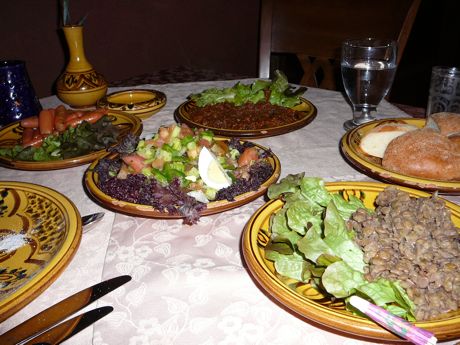
Starters:
Couscous Barbarian:
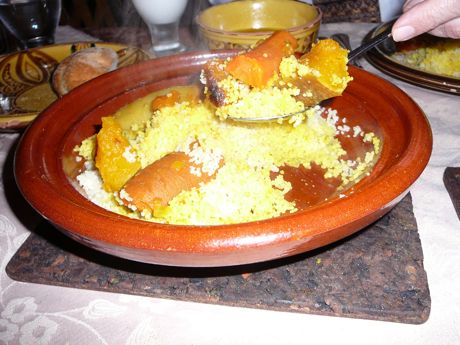
Lamb Tajine with Plums:

We really liked it that they played Moroccan music, that the primary wait staff were Moroccan, and that the food was really, REALLY good. Each starter had an individual and lightly spiced flavor, the couscous was rich and light, and the lamb tajine with plums was tender, sweet and heavenly. The tea was hot and our etched glass cups frequently refilled, and an irresistable plate of sweets arrived just when we thought none of us could eat another bite.
The table waiters were supplemented by kitchen staff delivering the meals hot and covered in the traditional tajines, and there are three separate richly decorated dining areas (one we think is just for men), AND the private cabinets in the back. We intend to go back often – it’s that good.
TELEPHONE: 3715333
Update: When I called for reservations, no one answered. When I went by in person to make reservations, I was told that the management has informed the staff that they have a “no reservations” policy, and you just have to show up and hope to get seated.
Recent Comments
ExpatAlien on What Country am I Living … intlxpatr on Yellowstone: Old Faithful to C… Michelle on Yellowstone: Old Faithful to C… Cathy on No Grown-Ups in Charge intlxpatr on Waiting for Snow Wikipedia Donate Button

Amazina


Early Voting in Florida


 Here There and Everywhere