Once In Royal David’s City
My absolute favorite of all the beautiful Christmas music:
The Coventry Carole
In the midst of this miraculous birth, a tragedy. The wise men warn the family that they must flee, and King Herod issues an edict that all babies 2 and under will be slain. Mary tries to keep her baby quiet and hidden as they escape to Egypt:
The Angel Gabriel From Heaven Came Down
What would you say if you were a 14 year old unmarried virgin, and God asked you to have a baby? Mary said “yes.”
Qatteri Cat Trims the Tree
3:30 in the morning, and I am wide-awake. I can lie in bad and toss and turn, or I can get up and make use of all this energy now and take a nap later, which is what I decide to do. I want to get a Christmas tree up, and I am hoping Qatteri Cat will not take too much interest. Two years ago, he pulled the tree over in the middle of the night, utter chaos.
Toss a load of laundry in the washer, pull down the tree box, get it set up, lights on – it’s great putting on lights while it is still dark out (I can see the ring of fishing boats along the horizon, and I shiver, thinking it must be really, really cold out there with the near zero Centigrade overnight temperatures) because I can see where I am putting them and how they will look when it is all finished, not too many lights in one area and big empty spaces elsewhere.
And then – the ornaments. When I have my own house, I usually have one big tree in the living room and one smaller one in the family room. The big tree has all the beautiful ornaments we have collected over the years, and the smaller tree is usually a theme tree – Maybe all red and white, pepperminty, one year and all blue and silver another. It’s my experiment tree. But we never mess with the serious family tree – it is thoroughly eclectic, and that is the way we want it to be. Hmmm. I think I will do a separate entry later on the ornaments.
The lights are on – just as the sky is beginning to lighten, the Qatteri Can and I finish up. The Qatteri Cat goes and gets his babies to share the tree with. Thanks be to God, he is not showing any interest in pulling on anything this year. We enjoy the lights together.

We put on Christmas music and I get a cup of coffee so I can sit and see if the tree needs more. Here is one of my very favorite Christmas CD’s (I have a collection of very old Christmas music, along with some very good more recent Christmas music)
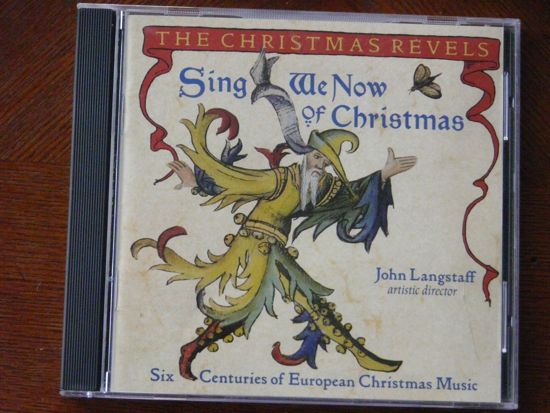
The Qatteri Cat says he is finished. He is exhausted. He is going to take a nap. Wouldn’t it be nice, to have the life of a housecat?

Hildegard of Bingen
I don’t often do this, reprint an entire article. I usually leave it to you to click on the blue type and read it for yourself. I am guessing very few people would make any effort to read this article, so for the few who have the interest, I am making it easy for you.
The article is written by James Kiefer, who writes many of the articles on saints in The Lectionary. He makes them human; his articles are so readable.
I like Hildegard of Bingen because she was a woman ahead of her time. She followed the yearnings of her soul to become a religious person, a nun, but rather than escaping from life, she engaged in it fully, as an administrator and as a musician. She engaged fully – and capably. She would probably be a remarkable woman in any age.

(This photo is from Geocities where there is another extensive article on Hildegard von Bingen and her life and times, with additonal information.)
“Listen: there was once a king sitting on his throne. Around him stood great and wonderfully beautiful columns ornamented with ivory, bearing the banners of the king with great honor. Then it pleased the king to raise a small feather from the ground, and he commanded it to fly. The feather flew, not because of anything in itself but because the air bore it along. Thus am I, a feather on the breath of God.”
Hildegard of Bingen has been called by her admirers “one of the most important figures in the history of the Middle Ages,” and “the greatest woman of her time.” Her time was the 1100’s (she was born in 1098), the century of Eleanor of Aquitaine, of Peter Abelard and Bernard of Clairvaux, of the rise of the great universities and the building of Chartres cathedral. She was the daughter of a knight, and when she was eight years old she went to the Benedictine monastery at Mount St Disibode to be educated.
The monastery was in the Celtic tradition, and housed both men and women (in separate quarters). When Hildegard was eighteen, she became a nun. Twenty years later, she was made the head of the female community at the monastery. Within the next four years, she had a series of visions, and devoted the ten years from 1140 to 1150 to writing them down, describing them (this included drawing pictures of what she had seen), and commenting on their interpretation and significance. During this period, Pope Eugenius III sent a commission to inquire into her work. The commission found her teaching orthodox and her insights authentic, and reported so to the Pope, who sent her a letter of approval. (He was probably encouraged to do so by his friend and former teacher, Bernard of Clairvaux.) She wrote back urging the Pope to work harder for reform of the Church.
The community of nuns at Mount St. Disibode was growing rapidly, and they did not have adequate room. Hildegard accordingly moved her nuns to a location near Bingen, and founded a monastery for them completely independent of the double monastery they had left. She oversaw its construction, which included such features (not routine in her day) as water pumped in through pipes. The abbot they had left opposed their departure, and the resulting tensions took a long time to heal.
Hildegard travelled throughout southern Germany and into Switzerland and as far as Paris, preaching. Her sermons deeply moved the hearers, and she was asked to provide written copies. In the last year of her life, she was briefly in trouble because she provided Christian burial for a young man who had been excommunicated. Her defense was that he had repented on his deathbed, and received the sacraments. Her convent was subjected to an interdict, but she protested eloquently, and the interdict was revoked. She died on 17 September 1179. Her surviving works include more than a hundred letters to emperors and popes, bishops, nuns, and nobility.
(Many persons of all classes wrote to her, asking for advice, and one biographer calls her “the Dear Abby of the twelfth century.”)
She wrote 72 songs including a play set to music. Musical notation had only shortly before developed to the point where her music was recorded in a way that we can read today. Accordingly, some of her work is now available on compact disk, and presumably sounds the way she intended. My former room-mate, a non-Christian and a professional musician, is an enthusiastic admirer of her work and considers her a musical genius. Certainly her compositional style is like nothing else we have from the twelfth century. The play set to music is called the Ordo Virtutum and show us a human soul who listens to the Virtues, turns aside to follow the Devil, and finally returns to the Virtues, having found that following the Devil does not make one happy.
She left us about seventy poems and nine books. Two of them are books of medical and pharmaceutical advice, dealing with the workings of the human body and the properties of various herbs. (These books are based on her observations and those of others, not on her visions.) I am told that some modern researchers are now checking her statements in the hope of finding some medicinal properties of some plant that has been overlooked till now by modern medicine.
She also wrote a commentary on the Gospels and another on the Athanasian Creed. Much of her work has recently been translated into English, part in series like Classics of Western Spirituality, and part in other collections or separately. If your university library or bookstore cannot help you, try a Christian bookstore. If they do not have it, try a trendy (feminist, New Age, ecology) bookstore.
But her major works are three books on theology: Scivias (“Know the paths!”), Liber Vitae Meritorum (on ethics), and De Operatione Dei. They deal (or at least the first and third do) with the material of her visions. The visions, as she describes them, are often enigmatic but deeply moving, and many who have studied them believe that they have learned something from the visions that is not easily put into words.
On the other hand, we have the recent best-seller, The Man Who Mistook His Wife for a Hat, by Oliver Sacks, Professor of Clinical Neurology at Albert Einstein College of Medicine, and author of Migraine and various other books. Professor Sacks is concerned with the relation of the brain to the mind, and ways in which the phsical state of the nervous system can affect our ways of perceiving reality. He views the pictures in Hildegard’s books of what she saw in her visions, and says, “The style of the pictures is a clear indication that the seer suffered regularly from migraine attacks. Migraine sufferers tend to see things in this manner.” And indeed, it is true that Hildegard suffered throughout her life from painful attacks of what may have been migraine. Professor Sacks hastens to add that this has nothing to do with whether her visions are authentic insights into the nature of God and His relation to the Universe.
Hildegard has undergone a remarkable rise in popularity in the last thirty years, since many readers have found in her visions, or read into them, themes that seem to speak to many modern concerns.
For example:
Although she would have rejected much of the rhetoric of women’s liberation, she never hesitated to say what she thought needed to be said, or to do what she thought needed to be done, simply because she was a woman. When Pope or Emperor needed a rebuke, she rebuked them.
Her writings bring science, art, and religion together. She is deeply involved in all three, and looks to each for insights that will enrich her understanding of the others.
Her use of parable and metaphor, of symbols, visual imagery, and non-verbal means to communicate makes her work reach out to many who are totally deaf to more standard approaches.
In particular, non-Western peoples are often accustomed to expressing their views of the world in visionary language, and find that Hildegard’s use of similar language to express a Christian view of reality produces instant rapport, if not necessarily instant agreement.
Hildegard wrote and spoke extensively about social justice, about freeing the downtrodden, about the duty of seeing to it that every human being, made in the image of God, has the opportunity to develop and use the talents that God has given him, and to realize his God-given potential. This strikes a chord today.
Hildegard wrote explicitly about the natural world as God’s creation, charged through and through with His beauty and His energy; entrusted to our care, to be used by us for our benefit, but not to be mangled or destroyed.
You can listen to some of her extraordinary and ethereal music of worship by clicking on the YouTube video below:
Water for Elephants by Sara Gruen

This is another one of those books I picked up on the last day of my last travels in the US. I had been through the Barnes and Noble nearby several times, picked this up and looked at is at least a dozen times, then put it down, just not that interested. On the last day, who knows why, I bought it and stuck it in my outer pocket of my suitcase. Maybe it was the only thing I could see that would fit, I don’t know. I had rejected it so many times before.
It hasn’t even been on my night stand, the books I really really intend to read. It has been on a shelf of books I will read someday when I don’t have anything else to do. Every now and then, it caught my eye. The Zanzibar Chest was on the same shelf. . . and that turned out to be a pretty good book. So recently, after I had read some books I had to read but were a little dry, and a couple books I wanted to read which were a little light, I grabbed Water for Elephants.
That was day before yesterday. I couldn’t put it down. I had a whole list of things to get done yesterday, but once I started Water for Elephants, I was lost, totally immersed in the tawdry world of circuses, bound in the magic of the illusion and performances, mesmerized by what goes on behind the scenes to make the spectacular possible.
The main character loses his parents in a totally unnecessary car accident just as he is about to take his final exams in Veterinary Science, at Cornell University. (You might think I am throwing in too much useless detail here, but it matters.) Stunned by the triple loss of both his parents, and the discovery that they had hocked everything to the bank to fund his education, he blanks on his exams and hits the road, ending up with a second rate circus.
What is so amazing about this author is that once you start reading, you are THERE.
The above mentioned Zanzibar Chest keeps you hooked by it’s painfullness, but for both AdventureMan and myself, we never liked the author, we found him a little full of himself. It doesn’t take away from the Zanzibar Chest being a worthy read, and unforgettable read.
Water for Elephants, on the other hand, has a hero you love to love. In a world of strict boundaries, a heirarchical social structure, he manages to cross all the boundaries. He truly loves the animals, and in one scene, that love just radiates, emanates, it illuminates the book from the inside, and makes you feel light and crazy with that same sort of love, love of the whole of creation. Jakob is loyal to his friends, and loyal even to his enemies, he is sacrificial in his loyalty, and, in the end, he is vastly and abundantly rewarded for his good character.
There is something for everyone, just like a circus. Like a circus, too, it has illusions, it distracts with one hand while the trick is performed with another, there is sensuality, there is sexuality, there are photos from old circuses. There are things which could offend just about every sensibility; there is kindness, there is cruelty, justice and injustice and cosmic justice. Sometimes you just have to suspend judgement and go with the read. This is one of those books.
I would say this is one of the finest reading experiences I have had for a long time. Brava, Sara Gruen. Worth every penny.
I’ve told AdventureMan as soon as he finishes The Zanzibar Chest, he has to start Water for Elephants. I can hardly wait. It’s that good.
You can find Water for Elephants in paperback at Amazon.com for $8.37 + shipping.
Here Comes the Sun
What’s that pale, tiny little orb hanging over the horizon? The dust is back, it never really went away:

at 0500 this morning, it was already 75°F / 24°C, with “haze”.
And to lighten the day a little, an oldie but goodie of the same name:
Pirates!
Wow! Wow! Wow!
The last night was sold out! When the Ahmadi Singers and Orchestra staged Pirates of Penzance in the Mishref Theatre, Kuwait had a real treat.

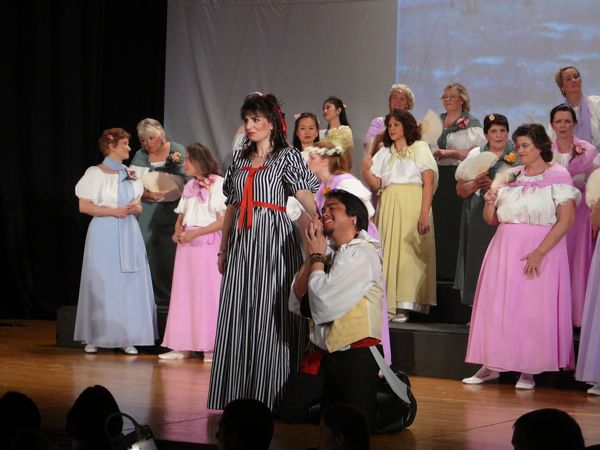

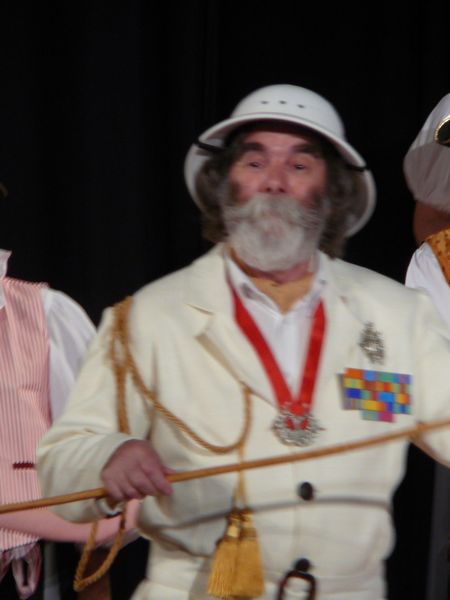
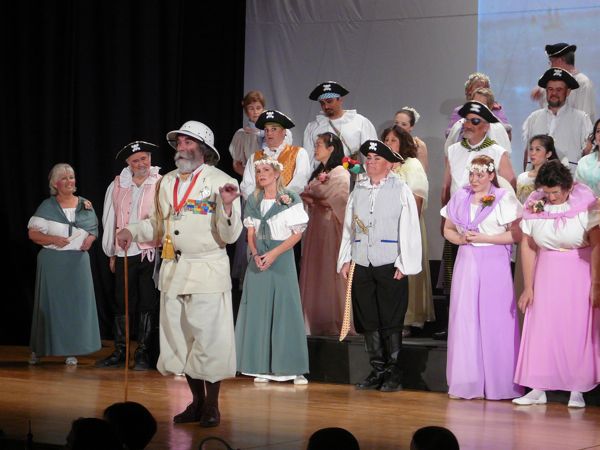
The Singers, the Orchestra – and the audience – were all multinational. The Mishref Theatre is a delightful space, warm, comfortable, intimate. There were many many children in the audience, and all were particularly well behaved. Only one cell phone went off (twice) and it was immediately silenced; the owner did not chat on his phone while the performance went on. Wooo Hoooo, Kuwait!
Neither did the audience sit on its hands! Each song was warmly applauded, and the old favorites, like the Modern Major General, brought the house down.
What I liked the very best about this performance of Pirates of Penzance was that the singers seemed to be having a lot of fun. The staging was clever and well-done, lots of stage play, lots of interaction, lots for people to see. Lots of fun for the kids, too. The actors sang the complicated song slowly but snappily, and we could understand the lyrics, those hysterically funny Gilbert and Sullivan lyrics. The costumes were a lot of fun – do you see the parrot on one pirate’s shoulder?
Brava! Bravo! The Ahmadi Singers and Orchestra have caught fire! Who knows what they will stage next?
Ahmadi Singers, Orchestra and Pirates of Penzance

Woooo Hooooooooo Al Ahmadi Singers and Orchestra! I love Gilbert and Sullivan so much, I might have to buy tickets for all three nights! The Gala includes a dinner, and the following two nights do not, but the singing will be great all three evenings, I have been promised.
The last time I saw Pirates of Penzance was at the Qatar Academy, and the Emir’s son was the hero. 😉 He did it with a lot of panache.
Pirates of Penzance! See you there!
“I Sparkle Like a Crystal . . .
. . . when I am with my pistol” sings Annie Oakley, from Annie Get Your Gun. It’s been running through my head ever since I heard about the Kuwait Bloggerettes outing to the shooting range. You’ve seen Megan Mullally on Will and Grace, but here she is, singing Annie’s song and hitting her target dead on:
And here are the lyrics:
Oh my mother was frightened by a shotgun they say
That’s why I’m such a wonderful shot
I’d be out in the cactus and I’d practice all day
And now tell me, what have I got
I’m quick on the trigger
With targets not much bigger than a pinpoint
I’m number one
But my score with a feller
Is lower than a cellar
No you can’t get a man with a gun
When I’m with a pistol
I sparkle like a crystal
Yes I shine like the morning sun
But I lose all my luster when with a crumple buster
Oh, you can’t get a man with a gun
With a gun! With a gun!
No you can’t get a man with a gun
If I went to battle with someone’s herd of cattle
You’d have steak when the job was done
But if I shot the herder
They’d holler bloody murder!
And you can’t get a hug from a mug with a slug
Oh, you can’t get a man with a gun
I’m cool, brave and darin’
To see a lion glaring when I’m out with my Remmington,
But a look from a mister
Will raise a fever blister
Oh, you can’t get a man with a gun
The gals with umbrellers
Are always out with fellers
In the rain or the blazing sun
But a man never trifles with gals who carry rifles
Oh, you can’t get a man with a gun
With a gun! With a gun!
No you can’t get a man with a gun
A Tom, Dick, or Harry
Will build a house for Carrie when the preacher has made ’em one
But he can’t build ya houses with buckshot in his trousers
And you can’t shoot a man in the tail like a quail,
Oh, you can’t get a man with a gun
A man’s love is mighty
He’ll even buy a nightie for a gal who he thinks is fun
But they don’t by pajamas for pistol-packin’ mamas!
Oh, a man may be hot, but he’s not
When he’s shot!
Oh you can’t get a man with a gun!
Recent Comments
intlxpatr on Yellowstone: Old Faithful to C… Michelle on Yellowstone: Old Faithful to C… Cathy on No Grown-Ups in Charge intlxpatr on Waiting for Snow intlxpatr on Waiting for Snow Wikipedia Donate Button

Amazina


Early Voting in Florida


 Here There and Everywhere