Visitors, Not Residents?
From yesterday’s Arab Times:
The General Immigration Department of the Ministry of Interior is studying a proposal to replace the term ‘resident’ — the status given to expatriates working in Kuwait, reports Al-Watan daily. The daily added this has been done to ‘fight’ attempts by international organizations asking Kuwait to grant citizenship to expatriates who have been working in the country for a long time. Meanwhile, a reliable source said ‘visitor’ will replace the term ‘resident’. The source also said the General Immigration Department has stopped receiving applications for self sponsorship after noticing an increasing number in applications over the past few months. According to knowledgeable sources the Assistant Undersecretary for Citizenship Affairs Major-General Sheikh Ahmad Al-Nawaf has issued instructions to take into account the demographic structure of the country while issuing work permits because Kuwaitis account for only 33 percent of the population compared to 67 percent expatriates.
Calling all us guest-workers “visitors” is just a dumb idea. Call us guest-workers, call us workers, but if you call us “visitors” then you run into problems with folks who are just coming in for a VISIT, i.e. visitors.
I have always preferred being a resident. When I come into Qatar or Kuwait and all the lines are long except the GCC lines, I can always take a chance that the guards will think I am married to one of you when I step into the GCC line. If the person at the desk says I am in the wrong line, I can always look confused and say “I am a resident!” It has worked – well, most of the time. 😉
This issue is hand-in-hand with the school issue. Times are changing, old traditions are not being observed, and the blame is falling on foreign influences. It’s kind of like that train has left the station – if you want to go back to old ways, you’ll have to get rid of automobiles, computers, mobiles, supermarkets, and most of all, that demon of all forces of modernization – television.
The Taliban managed to reinstate old traditions, and in doing so, to take Afghanistan right back to the stone age. It was not just the women who suffered – men who didn’t want to wear beards, men whose hair was too long, men who wanted to listen to music, men who wanted to discuss politics – all were punished, some were killed.
The real challenge here is how Kuwait, as a modern nations state with a lot of money, is going to move with the modern world, not against it.
Staph Fatalities Alarming
This is from AOL Health News but it is also featured on Good Morning America today. The government says there has been “an alarming increase” in staph infections, and the number of deaths due to these common infections could soon be overtake death from AIDs infection.
My own father spent a year dying, fighting of MRSA, which is common in many hospitals – even here in Kuwait. The old are particularly vulnerable, but so are all those with open wounds, recent hospitalizations, and compromised immune systems.
CHICAGO (Oct. 17) – More than 90,000 Americans get potentially deadly infections each year from a drug-resistant staph “superbug,” the government reported in its first overall estimate of invasive disease caused by the germ.
Deaths tied to these infections may exceed those caused by AIDS, said one public health expert commenting on the new study. Tuesdays report shows just how far one form of the staph germ has spread beyond its traditional hospital setting.
The overall incidence rate was about 32 invasive infections per 100,000 people. That’s an “astounding” figure, said an editorial in Wednesday’s Journal of the American Medical Association, which published the study.
Most drug-resistant staph cases are mild skin infections. But this study focused on invasive infections – those that enter the bloodstream or destroy flesh and can turn deadly.
Researchers found that only about one-quarter involved hospitalized patients. However, more than half were in the health care system – people who had recently had surgery or were on kidney dialysis, for example. Open wounds and exposure to medical equipment are major ways the bug spreads.
In recent years, the resistant germ has become more common in hospitals and it has been spreading through prisons, gyms and locker rooms, and in poor urban neighborhoods.
The new study offers the broadest look yet at the pervasiveness of the most severe infections caused by the bug, called methicillin-resistant Staphylococcus aureus, or MRSA. These bacteria can be carried by healthy people, living on their skin or in their noses.
Your best protection? Wash your hands frequently, and stay out of hospitals.
You can read the rest of the article HERE.
“Committee” Cracks Down on Education in Kuwait
This is a small article from yesterday’s (October 16) Kuwait Times:
MOE Cracks down on foreign schools:
Kuwait: The council of undersecretaries at the Ministry of Education chaired by Minister of Education Nouriya Al-Sabeeh will discuss after Eid holidays the demands of the committee about the negative effects of some traditions to the Kuwait society.
(Excuse me? What committee is that? What negative effects of some traditions? Could you make this any more opaque? Or is the goal to have us ask these very questions?)
It continues:
The committee demands to stop foreign schools from making foreign trips until the regulations to control these trips and stop mixing girls and boys together have been issued. The committee also demands that foreign schools inform the ministry about any parties they intend to have and the agenda of that party to ensure that the nimistry is present and in order to make sure that the school abides by the MOE’s regulations.
The committee also asked the ministry to implement a plan for segregation among boys and girls in the high school classes, as it is more important than segregation at universities. The committee noted that segregation should start in school activities as a preliminary step an foreign schools should be instructed by this through a circular to be distributed to them.
Comment: Let’s face it, foreign schools have strange foreign ways, including the mixing of boys and girls. They believe it creates healthier relationships down the road when people learn to get along with all kinds of other people at a very young age.
Even now, fewer western families are coming to Kuwait because of the education situation. It is often discussed among expat groups that the quality of education available in Kuwait is slipping dramatically.
Of those expat families that do come, many are choosing to home-school to avoid the problems developing in the local schools, even the “foreign” schools. It seems to me that local people who send their kids to the better “foreign” schools do so because these schools have a reputation for providing a better level of education than the public schools – is this correct? It also seems to me that if the “foreign” schools are doing better than the local schools, perhaps it is a good idea to keep letting them do their thing, rather than regulate them too closely?
I saw a group of home-schooled kids on the beach recently, having PE. They were playing volleyball, big kids, little kids, boys and girls all together. They were having a wonderful time. They were polite, respectful and modestly dressed. There wasn’t a sign of romance, just good, healthy fun as they played.
A friend who teaches in one of the local schools tells me of little Abdul, whose pencil fell on the floor the other day and he said to her – his teacher – “Pick that up.” She just stood there, half in shock that he would speak to her – or to anyone – so disrespectfully. Abdul looked up at her with those charming big eyes and grinned. And said “You’re not going to pick it up, are you?” She laughed and said “No, you are!” and he did. Little Abdul is learning some strange foreign ways.
Some of you went to foreign schools, either here in Kuwait or elsewhere. What do you think?
Need for Vigorous Exercise
From BBC Health News.
“Misleading” government guidelines have led to many Britons wrongly believing that moderate exercise is as beneficial as a vigorous workout, a study alleges.
In a survey of nearly 1,200 people, around half of men and three quarters of women thought moderate exercise conferred the greatest health benefits.
Guidelines urge 30 minutes of moderate exercise each day five days per week.
But the authors of the study, published in Preventive Medicine, said vigorous exercise was best for averting disease.
The NHS guidelines say “taking a brisk walk, spending some time doing the gardening or doing a few laps of the local swimming pool on the way home from work” can all improve health.
But the researchers from Exeter and Brunel Universities said these activities were unlikely to do much for them.
“It’s extremely worrying that British adults now believe that a brief stroll and a bit of gardening is enough to make them fit and healthy,” said Dr Gary O’Donovan, lead author.
“Brisk walking offers some health benefits, but jogging, running and other vigorous activities offer maximal protection from disease.”
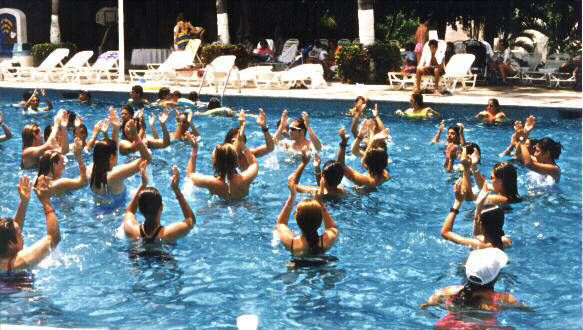
The article goes on to say that part of the problem is a series of studies with conflicting results. While any exercise is better than no exercise, vigorous exercise provides the maximum health benefits. You can read the rest of the article HERE.
Why The Appendix?
A few years ago, Adventure Man was getting all set to cross the Sahara with a camel caravan, until he read the disclaimers and warnings, including a small item that in one of the previous crossings, a traveller had a sudden bout of appendicitus and was left, alone in the desert, to die, because there was nothing else that could be done. He chose not to go!
CNN News has published an article on scientist’s discovering the use of the appendix:
WASHINGTON (AP) — Some scientists think they have figured out the real job of the troublesome and seemingly useless appendix: It produces and protects good germs for your gut.
That’s the theory from surgeons and immunologists at Duke University Medical School, published online in a scientific journal this week.
For generations the appendix has been dismissed as superfluous. Doctors figured it had no function. Surgeons removed them routinely. People live fine without them.
And when infected the appendix can turn deadly. It gets inflamed quickly and some people die if it isn’t removed in time. Two years ago, 321,000 Americans were hospitalized with appendicitis, according to the Centers for Disease Control and Prevention.
The function of the appendix seems related to the massive amount of bacteria populating the human digestive system, according to the study in the Journal of Theoretical Biology. There are more bacteria than human cells in the typical body. Most are good and help digest food.
But sometimes the flora of bacteria in the intestines die or are purged. Diseases such as cholera or amoebic dysentery would clear the gut of useful bacteria. The appendix’s job is to reboot the digestive system in that case.
You can read the rest of the article Here.
Saudis to Overhaul Legal System
Found this today on BBC Middle East News.
Saudi Arabia has announced an overhaul of its judicial system, including the allocation of $2bn (£981m) for training judges and building new courts.
The reforms, by royal decree, will lead to the creation of a supreme court, an appeals court and new general courts to replace the Supreme Judicial Council.
Reformers have welcomed the measures, which they say will improve human rights and help modernise the country.
They complain that the current judicial system is often opaque and arbitrary.
Until now, Saudi judges have had wide discretion to issue rulings according to their own interpretation of Islamic Sharia law.
The judiciary has also long resisted the codification of laws or the reliance on precedent when making a ruling.
Defendants also do not have recourse to appeal and often have no right to proper legal representation.
Unchecked powers
The new reforms announced by King Abdullah are aimed at addressing some of these perceived failings and at introducing safeguards such as appeal courts that can overturn decisions by lower courts, the BBC’s Heba Saleh says.
You can read the rest HERE.
Ignoble Awards 2007
Pioneering research into a “gay bomb” that makes enemy troops “sexually irresistible” to each other has scooped one of this year’s Ig Nobel Prizes.
Other winners included work on treating hamster jetlag with impotency drugs, extracting vanilla from cow dung, and the side-effects of sword swallowing.
The awards, founded in 1991, mark achievements that “first make people laugh, and then make them think”.
The prize ceremony took place at Harvard University, US.
Genuine Nobel Laureates handed out the much-coveted awards to the winners, who took away no cash, but instead received a handmade prize, a certificate, and, of course, the glory of such an illustrious win.
You can read the entire article, with all the awards at BBC News.
Degrading Gulf Character
In the October 2nd Kuwait Times the lead article on the front page has to do with Bahrain considering a 6 year ceiling on ex-pats living in Gulf Countries. Evidently they want the GCC countries to consider implementing it across the board.
How do you think that might work out? It seems to me there is a huge middle class here made up of mid-level managers who really keep things going. Who manages your stores? Who waits on customers? Who drives the buses and the taxis?
When you put that ceiling on, is it across the board? Does the ceiling apply to Palestinians who have never lived in Palestine, to Lebanese, to Syrians, to Yemenis? Does it apply to Europeans? To Canadians and Americans? Does it apply to Chinese? Indians? Nepalis? Or is it like some of the other laws, yes, it is the law, but you can get an exception?
I ask because it seems to me there are a lot of people who have lived here for 30 – 40 years, contributing to your economy, educating their children, teaching in your schools, designing your buildings, selling your hardware . . .
So how does this work?
Diversity or time?
The complaint, according to the paper, is that the expat population is eroding the national character of the states in the region. Is it the diversity of the population which degrades the local culture, or is this perhaps a function of time? We hear the same complaint in France, we hear it in Britain, we hear it in Germany, we hear it in the United States – things aren’t the same as they used to be. I have a feeling they said the same thing 50 years ago, after World War II. I have the feeling they said it 100 years ago, just after the turn of the last century.
Times change, culture changes. It’s slow, but unless you are walled off from the rest of the world, I believe it is inevitable. I suspect changing times have more to do with any change in Gulf character and customs than the expat population, who lives side by side with the Gulf natives.
Phone Fees to be Lowered
(for my non-Kuwait readers, Kuwait has a monopoly on all the communications in the country, and the phone rates are the highest I have experienced anywhere in the world. Most people who can subscribe to internet phone service providers like Skype, Vonage, etc. and use the internet connections to stay connected with family, friends, and to do personal financial transactions by phone. Kuwait claims they are losing millions of dinars in revenue, and continually tries to monitor and crack-down on illegal internet telephony.)
This is another tiny article from the Kuwait Times, September 26th.
Kuwait: Undersecretary for International Services at the Ministry of Communication Engineer Hameed Al-Qattan said that the ministry will offer outstanding call service fees over the Internet in order to stop the theft of international calls. Al-Qattan said that the announcement of this service will be in October and it will lead to a 50% reduction of international call fees from it’s present price.
I don’t have the figures. But I believe that most of the internet call services are charging between $16 (around 4KD) to $30 (around 8KD) per MONTH depending on the number of minutes you sign up for. Most of the calls to the US / Canada are free up to X number of minutes. Calls to foreign countries cost pennies per minute. They are charged to your credit card monthly, and the cost is a pittance. It’s laughable.
The call quality is not always so great, but hey, it’s a connection, right? And you are not paying an arm and a leg.
So Kuwait is going into competition with all the international internet call companies?
They will provide “outstanding” call service fees?
How cheap do those call service fees have to be in order to be competitive with the providers people are already using?
Will they also provide “outstanding” connections, better than the current internet connections we are dealing with?
Stay tuned!
Ride the S.L.U.T.
You’d have to know the humor. Every country, every tribe, has their own unique way of handling situations, and in Seattle, humor often beats anger, any day. When city officials asked a low-income area of Seattle how they could help, the people said “affordable housing.” The city officials responded with “How about a trolley?”
“What? ? ? ?” you might ask. Sounds like this might have been about a trolley all along, don’t you think?
So the South Lake Union residents played the humor card. You can read the full article at CNN Travel,
SEATTLE, Washington (AP) — Officially, it’s the South Lake Union Streetcar. But in the neighborhood where the new line runs, it’s called the South Lake Union Trolley — or, the SLUT.
At Kapow! Coffee, a shop in the old Cascade neighborhood, 100 T-shirts bearing the words “Ride the SLUT” sold out in days, and another 100 are on order.
“We’re welcoming the SLUT into the neighborhood,” said Jerry Johnson, 29, a part-time barista.
Some claim — incorrectly, according to representatives of Vulcan Inc., the company that is developing the area — that South Lake Union Trolley was the original name and that it was changed when officials belatedly realized the acronym.
The $50.5 million project should be completed with streetcars running in December. Underlying the lighthearted opposition, however, is resentment over changes in the old working-class neighborhood.
“There was a meeting with representatives from the city several years ago,” Johnson recalled.
“They asked us, ‘What we could do for you?’ Most people raised their hands and said, ‘Affordable housing,”‘ he said. “Then the people from the city huddled together — ‘whisper, whisper, whisper,’ — and they said, ‘How about a trolley?
The neighborhood has sold out of the “Ride the S.L.U.T.” T-shirts. You can see the video if you go to the CNN website. Just a little grin to start your day, and a little insight into the Seattle way of doing things. Seattle people do not have a great fondness for bureaucrats and politicians.
Recent Comments
ExpatAlien on What Country am I Living … intlxpatr on Yellowstone: Old Faithful to C… Michelle on Yellowstone: Old Faithful to C… Cathy on No Grown-Ups in Charge intlxpatr on Waiting for Snow Wikipedia Donate Button

Amazina


Early Voting in Florida


 Here There and Everywhere