Saudi Disinformation on Qatar Coup
Thank you, John Mueller, for contributing this fascinating piece on the reported – and then unreported – ‘coup attempt in Qatar’. We were there when this happened the last time. It was bizarre – there was nothing. No increased military or police presence, just the same quiet and relaxed day-by-day. It was all a lie, created to stir the pot, and to create a perception – based on nothing.
BREAKING; Qatar Military Coup “Rumours” Stir Bad Blood With House of Saud
by Finian Cunningham, April 17, 2012
The rumour mill is churning in the Persian Gulf with unconfirmed reports of a failed military coup against the Qatari ruler.
There were even media reports that American military helicopters had whisked the Emir and his wife to a safe unknown destination in the aftermath of the failed putsch, said to be have been attempted by high-ranking officers.
Saudi news channel Al Arabiya reported earlier today a coup bid against Qatari Emir Hamad Bin Khalifa Al Thani. However, by midday, the story appeared to have been removed from Al Arabiya’s English-language website.
Iranian news channel Press TV toned down its early headlines of a coup and later speculated that Saudi-owned Al Arabiya may have been engaging in disinformation to undermine the Qatari regime, indicating a power struggle between the Houses of Saud and Thani.
The FARS semi-official Iranian news channel, however, insisted that sources within the Qatari royal entourage had confirmed earlier this week that there was a foiled coup in Doha.
Not surprisingly, Qatari-owned Al Jazeera news site ran no information on the alleged plot.
Whether the reports of this week’s failed coup turn out to be rumour or something more sinister, there is nevertheless no disguising the fact of underlying bad blood in the Gulf Arab enclave, both between and within the Gulf monarchies.
That may at first seem at odds with the “thick as thieves” appearance of the six states that form the Gulf Co-operation Council: Saudi Arabia, Kuwait, Bahrain, Qatar, United Arab Emirates and Oman. All are Sunni monarchies that have aligned with the US-led NATO powers’ aggressive policy of isolating Shia Iran.
Saudi Arabia and Qatar have emerged in particular as militant allies of US/NATO geopolitics across the Middle East. They played instrumental roles in paving the way for NATO’s aerial bombardment and regime change in Libya; and they have been most strident in denouncing the Syrian government of Bashar Al Assad, calling for his overthrow and arming mercenary forces that are accused of committing atrocities and sabotage.
But herein lies the potential for rivalry and enmity. Saudi Arabia, the world’s largest oil exporter, and Qatar, the number one exporter of liquefied natural gas, are bankrolling mercenaries and jihadis from Iraq, Libya, Lebanon and elsewhere in a bid to be top dog in a fissile region. The region is being inflamed with sectarian tensions precisely because of self-serving Saudi and Qatari power politicking.
The Gulf monarchs have also been funding election campaigns of Islamist parties in Egypt and Tunisia, aligned to the conservative Muslim Brotherhood, in line with Western powers using these same parties to shunt and blunt popular calls for greater democracy.
The rapid growth of Saudi-backed satellite TV channels broadcasting across the region – several of them spouting Saudi theocratic rhetoric – is indicative of a rivalry for influence with Qatar, which originally pioneered the Arab medium with the Al Jazeera station.
While on the surface, Riyadh and Doha may appear joined at the hip in terms of advancing the US-led Western imperialist agenda for hegemony, that service generates tensions between and within the royal houses.
In Qatar, there are reported tensions within the Al Thani ruling family and other powerful clans over what critics of the Emir call “his excessive alignment with US foreign policy and breaking of Arab ranks”. There are also domestic problems of corruption owing to the Al Thanis monopolising Qatar’s lucrative property market.
And despite the apparent alliance with Saudi Arabia, the present Qatari Emir will be mindful that the Saudi rulers have been implicated in previous suspected coup attempts against him in February 2011, 2009, 2002 and 1996.
The present Qatari ruler came to power after he led a coup against his own father in 1995 while the latter was holidaying in Europe. The following year, the Saudi and Bahraini rulers backed a failed counter-coup to reinstall the older Emir.
In 2010, the coup plotters were released from jail by Emir Hamad after a request was made by Saudi King Abdullah.
So in the Arab enclave of the NATO camp, all is not as cosy as it may seem. Washington and the other Western powers no doubt think they have a clever Arab cover from the Gulf autocrats to redraw the Middle East political map according to their imperialist designs. But in all such intrigues of deception and power lust, the band of thieves have to watch their backs.
Finian Cunningham is Global Research’s Middle East and East Africa Correspondent
cunninghamfinian@gmail.com
Upcoming Execution in Iran?
Thank you, John Mueller 🙂
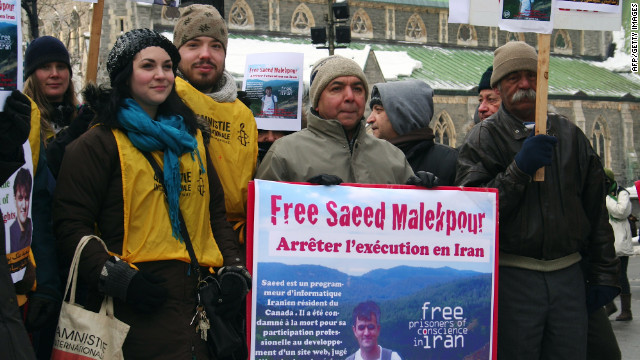
Supporters demonstrate in January for the release of Saeed Malekpour in Montreal, Quebec.
(CNN) — A computer programmer from Canada faces imminent execution in Iran for the actions of another person, which he had no control over, a human rights group says.
Saeed Malekpour wrote a program to upload photos to the Internet, an accomplishment that could cost him his life, Amnesty International reported Friday. Authorities in the Islamic Republic claimed his program was used by someone else to upload pornography and charged him with “insulting and desecrating Islam.”
Malekpour, who is a Toronto resident, was arrested in October 2008 while visiting relatives in Iran. He was convicted in a short trial and was sentenced to death in October 2011, according to Amnesty International.
Iran’s Supreme Court confirmed the sentence on January 17. Malekpour’s lawyers have been unable to ascertain the whereabouts of his court files since Tuesday and fear this could be an indicator that an executioner could carry out the sentence soon, Amnesty said. A court official suggested to the lawyers that the file had been sent to the Office for the Implementation of Sentences, according to Amnesty.
Malekpour sent a letter from prison detailing beatings and other mistreatment at the hands of Iranian prison officials to obtain a confession, said Hadi Ghaemi, executive director of the International Campaign for Human Rights in Iran.
“A large portion of my confession was extracted under pressure, physical and psychological torture, threats to myself and my family, and false promises of immediate release upon giving a false confession to whatever the interrogators dictated,” the letter says.
Malekpour’s supporters have created Facebook pages and websites in his support dating to at least 2009.
Amnesty International has requested on its website that concerned individuals write Iranian authorities inside and outside the country to demand that Malekpour not be executed.
US Navy Rescues Iranian Fishermen from Somali Pirates
I love this story. I found it on AOL News / Huffington Post; it’s an Associated Press Story.:
WASHINGTON — The political tensions between the U.S. and Iran over transit in and around the Persian Gulf gave way Friday to photos of rescued Iranian fisherman happily wearing American Navy ball caps.

The fishermen were rescued by a U.S. Navy destroyer Thursday, more than 40 days after their boat was commandeered by suspected Somali pirates in the northern Arabian Sea. The rescue came just days after Tehran warned the U.S. to keep its warships out of the Persian Gulf – an irony not lost on U.S. officials who trumpeted the news on Friday.
“We think it’s very doubtful that the Iranians or the pirates were aware of recent events of the last couple days,” Rear Adm. Craig S. Faller, commander of the U.S. Navy Carrier Strike Group involved in the rescue, told reporters by phone Friday. “Once we released them (the fishermen) today they went on their way very happily, I might add, waving to us wearing USS Kidd Navy ball caps.”
Faller, speaking from the aircraft carrier USS John C. Stennis in the Arabian Sea, said the fishermen, who had been living off the fish they could catch, expressed their thanks and are believed to be headed back to their homeport in Iran.
The rescue was carried out by American forces flying off the guided-missile destroyer USS Kidd, after crew on the Iranian fishing vessel, the Al Molai, made it clear they were in trouble.
The USS Kidd, part of the Stennis carrier group, was sailing in the Arabian Sea, after leaving the Persian Gulf, when it came to the sailors’ aid. It was alerted to the hostage situation when the captain of the fishing boat spoke by radio to the Americans in Urdu – a Pakistani dialect that he hoped the pirates near him would not understand – and managed to convey that he needed help.
A U.S. Navy team helicoptered to the ship, boarded it without any resistance, and detained 15 suspected Somali pirates. They had been holding the 13-member Iranian crew hostage and were using the boat as a “mother ship” for pirating operations in the Persian Gulf.
“They were scared,” U.S. Navy Cmdr. Jennifer L. Ellinger, commander of the USS Kidd, said of the Iranians. “They pleaded with us to come over and board their vessel, invited us to come over. And we reassured them that we would be on our way.”
Amid escalating tensions with Tehran, the Obama administration reveled in delivering the news.
“This is an incredible story. This is a great story,” State Department spokeswoman Victoria Nuland said, explaining that the very same American ships the Islamic republic protested for recently traveling through the Strait of Hormuz were responsible for the Iranian vessel’s recovery.
“They were obviously very grateful to be rescued from these pirates,” Nuland said.
The episode occurred after a week of hostile rhetoric from Iranian leaders, including a statement by Iran’s Army chief that American vessels are no longer welcome in the Gulf. Iran also warned it could block the Strait of Hormuz, the strategic waterway that carries to market much of the oil pumped in the Middle East.
The Iranian threats, which were brushed aside by the Obama administration, were in response to strong economic sanctions against Iran over its disputed nuclear enrichment program. Last week, President Barack Obama signed into law new sanctions targeting Iran’s Central Bank and its ability to sell petroleum abroad.
According to Faller and Ellinger, the incident began Thursday morning when the Navy got a distress call from a Bahamian-flagged ship, and saw six individuals in a small boat next to it, throwing what appeared to be weapons into the water. They checked but found no evidence of piracy, so they released the small boat, but followed it by helicopter.
The small boat headed back to the Iranian-flagged ship, where U.S. Navy officials said it looked like there were both Middle Eastern and Somali on board.
The radio conversation with the Iranian captain made it clear his crew was under duress, so the USS Kidd launched a Navy search and seizure team. The suspected pirates hid on the ship, but the Iranian crew told the team where they were, Ellinger said, adding that the pirates surrendered quickly.
“The Al Molai had been taken over by pirates for roughly the last 40-45 days,” said Josh Schminsky, a Navy Criminal Investigative Service agent aboard the Kidd. “They were held hostage, with limited rations, and we believe were forced against their will to assist the pirates with other piracy operations.”
Schminsky said the Iranian boat’s captain thanked the U.S. for assistance. “He was afraid that without our help, they could have been there for months,” Schminsky said in a prepared release.
The U.S. team gave the crew food, water and medical care, and on Friday morning they moved the captured pirates to the Stennis. They will remain there while the U.S. considers options for prosecution and consults with other nations that have joined forces against piracy.
“Sadly, this is not a new thing,” Nuland told reporters, citing more than 1,000 pirates picked up at sea who are under prosecution in some 20 countries. “So this is always a question of where to send them and who will do the prosecution.”
Asked if the rescue mission could provide a chance for a thaw in relations with Iran, Nuland declined to comment. She said the Navy had made a “humanitarian gesture” to take the Iranians onboard, feed them and ensure they were in good health before setting them off. She said the U.S. and Iranian governments have had no direct contact over the incident.
Defense Secretary Leon Panetta called Faller on Friday to congratulate him on the rescue, adding that, “When we get a distress signal, we’re going to respond. That’s the nature of what our country is all about.”
Adult Bullies: They’re Everywhere
How to Deal With Adult Bullies
From bulldozer bosses to pushy neighbors, bullying continues long beyond the playground years. Here’s how to recognize a full-blown, fully-grown bully – and what to do about it.
When you hear the world “bully,” what comes to mind — a pre-teen ruffian who’s constantly picking on the neighborhood wimp?
Actually, bullying lasts well into adulthood — and instead of the playground, the abuse is most likely to occur in the workplace. A recent survey of American workers found that more than 41 percent of them had experienced some form of bullying at work in the past year; 13 percent of them were bullied on a weekly basis. “Often, adult bullying occurs between bosses and employees,” explains Irina Firstein, LCSW, a relationship counselor in New York City.
But that’s not all: Many adults find themselves emotionally tormented by fellow employees, nasty neighbors, aggressive friends, and even their spouse, says Firstein.
No matter who’s doing the antagonizing, the effects of bullying can be extremely damaging psychologically. Here’s what you should know about adult bullies.
How to Spot a Grownup Bully
A recent Iowa State University study found that childhood bullies may very well grow into adult bullies. Of the participants, those with a history of childhood bullying were six times more likely to get in a fight and two and a half times more likely to threaten someone than those without a bullying past.
“Adult bullies tend to be opinionated, judgmental, and coercive,” says Katherine Krefft, PhD, a practicing psychologist in Buzzards Bay, Mass. “If a person repeatedly makes you feel intimidated or humiliated, you are probably dealing with a bully.”
These people tend to:
- Abuse a position of power.
- Repeatedly give undeserved criticism.
- Use verbal or physical abuse.
- Have excessive and unrealistic expectations.
- Repeat insults or threats.
- Abuse the rights and dignity of others.
The Toll Bullying Takes on the Victim
“Repeated bullying — whether it occurs between bosses and employees, between spouses, or in any adult relationship — is a form of traumatic stress that is toxic to one’s emotional health,” says Firstein. In fact, the effects of bullying have been linked to post-traumatic stress disorder (PTSD), a trauma-induced anxiety disorder.
In addition, bullying victims may experience:
- Anxiety and depression
- Loss of self-confidence or self-esteem
- Fearfulness
- Financial losses from missed work
- Sleep disturbance
- Aches and pains
- Digestive disturbances
How to Put an End to the Abuse
The worst thing you can do if you’re being bullied? Ignore it.
“The reason child bullies grow up to be adult bullies is because the behavior is repeated and reinforced,” warns Krefft. If not confronted, a bully will likely continue his antagonizing ways.
Here’s what you can do:
- Recognize that being bullied is something no one deserves.
- Document the bullying behavior as well as you can.
- Try to have witnesses to support you.
- Seek help from an appropriate authority.
Never try to retaliate directly, says Krefft. The proper authority will depend on the situation: If at work, your employee handbook or HR department may identify the right person in your workplace to talk to. If you have been physically threatened or attacked, you may want to go to the police.
Could You Be the Bully?
What if you’re the browbeater? In a national survey on bullying, 6 percent of adults admitted to picking on others.
If you’re constantly taunting others, enjoying other people’s discomfort, have trouble controlling destructive behavior, take out your anger on others, or have threatened other people, you could have a bullying problem. Other warnings signs include frequent lying and fighting.
Whether you are the bully or the bullied, it is important to recognize it and take steps to stop it. If not, it could continue on a destructive path, affecting the emotional health of everyone it touches.
From AOL Health News
Qatar Women Want Dress Code to Maintain Cultural Norms
Every year around this time The Peninsula (Qatar) runs an article reminding other nationalities to respect Qattari values on modesty, and asking women to wear loose clothing, cover arms and shoulders and wear skirts at least to the knees. This year, there are comments about women wearing ‘indecent’ clothing around the hotel swimming pools, and calling for a national dress code with enforcement.

Qatari women lament disregard for norms
By Huda NV
DOHA: Dress code in any country is a very sensitive topic, for, while it protects the rights of many, it may hinder the rights of many others. When France issued ban on Hijab in public places, many Muslims who used the attire had to let it go. Same is the case in Saudi Arabia where all, including non-Muslims have to wear the abaya.
As of now, there is no strict ruling on dress code in Qatar except that it asks for modest dressing in public. The rules are with loose ends, according to some. With the on going development much have changed in dressing over the last 10 years.
Some Qatari women who spoke to The Peninsula said that due to the lack of awareness or mainly due to disregard for local norms, many people flout with the Qatari Penal Code that “prohibits wearing revealing indecent clothing”. Since no action is taken against the violators, rules or laws are being flouted with.
“The law asks one dress decent lyto protect oneself and the society as a whole. We are functioning in a society in various roles and at various levels. We go out, do what we need to do and go home, as other women do. But it pains to see many women bring with them negative influences into the community and dress in a way which is against the discipline of the community,” said Sheikha Al Naimi, a Qatari woman.
“We are not asking them to use hijab or abaya. We just want them to be modest, by which we mean covering the arms and shoulders, wearing skirts at least up to knee length, and wearing loose clothes. We are asking for respect not hindering their personal choices,” said Asma Abdullah.
RIGHTS?
So would not any law or dress code be against personal rights? Then, is not smoking or drinking a personal choice and a law banning these are against the so called rights, ask some.
“There are laws banning smoking and penalties for violating traffic rules, which are issued in public interest and these are strictly followed, for fear of heavy fines on violations. So a dress code is also needed for public security. We all have our own freedom, but in public we need to check the rights of public too. One’s freedom should not hinder other person’s rights and people should realise that rights come along with duties,” said Mariam Al Ali.
However some argued dressing in skimpy clothes is not freedom, but rather lack of self respect. “We would say the western idea of freedom and right is twisted and is not based on truth. For example, when it comes to dressing, the so called right is more or less like what men want to see,” said Tammy, a US expatriate.
“Our policy is you see what we want you to see rather than you decide what you need to see. We choose to whom we show our beauty. It is not for public attention,” one of the Qatari women said
THE WORRIES
One of the key problems, most of the Qatari women who spoke to The Peninsula, was on encroachment on their identity. “We are a minority in our own land; this does not mean we leave our identity. We are trying to pass it over to next generation and all these influences is a threat to our identity as Muslims, Arabs and Qataris,” Al Naimi said.
“All the expats come here for a reason, mainly financial, and hence they need to respect the culture here but now its more on destroying the society,” she laments. “Even in some schools and colleges, teachers dress badly. Even if it’s a girls-only school, it does not mean teachers show their body parts which we ourselves do not show to our children. Wearing translucent dress, shirts which are waist length and short skirts are in no way modest for a teacher,” said Al Ali
PROTECTING IDENTITY
Some Qatari women revealed the measures they take to ensure their children are not influenced by the changes. “My children have gone to the malls or shopping centers only few times. I want them to know what the Qatari identity is. They are not usually taken for shopping here. For their amusement and entertainment, I built a house away from Doha with all the amenities.
“So the question would be how will they learn to live in the society if they are kept isolated? Its just that we do not want these influences at very young age. After they get to know their roots, children will go out and understand the world,” said Asma.
“Earlier, when I was young, we used to go out to the beaches and enjoy as a family. But now we cannot take our children to the beaches as people wear indecent clothing even in public beaches,” said Sara Yousuf.
“Even some of the Qatari media post almost nude pictures, especially when it comes to movies. So we do censoring at home so that our children at young age do not have to distinguish between the right and wrong,” Sara said. “I would love to take my children to hotels here and enjoy time with them in the pool. But how can we do it when many are indecently dressed,” said a Qatari woman.
DRESSING WHEN ABROAD
Even when dress code is debated here, Qataris are much criticised for not abiding to the Qatari customs while abroad. “These are mainly people who are ashamed of their identity. Abaya or hijab is part of culture and our culture is based on Islam, which is same throughout the world. Hence, indecent dressing while abroad tarnishes the whole Qatari community. I have gone abroad, and even recently when I visited Thailand, I was wearing the exact costume – abaya — which I wear here. They should respect laws of other countries when abroad but at the same time try to protect their identity,” said Sara.
“I was educated in the US. I did face few problems but I knew the influences were coming from all directions and made sure I held on to my traditions,” said Asma.
THE CULPRITS
Majority of the Qatari women say that some of the Arab communities themselves are responsible for violating the dress code. “We feel that majority of the westerners and Asians know and understand us and respect the culture. People from sub-continent culturally they have their own modesty which is almost similar to ours. If these people are dressing badly it is because they think ‘if Arabs can do, why not we’,” says Al Ali.
“The sad part is that there are some Arab communities who mock themselves and us wearing skimpy dresses. Also some are so talented that they know how to dress exactly as Qataris and impersonate — they actually tarnish our image. They also talk indecently when faults are pointed out,” said Hessa Al Kuwari.
“Worse is when many dress indecent inside the abaya and pose as Qataris. The very purpose of abaya is to cover, but now it is turning into something that is used for showcasing the body,” Sara said.
SUGGESTIONS
1. Set up a new committee to establish and implement specific regulation with regard to dress code
2. Define exactly what modest dressing means
3. Malls should have individuals to warn people as they have people to keep out bachelors on family days.
4. While issuing visas, embassies should inform people about the dressing. They should also make strict rulings.
5. The existing laws on dresses should be activated by the authorities.
URGENT ACTION
Few of the women say there is an urgent need for a law or enforcement of existent regulations, as the situation is getting worse. “Over last three to four years, we are seeing women wearing very-short shorts in public places. I would ask what next? Will we have to see ladies in bikinis in malls in the next few years? It can happen if there is no enforcement,” said Sara.
“The identity change that we talked is not going to happen today or tomorrow. We will see the effect in some 10 to 20 years — majority of our people will not know what being an Arab or Qatari means. The values what we have will be lost,” Asma said. “We need development, but it should be framed in our identity. It’s not fair to cut our roots and establish on top of us,” she said.
The Peninsula
Scamese
This was in my newest New Yorker magazine, originally given me by Little Diamond, now I can’t live without my subscription. 🙂 There is the kind of news you get on television, like what they have pictures of, maybe not the most important stuff but visual. Then there is National Public Radio news, and the New York Times, and The New Yorker. The New Yorker also has some of the greatest, funniest covers ever, and great cartoons. This one, as you might imagine, is near and dear to my heart:

King Abdulla Returns to Saudi Arabia, Announces Benefits
Sometimes, there is little to say, the news says it all. Ghadaffi calling his own Libyans “rats” “cockroaches” “cowards” “traitors”, aging, long term leaders announcing increased benefits for citizens . . . These are interesting times. The winds of change are blowing, and no one can tell where those changes will take us . . .
From todays BBC World News:
Saudi King offers benefits as he returns from treatment
The king was greeted by hundreds of well-wishers on his arrival at Riyadh airport
Continue reading the main story
Saudi Arabia’s King Abdullah has announced increased benefits for his citizens, as he returned after months abroad getting medical treatment.
There will be extra funds for housing, studying abroad and social security, according to state television.
King Abdullah has been away from the country for three months, during which time mass protests have changed the political landscape of the Middle East.
There have been few demonstrations in Saudi Arabia.
You can read more at BBC World News/Middle East
Cockroaches VS Drug-Resistant Bacteria
You have to know, I truly hate cockroaches. They give me the creeps. When I see one – and cockroaches are a part of life in Florida, even with a pest service – my knees feel weak, and I feel shaky, but I have to force myself to stomp on them and flush them away. Now, AOL News tells us cockroaches can help us fight serious infections, including the one I hate the most, MRSA. You can read the entire article by clicking on the blue type above.

(Sept. 7) — Cockroaches, the creepy critters reviled for invading kitchens the country over, might be modern medicine’s best option for fending off dangerous, drug-resistant bacterial infections.
British researchers at the University of Nottingham’s School of Veterinary Medicine and Science are behind the discovery, which entails harnessing molecules from the tissues of cockroaches and locusts to combat bacteria like E. coli and MRSA (drug-resistant staph infections).
Chemicals found in the brain and central nervous tissues of cockroaches are able to kill 90 percent of dangerous bacteria in lab-based tests.
The potent chemicals, found in the brain and central nervous tissues of the critters, are able to kill 90 percent of E. coli and MRSA in lab-based tests.
“Superbugs … have shown the ability to cause untreatable infections and have become a major threat in our fight against bacterial diseases,” Dr. Naveed Khan, who supervised the work of lead researcher Simon Lee, said in a press release. “Thus, there is a continuous need to find additional sources of novel anti-microbials to confront this menace.”
In a twist that’s an ironic upside to our own revulsion for roaches, it’s their “unsanitary and unhygienic environments,” Lee speculated, that spurred the critters to develop toxins against the bacteria.
You can read the rest of the original news article by clicking here.
Recent Comments
Kitchen on Isiais: Winding Down intlxpatr on Shampoo Ginger tigerbutterya0c5ff1d… on Shampoo Ginger intlxpatr on British Soldier Kidnapped, Esc… John on British Soldier Kidnapped, Esc… Wikipedia Donate Button

Amazina


Early Voting in Florida


