Amnesty International Report on Gaza
This is just an excerpt from a much longer article on Wired.com. You can read the entire article by clicking on the blue type.
Tracking Down Gaza War’s Deadly, Mysterious Cubes
By David Hambling February 24, 2009 | 11:21:49 AMCategories: Ammo And Munitions, Missiles, Sabras
An unidentified weapon packed with strange “cube shaped shrapnel” killed or wounded civilians in the recent Gaza war, according to a new report from Amnesty International.
Amnesty’s report on weapons used by both sides in Gaza finds much to condemn. The group is particularly hard on the U.S., having found numerous remains of American munitions — including white phosphorus shells from Pine Bluff Arsenal, and a Hellfire missile made in Orlando. Another weapon which bothers Amnesty is a mysterious munition, filled with cubic particles.

“Amnesty International delegates in Gaza also found evidence of the use of a new type of missile, seemingly launched from unmanned drones, which explodes large numbers of tiny sharp-edged metal cubes, each between 2 and 4 mm square in size. This purpose-made shrapnel can penetrate even thick metal doors and many were seen by Amnesty International’s delegates embedded deep in concrete walls. They appear designed to cause maximum injury…
Kuwait Independence / Liberation Holiday Treat
My friends, run to the nearest newsstand and pick up a copy of today’s Arab Times. On page 3, one of Kuwait’s most eminent bloggers, Amer al Hilal, has a full page article; his diary as a soldier during the Liberation.
It is an awesome article. He brings the liberation period, with its thrills and challenges, to life. He is a very readable writer, and his story is compelling. Now! Right now! Go read the paper! Its YOUR history!
Kuwait Times on Morality Police
Wooo HOOOO on you, Jamie Etheridge; you bring grammar, tone and content to the Kuwait Times
Kuwait’s illegal morality police
Published Date: January 02, 2009
By Jamie Etheridge
Two female students were attacked by two youths this past week in Hawally, reportedly for not wearing the hijab. The girls were standing outside their school when two bearded young men jumped from an SUV, whacked them with a stick and then jumped back into their truck and took off. The incident sparked outrage and triggered discussions across Kuwait about the self-proclaimed morality police encouraged by a radical Islamist cleric Mubarak Al-Bathali.
In late December, Al-Bathali announced that he had established a voluntary committee for the “Promotion of Virtue and the Prevention of Vice” along the lines of the dreaded Saudi mutaween. The mutaween are a sort of religious police that patrol the streets in the villages and cities of Saudi Arabia, ensuring that women are covered from head to toe, that men go to the mosque to pray and that unmarried men and women do not mix in public. They also enforce other important moral strictures, like no mixed dancing or playing rock and roll music.
Al-Bathali said that his ‘vice’ squad will patrol the Sulaibikhat area first and then slowly spread out to other areas. It’s not clear who was behind the attacks in Hawally. Some have argued that it might have been just a couple of youths having fun and playing a trick on the girls by whacking them like the mutaween in Saudi do.
Let’s hope it was a bad joke by bored teens. God help us if random groups of men suddenly start forming ‘morality’ patrols and beating women on the streets of Kuwait. A Kuwaiti mutaween would create a host of problems.
First, the morality police would be trying to enforce a brand of radical Islam and ideology many in Kuwait – both citizens and expats – do not follow. Many Muslim women in this country do not wear hijab and there are no laws that require them to do so – despite the best efforts of the fundamentalists in parliament.
Second, Kuwaitis are highly protective of their female family members and few are likely to accept strange men whacking their mothers, sisters, daughters, wives and aunts in public areas. Following the 1990-1991 Iraqi invasion and occupation, some radical Islamists tried to establish a religious police and had begun even stationing ‘officers’ outside the Co-ops in Jabriya, Surra and elsewhere.
These mullahs carried short sticks and would strike women coming out of the Co-ops who they deemed to be dressed inappropriately. The women, of course, immediately called their male relatives who then rushed to the Co-ops and attacked the mullahs for attacking the women. The resulting chaos led to the banning of the self proclaimed morality cops.
Third, an ad hoc security force running loose around the country poses a real and present danger to the forces of the Interior Minister and by extension, the stability and security of Kuwait as a whole.
Nearly 20 years later, the radicals have reemerged and wider popularity – as evidenced by the fundamentalists victory in parliamentary polls – has encouraged them to reassert their plans for greater social control.
Success for the mullahs will mean failure for Kuwait’s experiment with democracy. Unlike the rest of the Gulf Arab states, Kuwait isn’t just beginning this experiment. For nearly half a century, this diminutive Muslim country has balanced tribal mores and religious identity with the Islamic and democratic ideals of freedom, dignity and self respect. Allowing roving bands of self appointed religious police to patrol the streets of Kuwait will undermine all of the country’s efforts toward balancing tradition
and modernity.
To Obama from Alice Walker
Another gem from my mentor and from the morning mail – I share this with you because I have never seen it before; it is from Alice Walker who wrote a controversial book in America called The Color Purple.
An Amazing letter, by an amazing woman!!
Dear Brother Obama,
You have no idea, really, of how profound this moment is for us. Us
being the black people of the Southern United States. You think you
know, because you are thoughtful, and you have studied our history.
But seeing you deliver the torch so many others before you carried,
year after year, decade after decade, century after century, only
to be struck down before igniting the flame of justice and of law,
is almost more than the heart can bear. And yet, this observation
is not intended to burden you, for you are of a different time,
and, indeed, because of all the relay runners before you, North
America is a different place. It is really only to say: Well done.
We knew, through all the generations, that you were with us, in us,
the best of the spirit of Africa and of the Americas. Knowing this,
that you would actually appear, someday, was part of our strength.
Seeing you take your rightful place, based solely on your wisdom,
stamina and character, is a balm for the weary warriors of hope,
previously only sung about.
I would advise you to remember that you did not create the disaster
that the world is experiencing, and you alone are not responsible
for bringing the world back to balance. A primary responsibility
that you do have, however, is to cultivate happiness in your own
life. To make a schedule that permits sufficient time of rest and
play with your gorgeous wife and lovely daughters. And so on. One
gathers that your family is large.
We are used to seeing men in the
White House soon become juiceless and as white-haired as the
building; we notice their wives and children looking strained and
stressed. They soon have smiles so lacking in joy that they remind
us of scissors. This is no way to lead. Nor does your family
deserve this fate. One way of thinking about all this is: It is so
bad now that there is no excuse not to relax.
From your happy,
relaxed state, you can model real success, which is all that so
many people in the world really want. They may buy endless cars and
houses and furs and gobble up all the attention and space they can
manage, or barely manage, but this is because it is not yet clear
to them that success is truly an inside job. That it is within the
reach of almost everyone.
I would further advise you not to take on other people’s enemies.
Most damage that others do to us is out of fear, humiliation and
pain. Those feelings occur in all of us, not just in those of us
who profess a certain religious or racial devotion. We must learn
actually not to have enemies, but only confused adversaries who are
ourselves in disguise. It is understood by all that you are
commander in chief of the United States and are sworn to protect
our beloved country; this we understand, completely. However, as my
mother used to say, quoting a Bible with which I often fought,
“hate the sin, but love the sinner.”
There must be no more crushing
of whole communities, no more torture, no more dehumanizing as a
means of ruling a people’s spirit. This has already happened to
people of color, poor people, women, children. We see where this
leads, where it has led.
A good model of how to “work with the enemy” internally is
presented by the Dalai Lama, in his endless caretaking of his soul
as he confronts the Chinese government that invaded Tibet. Because,
finally, it is the soul that must be preserved, if one is to remain
a credible leader. All else might be lost; but when the soul dies,
the connection to earth, to peoples, to animals, to rivers, to
mountain ranges, purple and majestic, also dies.
And your smile,
with which we watch you do gracious battle with unjust
characterizations, distortions and lies, is that expression of
healthy self-worth, spirit and soul, that, kept happy and free and
relaxed, can find an answering smile in all of us, lighting our
way, and brightening the world.
We are the ones we have been waiting for.”
In Peace and Joy,
Alice Walker
Long Way Gone in PB
Just a quick note to say that if you have been waiting to read Long Way Gone in paperback, it is now on the shelves.
Kuwait’s History – for Children
Thank you, Little Diamond, for your sharp eye spotting this story:
Children”s books about Kuwait”s history translated into English
Al Watan staff
KUWAIT: A new and rare series of stories about Kuwait”s history and
the nature of life in Kuwait in the past can now be found on sale in
Kuwait. The books, written by Dr. Yaqoob Yousef Al-Ghunaim and
translated into English by Dr. Shaban Afifi Abdulaziz, have been
printed by the Center for Study and Research in Kuwait and contain
illustration by artist Suhiala Hussein Al-Jundi.
The stories in the books are written in a simple manner that interests
children and that allows them to learn more about the history of
Kuwait and how Kuwaitis lived in the past. In the stories AlÜGhunaim
discusses traditional Kuwaiti society and the importance of fishing
and the rearing of animals.
The first story entitled Kuwait”s Wall is about a group of children
who ask Abu Abdullah questions about Kuwait”s wall and the reasons
behind its construction.
In the second story, AlÜGhunaim relates in a dramatic style the
stories of old Kuwaiti ships and underlines how society was based on
conservative religious values.
Al-Ghunaim also discusses life in the desert and how people were fond
of hunting gazelles and other wild animals which were commonly found
in the country.
A story about Burqan oil field was also added to the series to show
how the discovery of oil changed the Kuwaiti community.
http://www.alwatan.com.kw/Default.aspx?MgDid=652853&pageId=473
More Three Cups of Tea
The timing couldn’t be better. Thank you, Phantom Man, for sending a link to this New York Times article on Three Cups of Tea, from the July 13th New York Times.
By NICHOLAS D. KRISTOF
Published: July 13, 2008
Since 9/11, Westerners have tried two approaches to fight terrorism in Pakistan, President Bush’s and Greg Mortenson’s.
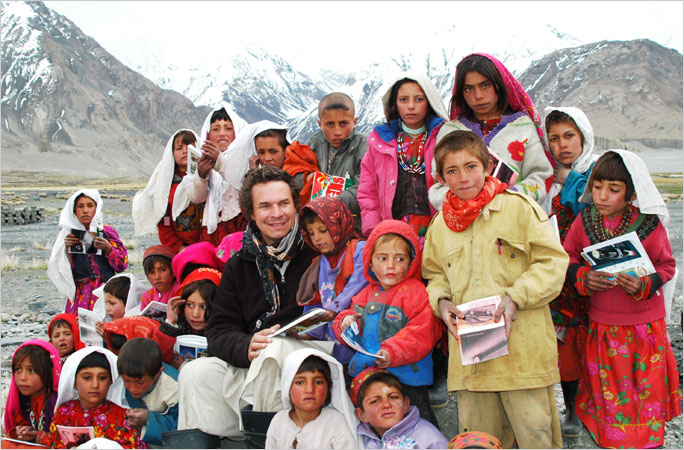
Greg Mortenson with Sitara “Star” schoolchildren. Photo: Fred R. Conrad/The New York Times
Mr. Bush has focused on military force and provided more than $10 billion — an extraordinary sum in the foreign-aid world — to the highly unpopular government of President Pervez Musharraf. This approach has failed: the backlash has radicalized Pakistan’s tribal areas so that they now nurture terrorists in ways that they never did before 9/11.
Mr. Mortenson, a frumpy, genial man from Montana, takes a diametrically opposite approach, and he has spent less than one-ten-thousandth as much as the Bush administration. He builds schools in isolated parts of Pakistan and Afghanistan, working closely with Muslim clerics and even praying with them at times.
The only thing that Mr. Mortenson blows up are boulders that fall onto remote roads and block access to his schools.
Mr. Mortenson has become a legend in the region, his picture sometimes dangling like a talisman from rearview mirrors, and his work has struck a chord in America as well. His superb book about his schools, “Three Cups of Tea,” came out in 2006 and initially wasn’t reviewed by most major newspapers. Yet propelled by word of mouth, the book became a publishing sensation: it has spent the last 74 weeks on the paperback best-seller list, regularly in the No. 1 spot.
Now Mr. Mortenson is fending off several dozen film offers. “My concern is that a movie might endanger the well-being of our students,” he explains.
Mr. Mortenson found his calling in 1993 after he failed in an attempt to climb K2, a Himalayan peak, and stumbled weakly into a poor Muslim village. The peasants nursed him back to health, and he promised to repay them by building the village a school.
Scrounging the money was a nightmare — his 580 fund-raising letters to prominent people generated one check, from Tom Brokaw — and Mr. Mortenson ended up selling his beloved climbing equipment and car. But when the school was built, he kept going. Now his aid group, the Central Asia Institute, has 74 schools in operation. His focus is educating girls.
To get a school, villagers must provide the land and the labor to assure a local “buy-in,” and so far the Taliban have not bothered his schools. One anti-American mob rampaged through Baharak, Afghanistan, attacking aid groups — but stopped at the school that local people had just built with Mr. Mortenson. “This is our school,” the mob leaders decided, and they left it intact.
You can read the entire article in the New York Times by clicking on the blue type.
Three Cups of Tea
My best-friend-from-college and I were chatting the other day and I asked her “what are you reading?” because we have always exchanged book recommendations back and forth.
“I’m reading a biography of Teddy Roosevelt,” she started, and I groaned, because most of the time biographies don’t interest me that much. “And I am reading Three Cups of Tea . . . “ and I interrupted her (rudely) to exclaim “so am I!”
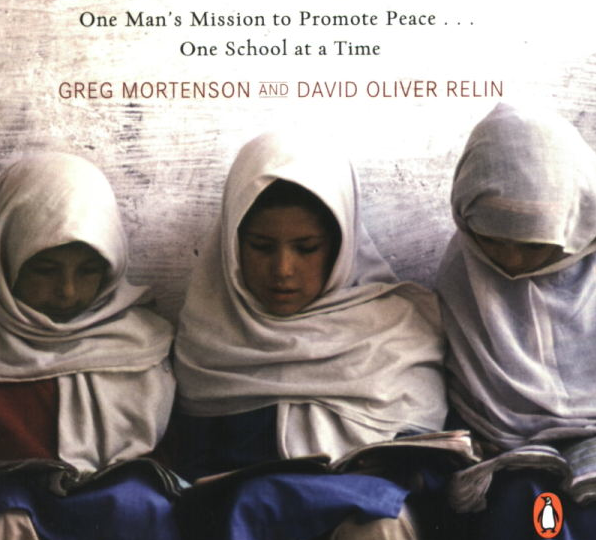
Three Cups of Tea is a must-read in the US. It was actually published in 2006, and has sold more and more books every month, and has been on the New York Times best seller list almost since it was published.
The book begins with a failure. A mountaineer, attempting a climb on K2 runs into problems, including evacuating two severely injured fellow climbers from the mountain. Exhausted, and devastated by his failure to capture the summit, he gets lost on his way back to the base camp, and ends up in a village where the people are very kind to him. He is treated as an honored guest, he regains his strength, and on his last day in the village, learns the children have no school. He rashly promises to come back and build a school for them.
One of the great redeeming features in this book is Greg Mortenson’s endless humility. He has a co-author, to whom he gave a long list of people he could talk with, including all his enemies and people who thought he was crazy. He’s that kind of guy. He talks about his life’s personal failures and his toughest moments, and he moves on.
He doesn’t take credit for the dogged persistence with which he keeps his promise, in spite of daunting obstacles. He doesn’t take any credit for the good will he builds.
Several years ago, I read another book which has changed my life, The Purpose Driven Life (which, by the way, the hardcover is $9.99 and the paperback is $10.19, go figure) in which the basic premise of the book is that we are each created uniquely, individually, by a loving creator, for a purpose. As I read Three Cups of Tea, I thought this man is greatly blessed; he discovered his purpose and nothing kept him from fulfilling it!
The book deserves every single one of it’s Amazon Five Star ratings.
I had a hard time putting the book down. Even though my life is full of other demands, once I had the chance, I spent an entire afternoon finishing this great book.
Greg Mortenson isn’t discouraged that his first school takes three years, and first he has to build a bridge. His second, third and fourth schools take just . . . three months! He has a gift for inspiring others, and people give what they can. The villagers give their time and their efforts, and western supporters donate funds.
By the end of the book, 24 school have been built, in the very poorest mountain villages in Pakistan, where money from the government for education doesn’t trickle at all, until near the end of the book. He doesn’t build the schools himself – he meets with the villagers, they donate a plot. He buys the materials, and together, they all build a school. These villagers are hungry for their children to become educated, to have a chance for a better life. Mortenson learns to focus on the girls.
He learns that as the boys become educated, they leave the villages for the city, but as the girls become educated, they come back, and like yeast, they raise the standard of living for the entire village, providing health care services and information, providing education for the newest crop of children, learning new skills, bringing them back and sharing them.
One of Mortenson’s gifts is that he isn’t interested in changing these mountain people into westerners. He likes them, and he learns from them, just the way they are. He dresses like them, he prays with them, he learns their language, and he has no western agenda for the curriculum in these schools. He also helps the government schools – building an additional room here for an overflowing school, paying a teacher’s salary there – his goal is to educate children. That’s it. No political agenda. The people of the villages love him for it, and give him their full support.
You cannot undertake a project like this without a lot of help. Mortenson had some extraordinary experiences, experiences that to me look like the grace of God, that drew together teams of people to help build and supply his schools.
“I looked at a sign in front of the school and saw that it had been donated by Jean Hoerni, my cousin Jennifer’s husband,” Bergman says. “Jennifer told me Jean had been trying to build a school somewhere in the Himalaya, but to land in that exact spot in a range that stretches thousands of miles felt like more than coincidence. I’m not a religious person,” Bergman says, “but I felt I’d been brought there for a reason and I couldn’t stop crying.”
A few months later, at Hoerni’s memorial service, Bergman introduced herself to Mortenson. “I was there!” she said, wrapping the startled man she’d just met in a bruising hug. “I saw the school!”
“You’re the blonde in the helicopter,” Mortenson said, shaking his head in amazement. “I heard a foreign woman had been in the village, but I didn’t believe it.”
“There’s a message here. This is meant to be,” Julia Bergman said. “I want to help. Is there anything I can do?”
“Well, I want to collect books and create a library for the Korphe School,” Mortenson said.
Bergman felt the same sense of predestination she’d encountered that day at the school. “I’m a librarian,” she said.
After struggling for many years, seeking donors who would help to build a school, Mortenson now has a foundation eagerly supported by many Americans, and especially the mountaineers, who continue to build schools. At the end of the book, the foundation is moving into the poorest sectors in Afghanistan, and building schools there. They have children’s programs in many of the schools in the United States, where children donate pennies to help pay for books for the schools, and for the teacher’s monthly salaries, where salaries are not reaching the teachers. You can donate to the school building fund, teacher’s salaries and books using your credit card, online, at the website Three Cups of Tea. You can order this book there, too, as well as music CD/s and learn more about the work being done.
Recent Comments
intlxpatr on Yellowstone: Old Faithful to C… Michelle on Yellowstone: Old Faithful to C… Cathy on No Grown-Ups in Charge intlxpatr on Waiting for Snow intlxpatr on Waiting for Snow Wikipedia Donate Button

Amazina


Early Voting in Florida


 Here There and Everywhere