WHO report into violence against women: key data
A new report from the World Health Organisation has drawn together data from dozens of studies and found that worldwide, 35% of women have experienced violence – and that the consequences for their and that the consequences for their health can be devastating.

Indian women attend a prayer ceremony for a rape victim. Though rape has become a prominent issue in India, it’s certainly not the only country where violence against women is an issue Photograph: Adnan Abidis/Reuters
Most women know their attackers. 35% of women worldwide have experienced violence and, according to a new report from the World Health Organisation (WHO), that figure only falls to 30% when they studied violence against women that was by intimate partners.
This is the first time that WHO have gathered this worldwide data by pulling together dozens of national and regional studies. Here, we look at which women are most likely to be experience violence and how their health is affected as a result.
Regional differences
Though violence against women is undoubtedly a universal problem, the WHO research suggests that there are regional patterns in its prevalence. It finds that women in Africa are almost twice as likely to experience violence than women in Europe – a particularly striking finding given that ‘women’ are defined in the study as females aged 15 and over.
However, the term ‘Europe’ may be slightly misleading here. Only Europe’s low and middle-income countries are included (from Albania to Ukraine) while countries like the UK and France are grouped together with those from other regions in the ‘High Income’ category.
Types of violence
Violence by an intimate partner and violence by someone other than a woman’s partner are both considered in this report – although the two differ hugely in their prevalence.
The fact that 38% of all murders of women worldwide are committed by intimate partners stands out as one of the most startling figures in the entire report..
Most violence against women worldwide, whether sexual or not, is committed by their intimate partners. In South-East Asia for example, women are almost eight times more likely to experience violence by a current or former partner than someone else. Looking at the ratio between partner and non-partner violence makes these trends more explicit.
Health consequences
The report catalogues the disastrous consequences that violence has on women’s physical, mental and sexual and reproductive health. Many of these are complex and not immediately evident, but their impact is often enormous.
Non-fatal injuries are one of the most direct effects of violence. The report uses the USA as an example where half of women in abusive relationships are physically injured by their partners and that most of them sustain multiple types of injuries – the head, neck and face being the most common, followed by muscular, skeletal and genital injuries.
Several studies identified that women with a history of intimate partner violence are 16% more likely to have a low-birth-weight baby and twice as likely to report having had an induced abortion – nearly half of which globally take place in unsafe conditions. What’s more, when compared with women who have not experienced partner violence, those that have are 1.5 times more likely to acquire HIV.
Every study that looked at the relationship between intimate partner violence and harmful alcohol use found a positive correlation between the two – although substance abuse may also be linked mental health disorders which also increase a woman’s vulnerability to violence.
Depression and suicide was also consistently cited as a severe health consequence of violence against women. Traumatic stress is the mechanism most likely to explain the fact that depression rates are double for women who have experienced violence.
Conflict and violence against women
Several studies have explored how violence against women rises in times of conflict. In March this year Maplecroft, a risk analytics company, analysed the risk of sexual violence in conflict across 15 years using indicators such as the “systematic use of sexual violence as a weapon of war”.
 Click to view full map. Source: Maplecroft 2013
Their findings may shed light on some of the regional trends in violence against women. Of the ten countries where the risk of sexual violence in conflict was highest, seven were in Africa.
The problem has also been recognised by the UN who have a specificcampaign called Stop Rape Now aimed at ending sexual violence in conflict.
Today’s report sheds light on not only how widespread violence against women is – but also the deep effect it has on their health. By highlighting the connection between violence and health, WHO has marked the first step in a public health response.
June 20, 2013
Posted by intlxpatr |
Family Issues, Health Issues, Interconnected, Marriage, Parenting, Women's Issues |
Leave a comment
I don’t know that this has been studied closely, or that there is any evidence supporting the theory, but it is a hilarious theory – blame men for menopause!
By: Tia Ghose, LiveScience Staff Writer
Published: 06/13/2013 05:04 PM EDT on LiveScience
Ladies, here’s one more thing you can blame on men: menopause. At least, that’s according to a new theory.
Women go through menopause because men have consistently preferred younger women in recent evolutionary history, according to a study published today (June 13) in the journal PLOS Computational Biology.Thus, menopause is not evolutionarily advantageous and may be the result of a series of random, harmful mutations that accumulated in women but weren’t acted on by evolution because the women had already reproduced by the time the mutations affected them.
“Our first assumption is that mating in humans is not random with respect to age, which means men of all ages prefer to mate with younger women,” said study co-author Rama Singh, an evolutionary biologist at McMaster University in Canada. “If mating is with younger women, any deleterious mutations which affect women’s reproduction later in life will accumulate because they are not being acted on by natural selection.”
Menopausal mystery
Menopause, in which women stop menstruating and become infertile, has been a long-standing puzzle for biologists: Why would evolution have led to a trait that essentially reduces the reproductive potential of an animal?
Most other animals don’t go through menopause (although killer whales do). Even chimpanzees, humans’ closest living relatives, seem to reproduce into old age in the wild, and males even prefer older females.
Biologists have proposed the grandmother hypothesis to explain the conundrum. The hypothesis holds that menopause allows a grandmother who is done rearing her own kids to help rear the young of her children, thereby increasing the survival odds of her grandkids, and therefore, her genes.
But grandchildren and grandparents share just a quarter of their genes, versus half for children and their parents, so menopause would have to dramatically boost survival of grandchildren to be evolutionarily advantageous. Past studies have shown that maternal grandmothers boost their grandkids’ survival rates, though exactly how much depends on the society.
Younger women
For thousands of years (at least), men have, on average, mated with younger women, Singh said.
That’s because, if all else is equal, “those who reproduce earlier, their genes are passed on faster,” Singh told LiveScience.
So the researchers created a computer simulation to model that preference.
Early on, both men and women in the model reproduced until death. But over time, the model found, men’s preference for youth reduced older women’s odds of reproducing.
Simultaneously, people accumulated random mutations, some of which decreased later-life reproductive ability. But since older women were left out in the cold anyways, those mutations didn’t impact their reproductive success, whereas mutations in men that could reduce late-life reproduction were weeded out. (Men who stopped reproducing at some point in life would produce fewer offspring than those who didn’t, and the late reproducers would outcompete those who stopped breeding earlier.)
Over 50,000 to 100,000 years, the accumulation of all those mutations could have led to universal menopause, the researchers suggest. Menopause would then be another form of aging akin to graying hair or wrinkles.
If later childbearing becomes the norm, as current societal trends suggest, women who can reproduce at older ages might gain an evolutionary advantage, and menopause could, in theory be pushed later, Singh said.But it’s more plausible that technological changes such as fertility treatments will artificially extend women’s ability to reproduce, Singh said.
Questionable assumptions
But the new model might have the causation reversed, wrote Kristen Hawkes, an anthropologist at the University of Utah, who was not involved in the study, in an email to LiveScience.
As human life spans increased, women might have had many healthy years after fertility. As a result, men grew to prefer younger women because older women couldn’t reproduce.
Supporting that hypothesis, female chimpanzees see their egg reserves decline around the same age as human females, Hawkes noted. But unlike humans, they die shortly after this age, whereas humans have decades of healthy life left.
“The preference men have for young partners is a striking contrast with other primates,” Hawkes said. “My guess about that has been it’s a consequence of our life history.”
June 15, 2013
Posted by intlxpatr |
Aging, Circle of Life and Death, Family Issues, Generational, Health Issues, Mating Behavior, Parenting, Relationships, Statistics, Women's Issues | Fertility, menopause |
Leave a comment
Don’t you love demographics? Demographics are a great forecasting tool, if you have the courage to use them. Demographics forced change on the United States military, forcing them to include women in more roles, recently increasing their job opportunities as the demographic pool dwindles. The same demographics are hurting the military budget now, as the huge bulge of baby-boomers retires, takes pensions and guaranteed free medical care, living a LONG time with more serious age-related illnesses, while the military struggles to allocate scarce resources.
Here is a fascinating factoid from The New York Times, a journal which notices small – but significant – changes, and gives us a little idea what the impact may be.
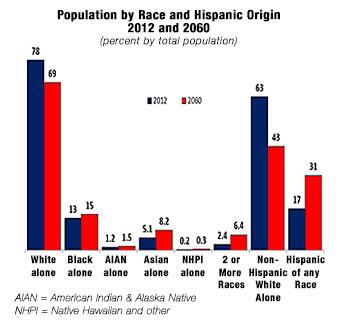
Census Benchmark for White Americans: More Deaths Than Births
By SAM ROBERTS
Published: June 13, 2013 232 Comments
Deaths exceeded births among non-Hispanic white Americans for the first time in at least a century, according to new census data, a benchmark that heralds profound demographic change.
The disparity was tiny — only about 12,000 — and was more than made up by a gain of 188,000 as a result of immigration from abroad. But the decrease for the year ending July 1, 2012, coupled with the fact that a majority of births in the United States are now to Hispanic, black and Asian mothers, is further evidence that white Americans will become a minority nationwide within about three decades.
Over all, the number of non-Hispanic white Americans is expected to begin declining by the end of this decade.
“These new census estimates are an early signal alerting us to the impending decline in the white population that will characterize most of the 21st century,” said William H. Frey, a demographer with the Brookings Institution.
The transition will mean that “today’s racial and ethnic minorities will no longer be dependent on older whites for their economic well-being,” Dr. Frey said. In fact, the situation may be reversed. “It makes more vivid than ever the fact that we will be reliant on younger minorities and immigrants for our future demographic and economic growth,” he said.
The viability of programs like Social Security and Medicare, Dr. Frey said, “will be reliant on the success of waves of young Hispanics, Asians and blacks who will become the bulwark of our labor force.” The issues of minorities, he added, “will hold greater sway than ever before.”
In 2010, according to the National Center for Health Statistics, more non-Hispanic whites died than were born in 11 states, including California, Florida and Pennsylvania. White deaths exceeded births in a majority of counties, including Los Angeles, the most populous.
The disparity between deaths and births in the year that ended last July surprised experts. They expected that the aging white population would eventually shrink, as it has done in many European countries, but not for another decade or so.
Nationally, said Kenneth M. Johnson, the senior demographer at the Carsey Institute, a research center based at the University of New Hampshire, “the onset of natural decrease between 2011 and 2012 was not anticipated.” He attributed the precipitous shift in part to the recession, adding that “the growing number of older non-Hispanic whites, which will accelerate rapidly as the baby boom ages, guarantees that non-Hispanic white natural decrease will be a significant part of the nation’s demographic future.”
Professor Johnson said there were 320,000 more births than deaths among non-Hispanic whites in the year beginning July 2006, just before the recession. From 2010 to 2011, the natural increase among non-Hispanic whites had shrunk to 29,000.
Census Bureau estimates indicate that there were 1.9 million non-Hispanic white births in the year ending July 1, 2012, compared with 2.3 million from July 2006 to 2007 during the economic boom, a 13.3 percent decline. Non-Hispanic white deaths increased only modestly during the same period, by 1.6 percent.
The census population estimates released Thursday also affirmed that Asians were the fastest-growing major ethnic or racial group. Their ranks grew by 2.9 percent, or 530,000, with immigration from overseas accounting for 60 percent of that growth.
The Hispanic population grew by 2.2 percent, or more than 1.1 million, the most of any group, with 76 percent resulting from natural increase.
The non-Hispanic white population expanded by only 175,000, or 0.09 percent, and blacks by 559,000, or 1.3 percent.
The median age rose to 37.5 from 37.3, but the median declined in Alaska, Hawaii, Kansas, North Dakota and Oklahoma. It ranged from 64.8 in Sumter, Fla., to 23 in Madison, Idaho.
The number of centenarians nationally neared 62,000.
June 13, 2013
Posted by intlxpatr |
Aging, Circle of Life and Death, Community, Cultural, Family Issues, Financial Issues, Generational, Living Conditions, Mating Behavior, Parenting, Political Issues, Social Issues, Women's Issues, Work Related Issues |
Leave a comment
Toddler Q, the light of our life, is chatty. He’s been talking for over a year, but on a daily basis, we are amazed and delighted by his ability to articulate and to express himself.

Yesterday, on the way to his swimming lesson, AdventureMan was working with him on “goldfish” which he has been pronouncing “Goldpish.”
“Gold FISH!” they shouted as they drove down the road!
After his swimming lesson, on the way home, AdventureMan could hear him softly saying “goldfish.”
Then he said “BaBa, when I was little, I used to say ‘Goldpish.’ Now, I say ‘Goldfish!”
🙂

April 11, 2013
Posted by intlxpatr |
Communication, Cultural, Exercise, Family Issues, Parenting |
3 Comments
I saw this on one of the parenting posts on AOL and loved it. Hug your babies, yes, hug them and hug them again! Make their brains grow BIG and strong!

March 31, 2013
Posted by intlxpatr |
Character, Civility, Family Issues, Parenting |
Leave a comment
Society changes. Cable television has had a huge influence, travel to other countries changes perceptions, education gives a wider perspective, The genie is out of the bottle; women are equal people. No woman should need someone else’s permission to travel, work, or to use contraception.
Egypt’s Muslim Brotherhood: Women’s Rights Could Destroy Society, Countries Should ‘Reject And Condemn’ UN Declaration
Reuters | Posted: 03/14/2013 5:40 pm EDT


By Michelle Nichols
UNITED NATIONS, March 14 (Reuters) – Egypt’s ruling Muslim Brotherhood warns that a U.N. declaration on women’s rights could destroy society by allowing a woman to travel, work and use contraception without her husband’s approval and letting her control family spending.
The Islamist party of President Mohamed Mursi outlined 10 reasons why Muslim countries should “reject and condemn” the declaration, which the U.N. Commission on the Status of Women is racing to negotiate a consensus deal on by Friday.
The Brotherhood, which was elected to power in June, posted the statement on its website, http://www.ikhwanweb.com, on Thursday.
Egypt has joined Iran, Russia and the Vatican – dubbed an “unholy alliance” by some diplomats – in threatening to derail the women’s rights declaration by objecting to language on sexual, reproductive and gay rights.
The Muslim Brotherhood said the declaration would give “wives full rights to file legal complaints against husbands accusing them of rape or sexual harassment, obliging competent authorities to deal husbands punishments similar to those prescribed for raping or sexually harassing a stranger.”
U.S. Ambassador Susan Rice last week touted at the commission – a global policy-making body created in 1946 for the advancement of women – progress made by the United States in reducing the rate of violence against women by their partners.
“All 50 states in our union now have laws that treat date rape or spousal rape as just as much of a crime as rape by a stranger,” Rice said. “We cannot live in truly free societies, if women and girls are not free to reach their full potential.”
The contrasting views show the gap that needs to be breached in negotiations on the declaration, which this year is focused on urging an end to violence against women and girls. The commission failed to agree a declaration last year on a theme of empowering rural women due to similar disagreements.
WORLD IS WATCHING
Egypt has proposed an amendment, diplomats say, that would allow countries to avoid implementing the declaration if it clashed with national laws, religious or cultural values. But some diplomats say this would undermine the entire declaration.
The Muslim Brotherhood warned the declaration would give girls sexual freedom, legalize abortion, provide teenagers with contraceptives, give equality to women in marriage and require men and women to share duties such as child care and chores.
It said the declaration would allow “equal rights to homosexuals, and provide protection and respect for prostitutes” and “equal rights to adulterous wives and illegitimate sons resulting from adulterous relationships.”
A coalition of Arab human rights groups – from Egypt, Lebanon, the Palestinian Territories, Jordan and Tunisia – called on countries at the Commission on the Status of Women on Thursday to stop using religion, culture, and tradition to justify abuse of women.
“The current positions taken by some Arab governments at this meeting is clearly not representative of civil society views, aspirations or best practices regarding the elimination and prevention of violence against women and girls within our countries,” said the statement issued by the Coalition for Sexual and Bodily Rights in Muslim Societies.
Michelle Bachelet, a former president of Chile and head of U.N. Women, which supports the commission, said the commission was unable to reach a deal a decade ago when it last focused on the theme of women’s rights and ending violence against women.
“Ten years later, we simply cannot allow disagreement or indecision to block progress for the world’s women,” Bachelet told the opening session of the commission last week. “The world is watching … the violence needs to stop.” (Editing by Mohammad Zargham)
March 14, 2013
Posted by intlxpatr |
Cultural, ExPat Life, Family Issues, Financial Issues, Health Issues, Living Conditions, Marriage, Mating Behavior, Parenting, Relationships, Social Issues, Spiritual, Values, Women's Issues, Work Related Issues |
Leave a comment
Horrifying article. I would have thought they would be talking about texting, which we can see for ourselves has people, young and old, swerving all over the highway, but no – the culprit is PASSENGERS! The death rate for teens in cars increases with each additional passenger!
The papers are full of heartbreaking obituaries, young people, men and women, who had so much potential, so much life ahead of them, and now they are gone. Heartbroken parents think of the years of joy they will miss.
Fatal Distraction: Teen Drivers And Passengers Are A Deadly Mix
Studies show that one passenger in a teen driver’s car increases fatality risk by 44%, two passengers doubles the risk
Sharon Silke Carty
AOL Auto News
Teen driving safety is one of those problems that is easy to ignore: So often the tragedies are spread out throughout small towns around the country. One lost life here, two lost there. We don’t often piece all those crashes together and realize what’s happening to our children.
Sometimes to get change, you need a tipping point. Maybe this week will be it: Since Sunday, 15 teenagers have died in major car accidents around the U.S. Six died after crashing into a pond in Ohio. Five died when they crashed into a tanker truck in Texas. Four died when they crashed into a creek in Illinois.
And that’s just the crashes that were major and notable enough to make national news. One teen in Colorado died Sunday when the teen driver of a car he was in crashed into the side of a mobile home. Three died in Indiana when the drivers, in two trucks, ran stop signs and collided head-on. A 15-year-old driver in Maryland died when he was fleeing police in a car. And there are others, many which don’t make the news. Crashes that don’t end in fatalities but left serious damage: traumatic brain injuries, crippling spinal cord issues.
“The numbers are so small and spread out geographically,” said Timothy Hollister, a teen driving safety advocate in Connecticut whose book, “Not So Fast: Parenting Teen Drivers Before They Get Behind The Wheel”, comes out in September. “It’s only when you put the numbers together nationally that people even begin to take notice.”
Driving is the No. 1 killer of teens in this country, accounting for about 25 percent of teen deaths each year. About 3,000 to 5,000 teens die annually in car wrecks, enough to fill the halls of a large high school. Or two.
Recently, the Governor’s Highway Safety Association release preliminary figures for 2012 that show a troubling trend: After 10 years of declining, teen driving deaths are on the rise.
Although teen crashes seem random and unpredictable, they actually often follow a predictable pattern: It’s likely a group of teens heading nowhere in particular, probably late at night, and going fast. Often, they’re not wearing seatbelts.
Researchers have identified the dangerous habits of young drivers, who can’t ever be considered safe behind the wheel because they are simply too novice. There’s a common thread for many fatal crashes: More than one passenger in the car, especially if those passengers are male.
The Passenger Effect
A study released last year by AAA said passengers have a huge impact on fatalities: Fatality rates went up 44 percent with one passenger under 21 years old, doubled with two passengers, and quadruples when carrying three or more passengers who are under 21 years old.
Many graduated drivers license (GDL) laws regulate how many passengers teens can have in the car before they are awarded a full license. Parents who are concerned about their teens behind the wheel want to pay close attention to this rule: Make sure your teens are driving alone mostly, with no more than one passenger. Don’t let them carpool to and from school events. Don’t let them head out for the evening with a bunch of other kids teens in one car. Remember that other passengers are a huge distraction that can turn into a fatal distraction.
Laws regarding passengers in vehicles driven by teens are “the single least enforced and most ignored rule,” Hollister said. “It’s the one piece that could make a difference. That’s parents putting convenience ahead of safety, and not understanding the dangers that every passenger in a teen driver’s car adds an additional risk.”
March 14, 2013
Posted by intlxpatr |
Circle of Life and Death, Family Issues, Health Issues, Living Conditions, Parenting, Safety, Social Issues, Statistics, Survival |
Leave a comment
I heard this yesterday on NPR and found this article today on the Huffpost/AOL News. The critical factor is that a woman needs to be taking folic acid supplements BEFORE she gets pregnant:
With autism now affecting one in 88 children in the U.S., many parents are searching for any step they can take to help lower their child’s risk of developing the disorder. A new Norwegian study joins a small but growing body of research that suggests a simple, low-cost option already exists: Taking folic acid during the earliest stages of pregnancy could lower a child’s odds of developing autism by nearly 40 percent.
“This is a relatively inexpensive way that parents can take action to possibly prevent risk of tube birth defects and autism,” Alycia Halladay, senior director for environmental and clinical Sciences for the advocacy group Autism Speaks, told The Huffington Post. Halladay did not work on the new study, which was published online in the Journal of the American Medical Association on Tuesday.
Researchers analyzed a sample of more than 85,000 children born in Norway between 2002 and 2008 to study the effect of taking a folic acid supplement — typically between 200 and 400 micrograms per day — from one month before a woman got pregnant to two months after. Some .10 percent of children whose moms took folic acid supplements were diagnosed with autism, compared to .21 percent of those whose moms did not — which is equal to 39 percent lower odds.
The study does not establish a cause and effect relationship between the vitamin and subsequent autism, and its authors do not know why folic acid may have a protective effect. Study researcher Pal Suren of the Norwegian Institute of Public Health told HuffPost that folic acid is critical to the synthesis of DNA, which could play some role in the connection. Folic acid may also affect how certain genes are turned on and off in the body, he hypothesized, saying it was “not biologically implausible” that folic acid supplementation has certain epigenetic effects.
The new study also raises questions about how much folic acid may be needed to lower autism risk, as well as what form it must come in.
“We do not know how other dosages would have affected the risk of autism, or whether it matters if folic acid is taken as single tablets or as part of a prenatal multivitamin supplement,” Suren said.
The researchers took steps to ensure that the decreased risk was not just because women who took folic acid were also engaged in other healthy behaviors. To control for that, they looked at fish oil use (assuming women who took fish oil were also likely to be healthy in other ways) and found no link between lower autism risk.
Since the early 1990s, groups like the Centers for Disease Control and Prevention and the U.S. Public Health Service have recommended that all women of childbearing age take 400 micrograms of folic acid daily to help prevent neural tube defects — birth defects of the brain and spinal cord including spina bifida and anencephaly. Since folic acid was added to the grain supply in 1998, the U.S. has seen a 26 percent decrease in those neural tube disorders, according to figures compiled by the March of Dimes.
The possibility of a link between folic acid consumption and lower autism risk is far more preliminary. A 2011, California-based study in the journal Epidemiology found that mothers of children with autism were less likely to have taken a prenatal vitamin in the three months before pregnancy or in the first month after getting pregnant, suggesting that so-called “periconceptional” use of prenatal vitamins may reduce autism risk. In the U.S., prenatal vitamins typically include between 400 and 800 micrograms of folic acid.
But folic acid is by no means a magic pill, experts caution. The fact that rates of autism diagnosis have skyrocketed in the past several decades despite more and more women taking folic acid shows how complex the origins of autism are. The exact causes of the disorder, which is characterized by social and communication difficulties and repetitive behaviors, are still unknown.
“This is one way that risk may be reduced, but this isn’t the only way,” said Halladay. “It’s an inexpensive way to potentially reduce the risk of autism, but there are a number of risk factors — genetics and other environmental factors — that solidly contribute to risk.”
February 13, 2013
Posted by intlxpatr |
Experiment, Family Issues, Health Issues, Parenting, Statistics, Women's Issues |
Leave a comment

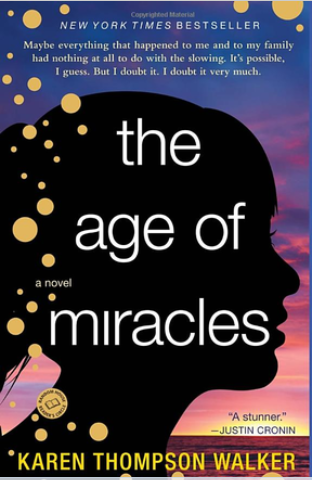
The Age of Miracles is a very odd name for this book, which starts off in a beautiful little coastal town in California, a very normal, modern town, and then everything changes. Suddenly, the earth’s rotation is slowing, incrementally, but resulting in longer and longer days and longer and longer nights. The difference is small at first, but grows.
Julia is in sixth grade, a painful time anyway in most lives where your body suddenly changes and all your relationships with all your friends change, and boys become a major factor. Imagine. All this AND the earth’s rotation is slowing.
No one knows what to expect. No one knows why or how the rotational slowing is happening, and no one has a clue how to fix it. Do you stay on a 24 hour clock, as the days grow to 30 hours? Forty hours? Can you even function in a forty hour day, or sleep a 40 hour night? How do you stay on a 24 hour clock and force yourself to sleep when the sun is shining brightly overhead? How do you have a school day entirely in the middle of the darkest part of the night? How does food continue to grow? What impact does this have on birds? Migrations? How does kicking a soccer ball feel when earth’s gravitational field starts to lessen?
The author does a brilliant job in a what-if situation, and manages to make it quite real. Don’t read this book if you are the suggestible type – it’s just one more thing you’ll start worrying about when you don’t need to. If you can read speculative fiction without letting it influence you, then by all means read this book, it is a good read.
January 30, 2013
Posted by intlxpatr |
Books, Community, Environment, Family Issues, Fiction, Friends & Friendship, Living Conditions, Parenting, Relationships, Technical Issue, Weather |
Leave a comment
Death of Bees was another powerful recommendation by National Public Radio.

I believe in a greater power, in a God who sends things my way and that I am meant to be paying attention. Several books have been recommended to me lately which I didn’t choose, or might have avoided had I known how painfully they dealt with poor parenting and children in the depths of horrific poverty.
Here is what the lead into the book says:
Today Is Christmas Eve,
Today is my birthday,
Today I am fifteen,
Today I buried my parents
in the back yard.
Neither of them were beloved.
Oh my goodness! I am sucked in immediately. And immediately I am overcome by the grinding nature of poverty, the enormous amount of energy it takes just to be fed, to have a roof over your head, to function in the bureaucracy that seeks to ameliorate the burdens of poverty.
I am horrified by the lives of innocent children in the hands of people who should never have responsibility for anyone, even themselves, their decision making skills are so non-existent. There are parents who have no idea what self-sacrifice GOOD parenting requires, who raise children who are often trying to survive their own parents.
The Death of Bees has redemption. It has two sisters who love one another and are smarter than the average child. It has a neighbor who notices, not in a snoopy or intrusive way, but in a kind, helping and ultimately sacrificial way. It has moments of black humor, when the neighbor’s dog keeps digging at the parental graves in the backyard and bringing bones inside just at the worst moments.
Ultimately, it is a tale of survival, in spite of the parents, in spite of the system, in spite of betrayals by family and friends. There is a glimmer of hope that life may be different for these sisters, if they can survive their upbringing and overcome their childhood.
Now, go read the book 🙂
January 30, 2013
Posted by intlxpatr |
Books, Bureaucracy, Character, Community, Family Issues, Fiction, Financial Issues, Food, Friends & Friendship, Humor, Lies, Living Conditions, Parenting, Relationships, Social Issues, Values | Glasgow, Scotland |
4 Comments





 Here There and Everywhere