Late Afternoon in DeLuna Park
One of the great joys of living in Pensacola is seeing our grandson often. Yesterday, we were picking him up and keeping him until dinner, so we decided to take him to run in the fountains, only to discover that the fountains stop at 5 on Mondays – Wednesdays, and run until 8 on Thursdays, Fridays and Saturdays. No problem – there is always something going on to thrill a two years old’s heart.
Yesterday, it was a tug-boat bringing in a huge dredger, with CRANES! Our two year old is all-boy. He loves car words, and truck words, and words like bulldozer, and pick-up, and CRANES. Watching the tugboat bring in the dredger thrilled his heart.

The crane lowers a cage onto the deck:

The pelicans are enthralled; the churning engines stir up fish and make finding supper easy pickings:


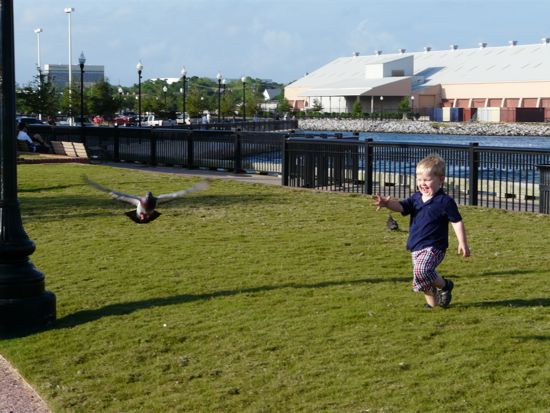
And then, chasing the pigeons! Where do they get the energy? A two-year-old can chase pigeons endlessly!


Bullying and Community
I found this on AOL/Huffpost Parenting: it contains a line – I italicized it – that I need to think about. In America, we tend to think of the individual over the community. For the most part, we don’t encourage our children to continue with an activity they don’t like ‘for the good of the group,’ we tend to take them out of the activity. I’ve lived in cultures where obligations to the group are much stronger, and I’ve always felt confined and constricted by the burden of those expectations, but it does make for a more peaceful situation when we consider the needs of others and the needs of the group.
Preventing Bullying Begins With Us
Richard Weissbourd and Stephanie M. Jones
On Feb. 29, Lady Gaga will launch a foundation dedicated to creating caring communities and stopping bullying. Hosted by the Harvard Graduate School of Education and Harvard’s Berkman Center, Lady Gaga will be joined by Oprah and other celebrities. A powerful new film, “Bully,” will be widely released at the end of March, and many Americans in recent years have been galvanized by a blizzard of tragic bullying stories.
Yet too often in the past a problem plaguing children like bullying has received huge waves of public attention that simply never translates into any positive changes in kids’ lives. What will it take to capitalize on this attention? How can we curb this problem once and for all?
We can start by recognizing where the main solution lies. There is a tendency to simply blame bullying on “bad” kids or peer groups or destructive media. But bullying often has deep roots in parents’ attitudes and behavior, and stopping bullying begins with us.
How can parents prevent bullying? Parents in recent years have been flooded with articles and books that guide them in shielding, or “bully-proofing,” their own child. But just protecting our own kids won’t stop bullying, and this guidance reinforces the damaging tendency of many parents to just focus on their own children. The best way to prevent bullying — and many other forms of cruelty and harassment — is to encourage and enable children to care for and take responsibility for each other. Research indicates that bullying is greatly reduced in particular when children who witness bullying stand up for the victim. Bullying brings home to parents our fundamental moral responsibilities. How can we help our children widen their circle of concern and stand up for other children? How can we help our children build more just and caring communities?
Bullying, unlike more typically developmental teasing and hurtful remarks, is commonly defined as prolonged or frequent cruelty to others, often characterized by imbalances of power. This kind of cruelty can produce intense and often lasting feelings of shame in children, a sense that they are defective in some core way. About 30 percent of children are bullied each year on school property alone. Adults’ understandable reflex is to curb this kind of bullying by punishing perpetrators. Yet this strategy alone usually fails to stop bullying, and sometimes it backfires.
On the other hand, bystanders — especially a friend of the bully — tend to be far more effective. A bystander is present in 85 percent of bullying situations, and bystanders who intervene appear to prevail over half the time. Yet in the vast majority of cases bystanders elect not to intervene.
What can we do as parents to help our children stand up for others? Research suggests that parents bolster their children’s ability to act independently and to withstand disapproval when they respect their children’s capacity as independent thinkers from early ages and give them input into family decisions. All the things parents do to build in their children a sturdy sense of self make it easier for children to hold their ground against a powerful peer. As parents we strengthen the self, for example, when we praise appropriately, know and appreciate who our children are and maintain their trust and respect. Nurturing empathy in children from early ages certainly matters as well. That means in part helping children appreciate people who may not be on their radar, whether a bus driver, a custodian or a new child in class. It means helping children consider the perspectives of those they’re in conflict with as well as people who are different from them in customs or background or other characteristics.
While it’s vital that we convey high moral expectations and underscore the importance of sticking up for others, we also must listen carefully to our children and understand the complexity of their social worlds and ethical decisions. We as parents will be more real and valuable to children if we pay careful attention to their perceptions and experiences of bullying and discuss when and how to stand up for someone else. We need to talk to them about the complexities of balancing our needs with others and what consequences are worth and not worth bearing. We need to help them figure out how to challenge someone else constructively.
But perhaps most important, stemming bullying will require us to seriously examine our parenting priorities. As a good deal of research now indicates, we live in an era when many parents are intensely focused on their children’s self-esteem, happiness and achievements, not on how well they care for others. And in all sorts of subtle ways we can prioritize happiness over taking responsibility for others. Too many of us, for example, don’t push our children to fulfill obligations that might distress them. We let our children write off friends they find annoying, or fail to reach out to a friendless child on the playground, or quit a team or chorus without asking them to consider what it means for the group. How many of us simply tell our children that their classrooms, schools and neighborhoods are communities to which they have obligations?
Just as worrisome, many of us as parents are failing to model for our children a sense of responsibility for others. Over and over we have heard from teachers that many parents are occupied with their own child and care little about other children in the classroom. “It’s a dog fight,” one recently retired teacher says, driven out of the profession in part by his fatiguing battles with parents. “Parents are out of control. They’re always seeking an advantage for their own kid… they lobby for a gifted class or they want their kid to get extra attention… and they don’t care how they might be hurting other kids.” Some parents say they want kids with behavior problems immediately removed from the classroom because they believe their own child’s learning is compromised. But that message certainly doesn’t convey responsibility for others and the community. At least for some period of time, we as parents ought to encourage teachers to work with that child and ask our own child how she/he might support the struggling child.
It is, of course, a great deal easier and tidier for us as parents to simply wrap our attention around our own child or to periodically remind our child to respect others. But such bland reminders will never get us where we need to go. Our children’s moral development is deeply interwoven with our own. If we want our children to be fair, courageous and humane, we have to take a close, hard look at whether those values are priorities in our parenting, and whether we are living those values day to day.
Teach Your Teen to Negotiate
I found this article on the National Public Radio Health Page; with the title Why a Teen Who Talks Back may have a Bright Future. It has to do with teaching your teen to talk problems through confidently; researchers found teens who could express themselves confidently had a greater likelihood of turning down offers of illegal drugs or behaviors.

It is interesting to me, too, that the Dutch who had the courage to shelter the Jews during the Holocaust were those who had learned to think independently as teenagers.
If you’re the parent of a teenager, you likely find yourself routinely embroiled in disputes with your child. Those disputes are the symbol of teen developmental separation from parents.
It’s a vital part of growing up, but it can be extraordinarily wearing on parents. Now researchers suggest that those spats can be tamed and, in the process, provide a lifelong benefit to children.
Researchers from the University of Virginia recently published their findings in the journal Child Development. Psychologist Joseph P. Allen headed the study.
Allen says almost all parents and teenagers argue. But it’s the quality of the arguments that makes all the difference.
“We tell parents to think of those arguments not as nuisance but as a critical training ground,” he says. Such arguments, he says, are actually mini life lessons in how to disagree — a necessary skill later on in life with partners, friends and colleagues on the job.
Teens should be rewarded when arguing calmly and persuasively and not when they indulge in yelling, whining, threats or insults, he says.
In Allen’s study, 157 13-year-olds were videotaped describing their biggest disagreement with their parents. The most common arguments were over grades, chores, money and friends. The tape was then played for both parent and teen.
“Parents reacted in a whole variety of ways. Some of them laughed uncomfortably; some rolled their eyes; and a number of them dove right in and said, ‘OK, let’s talk about this,'” he says.
It was the parents who said wanted to talk who were on the right track, says Allen. “We found that what a teen learned in handling these kinds of disagreements with their parents was exactly what they took into their peer world,” with all its pressures to conform to risky behavior like drugs and alcohol.
Allen interviewed the teens again at ages 15 and 16. “The teens who learned to be calm and confident and persuasive with their parents acted the same way when they were with their peers,” he says. They were able to confidently disagree, saying ‘no’ when offered alcohol or drugs. In fact, they were 40 percent more likely to say ‘no’ than kids who didn’t argue with their parents.
For other kids, it was an entirely different story. “They would back down right away,” says Allen, saying they felt it pointless to argue with their parents. This kind of passivity was taken directly into peer groups, where these teens were more likely to acquiesce when offered drugs or alcohol. “These were the teens we worried about,” he says.
Bottom line: Effective arguing acted as something of an inoculation against negative peer pressure. Kids who felt confident to express themselves to their parents also felt confident being honest with their friends.
So, ironically the best thing parents can do is help their teenager argue more effectively. For this, Allen offers one word: listen.
In the study, when parents listened to their kids, their kids listened back. They didn’t necessarily always agree, he says. But if one or the other made a good point, they would acknowledge that point. “They weren’t just trying to fight each other at every step and wear each other down. They were really trying to persuade the other person.”
Acceptable argument might go something like this: ‘How about if my curfew’s a half hour later but I agree that I’ll text you or I’ll agree that I’ll stay in certain places and you’ll know where I’ll be; or how about I prove to you I can handle it for three weeks before we make a final decision about it.”
Again, parents won’t necessarily agree. But “they’ll get across the message that they take their kids point of view seriously and honestly consider what they have to say,” Allen says.
Child psychologist Richard Weissbourd says the findings bolster earlier research that finds that “parents who really respect their kids’ thinking and their kids’ input are much more likely to have kids who end up being independent thinkers and who are able to resist peer groups.”
Weissbourd points to one dramatic study that analyzed parental relationships of Dutch citizens who ended up protecting Jews during World War II. They were parents who encouraged independent thinking, even if it differed from their own.
So the next time your teenager huffs and puffs and starts to argue, you might just step back for a minute, take a breath yourself, and try to listen. It may be one of the best lessons you teach your child.
Deb Roy: The Birth of a Word
Come back when you have some time – you’ll need about twenty minutes to watch this TED video about communication. I love this – but then you know I am a word nerd, and I love the way concepts are born and grow.
Computers have aided language analysis and taken it to lengths that were previously inconceivable. First, Deb Roy shows – with videos, graphs and cloud analysis – how his son learned to speak his first word.
He goes from there to what I would call “buzz analysis”, taking program content from cable television and correlating it to comments on public media – blogs, FaceBook, all kinds of public forums. The results are astonishing, and a great tool to understand the national psyche and how we think and process. This is amazing stuff.
Jesus Loves the Little Children
There are many times Jesus speaks obliquely, using an analogy to convey the message, and his disciples have trouble understanding. This time, Jesus speaks very clearly, telling his disciples that the most humble child will enter heaven, and that anyone who causes that child to lose innocence and belief is in big trouble.
I think of my little grandson. Since he was born, I have been singing to him a song I learned in my childhood, “Jesus Loves the Little Children, all the little children of the world, red and yellow, black and white, we are precious in his sight, Jesus loves the little children of the world.”
Matthew 18:1-9
18 At that time the disciples came to Jesus and asked, ‘Who is the greatest in the kingdom of heaven?’ 2 He called a child, whom he put among them, 3 and said, ‘Truly I tell you, unless you change and become like children, you will never enter the kingdom of heaven. 4 Whoever becomes humble like this child is the greatest in the kingdom of heaven. 5 Whoever welcomes one such child in my name welcomes me.
6 ‘If any of you put a stumbling-block before one of these little ones who believe in me, it would be better for you if a great millstone were fastened around your neck and you were drowned in the depth of the sea. 7 Woe to the world because of stumbling-blocks! Occasions for stumbling are bound to come, but woe to the one by whom the stumbling-block comes!
8 ‘If your hand or your foot causes you to stumble, cut it off and throw it away; it is better for you to enter life maimed or lame than to have two hands or two feet and to be thrown into the eternal fire. 9 And if your eye causes you to stumble, tear it out and throw it away; it is better for you to enter life with one eye than to have two eyes and to be thrown into the hell of fire.
We Need to Talk About Kevin: The Movie
“So what is your group reading?” I asked my friend as we talked my last evening in town, after a visit from Qatar, several years ago.
“I’m about to start something called ‘We Need to Talk About Kevin’ for Book Club,” she responded, “it’s like an Orange Award Winner.”
“What’s an Orange Award?” I asked
“I dunno,” she laughed, “but it’s on the list.” I was able to pick it up on my way to the airport.
A week later, I called her. “Are you reading ‘We Need to Talk About Kevin?'” I asked, and there must have been a note in my voice she recognized. “Why did you recommend this AWFUL book to me? It’s awful!”
“Can you put it down?” my friend asked.
“No! No, I can’t! But I can tell this isn’t going to end well.”
“Where are you?” she asked, and I told her.
“I’m right at the same place,” she said. “I hate it.”
We continued talking regularly as we read the book, a book which is truly, truly one of the scariest, most awful books I have ever read. Sometimes an author can make it so real, it’s almost too real, like the nightmare you can’t wake up from.
I passed the book along to some reading friends, and each one had the same reaction.
“WHY am I reading this? It’s awful!”
It IS awful, and, I suspect, so awful because if you have a child you think might have psychopathic tendencies, your life might be a nightmare. And you live with a sense that this isn’t going to end well, and it must be like waiting for the guillotine to fall and chop off your head.
What I didn’t know was that they’ve made it a movie. I haven’t seen any mention of it in the United States, but I’m told it’s opened in England.
The trailer captures some of the terror of the book. I’d suggest you read – or listen to – the book, by Lionel Shriver, before you see the movie. I honestly don’t know if I can go see it, it’s that scary for me. I reviewed We Need to Talk About Kevin, the book, here.
Recent Comments
ExpatAlien on What Country am I Living … intlxpatr on Yellowstone: Old Faithful to C… Michelle on Yellowstone: Old Faithful to C… Cathy on No Grown-Ups in Charge intlxpatr on Waiting for Snow Wikipedia Donate Button

Amazina


Early Voting in Florida


 Here There and Everywhere