Qatar National Day (Week) Schedules!
Found this in today’s Peninsula. Could not find a copy online, nor on the official website, so pardon the poor quality of the photograph of the schedule directly from today’s Peninsula:
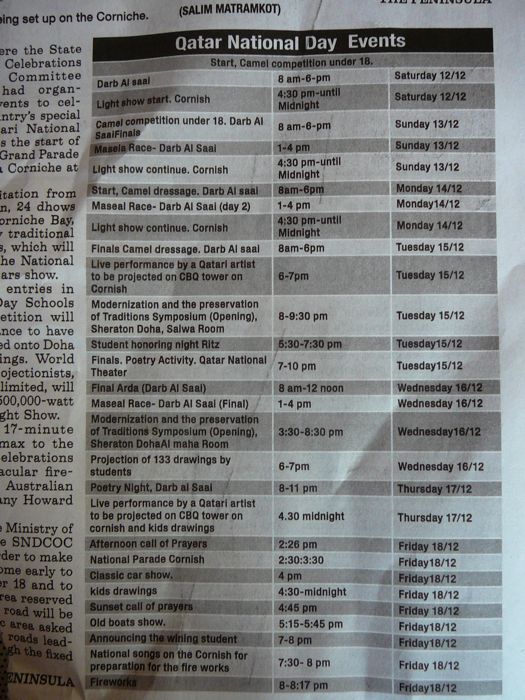
Qatar National Day Events to be Broadcast Live
According to today’s Gulf Times Qatar National Day Events will be carried live on television, Al Doha TV
National Day events to be telecast live
Al Doha TV, the official National Day television station, will be offering live broadcasts of National Day activities plus cultural, entertainment and documentary series through December 18.
Free-to-air Al Doha TV is an initiative of, and funded by, the State National Day Celebrations Organising Committee (SNDCOC), made its debut on December 18 last year, on the occasion of National Day.
Al Doha TV channel can be seen on Bader4 (Arabsat), Frequency: 12111mhz
Qatar celebrates its National Day on December 18 in commemoration of the historic day in 1878 when the country’s founder Sheikh Jasim, succeeded his father, Sheikh Mohamed Bin Thani, as a ruler and led the country toward unity.
The event is considered as an opportunity for all Qatari nationals and expatriates to recognise and celebrate what it means to live in modern day Qatar.
The 2009 schedule features programmes produced by Al Doha TV in its state-of-the-art production facilities or outsourced to renowned Qatari and international production companies.
Al Doha TV is to telecast documentaries which capture aspects of traditional and modern Qatari life.
‘Mosque Tales’ tells the history of Qatari mosques and reveals fascinating stories behind them. ‘Sport’ shows how the country is investing massively to create a culture of sporting participation amongst its citizens.
‘Destination Doha’ discovers how Qatar Tourism Authority attracts record numbers of business and vacation tourists by investing in hotels, museums, parks, new town and cultural attractions.
‘Health’ visits hospitals, health centres, and research centres to interview doctors and hospital managers and get the lowdown on the most up-to-date equipment and health techniques.
‘In Vision for Education’ depicts men and women who have the responsibility of graduating Qatar’s first generation of doctors, designers, and diplomats, and how the independent schools are helping raise standards and grades.
Qatar’s long-term economic prosperity is the focus of ‘Qatar Is Booming,’ a 60-minute documentary examining recent developments and future plans in Qatar’s energy, industry, commerce and agriculture sectors.
The complete list of National Day 2009 events and activities is available on the official website, http://www.ndqatar.com
Qatar National Day 2009 sponsors are the following:
Qtel (official sponsor)
QNB (official bank)
Barwa, Commercialbank, Qatari Diar (platinum sponsors)
Qatar Petroleum, Teyseer Group, United Development Company(gold sponsors)
Doha Bank, Ezdan, Qatar Airways, The Diplomatic Club (silver sponsors).
Pomegranate Soup by Marsha Mehran
I saw a mention of this book in an Amazon.com referral as a book I might like, and was almost set to order it when something said “go check the stack of books Little Diamond left for you” and sure enough, I already had the book.
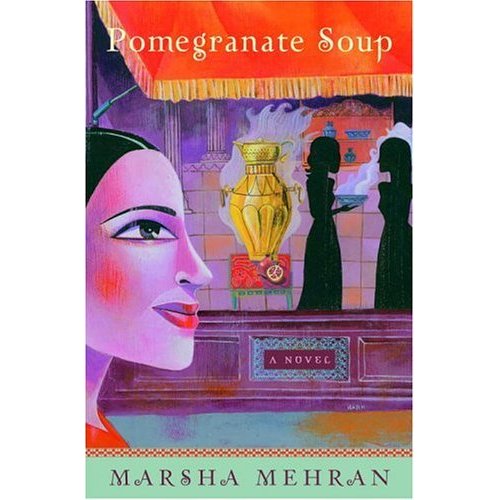
I use books as an incentive to get me through life’s inevitable tasks I don’t like – like “if I finish this project on time, I get to read this book as a reward.” It works for me.
When I first started reading Marsha Mehran’s book about three Persian sisters starting up a cafe in a small Irish town after fleeing Iran, I found it sour. The author has a critical point of view, and generally speaking, I don’t like hanging around with people who criticize others and judge them harshly. At the beginning of the book, Mehran introduces a lot of people, many of whom we are not meant to like.
Even the sisters are not all that sympathetic – at the beginning. But also, near the beginning, she discusses Persian cooking, the idea of balance in a meal, hot and cold, spicy and bland, so you kind of get the idea that if there is sour, then there will also be sweet. In addition, at the end of each chapter there is a wonderful recipe, a wonderful, fairly easy-to-follow recipe, and she included one, Fesanjan, that is my all-time favorite Iranian dish and now, I know how to make it, Wooo HOOOO!
Three sisters, orphaned by fate, held together by love and duty, start a cafe, which, against all odds, becomes a raging success. Raging success does not heal all the old wounds, however, nor the hearts that bear them, and we learn through the book what the sisters have borne and overcome.
It turns out to be a sweet book, one well worth reading. And oh! the recipes! In each chapter, there are also hints that make them even better, so you can’t just copy out the recipes and use them, you really have to read the book. 🙂
It’s a pity that two of the most wonderful countries in the world – Syria and Iran – are off limits. We’ve been back to Syria, and it was everything we remembered (see the Walking Old Damascus blog entries) but oh, how we would love to explore Iran. Sigh. The world turns, and we can only hope to be able to get there in our lifetime. Stranger things have happened.
What did Ezekiel See?
How would our flea-bitten, superstitious ancestors in Europe of the 1100’s describe a car, if it were to appear in their midst? How would they describe a gas stovetop? How would they describe a toilet? How would they describe a mobile phone, or a camera? Would they immediately understand its use, and how it works?
Many times we don’t understand what we see, not at first, sometimes not at all. When I read of Ezekiel’s vision, I wonder what he saw? I wonder if this is his interpretation of something else, something actually very different, but he used the words he had? It’s a mystery to me.
Ezekiel 1:1-14,24-28
1In the thirtieth year, in the fourth month, on the fifth day of the month, as I was among the exiles by the river Chebar, the heavens were opened, and I saw visions of God. 2On the fifth day of the month (it was the fifth year of the exile of King Jehoiachin), 3the word of the Lord came to the priest Ezekiel son of Buzi, in the land of the Chaldeans by the river Chebar; and the hand of the Lord was on him there.
4 As I looked, a stormy wind came out of the north: a great cloud with brightness around it and fire flashing forth continually, and in the middle of the fire, something like gleaming amber. 5In the middle of it was something like four living creatures. This was their appearance: they were of human form. 6Each had four faces, and each of them had four wings. 7Their legs were straight, and the soles of their feet were like the sole of a calf’s foot; and they sparkled like burnished bronze. 8Under their wings on their four sides they had human hands. And the four had their faces and their wings thus: 9their wings touched one another; each of them moved straight ahead, without turning as they moved. 10As for the appearance of their faces: the four had the face of a human being, the face of a lion on the right side, the face of an ox on the left side, and the face of an eagle; 11such were their faces. Their wings were spread out above; each creature had two wings, each of which touched the wing of another, while two covered their bodies. 12Each moved straight ahead; wherever the spirit would go, they went, without turning as they went. 13In the middle of* the living creatures there was something that looked like burning coals of fire, like torches moving to and fro among the living creatures; the fire was bright, and lightning issued from the fire. 14The living creatures darted to and fro, like a flash of lightning. 24When they moved, I heard the sound of their wings like the sound of mighty waters, like the thunder of the Almighty,* a sound of tumult like the sound of an army; when they stopped, they let down their wings. 25And there came a voice from above the dome over their heads; when they stopped, they let down their wings.
26 And above the dome over their heads there was something like a throne, in appearance like sapphire;* and seated above the likeness of a throne was something that seemed like a human form. 27Upwards from what appeared like the loins I saw something like gleaming amber, something that looked like fire enclosed all round; and downwards from what looked like the loins I saw something that looked like fire, and there was a splendour all round. 28Like the bow in a cloud on a rainy day, such was the appearance of the splendour all round. This was the appearance of the likeness of the glory of the Lord.
When I saw it, I fell on my face, and I heard the voice of someone speaking.
The Thirteenth Tale – Setterfield
After reading some heavier stuff, I needed a break, and waiting on my “read me!” bookshelf has been this book, The Thirteenth Tale, another one of those I pick up at the last minute and stuff into the last remaining centimeter of space in my overstuffed suitcases. Nobody recommended it, it just looked like it might be good.
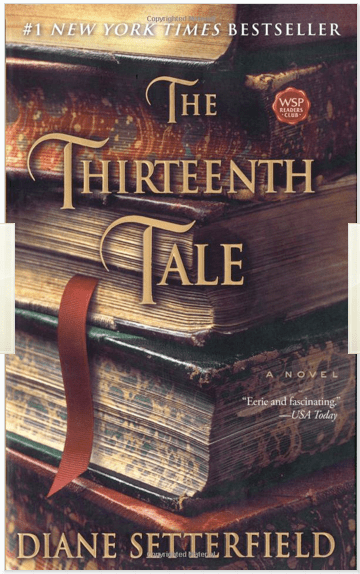
It was good, although now I can’t think of anything so gripping about it. Setterfield took the classic gothic novel – she mentions Jane Eyre frequently – and updates it, makes it modern and personal. It was a good, fun read, had me hurrying through my daily “must-do’s” so I could read more – I like a book like this now and then.
And – the main character, Margaret Lea, loves books. 🙂 She works in her family old-books business, leads a quiet, kind of sad life, haunted by the loss of her own twin early in life. When contacted by famous novelist Vida Winter to write her biography, she is intrigued, and accepts the job offer, which involves going to stay in Vida Winter’s house.
Part of what is fun reading this book is that we are dealing with an “unreliable narrator” with Vida Winter. Sometimes she is lying, sometimes she is lying by omission, and part of the mystery is that Margaret must try to verify what she has been told and try to figure out what has been left out. She has a great adventure in the process.
This is great escape reading. Good for a long plane trip, good for sitting by a sick relative in the hospital, good for using as a carrot (“if I get this done, and this, and this – then I get to go read ‘The Thirteenth Tale!’ “) You can buy it on Amazon.com for around $10 paperback.
Quote from The Thirteenth Tale by Diane Setterfield
“People disappear when they die. Their voice, their laughter, the warmth of their breath. Their flesh. Eventually their bones. All living memory of them ceases. This is both dreadful and natural. yet for some there is an exception to this annihilation. For in the books they write they continue to exist. We can rediscover them. Their humor, their tone of voice, their moods. Through the written word they can anger you or make you happy. They can comfort you. They can perplex you. They can alter you. All this, even though they are dead. Like flies in amber, like corpses frozen in ice, that which according to the laws of nature should pass away is, by the miracle of ink on paper, preserved. It is a kind of magic. “
Maybe that’s why we blog, hoping for a little immortality? Or maybe that’s why we delete entire blogs, entire entries, uncomfortable with the thought that this passing mood or passion will live to be an embarrassment?
Neil Gaiman’s Smoke and Mirrors

Smoke and Mirrors is a collection of – as the author puts it – short fiction and illusions.
My son got me started with Neil Gaiman when he gave me a book called Good Omens. He is probably not an author everyone would like – he can be cynical, but my experience with cynics is that their cynicism is an attempt to disguise a deeply idealistic nature, so his cynicism doesn’t bother me. I love his attention to world mythologies, those beliefs deep down that are passed from parent to child, beliefs so deep we don’t even know they are there.
Smoke and MIrrors was an easy, if uneven, read. I get the impression Gaiman gathered up a bunch of short writings he had done – like sometimes you jot down an idea for something and keep it to be developed later, into a book, a sub-plot, etc. and that these ones never quite graduated.
There are two stories I will never forget. The last story, Snow, Glass, Apples, is a re-telling of the Snow White legend, told from the point of view of the wicked step-mother, set far back in dark times. I will never see Snow White in the same light again. I love the flicker of perception that changes everything. Snow White as a vampiric, wild, uncontrolled child? When Gaiman writes, all the pieces fit together.
The other story hits me on a deeper level. In a house where stray cats come and are cared for, a cat arrives, scarred and damaged, seeking only love. Every night he goes out onto the porch, and late late on some nights, sounds of wild and horrendous battles are heard, from which the cat emerges more damaged, battered and scarred than before. Horrified, the people try to keep the cat inside, but after he has healed enough, he insists on going out again to do battle. One night, the man watches as an apparition appears; on a deep instinctive level, he knows it is a demon / devil. The cat protects the house and its occupants. The story is called The Price, and after I read it, I couldn’t read the book again for a couple days.
When I read Neil Gaiman, it frees me up to think outside the lines, outside the normal boundaries of what we consider normal. This man was gifted with an amazing imagination.
I think of Jesus, and his disciples, the 12 he gathered to help him in his earthly ministry. I think of how often they listened to Jesus – and got it wrong. He would be explaining something, and they just didn’t get it. I wonder how often it still happens, that we think we understand what he is telling us, but our minds are small and fuzzy, and we can’t begin to comprehend the magnitude of what he is telling us.
So I think about angels, and how they are all around us. . . and what if all these little cats and dogs are part of the angels God has sent to protect us? I think how they love us unconditionally, simply, and how good they are for our health (having a pet can lower blood-pressure, for example) and how truly truly AWFUL it is that we might be abusing, starving, neglecting the very angels God has sent to ease our lives and protect us? It fills me with horror!
Neil Gaiman sets me free to think such thoughts. You can read his stories as just stories, but if you have an ounce of depth, you will find your mind wandering to strange places after reading Gaiman. You can find Smoke and Mirrors on Amazon.com for around $10 in paperback, less if you buy it used.
Again, thank you, son, for introducing me to such a mind-stretching author.
William Dalrymple: The Age of Kali
Having read and loved In Xanadu: A Quest by William Dalrymple, and having received recommendations by friends who say they read ALL of William Dalrymple, I started on this second book, The Age of Kali. I didn’t like it, not one bit. I am proud to say I read it all the way to the end, because often if I don’t like a book, I will say to myself “I don’t need this!” and toss it, but I didn’t, I stuck with it. I am proud because it isn’t easy to stick with a book you don’t like, and I didn’t like this book.

In Xanadu, Dalrymple was wryly funny, hilariously funny, and most of the humor was directed at himself. In The Age of Kali, there is nothing funny.
The Age of Kali is a series of interviews and adventures in India and Pakistan. The author did these interviews and took notes (some are published in slightly different forms as magazine articles) over a period of ten years and then strung them all together to form this book. There is little or no linkage from one to the other. They are grouped geographically.
Here is what I like and admire – this man achieves the most amazing interviews, many times just by asking the right person at the right time. He insinuates himself, asks easy questions, and then sticks in a hard question. He doesn’t seem to flinch from putting himself in danger, and he doesn’t stand on respect when asking his questions. I admire that he went difficult places, interviewed difficult people, and wrote the interviews up without fawning over the celebrity status of his interviewee.
What I don’t like is that he doesn’t seem to like anybody very much. There are no funny anecdotes. By the end of the first interview, I began to get an impression that he doesn’t like India very much (and I believe that is NOT true, as he lives part-time in Delhi) and that India is not a place I want to visit. He interviews corrupt politicians, descendants of the moghuls, Benazir Bhutto – and her mother, Imran Khan (the cricket player) and many others. In each and every interview, he maintains a distance that tells us he doesn’t like these characters very much.
Here are some quotes from early in the book:
These days Bihar was much more famous for its violence, corruption and endemic caste-warfare. Indeed, things were now so bad that the criminals and the politicians of the state were said to be virtually interchangeable: no fewer than thirty-three of Bihar’s State Assembly MLAs had criminal records, and a figure like Dular Chand Yadav, who had a hundred cases of dacoity and fifty murder cases pending against him, could also be addressed as the Honorable Member for Barth.
As he interviews Bihar politician Laloo Prasad Yadav:
I asked Laloo about his childhood. He proved only too willing to talk about it. He lolled back against the side of the plane, his legs stretched over two seats.
‘My father was a small farmer,’ he began, scratching his balls with the unembarrassed thoroughness of a true yokel.
OK, that was funny. I had to read it aloud to AdventureMan. One of the things that still unnerves me living here is that the men are always touching themselves – something so totally forbidden in my culture as to be simply unthinkable.
In his section about Pakistan:
These people – the Pathans – have never been conquered, at least not since the time of Alexander the Great. They have seen off centuries of invaders – Persians, Arabs, Turks, Moghuls, Sikhs, British, Russians – and they retain the mixture of arrogance and suspicion that this history has produced in their character. History has also left them with a curious political status. Although most Pathans are technically within Pakistan, the writ of Pakistan law does not carry in to the heartland of their territories.
These segregated areas are in effect private tribal states, out of the control of the Pakistan government. They are an inheritance from the days of the Raj: the British were quite happy to let the Pathans act as a buffer zone on the edge of the Empire, and they did not try to extend their authority in to the hills. Where the British led, the modern Pakistani authorities have followed. Beyond the checkpoints on the edge of the Peshawar, tribal law – based on the institutions of the tribal council and the blood feud – rules unchallenged and unchanged since its origins long before the birth of Christ.
When I read this, I think of recent headlines about the problems Pakistan is having maintaining order, fighting the status of “failed-nation”, and the chaotic administration of tribal “justice.” The old ways have endured – but as we learned in Three Cups of Tea, there are villages where villagers are eager to have modern schools, eager to educate their daughters, and they, too, are victims of the fanatics who burn the schools and throw acid on women attending school.
The author is told, time and time again by Indian citizens, that India has entered The Age of Kali, “the lowest possible throw, an epoch of strife, corruption, darkness and disintegration.” The book reflects the darkness, corruption and disintegration the author found. I only wish there were some moments of relief, of lightness, hope or humor to encourage the reader on his/her way, but the documentation of this lowest throw was relentless.
Feast Day of John Donne
In church, on Friday, the speaker was discussing Lenten practices, and told us of a woman who seriously committed herself to Lent, but allowed herself respite on the feast days of the saints of the church. She has one coming up today – the feast of John Donne, a great priest, poet and thinker in the church.
His life is fascinating, and when he falls in love and secretly marries the daughter of the rich and powerful man for whom he works, he is imprisoned. When released, he began preaching, and ended up revered for his work with the church, and his fine writings.
He was also ahead of his times. Here is one of the essays/meditations best known in our culture; it is often read at funerals, and says, as many are saying now – we are all connected. What happens to my neighbor, happens to me. In this earthly world, we are connected in ways we don’t even understand, and it is our duty, as well as our own best interest, to look after our neighbor:
MEDITATION 17, BY JOHN DONNE
NUNC LENTO SONITU DICUNT, MORIERIS
[Now this bell tolling softly for another, says to me, Thou must
die.]
Perchance he for whom this bell tolls may be so ill as that he know not it tolls for him; and perchance I may think myself so much better than I am, as that they who are about me and see my state may have caused it to toll for me, and I know not that.
The church is catholic, universal, so are all her actions; all that she does, belongs to all. When she baptizes a child, that action concerns me; for that child is thereby connected to that body which is my head too, and ingrafted into that body whereof I am a member. And when she buries a man, that action concerns me: all mankind is of one author and is one volume; when one man dies, one chapter is not torn out of the book, but translated into a better language; and every chapter must be so translated. God employs several translators; some pieces are translated by age, some by sickness, some by war, some by justice; but God’s hand is in every translation, and his hand shall bind up all our scattered leaves again for that library where every book shall lie open to one another.
As therefore the bell that rings to a sermon calls not upon the preacher only, but upon the congregation to come, so this bell calls us all; but how much more me, who am brought so near the door by this sickness.
There was a contention as far as a suit (in which piety and dignity, religion and estimation, were mingled) which of the religious orders should ring to prayers first in the morning; and it was determined that they should ring first that rose earliest. If we understand aright the dignity of this bell that tolls for our evening prayer, we would be glad to make it ours by rising early, in that application, that it might be ours as well as his whose indeed it is. The bell doth toll for him that thinks it doth; and though it intermit again, yet from that minute that that occasion wrought upon him, he is united to God. Who casts not up his eye to the sun when it rises? but who takes off his eye from a comet when that breaks out? Who bends not his ear to any bell which upon eny occasion rings? but who can remove it from that bell which is passing a piece of himself out of this world?
No man is an island, entire of itself; every man is a piece of the continent, a part of the main. If a clod be washed away by the sea, Europe is the less, as well as if a promentory were, as well as if a manor of thy friend’s or of thine own were. Any man’s death dimishes me because I am involved in mankind, and therefore never send to know for whom the bell tolls; it tolls for thee.
Neither can we call this a begging of misery or a borrowing of misery, as though we were not miserable enough of ourselves but must fetch in more from the next house, in taking upon us the misery of our neighbors. Truly it were an excusable covetousness if we did; for affliction is a treasure, and scarcely any man hath enough of it. No man hath affliction enough that is not matured and ripened by it and made fit for God by that affliction. If a man carry treasure in bullion, or in a wedge of gold, and have none coined into current money, his treasure will not defray him as he travels. Tribulation is treaure in the nature of it, but it is not current money in the use of it, except we get nearer and nearer our home, heaven, by it. Another man may be sick too, and sick unto death, and this affliction may lie in his bowels as gold in a mine and be no use to him; but this bell that tells me of his affliction digs out and applies that gold to me, if by this consideration of another’s danger I take mine own into contemplation and so secure myself by making my recourse to my God, who is our only security.
You can read his history and learn more about him here: John Donne.
Ghostly Sunrise

One minute I looked and there was nothing, the next, this faint outline of the rising sun. It doesn’t look like rain – remember the forecast for today was 100% precipitation? Today the forecast is only for 30% rain.

I wouldn’t mind a little rain.
Today is one of those “miles to go before I sleep” kind of days. While it isn’t a snowy evening, and “woods” is not a word I would easily associate with Kuwait, nonetheless, I have promises to keep . . .
Stopping By Woods on a Snowy Evening
Whose woods these are I think I know.
His house is in the village though;
He will not see me stopping here
To watch his woods fill up with snow.
My little horse must think it queer
To stop without a farmhouse near
Between the woods and frozen lake
The darkest evening of the year.
He gives his harness bells a shake
To ask if there is some mistake.
The only other sound’s the sweep
Of easy wind and downy flake.
The woods are lovely, dark and deep.
But I have promises to keep,
And miles to go before I sleep,
And miles to go before I sleep.
Robert Frost
Recent Comments
ExpatAlien on What Country am I Living … intlxpatr on Yellowstone: Old Faithful to C… Michelle on Yellowstone: Old Faithful to C… Cathy on No Grown-Ups in Charge intlxpatr on Waiting for Snow Wikipedia Donate Button

Amazina


Early Voting in Florida


 Here There and Everywhere