Sunrise 19 Feb 2008
“Not with a bang, but a whimper. . . ”
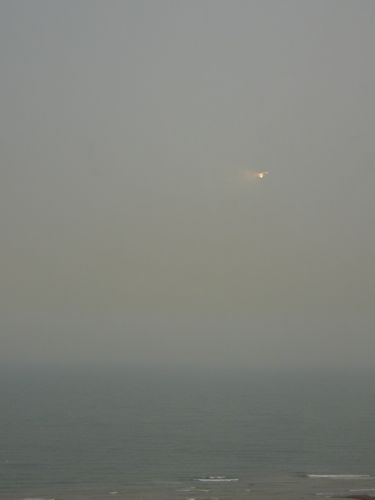
That tiny tiny bright speck you see is the sun fighting to shine through the clouds. It was only there for one brief moment – then gone! Maybe we will have rain today?
The gasp of brightness brought to mind T.S. Eliot’s poem, The Hollow Men (by clicking on the blue hypertext, you can go to a great website where it explains all the references in the poem.) Although it was written in 1925 – almost a century ago – it has a very modern feel to it. Your challenge for today – read the poem. Those with more time or interest – go to the website and read the references.:
The Hollow Men
I
We are the hollow men
We are the stuffed men
Leaning together
Headpiece filled with straw. Alas!
Our dried voices, when
We whisper together
Are quiet and meaningless
As wind in dry grass
Or rats’ feet over broken glass
In our dry cellar
Shape without form, shade without colour,
Paralysed force, gesture without motion;
Those who have crossed
With direct eyes, to death’s other Kingdom
Remember us – if at all – not as lost
Violent souls, but only
As the hollow men
The stuffed men.
II
Eyes I dare not meet in dreams
In death’s dream kingdom
These do not appear:
There, the eyes are
Sunlight on a broken column
There, is a tree swinging
And voices are
In the wind’s singing
More distant and more solemn
Than a fading star.
Let me be no nearer
In death’s dream kingdom
Let me also wear
Such deliberate disguises
Rat’s coat, crowskin, crossed staves
In a field
Behaving as the wind behaves
No nearer –
Not that final meeting
In the twilight kingdom
III
This is the dead land
This is cactus land
Here the stone images
Are raised, here they receive
The supplication of a dead man’s hand
Under the twinkle of a fading star.
Is it like this
In death’s other kingdom
Waking alone
At the hour when we are
Trembling with tenderness
Lips that would kiss
Form prayers to broken stone.
IV
The eyes are not here
There are no eyes here
In this valley of dying stars
In this hollow valley
This broken jaw of our lost kingdoms
In this last of meeting places
We grope together
And avoid speech
Gathered on this beach of the tumid river
Sightless, unless
The eyes reappear
As the perpetual star
Multifoliate rose
Of death’s twilight kingdom
The hope only
Of empty men.
V
Here we go round the prickly pear
Prickly pear prickly pear
Here we go round the prickly pear
At five o’clock in the morning.
Between the idea
And the reality
Between the motion
And the act
Falls the Shadow
For Thine is the Kingdom
Between the conception
And the creation
Between the emotion
And the response
Falls the Shadow
Life is very long
Between the desire
And the spasm
Between the potency
And the existence
Between the essence
And the descent
Falls the Shadow
For Thine is the Kingdom
For Thine is
Life is
For Thine is the
This is the way the world ends
This is the way the world ends
This is the way the world ends
Not with a bang but a whimper.
The Door Into Summer
We had a cat, a street cat from Tunisia, named Cinnamon. I had taken our son to see a movie and when I got home, my husband looked funny. You know, a wife can tell. I said “what’s up?” and he gave me those big innocent Bambi eyes that tell you for SURE something is fishy, and he said “Nothing!”
Just then, we could hear loud loud miowing at the back door, the kind only a kitten can make, the kind that attracts attention. We went to the back door and there was this tiny little kitten, barely old enough to be away from her family, and she is stuck between the screen door and the back door.
“How very strange!” I said, looking accusingly at AdventureMan, who continued to try to look innocent.
“She looks cold!” he said. “Maybe we had better bring her in!”
Later he confessed, he has found her wandering around alone, wet and miowing in our backyard and had been feeding her while we were at the movie, then put her in the back door so we could “discover” her. He wanted to keep her. We already had one big cat, but we had wanted another, and here she was.
She was my Door into Summer cat. She still had all her wild instincts, even though we adopted her at such a young age. Once, in Germany, I found a dead hare on my steps, with it’s throat torn out, an offering from Cinnamon – but the hare was at least twice her size! She was always bringing us offerings of a dead nature; she was a born huntress. One time when AdventureMan got out of bed, he stepped on what he thought was a rolled up sock, but it moved! It was a badly wounded mouse!
Cinnamon hated winter. We lived in a house with a lot of doors, and when it would snow, she would go from door to door, asking us to open so she could go out. When the bitter cold with the biting wind would hit her face, she would back into the house and head for the next door – always looking for the door she remembered, the one which led out into summer.

moar funny pictures
I used to read a lot of Robert Heinlein. His books are SO politically incorrect, so sexist, he was an old engineer, but man, could he write. His writing takes you WAAAYYY out of the here and now, and makes you stretch to think in new ways.
He wrote a book called Door into Summer, in which he wrote about another cat:
“…While still a kitten, all fluff and buzzes, Pete had worked out a simple philosophy. I was in charge of quarters, rations, and weather; he was in charge of everything else. But he held me especially responsible for weather. Connecticut winters are good only for Christmas cards; regularly that winter Pete would check his own door, refuse to go out it because of that unpleasant white stuff beyond it (he was no fool), then badger me to open a people door. He had a fixed conviction that at least one of them must lead into summer weather.”
The Door into Summer – Robert A. Heinlein
You can read about Robert Heinlein on Wikipedia and you can find many of his books still in publication on amazon.com.
Inheritance of Loss
Most of the time, if I don’t like a book, I won’t even bother telling you about it. This book, The Inheritance of Loss, by Kiran Desai, is an exception for one reason – it IS worth reading.
Inheiritance of Loss showed up on the book club reading list for the year, and I ordered it. I read the cover when the book came, and it didn’t sound that good to me, so I read other books instead. The next time it came to mind was when a friend, reading the book, said she was having trouble with it, and asked me if I had started it. This friend is a READER, and a thinker. It caught my attention that she would have problems reading a book, so I decided to give it a try.
This is a very uncomfortable book. The characters live in the shadow of the Himalayan mountains. The most sympathetic character is a young orphaned girl, sent to live with her grandfather. With each chapter, we learn more about all the characters, how they came to be here, what they think, what their lives have looked like.
The author of this book has a very sour look on life. She has snotty things to say about every character. You can almost feel her peering around the corner, eyes slit with evil intent. She is that vicious neighbor who comes by and never says anything nice about anybody, and when you see her talking with your neighbor, you get the uneasy feeling she could be saying something mean about you, and she probably is.
The book covers a wide range of topics – Indian politics, Ghurka revolts, English colonization, Indian emigration to the US and UK, everyday vanities and pride in petty things, how people destroy their own lives, how people can be cruel to one another, oh it’s a great read (yes, that is sarcasm).
At the same time, this vicious unwelcome neighbor has a sharp eye for detail. You may not like what she is telling you, but you keep listening, because you can learn important tidbits of information from her. In my case, I learned a lot about how life is lived in a small mountain village in India, the struggles of illegals in America and how class lines are drawn, ever so finely, when people live together. I learned a lot about the legacy of colonialism, and the creep of globalization. This unwelcome neighbor has a sharp tongue, always complaining, and yet . . . some of her complaints have merit.
I don’t believe there was a single redeeming episode in the book. There was not a paragraph to feel good about. I am glad to be finished with the book – but, yes, I finished it, I didn’t just set it aside in disgust, or give it away without finishing.
Here is the reason I am telling you about this book – as uncomfortable as this book is to read, I have the feeling, upon finishing, that ideas and images from this book will stick with me for a long time. I have the feeling that it contributes to my greater understanding of how things work, how people think differently from other people, and on what levels we are very much the same.
Here is an excerpt from the book, at a time during which the Judge is a young Indian, studying in England:
The new boarding house boasted several rooms for rent, and here, among the other lodgers, he was to find his only friend in England: Bose.
They had similar inadequate clothes, similar forlornly empty rooms, similar poor native’s trunks. A look of recognition had passed between them at first sight, but also the assurance that they wouldn’t reveal one another’s secrets, not even to each other.
. . . Together they punted clumsily down the glaceed river to Grantchester and had tea among the jam sozzled wasps just as you were supposed to, enjoying themselves (but not really) as the heavy wasps fell from flight into their laps with a low battery buzz.
They had better luck in London, where they watched the changing of the guard at Buckingham Palace, avoided the other Indian students at Veeraswamy’s, ate shepherd’s pie instead, and agreed on the train home that Trafalgar Square was not quite up to British standards of hygiene – all those defecating pigeons, one of which had done a masala-colored doodle on Bose. It was Bose who showed Jemubhai what records to buy for his new gramophone: Caruso and Gigli. He also corrected his pronunciation: Jheelee, not Giggly. . . .
This it was that the judge eventually took revenge on his early confusions, his embarrassments gloved in something called “keeping up standards,” his accent behind a mask of a quiet. He found he began to be mistaken for something he wasn’t – a man of dignity. This accidental poise became more important than any other thing. He envied the English. He loathed Indians. He worked at being English with the passion of hatred and for what he would become, he would be despised by absolutely everyone, English and Indians both.
I consider this a review, and not particularly a recommendation. I read the book, I finished the book and I learned from the book. I didn’t like the book. I recommend it only as a challenge, for people who like to read and stretch their minds in new directions.
My Wish For You
A dear friend gave me a book mark with this poem on it. I had never seen it before, and I found myself greatly moved. I hope you like it, too.
This is My Wish for You
That the spirit of beauty
may continually hover about you
and fold you close within
the tenderness of her wings.
That each beautiful
and gracious thing in life
May be unto you as a symbol
of good for your soul’s delight.
That sun-glories
and star-glories,
Leaf-glories and bark-glories,
Flower-glories
and glories that lurk
in the grasses of the field . . . .
Glories of mountains and oceans,
of little streams of running waters
Glories of song
of poesy,
of all the arts. . .
May be to you as sweet
abiding influences
That will illumine your life
and make you glad.
That your soul may be
as an alabaster cup
Filled to overflowing
With the mystical wine
of beauty and love.
That happiness may
put her arms around you,
And wisdom make
your soul serene.
This is my wish for you.
By Charles Livingston Snell (1914)
What Will Matter?
I am thinking about all the people who are making resolutions for the coming year. I don’t do resolutions – for me, it’s too depressing, I fail so often. I do try to change my behaviors, small changes that I hope will lead to grander changes in the long run. I try to keep things in perspective. I try to make good choices.
AdventureMan shared this writing with me, it is a writing by Michael Josephson called What Will Matter sent out by an organization called Character Counts.org.
What Will Matter
by Michael Josephson
Ready or not, some day it will all come to an end.
There will be no more sunrises, no minutes, hours or days.
All the things you collected, whether treasured or forgotten, will pass to someone else.
Your wealth, fame and temporal power will shrivel to irrelevance.
It will not matter what you owned of what you were owed.
Your grudges, resentments, frustrations and jealousies will finally disappear.
Soon, too, your hopes, ambitions, plans and to-do lists will expire.
The wins and losses that once seemed so important will fade away.
It won’t matter where you came from or what side of the tracks you lived on at the end.
It won’t matter whether you were beautiful or brilliant.
Even your gender and skin color will be irrelevant.
So what will matter? How will the value of your days be measured?
What will matter is not what you bought, but what you built,
not what you got but what you gave.
What will matter is every act of integrity, compassion, courage or sacrifice that enriched,
empowered or encouraged others to emulate your example.
What will matter is not your competence but your character.
What will matter is not how many people you knew,
but how many will feel a lasting loss when you’re gone.
What will matter is not your memories, but the memories of those who loved you.
What will matter is how long you will be remembered, by whom, and for what.
Living a life that matters doesn’t happen by accident.
It’s not a matter of circumstance but of choice.
Choose to live a life that matters.
Michael Malone: Handling Sin

Have I told you (only a hundred times?) that our family loves books? We buy them, we discuss them, and we pass them around. The one I am about to review came from my son, who got it from the wife of his wife’s father. Heee heee heeee, figure that one out!
Have you ever read A Confederacy of Dunces by John Kennedy Toole? As soon as you start reading Handling Sin, you get the same impression; this book is whacky, and will probably be an underground cult favorite. The author of Confederacy of Dunces, John Kennedy Toole, committed suicide – or so we are supposed to believe. I am not so sure. Handling Sin sounds SO like it, and they both heavily feature New Orleans.

Right off the top, this books starts out weird and keeps right on going. It opens with our hero, Raleigh Whittier Hayes at a Civitan (social and civic works group, kind of like diwaniyya) meeting at the local Chinese restaurant in Thermopylae, North Carolina, where his fortune cookie at the end of the meal says “You will go completely to pieces by the end of the month.” Raleigh sells insurance, he runs and watches what he eats because most of his family gets diabetes; and Raleigh likes order. When we meet Raleigh, he’s not all that likable.
His dying father takes off, leaving a message for Raleigh that he needs to do seven (crazy-sounding) tasks and meet him in New Orleans at a specific date and time, having accomplished these tasks, otherwise he won’t go back to the hospital for his cancer treatments.
His big fat best friend, Mingo Sheffield, insists on coming along. His wife, Aura, just laughs and tells him he needs to loosen up a little when he starts complaining about his Dad’s quest, and begins her campaign for mayor. His nice, safe structured little universe is flying apart, his twin teen-age daughters are out of control, reality as he knows it has just taken a big crunching shift and Raleigh is out of his element.
Perfect! It’s those times of maximum discomfort that we begin to achieve our maximum potential, isn’t it? If we stay in our safe little world, we aren’t challenged to grow, to think new thoughts, to see things from another perspective.
Handling Sin has a series of events that are at the same time heart warming, serious, and side-splittingly funny. I laughed out loud so many times reading this book, as our hero and his friend and all those he picks up along the way find themselves in the most outrageous and unlikely adventures, and learn what they are capable of (OK, for all you grammarians, do not end your sentences in a preposition, do as I say, not as I do!) I would not be at all surprised if this book were made into a movie, it is so much fun. As you rock along, Malone also deals with serious health issues, racial issues, family issues, political issues and law and order. You laugh, you cry, you learn a little and you laugh again. It’s a great read.
This was my back-up book on my flights back to Kuwait, and worth the weight – it’s a kind of big book. AdventureMan can hardly wait to get into it; he had started it but allowed me to read it while he caught up with his jet lag. Who knows who we will pass it along to when he finishes? It’s that good!
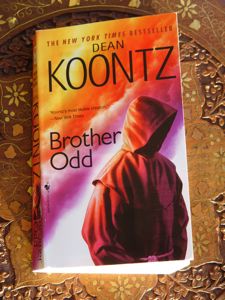
Brother Odd: Dean Koontz
I’ve always liked Dean Koontz; he knows how to be compassionate and funny at the same time. When I showed books I had bought, my long-time friend Momcat said “Oh, you’re going to like that book!” and oh, how right she was. I like it so much that now I have to go back and buy the previous ones to catch me up.
The main character, whose name, to his embarrassment, is Odd Thomas, has secluded himself in a monastery in search of spiritual peace. Or was he brought here for another reason? Odd Thomas has some very odd gifts; he can see the undeparted dead, for example, and he can sense things that normal humans can’t. You would think these would be very cool talents, but Odd is in his early twenties, and his talents only serve to isolate him and make him feel a little alien.
The monastery / nunnery is a good place for him, full of very human monks and nuns, some of them very wise and very compassionate, as well as competant. It’s a good place for Odd Thomas, a healing place and a place where his strange gifts are protected by his spiritual cohabitants. The monastic life attracts a lot of people trying to put their pasts behind them to seek spiritual goals, and also attracts those with their own agendas.
The monastery is well endowed, and contains a special school for young people who have physical and/or mental disabilities. Some can learn enough to return to society, and some will probably spend the rest of their shortened lives under the safety and care of the nuns – until, all of a sudden, a threat appears, directed at the children.
Dean Koontz writes interesting books. He often includes benign animals, he often focuses on threats to women and children, and while his books are not difficult to read, neither are they something you read and easily forget. Both AdventureMan and I read an earlier Dean Koonz book, Watchers, to which we have often referred through the years, as one of his characters ends up homeless and living in a car with her son. She talks about money just giving you more options, and about those who are one paycheck away from homelessness. It was an easy read, but he includes some tough ideas, things you find yourself mulling over even years later. That’s a good read in my book!
The only problem with this book was that it was so good I finished it in one flight. Good thing I had packed a back-up book in my carry-on!
Ozymandias: Nothing beside remains
This is one of my favorite poems. I learned it as a child, and didn’t understand it, but liked the exotic loneliness it evoked. I could hear the wind whistling across the empty sands, feel the grains on my cheek – so very different from my home in Alaska, and yet – not so different. In Alaska, the wind blew cold, and the grit against my cheek was snow! The memory of these ironic words lives in my heart.
The words come back to me, now and again as we stand amidst remains of complex, abundant civilizations that are now lifeless stone and rubble.
Ozymandias
by Percy Bysshe Shelley
I met a traveler from an antique land
Who said: Two vast and trunkless legs of stone
Stand in the desert. Near them, on the sand,
Half sunk, a shattered visage lies, whose frown,
And wrinkled lip, and sneer of cold command,
Tell that its sculptor well those passions read
Which yet survive, stamped on these lifeless things,
The hand that mocked them, and the heart that fed;
And on the pedestal these words appear:
“My name is Ozymandias, king of kings:
Look upon my works, ye Mighty, and despair!”
Nothing beside remains. Round the decay
Of that colossal wreck, boundless and bare
The lone and level sands stretch far away.

If you read through the entire poem, you are challenged to tell us about a poem that YOU still remember, and why. 😉
Laughter is the Best Weapon
I just heard this quote on Good Morning America as they are discussing how Hilary Clinton laughs to disarm her critics and opponents:
The human race has only one really effective weapon and that is laughter. Mark Twain.
Good old Mark Twain! That cagey old cynic said some great things. I found this wonderful web page: Brainy Quotes: Mark Twain
Here are some that I just love. Take a look and see what YOU like.
Why is it that we rejoice at a birth and grieve at a funeral? It is because we are not the person involved.
What a wee little part of a person’s life are his acts and his words! His real life is led in his head, and is known to none but himself.
We have the best government that money can buy.
To refuse awards is another way of accepting them with more noise than is normal.
There is no distinctly American criminal class – except Congress.
There are several good protections against temptation, but the surest is cowardice.
The most interesting information comes from children, for they tell all they know and then stop.
Man was made at the end of the week’s work when God was tired.
It’s not the size of the dog in the fight, it’s the size of the fight in the dog.
It is curious that physical courage should be so common in the world and moral courage so rare.
In the first place, God made idiots. That was for practice. Then he made school boards.
Good breeding consists in concealing how much we think of ourselves and how little we think of the other person.
Giving up smoking is the easiest thing in the world. I know because I’ve done it thousands of times.
Anger is an acid that can do more harm to the vessel in which it is stored than to anything on which it is poured.
A lie can travel half way around the world while the truth is putting on its shoes.
A Thousand Splendid Suns
Once I picked up Khaled Hosseini’s A Thousand Splendid Suns, I barely put it down again until I was finished. I found myself thoroughly involved in the lives of Mariam and Leila, unwilling even to stop to fix dinner! The author of Kiterunner has hit another home run.
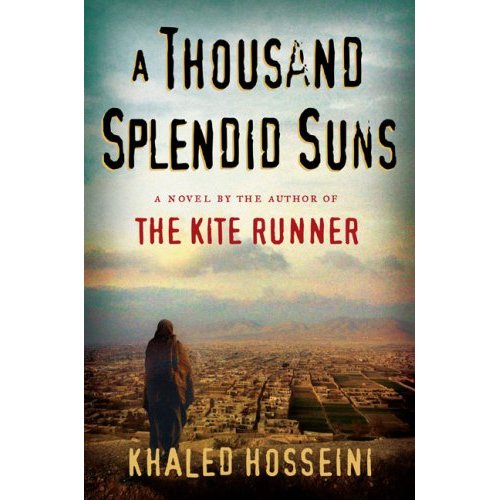
There was a time when we would listen to older state department types talk – with enormous longing – about their tours of duty in Afghanistan, pre-Soviet invasion, pre-Taliban, pre-American occupation. Have you ever read James Michener’s Caravan? There are two countries I long to vist, but the countries they are now are not the countries I heard people talk about – Afghanistan and Ethiopia. Our friends loved their times in these two countries.
A Thousand Splendid Suns opens in a small village outside Herat, and then takes us to Kabul. Mariam is born harami, a bastard, of a village cleaning woman in the house of a very wealthy man. Her father builds a small hut for her mother and herself in a remote part of the small village, and visits Mariam every week. Life is simple, and difficult, but also full of kind people who visit and who are concerned with Mariam’s welfare.
After marrying, Mariam goes to Kabul and learns a new way of life with her husband, Rasheed. What fascinates me with Hosseini is that while Rashid is one of the villians of this novel, he is just a man, doing the best he can given his own upbringing and limitations. In a sense, he is “everyman”, the strutting, domineering, sometimes brutal and abusive husband we find in every culture. But Hosseini also gives him transient bouts of kindness which blow through a little less often than the transient bouts of cruelty.
He also gives us good men, in this book, in the person of Jalil, the father of Mariam, who steps up to the plate in acknowledging Mariam and supporting her and her mother, but fails to nurture in the very real way women need nurturing from their fathers in order to reach their full potential in life. Hosseini also gives us a very strong man in the book, Tariq, who, although he has only one leg, is more wholly a man than any other man in the book. I imagine that this is not unintentional. (How Kissingerian is that for a double negative?!)
Written almost entirely in the Afghan world of women, we see through the eyes of Mariam, and later Leila, the transitions in Afghanistan and their impacts on daily life. We experience happiness with them, and peaceful scenes in quiet moments, raising the children, stepping outside into the garden at night to share a cup of tea and a shared bowl of halwa.
Between the moments of peacefulness, we also experience incoming morter rounds, explosions, marauding bands of warlords, and starvation. We go into a women’s hospital under Taliban control, where there are no medications, no running water, no instruments, and an Afghani female doctor does a C-section with no anaesthesia and is required to keep her burqa on. We watch a mother abandon her role and take to her bed when her two sons are killed fighting the Soviets, we experience betrayal and we experience helplessness, and we experience a Kabul women’s prison. A Thousand Splendid Suns is a rich feast of experiences, juxtaposing the everyday chores of women around the world – cooking, raising children, laundry – with events on the world stage.
(Available from Amazon for $14.27 plus shipping.)
Recent Comments
intlxpatr on Yellowstone: Old Faithful to C… Michelle on Yellowstone: Old Faithful to C… Cathy on No Grown-Ups in Charge intlxpatr on Waiting for Snow intlxpatr on Waiting for Snow Wikipedia Donate Button

Amazina


Early Voting in Florida


 Here There and Everywhere